Terme di Vicarello
In short. The Terme di Vicarello are closed and you can't go in: the spa complex of the ancient Aquae Apollinares, on Via Settevene Palo, on the road to Trevignano, in the territory of Bracciano, has been inactive and abandoned for decades and…
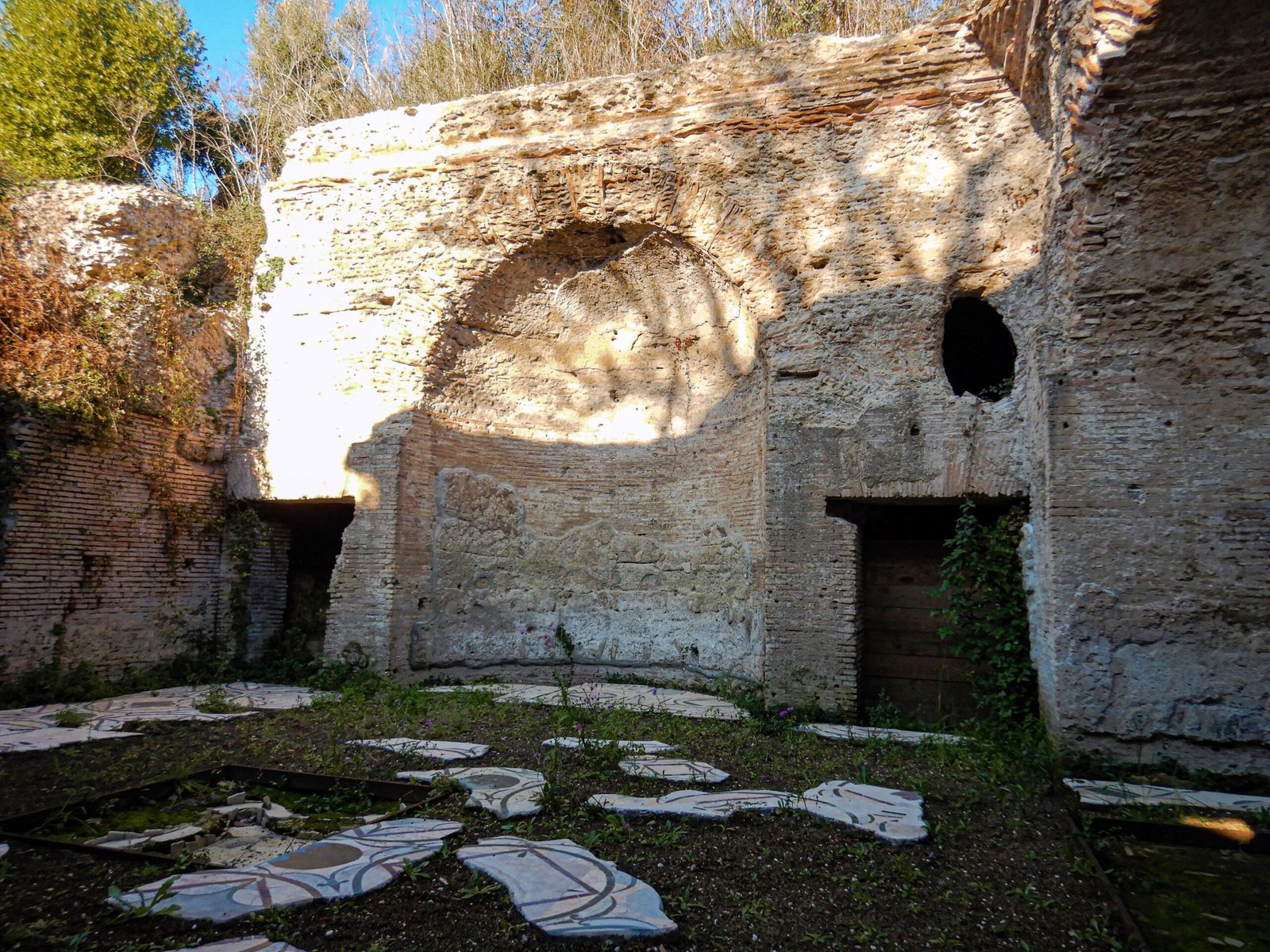
The Terme di Vicarello are closed and you can't go in: the spa complex of the ancient Aquae Apollinares, on Via Settevene Palo, on the road to Trevignano, in the territory of Bracciano, has been inactive and abandoned for decades and lies inside a private estate, sold in 1983 to the Società Agricola Vicarello. There is no ticket office, no open pools, no bathing. The nearby archaeological area of the Ninfeo di Apollo opens only for free events of the Park and the Soprintendenza, with booking.
What you can legally see is elsewhere. The four silver cups with the itinerary from Cadiz to Rome engraved on the surface, found here in 1852, are kept by the Museo Nazionale Romano, and the specialist press places them on the basement floor of Palazzo Massimo dedicated to coinage. Other vessels from the same votive deposit are displayed in the Vatican Museums. What remains on site is the landscape of Lake Bracciano, which you look at from public roads and from the villages on the shore.
Data checked on September 29, 2026 on the Comune di Bracciano page dedicated to the Terme di Vicarello, on the website of the Parco Naturale Regionale Bracciano Martignano, on the pages of the Museo Nazionale Romano and the Vatican Museums, and on the local press cited further on. The estate's owner does not publish a channel for the public. For openings of the archaeological area the reference is the Park Authority, phone 0699801176, for information on the area the Comune di Bracciano, number 06 998161.
At a glance: address, hours, ticket
- Address: Via Settevene Palo, road to Trevignano, 00062 Bracciano (RM), locality Vicarello, according to the Comune di Bracciano.
- Status: spa complex closed and abandoned, inside private property, access not permitted.
- Archaeological area of the Ninfeo di Apollo: open only on dates announced by the Parco Bracciano Martignano Authority or the Soprintendenza, normally free with booking.
- Price: there is no ticket for Vicarello. The cups are seen with the Museo Nazionale Romano ticket, €15 full price.
- Where to see the finds: Palazzo Massimo, Largo di Villa Peretti 2, Rome, Tuesday to Sunday from 9:30 to 19:00, and the Vatican Museums, Museo Gregoriano Etrusco, Room XV.
- How to get to the lake: FL3 regional train to Bracciano or Anguillara, then about 7 kilometers by provincial road toward Trevignano.
- Contacts: Park Authority 0699801176, Comune di Bracciano 06 998161, urp@comune.bracciano.rm.it.
Where it is and what you actually see
Vicarello is a hamlet of Bracciano, about 7 kilometers from the main town along the provincial road that runs on the north shore of Lake Bracciano toward Trevignano Romano. It lies inside the Bracciano Martignano Regional Natural Park. The name appears in two forms: the Terme di Vicarello, for the modern complex, and the Aquae Apollinares, the Roman name of the springs dedicated to Apollo.
What do you see driving past? Little. Olive groves, fences, a few buildings emerging among the trees. The spa complex, according to the essay by the geographer Annalisa D'Ascenzo published in the journal Geotema of the Associazione dei geografi italiani, is abandoned, in ruins and choked by scrub, with collapsing fences that block access. It is not a romantic ruin to visit. It is a private 20th-century complex, out of use, where entering without permission means trespassing and risking collapses.
The estate is large. The local press, in a 2023 article by Ecolagodibracciano, describes it as a property of more than 1,000 hectares belonging to the Vicarello Società Agricola, made up mostly of olive groves, with the remains of the old spa hotel. Wikipedia dates the sale to the agricultural company to 1983. Since then the baths have not reopened. Anyone arriving on site finds closed gates and no information for the public, because there is nothing open to the public to point out.
Next to the spa complex is the archaeological area, a different matter. According to the Parco Bracciano Martignano it includes the complex of the so-called Terme Apollinari, the remains of a Roman villa, stretches of paved road and an olive grove with about 170 trees. It has been declared of interest since 1939. Here the Park has set up a visitor center, the Casa di Ledo, and the special openings take place here. Outside those dates, the archaeological area stays closed too.
Wikipedia lists other signs of the past in the hamlet: a 16th-century Orsini hunting lodge, the church of the Annunziata from 1753, remains of the aqueduct of Trajan from AD 109 and traces of a prehistoric pile-dwelling village of the second millennium BC on the lake shore. The operator lists no visiting hours for any of these. They are places to know about, not to look for among the gates of an agricultural property.
A curiosity about the Terme di Vicarello
There were two Aquae Apollinares. The Comune di Bracciano recalls that the Tabula Peutingeriana, the medieval copy of a Roman road map, marks two spa centers near Forum Clodii: Vicarello and Stigliano, today in the municipality of Canale Monterano. D'Ascenzo's essay spells out the names. The Terme di Stigliano would be the Aquae Apollinares veteres, the oldest, Vicarello the novae, the new ones, about 15 kilometers away.
The second curiosity concerns the boundary. The Comune di Bracciano places the baths in its own territory, on Via Settevene Palo. The Vatican Museums page dedicated to the vessels from the deposit instead writes "Vicarello (Trevignano, Lake Bracciano)". The locality does in fact lie on the road between the two towns, and in 19th-century sources the reference to Trevignano is frequent. For anyone looking for the place on a map, the right name is Vicarello, hamlet of Bracciano.
Third curiosity: the silver cups have the shape of a milestone. Wikipedia describes them as cylinders between 95 and 115 millimeters tall that imitate the markers set along Roman roads. On the outer surface, in four columns, is the list of stops from Gades, present-day Cadiz, to Rome. It is a road guide in miniature, engraved on a tableware object, and then left as an offering at the spring sacred to Apollo.
The last curiosity is the temperature. The Comune di Bracciano page gives 48.8 degrees at the spring for the waters of Vicarello. It is a very high value for Lazio waters. The same Comune recalls that the springs of Vicarello and Stigliano were considered beneficial manifestations of the god Apollo, and this idea explains the ancient name. Today, though, no plant is in operation, and no one can legally immerse themselves in that water.
Something nobody tells you about the Terme di Vicarello
Anyone searching for "Terme di Vicarello" online often finds photos of pools, articles on the free hot springs of the lake and lists of free soaking pools. This is the opposite position worth keeping in mind: Vicarello is not a free hot spring, there is no hidden pool behind a bend, and the idea of a free hot bath on Lake Bracciano is a misunderstanding. The water exists but lies on private land, shut inside abandoned and dangerous structures.
Second thing rarely said: Vicarello's most important treasure is not found at Vicarello. The cups with the itinerary, the best-known find of the deposit, are in Rome, at the Museo Nazionale Romano. According to a 2025 article by the association L'agone Nuovo they are displayed at Palazzo Massimo alle Terme, in the numismatic section of the basement floor. In our judgment the right visit to Vicarello begins in a museum in Rome, not on the lake.
Third thing: the votive deposit was broken up. Wikipedia recalls that the collection originally went to the Museo Kircheriano, later merged into the Museo Nazionale Romano. Part of the vessels ended up in the Vatican Museums. L'agone Nuovo lists other finds at the Victoria and Albert Museum and the British Museum in London, the Cleveland Museum of Art in Ohio and the Museo Arqueológico Nacional in Madrid. Travelers can find pieces of Vicarello in four different countries.
Fourth thing: in 1948 three gold vessels disappeared. The Vatican Museums page dedicated to the vessels from Vicarello writes that three gold containers, a situla and two cups, were associated with the silver finds, stolen in 1948. L'agone Nuovo gives the date as July 22, 1948 and adds that they were never recovered. Today, in the Vatican room, seven vessels are seen, six in silver and an amphora in silvered bronze, according to the museum.
Why are the baths closed and who owns them today?
The baths operated well into the 20th century. According to Wikipedia in 1962 they were modernized in view of the Second Vatican Council and stayed in operation, run by a congregation of German nuns, until 1970. L'agone Nuovo speaks more generically of a plant that remained in operation until the early 1970s. The sources don't agree on the exact year of the last season, but they agree that for half a century the complex has not received guests.
In 1983 the estate was sold to the Società Agricola Vicarello, writes Wikipedia. According to L'agone Nuovo the new owner's plan was to turn the complex into a luxury hotel, a plan that stayed on paper. Ecolagodibracciano, in 2023, recalls that a proposal with about 270 villas and golf courses was stopped by environmental associations, and that the area was protected with a ministerial decree known as the Ronchey decree, after the minister.
Is there a recovery project? There have been some signs. Ecolagodibracciano wrote in August 2023 that a mining survey had been authorized to verify the possibility of putting the springs back into use, with the deadline to complete the groundwater monitoring extended to December 31, 2023. The outcome of that survey is not published by an official source. L'agone Nuovo, in September 2025, confirmed that the place is not open to the public and spoke of an enhancement project under study.
The distinction to make is sharp. The spa complex and the agricultural estate are private and closed. The archaeological area, with the Ninfeo di Apollo and the remains of the villa, is protected and is opened by the Park and the Soprintendenza on specific days. Everything else, that is ruins in the woods, pools, hotel buildings, is seen only from outside. The Comune di Bracciano publishes no visiting hours for the baths, because there are none.
The Casa di Ledo is the new piece. The Park was already announcing it in March 2022 as the visitor center of the thermal archaeological complex, open to schools, associations and hikers, with works funded by European and Lazio Region funds: consolidation of the structures, restoration of the floor of the Ninfeo di Apollo, a walkway accessible to people with disabilities. The inauguration with the public came on August 29, 2026, according to the Park and the local press.
The 2026 program, reported by L'agone Nuovo, included four events: on August 29 the opening at 16:00, a guided visit to the site at 17:00, the theater show Miti d'acqua and a tasting, then on September 5 music, on September 13 an afternoon with world music, on September 27 a historical lecture and a theater show. Promoted by the Park Authority, under the patronage of the Comuni of Bracciano and Trevignano Romano and with the collaboration of the Soprintendenza.
My advice for visiting the Terme di Vicarello
Split the visit in two. The first part in Rome, at Palazzo Massimo, in front of the cups with the itinerary and the coins from the deposit. The second on the lake, on one of the opening days of the archaeological area, when Soprintendenza staff show the Ninfeo di Apollo. Whoever does both understands Vicarello better than whoever drives up to the gates hoping to find them open, and avoids a wasted trip.
Follow the Park Authority's calendar. The openings of the archaeological area have no fixed schedule: in 2026 the Park organized a series at the Casa di Ledo between August 29 and September 27, and the Soprintendenza offered a visit for the European Heritage Days on September 26, free and with mandatory booking, according to the local press. The 2027 dates are not yet published. It's best to check the Park's website from the end of spring.
Don't try to enter the private property. Collapsing fences, abandoned buildings, thick vegetation and very hot water are a risky combination, as well as an illegal one. The photos that circulate online of the interiors of the complex give no one permission to replicate them. The lake offers plenty of other things to do safely on the same day, from the castle of Bracciano to walks on the shore, and the archaeological area can be visited anyway when it opens.
Prepare before you go. There are no panels on site, and the story of Vicarello is only understood with some references in your head: the two Aquae Apollinares, the votive deposit discovered in 1852, the Jesuits of the Collegio Germanico, the 20th-century spa complex. The Comune di Bracciano page and D'Ascenzo's essay in Geotema are short, useful reads. Then the lake, seen from the Trevignano road, takes on a whole different meaning.
How much does it cost to see the finds and how do you book?
You pay nothing for the baths, because you don't go in. For the archaeological area the reference is the Parco Bracciano Martignano Authority, which in 2026 presented the events at the Casa di Ledo as free, with booking indicated each time. For the silver cups you need instead the Museo Nazionale Romano ticket, valid for the three open sites, that is Terme di Diocleziano, Palazzo Massimo and Palazzo Altemps.
| Museo Nazionale Romano | Rate | Conditions |
|---|---|---|
| Full | €15 | one entry to Terme di Diocleziano, Palazzo Massimo and Palazzo Altemps, valid for one week |
| Reduced | €2 | European Union citizens between 18 and 25, with ID |
| Free | €0 | first Sunday of the month, as in all state museums |
Where do you actually buy? The official channel is the one given on the hours and tickets page of the Museo Nazionale Romano: online on the Musei Italiani portal, with the app of the same name or from the kiosks at the entrance. The museum accepts only electronic payments, and tickets are neither exchanged nor refunded. During temporary exhibitions €3 to €5 may be added. There is no paid tour dedicated to Vicarello worth mentioning.
A note on the museum's sources. The sources don't agree: the museum's English page dedicated to the Medagliere, the numismatic collection of Palazzo Massimo, lists it as closed to the public, while the specialist press, from Finestre sull'Arte to Panorama Numismatico, reported its reopening on December 23, 2025 on the minus-two floor, with the museum's hours. Before going specially for the cups it's best to ask the museum if the room is open and if the pieces are on display that day.
For the Vatican Museums the official Vatican ticket office applies, with the fares and booking rules published by the museum. The vessels from Vicarello are found, according to the Vatican Museums page, in Room XV, the Antiquarium Romanum of the Museo Gregoriano Etrusco. It is a room on the ordinary route, with no separate visit. Anyone entering the Vatican Museums can ask the staff for directions to reach it.
Another well-known fact, yet rarely mentioned
That the Romans traveled with written itineraries is known. Less known is that one of the most complete documents on the road between Spain and Rome has come down to us because someone threw it into a spring. The Vicarello cups, Wikipedia explains, list 104 stations between Gades and Rome, for a total of 1,840 Roman miles, about 2,723 kilometers. L'agone Nuovo gives 1,841 miles: the sources don't agree on the last digit.
The itinerary ends in Rome along Via Flaminia, passing through Narni and Otricoli, according to Wikipedia. Anyone arriving in the city today along the Flaminia enters from the Milvian Bridge area, the last stretch of that journey. The inscriptions are published in the Corpus Inscriptionum Latinarum, volume XI, at numbers 3281 to 3284, again according to Wikipedia. They are therefore cataloged and published epigraphic texts, not display-case curiosities.
The second rarely cited fact concerns quantity. According to L'agone Nuovo the 1852 deposit included 34 vessels, three gold, 25 silver and six bronze, about 400 kilograms of aes rude, that is raw bronze used as currency, about 1,400 pieces of aes grave, 2,136 Romano-Campanian coins, 688 Republican ones, many imperial ones from Augustus to the 4th century, and about a hundred coins from Etruscan, Oscan-Samnite and Magna Graecia cities. Wikipedia speaks of about 5,000 coins.
Third fact: the pilgrims at the springs were not few, and not for a short time. The Comune di Bracciano writes that Vicarello and Stigliano were frequented from the Neolithic, that the Roman era turned the natural springs into organized spa structures from the 4th century BC, and that intense use lasted until the 4th century AD, resuming from the 15th century. The deposit's coins cover the same span, from the oldest forms of exchange to late antiquity.
The right photo to take at the Terme di Vicarello
The right photo is not taken inside the complex, and should not be sought by climbing over a fence. It is taken from the lake. From the public shore of Trevignano Romano, looking east, you frame the north coast of the lake with the hills of Vicarello, and in the late afternoon the side light sculpts the olive groves. It is the image that tells the place as it is today: an agricultural estate facing the water, with the springs hidden in the green.
The second photo is taken in Rome, at Palazzo Massimo, in front of the cups, if they are on display and if the museum allows photographing without flash. It's best to look for a close framing on the engraved columns of text, where the names of the stations can be read. It is the photo that explains Vicarello better than any ruin. The rules on photography in the rooms should be asked at the entrance, because the museum can change them for individual sections.
Third choice, for those taking part in an opening of the archaeological area: the opus sectile floor of the so-called Ninfeo di Apollo, cited by the local press as the most remarkable element of the complex. It is photographed from the routes indicated by the staff, without stepping on the surfaces. People present at the events should be left out of the frame or filmed with their consent, and the Soprintendenza's directions on where you can stand should be respected.
A practical warning. On social media there are images of the complex's interiors, with tiles, empty pools and corridors overrun by vegetation. They are photos taken on private and dangerous property, and reproducing them means entering without right. Anyone looking for the aesthetics of abandonment finds more suitable public places on the lake, like the ruins of Monterano, inside a nature reserve with marked trails and regulated access.
How do you get from Rome to the lake and to Vicarello?
By train the Trenitalia regional line FL3 connects Rome to the lake, with stops at Anguillara Sabazia and Bracciano. The Rome stations on the line include Ostiense, Trastevere, San Pietro and Valle Aurelia. The line may have scheduled interruptions for works, so before leaving it's best to check timetables and notices on the Trenitalia website. From Bracciano to Vicarello there are about 7 kilometers of provincial road, without a continuous sidewalk.
Is there a bus to Vicarello? The Comune and the Park publish no directions for public transport to the hamlet. For intercity lines it's best to check the website of Cotral, the regional company, with Trevignano Romano as the destination, which is reached by passing right through Vicarello. Those attending Park events usually receive directions on the meeting point when they book, and that is the safest thing to ask.
By car from Rome you reach Bracciano, then take the provincial road to Trevignano along the north shore of the lake, given by Wikipedia as Strada Provinciale 4/a. The Comune's official address is Via Settevene Palo, direction Trevignano. There is no public parking marked in front of the gates, and the road is narrow in several places. Stopping at the roadside to look or take photos is dangerous. It's best to park in Trevignano or Bracciano and move from there.
For Palazzo Massimo everything is simpler. The museum is at Largo di Villa Peretti 2, a few minutes' walk from Termini station and Piazza della Repubblica. Anyone reaching the lake by train from Termini can organize the day like this: museum in the morning, train to Bracciano in the early afternoon, castle and shore until sunset, and back in the evening. Vicarello is seen in passing, from the road.
Some important events that happened here in history
The first human signs are very ancient. The Comune di Bracciano recalls Neolithic finds, and Wikipedia cites a pile-dwelling village of the second millennium BC on the shores. In the Roman era the locality becomes the Aquae Apollinares, recorded by the Tabula Peutingeriana and, according to D'Ascenzo, by the Antonine Itinerary. In the 1st century AD a villa rises on the shore that tradition attributes to the emperor Domitian. In 109 the aqueduct of Trajan passes through here.
After late antiquity the use of the springs declines. It resumes from the 15th century, according to the Comune. In 1573, writes Wikipedia, Pope Gregory XIII gives the estate to the Collegio Germanico, later Germanico Ungarico, the Roman college entrusted to the Jesuits. In 1692 the College extinguishes the emphyteusis rights of the Orsini, lords of Bracciano, and returns to full possession. In 1737 it builds the first spa complex, the Bagni di Vicarello, according to Wikipedia and D'Ascenzo's essay.
On January 18, 1852, during works for a new plant wanted by the College, workers find the votive stipe in the crevices of the spring, according to L'agone Nuovo. The Jesuit Giuseppe Marchi studies the find and publishes a volume on the stipe paid as tribute to the deities of the Acque Apollinari. The finds are divided between the Museo Kircheriano, later merged into the Museo Nazionale Romano, and the Vatican Museums. In 1939 the area is declared of archaeological interest, according to the Park.
In 1948 three gold vessels disappear from the Vatican. In 1962 the complex is modernized in view of the Second Vatican Council, until 1970 it is run by a congregation of German nuns, in 1983 the estate passes to the Società Agricola Vicarello, according to Wikipedia. In 1994 the decree of minister Alberto Ronchey protects the area, writes Ecolagodibracciano. In 2026 the Park inaugurates the Casa di Ledo and brings the public back, for a few evenings, beside the Ninfeo di Apollo.
Who has passed through the Terme di Vicarello
The oldest name is that of a god. Apollo, to whom the springs were dedicated, and the Nymphs, cited in the dedications engraved on the vessels kept in the Vatican Museums. Then the anonymous travelers who left coins, vessels and cups as thanks or as a request for healing. Among them, some came from far away: whoever offered a cup with the itinerary from Cadiz may have really traveled that road, but no source proves it. It remains a hypothesis suggested by the object itself.
Then the emperors, or at least their names. Domitian, to whom tradition and the local press attribute the 1st-century villa, and whom D'Ascenzo gives as the owner of a villa on the lake shores. Trajan, who in 109 had the aqueduct built whose remains cross the area. For those who want to follow Domitian to Rome, among our entries there is the Stadium of Domitian, under Piazza Navona.
The modern age brings popes and clergy. Gregory XIII, who in 1573 gave the estate to the Collegio Germanico. The Orsini, lords of Bracciano, holders of rights over the estate until 1692 and builders of the hunting lodge. The Jesuits of the College, who built the 1737 complex. Antonio Nibby, who in 1837, cited by D'Ascenzo, described the conditions of the complex as most wretched and unhealthy. And Father Giuseppe Marchi, the Jesuit who studied the 1852 stipe.
The 20th century adds the German nuns who ran the spa hotel until 1970, years in which the complex was modernized in view of the Second Vatican Council, the agricultural company that has owned it since 1983, the minister Alberto Ronchey and the association Italia Nostra, remembered by the local press for the 1994 protection. The latest arrivals are the Park Authority, with the Casa di Ledo, and the Soprintendenza staff, who in September 2026 showed the Ninfeo di Apollo to visitors.
What do the documents say and what does legend say?
What the documents say: the Aquae Apollinares appear in the Tabula Peutingeriana and in the Antonine Itinerary, according to D'Ascenzo. The 1852 cups exist, are cataloged in the Corpus of Latin inscriptions and carry a real itinerary. The votive deposit is described in Father Marchi's volume and in the museum catalogs. The ownership of the Jesuits of the Collegio Germanico, from 1573, is documented. The 1983 sale and the closing of the complex are also certain facts.
What tradition says: that the 1st-century villa on the shore belonged to the emperor Domitian. The local press writes "presumed", Wikipedia "attributed". The nymphaeum is called "of Apollo" for the cult of the springs, but the name is modern. The statue known as the Apollo of Vicarello, which the local press places in the Museo civico di Bracciano, is also part of this story built on the discoveries. These are reasonable attributions, not certainties written on a stone tablet.
What is legend or belief: that the waters of Vicarello heal. The Comune di Bracciano reports traditional uses against rheumatic and digestive complaints and injuries, but these are historical indications, not the opinion of a health authority on a plant in operation. No authorized facility at Vicarello today supplies those waters. Anyone seeking spa treatments should turn to operating facilities, with indications and contraindications published by the operator, and to their own doctor.
One last belief to dismantle concerns treasures still hidden. In the stories circulating online you read that there would still be precious objects in the spring. No official source says so. L'agone Nuovo recalls instead that already in the 19th century many finds were taken by clandestine diggers. The archaeological area is protected by the Soprintendenza, and searching for finds without authorization is a crime. Vicarello's treasure, the real one, is already on display in Rome and in the Vatican.
Where to take a hot bath in Lazio instead of Vicarello?
The closest answer, in name and history, is Stigliano, the other Aquae Apollinares, in the municipality of Canale Monterano. Among our entries you find the Terme di Stigliano, with data to check with the operator. In the same territory are the Caldara di Manziana, a natural area tied to emissions from the subsoil, and the Mola di Oriolo Romano. For each of these places the rules published by the operator apply.
Farther north, in the Viterbo area, the hot waters are more plentiful. On the site you find the Terme dei Papi, a paid facility, and the Piscine Carletti, free hot springs with access rules to be checked with the Comune di Viterbo. Toward the sea, at Civitavecchia, there are the Terme Taurine and the Ficoncella, two different places not to be confused, with their own rules and hours.
East of Rome the reference is the Acque Albule of Bagni di Tivoli. In southern Lazio, among the spa places with Roman history, on the site you find the Terme di Pompeo in Ferentino. In any case the rule holds: temperatures, composition, prices and contraindications are taken from the operator, and promises of benefits should be read as the operator's statements, not as facts.
And for those looking for Roman baths to see, not to take? In Rome there are the Baths of Caracalla and the Baths of Diocletian, with the Octagonal Hall. They are the city's great public baths, while Vicarello was a country spa sanctuary. Comparing the two models, the urban and monumental one and the one tied to a sacred spring, helps to understand what the Romans were looking for in hot water.
What can you see on Lake Bracciano on the same day?
The starting point is Bracciano, with the Castello Odescalchi, tied to the Orsini, the lords of Bracciano who had rights over Vicarello until 1692, according to Wikipedia. From there the road to Trevignano runs along the north shore and passes in front of the estate. Trevignano Romano, with its village on the lake, is the natural goal of the walk, and from its shore you look at the coast of Vicarello. On the opposite shore, Anguillara closes the circuit of the lake.
For those looking for nature, the Parco Bracciano Martignano also includes Lake Martignano, smaller and more secluded, and the wetland area of the Pantane di Trevignano. Toward the west you enter the woods: the Bosco Macchia Grande di Manziana and the Oriolo Romano Beech Forest are two walks suited to half a day, with easy trails.
Anyone who loves abandoned places, but ones you can visit, finds a few kilometers away the Riserva di Monterano, with the ruined village and the Cascate di Diosilla. It is the proper alternative to the unauthorized exploration of the Vicarello complex: public trails, open ruins, operator rules. In our judgment a day at Monterano is worth more than an hour in front of a closed gate on the road to Trevignano.
Toward Rome, in the countryside north of the city, on the site you also find Galeria Antica, another abandoned village in the Roman countryside. Anyone who wants to stay in the Etruscan world can move toward the sea, to Cerveteri, and then finish in Rome with the Museo Etrusco di Villa Giulia. The lake is the center of a territory that tells 3,000 years of history.
When is it closed and what shouldn't you expect?
The spa complex is always closed. There are no seasons, special days or opening windows: the private property does not welcome visitors and has published no reopening plans. The archaeological area opens only on announced dates. In 2026 the series at the Casa di Ledo ended on September 27, according to the Park and the local press. For the next openings you have to wait for announcements from the Park Authority and the Soprintendenza.
What shouldn't you expect? A pool to soak in: there isn't one. A free spring along the road: there isn't one. An information point open every day: the Casa di Ledo operates on the occasion of events. A local museum dedicated to the baths: the Comune lists none. Equipped parking: none is marked. Panels along the fence: there are none. Vicarello, today, is a name on the lake's map more than a destination, and should be treated as such in planning the day.
At Palazzo Massimo too it's best to take nothing for granted. The museum is open Tuesday to Sunday from 9:30 to 19:00, with the ticket office closing at 18:00, according to the official website. Rooms may close for works or installations, and the numismatic section had a long closure before reopening in December 2025. Anyone going specially for the cups should ask the museum for confirmation before leaving, especially on holidays.
At the Vatican Museums closures depend on the Vatican calendar, with holidays different from those of Italian state museums. Room XV of the Museo Gregoriano Etrusco may be closed for organizational reasons, like any section of the route. The advice is to check the calendar on the Vatican Museums website and, once inside, ask the staff if the room is accessible before crossing the whole museum to reach it.
Eating in the area
At Vicarello there are no services open to the public, and during the Park events the tastings are part of the program, according to the local press. To eat you go down to Trevignano or Bracciano, where the lakefront is full of places. Here the traps exist and are the typical ones of day-trip towns: the tout on the promenade, the menu with photos of the dishes, lake fish prices with no weight stated, items with no price.
Romans who come to the lake on weekends avoid places that adjust the price to the customer, those with a different menu outside and inside, and those with the kitchen open non-stop without a break, because quality in those places depends on passing traffic and not on those who come back. It isn't snobbery. It's a matter of accounts: by the lake, the view is paid for, and it's best to know how much before sitting down.
The practical rule is to go into the town, moving a few streets away from the shore, and choose where you see local families and a short menu with prices written out. Lake fish should be asked for with weight and price per kilo before ordering. On summer weekends it's best to book. To find carefully chosen addresses there is the list of addresses on Google Maps, useful for the lake and for Rome.
What to combine in a day
The Roman day for Vicarello revolves around the Museo Nazionale Romano. With the same ticket, valid for a week, you visit Palazzo Massimo, the Terme di Diocleziano and Palazzo Altemps. The Crypta Balbi, another site of the museum, is listed as temporarily closed according to the official website. Anyone passionate about coins can add the Museo della Zecca di Roma, another place where history passes through minted metal.
The day on the lake starts from Bracciano, with the castle and the historic center, and continues along the north shore to Trevignano, passing in front of Vicarello. Anyone with time goes around the whole lake and returns from Anguillara, where the train to Rome stops again. On the opening days of the archaeological area, the visit to the Ninfeo di Apollo fits into the afternoon, because the inauguration of the Park's series, on August 29, 2026, started at 16:00.
For a themed day on waters, the best pairing is Vicarello with Stigliano: the two Aquae Apollinares, the new and the old, about 15 kilometers from each other. Stigliano is in the municipality of Canale Monterano, and from there you continue toward the Riserva di Monterano. It is an itinerary that holds together archaeology, hot springs and volcanic landscape, and shows how the territory north of Rome has been tied to water for millennia.
For those with two days, the advice is to separate Rome and the lake. The first day in Rome, with Palazzo Massimo, the Terme di Diocleziano and Piazza della Repubblica, perhaps ending at the Vatican Museums to see Room XV. The second day on the lake, with Bracciano, Trevignano, Martignano and, if there is a Park event, the Vicarello archaeological area. That way the pieces of the votive deposit come together again into a single story.
Frequently asked questions
Are the Terme di Vicarello open?
No. The Vicarello spa complex is closed and abandoned, inside a private estate sold in 1983 to the Società Agricola Vicarello. There are no opening hours, no bathing, and access is not permitted. The nearby archaeological area, with the Ninfeo di Apollo, opens only on dates announced by the Parco Bracciano Martignano Authority or the Soprintendenza, usually with free events by booking.
Can you bathe in the hot waters of Vicarello?
No. The springs are on private property and no plant is in operation. The Comune di Bracciano gives the water a temperature of 48.8 degrees at the spring, a value that makes any uncontrolled contact dangerous. Anyone looking for a hot bath in the area should turn to operating facilities, such as those gathered among our entries on the spas of Lazio, following the rules and contraindications published by the operator.
Where are the Vicarello cups?
The four silver cups with the itinerary from Cadiz to Rome are kept by the Museo Nazionale Romano. According to L'agone Nuovo they are displayed at Palazzo Massimo alle Terme, Largo di Villa Peretti 2, in the numismatic section of the basement floor, reopened according to the specialist press on December 23, 2025. Before going specially it's best to ask the museum if the room is open and if the pieces are on display.
What is there of Vicarello in the Vatican Museums?
According to the official page of the Vatican Museums, in Room XV of the Museo Gregoriano Etrusco, the Antiquarium Romanum, seven vessels from the Vicarello deposit are kept: six in silver and an amphora in silvered bronze, dated to the 1st century AD and engraved with dedications to Apollo and the Nymphs. Three gold vessels associated with the deposit were stolen in 1948 and, according to the press, never recovered.
What is the Vicarello archaeological area and when does it open?
It is the protected area next to the baths, with the complex of the so-called Terme Apollinari, the remains of a Roman villa, stretches of paved road and an olive grove, according to the Park. The villa, from the 1st century, is attributed by tradition to Domitian. It opens only on particular occasions: in 2026 for the Casa di Ledo series, from August 29 to September 27, and for the European Heritage Days. Later dates can be found on the Park's website.
What is the difference between Vicarello and Stigliano?
They are the two Aquae Apollinares marked on the Tabula Peutingeriana near Forum Clodii, the Comune di Bracciano notes. According to Annalisa D'Ascenzo's essay, Stigliano corresponds to the Aquae Apollinares veteres, the older ones, and Vicarello to the novae. They are about 15 kilometers apart. Stigliano is in the municipality of Canale Monterano, Vicarello in the municipality of Bracciano, on the north shore of the lake.
How do you get to Vicarello from Rome without a car?
Take Trenitalia's FL3 regional train to Bracciano or Anguillara. From Bracciano to Vicarello it is about 7 kilometers on the provincial road toward Trevignano, not well suited to walkers. The Comune and the Park do not publish bus lines for the hamlet: it's best to check the Cotral website with Trevignano Romano as the destination and, for events, to ask for the meeting point when you book.
Is it true that the water at Vicarello cures rheumatism?
The Comune di Bracciano page reports traditional uses of the waters against rheumatic and digestive complaints and injuries. These are indications tied to the history of the baths, not health assessments of a working facility, because there are none at Vicarello today. The properties of thermal waters are found in the authorized statements of the operators currently active, and for any treatment your own doctor remains the reference.
Who wrote this and from what sources
The text comes from the editorial team of Tour Leader Pro, the Rome-based outfit that designs itineraries, visits and cultural events between Rome and Lazio. The access status, fares and hours given here come from the sources cited in the text, as of the date stated at the top: for Vicarello, the page of the Comune di Bracciano and the announcements of the Bracciano Martignano Park are authoritative. Tell us what you find changed.
Organizing a day at Vicarello, for yourself or for a group, means working on dates more than on tickets: follow the Park's announcements for the openings of the archaeological area, book in good time, check the room at Palazzo Massimo, and arrange trains and transfers around the lake. For anyone planning outings of this kind, a useful resource for organizing group trips is Tour Leader Pro, with tools designed to coordinate visits and itineraries.
Vicarello is also a way to look at Lake Bracciano with different eyes, as a territory of sacred springs, imperial villas, aqueducts and papal estates, as well as beaches and castles. Putting together the lake, the Tuscia, the Etruscan coast and the museums of Rome takes a few days and a bit of planning, and a useful resource for building a multi-day itinerary is Italy Planner.