Oreste Nardini Archaeological Museum
In short. The Oreste Nardini Archaeological Museum occupies rooms in Palazzo Comunale of Velletri, at Via Goffredo Mameli 4-6, 00049 Velletri (RM), telephone +39 06 96158268, email museicivicivelletri@gmail.com or museo.civico@comune.velletri.rm.it.
The Oreste Nardini Archaeological Museum occupies rooms in Palazzo Comunale of Velletri, at Via Goffredo Mameli 4-6, 00049 Velletri (RM), telephone +39 06 96158268, email museicivicivelletri@gmail.com or museo.civico@comune.velletri.rm.it. The official website of Musei Civici di Velletri displays a 2026 summer closure notice: before setting out it's worth making a phone call to have the dates confirmed, because in August the calendar of the civic museums changes. For groups and school classes reservation is mandatory, while individual visitors come in during opening hours without an appointment, and on August 15 the museum is closed in any case.
The hours given by the official website from June 1 are these: Monday closed, Tuesday to Thursday from 09:00 to 13:00, Friday from 15:00 to 19:00, Saturday, Sunday and public holidays from 10:00 to 14:00 and from 16:00 to 19:00. The other closing days are January 1, Easter Sunday, August 15 and December 25. The ticket office closes an hour before the museum. The portal of the Comune di Velletri publishes a different schedule for the same museums, with continuous opening Tuesday to Friday in the morning and on weekends from 10:00 to 17:00: if in doubt, call the museum, which answers during service hours.
The prices are the same for the whole Sistema Museale Urbano. Full price €5.00 for one museum, €8.00 for two museums, €2.00 for the Archaeological Area of the SS. Stimmate alone, €5.00 for the area plus one museum, €9.00 for the area plus two museums. Reduced €3.00 for one museum, €5.00 for two, €1.00 for the area alone, €4.00 for the area plus one museum, €6.00 for the area plus two museums. The guided tour for individuals from 6 years up costs €4.00 for one museum and €6.00 for two. For groups of 15 to 25 people it goes to €60.00 for one museum and €90.00 for two, and in English, for groups only, to €100.00 and €170.00. How to get there: regional train on the FL4 line from Roma Termini to the terminus at Velletri, 40 kilometers of railway opened in 1863, and in front of the station are the Cotral bus stops and the taxi stand. The full picture of the area is on the page of the Castelli Romani Park and on the one dedicated to Velletri.

Where the Oreste Nardini Archaeological Museum is and how to get there
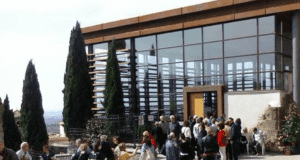
Velletri is the last of the Castelli Romani towns going south, leaning on the outer slope of the Alban volcanic complex, with vineyards running around it and the Pontine plain beginning downhill. The Oreste Nardini Archaeological Museum is inside Palazzo Comunale, the most important civic building in the town, and this already says something about the relationship between Velletri and its own archaeology: the antiquities were not confined to a warehouse on the outskirts, they stayed in the palace where the town is administered.
The train to the Oreste Nardini Archaeological Museum
The most convenient solution from Rome remains the train. The line to Velletri is a local railway of Lazio, 41 kilometers in all from Roma Termini, of which only the first 14 up to Ciampino are double track. The project dates to 1846, under Pius IX, as the first stretch of the connection between Rome and Naples, and service began in 1863. Electric traction at 3000 volts arrived on December 15, 1948. Today the service is the regional FL4, with stops at Ciampino, Pavona, Cecchina, Lanuvio and the minor stations of San Gennaro and Casabianca. Velletri is the terminus: you won't risk missing the stop while reading the newspaper.
Buses, cars and the parking knot
At the Velletri station you find the Cotral and Cotrav bus lines, along with a taxi stand. Anyone arriving by car should allow for the fact that the historic center is higher up than the station and that the streets inside the walls are narrow: it's best to look for a space in the outer parking areas and walk up. One detail no app tells you: the Oreste Nardini Archaeological Museum and Museo Civico di Geopaleontologia e Preistoria dei Colli Albani are adjacent and are visited with the same combined ticket, so the trip from Rome pays off much more than the words civic museum in the singular would suggest.
How much the Oreste Nardini Archaeological Museum costs and who gets in free
Five euros for the archaeological museum alone, 8 for the pair archaeological plus geopaleontological, 9 if you add the Archaeological Area of the SS. Stimmate. It is the price list of a virtuous civic museum, and for what you see it remains one of the most favorable ratios between price and content in Lazio. The reduced rate applies to residents of Velletri, to the 6 to 18 age group, to people over 65, to university students enrolled in archaeology and art history courses, in Biological, Environmental and Agricultural Sciences, and to affiliated organizations. The same reduced rate is applied during the Festa delle Camelie, the Festa dell'Uva e dei Vini and the Notte dei Musei.
Free admission at the Oreste Nardini Archaeological Museum
Children under 6, tourist guides, teachers, visitors with disabilities and their companion, ICOM members, journalists and school groups get in free. There are also days of free entry for everyone: ICOM Day, the European Archaeology Days, Women's Day and December 31. The verdict is clear: if you have less than 25 euros to spend between two people and want a full day, the 8 euro ticket for the two museums of Velletri is worth more than many Roman exhibitions at 15 euros a head, where you enter at a timed slot and leave after 40 minutes, jostled.
Palazzo Comunale of Velletri, home of the Oreste Nardini Archaeological Museum
The venue is not a neutral container. Palazzo Comunale of Velletri was begun in 1575 on a design linked to the names of Jacopo Barozzi da Vignola and Giacomo Della Porta and completed in 1590: late 16th-century architecture of the Roman school, with that severe measure that in Rome you see in the palaces of the same season. In 1944 the building was seriously damaged and later rebuilt, and this explains why the interior you walk through today alternates ancient masonry and 20th-century structures.
Why the venue matters for the Oreste Nardini Archaeological Museum
An archaeological museum inside a city government palace is a 19th-century and municipal idea in the high sense of the word: the civic collection as an act of identity. In Velletri the idea has held for a century. The route runs over two floors and is arranged, according to the Comune's entry, in 12 sections. You'll find the bookshop, an elevator, the specialized library, the restoration lab, two storerooms, a conference room and the offices: a museum small in surface area but complete in functions, which doesn't happen often outside provincial capitals.
The history of the collections of the Oreste Nardini Archaeological Museum
The raw material of the Oreste Nardini Archaeological Museum comes from far back, and it is a story made more of losses than of acquisitions. From the 17th century on, humanists and prelates of Velletri gathered the antiquities that the land gave back at every plowing. From that season came Museo Borgiano, the Ginnetti Collection, the nucleus that would later flow into the Diocesan Museum.
Cardinal Stefano Borgia and the lost collection
Stefano Borgia (1731-1804), from Velletri, cardinal and prefect of Propaganda Fide, put together one of the most extraordinary private collections of 18th-century Europe: Egyptian, Etruscan, Italic and Oriental antiquities, curiosities that reached Rome by the routes of the missions. In 1817 the heirs sold almost the whole collection to Ferdinand IV for the Bourbon Museum of Naples. In Velletri, through the stubbornness of a local academy, the Societa Letteraria Volsca Veliterna, a few inscriptions remained. It is the first great emptying: the paradox of a civic museum born where the richest collection had been and deprived of precisely that.
From the Fosso del Metabo to the inauguration of 1920
The first nucleus of the civic collections proper formed around 1881 with the materials from the Fosso del Metabo. Then comes the man who gives the museum its name: the engineer Oreste Nardini, Honorary Royal Inspector of Monuments and Excavations of Velletri, who in 1920 inaugurates the civic museum. He is not a parlor collector: he is a technician who digs, records, documents, and who year after year enlarges the collection with finds, donations and purchases. The naming after him came only in 2001, 80 years later.
The war, the dispersals and the return
The Second World War hit Velletri like few other towns of Lazio. The town found itself on the Caesar Line, the German front south of Rome, and was bombed. The liberation came on June 1, 1944, after the American breakthrough on Monte Artemisio. The museum paid the bill: losses and dispersal of materials, Palazzo Comunale damaged. The recovery begins in 1955, and it begins in the most spectacular way possible, with the discovery of the great Parian marble sarcophagus that is today the symbol of the museum.
The reopenings, the restoration and the Quality Mark
The museum reopens in 1982 and in the following decade enters a phase of stabilization. The most important construction project is the one that closes in 2001: the structure is brought up to the regulations on safety and conservation, the display is rethought, and the specialized library, the restoration lab, the storerooms and the conference room come into being. Since 2004 the museum has carried the Quality Mark of the regional museum organization, a recognition that has been reconfirmed. In 2003 the Pellegrini donation had added 170 fragments of Campana plaques from the Madonna degli Angeli area. The public numbers remain those of a provincial museum: about 9,000 visitors in 2024. It is little, and it is unfair.
The visit route of the Oreste Nardini Archaeological Museum, room by room
The display is spread over two floors with an arrangement that is both chronological and thematic, built to recompose the historical and evolutionary, environmental and human picture of the Velletri area. Put in everyday Italian: it is not a row of display cases with labels, it is a story that starts from the landscape and arrives at the early Middle Ages. A visitor who enters knowing this understands twice as much.
The two introductory sections on the ground floor
Before the route proper, on the ground floor, there are two small sections that deal with topics different from each other. The first is devoted to the conservation of cultural heritage: how a find is recovered, what happens between the field and the display case, why a poorly cleaned fragment permanently loses the information it carried on it. The second tells the story of the Velletri collections from the 17th century to today, and here the museum makes a rare gesture: it dedicates a large panel to the heritage kept at the Diocesan Museum of Velletri, that is, it sends its own visitors to another museum. In the Italian museum world, where everyone defends their own patch, it is a gesture of political intelligence.
The prehistoric section and the reconstructed burial
The archaeological route opens with the oldest materials of the territory and with one of the most effective display choices of the Oreste Nardini Archaeological Museum: the reconstruction of a prehistoric burial. It is not gratuitous staging. In front of a case of loose grave goods the visitor sees objects. In front of a recomposed burial, the visitor sees a rite, that is, sees the sense in which those objects had been placed there. Bring a 12-year-old and watch the difference in attention compared with the previous case.
The Volscian terracottas and the sphinx of the Stimmate
Here the museum plays the card that makes it unique. The terracotta plaques and architectural terracottas of Velletri, attributable to the cladding and roof of a late archaic temple, are first-rate material for understanding the art of central Italy before Romanization: processions, chariot races, banquets, a repertoire of forms that the manuals associate with Etruscan figurative culture but that in Velletri takes on its own characters. A part appeared as early as 1784 during work on the oratory of the church of the Stimmate, together with a sphinx head. Other plaques came to light in 1910 with the excavations of the inspector Giovacchino Mancini, who also intercepted the tuff wall remains of the temple. Look at them slowly: this is the only place where the Volsci stop being a line in the books of Roman history.
The favissa and the votive offerings
Another successful display is that of the votive offerings, arranged to recreate a favissa, that is, the pit where the sacred objects discarded by a sanctuary were deposited, which could not be thrown away because they were consecrated. Among the materials from the excavations of the sacred area of Velletri there are also anatomical votives: feet, hands, heads, internal organs modeled in terracotta and offered to the deity in exchange for healing. They are the most direct document we have of the physical relationship between an ancient person and their god. No literary text tells us as much.
The SS. Stimmate plaques and the Campana plaques
A specific section showcases the plaques from the SS. Stimmate complex, with a display designed to make their sequence readable. To the historical materials were added in 2003, with the Pellegrini donation, 170 fragments of Campana plaques from the Madonna degli Angeli area. Campana plaques are the terracotta relief cladding of Roman buildings of the late republican and imperial age, produced in molds and repeated in series: the name comes from the marquis Giampietro Campana, the 19th-century collector who assembled the most famous collection of them.
The Roman section and the reconstruction of the columbarium
With the Roman age the Oreste Nardini Archaeological Museum changes register. Velitrae is a municipium, the town is crossed by the road system that gravitates on the Appia, and the material becomes monumental: sculptures, funerary urns, altars, inscriptions. The reconstruction of the columbarium, the burial chamber with niches for the cinerary urns, is didactically the highlight of the floor: anyone who has never seen a Roman columbarium in person understands in 30 seconds what a collective burial of freedmen and modest families was.
The lapidary and the inscriptions
The epigraphic section gathers Roman inscriptions from the territory, some survivors of the Borgia dispersal thanks to the Societa Letteraria Volsca Veliterna. The inscriptions are the part of the museum that visitors pass through fastest and that instead contains the real names of people: who paid for a restoration, who buried a child, who had themselves remembered for a municipal office. Stop at least at two or three and read the labels in full.
Up to the early Middle Ages
The route does not stop at the fall of the empire. The materials reach the early medieval age, which lets you follow the passage from the Roman town to the fortified village, the phase in which Velletri entrenches itself and begins the story that will lead, in 1353, to the inauguration of the Torre del Trivio, symbol of communal autonomy. It is the part most neglected by visitors and one of the most useful for understanding the landscape you cross arriving by train.

The Sarcophagus of the Labors of Hercules, the masterpiece of the Oreste Nardini Archaeological Museum
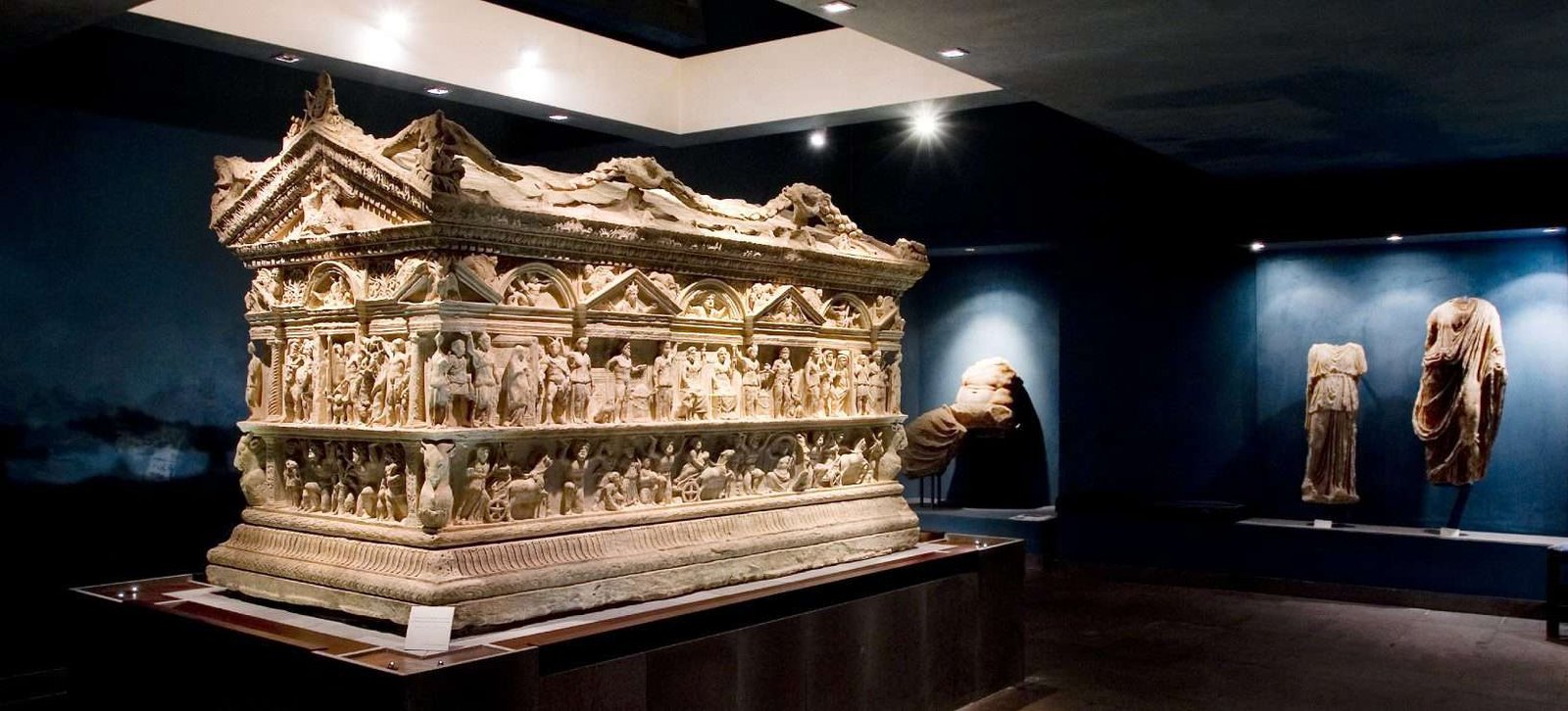
On July 10, 1955 a farmer, working in the countryside of Velletri, hits something hard with his tool. It is not a stone: it is the lid of a Parian marble sarcophagus 2 meters 60 centimeters long, one and a half meters high, 1 meter 20 centimeters deep, sculpted in high relief on all sides. It is the Velletri Sarcophagus, also known as the Sarcophagus of the Labors of Hercules, and in the international archaeological literature it is one of the most studied Roman sarcophagi of all.
The dating and the structure of the sarcophagus
The dating accepted today places it between 140 and 150 AD, in the full Antonine age. The chest is conceived as a building in miniature: columns of Doric and Ionic order, superimposed registers, a gabled roof. Scholars have counted 86 figures between human and divine, including caryatids and telamones, 43 mythical creatures and 40 animals. It is not decoration: it is a complete iconographic program, staged like a theater on several levels.
The scenes: Hercules, Persephone and the afterlife
On the front stand Pluto and Persephone enthroned, and around them are arranged the stories of those who managed to return from the afterlife or were brought back: Protesilaus, Alcestis, and the abduction of Persephone with Minerva and her companions. On the back run the labors of Hercules, the boar, the Cerynitian hind, the belt of Hippolyta, the stables of Augeas, the Cretan bull, the mares of Diomedes. In the lower register the damned: Sisyphus with his boulder, Charon, Tantalus, the Danaids with their pierced jars. On the roof, fruit garlands sculpted in the round and held up by cupids.
Why the sarcophagus of the Oreste Nardini Archaeological Museum really matters
The theme is not death as an end, it is the overcoming of death. Hercules is the hero who descends to the underworld and comes back up, Alcestis is the wife who returns from the land of the dead, the patron, whoever he was, had himself buried inside a discourse of salvation built with the only repertoire available before Christianity. Marion Lawrence devoted a study to it in 1965 in the American Journal of Archaeology that remains the reference, Riccardo Bartoccini published the first presentation after the discovery. In July 2025 Velletri celebrated 70 years since the discovery with a weekend of events. On its own it is worth the trip from Rome, and anyone who knows it from photographs has no idea how much it changes to see those superimposed levels walking around it.

The 1980 sarcophagus and the other Roman marbles of the Oreste Nardini Archaeological Museum
In 1980 the archaeological Soprintendenza recovers in Velletri a second great Roman sarcophagus, dated to the 3rd century AD, with the pair of the deceased and a winged victory. Between the two pieces lie at least 150 years, and the direct comparison is a small lesson in late antique art history: from Antonine virtuosity, with the drill digging deep undercuts and the surface vibrating, you move to a more compact and frontal language, where the portrait counts more than the narrative. Anyone who visits the museum in a rush sees two sarcophagi, anyone who stops sees the change of mentality of an empire.
The Lastra dell'Orante of the Oreste Nardini Archaeological Museum
It is the piece that specialists cite right after the sarcophagus. The Lastra dell'Orante dates to the Constantinian age, the first decades of the 4th century, and decorated the front of a tomb. In the center an elderly woman, veiled, with arms open in the gesture of prayer. On the left the Good Shepherd with the sheep on his shoulders. On the right a shepherd leaning on a rock with the flock.
The biblical scenes of the plaque
Around the three figures runs a repertoire of scenes that anyone who has visited the Roman catacombs recognizes: Daniel in the lions' den, Jonah swallowed by the sea monster, Adam and Eve, Noah in the ark, the multiplication of the loaves and fishes. It is the figurative language of the first Christian community, made of episodes of salvation and escaped danger. The documentary value is high because it testifies to an already structured Christian patronage in a center of the Alban Hills in the decades immediately following the Constantinian turn. If this vein interests you, the page of the Museum of the City and Territory of Cori and the one on Cori tell of a parallel and equally layered territory.
The Pallas of Velletri, the masterpiece that is not at the Oreste Nardini Archaeological Museum
At the entrance you are greeted by a colossal Athena. It is not the original, and it is right to say so immediately: it is the plaster replica donated in 1968 by the town of Puteaux, twinned with Velletri. The original is in the Louvre, Sully wing, room 344, inventory numbers MR 281, N 1021, Ma 464.
The discovery of 1797
The statue came to light in September 1797 during agricultural work in the vineyard of Giovanni Battista De Santis, in the locality of Troncavia. 3 meters 5 centimeters tall, 1.77 meters wide, in Thasian marble for the ancient parts and Carrara marble for the modern restorations, it is a copy of the Roman age, referred to the 1st century AD, of a Greek bronze original attributed to Kresilas and dated to the third quarter of the 5th century BC, around 410. Athena wears the helmet, the peplos, the aegis with the serpent and the gorgoneion, the serpent-shaped belt, the half-draped himation, the sandals.
Six years of disputes, seizures and negotiations
The story that follows is a novel. Over the find quarreled the owner of the land De Santis, the canon Bernardino Nardi who had owned the vineyard before, the sculptor Vincenzo Pacetti and the duke Luigi Braschi. On April 26, 1798 the French seized it. In October 1799 the Bourbon troops took it to Naples, where it stayed until September 1802. Then Napoleon intervened in person with Ferdinand of Bourbon and obtained the transfer: in the autumn of 1803 the Pallas arrived in Paris, where the Louvre records it as a purchase from the king of Naples. Six years, four claimants, two armies. The statue never came back.
Museo Civico di Geopaleontologia e Preistoria dei Colli Albani
Next to the Oreste Nardini Archaeological Museum, with the same combined ticket, is the second civic museum of Velletri, and it is a real surprise: a route through the remote past of the Alban Hills, from the geological origins hundreds of millions of years ago up to the Iron Age. Five sections on two levels: on the ground floor Geology, Paleontology and Anthropology, on the upper floor Prehistory and Protohistory.
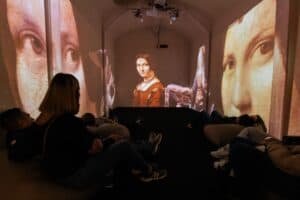
The fire conduit and the model of the Latial Volcano
The route opens with a fire conduit: a space that reproduces an eruption with sound effects and three-dimensional images. It looks like an attraction, and instead it is the correct didactic premise, because the whole landscape of the Castelli Romani, the lakes of Albano and Nemi included, is the product of the Alban volcanic complex. In the geological section there is the model of the Latial Volcano. In the paleontological one, the dinosaurs and the explanation of fossilization processes. Anthropology, Prehistory and Protohistory complete the story with casts, films and reconstruction models up to the threshold of writing. If the topic grabs you, the page of the Rocca di Cave Geopaleontological Museum and the one on Lake Albano tell of the same volcanism from two other points of observation.
The Archaeological Area of the SS. Stimmate, the third ticket
The third element of the system is the Archaeological Area of the SS. Stimmate, which can be visited with a surcharge of two euros for the site alone or included in the combined tickets at five and nine euros. The visit route is circular and the display is modern.
240 years of excavations under a church
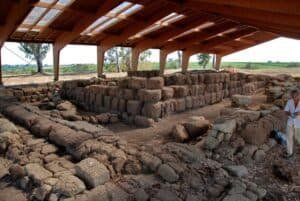
The history of the site is long. In 1784, during renovations of the church's oratory, the terracotta plaques and architectural terracottas attributable to the roof of a late archaic temple emerged, together with the sphinx head. In the same year came to light the famous Tabula Veliterna, the bronze plate inscribed in the Volscian language that today is in the National Archaeological Museum of Naples. In 1910 the inspector Giovacchino Mancini brought to light the tuff wall remains of the temple and part of the sphinx, today in the civic museum. In the mid 1970s the area was damaged by building works that followed the closing and deconsecration of the church. After the acquisition by the Comune in 1992, investigations restarted with the Soprintendenza, continued in 2005 and 2006 and then between 2014 and 2016: archaic terracottas, impasto vases, bucchero, inscribed proto-Italic fragments, anatomical votives and the traces of a protohistoric hut under the late archaic temple.
The Sistema Museale Urbano of Velletri
The Oreste Nardini Archaeological Museum, Museo Civico di Geopaleontologia e Preistoria dei Colli Albani and the Diocesan Museum together make up the Sistema Museale Urbano of Velletri: a single itinerary within which the stages of the town's history and culture are recomposed. The archaeological museum is part of the Regional Museum Organization of Lazio and its direction is entrusted to Dr. Raffaella Silvestri. The model, for those who like comparisons, is the same one that supports other territorial hubs: see the Archaeological Museum of Palestrina and the Museo la Reggia dei Volsci.
How to really visit the Oreste Nardini Archaeological Museum
Two and a half hours for the two museums is the honest measure: a good hour for the archaeological one if you stop at the sarcophagus and the terracottas, 40 minutes for the geopaleontological one, the rest for the Stimmate area. A practical tip: start with the archaeological and finish with the geopaleontological, not the other way around. The fire conduit and the dinosaurs raise the kids' level of excitement so much that afterwards, in front of the Volscian plaques, you can't hold them.
The Oreste Nardini Archaeological Museum with children
It works better than the word archaeology leads you to fear, and the credit goes to the reconstructive displays: the prehistoric burial, the columbarium, the favissa of the votive offerings. They are three devices that turn display cases into scenes. Add the second museum, which with the eruption and the fossils has an immediate impact, and you have a morning that holds up to 10 or 11 years old without effort. Under 6 you get in free, which makes the family bill very light.
Accessibility of the Oreste Nardini Archaeological Museum
The museum has an elevator and the Comune's entry lists it as accessible to people with disabilities. Admission is free for the visitor with a disability and for the companion, and the guided tour is not paid for by them. On the digital services side the museum has been judged behind: QR codes and audio guides were missing, and the announced improvement program included Braille panels, multisensory displays and interactive stations. If you have specific needs, make a phone call before leaving: the staff is small and answers better than any web page.
What to see around the Oreste Nardini Archaeological Museum
Leaving Palazzo Comunale you are in the historic center of Velletri, with the Torre del Trivio, inaugurated in 1353, a few steps away and the Diocesan Museum in the combined ticket circuit. Then there is all the rest of the Castelli: Lariano close by, Lanuvio on the same railway line, Genzano di Roma with its infiorata, Nemi overlooking the lake, Ariccia with Palazzo Chigi, Albano Laziale and its Severan remains, Castel Gandolfo, Rocca di Papa up high, Marino and Frascati with the Tusculan villas. If you want to link Velletri to the great suburban archaeology of Rome, you'll find the thread in the Appian Way Park, and if you head down toward the sea you can end the day at the Museo dello Sbarco di Anzio, which tells the same 1944 seen from the coast.
When to go to the Oreste Nardini Archaeological Museum
The weekend is the only time when the schedule covers afternoon and morning, so it is the obvious choice for those coming from Rome without waking up at dawn. Friday afternoon, with opening from 15:00 to 19:00, is the quietest window of all, sometimes with nobody else in the rooms. Avoid August without having called first. The best period of all is autumn, when the town is in the middle of the grape harvest and the Festa dell'Uva e dei Vini also brings the reduced rate.
A curiosity about the Oreste Nardini Archaeological Museum
On February 22, 1787 Johann Wolfgang von Goethe stops in Velletri on the road to Naples and visits the cabinet of the cavaliere Borgia. In the account of the journey he notes that the master of the house, through his kinship with the cardinal and his relations with the Propaganda, had been able to gather wonderful antiquities and other rare things. He lists the Egyptian idols made of stone of extraordinary hardness, the small metal figures of earlier and later times, the little Chinese boxes with scenes of silkworm breeding and rice cultivation. But the line that directly concerns the Oreste Nardini Archaeological Museum is another: Goethe records the objects worked in terracotta discovered in the vicinity of the town, which, he writes, would give grounds for ascribing to the Volsci a style of their own and special.
They are the Velletri terracottas, the same kind of material that you see today in the museum's cases. Goethe closes the passage with a complaint that two and a half centuries later still sounds very current: he is amazed that objects so precious, so close to Rome, are so little known and so little visited, and he blames the discomfort of the journey and the force of attraction that Rome exerts on anyone who arrives. 9,000 visitors in 2024 say that Goethe was right and that nobody listened to him. The curiosity, for me, is all here: the most famous involuntary tourist guide in European history pointed out Velletri in 1787, and the problem he denounced has remained identical.
One thing nobody tells you about the Oreste Nardini Archaeological Museum
The museum of Velletri has been emptied twice, and neither time through the fault of the people of Velletri. The first time in 1817, when the heirs of Cardinal Stefano Borgia sold almost the entire collection to Ferdinand IV for the Bourbon Museum of Naples: the Egyptian, Italic and Oriental antiquities left, the pieces that had made Velletri a stop on the Grand Tour. What held back a few inscriptions was only the stubbornness of a local academy, the Societa Letteraria Volsca Veliterna. The second time in 1798, with the French seizure of the Pallas, which after five years of passages between Rome, Naples and Paris entered the Louvre and never came back.
Add the Tabula Veliterna, the bronze plate with the inscription in the Volscian language found in 1784 under the church of the Stimmate and also ending up in Naples, and the picture is complete: the most important linguistic document produced by this territory is read in another region. This is why the Oreste Nardini Archaeological Museum should be looked at with different eyes from those with which you look at a national museum. It is not a collection that chose what to display: it is what remained after two centuries of removals. And what remained, the sarcophagus first of all, is enough to stand up to comparison with anyone. Knowing this completely changes the way you walk through the rooms.
The advice I give you for visiting the Oreste Nardini Archaeological Museum
Call. It is not generic advice: it is the specific advice for this museum. The number is +39 06 96158268 and during service hours someone who knows answers. There are three reasons. The first is the summer calendar, which this year includes a closure whose exact dates it is worth getting told. The second is that the schedules published by the Comune and by the civic museums site don't match, and leaving Rome by train only to find the door closed at 13:05 is one of the most frustrating experiences I know. The third is that the staff is small and an announced visit is welcomed better than a surprise one.
Second tip, on method: buy the combined ticket at 9 euros and take the whole morning, or the whole Friday afternoon. Doing only the archaeological is like going to a concert and leaving after the first half. Third: if you are in a group, the guided tour for 15 or 25 people costs 60 euros for one museum and 90 for two, that is between 3 and 6 euros a head, and with material like the Volscian terracottas or the sarcophagus the difference between looking and understanding is made exactly by that. Last thing, and it counts as a firm opinion: don't rush the group in front of the sarcophagus for the photo and then off. Walk around it. It is sculpted on all four sides, and anyone who sees it only from the front loses more than half of it.
Another well-known fact, yet rarely cited
That Velletri is the homeland of Augustus's family is said by all the guides. What nobody bothers to explain is that this fact has material consequences inside the museum. The gens Octavia originated from Velitrae, and local tradition, reported by ancient sources, preserves even the omen according to which in Velletri, struck in antiquity by lightning on a stretch of the walls, it was prophesied that a citizen of that town would one day seize power. Augustus was born in Rome, but the root of the family was here, and the properties of the gens in the Velletri territory are the key with which some scholars read the painted terracotta reliefs of the late republican age kept in the museum, hypothesizing that they come from the villa of the Octavii.
It is a hypothesis, not a documented fact, and it has to be said clearly. But it explains the sense of the Roman section of the Oreste Nardini Archaeological Museum: Velitrae was not just any town colonized by Rome, it was a municipium with a direct link to the imperial house. Add the other fact that is rarely cited: in 338 BC, after yet another rebellion, Rome punished Velletri with a harshness that the sources record in a few terrible words, walls torn down and senate deported. The town that in the 1st century would give birth to the family of the princeps had been, three centuries earlier, punished as an enemy. The museum tells both phases, and anyone who goes through it without knowing misses the most interesting thread.
The right photo to take at the Oreste Nardini Archaeological Museum
The photograph everyone takes is the front of the sarcophagus with Pluto and Persephone enthroned. It is a beautiful photograph and it is the most useless, because it already exists in a thousand versions better than yours. The right photograph is the short side, taken at three quarters, with the raking light coming in from the window: from that angle you see at the same time the thickness of the chest, the play of the Doric and Ionic columns and the gabled roof with the fruit garlands sculpted in the round and held up by the cupids. In a single frame you understand the fundamental thing, namely that this sarcophagus is a building in miniature, not a decorated panel.
The second photograph to take home is a macro of the Volscian terracottas: a detail of a procession or a chariot race, filling the whole frame, with no display case in the field. They are the images nobody has on their phone and that tell of a pre-Roman figurative world that you see almost only here. Third option, for those traveling with children: the reconstructed columbarium, photographed from below so that the niches line up in perspective. A practical rule for all three: no flash, rest your elbow or the camera on a steady surface and raise the sensitivity, because the lighting in the rooms is good but warm and the flash flattens the relief exactly where the relief is everything. Before shooting, ask the staff: the shooting conditions in the civic museums can change from one room to another.
Some important events that happened here in history
The first event is from 1784: during work on the oratory of the church of the Stimmate there emerge the terracotta plaques, the architectural terracottas, the sphinx head from the roof of a late archaic temple, and together with them the Tabula Veliterna, the bronze plate with the most important inscription in the Volscian language known. Three years later Goethe passes through Velletri and writes about it. The second is from September 1797, when in the De Santis vineyard in the locality of Troncavia the Pallas surfaces: from April 26, 1798, with the French seizure, begins its journey toward Paris by way of Naples.
The third is from 1881, with the materials from the Fosso del Metabo that form the first nucleus of the civic collections. The fourth is from 1910, when the inspector Giovacchino Mancini digs under the Stimmate and recovers the Volscian terracottas and the tuff remains of the temple. The fifth is from 1920, the inauguration of the museum through the work of the engineer Oreste Nardini. Then comes the war: Velletri ends up on the Caesar Line, is bombed, Palazzo Comunale is damaged, the museum loses and disperses materials, and the town is liberated on June 1, 1944 after the American breakthrough on Monte Artemisio. On July 10, 1955 a farmer hits the sarcophagus of the Labors of Hercules with his tool and the museum is reborn around that marble. In 1980 the Soprintendenza recovers the second sarcophagus. In 2001 the great restoration closes and the museum is named after Nardini. In 2003 the Pellegrini donation brings 170 fragments of Campana plaques. In July 2025 Velletri celebrates 70 years since the discovery of its masterpiece.
Who has passed through the Oreste Nardini Archaeological Museum
The biggest name is Goethe's, who on February 22, 1787 visited in Velletri the cabinet of the cavaliere Borgia, that is, the collection from which the very idea of a Velletri museum descends in a direct line, and who in his travel diary pointed out precisely the local terracottas as proof of an autonomous Volscian style. The second name is Stefano Borgia's, from Velletri, cardinal and prefect of Propaganda Fide, the collector who had gathered those antiquities and who in Velletri received the European travelers of the Grand Tour.
Then there are the figures who passed through this palace and this town for reasons that have little to do with archaeology. Napoleon Bonaparte never set foot in the museum, which didn't exist, but intervened personally with Ferdinand of Bourbon to obtain the transfer of the Pallas to Paris: his signature weighs on the rooms of Velletri more than that of many directors. Giuseppe Garibaldi fought here in 1849 and defeated the troops of Ferdinand II at the gates of the town, and his Velletri headquarters is still remembered by plaques. Before him, in 1744, Velletri had been the scene of a battle of the War of the Austrian Succession between Austrians and Spanish-Neapolitans.
On the scientific side, the names that count are those of the archaeologists: Giovacchino Mancini, the inspector who in 1910 brought to light the temple of the Stimmate. The engineer Oreste Nardini, who was the founder and the driving force of the museum. Riccardo Bartoccini, who published the sarcophagus after the discovery. Marion Lawrence, the American scholar who in 1965 devoted to it, in the American Journal of Archaeology, the study that is still the reference today. And, in the background, the family of Augustus, whose holdings in the Velletri territory remain the most accredited hypothesis for the provenance of some of the museum's terracottas.
Quick questions about the Oreste Nardini Archaeological Museum
Where is the Oreste Nardini Archaeological Museum
In Palazzo Comunale of Velletri, Via Goffredo Mameli 4-6, 00049 Velletri (RM), in the province of Rome, on the southern edge of the Castelli Romani.
How much is the ticket for the Oreste Nardini Archaeological Museum
Full price €5.00 for the archaeological museum alone, €8.00 for the combined ticket with the geopaleontological museum, €9.00 adding the Archaeological Area of the SS. Stimmate. Reduced €3.00, €5.00 and €6.00 respectively.
What are the hours of the Oreste Nardini Archaeological Museum
According to the official website of Musei Civici, from June 1: Monday closed, Tuesday to Thursday 09:00-13:00, Friday 15:00-19:00, Saturday, Sunday and public holidays 10:00-14:00 and 16:00-19:00. The ticket office closes an hour earlier. The Comune's portal gives a different schedule: better to confirm by phone.
Is the Oreste Nardini Archaeological Museum open in August
On August 15 it is closed, and the official website displays a 2026 summer closure notice. The exact dates should be asked at +39 06 96158268 before leaving.
Do you need to book to visit the Oreste Nardini Archaeological Museum
For individuals no, you enter during opening hours. For groups and school classes reservation is mandatory.
What is the phone number of the Oreste Nardini Archaeological Museum
+39 06 96158268. The email is museicivicivelletri@gmail.com, alternatively museo.civico@comune.velletri.rm.it.
What is the most important work in the Oreste Nardini Archaeological Museum
The Sarcophagus of the Labors of Hercules, also called the Velletri Sarcophagus, Parian marble from 140-150 AD, 2 meters 60 centimeters long, sculpted in high relief on all sides.
When was the Velletri sarcophagus found
On July 10, 1955, by chance, by a farmer working in the countryside of Velletri.
Is the Pallas of Velletri on display at the Oreste Nardini Archaeological Museum
No. The original is in the Louvre, Sully wing, room 344. In Velletri you see the plaster replica donated in 1968 by the twinned town of Puteaux.
How long does the visit to the Oreste Nardini Archaeological Museum take
About an hour and a quarter for the archaeological museum alone, two and a half hours for the two museums and the archaeological area.
Is the Oreste Nardini Archaeological Museum suitable for children
Yes, thanks to the reconstructive displays: the prehistoric burial, the columbarium, the favissa of the votive offerings. The geopaleontological museum next door, with the simulated eruption and the dinosaurs, works even better.
Do children pay at the Oreste Nardini Archaeological Museum
Under 6 admission is free. From 6 to 18 you pay the reduced rate.
Is the Oreste Nardini Archaeological Museum wheelchair accessible
The museum has an elevator and is listed as accessible. Admission is free for the visitor with a disability and for the companion, and for them the guided tour is not paid for. For particular needs it's best to phone beforehand.
Can you take photographs at the Oreste Nardini Archaeological Museum
The shooting conditions should be checked with the staff in the room. In any case flash is not recommended because it flattens the relief of the sarcophagus and the terracottas.
How much does the guided tour of the Oreste Nardini Archaeological Museum cost
For individuals from 6 years up €4.00 for one museum and €6.00 for two. For groups of 15 to 25 people €60.00 for one museum and €90.00 for two. In English, for groups only, €100.00 and €170.00.
Who gets in free at the Oreste Nardini Archaeological Museum
Children under 6, tourist guides, teachers, visitors with disabilities and companion, ICOM members, journalists and school groups. Free entry also on ICOM Day, the European Archaeology Days, Women's Day and December 31.
How do you get to the Oreste Nardini Archaeological Museum from Rome
By regional train on the FL4 line from Roma Termini to the terminus at Velletri, then on foot toward the historic center. In front of the station are the Cotral stops and the taxis.
What is the difference between the Oreste Nardini Archaeological Museum and the geopaleontological museum
The first tells the human history of the territory from prehistory to the early Middle Ages, the second the geological and paleontological past of the Alban Hills in five sections. They are adjacent and are visited with the same combined ticket.
What is the Sistema Museale Urbano of Velletri
The network that joins the Oreste Nardini Archaeological Museum, Museo Civico di Geopaleontologia e Preistoria dei Colli Albani and the Diocesan Museum in a single city visit itinerary.
Does the Oreste Nardini Archaeological Museum have a bookshop
Yes, the museum has a bookshop, as well as a specialized library, restoration lab, storerooms and conference room.
How many visitors does the Oreste Nardini Archaeological Museum have
About 9,000 in 2024, a very low number compared with the quality of the collections.
Who was Oreste Nardini
An engineer from Velletri, Honorary Royal Inspector of Monuments and Excavations of Velletri, who in 1920 inaugurated the civic museum and guided its growth. The museum was named after him in 2001.
What is the Archaeological Area of the SS. Stimmate
The site, with a circular visit route, where a late archaic temple of Velletri stood and where the Tabula Veliterna was found in 1784. It costs €2.00 on its own, or is included in the combined tickets at €5.00 and €9.00.
When is the best time to visit the Oreste Nardini Archaeological Museum
Friday afternoon for the quiet, the weekend for the wider schedule, autumn for the town during the grape harvest. In August only after confirming the opening by phone.
Among the civic museums of Lazio, very few leave the feeling of disproportion that Velletri leaves: an absolute masterpiece of Roman art, a corpus of pre-Roman terracottas that the manuals cite, a first-rate early Christian plaque, and 9,000 people a year. If I had to name a single museum of the Castelli Romani to see before dying, I would name this one, and I would say it even to those who think they have already seen everything in Rome. Give it two hours, not 40 minutes, and walk around the sarcophagus at least twice.
Article written by the team of TourLeaderPro, contact them for Private/Corporate/V.I.P. Tours and Experiences.
Planning a trip to Rome? The English guides to visiting the city are on ItalyPlanner.com.