Stimmate Archaeological Area
In short. The Stimmate Archaeological Area is at Via delle Stimmate 15, in the historic center of Velletri (00049, Metropolitan City of Roma Capitale), on a spur of rock facing the plain, a little under a kilometer from the Civic Museums at Via Goffredo Mameli 4-6.
The Stimmate Archaeological Area is at Via delle Stimmate 15, in the historic center of Velletri (00049, Metropolitan City of Roma Capitale), on a spur of rock facing the plain, a little under a kilometer from the Civic Museums at Via Goffredo Mameli 4-6. The ticket is not bought at the gate: you pick it up at the ticket office of the Civic Museums, behind the Palazzo Comunale. The rates given by the official website of the Velletri museum network are €2.00 for the archaeological area alone (€1.00 reduced), €5.00 for the area plus one museum (€4.00 reduced), €9.00 for the area plus two museums (€6.00 reduced). The hours published from June 1 are: Monday closed, Tuesday to Thursday 9.00-13.00, Friday 15.00-19.00, Saturday, Sunday and holidays 10.00-14.00 and 16.00-19.00. On weekdays the visit requires mandatory reservation, at 06 96158268 or at museicivicivelletri@gmail.com. The Civic Museums network publishes closures on the major holidays (January 1, Easter, August 15, December 25) and seasonal notices: in the summer months it is best to call before setting out. Official website: velletrimusei.it.
Velletri is served by the Rome-Velletri railway, of which it is the terminus, and by intercity bus lines. The station is at an elevation of 292 meters, the historic center climbs to over 330, so the climb exists and you feel it. Those arriving by car find the two classic routes of the Alban Hills: State Road 7 Appia and Via dei Laghi. If the trip includes other stops on the same day, the page on Velletri and the one on the Castelli Romani Park help build the itinerary.
What the Stimmate Archaeological Area really is
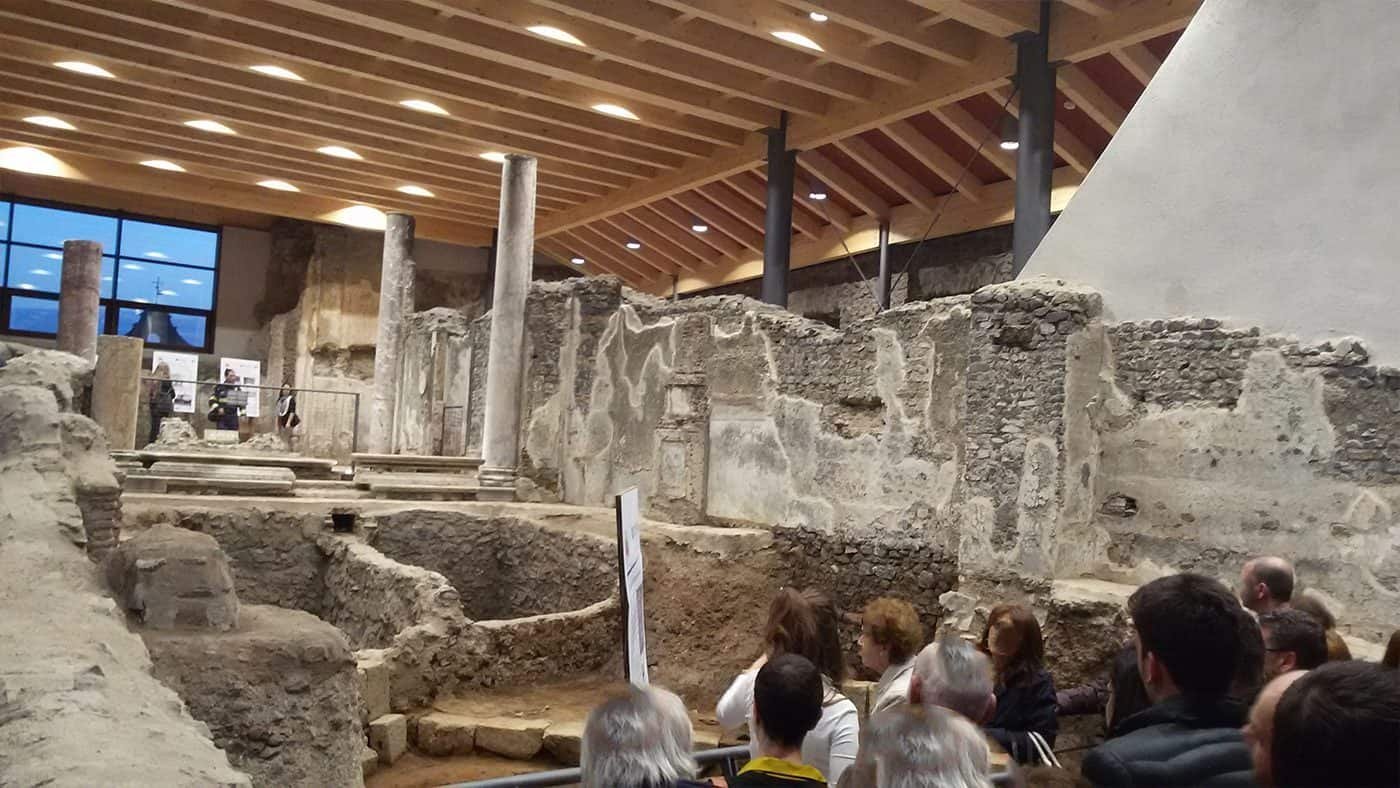
Forget the idea of a fenced-off ruin with a faded sign. Here there is a well of time dug into the living city, covered by a contemporary structure in cor-10 steel, wood and glass that protects the layers and lets you read them from above and from the side. The visitor walks on a circular path suspended over 3,000 years of Velletri history: beneath him, in a vertical line, are an Iron Age hut, an archaic place of worship, an Etruscan-Italic temple of the full 6th century BC, the Roman leveling that erased that temple, and finally the foundations and burials of a church that carried into the 20th century the name of a Franciscan archconfraternity.
It is a small site. Anyone arriving with Ostia Antica in mind will be thrown off: you visit it in 40 minutes, an hour if you read everything. But the stratigraphic density is that of the textbooks, and the fact that the sequence is legible to the naked eye, in a single glance, makes it one of the few places in Lazio where you understand physically what the word stratigraphy means. It is worth the trip for those who love archaeology for how it works, more than for how it looks.
The covering project of the Stimmate Archaeological Area
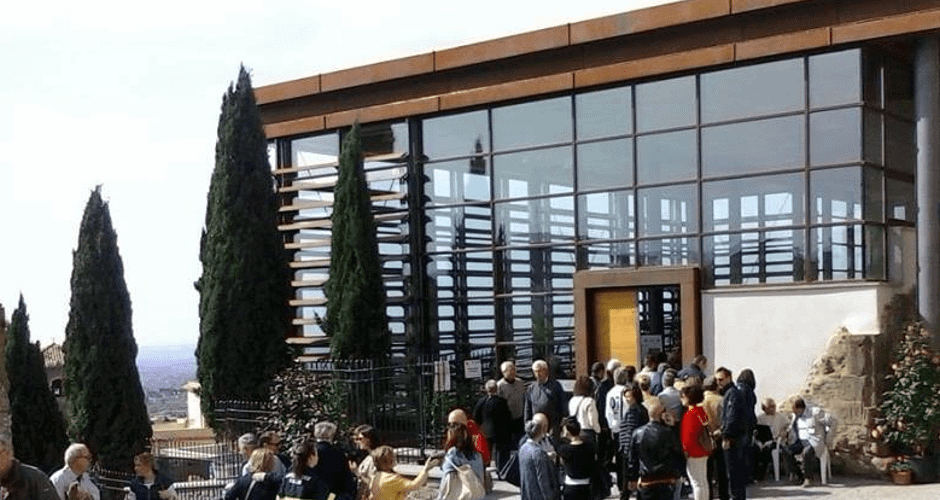
The recovery was financed with European funds from the 2007-2013 programming period, within the Local Urban Development Plan, for a sum of around €1,200,000. The intervention was not limited to putting up a canopy: it involved consolidating the cliff on which the complex rests, a terracing, the creation of a pedestrian path and the restoration of the surviving structures. The cor-10 steel cover, integrated with glazing and wooden parts, is the most debated choice and the most successful: the cor-10 ages with that rusty brown that does not compete with the tuff, the glass lets natural light onto the masonry, the wood softens the interior environment. The official inauguration was on April 2, 2016.
A firm opinion, from someone who has seen too many Italian archaeological covers solved with sheet metal and scaffolding tubes: this one is in a different category. It is not a masterpiece of architecture, but it is honest, measured and does not steal the scene from what it protects. In Italy, the way things go, that is already a lot.
The visit to the Stimmate Archaeological Area, layer by layer
The path is circular and is read from the bottom up, that is, from the oldest to the most recent. It is worth doing it twice: the first time following the panels, the second looking for the points of contact between one layer and the next, which are the real lesson of the place.
The deepest layer: the Iron Age hut
At the base of the sequence are the traces of an Iron Age occupation, dated between the 9th and 8th centuries BC. Don't expect walls: of a hut of wood, reeds and straw the volume doesn't survive, the negative does. What remains are the postholes, that is, the cavities in which the vertical supports were set, the traces of the beaten-earth floor, the perimeter legible as a patch of different color in the ground. The excavations carried out between 2014 and 2016 brought to light precisely this protohistoric hut below the temple structures, and with it ceramics covering the span from the Iron Age to the archaic age: vessels in brown impasto, in red impasto, bucchero.
The fact that matters is continuity. In the same spot where a community of huts gathered around a fire and a cult, three centuries later a masonry temple is built, and 2,500 years after that mass is still celebrated. Nobody ever decided at a drafting table that that hill was sacred: it became so by sedimentation, because people kept going back. It is the mechanism by which most ancient sanctuaries are born, and here you see it in section.
The archaic place of worship: the first tuff cella
Between the 7th and 6th centuries BC the hut gives way to a built structure, in all likelihood a single-cella sacellum in blocks of local tuff. The raw material is that of the Alban Hills, the lithoid tuff that outcrops everywhere in the area and that at Velletri is cut into squared blocks. The dimensions were modest: a rectangular room, a modest front, no monumental pretensions.
This phase is the least spectacular and the most interesting for those who know how to read it. It marks the passage from an open-air cult, tied to nature and to the dominant position over the landscape, to an architecturally defined cult, with a threshold, an inside and an outside. It is the moment when a community decides that the divinity needs a house, and starts spending to build it one.
The temple of 530 BC: the monumental phase
Around 530 BC, that is, in the years that traditional chronology assigns to Tarquinius Superbus, the sacellum is replaced by a temple of the Etruscan-Italic type, almost twice the size of the previous one, with a front that according to the reconstruction accepted by the Enciclopedia dell'Arte Antica measured 11.80 meters. It is a Tuscan temple, with side wings, a heavily projecting gabled roof, wooden columns and a terracotta decorative apparatus that fully clad its wooden parts.
The reconstructed decorative repertoire is the classic one of late archaic Latium and Etruria: a central acroterion with a double volute, side acroteria with sphinxes, antefixes with female heads alternating with lion-protome water spouts, figured cladding plaques along the long sides and on the raking cornices. The known architectural terracottas are dated by scholars to 550-525 BC. Whoever visits the area has to make an effort of imagination: that color, that whiteness of clay painted in red, black and cream, is no longer there. What you see is the plan. The rest is in Naples, and we will talk about it shortly.
The figured plaques: procession, banquet, apotheosis of Heracles
The cladding plaques that covered the wooden elements of the entablature carry three figurative cycles that scholars identify clearly: a procession of horsemen and chariots, a banquet scene, the apotheosis of Heracles welcomed into Olympus. They were displayed in 2021 at the Museo Archeologico Nazionale di Napoli in the show devoted to the Etruscans, presented as an example of cultural osmosis between Etruscan civilization and the Italic peoples in the archaic age.
It is worth understanding what those images mean. The banquet and the chariot race are not decoration: they are the language with which the archaic aristocracy declared itself, the way a local elite told its fellow citizens that the relationship with the divinity passed through it. The apotheosis of Heracles adds the theme of the man who becomes a god through his own merits, exactly the message that a rising personal power wants to put on the roof of the city temple. It is not propaganda in the modern sense, but it is close.
338 BC and the end of the temple
In 338 BC Rome settles accounts with the Latin League. Velitrae, which had repeatedly switched sides among Latins, Volscians and Romans, pays the highest price: the ancient sources recall the walls demolished and the city senate deported. On the hill of the Stimmate something consistent with that date happens: the temple suffers a partial destruction, the layers are leveled, the votive gifts scattered and buried.
It is not an earthquake and it is not an accidental fire. It is a political decision: a sanctuary is closed because that sanctuary is the identity heart of a community that has lost. Whoever visits the area with this key understands why the 338 level is, archaeologically, one of the most eloquent layers of the site: it is the moment when a city stops being itself and becomes something else. There is later use, down to the early imperial age, but the temple as such does not return.
The votive deposits and what they tell
Among the materials recovered in the area are votive deposits with pottery of different sizes and eras, testimony of the repeated gesture of leaving something for the divinity. In the Velletri territory the sanctuaries have also yielded figurines and anatomical ex-votos in terracotta, that is, reproductions of body parts offered to ask for or give thanks for a healing: feet, hands, heads, eyes, internal organs.
Anyone who looks at an anatomical ex-voto behind a display case sees a clumsy object. Anyone who looks at it knowing what it is sees a person who was afraid. It is the only document that remains to us of a medicine made of prayer, and its formal banality does not diminish its force: those terracottas were mass-produced precisely because the demand was enormous and constant.
The church: from Santa Maria ad Nives to the Most Holy Stimmate
Above the temple, in the modern age, a church rises. Its original dedication, in the 15th century, was to Santa Maria ad Nives, that is, Our Lady of the Snow. In 1602 Pope Clement VIII granted it to the venerable Archconfraternity of the Most Holy Stigmata of Saint Francis: from that passage, and not from an older devotion, derives the name by which the place is known today. It is worth fixing this, because the sequence is often told backward.
The choice of building a Christian place of worship exactly on top of a pagan sanctuary is a theme that historians of religion have debated for decades. The most widespread reading speaks of a will to erase. A more cautious reading observes that high places, well exposed and already consecrated by use, remain attractive for banally practical and topographical reasons. Both explanations have arguments. What the site documents without ambiguity is the material fact: the same height, the same sacred function, for almost three millennia.
The burial crypts under the nave
The 2014 investigations brought to light, under the nave of the church, burial chambers. It is a detail that escapes visitors and that instead completes the picture: a confraternity, in the modern age, buried its members in its own church, and the crypts were the visible sign of a pact between the living and the dead of the same community. The church was therefore not only a place of worship, it was the cemetery of a social body.
In 1782 Cardinal Stefano Borgia donated to this church the relics of Saint Euthicia. Two years later, in the same complex, the temple was dug up and found. The connection is more than a chronological coincidence, as we will see.
Velitrae, the Volscians and Rome: the historical context of the Stimmate Archaeological Area
Velletri, in Latin Velitrae, in the local language Velester, enters the Roman chronicles in the archaic age, when Rome begins to clash with the Volscians. There follows a century and a half of reversed alliances, rebellions and reconquests, until the showdown of 338 BC, after the defeat of the Latin League, of which Volscians, Latins and Aurunci were part. From that moment Velitrae enters the Roman orbit permanently and becomes a community under Roman law, with everything that implies in terms of language, institutions and cults.
The city stands at 332 meters above sea level, on the southern edge of the Alban Hills, in a dominant position over the plain that descends toward the coast. Whoever looks for the reason why a sanctuary arises exactly there finds it by looking out: the visual control of the territory is total. In archaic societies the place of worship is never random, it is almost always the point from which you see farthest.
The language of the Volscians and the Tabula Veliterna
Volscian is an Italic language of the Osco-Umbrian group, documented by very few texts. The most important of all is an inscribed bronze tablet found at Velletri in 1784, known to scholars as the Tabula Veliterna, now kept at the Museo Archeologico Nazionale di Napoli. It is a text of sacral and legal character, and for the knowledge of Volscian it is worth an entire archive.
The point that always throws off whoever hears it for the first time: the language of this city, before Latin, was another language, and we know it almost only thanks to an object found in this place. A town of the Castelli Romani an hour from Rome holds the key document of a vanished idiom. It is worth keeping in mind while you look down, from the walkway, toward the tuff blocks.
1784: the discovery that brought the Stimmate Archaeological Area into the history of archaeology
In 1784, during renovation works on the oratory attached to the church, there emerge fictile plaques and architectural terracottas, including a sphinx head, traceable to the roof of a late archaic temple. In the same year the Tabula Veliterna comes to light. The material flows into the collection of Cardinal Stefano Borgia, and from there takes the road that will carry it far from Velletri.
Who Stefano Borgia was and why he matters
Stefano Borgia was born in Velletri on December 3, 1731 and died in Lyon in 1804. He was secretary of the Congregation de Propaganda Fide from 1770, cardinal from 1789, rector of the Collegio Romano from 1801. In the two-year period 1797-98, in a dramatic phase for the Papal State, he received from Pius VI the administration of Rome. His most lasting undertaking, however, was the museum he founded in the family home in Velletri, where he gathered coins, manuscripts, Egyptian, Coptic, Etruscan and Italic antiquities. He was a collector of European standing in a provincial town.
At his death the collection was dispersed: the non-biblical manuscripts went to Naples, to the Biblioteca Borbonica. The biblical ones and the coins went to Propaganda Fide. In the 19th century part of the manuscripts passed to the Vatican Library. The terracottas of the Velletri temple followed the road to Naples and are today at the Museo Archeologico Nazionale. That is why the site you visit at Velletri is, so to speak, a body without skin: the structure is here, the decorative cladding is 200 kilometers away.
The excavations of the Stimmate Archaeological Area: two centuries of work
1910: Mancini, Nardini and the body of the sphinx
In 1910 Giovacchino Mancini and Oreste Nardini identify in the area masonry remains in tuff and part of the body of the sphinx whose head had emerged in 1784. That fragment is kept at the civic museum of Velletri, named precisely after Oreste Nardini. It is a small historical justice: the head in Naples, the body at home.
1989: the reconstruction of the roof
In 1989 Francesca Romana Fortunati works out a reconstruction of the temple roof cladding system, relating the known plaques to the architectural structure. It is the kind of work that makes no headlines and changes everything: without a reliable reconstruction of the roof, the terracottas remain display-case objects. With it, they become parts of a building again.
1992: the Comune acquires the area
In the mid-1970s building works in the area damage the complex. In 1992 the Comune of Velletri acquires the area and starts new investigations in collaboration with the Soprintendenza per i Beni Archeologici del Lazio, under the direction of Giuseppina Ghini. It is the decisive step: from private property in a state of abandonment to a public asset with a scientific project behind it.
2005-2016: the systematic excavations and the museum presentation
The campaigns of 2005-2006 and then those of 2014-2016 complete the picture, identifying the protohistoric hut, the ceramic sequence from the Iron Age to the archaic age, the modern crypts. The scientific contribution signed by Giuseppina Ghini, Cecilia Predan and Donata Sarracino documents the investigations carried out between 1989 and 2017 by the Soprintendenza in collaboration with the Università di Roma La Sapienza, and makes clear that before this cycle of research only part of the plan of the temple was known, of the Etruscan-Italic type, together with the architectural terracottas. Everything else, literally, came out of these building sites.
A curiosity about the Stimmate Archaeological Area
The name by which the site is known throughout Italy, and by which it appears in the international archaeological bibliography, has nothing to do with archaeology. It derives from the Archconfraternity of the Most Holy Stigmata of Saint Francis, to which Pope Clement VIII granted the church in 1602. Before that date the building was called Santa Maria ad Nives, Our Lady of the Snow, after a very widespread Marian dedication tied to the Roman legend of the August snowfall on the Esquiline.
A small chronological vertigo follows. The Etruscan-Italic temple you visit dates to about 530 BC. The hut beneath it to the 9th-8th century BC. The name that identifies the site in scientific catalogs worldwide dates to AD 1602. Between the object and its label run more than two millennia. A temple dedicated to a divinity we cannot name with certainty bears the name of the wounds of Francis of Assisi, received on La Verna in 1224, that is, almost 18 centuries after the laying of its tuff blocks.
There is more, and it is the most entertaining part. Cardinal Stefano Borgia, a native of Velletri, in 1782 donates to the church of the Stimmate the relics of Saint Euthicia. Two years later, in 1784, work is done in the adjoining oratory and under the floor the archaic temple pops up with its sphinx and the Volscian tablet. A cardinal who collects antiquities supplies with relics precisely the church that, 24 months later, hands him the archaeological find of his life. No source says that Borgia knew in advance what was down there, and I don't want to insinuate it. But the coincidence is one that, in a biography, would deserve a chapter.
Something nobody tells you about the Stimmate Archaeological Area
The ticket is not bought at the entrance of the archaeological area. Ticketing operations for access to the Area Archeologica delle Santissime Stimmate take place at the ticket office of the Civic Museums, at Via Goffredo Mameli 6, behind the Palazzo Comunale, a little under a kilometer away. Whoever arrives at Via delle Stimmate with the idea of paying at the gate, as is done almost everywhere, risks having to walk back down the climb of the historic center in the opposite direction, and then up again. At 30 degrees in August it is a mistake that costs dearly.
To the same logic belongs the second little-known fact: on weekdays the visit is possible only with mandatory prior reservation. It is not a bureaucratic formality, it is the consequence of a management model in which the Civic Museums staff physically accompany visitors into a site that has no permanent custodian. If you call 06 96158268 the day before, you find an open door and often someone who tells you about the excavation. If you show up on a Tuesday morning without notice, you find a gate.
Third element, which no paper guide reports because it changes: the Civic Museums network periodically publishes notices of seasonal and extraordinary closure, typically in the summer months and on major holidays. To the fixed closures of January 1, Easter Sunday, August 15 and December 25 are added periods that vary from year to year. A phone call before leaving Rome is worth an hour and a half of travel saved.
I add the most useful observation of all for anyone planning: the €9.00 formula that includes the archaeological area and two museums is the best ratio between cost and content in all of the Castelli Romani. Nine euros for a covered stratigraphic site, an archaeological museum with the Volscian and Roman materials of the territory and a geopaleontology museum of the Alban Hills. In Rome, with nine euros, you barely get into a room.
The advice I give you for visiting the Stimmate Archaeological Area
Go on a Saturday or Sunday afternoon, in the 16.00-19.00 slot, and start from the Civic Museums. The reason is twofold and practical. First: on weekends the area is open with no obligation to reserve, so you avoid the phone step and the juggling of schedules. Second: the late-afternoon light crosses the glazing of the cover at a low, raking angle, which on the tuff blocks gives back the texture of the stone instead of flattening it as the overhead midday sun does. Anyone who photographs understands it in three seconds.
The sequence I recommend is this: ticket office on Via Mameli, visit to the Museo Archeologico Oreste Nardini to see the materials of the territory, then the descent toward Via delle Stimmate. In this order the objects in the museums give meaning to the layers of the site, and not vice versa. If you do the opposite you'll find yourself in front of a wall of tuff without knowing what was on top of it.
Give yourself at least an hour for the area, even if the physical tour lasts 25 minutes. The time is for stopping on the walkway and letting your eye descend along the vertical: hut, sacellum, temple, leveling, church. It is the one thing here that you can't take home in a photograph, and it must be looked at calmly.
One last recommendation worth gold: ask if staff accompaniment is available. The Civic Museums offer guided tours at modest rates, €4 per person for one museum, €6 for two, and for groups of 15 to 25 people there are dedicated rates. In a site where 90 percent of the information is invisible to the naked eye, €4 of explanation is worth more than the ticket.
Another well-known fact, yet rarely mentioned
That Velletri is the city of origin of the gens Octavia, that is, of the family from which Octavian Augustus descends, many people know. That this origin has a direct relationship with the sacred landscape visited at the Stimmate, almost nobody says. The gens Octavia came from Velitrae and obtained citizenship and political rights in Rome in the archaic age, when it moved to the City. Ancient tradition also placed in the Velletri territory, in the San Cesareo area, a family property indicated as the birthplace of the future emperor: it is tradition, not an established archaeological fact, and should be taken as such.
The interesting point is another. A family of rank that in the 6th century BC lived in Velitrae probably frequented the sanctuary on the height of the Stimmate, then in its monumental phase. The plaques with the procession of horsemen and chariots and with the banquet depict exactly the world of those local aristocracies. Looking at the plan of the temple means looking at the social context from which, four and a half centuries later, Rome's first emperor emerges. It is not a direct link, it is a link of environment: and environments, in history, count as much as genealogies.
Second known and little-cited fact: the railway that leads to Velletri was inaugurated by Pius IX in 1863 and was the third line of the Papal State, among the first in Italy. Whoever gets off today at the Velletri station and raises their eyes toward the historic center is using infrastructure that is more than 160 years old and that was built, among other reasons, to link Rome to a city the popes considered strategic. The regional train at 7 in the morning runs on a 19th-century route.
The right photo to take at the Stimmate Archaeological Area
The photograph that works is not the one of the tuff blocks. It is the one that holds inside the same frame the contemporary structure and the excavation: the dark cut of the cor-10 steel beams in the foreground, the glass filtering the light, and below, in depth, the plan of the archaic temple. You need a wide-angle lens and you need to stand at the end of the circular path, where the perspective lengthens. In that single shot there are 2,500 years and the reason why the site was covered instead of left in the open.
The second shot I recommend is vertical, literally. Point the lens downward from the walkway, so that the frame cuts the stratigraphic section: deepest layer at the bottom, modern masonry at the top. It is a not very photogenic and very instructive photograph, the kind you understand a month later, when you go back through the trip archive.
Third suggestion, against the grain: leave the area and photograph the cover from outside, from the street. The oxidized cor-10 against the light plaster of the houses of the historic center is a material contrast that says more than a thousand words about the relationship between urban archaeology and the living city. Many visitors leave without looking back and miss the best image.
On technique, two blunt notes. A tripod in a space with narrow walkways is almost always a problem and must be agreed upon with the staff. Flash on glass surfaces produces reflections that ruin everything: better to raise the sensitivity and rest the camera on the parapet. And before shooting, ask: the rules on filming in sites run by the Civic Museums may include limitations, especially for commercial use of the images.
Some important events that happened here in history
The leveling of 338 BC. After the defeat of the Latin League, the temple suffers a partial destruction, the layers are flattened and the votive gifts scattered. It is the most violent event documented by the excavation, and it was not the work of nature: it was a choice. Erasing a city's sanctuary meant erasing its religious autonomy, and therefore its political autonomy.
1602 and the arrival of the archconfraternity. Clement VIII grants the church of Santa Maria ad Nives to the venerable Archconfraternity of the Most Holy Stigmata of Saint Francis. From that day the place changes name and social function: it becomes the seat of a lay body that buries its members in the crypts under the nave, brought back to light by the 2014 excavations.
1782 and the relics of Saint Euthicia. Cardinal Stefano Borgia donates the saint's relics to the church. It is the last act of devotional splendor before the great discovery.
1784 and the find. During work in the oratory emerge the fictile plaques, the architectural terracottas and the sphinx head of the late archaic temple, and the Volscian bronze tablet now known as the Tabula Veliterna. It is the date that places Velletri in the history of European archaeology.
1910 and the second campaign. Giovacchino Mancini and Oreste Nardini take up the ground again and find masonry remains in tuff and part of the body of the sphinx, now at the civic museum.
The 20th century and the ruin. The church decays until it is reduced to a ruin over the course of the century. The general picture should be recalled: after the Anzio landing of January 1944 the German Caesar defensive line ran through this sector of the Alban Hills, American troops broke through it across Monte Artemisio between May 30 and 31, 1944 and occupied the town on June 1. Velletri came out devastated, with the Palazzo Comunale by Vignola and Giacomo della Porta to be rebuilt. The page on the Museo dello Sbarco di Anzio tells the other end of that story.
The 1970s and the risk. In the middle of the decade building works damage the complex. It is the moment when the site could have disappeared forever, swallowed by a city that was growing without much attention to its own subsoil.
1992 and the salvation. The Comune acquires the area and starts the investigations with the Soprintendenza per i Beni Archeologici del Lazio. From this moment the fate of the place changes direction.
April 2, 2016 and the opening to the public. After the consolidation of the cliff, the terracing, the pedestrian path and the cover in cor-10 steel, glass and wood, financed with about €1,200,000 of European funds from the 2007-2013 programming period, the archaeological area is inaugurated. A city of a little over 50,000 inhabitants takes back its oldest layer.
Who has come through the Stimmate Archaeological Area
The archaic aristocracies of Velitrae. They are the first and the most anonymous. In the 6th century BC it was they who paid for the Tuscan temple, who commissioned the plaques with the procession of horsemen and the apotheosis of Heracles, who climbed this hill on feast days. We don't know a single name, but we know their self-portrait: it is on the roof, and it is in Naples.
Pope Clement VIII. Ippolito Aldobrandini, on the throne from 1592 to 1605, is not recorded as ever having climbed this height in person, but it is the act of his chancery that gives the place the name it bears today: in 1602 he grants the church to the Archconfraternity of the Most Holy Stigmata of Saint Francis.
Cardinal Stefano Borgia. Born in Velletri on December 3, 1731, died in Lyon in 1804, secretary of Propaganda Fide from 1770, cardinal from 1789, rector of the Collegio Romano from 1801, administrator of Rome by appointment of Pius VI in 1797-98. He founded in Velletri a museum that gathered coins, manuscripts and antiquities and that was a destination for scholars from all over Europe. In 1782 he donated to this church the relics of Saint Euthicia. In 1784 the terracottas of the temple entered his collection. Without him those materials would probably have been lost. Because of him, today they are no longer in Velletri. The history of collecting is almost always made of this double truth.
Giovacchino Mancini and Oreste Nardini. In 1910 they conduct the research that yields masonry remains in tuff and part of the body of the sphinx. Nardini gives his name today to the Museo Civico Archeologico of Velletri, and the two share the credit for having brought scientific attention back to a complex that since the 18th century had remained on the margins.
Francesca Romana Fortunati. In 1989 she signs the reconstruction of the temple's roofing system, the work that made it possible to put plaques, antefixes and water spouts back together into a credible building.
Giuseppina Ghini. Archaeologist of the Soprintendenza, she directs the investigations begun after the municipal acquisition of 1992 and is among the authors of the scientific contribution documenting the research conducted at the Most Holy Stimmate between 1989 and 2017, together with Cecilia Predan and Donata Sarracino, in collaboration with the Università di Roma La Sapienza. If today the site can be read, the credit is largely hers and that of the teams she led.
The brothers of the Most Holy Stimmate. For three centuries it was they who climbed this staircase daily. They left no famous names, they left their tombs under the floor of the nave. In a place where everything is stratification, they are the most recent layer before ours.
The Stimmate Archaeological Area with children
It works better than you would expect, on one condition: that someone tells the story. A child in front of a tuff foundation sees nothing. The same child, if you explain that under those walls there was a hut of wood and straw and that the archaeologists found it by looking at the holes left by the posts, starts looking for them with their eyes. The Civic Museums offer archaeology workshops for children from age five as part of dedicated initiatives, and the glazed cover makes the route practicable even in the heat or the rain.
Admission is free for children under six. From six to 18 the reduced rate applies. The practical advice is to combine it with the Museo di Geopaleontologia e Preistoria dei Colli Albani, which with its fossils and prehistoric materials holds the attention of the little ones better than any archaeological site. The combined ticket exists for exactly this. For a full family day in the area, the page on Nemi and the one on Lake Albano round out the program well.
Accessibility and services at the Stimmate Archaeological Area
The area has a pedestrian path built with the recovery work, and the cover makes it visitable in any weather condition. Admission is free for visitors with disabilities, and guided tours are free for this category according to the published rate list. The site, however, stands on a consolidated cliff, inside a sloping historic center, with level changes: anyone with specific mobility needs should make a preliminary call to 06 96158268 to have the real route described before organizing the trip. It is the kind of information that no website gives with the precision of a human voice.
In June 2026 the Civic Museums offered, as part of the European Archaeology Days, inclusive visits with Italian Sign Language interpretation and a tactile route: a sign that the theme of cultural accessibility, here, is not just a statement of principle. The initiatives are episodic and must be checked each time, but they exist.
How much it costs and how to save at the Stimmate Archaeological Area
The official rate list distinguishes three levels. The archaeological area alone costs €2.00 full price and €1.00 reduced. The area plus one museum costs €5.00 full price and €4.00 reduced. The area plus two museums costs €9.00 full price and €6.00 reduced. For the museums alone, without the area, you pay €5.00 for one and €8.00 for two (€3.00 and €5.00 reduced).
The reduced rate applies to residents of Velletri, to children and students between six and 18, to people over 65, to university students of archaeological and art-historical disciplines and to affiliated parties. Admission is free for children under six, tourist guides, teachers, groups on institutional visits, visitors with disabilities, ICOM members and journalists.
Guided tours have a separate rate list: €4.00 per person for one museum and €6.00 for two in the case of individuals over six. €60.00 for one museum and €90.00 for two in the case of groups of 15 to 25 people. €100.00 and €170.00 are the corresponding rates for groups in English. These are figures to keep in mind when organizing a school or company outing: the guide for a group costs less than €4 a head.
The professional's advice: always take the €9.00 combined ticket. Not so much for the saving, but because the archaeological area without the archaeological museum is a lopsided discussion. The materials that make the excavation understandable are displayed there, and the ticket office you have to reach anyway is the same.
What to see around the Stimmate Archaeological Area
The historic center of Velletri can be walked in an afternoon and is more interesting than its reputation. The Torre del Trivio, inaugurated on April 15, 1353, is the civic bell tower that marks the city's skyline and one of the most elegant Gothic structures of the Castelli. The Porta Napoletana of 1511, the work of Lombard workers, preserves the original fortified layout. Piazza Cairoli hosts a monumental fountain designed in 1622. The Cathedral of San Clemente is the main church of the suburbicarian diocese. The Palazzo Comunale, designed between 1575 and 1590 by Vignola and Giacomo della Porta and rebuilt after the destruction of the Second World War, hosts the Civic Museums and the ticket office through which your visit passes.
Widening the radius, the Castelli Romani offer a full day in every direction. To the north are Lanuvio, Genzano di Roma and Ariccia with its Palazzo Chigi. Farther on are Albano Laziale, Marino, Rocca di Papa with its Geophysical Museum, Frascati and Grottaferrata. To the south and east, for those who want to stay on the archaeological theme, there are Artena, Cori with its Museo della Città e del Territorio, and the great sanctuary of Palestrina with the Museo Archeologico Nazionale.
If the theme that interests you is the Italic sanctuary and its architectural language, the pairing to do in a single day is Velletri plus Palestrina: the small Tuscan temple of the archaic age in the morning, the colossal complex of Fortuna Primigenia in the afternoon. Two different scales of the same phenomenon, 40 kilometers apart.
When to go to the Stimmate Archaeological Area and when to avoid it
The best time is full spring, between April and June, when the Alban Hills are green, the days long and the Civic Museums' initiatives multiply: the European Archaeology Days in June, the Night of the Museums, the extraordinary evening openings. In June 2026 the area opened at night from 17 to 23 on Friday the 12th, with tactile visits and themed routes, and the following weekend with a double time slot.
The time to avoid is August. The historic center of Velletri, at 332 meters, is cooler than the plain but not cool, the climb from the station is exposed, and above all it is the period when the museum network publishes its seasonal closure notices, in addition to the fixed closure of August 15. Anyone planning an August outing should check first, always.
The second period to handle with care is the depth of winter on weekdays, when the Friday schedule shifts to the afternoon (15.00-19.00) and reservation remains mandatory from Tuesday to Friday. It is not a problem, just something to know in advance. The ideal window remains Saturday or Sunday afternoon, all year round.
Quick questions about the Stimmate Archaeological Area
Where exactly is the Stimmate Archaeological Area?
At Via delle Stimmate 15, 00049 Velletri, in the Metropolitan City of Roma Capitale, inside the historic center, between Via San Francesco and Via della Neve, a few steps from Piazza Mazzini and the Palazzo Comunale.
How much is the ticket for the Stimmate Archaeological Area?
The official rate list gives €2.00 full price and €1.00 reduced for the archaeological area alone, €5.00 (€4.00 reduced) for the area plus one museum and €9.00 (€6.00 reduced) for the area plus two museums. Rates may vary: it is best to confirm them on the official website before the visit.
Where do you buy the ticket?
At the ticket office of the Civic Museums, at Via Goffredo Mameli 4-6, behind the Palazzo Comunale, not at the entrance of the archaeological area.
What are the hours of the Stimmate Archaeological Area?
The hours published from June 1 are: Monday closed, Tuesday-Thursday 9.00-13.00, Friday 15.00-19.00, Saturday, Sunday and holidays 10.00-14.00 and 16.00-19.00.
Do you need to book to visit the Stimmate Archaeological Area?
Yes on weekdays, when reservation is mandatory. On weekends access follows the opening hours. The number is 06 96158268, the address museicivicivelletri@gmail.com.
How long does the visit take?
The physical tour is over in 25 minutes. With reading the panels and a considered pause on the walkway you comfortably reach an hour. With the guided tour, an hour and a half.
Is the Stimmate Archaeological Area closed on any day of the year?
The Civic Museums network indicates closure on January 1, at Easter, on August 15 and on December 25, in addition to the weekly Monday. Seasonal summer closures and extraordinary ones announced case by case are possible.
How old is the site?
The oldest traces date to the Iron Age, 9th-8th century BC. The monumental temple is placed around 530 BC. The church above it is from the 15th century. That is about 3,000 years of continuous use of the same place.
What do you actually see?
The traces of the protohistoric hut, the foundations of the archaic sacellum and of the Etruscan-Italic temple, the leveling after 338 BC, the structures and crypts of the modern church, all under a cover in cor-10 steel, glass and wood with a circular path.
Where did the temple's terracottas end up?
At the Museo Archeologico Nazionale di Napoli, where they arrived through the collection of Cardinal Stefano Borgia. They are part of the Etruscan-Italic core and were displayed in 2021 in a major show on the Etruscans.
What is the Tabula Veliterna?
An inscribed bronze tablet in the Volscian language, found at Velletri in 1784, now at the Museo Archeologico Nazionale di Napoli. It is the most important document we have for the knowledge of Volscian.
Can you take photographs at the Stimmate Archaeological Area?
Amateur filming is generally allowed, with possible limitations on tripods, flash and commercial use of the images. Ask the staff before shooting.
Is the Stimmate Archaeological Area wheelchair accessible?
There is a pedestrian path built with the recovery work, but the site occupies a cliff inside a sloping historic center. Call 06 96158268 to have the route described before organizing the trip.
Is it suitable for children?
Yes, especially if accompanied by an explanation. Free admission under six, reduced from six to 18, and archaeology workshops for children as part of the Civic Museums' initiatives.
How do you get to Velletri from Rome?
By regional train on the Rome-Velletri line, of which the town is the terminus. By intercity bus. By car along State Road 7 Appia or Via dei Laghi. From the station, at an elevation of 292 meters, the historic center is uphill.
Can you visit the Stimmate Archaeological Area in the rain?
Yes. The cover in steel, glass and wood fully protects the excavation, and it is one of the few archaeological sites in Lazio that can be visited without problems on bad-weather days.
Who runs the Stimmate Archaeological Area?
The Comune of Velletri through the Civic Museums network, in collaboration with the Soprintendenza. Direction is entrusted to Dr. Raffaella Silvestri.
Are there guided tours?
Yes, at published rates: €4.00 per person for one museum and €6.00 for two in the case of individuals over six. €60.00 and €90.00 for groups of 15 to 25 people. €100.00 and €170.00 for groups in English.
Why is it called the Stimmate Archaeological Area if the temple is pagan?
Because the name comes from the church above it, granted in 1602 by Clement VIII to the Archconfraternity of the Most Holy Stigmata of Saint Francis. Before then the building was dedicated to Santa Maria ad Nives.
When did it open to the public?
On April 2, 2016, at the end of a consolidation, restoration and roofing project funded with about 1,200,000 euros of European funds from the 2007-2013 programming period.
What is the difference between the Area Archeologica delle Stimmate and the Museo Archeologico di Velletri?
The archaeological area is the site in situ, with the structures in the ground where they were built. The Museo Archeologico Oreste Nardini, on Via Mameli, displays the movable finds of the Velletri area, including part of the body of the sphinx found in 1910. They complement each other, and the combined ticket links them.
Is it worth the trip from Rome for this site alone?
Not on its own, and it would be dishonest to say otherwise. As a day trip with the two civic museums, the historic center and a stop in the Castelli, yes, absolutely.
Are there evening events at the Area Archeologica delle Stimmate?
Yes, recurring ones: special evening openings, concerts, theater shows and the events of the European Archaeology Days and the Museum Night. The calendar is on the official website of the museum network.
How many people live in Velletri?
A little under 53,000, which makes it one of the most populous municipalities in the metropolitan city of Rome Capital after the capital itself.
The verdict on the Area Archeologica delle Stimmate
It pays to be wary of sites that show themselves off. This one doesn't: it asks for attention, it asks for a phone call beforehand, it asks for the effort of picking up the ticket at another point in the city. In return it gives you something rare, the chance to see 3,000 years stacked vertically, with no filters, no digital reconstructions and no stage sets.
If I had to say where people go wrong most often, I'd say the time they spend. Most visitors walk in, go around, leave in 20 minutes and file the place away as minor. Staying twice as long changes the verdict completely, because it's on the second pass that the eye starts to tell the levels apart and the site stops being a heap of stones and becomes a story. Bring someone who can explain it, or pay the €4 for the guide. It's the best-spent €4 in the Castelli Romani.
Article written by the editorial team of TourLeaderPro, contact them for Private/Corporate/V.I.P. Tours and Experiences.
Planning a trip to Rome? The English guides to visiting the city are on ItalyPlanner.com.