Rome Marathon 2027, Run Rome The Marathon, Sunday, March 14
In short. The Rome Marathon 2027, official name Acea Run Rome The Marathon, is run on Sunday, March 14, 2027, starting around 8:30 from Via dei Fori Imperiali, with the Colosseum behind the runners, and finishing inside Circus Maximus after 42.195 kilometers.
The Rome Marathon 2027, official name Acea Run Rome The Marathon, is run on Sunday, March 14, 2027, starting around 8:30 from Via dei Fori Imperiali, with the Colosseum behind the runners, and finishing inside Circus Maximus after 42.195 kilometers. It is the 32nd edition of the capital's marathon, and the official regulations specify that it is run in any weather conditions. The day before, Saturday, March 13, 2027, at 9:00 there is the Fun Run Saturday 5K, the city run of about five kilometers open to all ages and without a competitive medical certificate, which also finishes at Circus Maximus. For the start area the most convenient stop on a normal day would be Colosseo on metro B and metro C, but in 2026, at the request of the Questura, the station stayed closed from the start of service until the end of the race: so it's best to get off at Cavour (metro B) or at Circo Massimo (metro B), a few steps from the finish line and the Expo Village. The 2027 registration fees, published in the official regulations, rose in tiers from €99 to €129. From September 16, 2026 the last tier applies, €129 until registration closes and subject to availability, plus the cost of the online service. Registration is online only, from the portal indicated on the official Run Rome The Marathon website. For those watching from the sidewalk there is no ticket: just choose a point on the course and arrive early, because the road closures to traffic begin at dawn.
The Rome Marathon has changed a lot in a few years. Since 2021 it has been organized by Infront Italy, Corriere dello Sport and the sports club Rome Marathon Runners, grouped in the association that in April 2026 won the Roma Capitale tender and will manage the race until 2031. In the meantime the numbers have exploded: 8,000 registered in September 2021, 36,000 on March 22, 2026, with 75 percent of the athletes arriving from abroad, from 166 nations. Corriere dello Sport now calls it the 10th marathon in the world by participation, the 5th in Europe, the largest ever organized in Italy. Here you find everything needed by those who run and those who accompany them: course, fees, Expo, times, road closures, spots for cheering, and a history that begins long before the current brand, with an Ethiopian soldier who in 1960 ran across the Appian Way barefoot.
Rome Marathon 2027 at a glance: date, time, start and finish
The 32nd Rome Marathon is run on Sunday, March 14, 2027, starting around 8:30 from the Imperial Forums, finishing at Circus Maximus, with a seven-hour time limit.
Date and time
The official 2027 regulations set the race for Sunday, March 14, with the start "at about 8:30". The start is in waves, as in recent years: in 2026 the wheelchairs started at 8:00, then the first wave with the top athletes at 8:10 or 8:15 depending on the page consulted, the others at 8:20, 8:30, 8:45 and 9:00. The 2027 scheme of waves and corrals will be published by the organization later, as the regulations themselves provide. Anyone waiting for a friend along the course has to take this staggering into account: between the first and the last runner crossing the start line, a good three quarters of an hour can pass.
Start at the Imperial Forums
The start line is on Via dei Fori Imperiali, the boulevard that connects Piazza Venezia to the Colosseum. It is a wide street, able to absorb tens of thousands of people lined up by corral, and it has the scenic advantage of putting the Colosseum behind the runners and the Vittoriano in front. In 2026, for the setups, Via dei Fori Imperiali was closed to traffic as early as 22:00 on Friday until 12:00 on Saturday, as well as for the whole of Sunday morning.
Finish at Circus Maximus
The finish line is inside Circus Maximus. The official site describes the last two kilometers like this: you see the Vittoriano again, pass in front of the Mouth of Truth and enter the valley between the Palatine and the Aventine for the finish. Corriere dello Sport, which is part of the organization, confirms it for 2027. Until a few years ago the race instead finished at the Imperial Forums, under the Colosseum: moving the finish to Circus Maximus is one of the most successful novelties of the latest management.
Distance, elevation, time limit
The distance is the Olympic one, 42.195 kilometers. The official site gives 22 meters above sea level at the start, a maximum point of 31 meters and a minimum of 8.1: in practice a flat course, with the difficulties concentrated in the cobblestone stretches and in the curves of the historic center. The time limit for 2027 is seven hours. Along the course there are intermediate time gates, and anyone who doesn't meet them is invited to board the shuttles for those who withdraw or to continue on the sidewalk, respecting the traffic code.
Who organizes it
The regulations list as organizers Infront Italy, Corriere dello Sport and Rome Marathon Runners, a club affiliated with FIDAL, with the approval of the Italian federation and World Athletics. The race has the FIDAL Gold Label and is a partner race of the Abbott World Marathon Majors, the circuit of the world's big marathons. The title sponsor is Acea, which gives its name to the race and the related events.
The Rome Marathon 2027 course, section by section
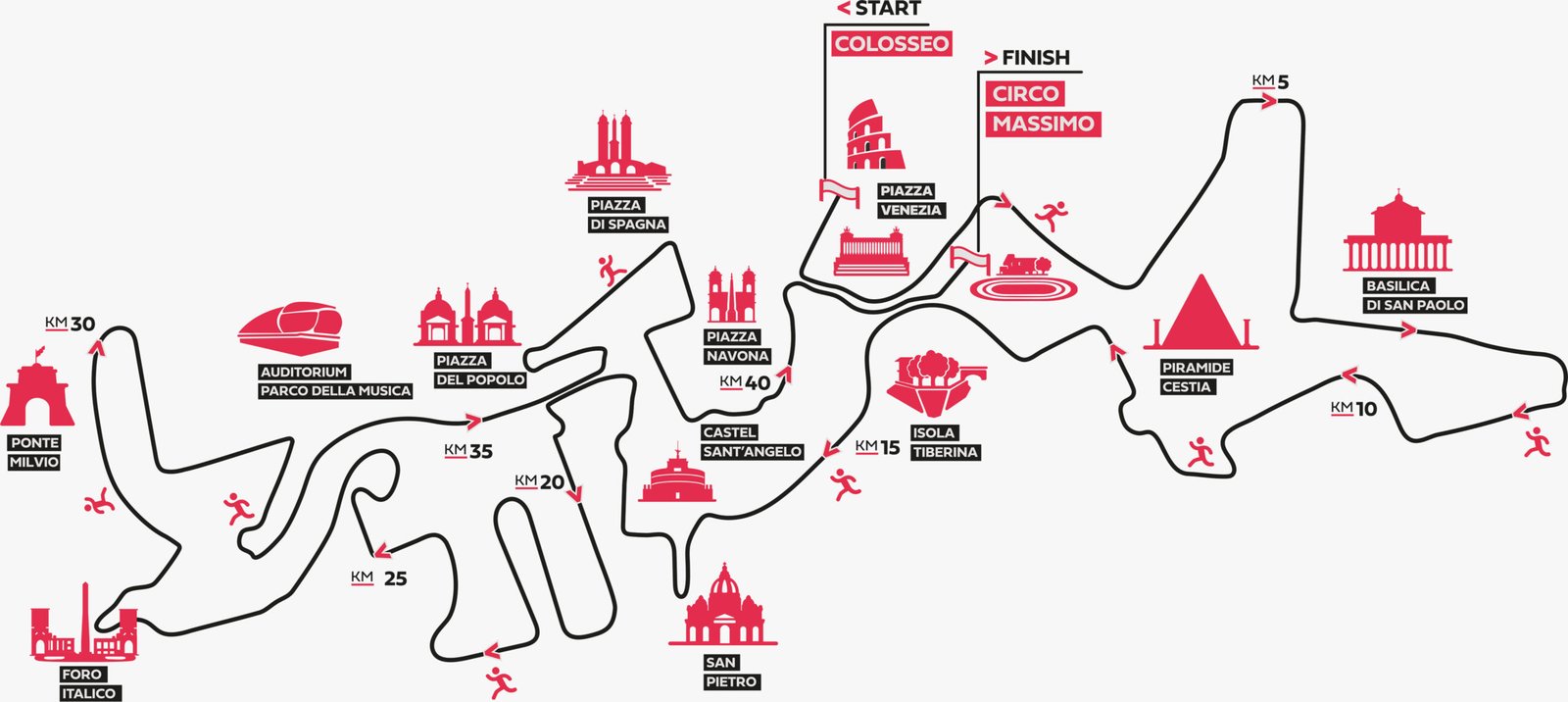
The Rome Marathon 2027 course starts from the Imperial Forums, goes down to San Paolo, comes back up the Tiber to St. Peter's, Foro Italico and Ponte Milvio, returns through Flaminio and closes by crossing the historic center to Circus Maximus.
The first kilometers: Piazza Venezia, Palatine, Circus Maximus
From the start, the runners head toward Piazza Venezia and the white mass of the Vittoriano, then turn left toward Via del Teatro di Marcello and the Mouth of Truth. The official site underlines the gaze that "rests on the Palatine and on Circus Maximus" already in the first part. In 2026 the list of streets involved, published by Roma Capitale, indicated after Piazza della Bocca della Verità the Lungotevere Aventino, Via Marmorata and Piazzale Ostiense.
Heading south: Pyramid of Cestius and San Paolo
The southern stretch leads to the Pyramid of Cestius and then along the Ostiense axis toward the Basilica of San Paolo fuori le Mura, which the official site names among the monuments of the course. In 2026 the race also touched Viale Marco Polo, Via Colombo, the Circonvallazione Ostiense, Ponte Spizzichino, Ponte dell'Industria and a loop in the Marconi and Portuense area before returning toward Testaccio from Ponte Testaccio. It is the least monumental and most working-class part of the route, the one in which you see the Rome of the gasometers and the former general markets.
The Lungotevere, Tiber Island and St. Peter's
Going up the Tiber you pass in front of Tiber Island, then along the Lungotevere dei Cenci, dei Vallati, dei Tebaldi and dei Fiorentini up to Ponte Vittorio Emanuele II. From there the race takes Via della Conciliazione and arrives under the colonnade of St. Peter's Square, perhaps the most photographed moment of the whole race. In 2026 the route left from Borgo and Via di Porta Castello toward Prati: Via Crescenzio, Piazza Cavour, Ponte Cavour, Lungotevere in Augusta, Ponte Regina Margherita, Via Cola di Rienzo.
The north: Prati, Mazzini, Foro Italico, Ponte Milvio
The second part of the first half of the race crosses the orderly neighborhoods of the late 1800s and early 1900s: Viale Giulio Cesare, Viale delle Milizie, Piazzale degli Eroi, the Circonvallazione Trionfale, Piazzale Clodio, Viale Mazzini, Piazza del Fante. Then the Lungotevere Oberdan and della Vittoria lead toward Foro Italico and the Farnesina. The official site names the passage over Ponte Milvio, on the Tiber north of Flaminio.
Flaminio and the Olympic Village
After the Tiber you enter the Flaminio quadrant: in 2026 the runners passed along Via Venezuela, Via India, Viale XVII Olimpiade and Viale Tiziano, brushing past Auditorium Parco della Musica, expressly cited by the race website. It is an area built for the 1960 Olympics, and running a marathon inside it has its historical sense: the Olympic marathon of that year is the most famous episode in the history of road running in Rome.
Back to the center: Ara Pacis, Piazza del Popolo, Piazza di Spagna
Along the Lungotevere Flaminio and then along the Lungotevere delle Navi and da Brescia you head back toward the center, pass the Passeggiata di Ripetta and Piazza Augusto Imperatore with the Ara Pacis, take Via del Corso up to Piazza del Popolo, and go back down Via del Babuino to Piazza di Spagna. In 2026 from there the race went down Via Due Macelli and Via del Tritone, came back onto Via del Corso and turned toward Piazza Borghese and Via Zanardelli.
The last kilometers: Navona, Corso Vittorio, Mouth of Truth
The finale crosses Piazza Navona along Corso Rinascimento, then Corso Vittorio Emanuele II, Largo Argentina, Piazza del Gesù, Via del Plebiscito and Piazza Venezia again. The last meters run along Via del Teatro di Marcello, Via Petroselli, Piazza della Mouth of Truth and Via della Greca, to the finish line in Circus Maximus. The official FAQ speak of about six kilometers of cobblestones in total: much of it is concentrated precisely in the last third, when the legs are already heavy.
What changes in 2027
The course description on the official 2027 site keeps the same sequence of monuments as 2026. The precise list of streets is published by Roma Capitale and by the mobility agency a few days before the race, together with the transport plan. The FAQ warn that the route may undergo small changes. The streets cited above, street by street, are the official ones from 2026.
A curiosity about Rome Marathon 2027, Run Rome The Marathon, Sunday, March 14
The Rome Marathon 2027 medal reproduces the helmet of Roman centurions: the announcement came on September 26, 2026, almost six months before the race.
The medals of the big marathons have become a collector's item in recent years, and Rome has chosen to play the card of ancient history to the fullest. For 2027 Corriere dello Sport, co-organizer, presented a medal in the shape of a centurion's helmet, the officer who commanded a century in the legions. The same communication insists on the gladiatorial register: the official hashtag of the race is #RunLikeAGladiator, the mascot sold in the shop is called Vittoria, and the site describes the finish with the national anthem and legionaries lined up next to the finishers.
You can smile at this rhetoric, and it is right to do so with measure. But there is a fact that makes it less gratuitous than it seems: the finish really is inside Circus Maximus, that is, in the building constructed for chariot races. Arriving there on foot after 42 kilometers means crossing the finish line in the same valley floor where for centuries people ran to win in front of the crowd. The comparison with gladiators is wrong historically, because gladiators fought in the Colosseum and did not run. The one with the charioteers of the Circus would have been more precise.
Another curiosity concerns the color of Rome in the community of marathoners. On the men's side the course record dropped to 2h06'24" with the Kenyan Asbel Rutto in 2024, and in 2026 the same Rutto won again in 2h06'32". On the women's side, according to the race's roll of honor, the Kenyan Pascaline Kibiwot set the new race record in 2026 in 2h22'44", a few seconds under the 2h22'52" of the Ethiopian Megertu Alemu from 2019. For a course with six kilometers of cobblestones these are times of full respect: Rome is not Berlin, and anyone who comes here for a personal best has to know it.
Registration and fees for the Rome Marathon 2027
Registration for the Rome Marathon 2027 costs €129 from September 16, 2026 until closing, according to the official regulations, subject to availability and plus the cost of the online service.
The price tiers
The regulations in English published in September 2026 list four tiers: €99 from opening to May 31, 2026, €109 from June 1 to July 31, €119 from August 1 to September 15, €129 until registration closes. The cost of the online registration service is not included and does not depend on the organization. The date of payment is what counts and the fee is non-refundable. The organization reserves the right to close registration early when the maximum number is reached: in that case it opens a waiting list, and the regulations warn that the list may have different prices. On the site, next to the registration button, the link to the waiting list already appears.
What the fee includes
The fee includes bib, civil liability insurance, technical and medical assistance, race pack with sponsors' products, official technical shirt, aid stations and sponge stations, official program, chip timing, finisher medal, bag drop and transport to the finish for those who withdraw. The marathon page on the official site summarizes the kit in three items: technical shirt, 2027 medal and the marathoner's backpack with sponsors' products.
Who can take part
Athletes aged 20 and over can run, that is, those born in 2007 or earlier. There are six ways in: FIDAL members, members of foreign federations affiliated with World Athletics, members of sports promotion bodies with RUNCARD-EPS, RUNCARD holders resident in Italy, RUNCARD holders not resident, and foreigners resident abroad who choose non-competitive participation by accepting a specific disclaimer. For the RUNCARD categories the medical certificate of competitive fitness specific to track and field is required, to be uploaded online by the 10th day before the race. The regulations are firm: certificates with the wording "running", "footracing" or "marathon" are not valid.
Transfer and deferral
Anyone who cannot take part can transfer the bib to another person or move the registration to the 2028 edition, in both cases by January 14, 2027, paying a €30 administrative fee plus commissions. Those registered by February 17, 2027 receive the bib personalized with their name. By the same deadline you declare your personal best of the last four years, which determines the starting corral.
Fitwalking and pacers
The marathon can also be done walking. The official site provides pacers dedicated to fitwalking, with paces that bring you to the finish between 5 hours 45 minutes and 6 hours 30 minutes. The running pacers, free and recognizable, accompany the groups at a steady pace to the finish.
A thing nobody tells you about Rome Marathon 2027, Run Rome The Marathon, Sunday, March 14
The Rome Marathon 2027 falls on March 14, a week earlier than usual: the latest editions had been run between March 16 and 22, and this changes the preparation.
Anyone preparing a marathon works on a block of 16 or 18 weeks, and moving the race up by seven days means starting to load the kilometers in the middle of the Christmas period. The organization's group training runs, the Get Ready, are scheduled accordingly: the long run of 25 kilometers on January 23, 2027, the one of 35 on February 20, the last of 15 on March 6, eight days before the start. Anyone running in Rome for the first time would do well to use them as a reference.
The second thing nobody says concerns the cobblestones. The official FAQ speak of about six kilometers on Roman paving, and a good part is in the historic center, crossed in the last 10 kilometers: Piazza del Popolo, Via del Babuino, Piazza di Spagna, Via del Tritone, Piazza Navona, Corso Vittorio. With rain, which in March in Rome is not rare, the cobblestone becomes slippery and the run turns into an exercise in balance. Shoes with a sole that grips well on wet ground are worth more than a few grams saved.
The third concerns the watch. The FAQ warn that the official distance is measured on the shortest possible trajectory and that almost no runner actually follows it: it is normal for the GPS to record a few hundred more meters. In a city full of tight curves, arches, tunnels and tall buildings, the difference is felt. Anyone running at a fixed pace while looking at the wrist risks being off by a good minute in the finish-time prediction. Better to rely on the kilometer signs or follow a pacer.
The last concerns withdrawals. In 2026 the shuttles for those who stopped left from collection points around kilometers 20.6, 28.3 and 32.8. Anyone who decides to stop between one point and the next must walk to the next one: in that area of Rome, with the streets closed and the metro far away, there is no quick alternative.
Expo Village and bib pickup for the Rome Marathon 2027
The Rome Marathon 2027 bib is picked up only in person at the Expo Village: the 2027 venue and hours will be announced by the organization, and in no case is the bib mailed.
Where it was in 2026
In March 2026 the Expo Village was set up for the first time at Circus Maximus, 50 meters from the Circo Massimo stop of metro B, with free admission for everyone. The hours were: Thursday from 9:00 to 20:00, Friday from 9:00 to 20:00, Saturday from 9:00 to 18:00. On race Sunday the Expo stayed open to visitors from 9:00 to 18:00, with no bib distribution. The organizers called that choice a return to the origins, and Corriere dello Sport spoke of it as a great success. For 2027 the venue has not yet been made official: the Expo page still shows the 2026 dates.
What you need to pick it up
You need the confirmation letter, which arrives by email a few days before the race and can be shown from the phone, and an ID document. You can delegate another person by giving them a copy of your own document, the confirmation letter and a signed proxy. If the registration is not yet confirmed because of a missing document, at the Expo there is a dedicated desk where you hand in what is missing. The fee, however, must already have been paid.
Why it's worth going early
With 36,000 marathoners, 20,000 Fun Run participants and 6,000 in the relay, the 2026 weekend saw over 60,000 bibs. Saturday afternoon is the worst time to show up at the Expo. Anyone who arrives in Rome on Thursday or Friday has a shorter line and the time to walk among the stands without hurry.
Race day: corrals, bag drop, aid stations, times
On the Sunday of the Rome Marathon 2027 you enter the corrals according to your declared personal best, leave your bag in the official backpack and start in waves a few minutes apart.
Corrals and waves
Each athlete receives a starting area printed on the bib, calculated on the best marathon time of the last four years or, failing that, on the half-marathon one. The entrances are staffed by volunteers who check the bib. Anyone arriving late starts at the back of the group. Meeting times and times for access to the corrals are published in the race information released in the days before.
Bag drop
The bag drop accepts only the backpack given with the race pack, with the bib number label on the transparent window. Inside go only clothes to change into, no valuables. After the finish the backpack is picked up by showing the bib.
Aid stations, sponge stations, entertainment
Aid stations and sponge stations follow the rules of World Athletics and FIDAL and are described in the race day information. Along the course there are many music entertainment points.
Timing
The time is taken with a chip attached to the bib, personal and non-transferable. The official time, from the gun of the wave, and the net time, from crossing the start line, are recorded, with split times at kilometer 10, at halfway (21.097) and at kilometer 30. Rankings and split times can be viewed in real time on the official site, and after the race the certificate of participation can also be downloaded.
After the finish line
Past the finish line you receive the medal, the final refreshment and access to services: bag drop, restrooms, medical assistance. In Circus Maximus there is no lack of space, and it is one of the advantages of the new finish compared to the Imperial Forums.
The advice I give you for visiting Rome Marathon 2027, Run Rome The Marathon, Sunday, March 14
To experience the Rome Marathon 2027 as a spectator the advice is only one: choose two points on the course connected on foot, one in the first half and one in the last 10 kilometers, and give up chasing the race with transport.
With the streets closed from 7:00 and dozens of bus lines suspended or diverted, moving on the surface during the marathon is a waste of time. The geography of the course, however, helps those who walk. The Lungotevere between Tiber Island and Ponte Vittorio Emanuele II is run only once, on the way out toward St. Peter's. The historic center between Piazza del Popolo, Piazza di Spagna and Piazza Navona is crossed in the last 10 kilometers. Anyone standing at Via della Conciliazione sees the pack pass in the first half, then in half an hour's walk through Ponte Sant'Angelo and Via dei Coronari reaches Piazza Navona in time to see the same runner again around kilometer 38.
The second piece of advice concerns Circus Maximus. The finish is the most exciting place and also the most crowded: relatives, friends, photographers, refreshments, bag drop. To find someone after the finish line it's best to set a precise point beforehand, far from the flow of finishers, for example high up on the side of Roseto or toward Viale Aventino. The phone, with tens of thousands of people in the same valley, often doesn't get a good signal.
The third concerns the schedule. The lead pack covers 42 kilometers in a little over two hours, amateur runners in four or five hours, walkers up to seven. Anyone who wants to see the Kenyans and Ethiopians in front of the Mouth of Truth has to be there shortly after 10:00. Anyone waiting for a friend aiming for four and a half hours can take it more calmly and have breakfast in Prati.
Finally: if you accompany a foreign marathoner, and 75 percent of the registered are foreign, explain the difference between the Colosseo stop, which stayed closed in 2026, and the Circo Massimo one, which instead serves the finish.
Fun Run Saturday 5K and Run4Rome relay of the Rome Marathon 2027
The Fun Run Saturday 5K of the Rome Marathon 2027 is run on Saturday, March 13, 2027 at 9:00, about five kilometers between the Imperial Forums and Circus Maximus, open to all ages and without a competitive medical certificate.
The Saturday city run
The official page of the Acea Water Fun Run indicates the start at 9:00 from the Imperial Forums and the finish inside Circus Maximus. The homepage presentation instead speaks of start and finish both at Circus Maximus, and the organization will specify the route in the race information. You can run or walk, with family, children or the dog. Registrants receive a technical T-shirt, the medal and a bag with sponsors' products. In 2026 the participants were about 20,000.
The Stracanina
Associated with the Fun Run is the Stracanina, the run on six legs: in 2026 registration for the dog cost €4.99 and included a bib and a surprise at the finish. At the finish the instructors of the group Un Lavoro da Cani offered free advice on dog training and obedience demonstrations.
The charitable side
The Fun Run is co-organized with CSV Lazio, the volunteer service center. Through the Charity Program associations collect registrations and keep part of the fees. At Circus Maximus, on the day of the city run, volunteers run workshops, free prevention checks and entertainment for adults and children. The nonprofit organizations taking part in the whole event, according to Corriere dello Sport, number over 40.
The Run4Rome relay
On Sunday, together with the marathon, the charity relay Acea Run4Rome Relay is run: teams of four people who together cover the 42.195 kilometers in four legs of different length, 11, 12.5, 8 and 10.695 kilometers. One of the legs is also open to 16-year-olds. In 2026 the relay started at 9:15 from the Imperial Forums and had about 6,000 participants. Here too teams of walkers only or mixed teams are allowed.
Road closures and diverted buses for the Rome Marathon 2027
The closure plan for the Rome Marathon 2027 will be published by Roma Capitale in the days before the race. In 2026 the streets closed progressively from 7:00 and reopened completely around 15:00.
The three phases of 2026
In the plan of March 18, 2026, Roma Capitale divided the day into three phases. In the first, from dawn, the streets occupied by the organization's vehicles were closed: Via di San Gregorio, Via Celio Vibenna, Via dei Fori Imperiali, Via dei Cerchi and Viale delle Terme di Caracalla. From 7:00 the progressive closures of all the streets of the course kicked in. From 8:00 the race began and the streets were reopened gradually, after the AMA cleaning crews passed. The reopenings were completed around 15:00.
Colosseo metro closed
At the request of the Questura, in 2026 Colosseo station stayed closed from the start of service until the end of the event, on both line B and B1 and line C. The other metro B stations near the course, such as Cavour and Circo Massimo, stayed open.
Buses and trams
In 2026 10 lines were suspended: tram 2 and buses 19Nav, 30, 40, 51, 64, 70, 77, 280 and 628. Eight were diverted: 23, 31, 85, 160, 671, 714, C2 and C3. Another 50 had a limited route, among them lines 3 and 8, and buses 44, 46, 62, 63, 75, 80, 81, 83, 87, 118, 170, 492, 590, 715, 716, 781, 870, 990 and bus H. The 64, which connects Termini to St. Peter's, was suspended from 6:27 to 15:27, the 40 from 7:06 to 15:14. For 2027 the exact numbers will come out with the new plan, but the affected lines will in all likelihood be the same, because the course does not change in substance.
The Fun Run Saturday
On Saturday too there are restrictions in the Forums and Circus Maximus area for the city run and for the setups. Anyone who has to cross the center by car on Saturday morning or on Sunday until early afternoon is better off giving up.
Where to watch the Rome Marathon 2027 as a spectator
The best spots to watch the Rome Marathon 2027 are Via dei Fori Imperiali at the start, Via della Conciliazione, the Lungotevere, Piazza del Popolo, Piazza Navona and Circus Maximus at the finish.
The start at the Imperial Forums
Watching the start means arriving before 8:00 and resigning yourself to a considerable crush on the sidewalks. The sight is worth the alarm clock: tens of thousands of people between the Colosseum and the Vittoriano, the waves following one another for almost an hour. Anyone who comes for a specific runner will hardly spot them in the mass.
Via della Conciliazione and St. Peter's
It is the most photogenic stretch and one of the widest, so also one of the most comfortable for cheering. The pack arrives from the Lungotevere over Ponte Vittorio Emanuele II, turns into the street, passes under the colonnade and comes out again from Borgo.
Piazza del Popolo and Piazza di Spagna
Here the pack passes in the last part of the race, when the runners need encouragement. Piazza del Popolo is wide and lets you see the runners arriving from far away. Via del Babuino is narrow and loud, with the crowd a meter from the athletes.
Piazza Navona and Corso Vittorio
In the last kilometers the course crosses Piazza Navona along Corso Rinascimento and then Corso Vittorio Emanuele II. It is one of the stretches where the Roman crowd gathers most willingly, with the bars open a few steps away.
Mouth of Truth and Circus Maximus
The finish is the choice for those waiting for someone at the arrival. Circus Maximus is reached by metro B getting off at the stop of the same name. The flow of people is continuous and you have to allow for a bit of patience. The stretch from Piazza della Bocca della Verità to Via della Greca, the very last meters, is the most exciting to experience from the roadside.
Another well-known fact, yet rarely mentioned
The Rome Marathon is by number of registered the largest race ever in Italy, and with 36,000 participants in 2026 it rose to 10th place in the world. Everyone remembers it, but few cite the jump in scale behind it.
In September 2021, at the first edition of the new management, the registered were 8,000, mostly Italians: a special edition, moved from spring to September and started at dawn. Five years later, on March 22, 2026, the bibs were 36,000, sold out four months ahead, and three registrants out of four came from abroad, from 166 countries. The Roman councilor for major events Alessandro Onorato recalled that in 2021 foreigners were 20 percent, and that the latest edition closed with 60,000 registrations across all the races of the weekend.
This jump has precise economic consequences. According to studies conducted with Sapienza University and cited by the organizers, the marathon generates every year over 120 million euros of induced activity in the area. And the city has noticed: the new concession for the period 2027-2031 is worth €1.25 million a year, more than triple the €333,000 paid for the two previous editions, for a total of €6.2 million in the public coffers over five years.
There is also another fact that is known and little told: in 2022 the Rome marathon obtained ISO 20121 certification, the international standard for sustainable event management, issued by the body RINA. For an event that closes half the city and moves tens of thousands of travelers it is not a detail. And among the sustainability partners of the race are Plastic Free, Ecopneus, Circularity and LifeGate.
How to get to the start and finish of the Rome Marathon 2027
For the start of the Rome Marathon 2027 on Via dei Fori Imperiali the most convenient metro, with Colosseo closed, is Cavour on line B. For the finish at Circus Maximus there is the Circo Massimo stop, again on line B.
By metro
Metro line B serves the whole area: Cavour, about 10 minutes' walk from the Colosseum and the Forums going down Via Cavour, Colosseo, closed on race day in 2026, Circo Massimo, across from the finish and the Expo, and Piramide, on the course in the southern stretch. Line C has a stop at the Colosseum, also closed in 2026 during the marathon. Line A takes you to Flaminio, near Piazza del Popolo, and to Spagna, for those who want to cheer in the historic center.
By train
From Termini you take metro B in the direction of Laurentina and get off at Cavour or Circo Massimo. From Ostiense station the same metro B, Piramide stop, is a few steps away, and from there the race course passes in front of the Pyramid of Cestius.
By bus and by car
On race day the buses in the center are largely suspended, diverted or limited: better not to count on them. Going by car is discouraged: the streets close from dawn, the parking lots in the Forums and Circus Maximus area are inaccessible and the ZTL of the center remains a constraint even in the days before. Anyone arriving from outside Rome leaves the car at the park-and-ride lots of the peripheral metro stations, such as those on line B toward Laurentina or Rebibbia, and continues by metro.
From the airport
Aeroporti di Roma is among the sponsors of the race. From Fiumicino the train connects the airport to Termini and to Ostiense, and from there you continue by metro B. Many foreign runners arrive on Thursday or Friday precisely to have time to pick up the bib and rest.
The right photo to take at Rome Marathon 2027, Run Rome The Marathon, Sunday, March 14
The right photo at the Rome Marathon 2027 is the one of the start seen from above on the Imperial Forums with the Colosseum in the background, or the pack flooding Via della Conciliazione with the dome of St. Peter's at the end.
For the start, the best spot is high up, toward Piazza Venezia, where the barriers allow it, from which you see the long line of corrals stretching to the Colosseum. At a March dawn the light comes from the east, that is, right from the Colosseum, and backlights the crowd: it is a dramatic image, less suited to recognizing someone, perfect for conveying the mass.
Via della Conciliazione is the classic postcard. The stretch toward the basilica is photographed well from the Castel Sant'Angelo side, with the telephoto lens compressing the perspective and bringing the dome closer to the runners. In 2026 the pack arrived there in the first half of the race, in mid-morning light.
For those photographing a friend, the right place is a narrow, straight stretch in which the runners arrive one at a time: Via del Babuino between Piazza del Popolo and Piazza di Spagna, or Corso Vittorio Emanuele II. It's worth knowing in advance the color of their shirt and their pace per kilometer, to calculate the passing time with a few minutes' margin.
The last photo is the one of the finish line, with the Palatine behind Circus Maximus. Here those who ran pose with the medal, which in 2027 will be the centurion's helmet, and the ruins of the imperial palaces in the background. It is the photo that foreign marathoners all post, and rightly so: few marathons in the world can offer a backdrop like this.
The history of the Rome Marathon, from Dorando Pietri to the Run Rome The Marathon
The history of the Rome Marathon spans more than a century: a race won by Dorando Pietri in 1906, the 1960 Olympic marathon, the first modern city edition in 1982, the refounding of 1995 and the new management since 2021.
The origins
A marathon was already run in the city on April 2, 1906, won by Dorando Pietri of Emilia, with the finish at Piazza di Siena, in Villa Borghese.
The city marathon since 1982
The international roll of honor of the Rome marathon starts from 1982, with the victory of the Belgian Emiel Puttemans and the Italian Laura Fogli. In the 1980s the race twice served as the Italian championship, in 1983 and 1986, and in 1987, according to the roll of honor in English, Gelindo Bordin won. After 1991 the race stopped for three years, from 1992 to 1994.
The refounding of 1995
In 1995 the marathon was deeply reorganized under the name Roma City Marathon, run by the Italia Marathon Club. In the following years it formed a twinning with the New York marathon, came close to 15,000 finishers and in 2011 obtained the Gold Label of the international federation. The side city run became the most-attended non-competitive run in Italy. It is from that refounding that the modern numbering comes: 2027 is the 32nd edition.
From 2019 to today
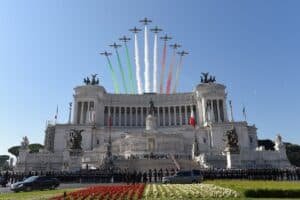
In 2019 the organization passed to FIDAL. The edition of March 29, 2020 was canceled for the pandemic, and the 2021 one slipped to Sunday, September 19 and started at dawn. Since 2022 the race has returned to spring. In 2023, on race day, the Frecce Tricolori flew over the course for the 100 years of the Italian Air Force. In 2024 came the men's record by Asbel Rutto. In 2026 the first sold-out, four months ahead, with 36,000 registered, and the move of the Expo and of the finish to Circus Maximus.
Some important events that happened here in history
The most important event in the history of the marathon in Rome is Abebe Bikila's victory at the Olympics of September 10, 1960: the Ethiopian soldier ran barefoot and arrived at the Arch of Constantine with the world record.
The World Athletics reconstruction tells the details. Bikila, enlisted in the Ethiopian imperial guard, had started running at 19 and had made his marathon debut only in 1959. In Rome his shoes broke in the last days of preparation. The new ones gave him blisters and he decided to run barefoot. The race started at 17:30 from Piazza del Campidoglio, to avoid the heat, with 69 athletes from 35 countries and a temperature of 23 degrees Celsius. Since the finish was expected after sunset, hundreds of Italian soldiers lit the course with torches.
The course followed the Appian Way. Up to kilometer 35 Bikila and the Moroccan Rhadi Ben Abdesselam ran side by side. Then, about 500 meters from the finish, at the level of Piazza di Porta Capena, the Ethiopian attacked. In that square stood the Obelisk of Axum, brought to Rome from Ethiopia after the Italian invasion of 1936. Bikila crossed the finish line under the Arch of Constantine in 2h15'16"2, a new world record, 25 seconds ahead of Abdesselam, with the bronze going to the New Zealander Barry Magee. He was the first Black African to win an Olympic marathon gold.
In 2010, 50 years later, the Rome marathon celebrated the anniversary: the Ethiopian Siraj Gena won and received a prize of €5,000 for crossing the finish line barefoot, in homage to Bikila. On January 1, 2000, 10 years earlier, the city had hosted a special marathon for the new millennium: start from St. Peter's Square, the blessing of Pope John Paul II and the bells of the basilica in place of the starter's gun.
Who has passed through Rome Marathon 2027, Run Rome The Marathon, Sunday, March 14
Olympic champions and record holders have run the streets of the Rome Marathon: Abebe Bikila in 1960, Gelindo Bordin in 1987, Stefano Baldini in 1998, Tegla Loroupe in 2000.
The rolls of honor tell a gallery of important names. The Belgian Emiel Puttemans, world record holder on the track, won the first city edition of 1982. Gelindo Bordin appears as the winner of 1987. On September 6 of the same year, in Rome the Kenyan naturalized Japanese Douglas Wakiihuri won. Stefano Baldini won Rome in 1998 in 2h09'33".
Among the women, the Kenyan Tegla Loroupe won the 2000 edition. Italy has had six winners: Franca Fiacconi in 1998, Maura Viceconte in 1999, Maria Guida in 2001, Maria Cocchetti in 2002, Gloria Marconi in 2003 and Ornella Ferrara in 2004. Three Italians have won the men's race since the refounding: Baldini, Ruggero Pertile in 2004 and Alberico Di Cecco in 2005, when he set the race record in 2h08'02".
The Ethiopian Firehiwot Dado won three consecutive editions, from 2009 to 2011. Her compatriot Rahma Tusa won three in a row from 2016 to 2018. In the last decade Kenya and Ethiopia dominate, with the Moroccan Taoufik Allam the only intruder in 2023. The Kenyan Asbel Rutto won in 2024 with the course record and repeated in 2026.
Then there are the tens of thousands of amateurs. In 2006 the last to finish was the Canadian John Guthrie, in 7h25'16", within a time limit that at the time was eight hours. In the same edition a group of 10 autistic kids ran the marathon as a relay with the Progetto Filippide. This too is the Rome marathon.
Training for the Rome Marathon 2027: the Get Ready
The Get Ready of the Rome Marathon 2027 are six free group training runs, from October 10, 2026 to March 6, 2027, with increasing distances from 10 to 35 kilometers.
The calendar
The official site lists these dates: October 10, 2026 with 10 kilometers, November 21 with 12, December 19 with 15, January 23, 2027 with 25, February 20 with 35, March 6 with 15. They are free-participation workouts, designed to arrive prepared and to meet other runners. Places and meeting times of each appointment are published from time to time by the organization. In past years the meeting point was often Foro Italico.
The training plans
With the advice of coach Marco Caponeri, the site makes available free generic training plans and paid personalized plans.
The editors' opinion
The 35-kilometer Get Ready of February 20, three and a half weeks before the race, is the decisive long run. Anyone preparing their first marathon should organize the calendar so as not to miss it.
Accessibility and kids at the Rome Marathon 2027
The Rome Marathon 2027 includes a wheelchair and handbike race, with an early start, while for kids there is the Saturday Fun Run, open to all ages.
The Paralympic race
In 2026 the wheelchair race started at 8:00 from the Imperial Forums, before the main waves. The site publishes dedicated regulations for the Paralympic competition. The race for people with disabilities on the full course has existed for many years, with the support of the Italian Paralympic Committee. The cobblestones of the center remain a serious problem for wheelchairs, and the organization takes it into account in the schedules.
For those watching
Circus Maximus is a large, gently sloping lawn, reachable by metro B. The finish area, however, is very crowded. For a spectator in a wheelchair the most comfortable stretch is Via della Conciliazione, flat, wide and paved.
With kids
The real marathon is reserved for those who are at least 20. The Fun Run on Saturday, March 13, instead, is open to all ages and does not require a competitive medical certificate: with kids you walk or run about five kilometers and arrive at Circus Maximus, where in 2026 there were workshops and entertainment. It is the best way to involve the family in the marathon weekend.
Where to eat before and after the Rome Marathon 2027
Around the finish of the Rome Marathon 2027, at Circus Maximus, the best areas to eat are Testaccio, to the south, and the Ghetto, to the north beyond the Theater of Marcellus.
Saturday dinner
The night before the marathon you eat pasta, everyone knows that. In Rome the temptation is carbonara or amatriciana, good but heavy dishes. Better a tomato pasta, a measured cacio e pepe or a soup, in a neighborhood trattoria near the hotel, without crossing the city. For Saturday lunch Prati and Borgo, near St. Peter's, have many trattorias and bakeries.
After the race
Testaccio, a 10-minute walk from Circus Maximus along Via Marmorata, is the neighborhood of traditional Roman cooking, with its covered market and the trattorias that cook offal, the quinto quarto. The Jewish Ghetto, on the other side, offers carciofi alla giudia, which in mid-March are in full season. Anyone who prefers to stay quieter finds bars and pizza-by-the-slice places on the Aventine and in San Saba.
A practical tip
On marathon Sunday the places in the area fill up with runners and companions from 12:00 on. Anyone who wants to sit down for lunch should book. Anyone who finishes early can also stop at the final refreshment and postpone the meal to the afternoon, when the crowd has thinned.
March in Rome: the time of the Rome Marathon 2027
In mid-March, when the Rome Marathon 2027 is run, the city has cool mornings and mild days: the official FAQ give for late March an average of about 13 degrees Celsius, with about 9 at the start.
The weather
March 14 falls a week before the latest editions, so the morning temperatures can be a degree or two lower. For running these are excellent conditions, for waiting in the corral at dawn they are not. An old sweater to discard before the gun, or a cut plastic bag, is a useful habit. March in Rome can also be rainy and windy, and the regulations are clear: the race is run in any weather.
The city in March
March is a good month for visiting Rome: museums are less crowded than in full spring, the days get longer, the terraces start reopening. Anyone who comes to run can devote the following Monday to a visit to the Colosseum and the Forums, or to the Imperial Forums Museum in Trajan's Markets, a stone's throw from the start line: walking after a marathon is good for the legs.
The other Roman race
The marathon is not the only big road race in Rome. In the fall the city hosts the Rome Half Marathon, on Sunday, October 18, 2026, finishing at the Colosseum: for many runners it is the trial half marathon ahead of the March marathon.
Frequently asked questions about Rome Marathon 2027
When is the Rome Marathon 2027 run?
The Rome Marathon 2027, Acea Run Rome The Marathon, is run on Sunday, March 14, 2027 with the start around 8:30 from Via dei Fori Imperiali. It is the 32nd edition. The day before, Saturday, March 13 at 9:00, is the Fun Run Saturday 5K. The start is in waves a few minutes apart, according to the corrals that the organization will publish before the race.
How much does it cost to register for the Rome Marathon 2027?
Registration for the Rome Marathon 2027 costs €129 from September 16, 2026 until closing, according to the official regulations. The previous tiers were €99, €109 and €119. The cost of the online service is separate, the fee is non-refundable and prices apply subject to availability. If registration sells out, a waiting list opens.
Where does the Rome Marathon 2027 start and finish?
The Rome Marathon 2027 starts from Via dei Fori Imperiali, with the Colosseum behind the runners, and finishes inside Circus Maximus. The course touches Piazza Venezia, the Pyramid, San Paolo, the Lungotevere, St. Peter's, Foro Italico, Ponte Milvio, Flaminio, Piazza del Popolo, Piazza di Spagna and Piazza Navona.
Where do you pick up the Rome marathon bib?
The Rome Marathon 2027 bib is picked up in person at the Expo Village, with the confirmation letter and ID. The 2027 venue and hours will be announced by the organization. In 2026 the Expo was at Circus Maximus, from Thursday to Saturday. The bib cannot be picked up on race Sunday, nor mailed.
Which streets are closed for the Rome marathon?
For the Rome Marathon the streets of the course close progressively from 7:00 on Sunday and reopen gradually until about 15:00, as in the 2026 plan. The Colosseo metro stop, lines B and C, stayed closed in 2026. The 2027 plan will be published by Roma Capitale in the days before.
What is the time limit of the Rome Marathon 2027?
The time limit of the Rome Marathon 2027 is seven hours, according to the official regulations. Along the course there are intermediate time gates: anyone who doesn't meet them boards the shuttles for those who withdraw or continues on the sidewalk. Walkers have dedicated pacers with finish times between 5 hours 45 minutes and 6 hours 30 minutes.
Who can run the Rome Marathon?
The Rome Marathon 2027 is open to athletes aged 20 and over, born in 2007 or earlier: FIDAL members or members of foreign federations, RUNCARD holders with a competitive certificate for track and field, foreigners resident abroad who choose non-competitive participation. Minors can take part in the Saturday Fun Run.
Where to watch the Rome marathon without running?
To watch the Rome Marathon as a spectator the best spots are Via della Conciliazione, Piazza del Popolo, Via del Babuino, Piazza Navona and Circus Maximus at the finish. No ticket is needed. It's best to choose two points reachable on foot, one in the first half and one in the last kilometers, and use metro B.
Final advice on the Rome Marathon 2027
The marathon has changed its skin: from a mostly Italian race to an international event with three registrants out of four arriving from abroad. I find it improved, especially since the finish moved to Circus Maximus: crossing the finish line in that valley, under the Palatine, has a meaning that no other city can offer. My advice to those who run is to arrive in Rome on Thursday, pick up the bib without hurry, spend Friday walking little and Saturday resting, leaving museums and walks for Monday. To those who accompany I advise choosing two points on the course and reaching them on foot. Rome, on marathon Sunday, is a city without cars: it is rare, and deserves to be experienced like that.
Article written by the editorial team of Tour Leader Pro, contact them for Private/Corporate/V.I.P. Tours and Experiences.
Planning a trip to Rome? The English guides to visiting the city are on ItalyPlanner.com.
Contact Information
Nearby
 Altar of the Fatherland (Vittoriano)100 m
- Central Museum of the Risorgimento100 m
- Trajan’s Column100 m
- Trajan’s Forum100 m
- The Two Churches of Trajan’s Forum100 m
- Domus Romane di Palazzo Valentini100 m



Upcoming events nearby
- Roma in moneta at the Vittoriano, through November 8, 2026100 m
- Kandinsky, the Revolution of Abstraction at Palazzo Bonaparte200 m
- Manifesto 2026, day 2: Blak Saagan and Laura Agnusdei at Chiesa Valdese, November 27, 2026200 m
- Diego Rivera at the Capitoline Museums: the Big Exhibition on 20th-Century Mexican Art200 m


You might also like
- Le dieu du carnage with Antonio Zavatteri at Teatro Quirino, March 30 to April 4, 2027
- L’uomo, la bestia e la virtù with Vanessa Gravina at Teatro Quirino, March 16 to 21, 2027
- Ispettore in casa Birling with Ettore Bassi and Galatea Ranzi at Teatro Quirino, March 2 to 7, 2027
- Belle Ripiene at Teatro Sistina in Rome, from April 8, 2027
- Nello Daniele in Daniele racconta Daniele at Teatro Quirino, April 9, 2027
- Sfidati di me, Paolo Kessisoglu at Teatro Sala Umberto, April 1 to 4, 2027