Raffaella il Musical at Teatro Brancaccio, February 10 to March 6, 2027
In short. Raffaella il Musical, the biographical musical dedicated to the life and career of Raffaella Carrà, written and directed by Luciano Cannito, debuts at Teatro Brancaccio, at Via Merulana 244 (00185 Rome), on Wednesday, February 10, 2027…

Raffaella il Musical, the biographical musical dedicated to the life and career of Raffaella Carrà, written and directed by Luciano Cannito, debuts at Teatro Brancaccio, at Via Merulana 244 (00185 Rome), on Wednesday, February 10, 2027 at 21:00 and runs through Saturday, March 6, 2027. The schedule published by the theater lists 20 performances, evening ones at 21:00 and matinees at 16:00. You get there by metro A, Vittorio Emanuele stop, by metro B, Cavour stop, or by buses 16, 75, 714, 717 and C3, which stop on Via Merulana by the theater. The prices published by the theater range from €40 (Poltrona B) to €69 (Poltronissima Gold). Tickets are bought at the box office on Via Merulana and on the authorized presale circuit named on the official Teatro Brancaccio website.
Language: performed in Italian. No English version or English surtitles are announced.
The show comes from Spain, where it debuted in Madrid in 2023, and is produced by Alessandro Longobardi for Viola Produzioni, the production center based right at Brancaccio, together with Valeria Arzenton for VA Srl and DreamCatcher. Among the titles of the Roman season it's the one with the most cross-generational audience, because it puts in the same row those who watched Canzonissima in black and white and those who discovered Pedro in a remix. The risk with biographical musicals is the parade of songs stitched together with two lines of connecting dialogue. The bet of Cannito, who comes from dance, is to tell the story of a woman through body and movement, exactly as she told her own story for 50 years.
Raffaella il Musical at Brancaccio in brief: dates, times and prices
Raffaella il Musical runs at Teatro Brancaccio from February 10 to March 6, 2027, with 20 performances listed in the theater's schedule: 12 evening ones at 21:00 and 8 matinees at 16:00, spread over four weeks.
The performance schedule published by the theater
- Wednesday, February 10, 21:00: Rome debut.
- Thursday, February 11, 16:00.
- Friday, February 12, 21:00.
- Saturday, February 13, 16:00 and 21:00.
- Sunday, February 14, 16:00.
- Thursday, February 18, 21:00.
- Friday, February 19, 21:00.
- Saturday, February 20, 16:00 and 21:00.
- Sunday, February 21, 16:00.
- Thursday, February 25, 21:00.
- Friday, February 26, 21:00.
- Saturday, February 27, 16:00 and 21:00.
- Sunday, February 28, 16:00.
- Thursday, March 4, 21:00.
- Friday, March 5, 21:00.
- Saturday, March 6, 16:00 and 21:00: last two performances.
After the first week the pattern is regular: Thursday and Friday evenings, two shows on Saturday, a matinee on Sunday. Monday, Tuesday and Wednesday are days off, except for the Wednesday of the debut. The first week has an anomaly worth noting: on Thursday, February 11, the day after opening night, the performance is at 16:00 and not at 21:00. Anyone who buys for that date thinking it's an evening show will show up at the theater after the show is over.
Prices by section
The price list published by the theater for Raffaella il Musical shows five sections, all at full price:
- Poltronissima Gold: €69.
- Poltronissima A: €65.
- Poltronissima B: €60.
- Poltrona A: €50.
- Poltrona B: €40.
The theater's rules specify that any fees and presale charges must be clearly indicated at the time of purchase and on the ticket. The site's booking form also lists the first and second balcony sections, which have no published price in this title's price list: for those seats, what counts is what the sales system shows at the time of purchase, or the box office.
Two shows about Raffaella the same evening: watch the title
On Wednesday, February 10, 2027, the evening the musical debuts at Brancaccio, at Teatro Olimpico in Piazza Gentile da Fabriano another show dedicated to Carrà is on: Raffaella! Sognando la Carrà. It is not the same title and not the same production. Sognando la Carrà is a theatrical recital produced by Nuovo Teatro Verdi Srl, performed by Beatrice Baldaccini, directed by Gabriele Colferai, with artistic direction by Claudia Campolongo and choreography by Angelo Di Figlia. It's touring in the 2026-2027 season, which started on October 16 from Teatro Verdi in Montecatini Terme, and in Rome it plays a single date, at Olimpico. Raffaella il Musical is instead the production by Cannito and Arzenton born in Madrid, with 20 performances at Brancaccio. If you're looking for tickets online, always check the theater and the title: the similarity of the names is the quickest way to buy the wrong show.
What Raffaella il Musical is
Raffaella il Musical is presented by Teatro Brancaccio as the first biographical musical dedicated to the life and career of Raffaella Carrà. It retraces the artist's personal and artistic story from her beginnings in Italy to her success in Spain, through her best-known songs.
Raffaella's life on stage
The official presentation speaks of a journey through music, dance, love stories, television and freedom of expression, blending entertainment and biographical storytelling. The show celebrates the artist and, at the same time, the courage of a free woman who marked entire generations. The call for auditions, circulated by the production in spring 2026, gives an idea of the characters the audience will see: alongside Raffaella, the key figures of her life, such as her first great love Gianni Boncompagni, her mother Iris and her friend Nadia. It's a choice that says a lot: the story goes through personal bonds, and the character of Boncompagni, director and author of many of her hits, is the natural bridge between the private woman and the television machine.
The songs
The full setlist isn't published. The show's presentation circulated by the production names among the soundtrack's tracks Fiesta, Tanti auguri, Pedro and Tuca Tuca. Those are four titles that cover Carrà's golden decade: Tuca Tuca is from 1971, Fiesta from 1977, Tanti auguri from 1978, Pedro from 1980. The rest of the repertoire the audience will discover in the hall. The theater states that the show invites the audience to sing and dance: translated for theatergoers, it means that in the final numbers the orchestra won't stay politely seated, and it's good to know that before choosing your seat.
The production's style
The theater promises a lavish production, faithful to the artist's style, with big stage effects, constant scene changes and a very rich set of costumes. For a musical about Carrà the costumes are not a detail: they are half the character. The woman who in 1970 bared her navel in prime time and in 1978 danced dressed as a nun in Ma che sera built her numbers on the outfit as much as on the choreography. The verdict on the show will also depend on that, on how Bruno Simeone, who designs the costumes, manages to evoke that wardrobe without turning it into a parade of copies.
Luciano Cannito, Valeria Arzenton and the creative team
Raffaella il Musical is written and directed by Luciano Cannito, on an artistic project by Valeria Arzenton, with choreography by Fabrizio Prolli and sets by Italo Grassi: an all-Italian creative team, as the official presentation stresses.
Valeria Arzenton, the idea
The theater credits Valeria Arzenton with the idea for the show. Arzenton signs the artistic project and co-produces with her company, VA Srl, together with DreamCatcher S.L., the label that handled the Spanish editions. At the presentation conference of the musical in Italy, in spring 2026, Arzenton was beside Alessandro Longobardi, artistic director of Brancaccio, and Cannito himself. The fact that an Italian show about an Italian icon was born and grew up in Madrid, and returns to Italy only after two Spanish editions, is the most interesting detail of the whole operation, and I'll come back to it later.
Luciano Cannito, text and direction
Cannito signs both the text and the direction. He comes from the world of dance, and for a musical about Carrà that is a clear advantage: Raffaella was first of all a dancer, trained at the National Dance Academy in Rome, and her television language was made of body before words. A director who thinks in movement is more likely to capture that energy than one who thinks in punchlines. The show's staying power is decided right here: in the passages between one song and the next, where the story has to hold without the safety net of the hits.
Choreography, sets, lights, music
The creative team published by the theater includes Fabrizio Prolli on choreography, Angelo Racz as music director, Italo Grassi on sets, Bruno Simeone on costumes, Alessandro Caso on lighting, Edmondo Angelelli on video. The musical arrangements are by Pino Perris and Dan Vidal Roloff. The production director is Carlo Buttò, the assistant director and artistic coordinator is Laura Galigani. The fact to keep in mind is the arrangements: Carrà's songs were born with precise sounds, from disco to light pop, and how they are rewritten for a musical orchestra decides if the audience will hear a tribute or a cover.
Raffaella il Musical in Spain: Madrid, awards and numbers
The first edition of Raffaella il Musical debuted in a world premiere in Madrid in 2023, earning seven nominations and the award for best choreography. The second Spanish edition, which started on October 3, 2025, ran for three months and drew over 150,000 spectators, according to figures released by Teatro Brancaccio.
The theater also lists the most recent honors: the award for Best Original Musical at the BroadwayWorld Spain Audience Awards 2026 and 11 nominations at the 18th edition of the Premios del Teatro Musical, including best original musical, best direction, best choreography, best leading actor, best lighting design and best costumes.
Why Madrid? The answer is in Carrà's biography. She arrived in Spain in 1976, shortly after the end of the Franco dictatorship, and became one of the figures who contributed to the change in customs on Spanish television. In the 1990s she lived and worked there, hosting ¡Hola Raffaella! on TVE 1 for three seasons. After her death, Madrid named a square after her in the Malasaña district, inaugurated on July 6, 2022. The theater calls the Spanish capital the symbol city of her international rise: for once it's not emphasis, it's chronology.
What changes in the Italian edition
The edition coming to Brancaccio has a new company, selected through auditions in Italy. The production looked for a lead between 20 and 25 years old, able to combine vocal mastery and exceptional dancing skills. The on-stage selections were scheduled in Rome on June 12 and 16, 2026. The theater, on the show's page, does not yet give the name of the lead or the rest of the company: anyone who wants to know who plays Raffaella has to follow the updates on the official website. It's a point that matters, and I say it plainly: in a biographical musical the lead is the show, and the name of whoever wears the blond bob will be the news of the season.
Who Raffaella Carrà was: the biography
Raffaella Carrà, stage name of Raffaella Maria Roberta Pelloni, was born in Bologna on June 18, 1943 and died in Rome on July 5, 2021. A singer, actress, dancer, television and radio host and television author, she is considered the queen of Italian television and an icon of pop culture in Europe and Latin America.
Bologna, Bellaria and Rome: the formative years
She was the daughter of Raffaele Pelloni and Angela Iris Dell'Utri, and after her parents' separation she spent her childhood between Bologna and Bellaria. In 1952, at age 8, she moved by her own choice to a boarding school in Rome to study at the National Dance Academy, founded by Jia Ruskaja. In the same year she appeared in a film for the first time, in Mario Bonnard's Tormento del passato. She then attended the Centro Sperimentale di Cinematografia and in 1960 had a small part in Florestano Vancini's La lunga notte del '43. She also auditioned for Vittorio De Sica's Two Women, for the role of Rosetta, which then went to Eleonora Brown. Rome, in short, is the city where the little girl from Bologna became a professional: the musical that tells her story returns to the right place.
The stage name and the movies
The name Raffaella Carrà came from a suggestion by the screenwriter Dante Guardamagna, who paired the name of Raffaello Sanzio with the surname of the painter Carlo Carrà. With the new name she acted in 1963 in Mario Monicelli's The Organizer. In 1965 she went to Hollywood for Von Ryan's Express, directed by Mark Robson, with Frank Sinatra and Trevor Howard. She signed a contract with 20th Century Fox and acted in French and Spanish films. In 1962 she had made her television debut as the assistant of Lelio Luttazzi in Il paroliere questo sconosciuto, and for radio she had created and hosted the column Raffaella col microfono a tracolla. In theater, among other titles, she worked in Garinei and Giovannini's Ciao, Rudy in 1966.
Canzonissima, Tuca Tuca and the navel
The breakthrough came with Canzonissima 1970, hosted alongside Corrado. The theme song Ma che musica maestro went to the top of the charts, and the performance with her navel bared sparked a debate in the newspapers. The following year, in Canzonissima 1971, came Tuca Tuca: Rai at first censored it as too daring, and the dance returned to the air after a performance with Alberto Sordi. In the same year, 1971, the song Borriquito came out, which started her popularity in Spanish-speaking countries. In 1972 came her first live album, Raffaella... Senzarespiro, and her first gold record.
Milleluci, Rumore and international success
In 1974 she hosted Milleluci with Mina, the variety show by Antonello Falqui written by Castellano and Pipolo. In the same year came Felicità tà tà, the album that contains Rumore. In the mid-1970s her fame crossed the Alps: the English version of A far l'amore comincia tu reached number 9 on the British chart, the 1976 album Forte forte forte was distributed in 36 countries, the single 53 53 456 went gold in Canada. In 1977 came Fiesta, in 1978 Tanti auguri, theme of Ma che sera, which in Spanish became Hay que venir al sur. In 1979 she came second at the Tokyo Music Festival with Drin Drin. In 1980 she released Mi spendo tutto, the album of Pedro.
The queen of television
In 1982 she hosted Fantastico 3 with Corrado, and the theme song Ballo ballo became a catchphrase hit. From 1983 to 1985 she in effect invented Rai's television midday with Pronto, Raffaella?, written with Giancarlo Magalli and directed by Gianni Boncompagni, the one with the bean game. In 1986 she was the first woman to host Domenica in. After two years at Canale 5 she returned to Rai, then from 1992 to 1995 worked mainly in Spain. At the end of 1995 she returned to Rai 1 with Carràmba! che sorpresa, conceived with Sergio Japino, which defined the 1990s. In 2001 she hosted the Sanremo Festival. In the 2010s she was a coach on three editions of The Voice of Italy, and in 2019 she hosted A raccontare comincia tu on Rai 3.
Records, awards, honors
In her career she released 25 studio albums, 42 counting adaptations in other languages, in 46 countries, with over 60 million records sold. She won 12 Telegatti and two TP de Oro. In 2011 the dance version of A far l'amore comincia tu made with Bob Sinclar brought it back to the international charts, and the track ended up in the soundtrack of Paolo Sorrentino's The Great Beauty. In 2017 she received the World Pride Award in Madrid. In 2018 the King of Spain Felipe VI named her Dame of the Order of Civil Merit. Her last album, Ogni volta che è Natale, is from 2018. In 2024 the remix of Pedro made her the first Italian woman in Spotify's overall top 50.
The last years and the farewell to Rome
Her last television appearance was on Che tempo che fa, on November 17, 2019. She died in Rome on July 5, 2021, at 78. On July 7 the funeral procession crossed the city, touching the places of her television career: the Rai Auditorium at the Foro Italico, the studios on Via Teulada, the Teatro delle Vittorie, the Rai headquarters on Viale Mazzini, up to the lying in state in the Protomoteca of the Campidoglio. The funeral was held on July 9 in the basilica of Santa Maria in Aracoeli, broadcast live on Rai 1. Her ashes now rest in the church of the municipal cemetery of Porto Santo Stefano, on the Argentario, the place she loved most.
A curiosity about Raffaella il Musical at Teatro Brancaccio, February 10 to March 6, 2027
The loveliest curiosity concerns the name of the protagonist. Raffaella Carrà never existed in the registry: the woman was called Raffaella Maria Roberta Pelloni. The stage name was invented by the screenwriter Dante Guardamagna, putting together two painters: Raffaello Sanzio for the first name and Carlo Carrà, the Futurist and metaphysical painter, for the surname. A girl from Bologna studying dance in Rome thus found herself carrying around the world the name of two masters of Italian painting, one of the Renaissance and one of the 20th century. It's a detail that in biographical musicals usually becomes a scene, and it will be interesting to see if Cannito uses it.
The second curiosity is a crossing with Brancaccio's lineup. In 1966 the young Carrà worked in Ciao, Rudy, the musical comedy by Garinei and Giovannini. Garinei and Giovannini are the same authors of Aggiungi un posto a tavola, which Brancaccio brings back to the stage in the same 2026-2027 season with Giovanni Scifoni and Lorella Cuccarini. In the same theater, a few weeks apart, two different ways of doing Italian-style musical entertainment pass through: the musical comedy by the two authors Carrà met as a girl, and the biographical musical that tells her story.
The third concerns the show's path. A title about an Italian icon, written and directed by an Italian, with an all-Italian creative team, debuted in Madrid and had two Spanish editions before reaching Italy. Seen from Rome it looks like a paradox. Seen from Madrid, where Carrà has a square with her name, it's the most natural thing in the world.
Teatro Brancaccio: the hall and how it's built
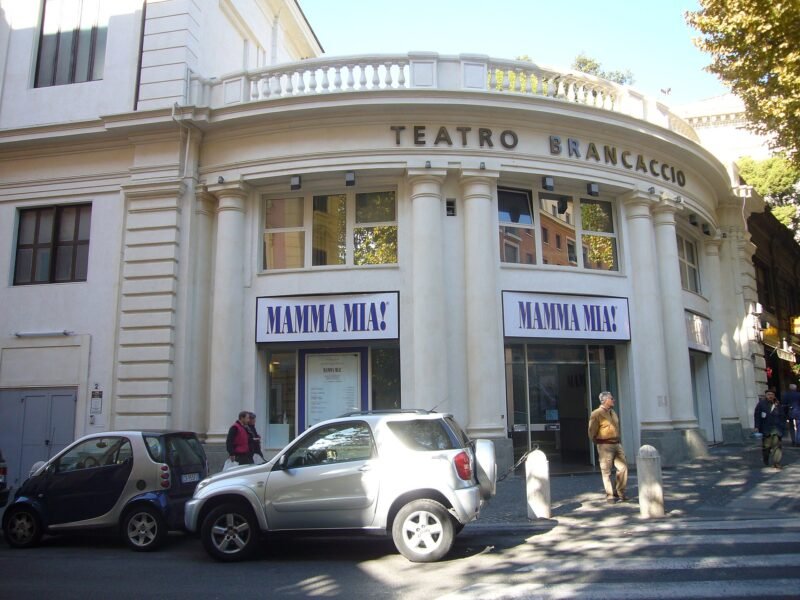
Teatro Brancaccio, at Via Merulana 244, has had its current configuration since 1937: two foyers, a large orchestra and two raised levels, first and second balcony, for about 2,000 seats at the time. It is one of the largest halls in Rome for drama and musicals, and the home of Viola Produzioni, which co-produces Raffaella il Musical.
Orchestra and sections on sale
The hall reads in three bands. The orchestra is divided into the Poltronissima and Poltrona sections, with the Gold and Gold Vip bands that appear in the theater's booking system. Above, the first balcony and the second balcony, each in bands A and B. For Raffaella il Musical the published price list covers only the orchestra: from Poltronissima Gold at €69 down to Poltrona B at €40. Between Poltronissima A and Poltronissima B there's a €5 difference, between Poltronissima B and Poltrona A €10: the real jump is there.
Where to sit for a musical you want to dance to
Here the verdict is clear. Raffaella il Musical is a dance show before it is a drama. Ensemble choreography, constant scene changes, costumes. Being too close to the stage means seeing faces and losing the choreographic patterns, which in group numbers are the substance. Poltronissima Gold and Poltronissima A are the seats for those who want to see the lead up close and hear the voice unfiltered. For those who want the whole scene, Poltrona A at €50 is the smartest choice on the price list: set back just enough, central, with €19 saved over Gold. One practical warning: the balconies are not served by elevators, and you get there on foot.
The Brancaccino and the rest of the complex
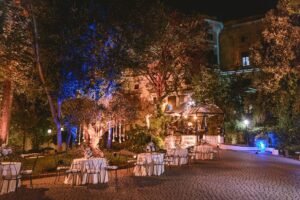
Brancaccio is the main hall of a larger complex. The complex includes the Brancaccino, a theater of about 100 seats with a telescopic orchestra dedicated to contemporary drama and children's theater, a park area used for training and a large terrace on Via Merulana. The theater hosts the Accademia STAP Brancaccio for acting, directing and playwriting and the BMA Brancaccio Musical Academy, directed by Lorenzo Gioielli, Rossella Marchi and Piero Di Blasio, and the Brancaccio Danza center directed by Alessia Gatta. For a show that looked for its lead through auditions, it's a coherent setting: in this building musical theater is taught every day.
Something nobody tells you about Raffaella il Musical at Teatro Brancaccio, February 10 to March 6, 2027
The thing nobody says is written in the theater's rules: Brancaccio asks spectators to show up at least one hour before the start. For the 21:00 evening show that means being on Via Merulana at 20:00, for the 16:00 matinee, at 15:00. With a hall this big, two foyers, visual checks of bags and backpacks and a coat check where even umbrellas must be left, the line at the entrance on sold-out nights is real. And in February in Rome, umbrellas are a real possibility.
The rules are strict on latecomers: entering the hall after the show has started is forbidden, and latecomers wait in the foyer until the first suitable break. In a biographical musical this means missing childhood, the beginnings, maybe Canzonissima: the part without which what follows becomes a sequence of songs. If the show has no intermission, the theater may at its discretion let the latecomer in, without guaranteeing the assigned seat.
Second thing left unsaid: the schedule. On Thursday, February 11 the performance is at 16:00, not 21:00, unlike all the other Thursdays of the run. Anyone who works and buys that date thinking it's an evening show risks finding out late. Third: tickets are issued in the buyer's name, after a personal registration, and cannot be transferred without an agreement with the theater. Anyone buying for a group of friends, and for this show there will be many groups of friends, should know this beforehand, not at the entrance. Fourth: the rules forbid bringing bulky containers over 17 liters into the hall. Small bag, folding umbrella, a coat you can keep on your lap.
How to get to Teatro Brancaccio
Teatro Brancaccio is at Via Merulana 244, in the Esquilino district, less than a kilometer from Termini station and a few steps from the Vittorio Emanuele stop of metro A. It is among the easiest theaters to reach by public transit in Rome.
By metro
The theater gives two directions. Metro A, Vittorio Emanuele stop, is the closest: you come out on Piazza Vittorio Emanuele II and reach Via Merulana in a few minutes on foot. Metro B and B1, Cavour stop, are the alternative for those coming from the Monti or Colosseum side, with a slightly longer walk. From Termini, where the two lines cross, the theater is less than a kilometer away: anyone with time can do it all on foot, passing by Santa Maria Maggiore.
By bus and surface lines
The theater names three stops. On Via Merulana, at the Merulana/Brancaccio and Merulana/Mecenate stops, lines 16, 75, 714, 717 and C3 pass. At the Labicana/Merulana stop, at the intersection with Via Labicana, lines 3, 53, 75, 85, 87, 186, 571, 810, C3 and the night line N10 pass. For the return after the evening show, N10 is the line to note down. My advice: metro A going, one of the lines on Via Merulana or Via Labicana coming back.
By taxi
The theater lists the nearest taxi stands: Largo Brancaccio, Piazza Vittorio Emanuele II at number 113, Via Principe Amedeo at 138, Via Giolitti at 6 and Via Venosta. At the exit of a sold-out evening show the Largo Brancaccio stand empties in a few minutes: anyone who needs a taxi is quicker to move toward Piazza Vittorio or to book one by phone.
By car
The car is the choice I advise against. The theater lists no partner parking, Esquilino is a dense district and evening parking is hard, especially on Saturday, when there are two shows. Anyone coming from outside Rome does better leaving the car near a metro A or B station and continuing by metro to Vittorio Emanuele or Cavour.
My advice for visiting Raffaella il Musical at Teatro Brancaccio, February 10 to March 6, 2027
The best choice: a Thursday or Friday evening in the second or third week, between February 18 and 26, with Poltrona A.
The reason for the date is simple. Opening night, Wednesday, February 10, is an evening of invited guests, press and industry insiders, with the atmosphere that comes with it. The first weekend coincides with Valentine's Day, Sunday the 14th, and the performances of February 13 and 14 will be the most requested by couples and groups. The last Saturday, March 6, has the air of closings, with an audience of devotees. The mid-run evening shows instead have the company already worn in by a series of repeats and an audience that comes for the show, not for the occasion. For a new musical, with a recently selected cast, the difference between the first week and the third is noticeable.
The reason for the seat is simple: ensemble choreography is understood from a certain distance, and Poltrona A at €50 gives you the whole scene for €19 less than Gold. If the budget allows and you're going for the lead, Poltronissima Gold at €69 remains the seat to see up close whoever wears the blond bob.
One last thing: if you want to sing, go to a Saturday or Sunday matinee. The 16:00 audience is more relaxed, and with a repertoire like this nobody will look at you sideways if you sing Tanti auguri out loud. The evening show is for those who want to watch the show. The matinee is for those who want to live it.
Tickets for Raffaella il Musical: box office, presale, groups
Tickets for Raffaella il Musical at Teatro Brancaccio cost from €40 to €69 and are bought through the official channels named by the theater: the box office at Via Merulana 244, the official website, the official call center and authorized points of sale.
Box office and hours
The Teatro Brancaccio box office is at Via Merulana 244 and is open to the public Tuesday to Saturday from 16:00 to 19:00. On Sunday it opens during show hours, if a performance is scheduled. On Monday it's closed. The box office's phone assistance answers Tuesday to Friday from 14:00 to 16:00. The theater also offers the option of paying by credit card through a payment link, by booking the ticket by email with the box office.
Online and by phone
The theater's rules name as official channels the website teatrobrancaccio.it, the Viola Produzioni box offices at Brancaccio, the official call center at 06 80687231 and authorized points of sale. From the show's page on the theater's website you reach the authorized presale circuit. Purchase requires mandatory personal registration, and tickets are issued in the buyer's name. The theater warns that tickets bought from unauthorized channels may not grant access to the hall, and reminds that resale at a markup is forbidden by law.
Groups, companies and discounts
For groups, companies and discounts Brancaccio has a dedicated Promotions Office, reachable at 06 80687232 or by email at the theater's communications office. Anyone organizing an outing for an association, a club or a company group has to start there, not from the online circuit. The theater also offers two subscription formulas for the 2026-2027 season, the Brancaccio Fan Card and the Super Fan Card. The detail of the included titles should be asked at the box office, and after buying the subscription, tickets for individual shows are booked by contacting the box office.
Exchanges, refunds and lost tickets
The rules are clear: tickets are neither exchanged nor refunded, except in case of cancellation of the event or legal provisions. The theater reserves the right to change date, time, staging and cast, which do not entitle you to a refund. For a musical whose cast hasn't been announced yet, that's worth keeping in mind. If a digital ticket bought at the box office or on the theater's webshop is lost, a copy can be requested from the box office at no cost. For those bought through other channels, you have to contact the sales channel used.
Another well-known fact, yet rarely mentioned
That Tuca Tuca is the most famous dance in Italian television, everyone knows. Less often mentioned is that Rai, in 1971, censored it: it was judged too daring and vanished from the show. It returned to the air only after Carrà danced it with Alberto Sordi, and from that moment it became untouchable. The most popular dance on state television was, for a few weeks, a forbidden dance.
The sequel is even less known. In 2010, for the 40th anniversary of the choreography, in Bellaria-Igea Marina, the town where Carrà had grown up, almost 500 people danced Tuca Tuca together, and the performance earned a Guinness World Records recognition. Two years later, in 2012, Madonna included the dance in her MDNA Tour. From Rai censorship to Guinness and Madonna in 40 years: few Italian choreographies have come so far.
For those going to Brancaccio this fact has a practical implication. Tuca Tuca is among the songs named by the production, and the audience knows it by heart, gestures included. With a director who comes from dance and a choreographer like Fabrizio Prolli, the staging of that number will be the show's severest test: the audience will compare every gesture with the one from 1971.
House rules at Teatro Brancaccio: what to know before going in
The rules of Teatro Brancaccio apply to all performances of Raffaella il Musical: arrive at least one hour before, no entry once the show has started, no photos or recording during the show, no food in the hall.
Arrival, late entry and seats
In addition to arriving an hour early, the rules ask you to occupy only your assigned seat: for safety reasons switching seats is not allowed, even with empty seats. Hall staff may ask to see your ticket at any time. Reduced-rate tickets are valid only with a document proving the right to the reduction. Without it, you pay the difference.
Bags, umbrellas and coat check
The theater has a coat check service, a bar and merchandising sales. Umbrellas, large or small, do not go into the hall: they must be left at the coat check, in a bag provided by the staff. It is forbidden to bring in plastic bottles over half a liter, glass containers, motorcycle helmets, professional and semi-professional cameras, tripods, selfie sticks. Food and drinks are consumed only at the bar, during intermissions.
Phones, photos and dress
The rules forbid photographing the show with or without flash and making audio or video recordings, even with a cell phone, and ask that phones be turned off before the start. For a show that invites you to sing and dance the temptation to film the finale will be strong: the hall staff steps in, and is right to. On dress, the theater asks for attire fitting the decorum of the hall, without a real code. For this title someone will show up in a blond bob wig: it's in the spirit of the evening, as long as it doesn't block the view of the person sitting behind.
The right photo to take of Raffaella il Musical at Teatro Brancaccio, February 10 to March 6, 2027
During the show, no photos: the theater's rules forbid photographing and recording the performance, even with a cell phone. The right photo has to be taken before and after, and there are two worth the evening.
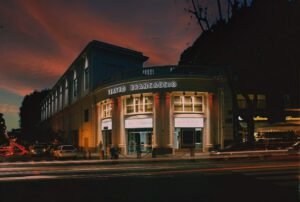
The first is the theater's facade on Via Merulana, in the evening, with the illuminated Raffaella poster. The tip is to cross the street and shoot from the opposite sidewalk, with a wide lens: the whole front of the theater fits, along with a stretch of Via Merulana, one of the longest, straightest streets in the center. In February darkness comes early, and at 20:00, the time the rules ask you to already be at the theater, the artificial light of the sign and the entrance does all the work. A photo with people in line, maybe some in a blond bob, tells the evening better than any close-up.
The second is the hall seen from the orchestra before the lights go down, with the curtain closed and the audience taking their seats. It's the only image of the hall you take home. No flash, no selfie sticks, and with the phone back in your pocket as soon as the lights start to dim.
Anyone who wants an extra keepsake can look around Rome for Carrà's places: the Rai production center on Via Teulada, which has borne her name since July 5, 2022, and the Teatro delle Vittorie, where the 2021 funeral procession passed. A photo in front of the entrance on Via Teulada, the day before or the day after the show, completes the story better than any souvenir.
Raffaella il Musical with children and teens
Raffaella il Musical is classified by Teatro Brancaccio in the Musical category. The 16:00 matinees, on Saturday and Sunday, are the best-suited performances for those going with children or grandchildren.
Age, chaperones and tickets for little ones
The theater's rules provide that minors under 14 enter only accompanied by an adult. Children under 3 enter free if they don't occupy a seat, with a document certifying their age. Access remains at the production's discretion, depending on the type of show. Everyone else pays the full ticket of the chosen section: in the price list published for this title no discounts for kids appear.
Three generations in the hall
The natural audience for this show is intergenerational, and the production knows it. The grandmother who watched Canzonissima, the mother who watched Carràmba, the daughter who knows Pedro from the remix: it's rare for a musical to get three generations to agree on the same soundtrack. The story contains love stories and touches the artist's private life, but the declared tone is that of a party. From age 10 up I'd recommend it without hesitation, especially if Carrà's songs already circulate in the family. With the youngest I'd pick a matinee and an aisle seat, so you can step out into the foyer without disturbing anyone. Food in the hall is not allowed: a snack at the theater's bar before the start, a half-liter bottle of water in the bag.
Accessibility at Teatro Brancaccio for Raffaella il Musical
Teatro Brancaccio states that it has no architectural barriers for access to the orchestra: there's a ramp, an area dedicated to wheelchairs and an accessible restroom on the ground floor, reachable from the orchestra foyer.
Wheelchair and reduced mobility
For the performances organized by the operator, the theater offers, while they last, four orchestra seats for wheelchair users with a companion and two orchestra seats for people with walking difficulties, with a companion if needed. The balconies are not wheelchair accessible: there are no elevators to the upper sections. Seats must be booked by sending the box office the dedicated form, filled out and accompanied by the disability certificate or the Disability Card, plus the companion allowance certificate if applicable. The box office then communicates the rate set by the production and confirms availability. The theater is explicit: an ordinary ticket bought through other channels does not guarantee access for people with disabilities.
Visual and hearing impairments and service dogs
For spectators with visual and hearing impairments, the theater reserves orchestra seats on request, while they last. Anyone with a service dog can ask to bring the animal into the hall by writing to the box office and attaching the disability certificate that indicates the accompaniment service. The rules warn in general terms that open flames, pyrotechnic or strobe effects may be used on stage, with prior authorization: for a show that promises big stage effects, anyone sensitive to strobe lights would do well to ask the box office when booking.
Some important events that happened here in history
The history of Teatro Brancaccio begins in January 1916, when the hall opened under the name Teatro Morgana. It was built right up against the embankment of the gardens of the Field-Brancaccio noble palace, whose name comes from Isabella Field, who married Prince Brancaccio. The link with Palazzo Brancaccio is therefore physical even before it is a matter of name.
Over the years the theater has been remodeled several times, to enhance the exterior and to improve how the interior works. The decisive step came in 1937: the hall opened in the configuration we know, with two foyers, a large orchestra section and two balconies for about 2,000 seats at the time, and took the name Teatro Brancaccio. Since then it has been considered, by tradition, the theater of Rome.
The second chapter opens in 1985, when the hall became the home of the Fondazione dell'Opera di Roma, which stayed until 2000. The Municipality of Rome then took over and entrusted the direction to Gigi Proietti until 2007. Maurizio Costanzo's management followed until 2010, and that of Stage Entertainment Italia until 2012. Since September 2012 the artistic director has been Alessandro Longobardi, the same Longobardi who today produces Raffaella il Musical with Viola Produzioni.
The most recent years are those of the transformation into a cultural hub: the Brancaccino, the park area for training, the terrace on Via Merulana, the academies. In 2014 Spazio Impero opened, with nine rehearsal rooms, connected to the other spaces of the production center, Sala Umberto and Spazio Diamante. The theater has since started an energy efficiency project funded by the European Union, Next Generation EU, through the Ministry of Culture, and digitization projects with funds from the Lazio Region. The Rome debut of Raffaella il Musical, on February 10, 2027, fits into this history as a home production: born in Madrid, but also produced by the people who run Brancaccio.
Around Brancaccio: Esquiline Hill, Monti and Via Merulana
Teatro Brancaccio is on Via Merulana, in the Esquiline Hill neighborhood, between the Basilica of Santa Maria Maggiore, the Colosseum and the Basilica of San Giovanni in Laterano. If you arrive an hour or two early, you have one of the densest areas of the city's history all around you.
Before the show: what's a few steps away
Via Merulana runs between two of Rome's major basilicas: Santa Maria Maggiore on one side, St. John Lateran on the other. The theater sits along the stretch between the two. On the same street are Palazzo Merulana and, a little farther on, the Auditorium of Maecenas. To the north, past the metro stop, is Piazza Vittorio Emanuele II with the Porta Alchemica, one of the most photographed curiosities of the Esquiline Hill. To the west you drop down into the Monti district: if you want to explore it at a relaxed pace, see our guide to Rione Monti.
In February my advice is to take the walk before the show and in daylight: with the 16:00 matinees it works very well, with lunch in Monti and a walk to Santa Maria Maggiore. For the evening performances, better to go straight to the theater.
Where to eat before or after the show
The area offers three different options. Via Merulana and the streets around the theater have neighborhood bars and restaurants, good for an aperitivo or a quick meal before the evening performance. Piazza Vittorio and the streets around it are the multiethnic Esquiline Hill, with cuisines from half the world and low prices. The Nuovo Mercato Esquilino is the place where you best understand this character of the neighborhood, but it's a market, not a solution for the evening. Rione Monti, a quarter of an hour's walk away, has trattorias, osterias and wine bars, and it's the best choice for dinner after the evening performance. A practical tip: book, especially on Saturday. With two performances in one day, two full houses leave the theater and look for a table in the same blocks.
Who has passed through Raffaella il Musical at Teatro Brancaccio, from February 10 to March 6, 2027
Over its history, some of the biggest names in Italian and international entertainment have appeared on the Brancaccio stage. The theater itself recalls a few: Totò, Anna Magnani, Aldo Fabrizi and Gigi Proietti among the actors, Fabrizio De André, Louis Armstrong and Jimi Hendrix among the musicians. It's a list that says a lot about the nature of the hall: Roman variety and cinema, the singer-songwriter tradition, jazz and rock were at home here, even before the musical. For a show that tells the story of the queen of TV variety, it's the right setting: variety, before it ended up on television, was staged in halls like this one.
Proietti wasn't just a passing actor: after 2000 he ran the theater on behalf of the Municipality of Rome, until 2007. After him, until 2010, the management was Maurizio Costanzo's, another name from television that Carrà crossed paths with throughout her career.
In the same season as Raffaella, Brancaccio hosts, among others, the national premiere of Principe d'Egitto il Musical in the fall, Amélie with Giulia Ottonello, Aggiungi un posto a tavola from December, Murder on the Orient Express with Claudio Gregori, known as Greg, as Poirot, and from March 31, 2027 Mrs Doubtfire with Francesco Cicchella. History, hall and practical information are collected in our page on Teatro Brancaccio.
Rome between February and early March, Raffaella's season
Raffaella il Musical is on stage at Brancaccio between February 10 and March 6, 2027, in the heart of the Roman winter: the theater season is at its peak, there are fewer tourists than in spring, and the city is easier to get around at a relaxed pace.
Valentine's Day and the weekends
The first weekend of the run falls on Valentine's Day: Saturday, February 13 with two performances, Sunday the 14th with the 16:00 matinee. For a couple it's a good idea, as long as you buy early: those will be the most requested dates. For those who are flexible, Thursday evenings in late February and early March are the quietest nights. If you're coming from outside Rome and want to combine the show with a visit to the city, you have four weekends to choose from, all with two performances on Saturday.
Weather, light and what to wear
February in Rome alternates clear, cold days with rainy spells. For the theater the practical consequences are two. The first: umbrellas don't go into the hall and end up at the coat check, so better a folding umbrella or a good raincoat. The second: it gets dark early, and if you want to combine the show with a walk between Santa Maria Maggiore and Monti, you have to do it in the early afternoon.
Brancaccio and the Rome of Raffaella Carrà
Rome is the city where Raffaella Carrà trained, worked and died: she arrived at eight, in 1952, to study at the Accademia nazionale di danza, and here she was bid farewell in July 2021 with a procession that passed through the places of her television career.
If you're going to see the musical, you can put together a small Roman itinerary on her trail, all at verifiable places. The Rai production center on Via Teulada, named after Raffaella Carrà on July 5, 2022, is where many of her programs were born. Teatro delle Vittorie and the Rai Auditorium at Foro Italico were on the route of the funeral procession on July 7, 2021, along with the Rai headquarters on Viale Mazzini. The Protomoteca of Campidoglio hosted the lying in state, and the Basilica of Santa Maria in Aracoeli, at the top of the staircase next to Campidoglio, the funeral on July 9. They are stops far from one another, between Prati, Flaminio and the historic center: you can't do them on foot in one afternoon, but one or two, combined with the show, give the evening a meaning that goes beyond nostalgia.
The right place to end the itinerary is Aracoeli itself. From the top of the staircase you see the city that Carrà chose at eight, and the day after the musical that view is worth more than a program booklet.
Frequently asked questions about Raffaella il Musical at Brancaccio
When is Raffaella il Musical on in Rome?
Raffaella il Musical is on at Teatro Brancaccio in Rome from February 10 to March 6, 2027: opening Wednesday, February 10 at 21:00, last performances Saturday, March 6 at 16:00 and 21:00. The calendar published by the theater lists 20 performances, with evening shows at 21:00 and matinees at 16:00. Monday, Tuesday and Wednesday are days off, except the Wednesday of the opening.
How much do tickets for Raffaella il Musical at Brancaccio cost?
Tickets for Raffaella il Musical at Teatro Brancaccio run from €40 to €69, according to the price list published by the theater. Poltronissima Gold costs €69, Poltronissima A €65, Poltronissima B €60, Poltrona A €50, Poltrona B €40. Any fees and presale charges are shown at the time of purchase.
Where do you buy tickets for Raffaella il Musical?
Tickets for Raffaella il Musical are bought at the box office of Teatro Brancaccio, at Via Merulana 244, open Tuesday to Saturday from 16:00 to 19:00, or on the theater's official website, which links to the authorized presale network. There is also the official call center at 06 80687231. For groups there is the Promotions Office, at 06 80687232.
Who plays Raffaella Carrà in the musical?
The lead of Raffaella il Musical at Teatro Brancaccio was chosen through auditions in Italy, among performers aged 20 to 25 with strong singing and dancing skills. The theater doesn't yet give her name on the show page. The show is written and directed by Luciano Cannito, with choreography by Fabrizio Prolli: for the final cast, the official website is the authority.
Which songs are in Raffaella il Musical?
Raffaella il Musical retraces the career of Raffaella Carrà through her greatest hits. The production's presentation cites Fiesta, Tanti auguri, Pedro and Tuca Tuca among the songs. The complete setlist is not published. The arrangements are by Pino Perris and Dan Vidal Roloff, the musical direction by Angelo Racz.
Are Raffaella il Musical and Raffaella! Sognando la Carrà the same show?
Raffaella il Musical at Teatro Brancaccio and Raffaella! Sognando la Carrà at Teatro Olimpico are two different shows. The first is the Luciano Cannito musical born in Madrid, with 20 performances at Brancaccio. The second is a recital produced by Nuovo Teatro Verdi, performed by Beatrice Baldaccini, with a single Rome date at Olimpico, on February 10, 2027.
How do you get to Teatro Brancaccio by public transit?
Teatro Brancaccio, at Via Merulana 244, can be reached by Metro Line A, Vittorio Emanuele stop, or Metro Line B, Cavour stop. Lines 16, 75, 714, 717 and C3 stop on Via Merulana. At the Labicana/Merulana stop 3, 53, 85, 87, 186, 571 and 810 also pass, along with the N10 night bus. From Termini the theater is less than a kilometer away.
What time do you need to arrive at Brancaccio?
The rules of Teatro Brancaccio ask you to show up at least an hour before the start: 20:00 for the evening performances of Raffaella il Musical, 15:00 for the matinees. Entering the hall after the show has started is forbidden, and latecomers wait in the foyer until the first intermission, thus missing the entire first part of the show.
Is Teatro Brancaccio wheelchair accessible?
Teatro Brancaccio has a ramp to the orchestra section, four orchestra seats for wheelchair users with a companion, two for people with walking difficulties and an accessible restroom on the ground floor. The balconies have no elevator. Seats are booked by sending the box office the theater's form with the required documentation.
Final advice on Raffaella il Musical
Go, and go with the right people. This is a show to see in company, ideally of different ages: its strength is getting people to sing together, those who remember Canzonissima and those who discovered Carrà on a smartphone. Buy from the theater's website or at the box office on Via Merulana, never from unauthorized resellers, and double-check that you've chosen Brancaccio and not Olimpico. Pick an evening performance in the middle of the run, Poltrona A if you want the choreography, Poltronissima Gold if you want the lead. Arrive at 20:00 and leave your umbrella at the coat check. The moment of truth will have just one title, Tuca Tuca: if the hall stands up, the evening was a success. If you'd like to build a day around the show on Carrà's trail in Rome, from the Esquiline Hill to Campidoglio, with a guide who knows these neighborhoods, you can contact Tour Leader Pro.
Article written by the editorial team of Tour Leader Pro, contact them for Private/Corporate/V.I.P. Tours and Experiences.
Planning a trip to Rome? The English guides for visiting the city are on ItalyPlanner.com.
Contact Information
Nearby
 Teatro Brancaccio100 m
- Auditorium of Maecenas100 m
- Palazzo Brancaccio200 m
- Arch of Gallienus300 m
- Museum of Illusions in Rome300 m
- Esquiline Hill300 m
Upcoming events nearby
- The Prince of Egypt the Musical at Teatro Brancaccio, October 29 to November 15, 2026100 m
- Mrs Doubtfire the Musical at Teatro Brancaccio, March 31 to April 18, 2027100 m
- Francesco Renga at Teatro Brancaccio, Live Teatri 2026, May 11, 2027100 m
- Il Babysitter with Paolo Ruffini at the Teatro Brancaccio, December 21 and 22, 2026100 m



You might also like
- Mahler’s Third Symphony by John Neumeier at Teatro dell’Opera di Roma, February 4 to 10, 2027
- Seoul Mafia in Tutta colpa del K-pop at Teatro Brancaccio, January 18, 2027
- The Nutcracker at Teatro Nazionale, November 24 to December 3, 2026
- The Nutcracker at Teatro Brancaccio by Brancaccio LAB, December 4 to 6, 2026
- The Rake’s Progress at Teatro dell’Opera di Roma, November 27 to December 5, 2026
- Motus by Blanc, McGregor and Ekman at Teatro dell’Opera di Roma, March 31 to April 4, 2027