RomArt Factory
In short. The place. RomArt Factory, Via Stanislao Carcereri 7, Rome, Garbatella neighborhood.
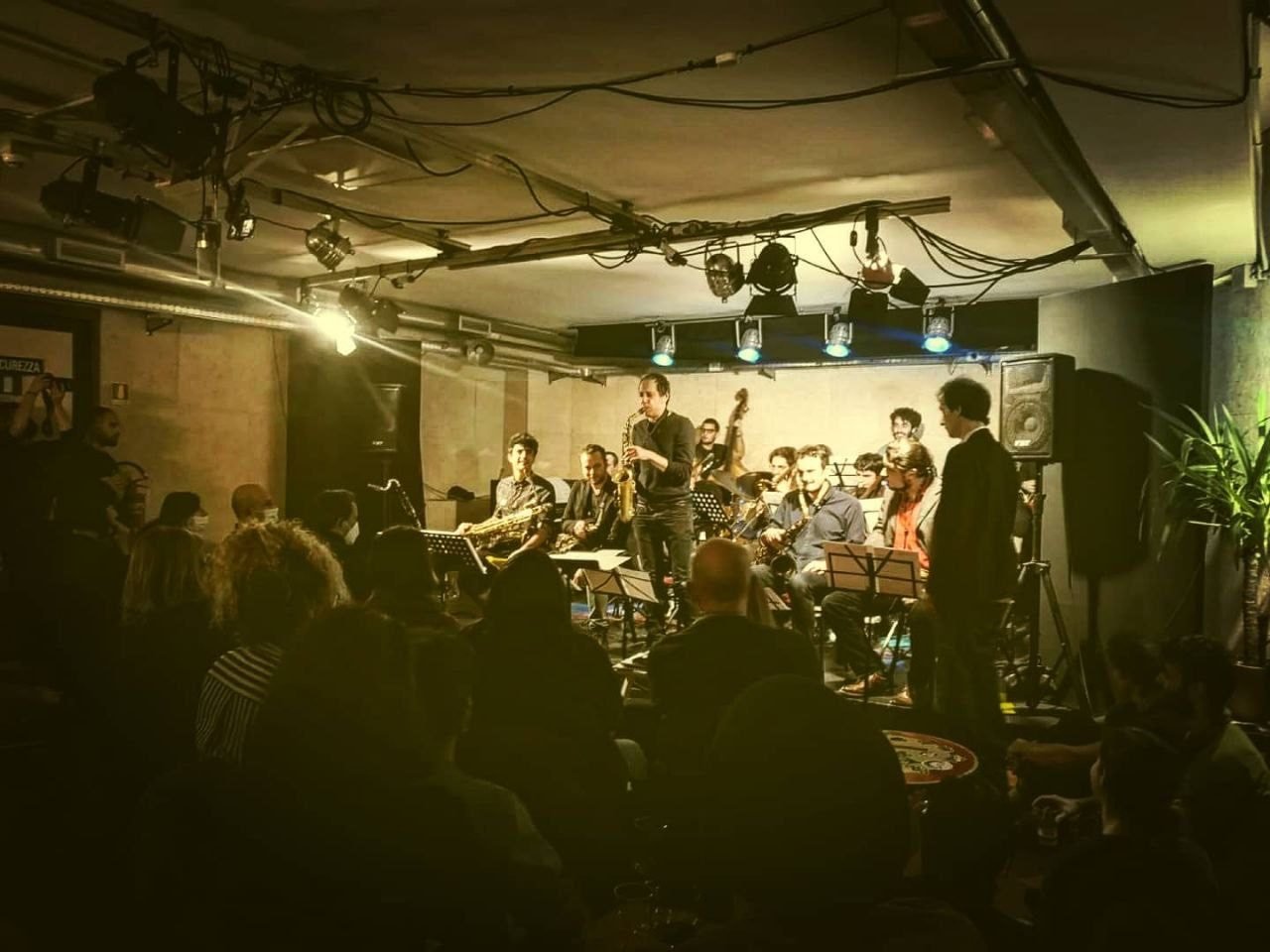
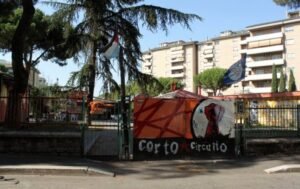
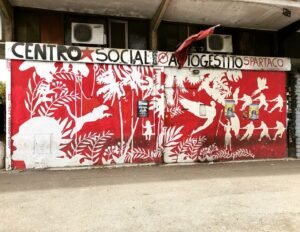
The place. RomArt Factory, Via Stanislao Carcereri 7, Rome, Garbatella neighborhood. A Social Promotion Association and Arci club in the heart of Garbatella, RomArt Factory promotes and spreads art in all its aspects, in particular visual, musical, literary and theatrical art.
What we're talking about. One of those addresses that don't appear on tourist maps, that have no ticket office, that don't sell an entrance, and that nevertheless, in the cultural fabric of a Roman neighborhood, weigh as much as and sometimes more than a museum. A club affiliated with Arci, inside a residential street of Garbatella, with a precise legal formula behind it and an even more precise social function ahead of it.
A preface that's best made right away. The listing on Zero, the public source the description above comes from and to which I point at the bottom, now accompanies the name RomArt Factory with the label Permanently closed. It's a fact I report as I find it, adding nothing that isn't there. Anyone reading these lines with the idea of showing up on Via Stanislao Carcereri some evening would do well to look for a direct contact first, because neighborhood clubs have lives made of cycles, moves, closures and reopenings under new names, and a page reporting a closure doesn't always tell the last chapter of the story. What follows, then, is a portrait of what an address like this has been and what it represents, and of the extraordinary neighborhood that hosts it.
There are hundreds of places like this in Rome, and almost nobody writes about them. An Arci club in a working-class neighborhood has no press office, no communication campaign, no budget to get noticed. It has a door, a sign, a calendar hung on the wall and a group of people who reopen every September and pull down the shutter every July because of the heat. The result is that the memory of these places lives almost exclusively in the heads of those who frequented them, and when they close it dissolves within two or three years. Writing a long page about RomArt Factory serves this too: putting a few lines under a name that would otherwise remain just an entry in a list of addresses.
The first thing to clarify is the legal nature, because it explains everything else: why it works the way it does, why it asks for a membership card, why it isn't a bar open to anyone passing by, why the prices at the counter are at that level and not another. RomArt Factory presents itself with two labels placed side by side: Social Promotion Association and Arci Club. They are not synonyms and they are not alternatives either. They are two different levels that overlap.
What Social Promotion Association Really Means
Associazione di Promozione Sociale, abbreviated APS, is an Italian legal status. Today it lives inside the Third Sector Code, Legislative Decree 117 of 2017, which reorganized a subject that was previously scattered across different laws and that before that, for APS, had its reference norm in Law 383 of 2000. The meaning of the status is simple to summarize even if the regulation is dense: an entity formed by people who associate to carry out activities of general interest for the benefit of their members, their families or third parties, without profit motive.
The key words are two. The first is members: an APS is not a business that sells a service to a customer, it is a group of people who recognize themselves in a common purpose and who carry out that purpose together. The second is without profit motive, which doesn't mean money can't circulate, because money circulates plenty, it goes to pay the rent and the bills and SIAE and the fees of those who play. It means that any surplus can't be distributed among the members, and has to go back into the activity. It's the fundamental difference from a commercial venue, and anyone who has frequented both perceives it right away even without knowing the regulatory detail: in a club, the feeling that someone is trying to sell you something is much fainter.
With the Third Sector reform the RUNTS was also born, the Registro Unico Nazionale del Terzo Settore, the Single National Register of the Third Sector, which absorbed the old regional and provincial registers of social promotion associations. An APS registered in the RUNTS is a traceable entity, with a filed statute, an administrative body, a members' assembly, a budget to approve every year. It's not an informal group of friends. It's a structure with precise obligations, and whoever runs it knows this very well because they spend a not insignificant part of their free time on paperwork nobody sees and nobody thanks them for.
This aspect deserves underlining, because it's the one that most escapes people who look at clubs from outside. The romantic image is of a place born from nothing, run casually, where everything happens by chance. The reality is that behind an evening of concerts in a neighborhood club there are a statute, a members' book, an attendance register, insurance coverage, a notification to SIAE for the pieces performed, often a license for serving members, a safety officer for the crowding of the room. All this has to be kept up by volunteers who do something else for a living. The fragility of clubs comes exactly from here: not from lack of audience, but from the effort of holding up the administrative scaffolding year after year with the same four or five people.
How an Arci Club Works, Explained to Someone Who Has Never Walked In
Arci, in full Associazione Ricreativa e Culturale Italiana, the Italian Recreational and Cultural Association, was born in Florence in 1957 and since then has been the largest grassroots association network in the country. The structure has three levels: the clubs, the territorial committees, the national level. The club is the elementary unit, the one with a physical premises and a door that opens. The territorial committee, in Rome, coordinates the clubs of the city and the province. The national level holds the network together, defines the political and cultural lines, manages the relationship with institutions.
The operating mechanism that matters to someone who wants to walk into a club is membership enrollment, and it's worth explaining well because it generates constant misunderstandings. An Arci club is not a public venue: it is a members' premises. Whoever enters and takes part in the activities has to be a member. Becoming a member means filling out a membership application, being accepted by the board, receiving a named card and ending up registered in the members' book. It's not a formality invented to complicate anyone's life, it's the condition that makes the whole activity of the association legitimate.
The Arci card has a feature that makes it particularly interesting, which is its network validity. It's not the card of that single club: it is the Arci card, valid at all affiliated clubs in Italy for the whole association year. This means that someone who joins a neighborhood club in Garbatella, with the same card, can walk into a club in Bologna, in Palermo, in Turin. For people who travel a lot it's a concrete advantage, and for the Arci system it's the glue that turns thousands of autonomous local realities into a recognizable national network.
The Arci association year does not coincide with the calendar year. It is calibrated to the season of activities, the one that restarts in the fall and closes at the end of the following summer, exactly like the school year or the theater season. This detail explains something that to someone approaching for the first time looks like a whim: the card made in May expires shortly afterward anyway, because it follows the association's calendar and not the date on which it was signed. Whoever knows the mechanism waits for the fall to sign up, if they can, and gains 11 full months instead of three.
I don't go into the figures, and the choice is deliberate. Membership fees change from year to year, change from club to club because on top of the cost of the national card each club can add its own membership fee, and also change based on any reductions for students or for people renewing. Writing a number here would mean writing a wrong number within a few months. The principle to keep in mind is another, which is that the fee of an Arci club is designed to be accessible: it's not an economic filter, it's an act of joining. Whoever pays it isn't buying an entrance, they're joining an association.
Then there's the question of the counter, which is the one that most often confuses. Many Arci clubs have an internal bar. It isn't a bar in the commercial sense of the term: it's a service reserved for members, which is a different category and regulated differently. That's why the price of beer in a club is what it is, and why nobody can walk in from the street to order a coffee without being a member. It isn't rudeness, it's the very structure of the relationship.
Finally the part that counts most, and that no regulation manages to describe: in a club the audience is not an audience. It is an associative body. The difference shows in tiny things. It shows in who moves the chairs at the end of the evening without anyone asking. It shows in the fact that the person behind the counter that night is the same one who two weeks earlier was playing on the stage. It shows in the way programming choices are discussed, which in a commercial venue would be the owner's decisions and here instead become a topic for the assembly. Whoever walks into a club looking for a service is left disappointed. Whoever walks in looking for a place to be almost never is.
A Curiosity About RomArt Factory
The curiosity concerns the name, and once you notice it you can't stop seeing it. RomArt Factory puts together three things: Rome, art and the factory. The term Factory, in a context of visual arts, is never neutral: it refers to the New York Factory, to the studio as a place of continuous and collective production, to the idea that the work is not born in the solitude of the studio but in the noise of a space crossed by many people at the same time. Applying that word to a neighborhood premises in Garbatella is a fairly explicit statement of intent, and it should be read together with the list of disciplines that the official description lines up: visual, musical, literary, theatrical art.
Four disciplines in a list, in a neighborhood club, mean one thing only: the same space has to change skin depending on the evening. The room that on Thursday is a concert hall with the speakers on becomes a gallery on Saturday with paintings hung on the walls, and the following Tuesday an audience of chairs set out in rows for a book presentation. This forced versatility is the very hallmark of Italian clubs, and it's both their strength and their structural limit. The strength is that one square meter produces four different activities instead of one. The limit is that none of the four ever finds ideal conditions: the acoustics designed for the concert ruin the book presentation, the lighting good for the exhibition is terrible for the theater, and the stage the band needs steals precious meters from the audience.
Anyone who has run a space like this knows that the typical day is not made of cultural programming, it's made of setting up and taking down. You move, you stack, you cover, you uncover. An exhibition that stays up for three weeks coexists with six different evenings, and every time you have to decide between covering the works and taking the risk. The category that Zero assigns to this address, besides Social Spaces and Associations, is precisely Hybrid Spaces: the label is exact, and describes a condition more than an aesthetic choice.
The second curiosity, smaller but no less telling, concerns the address. Via Stanislao Carcereri is named after a nineteenth-century Comboni missionary, and fits into a naming custom that in Garbatella is systematic: a neighborhood in which the streets carry the names of missionaries, explorers, geographers and navigators, and in which the naming tells the culture of the moment when the neighborhood was designed. Walking through Garbatella reading the street signs is an exercise in open-air cultural history, and the address of this club is fully part of it.
Garbatella, or the Neighborhood That Explains the Club
You can't understand what RomArt Factory is without understanding where it is, and Garbatella is one of the few Roman neighborhoods whose birth date is known precisely. The first stone was laid on February 18, 1920. Not an approximate date drawn from a land registry: a ceremony, with King Victor Emmanuel III present, a public and documented founding act. From that moment begins the construction of a piece of city that, more than a century later, remains one of the most successful urban experiments in the whole of modern Roman history.
The starting idea came from far away, from England, from the garden city model theorized at the end of the nineteenth century. That model imagined low-density settlements, with low houses, vegetable gardens, gardens, local services, conceived as an alternative to the congested industrial city. In Italy that idea arrived filtered through local taste and needs, and in Garbatella it produced a result that resembles neither the English suburbs nor the peripheries that would come afterward. It produced courtyards, staircases, small squares, two- and three-story houses with colored plaster, shared flower beds, and above all it produced a human scale that in Rome, in the later expansions, was almost always lost.
The architectural language that characterizes the oldest part of the neighborhood has a precise name, which is barocchetto romano: a repertoire made of broken pediments, molded frames, votive aedicules, travertine portals, wrought iron, warm colors. It isn't high-style architecture, it's cultivated popular architecture, an explicit attempt to give formal dignity to housing for the working classes instead of reducing it to an anonymous box. Looking carefully at the facades of Garbatella means noticing that every doorway is different from the next, that every lot has its details, that whoever designed these houses put care into them. No Roman working-class neighborhood built after 1960 offers anything similar.
The Lots, or an Address System That Is Also a System of Life
Garbatella isn't organized by blocks like the rest of the city: it's organized by lots. The lot is the basic unit of construction, a complex of buildings gathered around one or more shared courtyards, numbered progressively. Garbatella locals say lot such-and-such or lot so-and-so the way elsewhere you'd say the name of a street, and that's because the lot is at once an address, a courtyard and a community.
The social consequence of this layout is enormous, and you can still feel it today. A shared courtyard produces neighborliness. Children play in the same space, adults meet while hanging out the laundry, condominium meetings are meetings of people who have known each other for 30 years. It isn't an idyll, because courtyards also produce quarrels, noise, tension, and those who live there know it better than anyone. But they produce relationships, and relationships are the raw material that clubs live on. It's no accident that in the quadrant of Garbatella and Ostiense there is a concentration of associative realities that few other Roman areas can match: clubs are born where a fabric of people who know each other already exists.
It's worth walking it with attention, because Garbatella can really only be read on foot. Piazza Benedetto Brin is one of the points to start from, with its open geometry and the houses closing it on three sides. Piazza Damiano Sauli offers one of the most photographed staircases in the neighborhood, one of those sets that seem built for a movie camera and that were simply the most elegant way to solve a difference in level. Piazza Michele da Carbonara holds the most famous building in the whole neighborhood. Piazza Bartolomeo Romano hosts the theater. And then there are the interior alleys, the stairs connecting one lot to another, the passages that seem private and are actually public, the vegetable gardens that pop up where the ground allows.
The Suburban Hotels, the Most Surprising Page of Garbatella
If I had to name a single reason why Garbatella deserves a trip even for those not interested in architecture, I would name the suburban hotels. The story is this. In the 1920s Rome began to demolish entire sectors of the historic center to open the great representative avenues the regime wanted. Those demolitions uprooted thousands of families, who found themselves without a home from one day to the next. A quick, temporary, dignified housing solution was needed. The answer was the suburban hotels of Garbatella: collective buildings with rooms for families and shared services, canteens, laundries, shared social spaces.
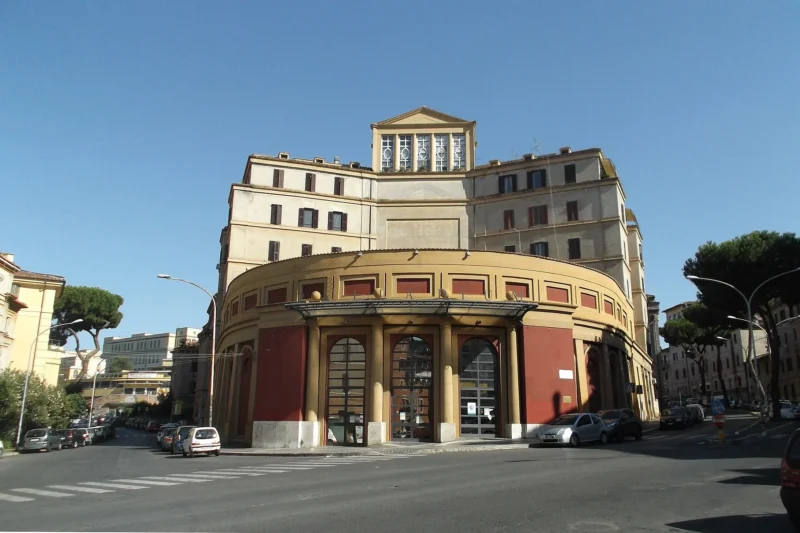
They were designed by Innocenzo Sabbatini, an architect of the Istituto per le Case Popolari, who is the decisive figure of that season. The best known of his buildings is the Albergo Rosso, in Piazza Michele da Carbonara, a block of unmistakable shape with its curved mass, bright color, loggias, little tower. Next to it were the Albergo Bianco and the Albergo Giallo, distinguished precisely by the color of the plaster. They are buildings we look at today as remarkable architectural objects and which were born as tools of housing emergency, and this double nature is exactly what makes them extraordinary: someone decided that even a temporary arrangement for displaced families deserved to be beautiful.
Anyone who arrives in Garbatella for the first time and stops in front of the Albergo Rosso understands in 30 seconds why this neighborhood has a fame that goes beyond the borders of Rome. It's a building that resembles nothing you'd expect from a working-class neighborhood, and which nevertheless was born precisely to answer a very urgent popular need.
Then there is an element that adds to this picture and that visitors often don't notice: the constant presence of green. Not monumental gardens, but green for everyday use, flower beds, rows of trees, vegetable gardens. The tradition of vegetable gardens in Garbatella isn't a contemporary phenomenon born with the fashion for urban agriculture: it goes back to the original structure of the neighborhood, conceived from the start as a settlement in which part of the land remained cultivable. Those who want to see how that tradition has turned into a contemporary collective project can look at the experience of the urban gardens of Garbatella, which are the direct continuation of that historic vocation.
Teatro Palladium and the Neighborhood's Theatrical Vocation
In Garbatella theater is not a guest: it has been at home for almost a century. The building that shows it is Teatro Palladium, in Piazza Bartolomeo Romano, built in the second half of the 1920s to a design by the same Innocenzo Sabbatini who had signed the suburban hotels. It was born as a movie theater for the neighborhood, in an era when equipping a working-class settlement with a performance hall was an explicit political choice: it meant saying that culture had to arrive there too.
The hall has gone through every possible season: first-run cinema, neighborhood hall, a period of decline, risk of closure, recovery. Today it is tied to Roma Tre University, which has made it a production and research center open to the city, with a program that mixes contemporary music, experimental theater, dance, film, talks. It's one of the few Roman cases in which a university institution took charge of a historic neighborhood building and returned it to the public without turning it into a closed container.
The presence of the Palladium a few hundred meters from a club like RomArt Factory is not a side detail. It creates an ecosystem. A neighborhood that has a structured theater hall and a network of informal clubs produces an audience that moves between the two levels: whoever goes to see a show at the Palladium then ends up having a drink in a club, and whoever frequents the club gets used to the idea that theater is a normal thing and not an exceptional event. This circulation is the real cultural capital of an area, and it is built over decades.
Alongside the Palladium, over the years the quadrant has developed a remarkable density of associative experiences. Within a radius of one kilometer from the address on Via Stanislao Carcereri you find the Casetta Rossa, the Villetta Social Lab, historic social centers, municipal libraries, senior centers that organize open activities. It's a concentration that isn't explained by chance: it's explained by the structure of the neighborhood, by the courtyards, by the lots, by the fact that here people know each other.
Something Nobody Tells You About RomArt Factory
What nobody tells you is that a club like this doesn't live on the evenings it puts on the bill. It lives on the afternoons when nothing happens.
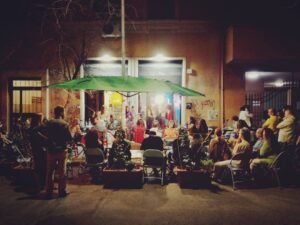
The pages that describe clubs always talk about concerts, exhibitions, presentations. They are the visible part, the one that ends up on social media and in event listings. But anyone who has really frequented a space like this knows its real function is exercised in the dead hours: late afternoon on a Tuesday, when inside there are four people, one trying a guitar in the back, two arguing at a table, someone dropping by just to say hello. Those hours produce no content, generate no tickets, can't be told. And yet they are exactly the reason the club exists.
There's a practical consequence of this observation, and it concerns the way you judge a place like this. A commercial venue is judged by the quality of what it offers on the evening you go. A club is judged by how useful it is to the people who pass through it every week. These are two completely different metrics, and applying the first to the second produces unfair reviews and systematic misunderstandings. Whoever walks into a club expecting the service of a venue finds a wobbly chair and a spartan bathroom. Whoever walks in knowing it is the living room of a piece of the neighborhood finds something no commercial venue can offer.
The second thing nobody tells you concerns the effort. Behind the apparent lightness of an evening in a club there is an enormous amount of unpaid work. Someone opened, someone bought the ice, someone set up the sound system, someone made the cards, someone will stay until two washing glasses and taking out the trash. None of these people is paid to do it, and almost all of them have a job the next day. When a club closes, nine times out of 10 it doesn't close for lack of audience. It closes because those four people can't do it anymore, or moved away, or had a child, or fell out. It's a structural fragility that no public funding solves, because the problem isn't money, it's the continuity of human energy.
The third thing, and perhaps the most important, is that clubs aren't visited, they're frequented. There is no way to understand RomArt Factory or any other club by going once. The first time you see only a room with people in it who know each other and don't know you. The second time someone recognizes you. The third time you start to understand who does what. Whoever arrives with a visitor's mentality always stays outside, not because they're excluded but because the door opens in a different way.
My Advice for Visiting RomArt Factory
The advice is blunt and goes against the instinct of someone planning an evening: don't go for the evening. Go for the neighborhood, and let the club be the end of the day instead of its purpose.
Let me explain why. A neighborhood club doesn't have a program you can consult weeks ahead like a theater, and the schedule can change at the last minute for the most banal reasons. Building a trip across Rome to arrive at Via Stanislao Carcereri at 21:00 and find the door closed is a real risk, all the more so today when the public listing for the place reports a closure. Building instead an afternoon in Garbatella is an operation that can't fail, because the neighborhood is there and never closes.
Here's how I'd organize it. You arrive by metro line B at the Garbatella stop and you walk out without looking at your phone. You head up toward Piazza Benedetto Brin and start walking among the lots with no precise itinerary, because Garbatella rewards those who get lost. You go to see Piazza Michele da Carbonara and the Albergo Rosso, and you stop for as long as it takes to notice how strange that building is. You go down to Piazza Damiano Sauli, climb the staircase, look at the courtyards of the lots through the open gates. You arrive at Piazza Bartolomeo Romano and check what's on at the Palladium, because it might solve the evening. Then you slowly go down toward Via Stanislao Carcereri, which is a few minutes' walk from all this, and you check in person what's there.
A day like this has two qualities a single evening doesn't have. The first is that it works anyway, whatever happens at the club's address. The second is that anyone who reaches the door of a club after three hours of walking around the neighborhood arrives with the right head: they've understood where they are, they've seen the courtyards, they've breathed the scale of the place. It's not a sentimental detail, it really changes the way you look at a room with 20 people in it.
On timing, a few concrete indications. Late-spring afternoons and those of September are the best moments: the raking light lights up the plaster of the barocchetto and the facades change color hour by hour. In summer, between July and August, many Roman clubs suspend activity because of the heat and the emptying of the city, and Garbatella becomes a silent and beautiful neighborhood to walk but poor in evening life. In the fall, between late September and November, everything restarts: it's the season when clubs open the association year, redo the cards, present the program. If you have to choose a moment to approach a Roman associative reality, that's the moment.
One further piece of advice, valid for any club and not just this one: when you walk in, ask. Ask what they do, ask how membership works, ask when things are on. In clubs there's no welcome staff and nobody will come toward you with a brochure, but almost everyone is happy to tell you what they do if someone shows they're really interested. The difference between remaining a stranger and not remaining one, in these places, is made by a question.
How to Get There, by Metro B and on Foot
The backbone of the quadrant is metro line B, which is also the oldest of the Roman metros: the first stretch entered service in 1955, connecting Termini to EUR, and was born from a tunnel that had originally been dug for a completely different purpose, in view of the world's fair that was supposed to be held in Rome in 1942 and that the war prevented. It's one of the most curious urban stories of the city: a metro born from the foundations of an event that never happened.
The Garbatella stop serves the neighborhood directly. From there you reach the heart of the historic lots on foot in a few minutes, and almost all the points of interest in the area in a good quarter of an hour. The same line, one stop farther toward the center, takes you to Piramide, where it crosses the railway to Lido and where another piece of Rome begins that shares industrial history and working-class vocation with Garbatella.
The practical advice is not to use the car. Garbatella is a dense residential neighborhood, parking is very scarce, the interior streets are narrow and partly one-way, and driving around means seeing nothing of what makes the place special. All the quality of this neighborhood shows at the eye level of a pedestrian: the staircases, the courtyards, the plaques, the details of the facades, the passages between one lot and another. In a car you only see rows of parked cars.
The Settimia Spizzichino Bridge, the Hinge of the Quadrant
Anyone who looks at a map of the south of Rome notices the problem right away: between Garbatella and Ostiense runs a bundle of tracks that for decades worked as a barrier, separating two areas that are geographically attached. The solution came in 2012 with the Settimia Spizzichino Bridge, an arch bridge with a white, curved silhouette that crosses the railway bundle and stitches the urban fabric back together.
The name is that of Settimia Spizzichino, the only woman to survive among the Roman deportees of the roundup of the ghetto on October 16, 1943. Deported to Auschwitz Birkenau, a survivor of the camps, returned to Rome, she spent the last decades of her life telling what she had seen, especially in schools. She lived in Garbatella. Naming a bridge after her in this quadrant wasn't an abstract symbolic gesture: it was a way of tying national memory to a precise piece of the city where that person lived.
The bridge is also, simply, a nice thing to cross. The white curve of the arch can be read from afar, in the evening it's lit, and walking over it offers one of the least obvious viewpoints on the railway and industrial landscape of southern Rome, with the sheds, the gasometers, the city stretching toward EUR. Anyone with an extra hour to spend in the area would do well to walk it in both directions, because the panorama changes completely.
On the other side of the bridge begins Ostiense, which is the natural extension of any visit to Garbatella. There you find the Centrale Montemartini, which is probably the most surprising archaeological museum in Italy because it displays ancient statues inside a decommissioned thermoelectric plant, and the Museo della Via Ostiense, housed in Porta San Paolo. Farther on still the Pyramid of Cestius and the Basilica of San Paolo fuori le Mura. In the opposite direction, toward Via delle Sette Chiese, the Catacombs of Commodilla, which very few Romans have seen and which are a step from the neighborhood.
Another Well-Known Fact, Yet Rarely Cited
The well-known fact is that Garbatella is the most filmed neighborhood in Rome after the historic center. Everyone knows it, it's repeated in every article. What is cited much less is the concrete consequence this has produced on the neighborhood and on the relationship between those who live there and those who come.
The reasons directors loved this place are technical before they are aesthetic. Garbatella offers ready-made and coherent sets: staircases, closed courtyards, uniform facades, small and controllable squares. It offers the possibility of shooting without having to rebuild anything, with shots that don't need to be cleaned of contemporary elements because the neighborhood has remained substantially that of the 1920s and 1930s. And it offers something the center of Rome no longer offers: streets you can work in, manageable permits, spaces to set up a crew without blocking half the city's traffic.
Italian cinema has worked there for decades. Nanni Moretti rode through this quadrant in the famous Vespa sequence of Caro Diario, from 1993, which became one of the most quoted portraits of the Roman periphery in motion. Television settled in permanently with the series I Cesaroni, which began airing in 2006, set its story here for several seasons and made squares and glimpses recognizable to a national audience that until then only Romans knew.
Here is the point that is rarely cited. That popularity has had a cost. Since the squares of Garbatella became recognizable on television, the neighborhood has started to receive a constant flow of visitors who come to photograph a set, not to get to know a place. The people who live in the lots regularly find groups photographing their doorway. The relationship between residents and visitors, in the most exposed areas, has become rougher, and not out of malice: whoever lives in a courtyard didn't sign up to live inside a permanent set.
The practical consequence for those arriving is only one, and I write it plainly: you enter Garbatella with respect. The courtyards of the lots are private spaces even when the gates are open. The windows are windows of inhabited homes. The acceptable noise level in a square in the center is not the acceptable level in a residential square at 23:00. Whoever treats this neighborhood as a backdrop behaves badly, and the people who live there notice immediately.
There's also a second element rarely cited, and it concerns the name. Several explanations circulate for the origin of the word Garbatella, none of which has ever been definitively proven. One has it derive from an innkeeper woman with courteous manners who kept an inn in the area. Another traces it back to a vine-growing technique, called a garbata, practiced on these lands. Yet another links it to the place name of a pre-existing villa. The truth is that nobody knows for sure, and it's worth saying so, because the confidence with which certain guides tell a single version isn't justified by the sources.
The Right Photo to Take at RomArt Factory
First the wrong photo, because it's the one everybody takes. The wrong photo is the sign. You arrive, frame the board with the name of the club, shoot, and leave. It's a photograph that tells nothing, because a sign over a door on a residential street has no visual quality and no information to give.
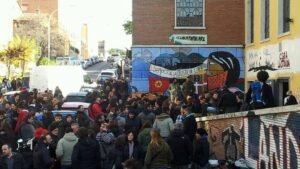
The right photo, in a place like this, is the one that holds the door and the street together. You stand on the opposite sidewalk, take the full width of Via Stanislao Carcereri, include the facades of the surrounding houses, the windows, the hanging laundry if there is any, the parked cars, and let the club's entrance be an element within a scene and not the isolated subject. That photograph tells the true thing: that this is a place of culture set inside an inhabited neighborhood, and that the two things can't be separated.
On light, the rule in a neighborhood like Garbatella is always the same: you shoot in the two hours before sunset. The ocher, red and yellow plasters of the barocchetto return a warmth that at noon goes completely flat. In raking light the frames, the moldings, the projections cast shadows that draw the facades, and the neighborhood suddenly becomes three-dimensional.
If the goal is to take home a single image that says Garbatella to anyone who looks at it, then the club's address isn't enough and you have to move a few hundred meters. The Albergo Rosso in Piazza Michele da Carbonara is the strongest subject in the neighborhood, and it should be shot from three quarters to show the curve of the facade. The staircase in Piazza Damiano Sauli works better from above, including the houses that frame it. The inner courtyards of the lots, when the gates are open, offer the most intimate images, and that's exactly where the greatest delicacy is needed, because those are somebody's gardens under their home.
A final rule, which counts double inside a club: people are photographed only if they agree. In an associative space people aren't a paying audience, they're people in their own home. Asking first costs nothing and completely changes the way you're perceived.
Some Important Events That Happened Here in History
On this point I want to be completely honest: the internal chronology of a neighborhood club isn't documented anywhere in a verifiable way. There are no public archives of RomArt Factory's evenings, no press reviews you can consult, no written history of this address. Inventing one would be very easy and would be a fraud. What can be reconstructed with precision, instead, is the chronology of the place where the club settled, and it's a dense chronology that explains a great deal.
February 18, 1920. The first stone of Garbatella is laid, in the presence of King Victor Emmanuel III. It's the official birth certificate of the neighborhood, and one of the few certain founding dates of Rome's twentieth-century expansion. The project fits into a season in which the Istituto per le Case Popolari builds entire pieces of city for the working classes, with a layout inspired by garden city theories.
The 1920s. The first lots are built, the language of the barocchetto romano is defined, the model of the shared courtyard is perfected. The neighborhood takes the form it still keeps today. In the same decade the first collective facilities arrive, including the performance hall that will become Teatro Palladium, in Piazza Bartolomeo Romano, designed by Innocenzo Sabbatini.
The second half of the 1920s. The demolitions in the historic center of Rome, opened to make room for the great representative arteries, leave thousands of families without a home. In Garbatella the suburban hotels are born, collective buildings with shared services designed by Sabbatini to take in the displaced. The Albergo Rosso, in Piazza Michele da Carbonara, is the most famous example, flanked by the Albergo Bianco and the Albergo Giallo.
October 16, 1943. The roundup of the Rome ghetto. Among the deportees is Settimia Spizzichino, who will be the only Roman woman to return alive from the extermination camps and who will then live in Garbatella, devoting the last decades of her life to public testimony. Her name will return, many years later, on the bridge that connects this neighborhood to Ostiense.
1955. The first stretch of line B of the Rome metro enters service, the first in the city, connecting Termini to EUR and passing under this quadrant. The Garbatella stop radically changes the neighborhood's relationship with the rest of the city: from a peripheral settlement reachable with difficulty to an area connected to the center in a few minutes.
The second postwar period and the following decades. Garbatella consolidates its political and social identity, becomes one of the symbol neighborhoods of organized working-class Rome, sees party sections, people's houses, clubs, cooperatives and grassroots sports associations spring up. It's the cultural ground on which, many decades later, realities like contemporary Arci clubs will take root.
1957. Arci, the Associazione Ricreativa e Culturale Italiana, is born in Florence, and within a few decades will become the largest Italian association network and the national container to which thousands of local clubs will affiliate, including the Roman ones.
1993. Nanni Moretti's Caro Diario is released, with the Vespa sequence through the neighborhoods of Rome that hands Italian cinema one of the most memorable images of the residential and peripheral city.
2006. The series I Cesaroni, set in Garbatella, begins airing and for several seasons will make the neighborhood familiar to a national television audience and turn some of its squares into pilgrimage destinations.
2012. The Settimia Spizzichino Bridge opens, crossing the railway bundle and stitching Garbatella back to Ostiense, eliminating an urban break that had lasted for decades.
Recent years. The quadrant between Garbatella and Ostiense confirms itself as one of the most active cultural laboratories in Rome, with widespread festivals that use several venues at once, as in the case of Aperossa between Garbatella and Ostiense, and with an associative network that keeps producing open activities, often free, almost always self-financed.
Who Has Passed Through RomArt Factory
Here too I prefer to say how things stand instead of filling the paragraph with names. There is no public and verifiable list of the artists who have performed or exhibited in this club, and every name I wrote here would be a name put there for show. I won't do it.
What can be said with certainty concerns the type of people who pass through a neighborhood Arci club, and it's a type recognizable anywhere in Italy. Musicians at the start of their path pass through, those who have recorded two tracks and look for a stage to try them out in front of 30 people. Neighborhood bands with 20 years of career behind them pass through, who have never signed a contract and never will, and who play because playing is what they do. Authors at the first presentation of a book published by a small press pass through, books that would never get into a bookstore and that here find a real audience. Photographers and painters exhibiting for the first time outside their own room pass through. Amateur theater companies that rehearse for months for two performances pass through.
Above all the members pass through, who are the decisive category and the one nobody ever talks about. People from the neighborhood who come because their friends are there. Students looking for a cheap place to spend the evening. Retirees who have found a place to be listened to. Parents who bring their children to a workshop. None of these names will ever end up on a poster, and all together they make up 90 percent of the real life of a space like this.
If instead the question concerns who has passed through Garbatella, there the answer is documented and extremely rich, and I want to keep it well separate from the previous paragraph to avoid confusion: these are figures tied to the neighborhood, not to this specific address. Italian cinema has passed through Garbatella systematically, from Nanni Moretti onward. Mainstream television has passed through with one of the most watched series of the 2000s. Settimia Spizzichino lived here, and her testimony on the deportation is one of the most important civic documents of twentieth-century Rome. Architects like Innocenzo Sabbatini worked here, whose name in the history of twentieth-century Italian architecture is tied almost entirely to this neighborhood. And generation after generation, tens of thousands of Roman families have passed through, for whom Garbatella was not a photographic subject but simply home.
What to See Within a 20-Minute Walk
Anyone who devotes a day to this area would make the classic mistake if they limited themselves to Garbatella. The southern quadrant of Rome, between Garbatella, Ostiense and Testaccio, concentrates a quantity of things to see that in any other city would be the heart of the tourist offering and that in Rome stays in the background only because the center absorbs all the attention.
A few minutes' walk from the club's address you meet the neighborhood's associative network, starting with the Casetta Rossa, which is one of the historic reference points of Garbatella's social life. A little farther on, the tradition of the urban gardens of Garbatella tells how a neighborhood won back pieces of land to cultivate them collectively, in direct continuity with the original 1920 layout.
Going down toward Ostiense you reach the Centrale Montemartini, which should be seen at least once in a lifetime: white marble Roman statues lined up in front of the turbines and diesel engines of an early twentieth-century power plant, in one of the most successful museum pairings in Europe. Continuing, the Museo della Via Ostiense inside Porta San Paolo, the Pyramid of Cestius with its improbable Egyptian silhouette wedged into the Aurelian Walls, and the Basilica of San Paolo fuori le Mura, one of the four papal basilicas, with a Cosmatesque cloister that alone is worth the detour.
Toward Via delle Sette Chiese, in the opposite direction, are the Catacombs of Commodilla, an underground complex that almost no visitor to Rome puts on the schedule and that preserves paintings of great interest. Crossing the Tiber you enter Testaccio, with the Nuovo Mercato Testaccio and the Museo Diffuso del Rione Testaccio, which tells the story of the slaughterhouse era and of working-class Rome. To the south, finally, opens the completely different world of EUR, with its rationalist architecture and its monumental perspectives.
Lined up, these stops make up a full-day itinerary that crosses 2,000 years of Roman history, from archaeology to the catacombs, from industrial archaeology to twentieth-century public housing, all the way to rationalism. And all of this moves along a single metro line, which makes it one of the most efficient itineraries you can build in Rome.
The Picture, in the End
RomArt Factory is, or was, one of those tiny nodes that hold together the cultural fabric of a city. It doesn't have the institutional weight of a public theater or the visibility of a festival. It has, or had, a door on a residential street in Garbatella and the declaration of wanting to promote visual, musical, literary and theatrical art within the perimeter of a social promotion association and an Arci club. Put like that it seems little. Multiplied by the thousands of similar realities scattered across Italy, it is the basic cultural infrastructure of an entire country, the one no ministry designed and without which very many artists would never have had a first stage.
That the public source now reports a permanent closure erases none of this, and in fact makes it more useful to remember. Clubs close and reopen, change premises, change name, merge, split. The neighborhood that made them possible does not: that remains, with its lots, its courtyards, its staircases and its stubborn capacity to produce places where people meet. Whoever arrives in Garbatella looking for RomArt Factory and finds a closed door would do well to look around, because 200 meters away, in all probability, another one has been born.
Frequently Asked Questions About RomArt Factory
Where is RomArt Factory?
RomArt Factory is in Garbatella, one of the few Roman neighborhoods whose birth date is known precisely: the first stone was laid on February 18, 1920 in the presence of King Victor Emmanuel III.
What is RomArt Factory?
RomArt Factory is an Arci club run as a Social Promotion Association, whose name puts together Rome, art and the factory, evoking the idea of a space of collective production rather than a solitary artist's studio.
What does it mean that RomArt Factory is a Social Promotion Association?
Associazione di Promozione Sociale, abbreviated APS, is an Italian legal status that today lives inside the Third Sector Code, Legislative Decree 117 of 2017, and before that had as its reference Law 383 of 2000.
Does RomArt Factory have a fixed events calendar?
No, a neighborhood club like RomArt Factory doesn't have a program you can consult weeks ahead like a theater, and the schedule can change at the last minute for ordinary organizational reasons.
Which neighborhood is RomArt Factory in and why is it special?
RomArt Factory is in Garbatella, a neighborhood organized not by blocks but by lots, groups of buildings gathered around shared courtyards that the Romans of the area still use as an address and as a community identity.
How do you get to RomArt Factory by metro?
The backbone of transport to RomArt Factory is metro line B, the oldest in Rome, whose first stretch entered service in 1955 connecting Termini to EUR and crossing the Garbatella area.
If This Itinerary Is Really Useful to You
Two useful addresses for those who want to go beyond reading. If you organize trips for others, escort groups or work in hospitality and guiding, the tools and materials of TourLeaderPro are designed exactly for people who have to build itineraries that work in the field and not just on paper. If instead you're planning your own trip to Italy and want to understand how to fit Rome in with the rest, ItalyPlanner is the place to line up days, transfers and priorities without wasting time. They're two different starting points for two different needs, and in both cases the logic is the same: first you understand the place, then you decide what to do with it.
For those who want to keep walking a little in this quadrant, the account of the widespread festival Aperossa between Garbatella and Ostiense shows well how the cultural network of this area works today, with several venues working together within the same 20-minute walking radius.
Contact Information
Via Stanislao Carcereri , 7
Roma Roma Città, Roma Città
Nearby
 Casetta Rossa200 m
- Garbatella600 m
- Teatro Palladium600 m
- Csoa La Strada700 m
- Catacombs of Commodilla800 m
- Roman Legionary Museum800 m

Upcoming events nearby
- Garbatella Jazz Winter: Miles Davis lesson and the film 100 Miles at Villetta Social Lab, Nov 14, 2026600 m
- Garbatella Jazz Winter: Daniele Corvasce Gipsy Jazz Quartet at Villetta Social Lab, Nov 15, 2026600 m
- Untethered by Sissela Johansson at Millepiani Coworking, from September 11 to November 3, 2026600 m
- Sun Hee You, Unlimited at Casa del Jazz, December 10, 2026800 m