Boris Petrushansky at Teatro della Cometa, December 13, 2026
In short. Boris Petrushansky, a pianist born in Moscow in 1949 and a pupil of Heinrich Neuhaus, plays on Sunday, December 13, 2026 at 17:00 at Teatro della Cometa, the historic hall at Via del Teatro di Marcello 4, between Piazza Venezia and the Capitoline Hill.
Boris Petrushansky, a pianist born in Moscow in 1949 and a pupil of Heinrich Neuhaus, plays on Sunday, December 13, 2026 at 17:00 at Teatro della Cometa, the historic hall at Via del Teatro di Marcello 4, between Piazza Venezia and the Capitoline Hill. The recital pairs Pyotr Ilyich Tchaikovsky's The Seasons, Op. 37a, and Modest Petrovich Mussorgsky's Pictures at an Exhibition, two different ways, the theater writes, of turning image into music. The most convenient stop is Via del Teatro di Marcello, served by buses 30, 4, 118, 160 and 170. From metro line B, Colosseo station, it's about five minutes on foot toward Piazza Venezia. On Sunday the limited traffic zone (ZTL) of the historic center is not in force. Prices are published on the theater's official site, where tickets are bought through the venue's online box office.
Petrushansky at the Cometa: date, time and tickets
Boris Petrushansky's recital is scheduled for Sunday, December 13, 2026 at 17:00 at Teatro della Cometa: a single appointment, within the theater's 2026 and 2027 music season.
The time
Like the Cometa's other Sunday concerts, the recital begins at 17:00. The running time isn't published. In mid-December, at that hour, it's already dark outside: those who arrive a little early find the hall lit and the foyer on the garden of Palazzo Pecci Blunt still quiet.
The tickets
The theater sells tickets through its own online box office, linked to the concert's page on the official site, where the prices are also given. A contact form on the same site collects requests for assistance, including those for people with disabilities.
The recital in the season
Petrushansky's concert comes two weeks after the Roman debut of the Quatuor Arod with the pianist Massimo Spada, on November 29. The music season continues in 2027 with the Georgian pianist Giorgi Gigashvili on April 18 and with Rosa Feola and Vincenzo Rana on May 16, while the opening, on October 4, was entrusted to the Metaphora Ensemble.
The program: Tchaikovsky and Mussorgsky
The recital's program sets side by side, according to the theater, two different ways of turning image into music: Tchaikovsky's The Seasons, Op. 37a, and Mussorgsky's Pictures at an Exhibition.
Tchaikovsky's The Seasons
In The Seasons, the concert's presentation explains, 12 miniatures follow the passing of the year through scenes, atmospheres and memories, composing a musical diary of surprising intimacy. One piece for each month: the cycle is heard as a sound calendar, in which each piece has the measure of a memory.
A cycle to hear in December
Hearing The Seasons on December 13 has its own logic: the cycle follows the year month by month, and the concert falls in the very month that closes the year and Tchaikovsky's diary. In our judgment it's the most fitting moment for a cycle built on the passing of time.
Pictures at an Exhibition
In Mussorgsky's Pictures at an Exhibition, the theater continues, the visual experience becomes a great sound itinerary, in which the piano evokes figures, spaces and movements with an almost theatrical force. It's the second part of a program that goes from the intimacy of a diary to the monumentality of a gallery.
Two universes side by side
Two different universes, the presentation concludes, united by the ability to tell through sound and entrusted to an interpreter who seeks in the score not only the form but the deepest expressive core of the music. For a pianist trained in Moscow, it's a program that returns to the roots of the Russian repertoire.
Boris Petrushansky, the Neuhaus school
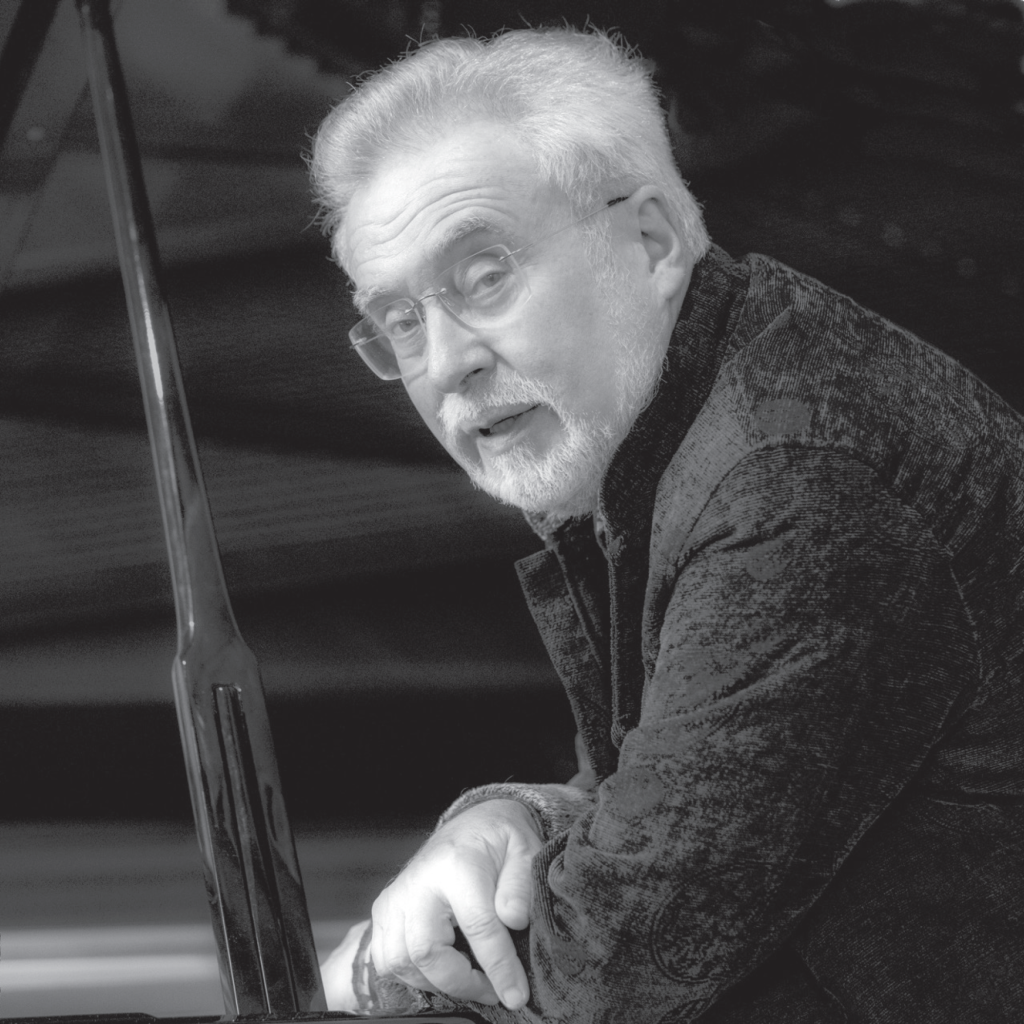
Boris Petrushansky, in the Italian transliteration Boris Vsevolodovich Petrushansky, is a Russian pianist naturalized Italian, born in Moscow on June 3, 1949, whom the theater presents as one of the most authoritative figures of the Russian piano school.
Moscow and the teachers
Petrushansky graduated from the Moscow Conservatory. Among his teachers are Heinrich Neuhaus, of whom he is described as the last pupil in Moscow, and Lev Naumov.
The Terni competition and Italy
Petrushansky came to international attention with his victory at the Casagrande Piano Competition in Terni. From there came invitations from Italian festivals and concert associations, including the Festival dei Due Mondi in Spoleto, the Maggio Musicale Fiorentino and the Arturo Benedetti Michelangeli International Piano Festival. His international concert career begins in the mid-1970s.
The orchestras and partners
He has played with orchestras such as the Saint Petersburg Philharmonic, the Berlin Staatskapelle and the Moscow Philharmonic, with conductors such as Valery Gergiev and Roberto Abbado. In chamber music he has collaborated with the violinists Leonid Kogan and Igor Oistrakh, with the cellist Mischa Maisky and with the soprano Cecilia Gasdia.
The recordings
Petrushansky has recorded for Melodia and Art and Electronics in Russia, Symposium in England, and for Fonè, Dynamic, Stradivarius and Agorà in Italy. His recordings of Shostakovich's complete solo piano works have received generally favorable reviews.
Imola
In the years of the dissolution of the Soviet Union Petrushansky settled in Italy, and since 1990 he has taught at the Incontri col Maestro International Piano Academy in Imola. Many young Italian pianists have studied with him, among them the Roman Massimo Spada, who plays at the Cometa on November 29 with the Quatuor Arod.
Petrushansky's career, from competitions to Imola
The biography published by the International Academy in Imola, where he teaches, reconstructs Boris Petrushansky's career from his first studies in Moscow to his arrival in Italy.
The Central School and Inna Levina
Born in Moscow to musician parents, Petrushansky was admitted at eight to the Central School of the Moscow Conservatory, in the class of Inna Levina, according to the MITO SettembreMusica biography. In 1964, at 15, he met Heinrich Neuhaus and became his last pupil.
Naumov and the school of Gilels and Richter
After Neuhaus, his training continued with Lev Naumov, a pupil and assistant of Neuhaus, whom the MITO biography describes as a custodian of the Romantic traditions of the school that gave the world Emil Gilels and Sviatoslav Richter. This is the line Petrushansky brings to the Cometa's stage.
Four competitions
Before Terni, Petrushansky won prizes in three competitions: Leeds in 1969, Munich in 1970, Moscow in 1971. The victory at the Casagrande Competition in Terni came in 1975 and was followed, the Imola Academy explains, by an important concert tour. From 1975 to 1979 he taught at the Moscow Conservatory, and he has given masterclasses around the world.
Orchestras and conductors
Among the orchestras he has played with, the MITO biography recalls the USSR State Symphony Orchestra, the Saint Petersburg Philharmonic, the Moscow Philharmonic, the Berlin Staatskapelle, the Moscow Chamber Orchestra, the European Community Chamber Orchestra and the Accademia Nazionale di Santa Cecilia. Among the conductors are Esa-Pekka Salonen, Vladimir Fedoseev, Valery Gergiev, Roberto Abbado and Vladimir Jurowski. Among the chamber music partners are Leonid Kogan, Igor Oistrakh, Valery Afanassiev, Dmitry Sitkovetsky and Mischa Maisky.
Rome and Santa Cecilia
The recital at the Cometa is therefore not Petrushansky's first encounter with the Roman audience: the orchestra of the Accademia di Santa Cecilia appears in his biography. In our judgment, finding him alone, in a compact hall, is the chance to hear up close a pianist used to the big halls.
How to listen to Petrushansky's recital
Boris Petrushansky's program asks for two different kinds of listening: a focused one, for the 12 miniatures of The Seasons, and a broader one, for the great itinerary of Pictures at an Exhibition.
The Seasons as a diary
The theater describes The Seasons as a musical diary of surprising intimacy. It's best to listen to them that way: one piece at a time, like pages being turned, without expecting great contrasts. The charm of the cycle lies in the variety of atmospheres within a small measure.
Pictures as a gallery
For Pictures at an Exhibition, by contrast, the theater speaks of a great sound itinerary and an almost theatrical force. It's music that asks you to follow a path, picture after picture, with the piano evoking figures, spaces and movements. In a small hall like the Cometa, the most powerful moments arrive with a physical impact.
Read first, listen later
In our judgment the best way to prepare is to read the titles of the pieces before going in, and then leave the program closed during the performance: the listening gains in concentration.
A curiosity about Boris Petrushansky at Teatro della Cometa, December 13, 2026
The curiosity is that on the Cometa's stage, within two weeks, the master and one of his pupils appear. Massimo Spada, a Roman pianist born in 1986, studied at the Imola piano academy with Boris Petrushansky and Riccardo Risaliti, according to the biography published by MITO SettembreMusica. On November 29 Spada plays at the Cometa with the Quatuor Arod the quintets by Korngold and Franck. On December 13, on the same stage, his master sits at the piano. Those who follow both concerts hear, in two Sundays, two generations of the same school.
The second curiosity concerns piano genealogy. Petrushansky is described as the last Moscow pupil of Heinrich Neuhaus. Those who hear the December 13 recital are therefore hearing a pianist who received that teaching directly, and who for over 30 years has passed it on in Imola to Italian students.
The third concerns the title of the first piece. Tchaikovsky's The Seasons is a cycle of 12 pieces, one per month. The Teatro della Cometa's music season, in the same year, is called a season. The play on words is unintended, but in December, with the year ending, Tchaikovsky's musical diary sounds like a reckoning.
Teatro della Cometa, a chamber hall at the foot of the Capitoline Hill
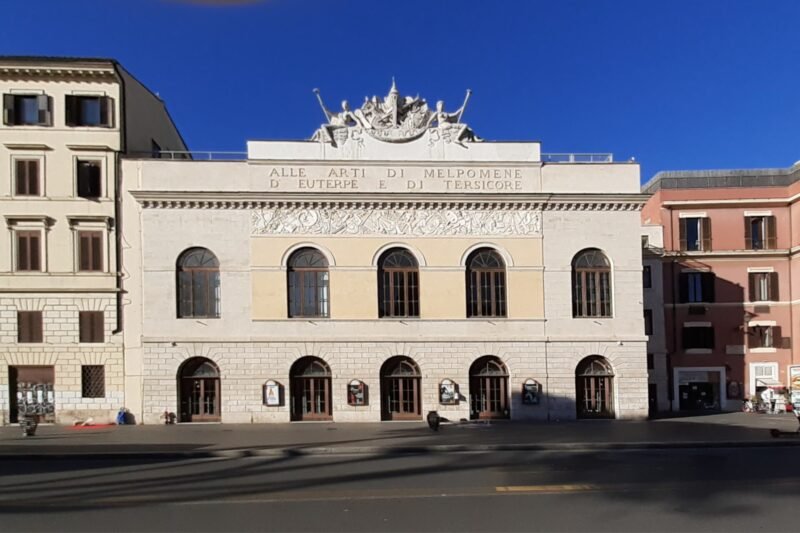
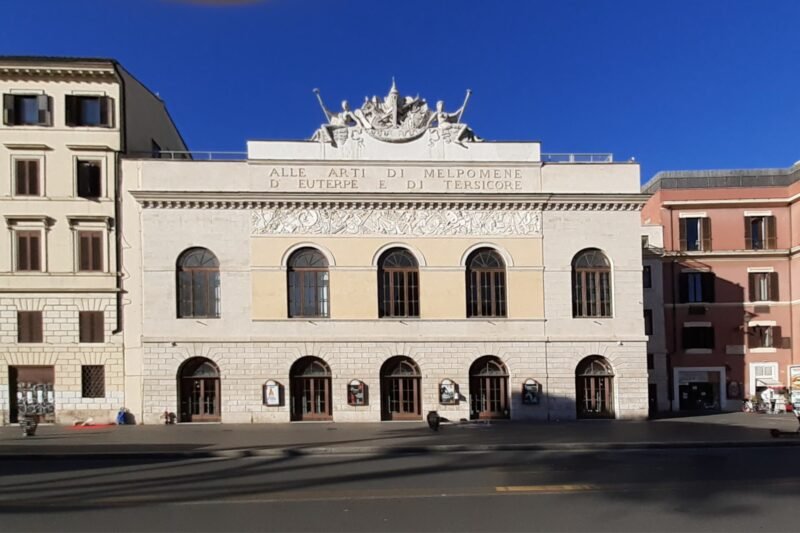
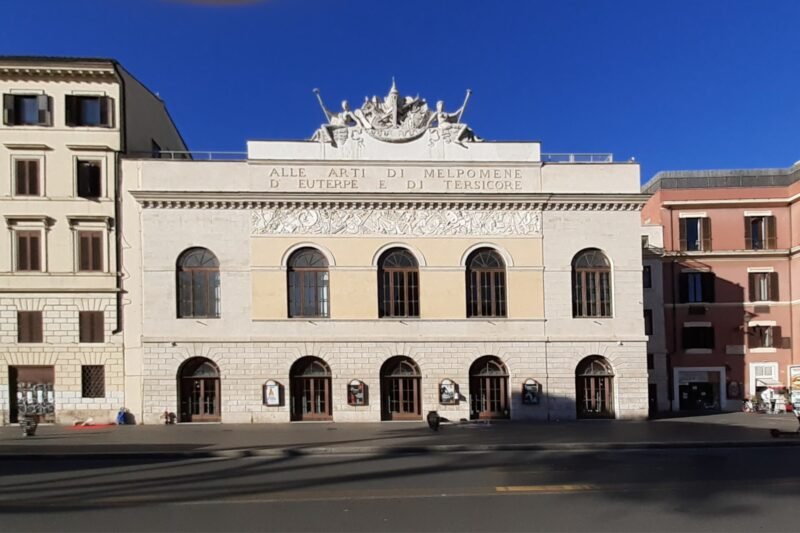
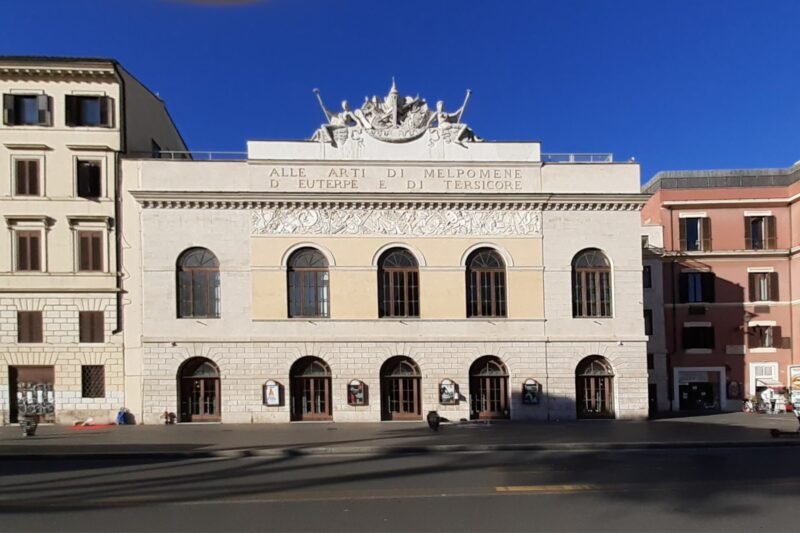
Teatro della Cometa, at Via del Teatro di Marcello 4, is the small hall wanted by Mimì Pecci Blunt in a little palazzo near her home on Piazza d'Aracoeli and inaugurated on November 17, 1958.
The patron
Anna Laetitia Pecci Blunt, known as Mimì, born in Rome in 1885 and a niece of Pope Leo XIII, was a patron of the arts: in Paris she kept a salon frequented by artists and writers, in Rome from 1933 she organized the Concerti di Primavera with Goffredo Petrassi, Vittorio Rieti and Mario Labroca, and in 1935 she founded the Galleria della Cometa with the poet Libero De Libero.
Buzzi's project
The theater was designed, from 1956, by the architect Tomaso Buzzi, after the first works by the engineer Stefano Gentiloni Silverj had stopped with the war. The palazzo's facade was kept. Inside, Buzzi designed a hall with platea, parterre and two galleries and chandeliers shaped like stars and comets, the emblem of the Pecci family.
The restoration
After the fire of 1968, the reconstruction of 1986 and over 30 years of management by Giorgio Barattolo, the theater was restored from 2020 to a design by Fabio Tudisco and Andrea Panzini. The revolving stage and the stage machinery came back into operation, the brass doors and the chandeliers were recovered and the foyer on the garden was restored. The reopening was on May 25, 2025.
A recital in a small hall
For a piano recital, a hall of this size has an obvious merit: the sound of the instrument fills the space without forcing, and even from the galleries the subtlest dynamics are perceived. For a program that goes from the intimacy of The Seasons to the almost theatrical force of Pictures, it's the ideal condition.
Something nobody tells you about Boris Petrushansky at Teatro della Cometa, December 13, 2026
What few remember is that in Rome there are two Cometas. Petrushansky's recital is at Teatro della Cometa, the historic hall at Via del Teatro di Marcello 4, reopened in 2025. Teatro Cometa Off is another hall, in Testaccio, on Via Luca della Robbia, born as a second venue on the initiative of Giorgio Barattolo. Anyone booking a taxi or setting the navigator must write the full address.
The second thing little said concerns the car. The theater is inside the ZTL Centro Storico, which is in force Monday to Friday from 6:30 to 18:00 and Saturday from 14:00 to 18:00. On Sunday and holidays access is free. December 13 is a Sunday: you can arrive by car without a permit, but there is no reserved parking, and the theater points to the paid car parks in nearby streets and the parking areas toward Piazza Venezia and Via Petroselli. In mid-December, with the city center's streets full of Christmas shopping, it's best to allow more time.
The third concerns the program. The Seasons and Pictures at an Exhibition are two much-loved cycles, and a recital that pairs them, entrusted to a pianist of the Russian school in a small hall, tends to fill up among enthusiasts. Buying early is prudent.
The advice I give you for visiting Boris Petrushansky at Teatro della Cometa, December 13, 2026
The advice is to arrive at the recital knowing the titles of The Seasons: 12 pieces, one per month, which follow one another like pages of a diary. Following the cycle knowing where you are in the year makes the listening much richer. For Pictures at an Exhibition the opposite holds: it's best to let yourself be carried by the images, picture after picture, as in a gallery.
For the seat, the central part of the platea or the first galleria is best, shifted slightly to the left if possible, to see the pianist's hands on the keyboard. For the evening, leaving around 19:00 gives time for a stroll between the Capitoline Hill and Piazza Venezia lit for the holidays, before dinner.
One last tip: those who heard Massimo Spada with the Quatuor Arod on November 29 have one more reason to return. Hearing the pupil and then the master, in the same hall, is a rare way to understand what a piano school means.
How to get to Teatro della Cometa
Teatro della Cometa is at Via del Teatro di Marcello 4, 00186 Rome, between Piazza Venezia, the Capitoline Hill and the Theatre of Marcellus. The coordinates are 41.8935 latitude and 12.4815 longitude.
By bus
The theater lists the stop Via del Teatro di Marcello, where lines 30, 4, 118, 160 and 170 pass. From Termini, Trastevere and the Aventine at least one of these lines arrives without changes.
By metro
The nearest station, according to the theater, is Colosseo on line B. From there you walk about five minutes toward Piazza Venezia.
By car
On Sunday the ZTL is not in force. There is no reserved parking: the theater points to the paid car parks in nearby streets and the parking areas toward Piazza Venezia and Via Petroselli.
On foot
From the historic center the simplest solution remains on foot: the theater is a few minutes from Piazza Venezia and the Capitoline Hill.
Another well-known fact, and yet rarely mentioned
It's well known that Boris Petrushansky is a pianist of the Russian school. It's less often remembered that the teaching of his master, Heinrich Neuhaus, reached as far as Imola. Boris Petrushansky, described as the last Moscow pupil of Neuhaus, settled in Italy in the years of the end of the Soviet Union and since 1990 has taught at the Incontri col Maestro International Piano Academy in Imola. For over 30 years, young Italian pianists have studied with a direct heir of that school, in Italy.
The second fact concerns Petrushansky's Italian career, which began well before his move: it was the victory at the Casagrande Competition in Terni that opened to him the doors of the Italian concert associations, from the Festival dei Due Mondi in Spoleto to the Maggio Musicale Fiorentino. The bond with Italy, then, was born from a competition.
The third fact concerns the recordings. Among Petrushansky's recordings, that of Shostakovich's complete solo piano works was received favorably by critics: a repertoire less frequented than Tchaikovsky's and Mussorgsky's, which says a lot about the breadth of his interests.
The right photo to take at Boris Petrushansky at Teatro della Cometa, December 13, 2026
The right photo is taken in the empty hall, before the audience enters, or in any case before the start: the grand piano alone on the Cometa's stage, with the comet-shaped chandeliers designed by Tomaso Buzzi lit above the platea. In a recital the protagonist, before the pianist, is the instrument, and the small hall puts it in the foreground.
During the concert the phone stays off. In a piano recital every noise is heard, and the quietest pages of The Seasons live on pianissimos that a shot can ruin.
The second photo is taken outside, on leaving. At 19:00 in mid-December the Theatre of Marcellus is lit, and a few steps farther the Capitoline Hill and Piazza Venezia have the holiday lights: the best way to close a Sunday of Russian music in ancient Rome.
What is around the Cometa
Teatro della Cometa is between the Capitoline Hill, the Theatre of Marcellus and the Ghetto: everything around it can be reached on foot in a few minutes.
The Capitoline Hill
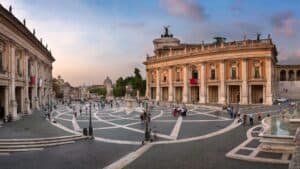
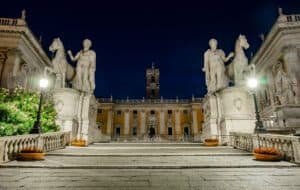
Above the theater is the Capitoline Hill, with Michelangelo's square, the Cordonata and the Capitoline Museums. Next to it, the stairway climbs to Santa Maria in Aracoeli, on the square where the Pecci Blunts lived.
The Theatre of Marcellus and the Portico of Octavia
A short walk away are the Theatre of Marcellus and the Portico of Octavia, the entrance to the Jewish Ghetto, with its trattorias.
The Tiber
Toward the river you reach the Tiber Island and, along Via Petroselli, the Mouth of Truth.
Some important events that happened here in history
The story of the Cometa begins with an art gallery. In 1935 Mimì Pecci Blunt founded with Libero De Libero the Galleria della Cometa, inaugurated with an exhibition of drawings by Corrado Cagli. In 1937 she opened a branch in New York. In 1938, with the racial laws, the gallery closed. In 1937 the Pecci Blunts bought the little palazzo next to their home, destined for the theater.
After the war, in 1956, the project passed to Tomaso Buzzi. On November 17, 1958 the hall was inaugurated with Alfred de Musset's I capricci di Marianna, with artistic direction by Linda Chittaro. From November 1959 the impresario Remigio Paone managed it. In the 1960s, with Diego Fabbri, Beckett, Ionesco and Stravinsky passed through, with productions directed by Giorgio Strehler.
On October 18, 1968 a fire, caused by a short circuit in the stage area, destroyed the theater. Mimì died in 1971. The hall stayed closed for about 17 years, until the 1986 reopening wanted by her daughter Viviana with the engineer Giorgio Barattolo, on a reconstruction by the architect Alberto Filippi. The restoration began in 2020 and on May 25, 2025 the theater reopened. On December 13, 2026 it hosts Boris Petrushansky's recital.
Who has passed through Boris Petrushansky at Teatro della Cometa, December 13, 2026
Many protagonists of the 20th century pass through the Cometa's history. A 1936 photograph portrays in Mimì Pecci Blunt's salon Mirko Basaldella, Corrado Cagli, Sibilla Aleramo, Alberto Moravia, Giuseppe Ungaretti and Libero De Libero. In Paris, in her house on rue de Babylone, the guests were Salvador Dalí, Paul Valéry and Jean Cocteau. At the Concerti di Primavera Petrassi, Rieti and Labroca worked.
On the stage have passed the company of I capricci di Marianna, the seasons of Remigio Paone and Diego Fabbri, the productions of Giorgio Strehler. Behind the scenes the architects Tomaso Buzzi, Virgilio Marchi, Alberto Filippi, Fabio Tudisco and Andrea Panzini, and the custodians Viviana Pecci Blunt and Giorgio Barattolo.
Through Boris Petrushansky's career pass Heinrich Neuhaus and Lev Naumov, the masters. Valery Gergiev and Roberto Abbado, the conductors. Leonid Kogan, Igor Oistrakh, Mischa Maisky and Cecilia Gasdia, the chamber music partners. And a long series of Imola pupils, among them Massimo Spada. On December 13, with them, Tchaikovsky and Mussorgsky pass through the Cometa.
Accessibility and practical tips
With the restoration completed in 2025, the theater explains, accessibility and visibility for the audience have improved. For specific needs it's best to use the entry dedicated to assistance for people with disabilities in the site's contact form, before buying the ticket.
With teenagers
The program suits teenagers who study piano: hearing The Seasons from a master of the Russian school who has taught for over 30 years is a precious lesson. Pictures, with their images, are a good gateway to piano music even for those who don't play.
December in Rome
In mid-December the Roman afternoon is cold and darkness comes early. On leaving, around 19:00, you need a coat and, if the weather is uncertain, an umbrella. The streets of the center are decorated for the holidays and very busy.
How to organize the recital Sunday
Boris Petrushansky's recital begins at 17:00 on a December Sunday: a day that is built well around the concert, without hurry.
Lunch and early afternoon
A Sunday lunch in the Ghetto or Trastevere, followed by a stroll along the Tiber to the Tiber Island, leads naturally toward Via del Teatro di Marcello. Those who prefer a museum find the Capitoline Museums a few steps from the theater: it's best to check their December holiday hours and leave at least half an hour of margin before the concert.
Arriving in the hall
Arriving around 16:30 lets you collect your ticket calmly, see the foyer on the garden of Palazzo Pecci Blunt and choose your seat with the hall still lit. In a piano recital the silence at the start matters: coming in at the last minute disturbs those already seated.
The evening
On leaving, around 19:00, the center is lit for the holidays. A dinner in the Ghetto, booked in advance, closes the Sunday a few minutes' walk from the theater.
Two pianists, two Sundays at the Cometa
The music season of Teatro della Cometa lines up, two weeks apart, two concerts linked by a thread: on November 29 the Roman debut of the Quatuor Arod with the pianist Massimo Spada, on December 13 the recital of Boris Petrushansky.
The pupil
Massimo Spada, born in Rome in 1986, graduated with honors from the Santa Cecilia Conservatory, studied further in Imola with Petrushansky and Riccardo Risaliti. At the Cometa he plays with the Parisian quartet the quintets by Korngold and Franck: chamber music, in which the piano converses on equal terms with the strings.
The master
Petrushansky, two weeks later, is alone at the piano, with an entirely Russian program. Those who follow both concerts hear, in two Sundays, two generations of the same school and two ways of being on stage: in dialogue and in the solitude of the recital.
Where to eat before or after the recital
The recital ends in the late afternoon, in one of the areas of the center richest in trattorias. Around the Portico of Octavia and in the streets of the Ghetto there are restaurants serving Roman and Roman-Jewish cuisine, with carciofi alla giudia among the best-known dishes. Across the Tiber, toward Trastevere, and toward Campo de' Fiori the choice widens. In December, with the holiday dinners, booking is essential.
A snack beforehand
With the 17:00 start, those arriving from a Sunday lunch can stop for a coffee in the bars around Piazza Venezia and then climb to the Capitoline Hill, before descending toward the theater.
Frequently asked questions about Boris Petrushansky at the Cometa
When does Boris Petrushansky play in Rome?
Boris Petrushansky plays in Rome on Sunday, December 13, 2026 at 17:00 at Teatro della Cometa, at Via del Teatro di Marcello 4, at the foot of the Capitoline Hill, in the theater's 2026 and 2027 music season.
What does Petrushansky play at the Cometa?
At Teatro della Cometa Boris Petrushansky plays Pyotr Ilyich Tchaikovsky's The Seasons, Op. 37a, 12 miniatures devoted to the months of the year, and Modest Petrovich Mussorgsky's Pictures at an Exhibition.
Who is Boris Petrushansky?
Boris Petrushansky is a Russian pianist naturalized Italian, born in Moscow in 1949, a pupil of Heinrich Neuhaus and Lev Naumov. A winner of the Casagrande Competition in Terni, since 1990 he has taught at the International Piano Academy in Imola.
Where do you buy tickets for Petrushansky at the Cometa?
Tickets for Boris Petrushansky's recital are bought on the online box office of Teatro della Cometa, linked to the concert's page on the theater's official site, where the prices are also published.
How do you get to Teatro della Cometa?
Teatro della Cometa is reached by buses 30, 4, 118, 160 and 170, stop Via del Teatro di Marcello, or by metro line B to Colosseo and five minutes on foot. On Sunday the historic center's ZTL is not in force.
Is Teatro della Cometa the same as Cometa Off in Testaccio?
No, Teatro della Cometa is the historic hall at Via del Teatro di Marcello 4, reopened in 2025. Teatro Cometa Off is another hall, in Testaccio. Petrushansky's recital is at Teatro della Cometa.
The final advice on Boris Petrushansky at the Cometa
Boris Petrushansky's recital is, in our judgment, the most interesting piano concert of the Roman December in a small hall: a direct heir of the Neuhaus school, two cycles of the Russian repertoire, a restored theater with the acoustics of a salon. It's best to buy early, review the 12 titles of The Seasons, choose a seat from which you can see the hands and close the Sunday with a dinner in the Ghetto.
Article written by the editorial team of Tour Leader Pro, contact them for Private/Corporate/V.I.P. Tours and Experiences.
Planning a trip to Rome? The English guides for visiting the city are on ItalyPlanner.com.
Contact Information
Nearby
 Insula of the Ara Coeli100 m
- Capitoline Museums100 m
- Tor de’ Specchi Monastery100 m
- Palace of the Conservators on Capitoline Hill100 m
- Capitoline Hill100 m
- Capitoline Cordonata100 m
Upcoming events nearby
- White Rabbit Red Rabbit at Teatro della Cometa, December 1 to 6, 2026100 m
- The Vagina Monologues with Lella Costa at Teatro della Cometa, from November 3 to 8, 2026100 m
- Quatuor Arod with Massimo Spada at Teatro della Cometa, November 29, 2026100 m
- The Colossus of Constantine, the Reconstruction at the Capitoline Museums100 m
You might also like
- Thomas Oliemans, Winterreise at Teatro Argentina, February 11, 2027
- Adélaïde Ferrière for the Filarmonica Romana at Teatro Argentina, February 4, 2027
- Rooftop Bar Opera Show at Palazzo Pamphilj, until December 30, 2026
- Trio Concept for the Filarmonica Romana at Teatro Argentina, December 10, 2026
- Samuele Rizzuto, Il pianista dell’anima at Teatro Sala Umberto, March 31, 2027
- Filippo Gorini for Filarmonica Romana at Teatro Argentina, March 18, 2027