Acqua Sacra
In short. Acqua Sacra is a natural mineral water spring located inside Rome, at Via Passo del Furlo 57, in the northeast quadrant of the city, between the Monte Sacro neighborhood and the Talenti area.
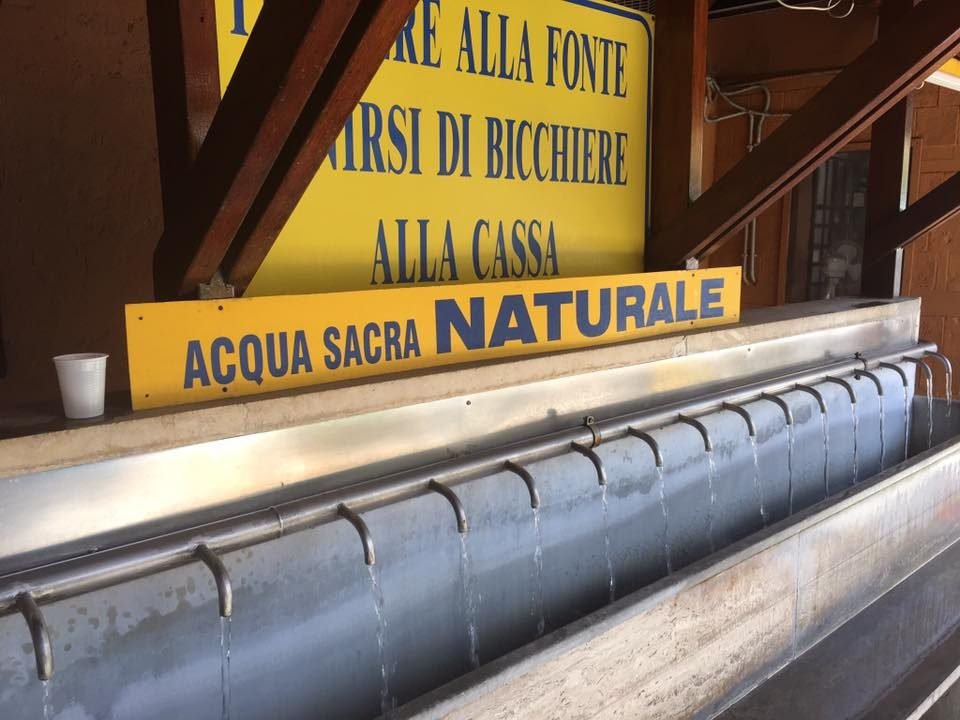
Acqua Sacra is a natural mineral water spring located inside Rome, at Via Passo del Furlo 57, in the northeast quadrant of the city, between the Monte Sacro neighborhood and the Talenti area. It is not a municipal drinking fountain and it is not a nasone: it is a private well, drilled in 1911, on which a bottling plant grew that is still in operation and bears the name of the water. The company that runs it is called S.I.V.A.M. Srl and states on its website that the water can be drawn directly from the taps at the plant or bought bottled in glass. It is this double nature, industrial and neighborhood, that makes the place interesting: a production facility in the middle of a residential fabric, with people arriving on foot or by car with empty bottles and leaving with full ones. Anyone who knows Rome for its monumental aqueducts, for the Trevi Fountain or for the Aqueducts Park finds here the least told chapter of the same story: the water that the city keeps drawing from its own subsoil and putting into bottles, without any scenography.
Before going further, one point about the accuracy of the information needs to be cleared up, because there is a lot of confusion about Acqua Sacra. The place is often described as a public drinking fountain fed by the city water network, the one that brings to Rome the water collected in the upper Aniene valley, toward Subiaco and the Monti Simbruini Regional Nature Park. This description doesn't hold up. The water of the city network and the water of Acqua Sacra are two different things, with two different origins, two different legal regimes and two different supply chains. The first comes from springs dozens of kilometers away through public pipes and comes out of the nasoni for free. The second comes from a well that drills into the subsoil of the northeast quadrant and belongs to a private party holding a mining concession. Confusing the two is not a nitpicker's detail: it completely changes what you go to see and what you take home.
Where Acqua Sacra is and how to really get there
The address is Via Passo del Furlo 57, postal code 00141. We are in Municipio III of Roma Capitale, in the urban strip that rises from the bridge over the Aniene toward the northeast along Via Nomentana and Via Jonio. The street names in the area help you get your bearings even without a map: the streets around carry the names of Apennine passes and mountain gorges, Passo del Furlo precisely, which is the gorge carved by the Candigliano in the Marche and crossed by Via Flaminia. Anyone who has already walked those streets knows it is a residential grid built in large part between the 1960s and 1970s, with apartment buildings of six or seven floors, inner courtyards, neighborhood shops on the ground floor and traffic that condenses on the main axes at rush hour.
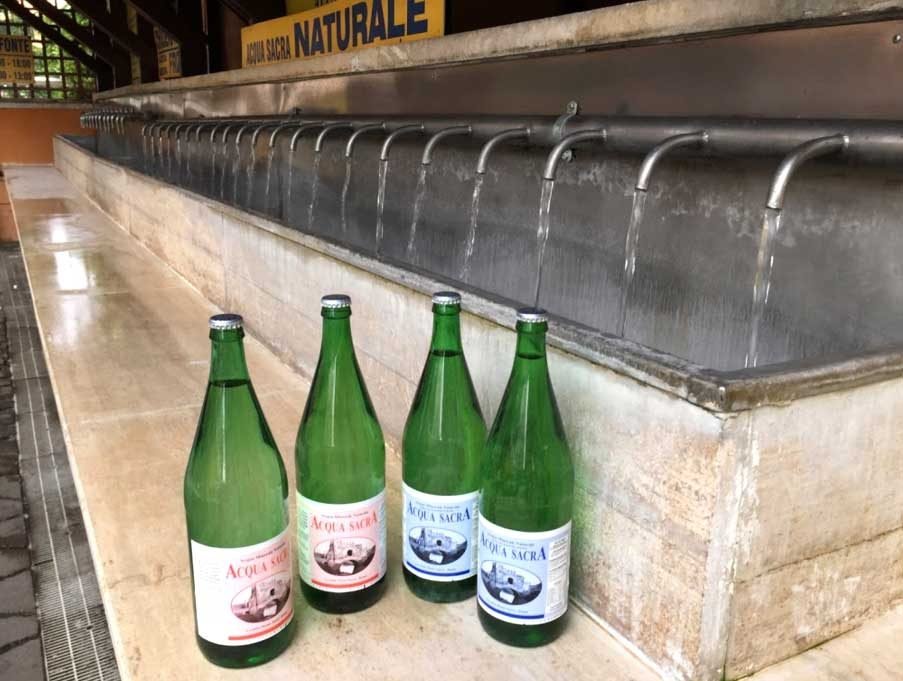
The plant doesn't announce itself. If you pass by car you risk driving past it without noticing, because the street front is that of an urban production facility, with a gate, a sign and a maneuvering area for vehicles, not that of a thermal spring with a portico and a garden. It's worth factoring in this sobriety before arriving, because anyone expecting a monumental fountain is left disoriented. You don't come here for the architecture.
By metro and surface transit
The most convenient rail reference is the B1 branch of the metro, the one that goes north from Bologna serving Sant'Agnese Annibaliano, Libia, Conca d'Oro and Jonio. The last two stations are the ones to keep in mind: from there the walking distance to Via Passo del Furlo is covered in a neighborhood stroll, flat or almost, with no dangerous stretches but also with nothing particularly pleasant to look at along the way. It's worth checking the exact route on your phone map before leaving, because the street grid of Talenti is regular but not entirely intuitive for those who don't know it.
The surface lines that go up Viale Jonio, Via Ugo Ojetti and the parallel axes cover the whole area well and connect the quadrant with Montesacro, with the Nomentana and with the interchange hubs toward the center. Line numbers change over time, so it's better to check the Roman public transport app on the day itself instead of trusting a list read elsewhere. The practical advice is another one and is worth more than any bus number: if the goal is to carry water away, public transport quickly becomes uncomfortable. Six glass bottles of a liter and a half weigh as much as a checked suitcase, and glass has the unpleasant defect of breaking when the vehicle brakes.
By car, which is how almost everyone goes
Most people arrive by car, and the reason is obvious: you come to load weight. The neighborhood has blue stripes on a large part of the main axes and white stripes on the inner side streets, with the hunt for a spot becoming a sport at rush hour and on weekday mornings. The best time to find parking nearby is midweek mid-morning, when those who work have already left and those who do the shopping haven't yet gone out. On Saturday morning the neighborhood fills up and parking becomes a gamble.
If you come from the Grande Raccordo Anulare, you exit onto the Nomentana or the Salaria depending on where you're coming from and then head up toward the interior of the quadrant. If you come from the center, you follow the Nomentana to the bridge over the Aniene and continue past Piazza Sempione. It's a route that costs dearly in minutes at rush hour, because the Nomentana is one of the most congested axes in the city and there are no credible shortcuts.
The hours published by the producer
On the company's website the hours given are from 8:00 to 18:00 on weekdays and from 8:00 to 13:00 on holidays, with a phone number, 06 86898223, and an email address for information requests. These hours should be taken for what they are: data published by the producer, which can change for vacations, plant maintenance, holidays or internal reorganization. A phone call before getting in the car costs 30 seconds and saves a wasted trip, especially in August and around the year-end holidays, when Roman production plants close with a certain nonchalance.
What Acqua Sacra really is: a private spring, not a nasone
Here a clear distinction is needed, because it is the key to understanding the place. In Italy, waters intended for human consumption fall into two large legal families. On one side is network water, which is a public service: it is collected from springs or well fields, treated if necessary, fed into pipes and distributed to household taps and street fountains. On the other side are natural mineral waters, which are an unavailable asset of the State patrimony given in concession, must be bacteriologically pure at the source, cannot undergo treatments that alter their composition and must maintain stable characteristics over time. The first kind you drink at the nasone. The second kind is bottled, and its label is a document regulated by law.
Acqua Sacra belongs to the second family. It is a natural mineral water, the producer describes it as slightly naturally sparkling and states that the mineralization is of medium degree and the taste pleasant. The difference from the nasone doesn't concern only perceived quality: it concerns the regime, the controls, the label and the fact that it is a private economic activity and not a municipal service. Anyone who arrives with a jerrycan thinking of filling it for free as at a drinking fountain shows up with the wrong idea of the place.
The ministerial recognition of 2005
On the producer's website you read that on November 17, 2005, with decree No. 3643, the Ministry of Health recognized certain properties for this water, indicated as diuretic, digestive and stimulating the metabolism of purines. This datum must be handled with care and explained well, because it is the point on which the biggest misunderstandings are built.
The ministerial recognition of properties favorable to health is an administrative act provided for by the regulations on mineral waters. It serves to establish what the producer may write on the label and what it may not write. It is not a medical prescription, it is not a therapy, it is not equivalent to saying that the water cures anything. A water authorized to declare itself diuretic is a water for which that claim was deemed admissible on the basis of the documentation presented. Anyone with a problem of kidney stones, hyperuricemia, kidney function or pregnancy must talk about it with their own doctor and not with a label. The correct way to read this information is: the producer reports a ministerial decree that authorizes certain wordings. Period. Any further step into the territory of health must be left to those who have the qualification to take it.
The analytical values, and why you won't find them listed here
The company states that it has an in-house laboratory and makes the microbiological and chemical analysis reports available in downloadable format, with recent update dates. The numbers that really matter for getting your bearings on a mineral water are few and always the same: fixed residue at 180 degrees, which tells how much dissolved material remains after evaporation. Then pH. Hardness. Content of bicarbonates, calcium, magnesium, sodium, potassium. Nitrates. Free carbon dioxide. On this page those values are not reported, and the reason is simple: the analytical documents do not appear readable in the publicly accessible part of the producer's website, and writing figures from memory or by analogy with other waters of Lazio would be improper. Anyone who needs those numbers, for a low-sodium diet or for a medical indication, should ask for them directly at the plant or download them from the official site: the test report signed by a laboratory is the only source that counts.
Mineralization and natural effervescence in the context of Lazio
That a slightly sparkling water comes out of the subsoil in Rome is neither an isolated nor a surprising fact. The whole central quadrant of Lazio rests on a succession of Quaternary volcanic deposits, left by the Colli Albani districts to the southeast and the Monti Sabatini to the northwest, and in that context the rise of carbon dioxide of deep origin along the fractures of the substrate is a widespread and well-known phenomenon. The same thing explains the acidulous waters of the capital and its surroundings, from the spring of Acqua Acetosa north of the center to the Laurentino Acqua Acetosa Nature Reserve to the south, up to the sulfurous and thermal waters of the Acque Albule Springs of Bagni di Tivoli in the plain at the foot of Tivoli. Rome sits on a living, gassy hydrogeological system, and Acqua Sacra is one of the points where that system was intercepted with a well and put to use.
This general frame serves to understand the context, not to describe the specific water of this well. The exact composition of an aquifer depends on the depth of capture, the rocks crossed, the times of underground residence: two wells a few hundred meters apart can give different waters. For this reason the geological frame must be kept separate from the numbers of the analysis, which remain a documented and certified company datum.
Drawing water at the source: what is open to the public and what is not
The point that interests the reader most is always the same: can you go and get the water, yes or no. The honest answer is that the producer, on its website, states that the water can be drawn directly from the taps or bought bottled in glass. This is the official wording, and it is the only one worth leaning on. Everything else, that is, whether the drawing is free or paid, whether there is a limit of liters per person, whether you need your own containers or can buy them on site, whether there is a deposit return on the glass bottles, are operational details that change over time and must be asked at the company's number before showing up. Anyone who tells you with confidence how it works in detail, without having asked during the week, is telling you a memory and not a rule.
A plant remains a plant
There is one aspect that the romantic descriptions of this place tend to skip: Via Passo del Furlo 57 is first of all a production site. There are heavy vehicles going in and out, loading areas, bottling lines, staff at work, safety rules to respect. Whoever arrives must behave accordingly: you don't move around as in a park, you don't let children run, you don't park in front of a driveway to save time, you don't enter areas not marked as open to the public. It seems obvious and yet it isn't, because the word spring evokes bucolic images that have no match here.
Likewise, not the whole plant can be visited. The production areas of a mineral water are subject to strict hygiene requirements and are not spaces you enter out of curiosity. If the idea is to see how a bottling line works, the right way is to ask the company whether it organizes visits and on what conditions, not to show up at the gate hoping for an improvised permit.
Glass, which is a choice and not a whim
The glass bottle deserves a paragraph of its own. In the Italian mineral water market glass is by now a minority compared to plastic, because it weighs, costs more to transport and forces a return logistics if a deposit return is adopted. Continuing to use it is a choice that makes economic sense above all for those who work over a short radius: if the clientele is the neighborhood and the restaurants of the area, the weight is not a problem because the kilometers are few. It is exactly the opposite model of the big national brands that ship pallets of plastic from one end of the peninsula to the other.
For those who drink, glass has two concrete advantages. The first is that it gives up nothing to the contents and is not affected by light and heat as plastics are, which matters above all in summer and for a bottle that sits in storage. The second concerns the effervescence: a glass closure holds the carbonation better than a light plastic bottle does over the long term. For a water that the producer describes as naturally sparkling, the question is not purely aesthetic.
How to get organized if you come to load up
Anyone who decides to make the trip with the goal of carrying water away should get organized as they would for a heavy grocery run. Suitable, clean containers, a cart or a crate that stands upright in the trunk, gloves if you handle glass, a blanket or a mat to keep the bottles from rolling and chipping on curves. The most banal advice is also the most useful: load the bottles upright and wedged against each other, not lying down, because a lying bottle that slides in braking breaks the others.
Anyone with back problems or of advanced age would do well to consider smaller formats and more frequent trips instead of a single load. Six and a half liters in glass comfortably exceed 10 kilos once containers and crate are counted, and the road from the parking spot to the front door at home is always longer than it seemed at the time of loading.
A curiosity about Acqua Sacra
The curiosity that best sums up this place concerns the dates. The well was drilled in 1911. The neighborhood that surrounds it today did not exist. In 1911 the area north of the bridge over the Aniene was Roman countryside with farmhouses, vineyards and vegetable gardens, crossed by Via Nomentana and lacking any continuous urban fabric. The Città Giardino Aniene, the historic core of Montesacro with its low buildings and tree-lined piazzas, was born in the 1920s, so a good decade later. Talenti, with its apartment blocks and its grid of streets dedicated to Apennine passes, arrives much later, in the midst of the postwar building expansion.
This overturns the way the story is usually told. It is not a company that settled in a neighborhood: it is a neighborhood that grew around an already existing well. When the first cranes arrived on these streets, the water had already been extracted for years. It is a sequence that is often repeated in 20th-century Rome, because the city expanded by swallowing rural and productive pre-existing sites that were born when there was nothing around, and it is the reason why today you find industrial plants in the middle of houses without anyone ever having really put them there.
There is then a second curiosity, entirely linguistic, concerning the name. Sacra does not allude to a cult tied to this spring, for which there is no evidence. The reference is to the place name of the area, Monte Sacro, which in turn comes from another story, very distant in time and of a completely different nature, which is discussed further on. The water took its name from the hill, not the hill from the water. Anyone who reconstructs the history backward, imagining priests and rites around this vein, builds a legend on a place-name coincidence.
The 1911 well and the geology of the northeast quadrant
1911 is not just any year in the history of Rome. It is the year of the International Exposition for the 50th anniversary of Italian Unity, the one in which the city fills with construction sites, pavilions and public works, and in which the very idea of a modern capital takes shape in the collective imagination. It is also a moment in which mineral waters are enjoying in Italy a season of great commercial fortune, among thermal establishments, springs put to profit and a widespread faith in hydrology as an instrument of health. Drilling a well in search of mineral water, in that context and on that date, is an entrepreneurial choice perfectly consistent with the climate of the time.
Why exactly there
The location is not random. The subsoil of the strip northeast of Rome is made of volcanic deposits and river sediments of the Aniene, laid over one another in layers of different permeability. This alternation favors the formation of superimposed and confined aquifers, which under the right conditions give waters of medium-high mineralization and, where there is a rise of deep gas, naturally sparkling waters. The acidulous waters of the Roman countryside have been known for centuries and have left a trace in place names: the several Acqua Acetosa scattered around the city owe their name exactly to this fizzy and slightly sour character.
The fact that the Aniene flows a few hundred meters away does not mean that the water of the well comes from the river. A confined aquifer and a surface river are distinct systems, and in fact the correct protection of the capture consists precisely in isolating it from surface waters and infiltrations. The proximity of the watercourse explains the morphology of the valley and the history of the neighborhood, not the composition of the water.
A century and more of continuity
The remarkable thing, if you stop to think about it, is the duration. A well opened in 1911 that is still exploited today has lived through two world wars, the area's passage from countryside to periphery and then to consolidated neighborhood, decades of ever stricter regulations on waters intended for human consumption, the collapse and rebirth of the glass market, the arrival of plastic and its partial ebb. In a sector where industrial concentration has brought almost all the historic brands under the control of a few international groups, the survival of an urban spring run by a company of modest size is an anomaly that deserves to be pointed out.
This continuity also has a practical effect on the perception of the place. For many families of Montesacro and Talenti, going to get water here is an inherited habit, handed down from one generation to the next along with the name of the place and the knowledge of the best hours. They are habits that are not built with advertising, and that once interrupted are not rebuilt.
One thing nobody tells you about Acqua Sacra
The thing nobody says concerns the difference between what the place is and what people believe it to be, and it has concrete consequences for how you behave once you arrive. In the common imagination Acqua Sacra works as a common good: a vein that belongs to the neighborhood, from which one draws freely because that is how it has always been. In legal reality it is a mining concession on a good of the State, exercised by a private company that bears the costs of capture, analytical control, plant maintenance and regulatory compliance. The two readings have coexisted for a century and normally do not come into conflict, but when they do the second prevails, because it is the one written in the documents.
From here follows a second point, equally little discussed. The controls on a natural mineral water are not a formal obligation: they are the heart of the product. A mineral water cannot be disinfected as network water is, because by definition it must be bacteriologically pure at the source. This means that all the safety is played upstream, on the protection of the capture, on the integrity of the internal pipes, on the sterility of the containers and on the frequency of the analyses. An in-house laboratory that monitors continuously, like the one the company states it has, is not a brochure whim: it is the condition that makes the activity itself possible.
There is then an almost anthropological aspect that escapes those who look at the place from outside. Drawing water at the source in the city is a practice that survives in few Italian realities, and almost always in provincial or mountain contexts. Seeing it work inside the fabric of a metropolis, with the apartment building across the street and the traffic light at the corner, is an authentic oddity. Rome has many of these remnants: trades, customs and places that elsewhere would have been erased by rationalization and that here resist out of inertia, out of affection or simply because nobody had an interest in closing them. Anyone who wants to understand the city rather than visit it should look at precisely these, and not only at the ruins.
A final note on which it is best to be explicit, because it concerns people's health. There are stories about alleged therapeutic virtues of this water, from aiding digestion to dissolving stones to helping you lose weight. What is documented is only the ministerial decree that authorizes certain wordings on the label. Everything else belongs to word of mouth, and word of mouth on water and health is historically generous and historically unreliable. Anyone who takes medication, who has kidney or cardiovascular conditions, who follows a diet with controlled sodium content must talk to their own doctor before changing the water they usually drink, exactly as they would for any other systematic change to their diet.
The advice I give you for visiting Acqua Sacra
My advice is not to treat this address as a destination, because by itself it doesn't hold up as an outing. Treat it as the first stop of a morning devoted to the northeast quadrant, and everything changes. You arrive early, when the plant has just opened and the neighborhood hasn't yet become congested, you do what you came to do, you leave the load in the car and you continue on foot toward the river. In two hours you cross a piece of Rome that visitors never see and that tells the urban 20th century better than many more photographed neighborhoods.
The route I really recommend
From Via Passo del Furlo you go down toward Montesacro and enter the Città Giardino Aniene, the nucleus of the 1920s built according to the English idea of the garden city: curved streets instead of a grid, low buildings with greenery in front, conical piazzas with a fountain in the center, a layout designed to make moderate density and quality of living coexist. Piazza Sempione with its church, the stairways, the bridges over the Aniene: it's a piece of Italian urban planning history that you can walk for free, with no tickets and no lines.
From there you go down to the river and enter the Parco delle Valli Conca d'Oro, which follows the bend of the Aniene and works as a green corridor for the whole quadrant. Those with more time can extend toward the Aniene Valley Nature Reserve, which protects the river course in its urban stretch, or toward the Aguzzano Urban Park on the opposite side. These are spaces used by people who run, by people who walk dogs, by people who pass through on their bicycles to get to work: the everyday Rome, not the postcard one.
The mistakes to avoid
The first mistake is arriving in the early afternoon of a weekday, when the traffic of the quadrant is at its worst and parking nearby becomes a lottery. The second is arriving without having called, taking for granted hours read somewhere months before. The third is bringing unsuitable containers: garden jerrycans, drums reused for other liquids, plastic bottles filled and emptied a hundred times are all bad ideas for hygiene reasons before practical ones. The fourth is showing up in a large group and behaving as if on a field trip, in a place where people work.
The fifth mistake, a subtler one, is expecting an experience. There is no constructed narrative, there is no company museum, there is no visitor route with panels and captions. There is an urban well more than a century old, a plant and people who work. The value of the place consists exactly in not having been turned into an attraction, and those who arrive with a tourist's mindset leave disappointed while those who arrive with a curious person's mindset leave happy.
The green around it: Aniene, Città Giardino and the Rome nobody visits
The Aniene is the second river of Rome and the most mistreated. It rises in the Monti Simbruini, passes through Subiaco and then Tivoli, where it plunges into the waterfalls that made the park of Villa Gregoriana famous, descends into the plain of the Acque Albule and finally enters Rome from the east, cutting through the northeast quadrant before flowing into the Tiber at Ponte Salario. For centuries it was the river of the mills, the paper mills and the ironworks. For ancient Rome it was the source of two of its major aqueducts, the Anio Vetus and the Anio Novus. Today it is a silent presence that many Romans cross every day without looking at it.
Città Giardino Aniene, an experiment that worked
The historic core of Montesacro was born in the 1920s as a neighborhood for clerks and railway workers, built according to the principles of the English garden city adapted to the Roman context. The result is an urban layout that still today stands out at a glance from everything that grew up around it: streets that follow the lie of the land instead of imposing a grid on it, two- or three-story buildings with gardens, shared spaces designed as places and not as leftovers between lots. Walking those streets, especially in spring when the wisterias and the flowering trees are in full bloom, is one of the most underrated urban walks in Rome.
Around it, in the following years and above all after the war, everything else arrived: Talenti, Tufello, Val Melaina, Vigne Nuove, Serpentara, the quadrant that today extends to the Grande Raccordo Anulare. Taller buildings, higher density, less private greenery and more public greenery, a fabric that is at once the product of real estate speculation and of public housing. Anyone who wants to understand how 20th-century Rome grew has here a complete sampler, from the garden city seen close up to mass expansion, within a radius of 2 kilometers.
The real green, where you actually go
The Parco delle Valli Conca d'Oro is the reference lung for those who live here and the simplest way to reach the river on foot. Farther east, the Cervelletta Park preserves a historic farmhouse and a residual agricultural landscape that gives an idea of what this whole strip was like before urbanization. To the north, beyond the Salaria, the Marcigliana Nature Reserve protects an enormous piece of Roman countryside with arable fields, ditches and farmhouses, a 15-minute drive from the buildings of Talenti. Toward the center, Villa Ada closes the sequence of the large green spaces of the northern sector.
Another well-known fact, yet rarely cited
The well-known fact is that Rome is the city of water par excellence: 11 ancient aqueducts, hundreds of monumental fountains, thousands of cast-iron drinking fountains that flow 24 hours a day. What is rarely cited is that this public abundance coexisted for centuries with a private water market, made of mineral springs put to profit, of acidulous waters sold for their alleged virtues and of family businesses that built activities lasting generations on those veins. The two stories run in parallel and almost never meet in popular accounts, where Roman water is always and only that of the nasoni.
Yet the second story is documented at least as much as the first. The Acqua Acetosa north of the center was a destination for strolling and for cures from the 17th century on, with a monumentalized spring and a clientele that the chronicles of the time record in detail. The sulfurous waters of the Tivoli plain were known to the Romans as Aquae Albulae and have remained in use without interruption up to today's thermal establishments. Around the volcanic lakes, from Nemi to the Sabatini, and in the Viterbo strip, from the Mola della Corte Settecannelle Capodacqua upward, volcanic geology has produced such a quantity of mineral springs that counting them all is a job for specialists.
There is a second fact, equally well known and equally little connected to the rest. The ancient Roman aqueducts drew water from exactly the same basins from which a large part of the city's supply comes today: the upper Aniene valley and the edge of the Monti Simbruini for the Marcia, Claudia and Aniene waters, the springs of the Colli Albani for others. The Aqua Virgo, which still today feeds the Trevi Fountain and the Fontanella degli innamorati, comes instead from much closer aquifers, in the Salone area east of the city. Put another way, Rome drinks today where it drank 2,000 years ago, with different pipes. Acqua Sacra stands outside this scheme: it doesn't draw upstream and doesn't bring the water into the city, because it has the water under its feet.
It is worth recalling, to close the argument, that the Roman primacy in the matter of water was never only technical. The Acqua Paola Fountain on the Janiculum and the Baroque water displays exist because bringing water to a city was always a political act, to be shown off. A neighborhood industrial well is the exact opposite: no display, no inscription, no commissioning pope. Just a pipe that goes down and a pump that brings it back up.
The right photo to take at Acqua Sacra
The wrong photo is the one that tries to make a shed poetic. The front of the plant, shot head-on in full daylight, gives back an anonymous image that says nothing and that anyone would mistake for any warehouse. If the goal is to take home a photograph that is worth something, you have to change subject.
The detail, not the whole
The right photograph is the detail: the stacked glass crates, the reflection of light on the necks of the full bottles, the hands of the person loading, the row of empty bottles set on the ground waiting. These are images that tell a gesture and not a building, and the gesture here is everything. A crate of glass bottles photographed against the light at 8:30 in the morning, with the low sun passing through the green glass, is a photograph that works in any context, from reportage to a simple keepsake.
The second subject is juxtaposition. Framing the plant with the residential building behind it, or the industrial gate with the parked car and the woman loading the bottles, means putting in the same image the two souls of the place: the factory and the neighborhood. It is exactly the point that the rest of the text tries to explain in words, and a single photograph says it better.
Light, timing and good manners
The best light is that of early morning, when the sun arrives raking from the east and the neighborhood still has long shadows. At noon the vertical light flattens everything and the building fronts become white walls with no volume. Late afternoon works in winter, when the low sun comes back in between the buildings, while in summer at that hour the area is still in full heat and the urban haze takes away contrast.
Then there is the most important rule, which has nothing to do with technique. This is a workplace and the people who are here are not extras. You don't photograph faces without asking, you don't capture car license plates, you don't enter the production areas with a camera, you don't obstruct the maneuver of a vehicle to find the best angle. If you want to photograph someone who is loading, you ask: in most cases the answer is yes and you take home a conversation too. If you want to publish the image of a commercial business for promotional purposes, you ask the company.
For those looking for the image that completes the story, my advice is to go down to the river after the plant. The bends of the Aniene in the Parco delle Valli Conca d'Oro early in the morning, with low fog on the water and the buildings of Montesacro in the background, give the photograph that closes the circle between the water of the subsoil and the water of the surface.
Some important events that happened here in history
The history of this piece of Rome is measured in millennia and not in decades, but it has to be told by distinguishing precisely what is documented from what belongs to the literary tradition.
494 BC, the secession of the plebs
The hill that gives its name to the whole quadrant owes its fame to an episode that Roman tradition places in 494 BC. The plebs, crushed by debts and without institutional protections, would have abandoned the city en masse, withdrawing to a height beyond the Aniene, the Mons Sacer, to force the patricians to negotiate. The negotiation would have been conducted by Menenius Agrippa, to whom tradition attributes the fable of the limbs and the stomach: the parts of the body that rebel against the belly because they consider it idle, and discover that they waste away along with it. The outcome would have been the institution of the tribunes of the plebs, a magistracy destined to weigh enormously on the constitutional history of Rome.
It must be said clearly that this story reaches us through much later authors, Livy and Dionysius of Halicarnassus first of all, and that modern historiography has long discussed how much of it is retrospective reconstruction and how much authentic memory. Even the exact location is debated, because some ancient sources place the secession on the Aventine. What is certain is the effect of the story: the name Mons Sacer became fixed on the hill beyond the Aniene, has crossed 2,500 years and ended up on the signs of a 20th-century neighborhood and on the label of a mineral water.
Ponte Nomentano and the Middle Ages
A short distance away, Ponte Nomentano spans the Aniene with a structure that joins a core of Roman date to a crenellated medieval watchtower. It was the point where Via Nomentana left the city toward the Sabina, and for centuries it worked as a checkpoint and a military barrier: anyone who wanted to enter Rome from the northeast had to pass through there. It is one of the few fortified bridges preserved in the Roman area and is worth the detour for those who go down to the river after passing by Via Passo del Furlo.
1911, the well
The drilling of the well in 1911, in the middle of the countryside and coinciding with the year of the International Exposition, is the founding act of the activity that continues still today. From that moment on, the story of this water runs parallel to that of the city growing around it.
The 1920s, Città Giardino Aniene
The founding of the neighborhood north of the bridge, with its garden-city layout, transforms a strip of countryside into a designed piece of city. It is the moment in which the place name Monte Sacro stops indicating a hill and begins to indicate an inhabited place, with a piazza, a church, schools and an identity.
The postwar period, Talenti and the quadrant
Between the 1960s and 1970s the building expansion fills all the space between the Città Giardino and the Raccordo. Talenti is born with its streets dedicated to Apennine passes, among them Via Passo del Furlo. The well, which for half a century had been in open countryside, finds itself surrounded by apartment buildings.
November 17, 2005, the ministerial decree
The producer indicates this date, and decree No. 3643 of the Ministry of Health, as the recognition of the properties that can be declared for this water. As already explained, it is an administrative act concerning the wordings permitted on the label and not an attestation of therapeutic efficacy.
Who has passed through Acqua Sacra
Honesty is needed here, because the temptation to fill a paragraph with illustrious names is strong and it would be a fraud. There is no register of famous visitors to the plant on Via Passo del Furlo, no documented visits by well-known figures appear, there is no plaque recalling anyone's passage. It is a neighborhood production facility and its history is made of nameless people.
Those who have passed through here, in the proper sense, are the generations of families from Montesacro, Tufello, Talenti and Val Melaina who made this address a domestic habit. They are the workers who have labored on the bottling lines over a century of activity, the truckers who loaded the crates, the restaurateurs of the quadrant who served that water at their tables. It is an anonymous and very large population, and in a place like this it counts for more than any celebrity.
On the level of names, what can be said with certainty concerns the hill and not the plant. The Mons Sacer is tied by tradition to Menenius Agrippa and the seceding plebs, and entered European political literature through the fable of the limbs and the stomach, taken up over the centuries by authors of every orientation and arriving as far as Shakespearean theater, where it opens Coriolanus. The 20th-century neighborhood that inherited that name was designed and built in the season when Italian urban planning was debating garden cities and decentralization, and over the years it hosted a population of clerks, railway workers, teachers and craftsmen that made it one of the neighborhoods with the strongest identity in northern Rome.
A note must be added on a detail that intrigues those who read the producer's pages. The judgment on the water reported by the company is attributed to a Professor Talenti, and Talenti is also the name of the urban zone in which the plant is located. The coincidence is evident, but a documented link between that attribution and the place name is not established: the name of the zone derives from the landed property that occupied these lands before urbanization, and establishing a kinship on the basis of the shared name alone would be an arbitrary reconstruction. Better to point out the coincidence and leave it open than to build an anecdote on it.
When to go to Acqua Sacra and when to avoid it
The seasonality of this place is different from that of a monument, because it doesn't depend on the weather but on the habits of the neighborhood and the rhythms of the plant.
The best times
The ideal window is a weekday morning, roughly between opening and mid-morning. The traffic of the quadrant has already cleared the peak of school and work entry, parking is easier, the plant has been operating for a couple of hours and the light, for those who want to photograph, is the best of the day. If you want to combine it with the walk along the Aniene, this is also the hour when the park is used by runners and not yet crowded.
Spring and autumn are the right seasons for the full route, because the walk to the river and through the Città Giardino becomes pleasant instead of tiring. April and May, with the blooms in the gardens of the 1920s apartment buildings, are the moment when this part of Rome is at its best. October and November offer the best light and a livelier river after the first rains.
The times to avoid
Avoid the weekday afternoon between 17:00 and 20:00, when the whole northeast quadrant clogs up and reaching Via Passo del Furlo by car becomes an exercise in patience. Avoid Saturday morning, when the neighborhood is on the move for shopping and parking is difficult. Avoid August without having called first, because the vacation closure of Roman production plants in that month is the rule and not the exception. Avoid, for opposite reasons, heavy-rain days too: the area offers no shelter, the walk along the Aniene becomes muddy and loading wet glass into the car is an excellent way to break something.
One last warning concerns holidays. The published holiday hours are reduced compared to weekday ones, and on public holidays or long bridge weekends it is reasonable to expect closures that the site might not report in real time. A call beforehand resolves every doubt.
What is around Acqua Sacra
The northeast quadrant has a density of things to see that nobody credits it with, because they don't appear in itineraries. Here is how to build a day around this address.
On foot or a few minutes away
Città Giardino Aniene and Piazza Sempione, Ponte Nomentano with its tower, the banks of the Aniene in the Parco delle Valli Conca d'Oro. Those with legs and desire continue into the Aniene Valley Nature Reserve following the river's course eastward, or cross toward the Aguzzano Urban Park, where a farmhouse and a residual agricultural setup tell of the passage from countryside to city.
Within 15 minutes by car or metro
Heading down toward the center along the Nomentana you reach the Catacombs of Priscilla, one of the oldest and best preserved Christian cemetery complexes in Rome, with frescoes of great interest. A little farther on you enter Villa Ada, which with its small lakes and its woods is one of the largest historic parks in the city. To the west the Tiber leads to Milvian Bridge and, a little farther, to the Auditorium Parco della Musica and the Bioparco di Roma (Rome Zoo).
For a day out on the water theme
Those who want to build an itinerary consistent with the theme can follow the Aniene backward: the Acque Albule Springs of Bagni di Tivoli in the plain, then Tivoli with its waterfalls and its villas, finally Subiaco and the Monti Simbruini Regional Nature Park, where the river rises and where the ancients drew the waters that still arrive in Rome today. On the opposite side, to the north, the Roman countryside and the Monte Gelato Waterfalls in the Treja Valley Park offer a completely different day of water, made of tuff gorges and woods.
Quick questions about Acqua Sacra
Is Acqua Sacra a free public drinking fountain?
No. It is a natural mineral water spring under concession, run by a private company, with a bottling plant. The producer states that the water can be drawn from the taps or bought in a glass bottle, but conditions and arrangements must be asked of the company directly.
Where exactly is it?
At Via Passo del Furlo 57, 00141 Rome, in the northeast quadrant between Monte Sacro and Talenti, within Municipio III.
What are the hours?
The hours published by the producer are from 8:00 to 18:00 on weekdays and from 8:00 to 13:00 on holidays. They need to be confirmed by phone, especially in August and during the holidays.
Is the water sparkling?
The producer describes it as a natural mineral water that is slightly sparkling in a natural way, with medium-degree mineralization.
Does it have healing properties?
The producer cites a decree of the Ministry of Health of November 17, 2005, No. 3643, that recognizes properties indicated as diuretic, digestive and stimulating the metabolism of purines. It is an administrative act that authorizes certain wordings on the label and not a therapeutic indication. For any health question you need to consult your own doctor.
What are the values of the chemical analysis?
The microbiological and chemical analysis reports are made available by the company in downloadable form on the official site. No figures are reported in these lines, because the specific values do not appear readable in the publicly accessible part and reporting them from memory would be improper.
Can you visit the plant?
The production areas of a mineral water are subject to strict hygiene requirements. Anyone who wishes to visit them must ask the company beforehand whether visits are offered and on what conditions.
Can you get there by metro?
The B1 branch leads to the Conca d'Oro and Jonio stations, from which you continue on foot. Those who come to carry away water, however, will find the car much more practical, because glass is heavy and breaks.
Why is it called Sacra?
From the place name Monte Sacro, the hill beyond the Aniene that tradition ties to the secession of the plebs in 494 BC. The name comes from the place, not from a cult tied to the spring.
Is it worth going?
It is worth it for those who want to understand how a city works, not for those looking for a monument. By itself it doesn't hold up as an outing, but as the first stop of a morning among Città Giardino, Ponte Nomentano and the banks of the Aniene it becomes a piece of Rome that few visitors ever see.
Frequently asked questions about Acqua Sacra
Is Acqua Sacra a free public drinking fountain?
No, Acqua Sacra is not a public drinking fountain but a natural mineral water spring under concession, run by a private company with a bottling plant at Via Passo del Furlo 57 in Rome. The producer states that the water can be drawn from the taps or bought bottled in glass.
Can you draw water for free at Acqua Sacra?
The producer of Acqua Sacra states on its website that the water can be drawn directly from the taps of the plant or bought bottled in glass. Conditions, hours and arrangements for the drawing, including whether it is free or paid, must however be verified directly with the company.
Where exactly is Acqua Sacra?
Acqua Sacra is at Via Passo del Furlo 57, postal code 00141, in Municipio III of Roma Capitale, in the urban strip that rises from the bridge over the Aniene toward the northeast along Via Nomentana and Via Jonio, near the Montesacro neighborhood.
When is it best to stop by Acqua Sacra?
The ideal window for Acqua Sacra is a weekday morning, roughly between opening and mid-morning: the traffic of the quadrant has already cleared the peak of school and work entry, and parking in the area is easier.
Since when has the Acqua Sacra spring existed?
The Acqua Sacra well was drilled in 1911, when the area north of the bridge over the Aniene was still Roman countryside with farmhouses and vineyards, lacking the neighborhood that surrounds it today. 1911 is also the year of the International Exposition for the 50th anniversary of Italian Unity.
What can you visit near Acqua Sacra?
In the surroundings of Acqua Sacra, on foot or a few minutes away, you find Città Giardino Aniene and Piazza Sempione, Ponte Nomentano with its tower and the banks of the Aniene in the Parco delle Valli Conca d'Oro. Those with more time can continue toward the Aniene Valley Nature Reserve.
Is Acqua Sacra a public good of the neighborhood?
No: in the common imagination Acqua Sacra is experienced as a common good of the neighborhood, but in legal reality it is a mining concession on a private spring run by a company. This distinction has concrete consequences for how you should behave once you arrive.
Article written by the editorial team of TourLeaderPro, contact them for Private/Corporate/V.I.P. Tours and Experiences. For a guided morning in the northeast quadrant of Rome, among the Città Giardino Aniene, Ponte Nomentano and the banks of the river, with a licensed tour guide, start from the TourLeaderPro contact page. Tour operators building themed itineraries on water in Rome and Lazio will find the consulting service in the section dedicated to tour operators.
Planning a trip to Rome? The English guides for visiting the city are on ItalyPlanner.com. If you think in terms of days out of town, you'll find the guide to the best day trips from Rome, while if you want to understand how to get around the city without wasting time you'll find the practical directions in the section dedicated to how to organize a trip to Italy.