Riccardo Minasi conducts the Eroica at Auditorium Parco della Musica, January 7, 8 and 9, 2027
In short. Riccardo Minasi conducts the Eroica, Beethoven's Symphony No.
Riccardo Minasi conducts the Eroica, Beethoven's Symphony No. 3, with the Orchestra, Choir and Children's Choir of the Accademia Nazionale di Santa Cecilia on Thursday, January 7, 2027 at 19:30, Friday, January 8 at 20:00 and Saturday, January 9 at 18:00, at Auditorium Parco della Musica Ennio Morricone, Viale Pietro de Coubertin 30. With the Eroica the cantata Il momento glorioso and the Canto del sacrificio op. 121b are on the program. The singers are the sopranos Benedetta Torre and Elena Gvritishvili, the tenor Siyabonga Maqungo and the bass Alessandro Luongo, with the choir prepared by Andrea Secchi and the children's voices by Claudia Morelli. It is the concert that opens the Academy's Beethoven Year, for the 200 years since the composer's death. You get to the Auditorium by metro A to Flaminio and tram 2 to the Flaminia/Reni or Apollodoro stops, or by buses 910 from Termini, 53, 982 and 168. Tickets cost from 23 to 54 euros and are bought at the box offices of the Auditorium and of Via Vittoria 6 or through the presale network authorized by the Academy, from the official concert page. Presale for the January concerts has been open since September 10, 2026. Doors close at the start time.
2027 is the year of the 200th anniversary of Beethoven's death, and Santa Cecilia opens it by relying on a Roman conductor, trained at the city's Conservatory, who has built a career between Salzburg, Hamburg, Zurich and Genoa. The program does not stop at the most famous symphony. It lines up three moments of Beethoven's relationship with politics and history, from the young idealist to the composer celebrated by the sovereigns of the Congress of Vienna.
Minasi's Eroica at Santa Cecilia: the dates
The three evenings have the same program: Thursday, January 7, 2027 at 19:30, Friday 8 at 20:00, Saturday 9 at 18:00. They are the Academy's first symphonic concerts after the holidays.
Which performance to choose
Thursday the 7th falls the day after Epiphany, when the city resumes its working rhythm. With the 19:30 start the margin is tight. Friday at 20:00 is more comfortable. Saturday at 18:00 suits those arriving from out of town or who want to dine unhurried afterward.
The Beethoven Year
The Academy celebrates the bicentenary of Beethoven's death, 1827 and 2027, with a series of concerts through the season, and entrusts Minasi with the opening. The rest of the season is gathered in the page on the Santa Cecilia concert season.
A full ensemble
For this concert the Academy fields all its vocal and instrumental forces: the orchestra, the choir and the children's choir, with four vocal soloists. One symphony and two choral pieces: rarely is the Eroica heard in such a broad frame.
The program: three faces of Beethoven
According to the Academy's presentation, the three works represent three different moments of Beethoven's relationship with the ideals of freedom, peace, society and history.
The Canto del sacrificio
The Canto del sacrificio, Opferlied "Die Flamme lodert", op. 121b, according to the Academy takes us back to the young Beethoven, who puts at the center of his music the ideals of freedom, goodness and human dignity. In the order indicated by the Academy, it is the first piece of the path: idealism before history.
Il momento glorioso
Der glorreiche Augenblick, Il momento glorioso, is a cantata for soloists, choir and orchestra that Beethoven composed in 1814 for the Congress of Vienna, on a libretto by the poet and physician Aloys Weissenbach, his friend. The characters are allegorical: Vienna, entrusted to the soprano, the Genius to the tenor, the Leader of the people to the bass. The first performance took place on November 29, 1814 in the Redoutensaal of the imperial palace in Vienna. The Academy describes it as the celebration of regained peace and of hope in a new European order.
The Eroica Symphony
Symphony No. 3 in E-flat major op. 55, composed between 1802 and 1804, was first performed in private on June 9, 1804 and in public on April 7, 1805 at the Theater an der Wien, conducted by Beethoven himself. Four movements: Allegro con brio, Funeral March, Scherzo, Finale. The running time ranges from about 41 to 56 minutes, depending on the conductor's choices and on if repeats are observed.
A turning point in music history
The Eroica is considered a turning point in the conception of the symphony: movements of unprecedented length, an imposing orchestra, the first foundations of the passage between classicism and romanticism. It was the longest symphony written up to that time, later surpassed only by Beethoven's own Ninth.
Who Riccardo Minasi is, the conductor of the Eroica
Riccardo Minasi is a conductor and violinist born in Rome in 1978, today music director of the Opera Carlo Felice in Genoa, principal guest conductor of the Ensemble Resonanz at the Elbphilharmonie in Hamburg and artistic director of the La Scintilla Orchestra at the Zurich Opera.
Rome and Basel
Minasi studied at the Conservatorio Santa Cecilia in Rome with Paolo Centurioni and Alfredo Fiorentini, followed courses with Enrico Parizzi, Luigi Mangiocavallo and Enrico Gatti and perfected his studies at the Schola Cantorum Basiliensis with Chiara Banchini, one of the European centers of historical practice.
The violin
Before the podium there is the violin. Minasi was a soloist and concertmaster with Jordi Savall's Le Concert des Nations, the Balthasar Neumann Ensemble, Il Giardino Armonico, Al Ayre Español, the Accademia Bizantina, the Concerto Italiano and the Orchestra of the Accademia Nazionale di Santa Cecilia, the same one he conducts in January.
Il Pomo d'Oro and Salzburg
From 2011 to 2016 he was co-founder and conductor of Il Pomo d'Oro, the ensemble with which he signs many of his most awarded records. From December 2016 he succeeded Ivor Bolton as head of the Mozarteumorchester of Salzburg. From 2008 to 2011 he was associate conductor of the Helsinki Baroque Orchestra.
The great orchestras
As a guest conductor he has worked with the Staatskapelle Dresden, the Berliner Philharmoniker, the Concertgebouw Orchestra of Amsterdam, the Gürzenich Orchester of Cologne, the Bavarian Radio Symphony Orchestra, the City of Birmingham Symphony Orchestra, the Orchestra of the Age of Enlightenment. On August 20, 2024 he made his debut at the London Proms with the Ensemble Resonanz.
Opera
In the theater he has conducted Norma in Cologne, Hamburg, Genoa and Aix-en-Provence, Les pêcheurs de perles at the Salzburg Festival, Mozart and Il matrimonio segreto at the Zurich Opera, Handel at the Hamburg Opera, Carmen in Lyon, Rinaldo at the Theater an der Wien, where the Eroica had its first public performance. With Maurizio Biondi he edited the critical edition of Norma published by Bärenreiter in 2016.
Records and prizes
The discography is long and awarded: Stella di Napoli with Joyce DiDonato, Diapason d'Or of the year 2015 and Grammy nominee. Catone in Utica by Leonardo Vinci, Echo Klassik prize 2016. Agrippina with Ann Hallenberg, International Opera Award 2016. Handel's Partenope, album of the year for the New York Times. Haydn's Seven Last Words with the Ensemble Resonanz, Diapason d'Or of the year 2019. With Gianluca Cascioli he recorded for Harmonia Mundi Beethoven's Piano Concerto No. 4 and the piano version of the Violin Concerto.
Minasi and Beethoven
Minasi's tie with Beethoven also passes through records. With the Ensemble Resonanz and the pianist Gianluca Cascioli he recorded for Harmonia Mundi the Piano Concerto No. 4 op. 58 and the so-called "Sixth", the piano transcription of the Violin Concerto op. 61a. Alongside this Beethoven are the symphonies of Mozart and of Carl Philipp Emanuel Bach, Haydn's Seven Last Words, Strauss's Metamorphosen with the Mozarteumorchester. A repertoire that, in our judgment, prepares ideally for a reading of the Eroica attentive to the classicism from which it is born, before the romanticism it announces. In Rome this reading meets, in full, the choir and orchestra of the symphonic institution of his city.
A curiosity about Riccardo Minasi conducts the Eroica at Auditorium Parco della Musica, January 7, 8 and 9, 2027
The most famous curiosity of the Eroica concerns the dedication. The symphony was initially written for Napoleon. Beethoven, who saw in the Corsican general the embodiment of the ideals of the revolution, addressed a dedication to him. When Napoleon had himself crowned emperor, the composer withdrew it in a burst of disdain, tearing the title page of the work. The definitive title, in Italian, became "Sinfonia Eroica composta per festeggiare il sovvenire di un grand'uomo".
The official dedicatee was Prince Lobkowitz, a Bohemian aristocrat passionate about music and a good amateur violinist, who in 1804 hosted in his Vienna palace the first private orchestral performance. The hall in which it took place is today called the Eroica-Saal.
The second curiosity links the two main pieces of the program. 10 years after tearing up the dedication to Napoleon, Beethoven wrote Il momento glorioso for the sovereigns gathered in Vienna after the defeat of the same Napoleon. With that cantata and with Wellington's Victory, composed almost in the same days, he obtained a success never known before, applauded by kings, princes and ambassadors. Listening to the two works on the same evening means crossing, in little more than an hour, the arc of an era.
Sala Santa Cecilia and the Auditorium
Since 2003 the Academy's symphonic season has been held in Sala Santa Cecilia, the largest of the three halls designed by Renzo Piano for Auditorium Parco della Musica Ennio Morricone, with 2,756 seats. The hall of each concert is given on the ticket.
A cherry-wood ceiling
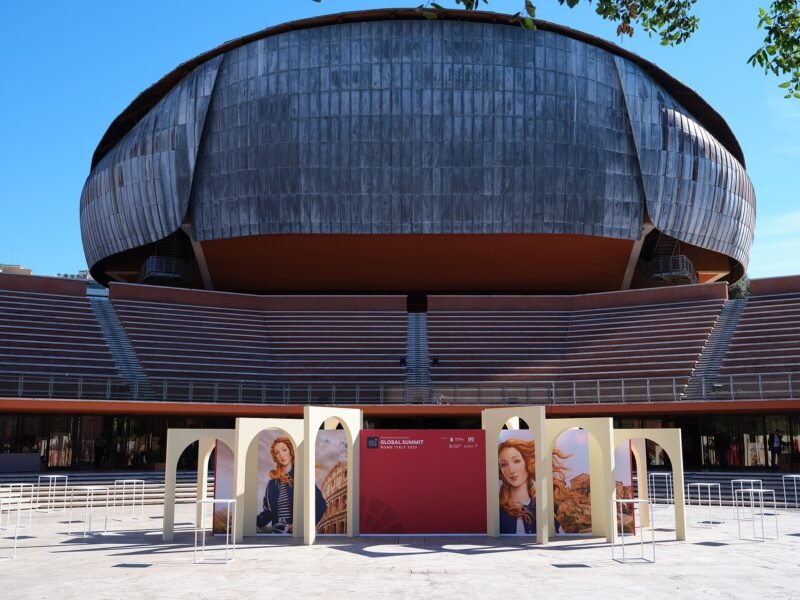
Above the orchestra open 26 shells of American cherry wood, each of about 180 square meters, and the reverberation time is 2.2 seconds. With choir, children's choir and orchestra on stage, it is the right hall for a program that alternates the choral mass and the transparency of a classical symphony.
Choosing the seat
Those who frequent the hall note that sound intensity drops up to the tenth row and then stays stable. The rearmost central stalls and the frontal gallery give the best balance between choir and orchestra. The gallery behind the stage, behind the choir, is for those who want to watch the conductor's gesture.
The architecture
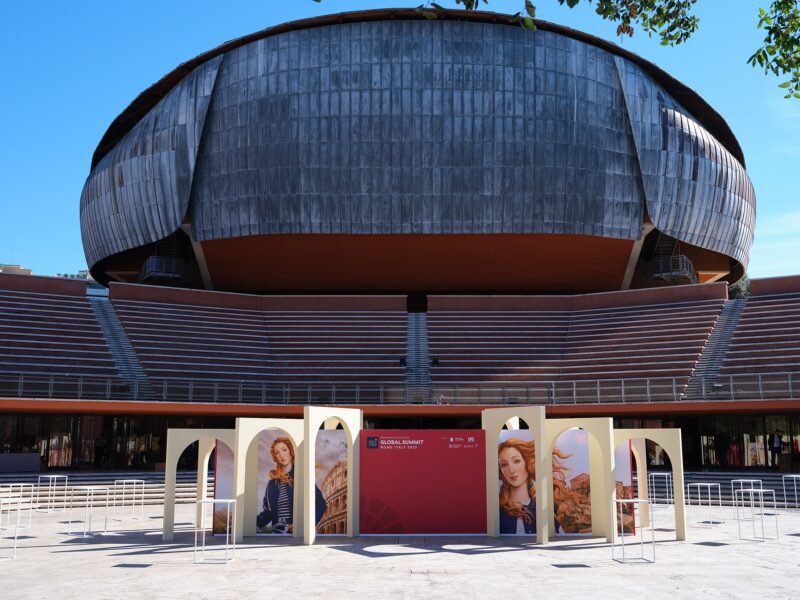
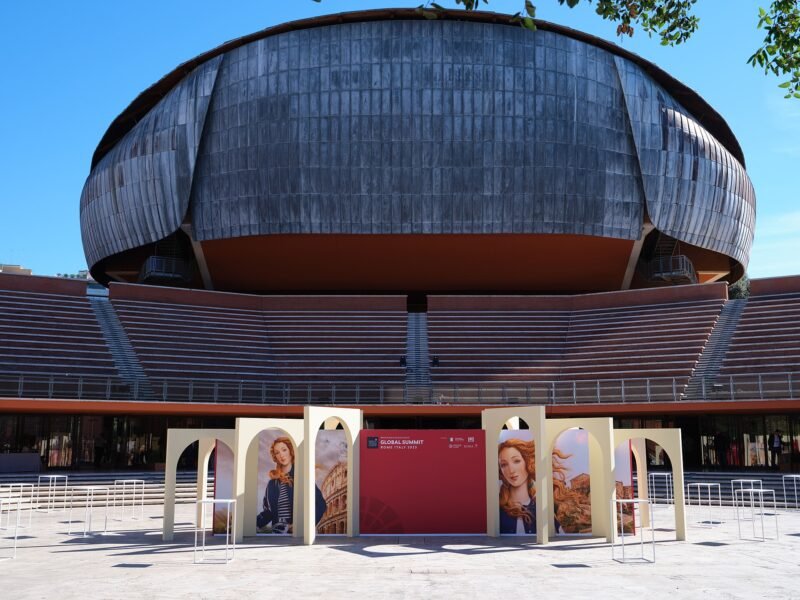
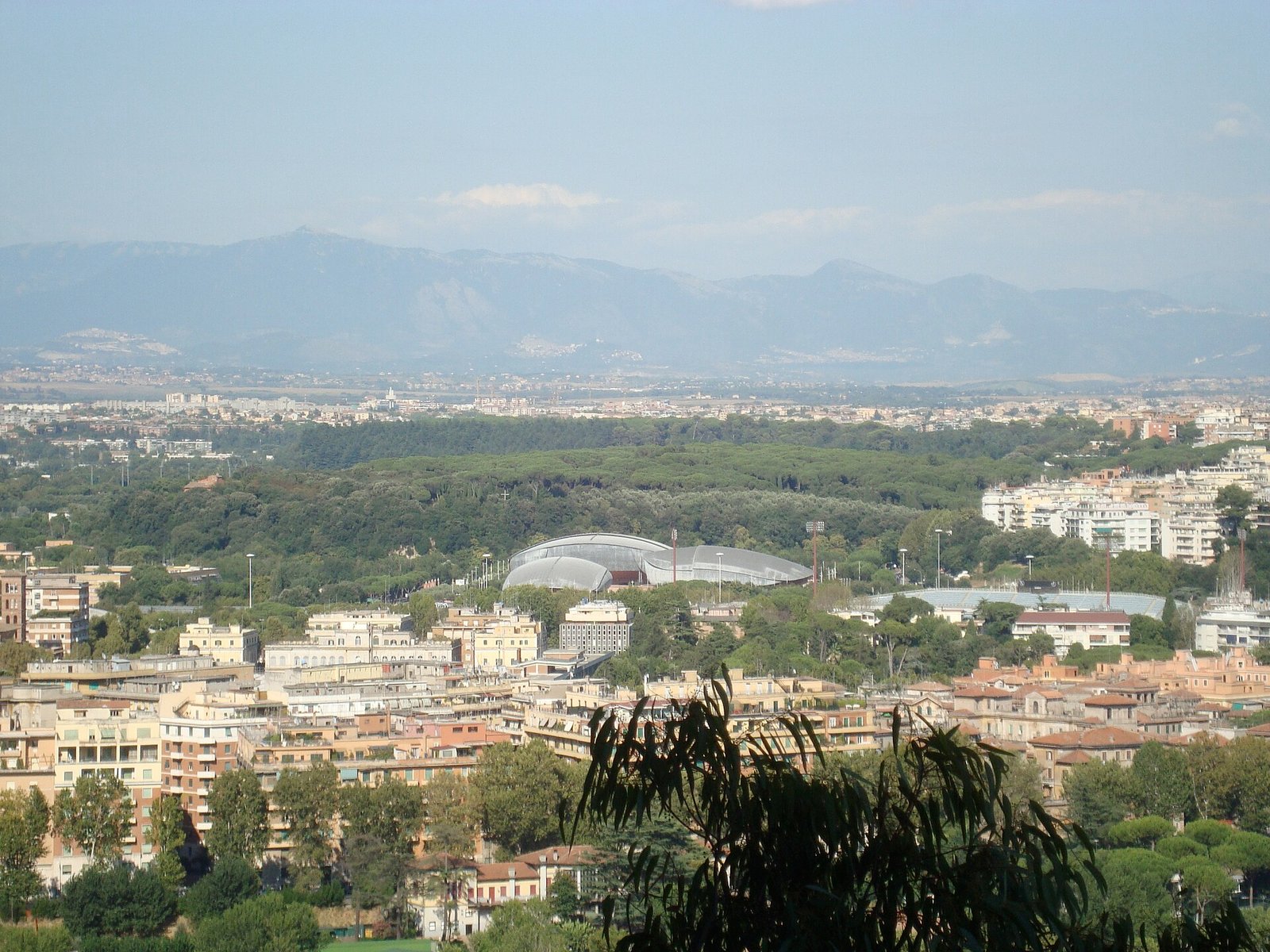
Outside, the three lead-covered volumes rest on a brick base and open in a fan around the cavea named after Luciano Berio. Piano won the competition in 1993. With him worked the acoustician Jürgen Reinhold of the Müller-BBM studio and the landscape architect Franco Zagari. The complex is described in our page on the Auditorium Parco della Musica.
Something nobody tells you about Riccardo Minasi conducts the Eroica at Auditorium Parco della Musica, January 7, 8 and 9, 2027
What few remember is that the original manuscript of the Eroica has been lost. A copy revised by the author survives. For a conductor trained in historical practice like Minasi, who signed a critical edition of Norma, work on the sources is part of the interpretation: tempos, articulations and repeats are choices, not habits. The very length of the symphony, which can vary by a quarter of an hour, depends on this too.
The second thing concerns the finale. The theme of the last movement of the Eroica was not born for the symphony: Beethoven had already used it in the ballet The Creatures of Prometheus. The Titan who brings fire to men and the hero of the symphony literally share the same music.
The third is practical: the Academy closes the doors at the start time, and latecomers follow the concert in the listening rooms as long as there are seats. On January 7, the first working day after the holidays, traffic toward Flaminio can surprise. It is best to allow half an hour of margin.
The Academy and the start of 2027
The Accademia Nazionale di Santa Cecilia, which organizes the concert, is a foundation with a symphony orchestra and choir, a children's choir and an academic body. The music director is Daniel Harding. In the Auditorium it keeps the Bibliomediateca and the Museum of Musical Instruments.
January in the hall
After Minasi, the season continues at the end of January with Jakub Hrůša and Daniil Trifonov. In the first days of the year the Auditorium also hosts concerts by other organizers, such as Nicola Piovani's Viaggi di Ulisse on January 3.
The patron saint
Saint Cecilia, patron saint of music and of the Academy, is venerated in the basilica of Santa Cecilia in Trastevere, a visit to make by day for those staying in Rome over the concert weekend.
The advice I give you for visiting Riccardo Minasi conducts the Eroica at Auditorium Parco della Musica, January 7, 8 and 9, 2027
My advice is to listen first to the Funeral March, the second movement of the Eroica. It is the heart of the symphony: timpani rolls, trumpets with an apocalyptic sound, a central fugato, a coda that falls apart. Those who know it will recognize in the hall the conductor's tempo choices, and with an interpreter of the historical school the differences from traditional recordings can be considerable.
Second piece of advice: read the text of Il momento glorioso. It is a cantata for an occasion, full of allegories, and without knowing who is singing, Vienna, the Genius, the Leader of the people, you lose its sense. Knowing the context, the Congress of Vienna and the fall of Napoleon, turns the listening into a lesson in European history.
Third: the seat. With choir and children's voices on stage, the frontal gallery or the central stalls beyond the tenth row render the ensemble better. Finally, for those who can choose, Saturday the 9th at 18:00 is the most relaxed performance, far from the Thursday return to work.
Tickets for Minasi's Eroica: prices and discounts
Tickets for the Eroica conducted by Riccardo Minasi cost from 23 to 54 euros, in six sections: 54, 47, 37, 35, 30 and 23 euros. Presale for the concerts up to February 27, 2027, January included, has been open since September 10, 2026.
Box offices
The Auditorium box office, in the greenhouse space, is open every day from 11:00 to 20:00. The one at Via Vittoria 6, near Piazza del Popolo, is open Monday to Friday from 11:00 to 19:00 and Saturday from 11:00 to 14:00, with electronic payment only.
Online and information
From the official concert page, under each date, the purchase button leads to the authorized presale network. For information the infoline is 06 8082058. The Academy is not responsible for surcharges applied by unauthorized resellers.
Young people
Under-26s get 30% off the season's concerts, and children under 14, with an adult, pay 3 euros. Reduced tickets are bought at the box offices while promotional seats last and cannot be combined.
How to get to the Auditorium for the Eroica
Auditorium Parco della Musica Ennio Morricone is at Viale Pietro de Coubertin 30. The metro does not reach the entrance: you combine metro A and tram 2, or take a direct bus.
Metro and tram
Take metro A to Flaminio, then tram 2 up Via Flaminia to the Flaminia/Reni or Apollodoro stops. From there you cross the Olympic Village on foot in a few minutes.
Buses
Bus 910 runs from Piazza dei Cinquecento, in front of Termini, to the Auditorium with no changes. Bus 53 links Piazza Mancini and the center, 982 Viale XVII Olimpiade area, 168 the Tiburtina station on weekdays. For the Saturday performance it is best to check the times on the transport company's website.
By car
The stretch of Viale Pietro de Coubertin in front of the entrance is closed to traffic, and the complex's paid parking has limited spaces. On concert evenings the streets of the Olympic Village fill up early.
Another well-known fact, yet rarely mentioned
It is well known that the Eroica changed the history of the symphony. Less often remembered is how it did so from the very first bars: the first theme, in E-flat major, is built simply on the three notes of the home key's chord. An elementary, almost schoolbook material, from which Beethoven draws a first movement of unprecedented size. Anyone who recognizes that theme at the start already holds the key to the whole Allegro.
The second fact concerns the audience at the premiere. During the exposition of the first movement there is a passage of four measures in which the accents fall off the beat, against the meter: a rhythmic jolt that, at the first public performance on April 7, 1805 at the Theater an der Wien, must have surprised listeners. Two centuries later, that surprise is still perceptible.
The third is almost a paradox: the celebratory cantata of 1814 and Wellington's Victory gave Beethoven the most resounding success of his life, while today they are considered minor works. The Eroica, received as a challenge, has become a monument. Hearing them together helps us understand how the history of music sometimes overturns the judgments of contemporaries.
How to organize the evening
For Minasi's Eroica it is best to arrive at the Auditorium at least 40 minutes early: ticket pickup, checks, coat check and the climb to the hall take time.
Before going in
The foyer shared by the halls has a bar, a cafeteria and a well-stocked music bookstore. From the terrace that runs around the buildings you see the remains of the Roman villa uncovered during the works, a good way to use 10 minutes of waiting.
How long it lasts
The concert page does not give the overall duration. The Eroica alone takes between 41 and 56 minutes depending on the conductor's choices. With the two choral pieces it is a full symphonic evening.
On the way out
The cavea is the space where the audience can disperse. Those who left the car in the side streets of the Olympic Village should be ready for a few minutes of waiting.
The right photo to take at Riccardo Minasi conducts the Eroica at Auditorium Parco della Musica, January 7, 8 and 9, 2027
During the concert the phone stays off: in the Funeral March the strings' pianissimos are part of the music, and a lit screen disturbs the whole hall. The photo is taken before and after.
The most beautiful is the full stage before the start, if the staff allows it: the orchestra, the choir behind and the children's voices lined up, under the cherry-wood shells of the ceiling. It is rare to see all the Academy's forces together, and the image tells the evening better than any portrait.
Outside, in January, at 18:00 it is already dark. From the top of the cavea the three lead volumes reflect the lights, and the crowd going in gives the measure of the spaces. During the final applause, without flash, you can photograph Minasi's bow with the soloists and the choirs. And on the way out, the view of the volumes seen from below on Viale Pietro de Coubertin remains, in our judgment, the most original shot.
Some important events that took place here in history
An ancient history lies beneath the Auditorium: during construction the remains of a Roman villa of the 3rd century BC emerged, built in place of a small archaic farm of the 6th century BC. To preserve them Renzo Piano moved two of the three volumes westward, almost to the Corso di Francia viaduct, and the finds are displayed in a small museum under the cavea.
The musical history of the place was born from a loss: in 1936 the Augusteo, Rome's great concert hall, was torn down, and for more than 60 years the city had no auditorium built for symphonic music. In 1992 the city chose the Olympic Village area, and in 1993 Piano won the competition.
Sala Sinopoli opened on April 21, 2002, Sala Santa Cecilia on December 21, 2002 with the Academy's orchestra conducted by Myung-Whun Chung. Since 2003 it has been the permanent home of the Academy's season, since 2006 of the Rome Film Festival, and since 2020 it has carried the name of Ennio Morricone. In 2027 the Beethoven Year opens here.
Who has passed through Riccardo Minasi conducts the Eroica at Auditorium Parco della Musica, January 7, 8 and 9, 2027
Sala Santa Cecilia has seen on the podium the Academy's music directors, from Myung-Whun Chung, who inaugurated it, to Antonio Pappano and Daniel Harding. Goffredo Petrassi attended the opening of Sala Petrassi, Luciano Berio gave his name to the cavea, and Wolfgang Sawallisch criticized its acoustics in the first months. Evgeny Kissin has been a guest of the Academy since 1991.
Minasi himself has already been here, as violinist and as conductor: he was soloist and concertmaster with the Academy's orchestra and has been its guest on the podium. His training includes the same names that run through the Academy's season: Jordi Savall, with whom he played in Le Concert des Nations, and Il Giardino Armonico, the same school Enrico Onofri comes from, who conducts the Christmas Oratorio in this hall in December.
In January 2027 the soprano Benedetta Torre, the soprano Elena Gvritishvili, the tenor Siyabonga Maqungo, the bass Alessandro Luongo, the Academy's Choir with Andrea Secchi and the Children's Choir with Claudia Morelli return with him.
Accessibility and young people at the Eroica
The Academy offers people with walking disabilities who hold the Disability Card a 15% discount on two tickets, at the box office. For wheelchair users the ticket costs 10 euros and the person assisting enters free, while seats last.
Booking
Non-ambulatory people must book from 15 days before up to the day before the concert, at 06 8082058 or biglietteria@santacecilia.it. For January 7 the window opens on December 23, in the middle of the holidays. Better not to leave it to the last minute.
The route
The hall is built on a raised floor, above the Roman villa, and the galleries have only two elevators. Arriving an hour early avoids the lines. The Academy's Courtesy Service is present from one hour before the start at subscription concerts.
With young people
The children's choir on stage makes the concert especially suited to a young person who sings or studies music: seeing peers next to a symphony orchestra is a motivating experience. With the 3-euro ticket for under-14s, it is an opportunity to consider.
The Auditorium's neighborhood
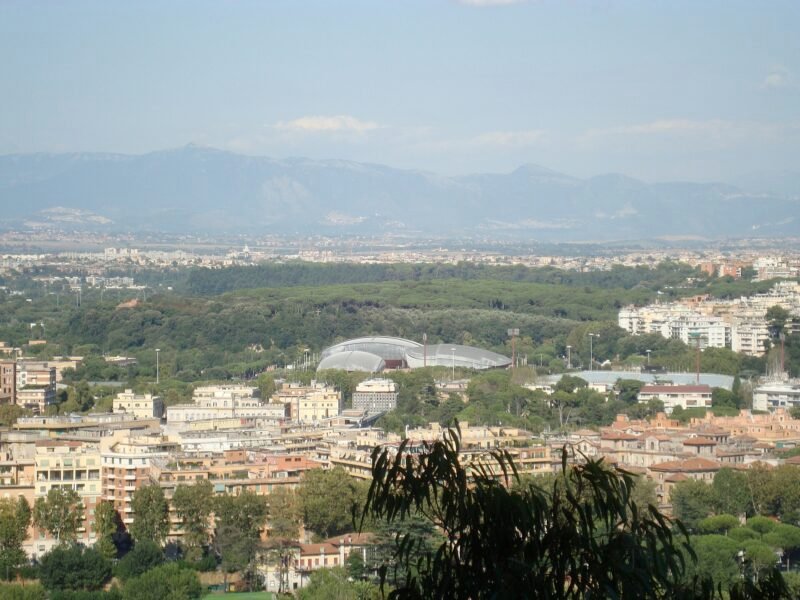
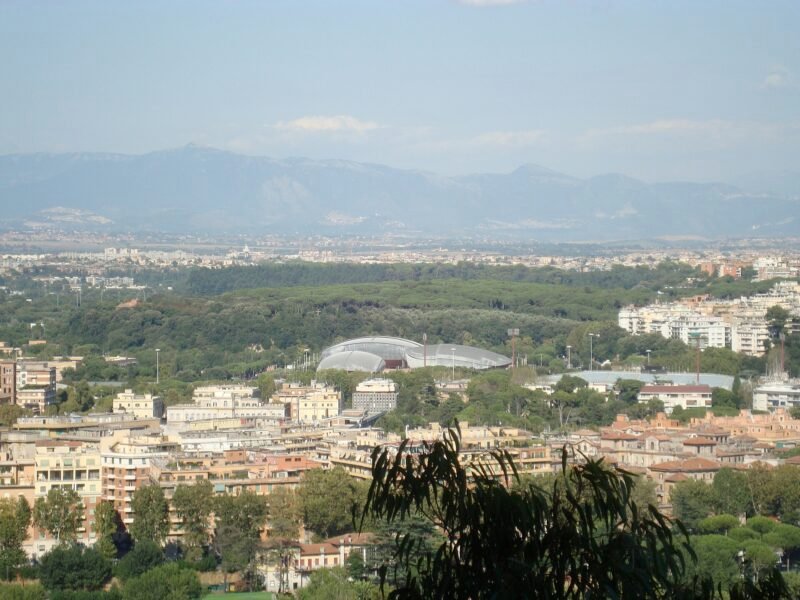
The Auditorium covers about 55,000 square meters between Villa Glori, the Olympic Village, the Corso di Francia viaduct and Viale Maresciallo Pilsudski, in a quadrant of 20th-century Rome where contemporary architecture coexists with greenery.
The MAXXI
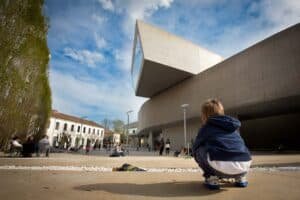
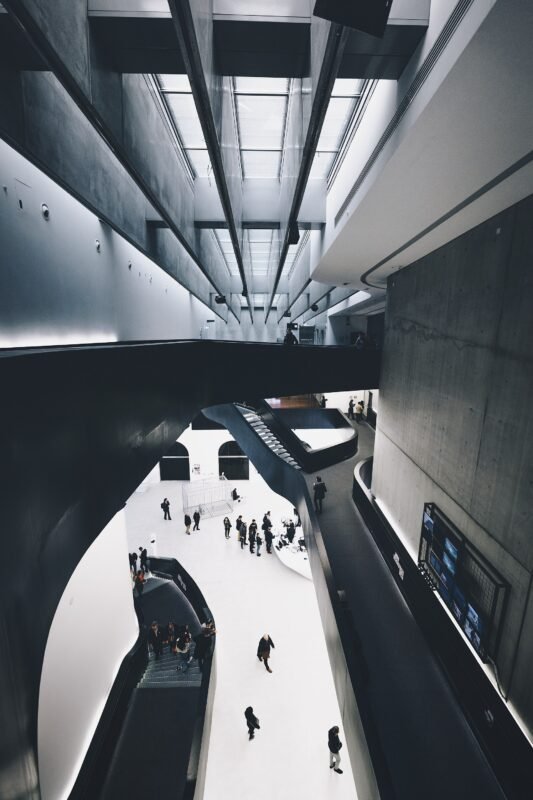
Toward Via Guido Reni, a few minutes on foot, Zaha Hadid's MAXXI forms with the Auditorium the most important pair of contemporary architectures in the city.
Milvian Bridge
A little farther north, Milvian Bridge is the evening meeting point of northern Rome, with the widest choice of venues for after the concert.
Where to eat before or after the Eroica
Inside the Auditorium there are a bar and a cafeteria in the foyer and a restaurant bar with street access too, convenient for the Thursday concert. Between the Olympic Village, Via Flaminia and Piazza Mancini you find pizzerias, trattorias and neighborhood bars. After the Saturday performance, Ponte Milvio offers venues open late, while toward Piazzale Flaminio and the Tridente the choice is the pricier one of the historic center.
January in Rome
The days after Epiphany are among the quietest of the year in Rome: the holidays are over, museums are less crowded, music seasons start again. Those arriving on the concert days still find some traces of the festivities described in the page on Christmas in Rome. January evenings are cold and the Auditorium is an open complex: a coat and a folding umbrella are useful.
Frequently asked questions about Minasi's Eroica at Santa Cecilia
When does Riccardo Minasi conduct the Eroica in Rome?
Riccardo Minasi conducts Beethoven's Eroica with the Orchestra of the Accademia di Santa Cecilia on Thursday, January 7, 2027 at 19:30, Friday the 8th at 20:00 and Saturday the 9th at 18:00, at Auditorium Parco della Musica Ennio Morricone, Viale Pietro de Coubertin 30, with the same program on the three evenings.
What is on the program besides the Eroica?
In Riccardo Minasi's concert at Santa Cecilia, besides Symphony No. 3, the "Eroica," you hear the cantata Il momento glorioso, written for the Congress of Vienna, and the Canto del sacrificio op. 121b, with four soloists, the Academy's Choir and Children's Choir.
How much do tickets for Minasi's Eroica cost?
Tickets for the Eroica conducted by Minasi cost from 23 to 54 euros depending on the section. Under-26s get 30% off and children under 14 with an adult pay 3 euros, at the box offices and while promotional seats last.
Why does the Academy celebrate Beethoven in 2027?
In 2027 the Accademia di Santa Cecilia celebrates the bicentenary of Beethoven's death, which took place in 1827. Riccardo Minasi's concert from January 7 to 9 opens the season's Beethoven Year.
Who is Riccardo Minasi?
Riccardo Minasi, who conducts the Eroica at Santa Cecilia, was born in Rome in 1978 and studied at the Conservatorio Santa Cecilia. He is music director of the Opera Carlo Felice in Genoa, has led the Mozarteumorchester of Salzburg and co-founded the ensemble Il Pomo d'Oro.
How do you get to Auditorium Parco della Musica?
Auditorium Parco della Musica is reached by metro A to Flaminio and then tram 2, stops Flaminia/Reni or Apollodoro, or by buses 910 from Termini, 53, 982 and 168. In front of the entrance, Viale Pietro de Coubertin is closed to cars.
Can you get in if you arrive late?
At the Accademia di Santa Cecilia concerts the doors close at the start time. Those who arrive late to Minasi's Eroica do not enter the hall and follow the concert in the listening rooms, while seats last. It is best to arrive 40 minutes early.
The final advice on Minasi's Eroica at Santa Cecilia
A Roman conductor, a student of the Conservatory that bears the same name as the Academy, opens the bicentenary year with the symphony that Beethoven dedicated and then withdrew from Napoleon, next to the cantata written for Napoleon's victors. In our judgment it is the smartest way to begin 2027 in music. It is best to listen first to the Funeral March, read the text of Il momento glorioso, choose the Saturday performance if you can, and arrive early: the doors do not wait.
Article written by the editorial team of Tour Leader Pro, contact them for Private/Corporate/V.I.P. Tours and Experiences.
Planning a trip to Rome? The English-language guides to visiting the city are on ItalyPlanner.com.
Contact Information
Nearby
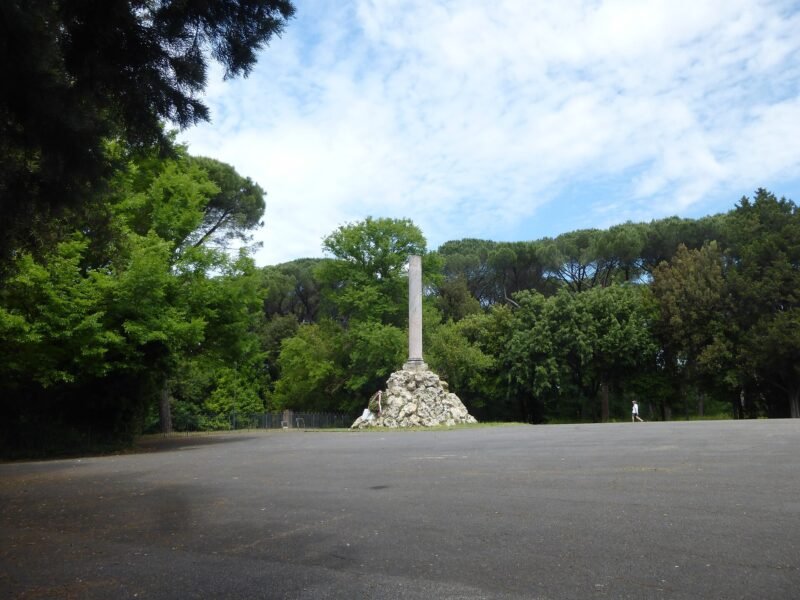
 Museum of Musical Instruments (MUSA)100 m
- Auditorium Parco della Musica100 m
- Villa Glori500 m
- Fountain of Anna Perenna500 m
- MAXXI – National Museum of 21st Century Arts700 m
- Flaminio700 m
Upcoming events nearby
- Roma Jazz Festival 2026, November 1 to 24 at the Auditorium and Casa del Jazz100 m
- Evgeny Kissin and András Schiff at Santa Cecilia, November 9, 2026100 m
- Roma Gospel Festival 2026 at Auditorium Parco della Musica, December 13, 2026 to January 1, 2027100 m
- Santa Cecilia 2026/2027 Concert Season at Auditorium Parco della Musica, October 21, 2026 to June 5, 2027100 m



You might also like
- Nubras Ensemble at Auditorium Parco della Musica, February 27, 2027
- Fabio Luisi and Beethoven’s Missa Solemnis at Auditorium Parco della Musica, February 25 to 27, 2027
- Lorenzo Viotti and Lisa Batiashvili at Auditorium Parco della Musica, February 18, 19 and 20, 2027
- Antonio Pappano and Jan Lisiecki at Auditorium Parco della Musica, February 11, 12 and 13, 2027
- Tarmo Peltokoski and Bertrand Chamayou at Auditorium Parco della Musica, February 4, 5 and 6, 2027
- Sergej Khachatryan and Alexandre Kantorow at Auditorium Parco della Musica, February 3, 2027