Nicola Piovani, Viaggi di Ulisse at Auditorium Parco della Musica, January 3, 2027
In short. Nicola Piovani brings Viaggi di Ulisse to Auditorium Parco della Musica Ennio Morricone on Sunday, January 3, 2027 at 18:00, in Sala Sinopoli, Viale Pietro de Coubertin 30 (00196 Rome).
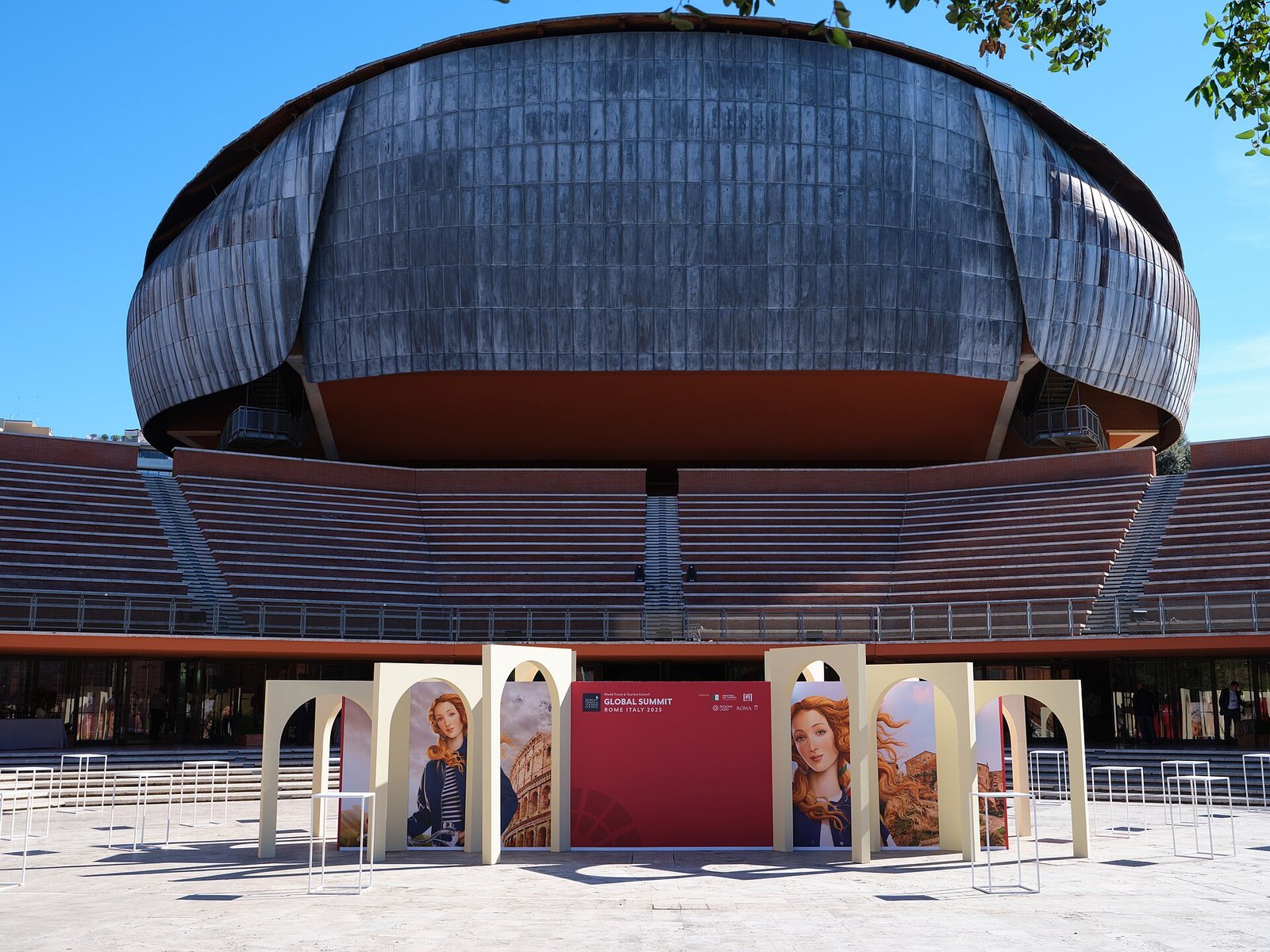
Nicola Piovani brings Viaggi di Ulisse to Auditorium Parco della Musica Ennio Morricone on Sunday, January 3, 2027 at 18:00, in Sala Sinopoli, Viale Pietro de Coubertin 30 (00196 Rome). It is the mythological concert written and conducted by the Oscar-winning composer, with Piovani on piano and five soloists of his orchestra, recorded voices and drawings by Milo Manara. You get there by metro A to Flaminio and then tram 2, or by bus 910 from Termini, with no changes. The complex also has paid parking. Tickets start from 25 euros according to the Auditorium's official page and are bought on the venue's official website, which links to the authorized presale network, or at the complex's box office.
A Sunday afternoon in early January, with the holidays winding down, is the right moment for a story told in music about journey and return. Piovani has been taking it around for 15 years and has brought it back to Rome several times. Those who have never seen it find here the most mature version, those who know it find a work that has become leaner over time.
Viaggi di Ulisse: what you hear in Sala Sinopoli
Viaggi di Ulisse is a story told in music for instruments that dialogue with recorded voices. Piovani calls it a mythological concert, and built it on the emotions left by reading some of the Homeric hero's journeys.
Music in place of words
In the official presentation the composer immediately clarifies the pact with the audience. Instrumental music cannot recount facts, which only words can describe. It can, however, try to give body to the emotion that those facts still arouse today. Ulysses, a character three millennia old, remains for Piovani a figure of indecipherable fascination and wonder, and the concert is born from this amazement of a reader.
The recorded voices
Alongside the instruments are voices reciting verses by poets: Homer, Pindar, Torquato Tasso, Konstantinos Kavafis, James Joyce, Umberto Saba. They are inserted into the score and have, Piovani explains, a fundamentally sonic role: they do not comment on the music, they are part of it. Among the recorded voices listed by the official page are those of James Joyce and Siobhan McKenna.
The actors on video
The show also uses video. On the screen appear Carlo Cecchi, Paila Pavese, Massimo Popolizio, Mariano Rigillo, Virgilio Zernitz, Chiara Baffi and Massimo Wertmuller: a small company of Italian theater lending face and voice to the texts. The name of Carlo Cecchi, in particular, is no accident in Piovani's biography, since in his youth he worked at length with his company.
Milo Manara's drawings
The visual part is completed by Milo Manara's drawings. The meeting between the cartoonist and the Odyssean imagination is one of the reasons Viaggi di Ulisse works even for those who do not frequent concert halls: the narration passes through the eyes as much as through the ears.
The lineup: Piovani and the soloists of his orchestra
On stage, according to the Auditorium's page, are six musicians: Nicola Piovani on piano with Marina Cesari on sax and clarinet, Sergio Colicchio on keyboard and accordion, Pasquale Filastò on cello and mandocello, Marco Loddo on double bass and Vittorino Naso on drums and percussion.
A chamber ensemble
The ensemble described by Piovani includes piano, double bass, sax, cello, percussion and electronic keyboard. It is a small group, closer to a chamber ensemble than to an orchestra, and precisely for this reason suited to letting detail be heard: the timbre of the mandocello, the breath of the clarinet, the measured strokes of the percussion.
Long-standing musicians
The soloists are those the audience of Piovani's concerts has known for years. Marina Cesari, on sax, is also the composer's wife, as her biography recalls. A detail that says a lot about the family, almost workshop-like nature of this group.
Written and conducted by Piovani
The official wording is clear: written and conducted by Nicola Piovani. The composer is author, conductor and pianist at once, and the evening has the form of a first-person narrative, even when Homer and Joyce speak on stage.
Date, time and tickets for Viaggi di Ulisse
There is only one concert: Sunday, January 3, 2027 at 18:00, in Sala Sinopoli, with tickets starting from 25 euros.
The afternoon time
The 18:00 start is a precise choice for a holiday Sunday. You leave in time to dine without hurry, and those from outside Rome can head home in the evening. It is also the most convenient time for those bringing young people or elderly parents.
Where to buy tickets
Tickets are bought from the button on the event page on the Auditorium's official website, which links to the authorized presale network, or at the box office. The box office, according to the website, is open from 11:00 to 20:00 from October to March, on Sundays and holidays too.
The price
The official page lists prices from 25 euros. Rates vary by section. The exact price of each seat appears at the time of choosing on the hall map.
Nicola Piovani: the biography
Nicola Piovani was born in Rome, in the Trionfale neighborhood, on May 26, 1946. A pianist, composer and conductor, he won the Oscar in 1999 for the soundtrack of Roberto Benigni's La vita è bella.
A family of music and theater
His father, Alberico, originally from Corchiano in the Viterbo area, was an amateur musician and played trumpet in the town band. His aunt, Pina Piovani, was an actress of the great Roman companies, from Ettore Petrolini's to Aldo Fabrizi's, and in 1935 founded a Roman musical company with Romolo Balzani. Little Nicola began with the accordion, then moved to the piano, up to his diploma at the Conservatorio Giuseppe Verdi in Milan.
The years of protest
After the Mamiani high school, at university he joined a collective that also included the director Silvano Agosti. In 1968 the collective produced a series of newsreels on the student movement, and Piovani was assigned the musical commentary: his first soundtrack. The following year Agosti entrusted him with N.P. Il segreto, with Irene Papas.
Cabaret, Hadjidakis, De André
To support himself he played in a cabaret venue, where one evening he found himself at the piano for Vittorio De Sica singing Parlami d'amore Mariù. He offered himself as an anonymous orchestrator to the Greek composer Manos Hadjidakis to steal the secrets of his writing. He worked as an arranger for the Produttori Associati and co-authored with Fabrizio De André two albums, Non al denaro non all'amore né al cielo and Storia di un impiegato.
Film
After N.P., Marco Bellocchio called him for Nel nome del padre (1972): a collaboration lasting more than 10 years and the beginning of a path that led him to work with the Taviani brothers, Nanni Moretti, Mario Monicelli, Giuseppe Tornatore and Federico Fellini, whose last three films he scored, Ginger e Fred, Intervista and La voce della Luna. With Benigni the partnership began in the theater with Tuttobenigni and reached La vita è bella. After the Oscar, in Los Angeles, he used the journalists to clarify that he was not a pseudonym of Ennio Morricone, as had been wrongly written in the United States.
The prizes
Besides the Oscar, Piovani has won four David di Donatello (Ginger e Fred, Caro diario, La stanza del figlio, I fratelli De Filippo), several Nastri d'argento and Ciak d'oro, the foreign press Golden Globe for lifetime achievement, the Premio Elsa Morante. In 2008 France named him a knight of the Ordre des Arts et des Lettres. In 2001 he became a commander of the Order of Merit of the Republic.
Nicola Piovani's musical theater
Alongside film, Piovani built a personal musical theater, in which music and words have the same weight. Viaggi di Ulisse is one of its fruits.
The Compagnia della Luna
At the end of the 1980s, with the writer Vincenzo Cerami and the actor Lello Arena, he founded the Compagnia della Luna. La cantata del Fiore (1988) and La cantata del Buffo (1990) were born, then Il signor Novecento, Canti di scena, performed for six seasons, and Romanzo musicale, where Cerami and Piovani told the classical myths through the eyes of the contemporary man: the seed, in our judgment, of the future Ulysses.
From La Pietà to L'isola della luce
In 1998 La Pietà debuted, a stabat mater on a text by Cerami, later taken to Bethlehem and Tel Aviv. In 2003, commissioned by the Greek government, he wrote L'isola della luce, with texts from Homer and Ecclesiastes, performed among the ruins of Delos as the opening show of the Athens 2004 Olympics. The Greek world, in short, returns often in his music.
The birth of Viaggi di Ulisse
Viaggi di Ulisse was first presented at the Ravello Festival in September 2011, as a musical tale for orchestra and recorded voices on verses by Joyce, Kavafis, Homer, Saba and Tasso. In 2016 Rai included it in Piovani's cycle La cometa musicale, alongside Canti di scena, Padre Cicogna and Epta.
The most recent works
In recent years Piovani has also reached opera: Amorosa presenza, from Cerami's novel, at the Teatro Verdi in Trieste in 2022, and Il labirinto di Creta at the Petruzzelli in Bari in 2024, a fable for young people with a libretto written with Paola Ponti. Since 2022 he has been artistic director of the Gigi Proietti Globe Theatre in Rome.
Sala Sinopoli of Auditorium Parco della Musica
Sala Sinopoli is the middle-sized hall of Auditorium Parco della Musica Ennio Morricone: 1,133 seats, inaugurated on April 21, 2002, Rome's birthday, together with Sala Petrassi.
The name
The hall is named after Giuseppe Sinopoli, conductor and composer, permanent conductor of Santa Cecilia and among the most convinced supporters of a hall built expressly for music in Rome. The acoustic design of the entire complex was handled by Jürgen Reinhold of the Müller-BBM studio of Munich.
The right size
A little over 1,000 seats is an ideal size for a chamber ensemble with video and recorded voices: enough for an event, not so many that the sound disperses. Stalls and galleries stay close to the stage, and the screen with Manara's drawings is visible from almost every seat.
Auditorium Parco della Musica Ennio Morricone
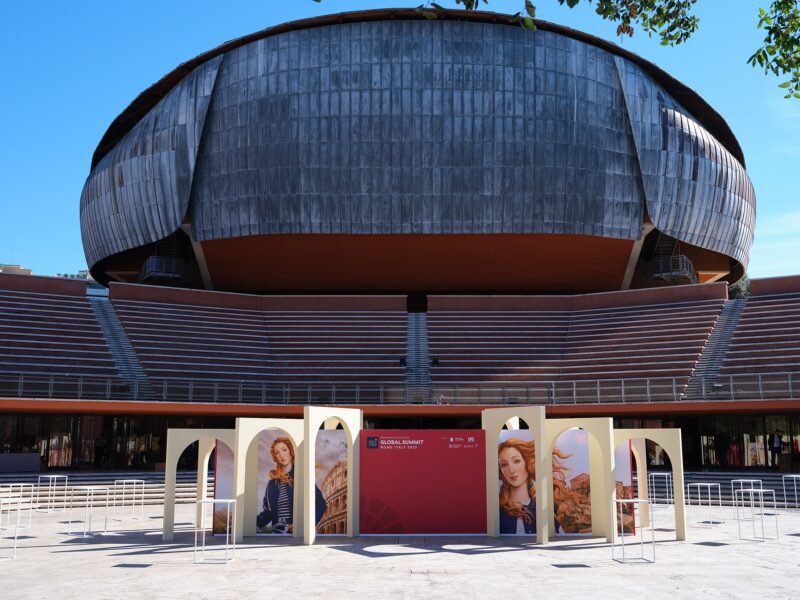
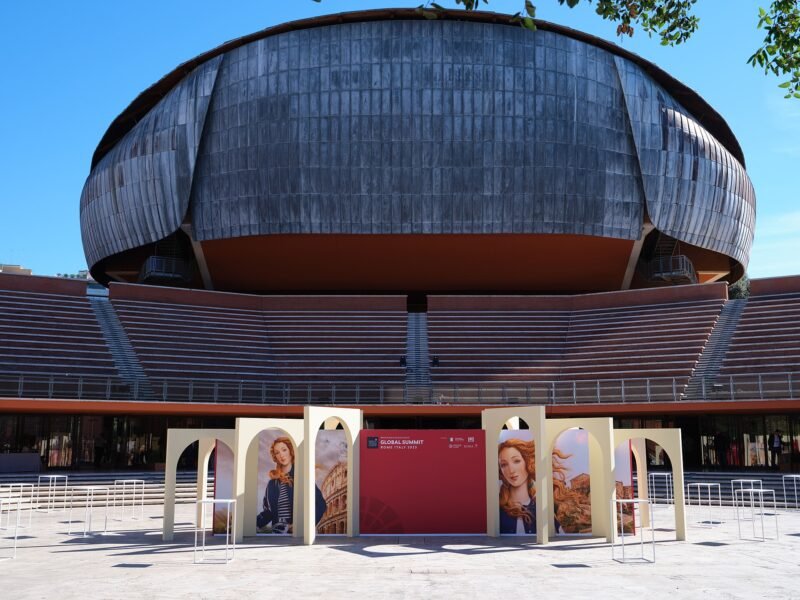
The Auditorium Parco della Musica Ennio Morricone is the complex designed by Renzo Piano at Flaminio, opened in 2002: three large halls, the Teatro Studio Borgna and the open-air cavea named after Luciano Berio.
The three sound boxes
The main halls, Santa Cecilia, Sinopoli and Petrassi, are arranged around the cavea like three large sound boxes. The complex is completed by the Teatro Studio, the Museum of Musical Instruments of the Accademia di Santa Cecilia and the hanging gardens named after Claudio Abbado.
A name from film
In 2020 the Auditorium was named after Ennio Morricone. For Piovani, who in Los Angeles had to explain that he was not a pseudonym of his colleague, playing in a house that bears that name has a special flavor.
The Roman villa under the cavea
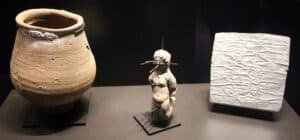
During the excavations for the foundations the remains of a Roman villa of the 3rd century BC emerged, built on the site of an archaic farm. Renzo Piano modified the design and the finds are displayed in a small museum under the cavea: another ancient story, a few meters from the Odyssey in music.
How to get to the Auditorium for Viaggi di Ulisse
The Auditorium is at Viale Pietro de Coubertin 30, at Flaminio. The simplest connection from the center is metro A to Flaminio and then tram 2 toward Piazza Mancini.
Tram and metro
From Piazzale Flaminio tram 2 runs along Via Flaminia and stops at Flaminia/Reni and Apollodoro, a few minutes' walk from the entrance. On Sundays the frequencies are lower than on weekdays, so it is best to leave with some margin.
By bus
Bus 910 leaves from Termini and arrives with no changes. Lines 53, 168 and 982 also pass nearby. For the updated route it is best to use the ATAC planner.
By car
The complex has paid parking, open-air and multistory, with spaces reserved for people with disabilities. On a Sunday in January at 18:00 traffic on the Lungotevere and on Corso di Francia is usually bearable.
On foot
From Piazza del Popolo it takes about 40 minutes along Via Flaminia. A long but flat walk, possible on a clear winter day.
What is around the Auditorium
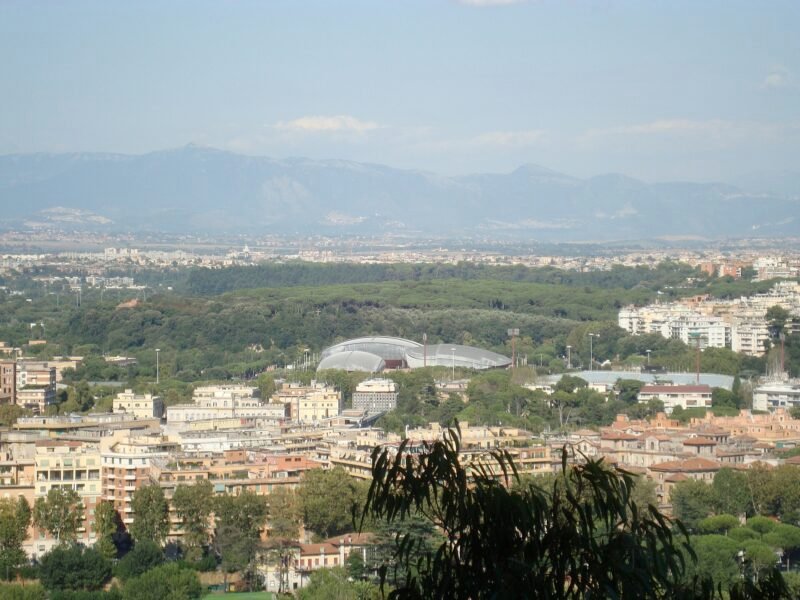
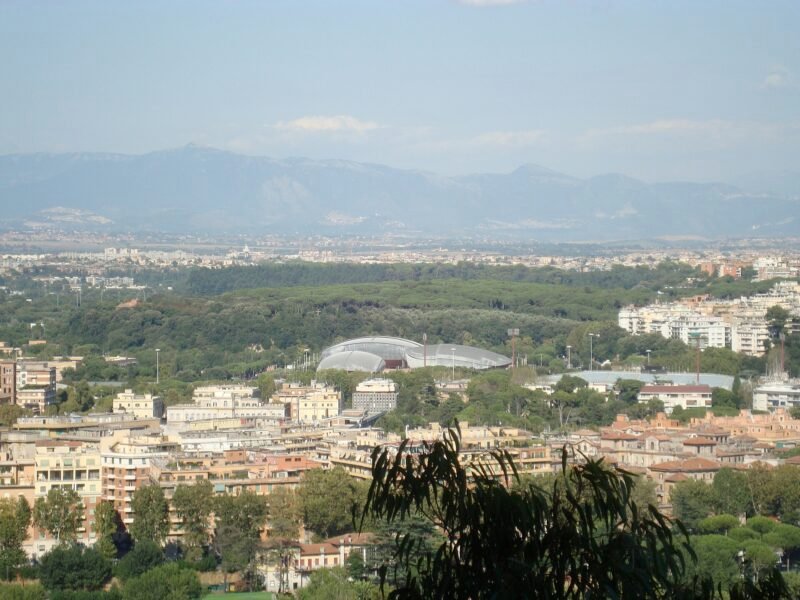
The Auditorium lies between Villa Glori, the Olympic Village and the Corso di Francia viaduct, in a neighborhood that combines 20th-century architecture and contemporary art.
The MAXXI
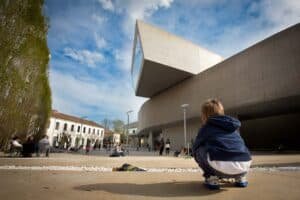
A few minutes away, along Via Guido Reni, is the MAXXI, the national museum of 21st-century arts. A Sunday can begin there and end in Sala Sinopoli.
Ponte della Musica and Foro Italico
Going down toward the Tiber you meet the Ponte della Musica, the footbridge that leads to the Foro Italico. Farther north is Milvian Bridge, an evening meeting place.
Teatro Olimpico
Not far away is the Teatro Olimpico, another historic hall of the neighborhood. Those staying in Rome a few days can build a small tour of the stages of Flaminio.
Where to eat before or after the concert
Inside the Auditorium there are a bar and a cafeteria in the foyer and a restaurant bar with street access too. Outside, between the Olympic Village, Via Flaminia and Piazza Mancini, pizzerias, trattorias and neighborhood bars.
Before 18:00
With the start at 18:00 a late lunch or a snack at the foyer bar is enough. Those who arrive early can sit in the hanging gardens or visit the instruments museum.
After the concert
On the way out, around 19:30, the widest choice is at Ponte Milvio, a few minutes away. On an early January Sunday evening many venues are still on holiday schedules, so booking is prudent.
Accessibility, age and practical information
The Auditorium is spread over several levels among terraces, foyers and halls. For accessibility needs it is best to write in advance to Fondazione Musica per Roma, info@musicaperroma.it, to find out which entrance to use and which seats to choose.
With teens and students
Viaggi di Ulisse is one of the classical music offerings best suited to middle and high school students who study the Odyssey: Manara's drawings, the actors on video and Piovani's melodies make the myth accessible without simplifying it. For very young children the length of a concert can be demanding.
Arriving on time
The complex is large and the halls are reached by crossing the cavea. It is best to be at the box office or ticket check at least 20 minutes early.
Early January in Rome: the last holiday Sunday
January 3 falls at the tail of the holidays: the center is still lit, the museums crowded, and Epiphany is three days away.
The weather
In January Roman evenings are cold and often damp, and the stretch from the tram to the entrance is outdoors. A coat to leave at the coat check and a folding umbrella are the right gear.
After the concert
Those staying in the center can return by tram 2 to Piazzale Flaminio and take a short walk toward Piazza del Popolo and Villa Borghese, still dressed for the holidays.
A curiosity about Nicola Piovani, Viaggi di Ulisse at Auditorium Parco della Musica, January 3, 2027
The nicest curiosity is a family one. Nicola Piovani's aunt, Pina Piovani, was an actress of Roman theater between the wars, who passed through the companies of Ettore Petrolini and Aldo Fabrizi, and in 1935 founded the Compagnia Musicale Romana with Romolo Balzani. The nephew who goes on stage in Sala Sinopoli to tell of Ulysses comes therefore from a house where popular musical theater was daily work, and his theater with Cerami, made of songs and words, is in some way its learned version.
The second curiosity concerns the stage. Among the actors on video in Viaggi di Ulisse is Carlo Cecchi. With his company, in his youth, Piovani toured Italy writing incidental music and sometimes playing on stage as pianist and drummer. 50 years later, the actor returns in the composer's score, this time on a screen.
The third is almost a paradox. The concert is built on recorded voices, and among them is that of James Joyce: the real voice of the Irish writer who turned the Odyssey into the novel of the 20th century. In a hall named after a film composer, those listening to Joyce will be an audience that perhaps has only read him.
Something nobody tells you about Nicola Piovani, Viaggi di Ulisse at Auditorium Parco della Musica, January 3, 2027
What the posters do not say is that Viaggi di Ulisse is not a concert of soundtracks. Those who buy the ticket thinking they will hear La vita è bella or the Fellini themes will find something else: an original score, conceived as a unified narrative, in which the famous pieces do not appear as separate numbers. It is a frequent misunderstanding at concerts by film composers, and it is worth clearing up beforehand.
The second thing concerns the history of the title in Rome. The Auditorium has already hosted it several times: on April 10, 2013, on January 2, 2026, and a date planned for September 4, 2026 was canceled. The return on January 3, 2027 is therefore, in effect, the recovery of a missed appointment and at the same time a small start-of-year tradition: exactly one year after the 2026 performance, only the day of the week changes.
The third thing is practical. The concert lasts as long as a theater show, without the ritual of the symphonic season: no program notes to study, no fear of applause between movements. You go in, listen to a story, and come out with the streetlamps just lit.
The advice I give you for visiting Nicola Piovani, Viaggi di Ulisse at Auditorium Parco della Musica, January 3, 2027
My advice is to choose a central seat, at medium distance from the stage, and not too high in the galleries. Viaggi di Ulisse works on two levels, sound and screen. From the front rows you see Piovani's hands on the keyboard well but the screen is too high. From the last galleries you lose the presence of the musicians. The central stalls hold the two together.
Second piece of advice: reread a canto of the Odyssey in the days before. You do not need a classicist's preparation. The episode of Nausicaa or that of the Sirens, or one of Kavafis's poems, is enough. The recorded voices will arrive like already familiar faces.
Third: arrive half an hour early and go up onto the cavea before entering. At 17:30 on a January day the sky above Flaminio is already dark, Piano's three halls light up and the complex shows its best form.
Finally, in our judgment, it is worth not rushing off. After a tale of journeys and returns, 10 minutes of silence in the hanging gardens, if open, are worth as much as an encore.
Another well-known fact, yet rarely mentioned
Everyone knows that Nicola Piovani won the Oscar for La vita è bella. Less often remembered is that his career begins alongside Fabrizio De André, as co-author of Non al denaro non all'amore né al cielo and Storia di un impiegato. Two albums born from literary texts that put music at the service of a narrative: exactly the principle that supports, 50 years later, Viaggi di Ulisse.
A second fact, known but rarely cited, concerns television. From June 2014 to September 8, 2022 the theme of the Tg1 news was Kopertina, composed by Piovani: millions of Italians listened every evening for eight years to his music without knowing it. The composer of a mythological concert is also the one who marked the evening news.
The third concerns art-house film. The collaboration with Fellini, for the last three films, made Piovani the natural heir of Nino Rota, and the tie with Nanni Moretti brought him two Davids, for Caro diario and La stanza del figlio. The audience on January 3 will hear different music, but the hand is the same: clear melodies, light orchestrations, a taste for irony that never becomes coldness.
The right photo to take at Nicola Piovani, Viaggi di Ulisse at Auditorium Parco della Musica, January 3, 2027
During the concert you do not take photos or film: in a show that lives on video and lights, a lit phone disturbs the whole row. The photo is taken before or after.
The most successful is shot from the cavea, shortly before 18:00. With the January darkness Renzo Piano's three halls stand out against the Flaminio sky, and the foyer windows light up. Stand at the center of the steps, low down, and frame Sinopoli with the cavea in the foreground. It is the image that best tells an architecture conceived as a city of music.
A second photo can be taken in the foyer, in front of the concert posters, for those who want a keepsake of the evening. Those who arrive early also find, under the cavea, the display cases with the finds from the Roman villa of the 3rd century BC discovered during the works: a real antiquity, to photograph before listening to the one told in music.
On the way out, if the sky is clear, the view from the footbridge toward the Tiber and the lit Foro Italico ends the evening with another night frame.
Some important events that took place here in history
The history of the Auditorium begins with an absence. In 1936 the Augusteo, Rome's great concert hall, was demolished, and for over 60 years the city remained without a place built for symphonic music. In 1992 the city council chose the Olympic Village area. In 1993 Renzo Piano won the invitational competition. The works brought to light the Roman villa of the 3rd century BC that forced the architect to revise the design.
On April 21, 2002, Rome's birthday, Sala Sinopoli and Sala Petrassi were inaugurated, in the presence of an elderly Goffredo Petrassi. On December 21 of the same year Sala Santa Cecilia opened. Since 2003 the complex has been the home of the Accademia Nazionale di Santa Cecilia season, since 2006 it has hosted the Rome Film Festival, and in 2020 it was named after Ennio Morricone.
For Nicola Piovani the Auditorium is a frequent home. Here in January 2017 he was a guest at Tosca's concert, and here Viaggi di Ulisse was staged on April 10, 2013 and January 2, 2026. The concert of January 3, 2027 adds to a list of returns: fitting, for a show about a man who comes home.
Who has passed through Nicola Piovani, Viaggi di Ulisse at Auditorium Parco della Musica, January 3, 2027
Through Sala Sinopoli and the complex's other halls have passed, in over 20 years, the great names of symphonic music, jazz and song: the orchestras conducted for Santa Cecilia, from Chung Myung-whun, who inaugurated the large hall, to Daniel Harding and Jakub Hrůša in the current season. The jazz musicians of the autumn Roma Jazz Festival, such as Paolo Fresu, who presents in Sala Sinopoli this year both Kind of Lives and his Christmas Songs. The Italian singer-songwriters and the international stars of the summer cavea.
The history of the complex also includes film. Since 2006 the Rome Film Festival has brought directors and actors from all over the world onto the red carpets of the cavea, and the naming after Ennio Morricone links the Auditorium forever to film music. Piovani arrives as an Oscar-winning composer, with Fellini, Moretti, Benigni, the Tavianis and Bellocchio behind him.
On January 3, 2027 Nicola Piovani, Marina Cesari, Sergio Colicchio, Pasquale Filastò, Marco Loddo and Vittorino Naso pass through Sala Sinopoli. On the screen, Carlo Cecchi, Paila Pavese, Massimo Popolizio, Mariano Rigillo, Virgilio Zernitz, Chiara Baffi and Massimo Wertmuller. In the recordings, the voice of James Joyce and that of Siobhan McKenna. In the drawings, Milo Manara. And, through the verses, Homer, Pindar, Tasso, Kavafis and Saba.
Frequently asked questions about Nicola Piovani's Viaggi di Ulisse
When is Nicola Piovani's concert at the Auditorium in 2027?
Nicola Piovani's Viaggi di Ulisse is staged on Sunday, January 3, 2027 at 18:00 in Sala Sinopoli, at Auditorium Parco della Musica Ennio Morricone in Rome. It is a single date: no repeat performances are planned in the same period.
How much do tickets for Viaggi di Ulisse cost?
Tickets for Viaggi di Ulisse start from 25 euros according to the Auditorium's official page. The price varies by section and is seen on the Sala Sinopoli map at the time of purchase, online or at the complex's box office.
What is Viaggi di Ulisse?
Viaggi di Ulisse is a mythological concert written and conducted by Nicola Piovani: a story told in music for piano, sax, cello, double bass, percussion and keyboard, with recorded voices reciting verses by Homer, Joyce, Kavafis, Tasso, Pindar and Saba, actors on video and drawings by Milo Manara.
Who plays with Nicola Piovani in Viaggi di Ulisse?
In Viaggi di Ulisse Nicola Piovani plays piano with Marina Cesari on sax and clarinet, Sergio Colicchio on keyboard and accordion, Pasquale Filastò on cello and mandocello, Marco Loddo on double bass and Vittorino Naso on drums and percussion.
How do you get to Auditorium Parco della Musica?
Auditorium Parco della Musica is at Viale Pietro de Coubertin 30, at Flaminio. You get there by metro A to Flaminio and then tram 2, or by bus 910 from Termini. Lines 53, 168 and 982 also pass nearby. The complex has paid parking.
Is Viaggi di Ulisse suitable for young people?
Viaggi di Ulisse suits young people who study the Odyssey at school: music, video and drawings make the myth alive and understandable. For very small children the length of a concert can be demanding.
Does the concert include Piovani's film soundtracks?
Viaggi di Ulisse is not a concert of soundtracks. It is an original score built as a unified narrative on the journeys of Ulysses. Those looking for the themes of Fellini's films or La vita è bella find here another Piovani, the one of musical theater.
The final advice on Viaggi di Ulisse
Viaggi di Ulisse is the most elegant way to close the holidays in Rome: an afternoon of clear music, ancient verses and drawings, in a hall of the right size and at a time that leaves the evening free. In our judgment it is worth booking early a central seat in the stalls, rereading a canto of the Odyssey or a poem by Kavafis, arriving in the sunset light to see the cavea light up and, on the way out, treating yourself to dinner at Ponte Milvio. For lovers of Italian film it is also the chance to discover the lesser-known side of a composer everyone knows.
Article written by the editorial team of Tour Leader Pro, contact them for Private/Corporate/V.I.P. Tours and Experiences.
Planning a trip to Rome? The English-language guides to visiting the city are on ItalyPlanner.com.
Contact Information
Nearby
 Museum of Musical Instruments (MUSA)100 m
- Auditorium Parco della Musica100 m
- Villa Glori500 m
- Fountain of Anna Perenna500 m
- MAXXI – National Museum of 21st Century Arts700 m
- Flaminio700 m
Upcoming events nearby
- Roma Jazz Festival 2026, November 1 to 24 at the Auditorium and Casa del Jazz100 m
- Roma Gospel Festival 2026 at Auditorium Parco della Musica, December 13, 2026 to January 1, 2027100 m
- Santa Cecilia 2026/2027 Concert Season at Auditorium Parco della Musica, October 21, 2026 to June 5, 2027100 m
- Kyle Dixon and Michael Stein, The Music of Stranger Things at Auditorium Parco della Musica, November 19, 2026100 m




You might also like
- Nubras Ensemble at Auditorium Parco della Musica, February 27, 2027
- Fabio Luisi and Beethoven’s Missa Solemnis at Auditorium Parco della Musica, February 25 to 27, 2027
- Lorenzo Viotti and Lisa Batiashvili at Auditorium Parco della Musica, February 18, 19 and 20, 2027
- Antonio Pappano and Jan Lisiecki at Auditorium Parco della Musica, February 11, 12 and 13, 2027
- Tarmo Peltokoski and Bertrand Chamayou at Auditorium Parco della Musica, February 4, 5 and 6, 2027
- Riccardo Minasi conducts the Eroica at Auditorium Parco della Musica, January 7, 8 and 9, 2027