Miles Davis 100. The Art of Change at the Aula Magna della Sapienza, December 1, 2026
In short. On Tuesday, December 1, 2026, at 20:30, Miles Davis 100 comes to the Aula Magna della Sapienza with «Special: Miles Davis 100.
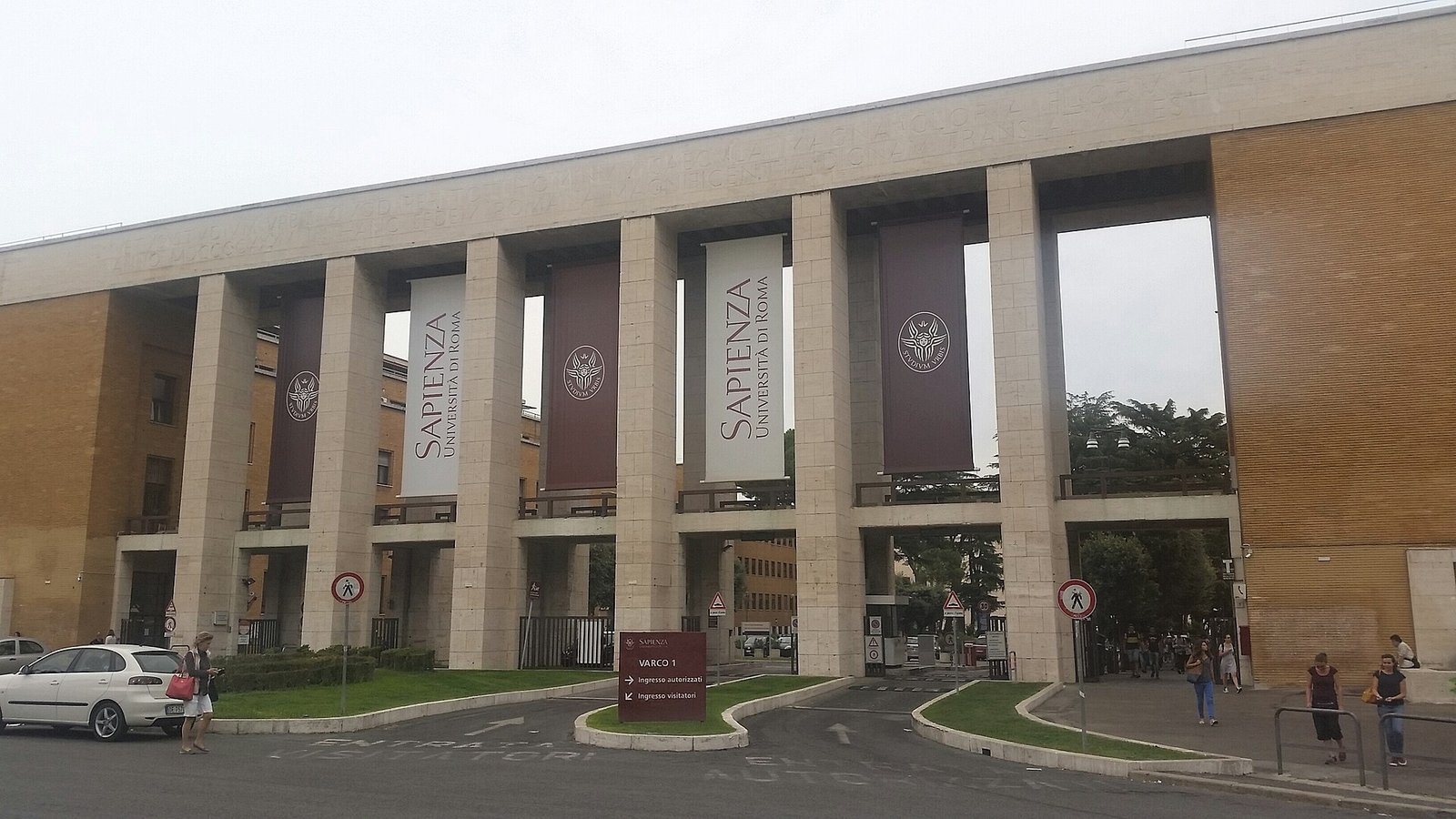
On Tuesday, December 1, 2026, at 20:30, Miles Davis 100 comes to the Aula Magna of Sapienza University with «Special: Miles Davis 100. The Art of Change», a non-subscription concert in the season of the Istituzione Universitaria dei Concerti (IUC) devoted to the 100th anniversary of the trumpeter's birth. The hall is in the Palazzo del Rettorato, in the Città Universitaria, Piazzale Aldo Moro 5, 00185 Rome. For the quintet led by pianist Alberto Giraldi, the organizer gives a time frame from 20:30 to 22:30. The specific price of the concert isn't published on the event page. The official box office is online on the circuit indicated by the IUC, while the Aula Magna box office opens one hour before the start. To get there, use the ATAC journey planner. The sales page specifies that entry is from the Città Universitaria, Palazzo del Rettorato, and that parking is available inside the campus.
Miles Davis 100 at a glance
The «Miles Davis 100» project celebrates one of the most influential musicians in jazz history, with a quintet that spans the trumpeter's entire career, from the new readings of standards from his early period to the experimental material of his last records. The organizer calls the concert an extraordinary event for the centenary of his birth, and it's supported by the Ministry of Culture, Directorate General for Performing Arts, as part of the «Progetti speciali musica 2026».
The essentials
Date: Tuesday, December 1, 2026. Time: 20:30, with the end given as 22:30. Venue: Aula Magna of the Sapienza Rectorate, Piazzale Aldo Moro 5. Type: non-subscription concert. Detailed program: the information isn't published, the event page only describes the journey through Davis's career. Prices: the information isn't published for this concert.
An evening with an exhibition
On the day of the concert, from 16:00 to 23:00, a monographic photo exhibition devoted to Miles Davis is open at Sapienza. The official page doesn't say in which part of the complex it's set up. If you want to see it before the concert, check the details on the IUC website.
Who organizes it
The event is organized by the IUC, which concentrates its season in the Aula Magna. The opening of the 82nd season is set for October 17, 2026, and in the following weeks the program includes events with artists such as Alexandra Dovgan and Antonio Ballista. The full picture is on the page on the 2026-2027 IUC season.
The quintet on stage
The lineup indicated by the IUC is an acoustic jazz quintet, led by pianist Alberto Giraldi, who also writes the arrangements.
Alberto Giraldi, piano
Giraldi is the leader of the group and the author of the arrangements.
Francesco Fratini, trumpet
The trumpet is Davis's instrument and the one the audience will try to recognize in the sound of the concert. The person playing it is Francesco Fratini.
Filiberto Palermini, alto sax
The alto sax recalls the voice of Julian «Cannonball» Adderley, who in the Kind of Blue sextet was alongside Davis and John Coltrane. On alto sax, at this concert, is Filiberto Palermini.
Marco Siniscalco and Valerio Vantaggio
The rhythm section is completed by Marco Siniscalco on double bass and Valerio Vantaggio on drums.
Who was Miles Davis
Miles Davis was born on May 26, 1926 in Alton, north of St. Louis, the son of a dentist and a music teacher who played the violin. He died in Santa Monica, California, on September 28, 1991, after pneumonia and two strokes linked to complications from diabetes. The centenary of his birth therefore falls in 2026, and that's the anniversary the concert celebrates.
Beginnings in St. Louis and New York
The family moved to East St. Louis in 1932. Davis received his first trumpet in 1935 and made his public debut in 1943 with Eddie Randle's Blue Devils. In 1944 he heard Billy Eckstine's big band in St. Louis, with Charlie Parker and Dizzy Gillespie, and that same year he moved to New York.
Meeting Charlie Parker
In New York he enrolled at Juilliard, which he left in fall 1945 to play every night with Parker and other musicians at Minton's Playhouse in Harlem. Between 1945 and 1948 he was part of Parker's quintet, with Max Roach among his bandmates.
Newport 1955 and the Columbia contract
In 1955, at Newport, he played «'Round Midnight» with Thelonious Monk. That performance opened the way to his contract with Columbia.
The three turns that changed jazz
The event page sums up Davis with a clear formula: he reshaped jazz three times. The first in the 1950s, alongside Gillespie and Parker, in the birth of bebop. The second in 1959 with Kind of Blue. The third in 1970 with the electric turn of Bitches Brew. The concert's title, «The Art of Change», comes from here.
Birth of the Cool
Arranged by Gil Evans and built around a nonet, the group played at the Royal Roost in New York in August 1948. The Capitol recordings run from January 1949 to April 1950. The 11 tracks were collected on an album in 1957, which gave cool jazz its name.
The partnership with Gil Evans
Davis and Evans worked together for about 20 years. Their best-known records include Miles Ahead (1957), Porgy and Bess (1958) and Sketches of Spain. Their last studio collaboration was Quiet Nights.
The two quintets
The first quintet, formed in 1955, brought together John Coltrane, Red Garland, Paul Chambers and Philly Joe Jones. The second, active between 1964 and 1968, put Wayne Shorter, Herbie Hancock, Ron Carter and Tony Williams alongside Davis. Its first studio album was E.S.P., from 1965.
Kind of Blue, the 1959 album
Recorded in two sessions at Columbia's 30th Street Studio in New York, Kind of Blue came out on August 17, 1959. It was produced by Teo Macero and Irving Townsend.
The March 2 and April 22 sessions
On March 2 «So What», «Freddie Freeloader» and «Blue in Green» were recorded. On April 22, «Flamenco Sketches» and «All Blues». There were no rehearsals: Davis gave the musicians melodic sketches and brief instructions to improvise on. The legend that everything was recorded in the first take is false: only «Flamenco Sketches» was recorded in a single take, released in 1997 as a bonus, while the original album uses a second take.
Who plays
Alongside Davis are Julian «Cannonball» Adderley on alto sax, John Coltrane on tenor, Bill Evans on piano (Wynton Kelly only on «Freddie Freeloader»), Paul Chambers on double bass and Jimmy Cobb on drums.
Modal jazz, in simple terms
The album is considered one of the first examples of modal jazz: instead of following rapid chord progressions, the soloists improvise on a few modes, giving the melody more room to breathe. Coltrane would develop this approach in the 1960s.
Numbers and honors
With about 4 million copies sold, it's considered the best-selling jazz album of all time. It was inducted into the Grammy Hall of Fame in 1992 and chosen in 2002 by the US Library of Congress for the National Recording Registry. On Rolling Stone's 2020 list it ranks 31st.
Bitches Brew and the electric turn
The third change is electric. Bitches Brew was recorded on August 19, 20 and 21, 1969 in Columbia's Studio B, in New York, with a large lineup and studio editing by Teo Macero. It came out in April 1970 as a double LP.
The lineup
The album features Wayne Shorter, Bennie Maupin, Joe Zawinul, Chick Corea, Larry Young, John McLaughlin, Dave Holland, Harvey Brooks, Lenny White, Jack DeJohnette, Don Alias and Juma Santos. A later session, on January 28, 1970, adds Billy Cobham and Airto Moreira.
Cover and sales
The cover is a painting by Mati Klarwein. The album sold more than half a million copies, making it Davis's first gold record, and won the 1971 Grammy for Best Jazz Instrumental Performance.
Why it's considered a frontier
It's considered a turning point that brought jazz closer to rock, at a time when Sly Stone, Jimi Hendrix and James Brown were also active. For those listening to an acoustic quintet, it's a useful reminder: the December 1 concert doesn't replace those recording rooms, but rereads their spirit in small-group form.
Miles Davis and Italy
Davis's relationship with Italy had specific moments. In 1988 he collaborated with Zucchero Fornaciari on the song «Dune mosse», released only in 2004. In 1989 he was a guest at two concerts of the «Oro, Incenso e Birra Tour» and recorded a 32-minute concert for the RAI program «D.O.C.», arranged thanks to Renzo Arbore.
Rome, July 23, 1991
His last Italian concerts were on July 23, 1991 at the Stadio Olimpico in Rome, with Pat Metheny opening, and on July 24 in Castelfranco Veneto, in Piazza Giorgione. Many years later, the December 1 evening brings his repertoire back to the capital in a very different hall.
The last years
In 1986 Davis recorded Tutu with Marcus Miller, which won a Grammy in 1987. He received the Lifetime Achievement Grammy in 1990. In 1991 he appeared at Montreux in Miles and Quincy Live at Montreux, with Quincy Jones, revisiting Gil Evans's arrangements for the first time in about 30 years. His last studio album, Doo-Bop, came out after his death.
A curious fact about the Aula Magna della Sapienza
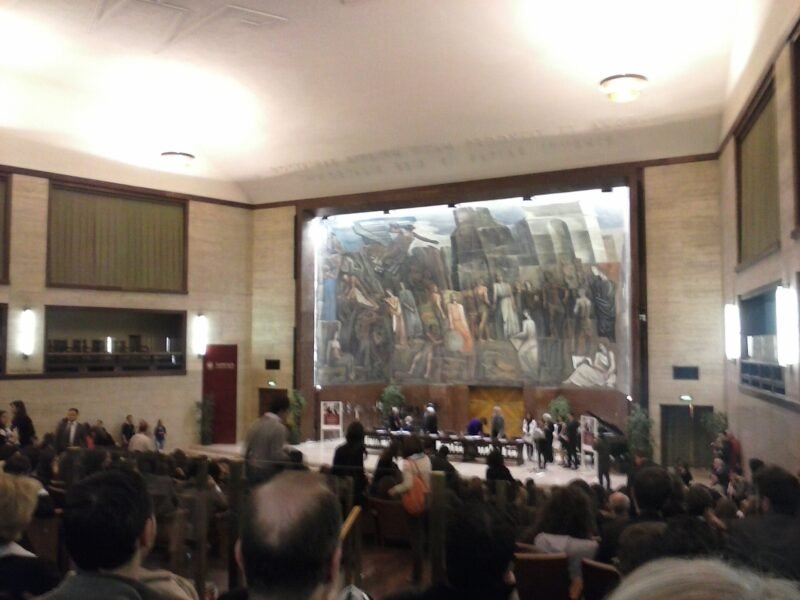
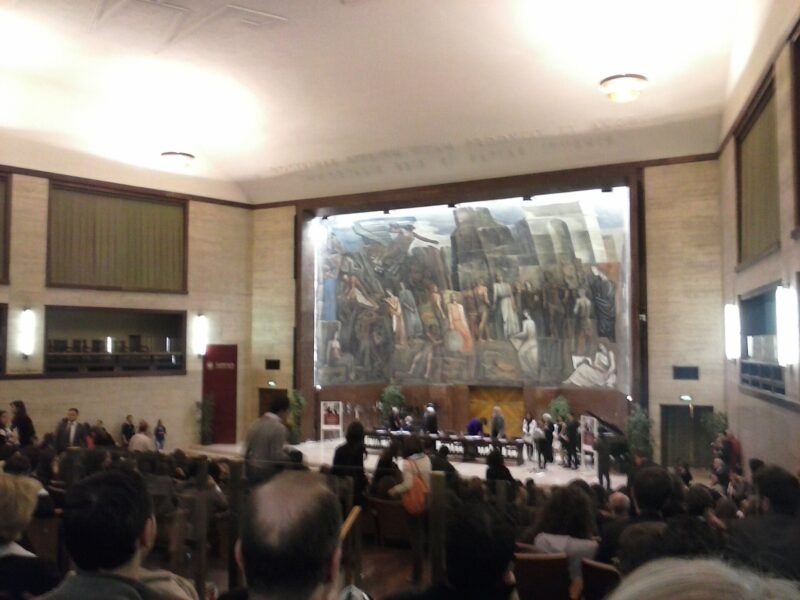
The Aula Magna is known for Mario Sironi's fresco, «L'Italia tra le Arti e le Scienze» (Italy between the Arts and the Sciences), which covers the entire apse vault. The curious fact concerns its history: the 1935 work was altered after the war, when the symbols of the regime were removed and the figures repainted.
What was there originally
The original fresco included a triumphal arch, an eagle, the date «XIV» and a figure on horseback believed to be the Duce. The postwar repainting, in the early 1950s, was carried out by Carlo Siviero, who removed the symbols and then retouched the figures.
Surfaces and dimensions
The fresco covers about 90 square meters.
Something nobody tells you about the Aula Magna della Sapienza
Few people know that the hall went through a long restoration of the fresco: the University decided to intervene with the aim of finishing it in fall 2016, but the restored painting was presented at the conference in November 2017.
The restoration timeline
Work began on July 1, 2015, with completion planned for fall 2016. The restored work was presented in November 2017, at the conference for the 80th anniversary of the Città Universitaria.
A restoration that speaks of the past
A 1994 study seminar, with the Istituto Centrale del Restauro, had established that the censored parts had been covered and not scraped off. This explains the approach of the restoration: bringing the painting back closer to its original state.
My advice for visiting the Aula Magna della Sapienza
My advice is to arrive early, calmly, and spend the time before the concert at the entrance to the Città Universitaria. The avenue starting from Piazzale Aldo Moro leads to the Rectorate and the statue of Minerva. Walking it while there's still some light gives a sense of the composition the architect intended.
The right entrance
The sales page gives the access as Città Universitaria, Palazzo del Rettorato. The Aula Magna box office opens one hour before the start and accepts cash, credit cards and debit cards.
Before the concert: exhibition and walk
The photo exhibition on Davis is open from 16:00 to 23:00 on December 1. If you have time you can combine it with a walk around the campus. If you'd rather take a break at the table, a short walk away are the restaurants and bars of San Lorenzo, the main university neighborhood of Rome.
Dressing for December
In December the evening is cold and the walk from the gate to the hall is outdoors: a proper coat makes the wait more pleasant.
Another well-known fact, yet rarely mentioned
It's well known that Sapienza was founded in 1303 by Boniface VIII. Less often mentioned is that for centuries its home was elsewhere, the Palazzo della Sapienza in the Sant'Eustachio neighborhood, with Borromini's church of Sant'Ivo alla Sapienza, and that the 1935 Città Universitaria is therefore a relatively recent location in the university's history.
The 1303 bull
The Studium Urbis was founded with the bull «In supremae praeminentia dignitatis» of April 20, 1303.
From the Collegio Romano to the Città Universitaria
Between 1811 and 1815, under French rule, the university moved to the Palazzo del Collegio Romano. The first rector of the university of the Kingdom of Italy, Clito Carlucci, was appointed on October 3, 1870.
The right photo to take at the Aula Magna della Sapienza
The best photo is the perspective one. From the end of the avenue, where the statue of Minerva rises from a pool of water, you frame the Rectorate behind the goddess, with the monumental axis closing the scene. Turismo Roma describes the large square in front of the building as proportioned on the model of the Circus Agonalis, today's Piazza Navona.
Arturo Martini's Minerva
The statue is a bronze by Arturo Martini, who called it Athena. It's one of the university's symbols and the point toward which the entrance perspective converges.
A rule for inside
In the hall, common sense applies: the official page says nothing about photography during the concert, so follow the instructions given in the hall.
Some important events that happened here
The Palazzo del Rettorato and its Aula Magna were built between 1933 and 1935 to a design by Marcello Piacentini. Since then the hall has hosted academic ceremonies, conferences and, with the IUC, concerts.
The 1935 inauguration
The Città Universitaria was inaugurated on October 31, 1935 in the presence of Vittorio Emanuele III.
The restoration and the 2017 conference
From November 23 to 25, 2017 an international conference with about 180 speakers was held for the 80th anniversary of the Città Universitaria. From November 23, 2017 to January 26, 2018 the exhibition «La nuova Città universitaria di Roma», with previously unpublished archival material, was open in the Rectorate's entrance gallery.
1994 and 1985: two milestones for the painting
In 1985, on the building's 50th anniversary, Simonetta Lux and Ester Coen denounced the inauthenticity of the image. In 1994 the seminar with the Istituto Centrale del Restauro was held in the Aula Magna itself.
The neighborhood and July 19, 1943
A short walk from the Città Universitaria is San Lorenzo, hit on July 19, 1943 by the first Allied bombing of Rome, with about 3,000 dead and about 11,000 wounded, with 662 bombers and about 4,000 bombs. It was also the day Pope Pius XII personally visited the damaged neighborhoods.
Who has passed through the Aula Magna della Sapienza
The Aula Magna is the stage of the IUC season, and in the first weeks of the 2026-2027 season the calendar lists names such as Alexandra Dovgan, Antonio Ballista, Luca Pincini and Lonquich.
The campus architects and artists
For the project Piacentini involved architects such as Arnaldo Foschini, Giuseppe Pagano, Pietro Aschieri, Gio Ponti, Giovanni Michelucci, Gaetano Rapisardi and Giuseppe Capponi. For the visual arts, Mario Sironi with the Aula Magna fresco and Arturo Martini with the Minerva are documented.
The IUC and Sapienza
The IUC has been linked to Sapienza since 1946.
Davis's centenary
The December 1 evening remembers Davis through Giraldi's quintet.
The Città Universitaria in a few steps
Wanted by Mussolini so that the capital would also have a university hub, the Città Universitaria is considered the largest building project promoted by the regime up to that time. More than 40 buildings, according to Turismo Roma, combine Rationalist architecture and academic monumentality.
The masters' buildings
The Physics Institute is by Giuseppe Pagano, the Chemistry Institute by Pietro Aschieri, the Mathematics Institute by Gio Ponti. The Rectorate, with the Biblioteca Alessandrina and the Aula Magna, is by Piacentini.
The church of the Divina Sapienza
The chapel of the Divina Sapienza, built between 1947 and 1952 to a design by Piacentini, is run by the Jesuits. The chapel was a gift from Pius XII.
What to see nearby
The Città Universitaria borders San Lorenzo and the Policlinico Umberto I. Not far away are very different places, useful for building an evening around the concert.
San Lorenzo and the basilica
The Basilica of San Lorenzo fuori le Mura, on Piazzale del Verano, dates from the 4th century and was built by Constantine over the tomb of the martyr Lawrence. Next to it is the Verano cemetery.
Pigneto
If you're looking for an alternative for dinner, the page on Pigneto gathers addresses and information about the neighborhood.
The places of jazz in Rome
Casa del Jazz is in a villa built between 1936 and 1939, confiscated from organized crime in 1996 and opened to the public in April 2005. Its auditorium has 150 seats. For the city's wider calendar, see the Roma Jazz Festival 2026.
Tickets and prices
Tickets are sold online through the circuit indicated by the IUC, at the IUC offices at Lungotevere Flaminio 50 and at the Aula Magna box office one hour before the start.
The concert price
For this concert the price isn't published on the event page. The general season price list, published on the IUC website, gives 26 euros for the first section, 21 for the second and 15 for the third, with a 10 percent booking fee. The under-30 ticket costs 8 euros, 5 for under 18. It isn't stated if these amounts also apply to the non-subscription concert.
Discounts and cards
The website offers discounts for subscribers, partner organizations, young people and families. Discounts can't be combined. The Carta del Docente is also accepted.
Contacts
The offices answer at 06 3610051 and at the email address given on the website. The Lungotevere Flaminio office is open Monday, Wednesday, Thursday and Friday from 10:00 to 13:00 and from 14:00 to 17:00.
Practical information
A summary for planning the evening, with only the information confirmed by the official pages.
Getting there
The ATAC journey planner is the right tool for choosing up-to-date lines and stops. The sales page mentions parking inside the Città Universitaria. Availability on the evening of the event should be checked.
Accessibility
Turismo Roma refers to the «Roma accessibile» section of the university website for accessibility information. For the Aula Magna the specific information isn't published.
Length
The time given runs from 20:30 to 22:30. It isn't specified if there's an intermission.
How to listen to a tribute to Davis
A concert devoted to Davis isn't measured by faithfulness to the recordings. His recordings say something precise: the most famous albums were born with very little preparation and a lot of improvisation, and his career is a sequence of changes of direction. A successful tribute, then, is one that keeps the same freedom.
Silence as material
In 1959 Davis gave the musicians melodic sketches and brief instructions, with no rehearsals. If you listen to the quintet on December 1, you can try to catch precisely this: how much space the group leaves between one phrase and the next.
The standards of the early period
The organizer says the journey starts from new readings of standards from the early period. Which pieces are on the set list isn't published.
Material from the last records
At the other end of the journey is the experimental material of his last recordings. Among the last recordings is Doo-Bop, released after Davis's death and leaning toward acid jazz.
The weight of 1959 on other musicians
Duane Allman recognized Davis and Coltrane as the source of his solos, and Pink Floyd keyboardist Richard Wright cited its chord progressions for «Breathe». Quincy Jones says he listens to the album every day.
Sapienza in numbers and dates
Around the Aula Magna there's an enormous university, and the figures vary depending on the year.
Students
There were 129,500 students in 2010 and 101,798 on May 3, 2016, with 19,631 staff. Enrollment was about 3,000 in 1909, about 12,000 in 1935 and 192,000 in 1993-94.
The size of the campus
The Città Universitaria covers about 439,000 square meters.
The campus after 1935
The campus soon proved too small: the Law, Humanities and Physics buildings had floors added in the 1950s and 1960s. A university complex on Via del Castro Laurenziano was built between 1961 and 1968 by Gaetano Minnucci and Giuseppe Cigni.
Sapienza's other places
Sapienza runs a system of university museums: the university's page lists about two dozen, including those of Mineralogy, Chemistry, Physics, Zoology, Classical Art and History of Medicine, as well as a botanical garden.
The Botanical Garden
The Botanical Garden of Rome is listed among the venues of the university's cultural activities.
Other cultural venues
Among the university's cultural venues, our pages also include the Gipsoteca and the MLAC. Check opening hours before visiting.
Frequently asked questions about Miles Davis 100
When is the Miles Davis 100 concert in Rome?
Tuesday, December 1, 2026 at 20:30, in the Aula Magna of the Sapienza Rectorate, Piazzale Aldo Moro 5. The organizer's page gives the overall time frame as 20:30 to 22:30 and specifies that it's a non-subscription concert in the IUC season.
Who plays in the quintet?
Alberto Giraldi on piano, who leads the group and writes the arrangements, Marco Siniscalco on double bass, Francesco Fratini on trumpet, Filiberto Palermini on alto sax and Valerio Vantaggio on drums. The detailed program of pieces isn't published: all we know is that the journey covers Davis's whole career.
How much are tickets?
The concert price isn't published on the event page. The general IUC season price list gives 26, 21 and 15 euros for the three sections and 8 euros for under 30, but it isn't specified if it also applies to this event. Check the sales page.
Where do you buy tickets?
Online on the circuit indicated by the IUC, at the offices at Lungotevere Flaminio 50, by phone at 06 3610051 and, one hour before the start, at the Aula Magna box office. The official sales page shows the date and time of the concert.
Is there a related exhibition?
Yes: on the day of the concert, from 16:00 to 23:00, a monographic photo exhibition on Miles Davis is open at Sapienza. The event page doesn't specify where on campus the exhibition is or if a ticket is needed. The information isn't published.
How do you get to the Aula Magna?
Entry is from the Città Universitaria, Palazzo del Rettorato, Piazzale Aldo Moro 5. For up-to-date ATAC lines and stops, use the company's journey planner. The sales page mentions parking available inside the campus.
Why is the centenary being celebrated?
Miles Davis was born on May 26, 1926: 2026 is the centenary year. The concert, supported by the Ministry of Culture through the «Progetti speciali musica 2026», marks it with a journey through the three turns of his language: bebop, modal jazz and electric fusion.
Final advice on Miles Davis 100
Arrive early, see the photo exhibition, walk along the avenue of the Città Universitaria to the Minerva and then enter the hall with time to look at Sironi's fresco at the back: the evening is all the better for it. Then listen to the quintet in a repertoire that runs from Kind of Blue to Bitches Brew, without expecting a copy of the records: the title, «The Art of Change», promises exactly the opposite.
Article written by the editorial team of Tour Leader Pro, contact them for Private/Corporate/V.I.P. Tours and Experiences.
Planning a trip to Rome? The English-language guides to visiting the city are on ItalyPlanner.com.
Contact Information
Nearby
 Physics Museum100 m
- Gipsoteca – Museum of Classical Art100 m
- Museum of Etruscan and Italic Antiquities200 m
- Primo Levi Chemistry Museum200 m
- Herbarium Museum of Rome200 m
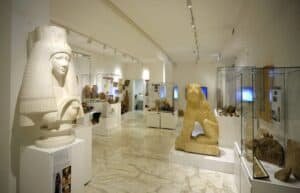
- Museo del Vicino Oriente, Egitto e Mediterraneo200 m
Upcoming events nearby
- Favola Sismica, open artistic residency by Fabiana Iacozzilli at Nuovo Teatro Ateneo, Dec 18, 2026100 m
- IUC Concert Season 2026-2027 at Aula Magna della Sapienza, October 17, 2026 to May 8, 2027200 m
- Mario Brunello at the Aula Magna of the Sapienza, January 19, 2027200 m
- Marc-André Hamelin at the Aula Magna of the Sapienza, January 23, 2027200 m
You might also like
- Shiva at Palazzo dello Sport in Rome, November 27, 28 and 29, 2026
- The Lord of the Rings, The Orchestra (Lords of the Sound) at Teatro Orione, January 28 and April 13, 2027
- Talco Freek Tour 2027 at Hacienda Roma, April 2, 2027
- The Devon Allman Project at CrossRoads Live Club: March 26, 2027
- Voyage 35 (ex Porcupine Tree) at CrossRoads Live Club, March 10, 2027
- Pornodrama by Guarino/Comuniello, meeting at Teatro del Lido: Tuesday, November 10, 2026