Central Institute for Intangible Heritage
In short. Address: Piazza Marconi 8/10, 00144 Rome, EUR neighborhood. Subway line B, EUR Fermi stop, then a five-minute walk.

Address: Piazza Marconi 8/10, 00144 Rome, EUR neighborhood. Subway line B, EUR Fermi stop, then a five-minute walk. Buses 30, 170, 671, 714, 791, with stops along Viale della Civiltà del Lavoro and on the piazza. Telephone +39 06 5910709, email ic-pi@cultura.gov.it, certified email ic-pi@pec.cultura.gov.it. The offices answer Monday to Friday, approximately between 8:00 and 18:00, and are closed on Saturday and Sunday. You don't buy a ticket, because there is no ticket: Istituto Centrale per il Patrimonio Immateriale is not a museum and has no rooms open to the public. It is an institute of the Ministry of Culture with special autonomy, that is a center of research, cataloging and documentary conservation. Whoever arrives in Piazza Marconi with the idea of buying an admission and wandering among the display cases must go in through the next door, that of Museo delle Civiltà, which occupies the same building and the twin building across the way: open Tuesday to Sunday from 8:00 to 19:00, last entry at 18:30, closed Monday, full ticket €10 and reduced €2, free admission on the first Sunday of the month. The Institute's archives and library serve scholars, students, thesis writers, documentary makers and local administrations, and consultation must be agreed in advance by writing to the Institute's address.
Said in two lines, so nobody loses the afternoon: here you don't visit anything, here you study. It is worth knowing, though, what goes on inside, because this building holds the voices, the faces and the gestures of the peasant, pastoral and seafaring Italy that no other institute has recorded with the same continuity. If you are looking for places to really see in the same half day, the page of Rome's tourist attractions takes you elsewhere. If instead you want to understand how a state tries to protect a procession, a song or a way of kneading dough, stay here.

What Istituto Centrale per il Patrimonio Immateriale is today
The administrative definition is dry: an office of non-general managerial level, endowed with scientific, financial, organizational and accounting autonomy. Translated into understandable language, Istituto Centrale per il Patrimonio Immateriale has its own budget, its own board of directors, its own scientific committee and a director, and does not depend on the museum with which it shares the main door. It deals with the safeguarding and enhancement, in Italy and abroad, of material and immaterial demo-ethno-anthropological cultural assets, and of the expressions of cultural diversity present on the national territory. The acronym under which you find it in every ministerial document is ICPI.
The key word is the awkward one: demo-ethno-anthropological. It comes from the welding of three traditions of study, demology, ethnography and anthropology, and it entered Italian legal vocabulary to indicate a category of cultural assets that the Cultural Heritage Code recognizes alongside archaeological, architectural, historical-artistic and archival assets. A nail plow is a material demo-ethno-anthropological asset. The way of building it, the name they give it in a certain village in Molise, the sequence of gestures with which it is used and the song that accompanies the plowing are immaterial demo-ethno-anthropological assets. The difference seems academic and instead decides what is protected and how.
What Istituto Centrale per il Patrimonio Immateriale concretely does
Four strands, if we want to put things in order. The first is fieldwork research: documentation campaigns conducted with anthropologists, ethnomusicologists, photographers and video operators, who come back with tapes, frames and cards. The second is cataloging, that is the production of standardized records that enter the national catalog of cultural assets and make one rite comparable with another rite, one trade with another trade. The third is the conservation and use of the institution's historical archives, which are its real wealth. The fourth is the international function: the Institute is the technical body that follows, for the scientific part, the Italian application of the 2003 UNESCO Convention for the Safeguarding of the Intangible Cultural Heritage, and accompanies the building of nomination dossiers.
Then there are the activities that are most visible: training, seminars, conferences, exhibitions hosted elsewhere, publications, digital projects. In the latter the body has invested a lot, with the Geoportale della Cultura Alimentare as the most successful example. Our opinion: the digital production of this institute is underused by Italian tour operators, who keep telling about popular festivals with the same four brochure sentences while here are deposited hours of footage made by people who studied those festivals for 20 years.
Who directs Istituto Centrale per il Patrimonio Immateriale
Leandro Ventura sits at the head, appointed in July 2020 and still in office. In his public statements an idea returns that deserves to be reported because it explains the line of the body better than any organization chart: intangible heritage is not a list of beautiful things to show off, it is the way a community recognizes itself. The lines of work opened in recent years follow that idea, and are listed without shame even in interviews: craft knowledge at risk of extinction, the landscape as cultural construction, music of oral tradition, food and wine traditions, fire festivals, the Palio of Siena, historical reenactments, maritime culture.
Can you visit Istituto Centrale per il Patrimonio Immateriale?
No, not in the sense in which you visit a museum. There are no exhibition rooms, there is no ticket office, there is no route, there are no ordinary guided visits. Whoever shows up at the main door without an appointment finds a public office that does a completely different job. Whoever has a reason for study, instead, can ask to consult the archives and the library: you write to ic-pi@cultura.gov.it explaining who you are, what research you are conducting and which collections interest you, and agree on access. It is not an annoying formality, it is the normal way research archives work all over Europe.
The practical advice for those wondering if it is worth going all the way to EUR: go for Museo delle Civiltà, which occupies the same Palazzo delle Arti e Tradizioni Popolari and Palazzo delle Scienze across from it, and devote half a day to the ethnographic collections. In those display cases you see the objects. In the Institute's archives, which you won't see, are kept the voices and the movements that gave meaning to those objects. Knowing that the two things exist in the same block changes how you look at a butter churn or a Sicilian cart.
The occasions when Istituto Centrale per il Patrimonio Immateriale opens
It happens, a few times a year, that the body takes part in extraordinary opening days, project presentations, screenings of archive materials, open conferences. They are occasions announced with little notice on the institutional channels of the Ministry of Culture and on the Institute's website, and have to be caught when they come out. Whoever lives in Rome and is interested in anthropology would do well to follow them: a screening of footage from the 1960s commented on by the person who cataloged it is worth 10 generic lectures.
Where Istituto Centrale per il Patrimonio Immateriale is and how to get there
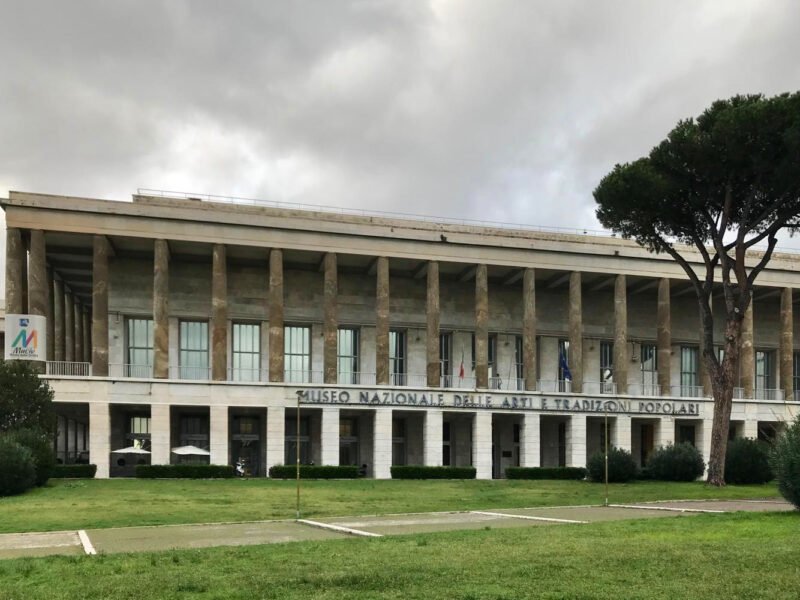
Piazza Marconi is the geometric center of EUR, the neighborhood designed for the 1942 Universal Exposition that was never held. The Institute occupies a part of Palazzo delle Arti e Tradizioni Popolari, the large travertine building on the southern side of the piazza, at numbers 8 and 10. Subway line B has two useful stops: EUR Fermi, the most convenient, about 500 meters away, and EUR Palasport, if you arrive from the lake side. From Termini station it is a scant 25 minutes by subway train, and at peak hours it stays 25 minutes: line B toward Laurentina doesn't suffer surface traffic.
By bus and by car to Istituto Centrale per il Patrimonio Immateriale
The surface lines serving the piazza are the 30, the 170, the 671, the 714 and the 791. The 30 and the 714 come from the center and the Aventine, the 170 from Termini station via Piramide, the 671 and the 791 connect EUR with the surrounding neighborhoods. By car you arrive from Via Cristoforo Colombo or from Via Laurentina, and this is one of the few areas of Rome where parking is not a test of character: the spaces along the side streets of the piazza are plentiful and in large part free. On days of a big event at the Nuvola or Palazzo dei Congressi the situation changes, and then the subway is better.
On foot around Istituto Centrale per il Patrimonio Immateriale
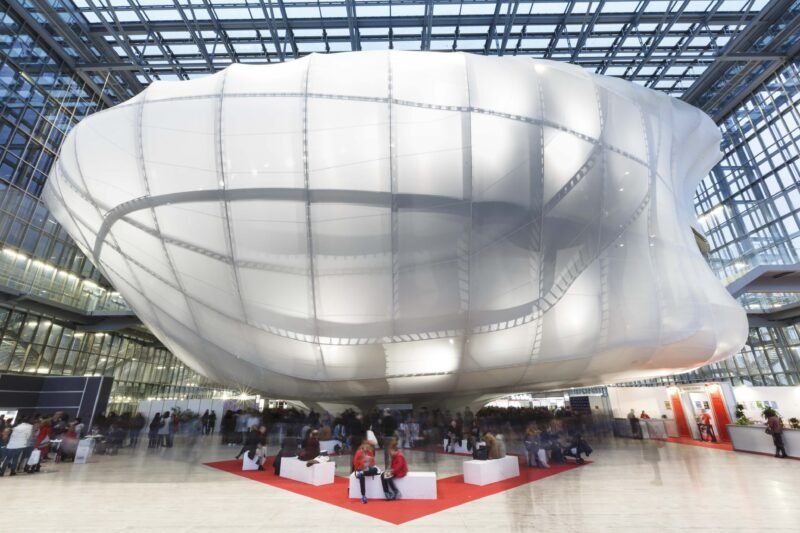
From the entrance of the building, in 10 minutes on foot you reach the Palazzo della Civiltà Italiana, which everyone calls the Square Colosseum, the Palazzo dei Congressi with its white vault, the Nuvola by Fuksas and the basilica of Santi Pietro e Paolo on the hill. In a quarter of an hour you reach the EUR lake with its Japanese cherry trees. Those who want a general overview of the neighborhood will find it on the page dedicated to EUR and its Universal Exposition.
The building that houses Istituto Centrale per il Patrimonio Immateriale
The building was designed by Massimo Castellazzi, Pietro Morresi and Annibale Vitellozzi and built between 1938 and 1942 to house the folk arts and traditions section of the Universal Exposition. The war stopped everything, the exhibition was never held, and the palace remained an empty shell for more than 10 years. Its plan is organized around a central courtyard, two projecting wings and two colonnaded porticoes, one of which connects it to Palazzo delle Scienze that stands opposite, on the same piazza. The travertine, the squared pillars, the obsessive rhythm of the bays: it is regime architecture, and it has to be looked at knowing what it was, with no discounts and no embarrassment.
Prampolini's mosaic on the building of Istituto Centrale per il Patrimonio Immateriale
On the building you find the large natural-stone mosaic titled The Corporations, made in 1942 by Enrico Prampolini. Prampolini had been one of the protagonists of the second Futurism, a theorist of aeropainting and a stage designer, and here he works with stone tesserae instead of color, composing figures of workers inside a squared geometry. It is one of the greatest examples of that language in Italy and almost nobody stops to look at it, because whoever passes through Piazza Marconi already has their eyes on the obelisk. Stop. From under the portico, in the afternoon light, the mosaic reads much better.
Amerigo Tot and the folklore bas-relief
Also on the building is a marble bas-relief by Amerigo Tot dedicated to the characteristic elements of folklore. Tot, Hungarian by birth and Roman by adoption, is the sculptor of the large frieze of Termini station, and he is also the man the Italian public remembers as an actor in Coppola's second Godfather. Seeing a work of his here, on a building conceived for Italian folklore, is one of those short circuits that EUR gives to those who walk with their head up.
The salone d'onore and the frescoes
Inside, in the salone d'onore, are kept cycles of frescoes with scenes of Italian popular traditions, painted in the years of construction. These are not rooms for ordinary visits and their opening depends on the initiatives of Museo delle Civiltà and the Institute. Whoever manages to get in on extraordinary occasions sees a curious thing: an idea of popular Italy painted in the early 1940s on the walls of the same building that today hosts the scholars charged with dismantling that idea. The history of the studies passes through here too.
From the 1911 Exhibition of Italian Ethnography to Istituto Centrale per il Patrimonio Immateriale
The collections and archives that today revolve around this building were born from a man and a date. The man is Lamberto Loria, born in 1855 and died in 1913, a traveler and ethnographer with long experience in New Guinea, Eritrea and Lapland, who at a certain point in life became convinced that peasant Italy deserved the same scientific gaze reserved for distant peoples. The date is 1911, the fiftieth anniversary of Unification.
Loria and the Florentine museum of 1906
Loria founded in Florence, in 1906, the first museum of Italian ethnography. The 2,000 things exhibited that year had become 5,000 in 1908. They were not art objects: they were tools, textiles, containers, ex-votos, musical instruments, things of daily use collected from the hands of those who used them. The methodological choice was radical for the time and still concerns us: if you collect the plow and throw away the dialect name, the gesture and the work calendar that gave it meaning, you have collected scrap iron.
The 1911 Exhibition of Italian Ethnography
For the fiftieth anniversary, in Rome, Loria organized the Exhibition of Italian Ethnography: 14 regional pavilions built in Piazza d'Armi, about 40 living ethnographic groups, and a collection that reached about 30,000 objects from all the regions, to which were added manuscripts, transcribed songs, postcards and photographs. It was the largest effort to document Italian popular culture ever attempted up to then, and it was built in a few years, with a network of local correspondents scattered across the peninsula.
The exhibition closed, as all exhibitions close. The objects remained, and their fate was long and complicated: temporary storage, transfers, crates closed for decades. The photographic core gathered on that occasion, with images from the archives of the Fratelli Alinari and Giacomo Brogi in Florence and Romualdo Moscioni in Rome, is still today the oldest part of the Institute's photographic archive.
The EUR museum and Paolo Toschi
One has to wait until the mid-1950s for those collections to find a stable home. The collections arrived at EUR in 1956 and the Museo nazionale delle arti e tradizioni popolari opened to the public in 1957, in the building constructed and never inaugurated 15 years earlier. The person who directed the layout was Paolo Toschi, born in Lugo di Romagna in 1893 and died in Rome in 1974, who in 1949 had won the first Italian chair in literature of popular traditions. Toschi came from philology and from studies on theater: his are Le origini del teatro italiano from 1955 and Arte popolare italiana from 1960. The museum he built was the most important Italian folklore museum, and it carried within itself the limits of its era, an idea of the people that was aestheticized and a little immobile.
The three names of Istituto Centrale per il Patrimonio Immateriale
Whoever looks for news about this body finds different names depending on the year of the document, and the confusion is understandable. It's worth putting them back in line, because each change of name corresponds to a real shift in the way the Italian administration has thought about popular culture.
Before 2007: the catalog and the demological part
For decades, the documentation and cataloging of demo-ethno-anthropological assets were the responsibility of the Istituto centrale per il catalogo e la documentazione, the ICCD, which since the 1970s has produced the standardized records with which any cultural asset in Italy is described. It is there that the templates for material and, later, immaterial demo-ethno-anthropological assets were born. The EUR museum, meanwhile, lived a life of its own: it conserved, exhibited, conducted research, but it was not a central institute with national guidance functions.
2007: Istituto Centrale per la Demoetnoantropologia
The decree of the President of the Republic of November 26, 2007, number 233, establishes Istituto Centrale per la Demoetnoantropologia, and a ministerial decree of October 7, 2008 defines its place in the organization chart. It is a date to be read together with another: 2007 is also the year in which Italy ratifies the UNESCO Convention on intangible cultural heritage. The State, after signing an international commitment, gives itself a technical instrument to honor it. In daily practice, the new institute inherits the archives, the library and the scientific staff that revolved around the national museum at EUR.
2019: Istituto Centrale per il Patrimonio Immateriale
With the decree of the President of the Council of Ministers of December 2, 2019, number 169, the name changes to Istituto Centrale per il Patrimonio Immateriale. It is not lexical cosmetics. The word demoetnoantropologia is a specialists' term, incomprehensible outside academia and tied to an Italian disciplinary history. Intangible heritage is the term by which the whole world, after 2003, calls that subject. A body that has to dialogue with UNESCO, with foreign ministries and with local communities needed a pronounceable name. A later ministerial reorganization, in February 2022, redefined its internal organization.
A note useful to those doing research online: the body's old internet address, on the beniculturali.it domain, no longer responds, and the institutional pages have migrated to the cultura.gov.it domain together with the whole Ministry. The email addresses have also changed accordingly. The records published by the Ministry point to the body's page on the cultura.gov.it portal, which gives updated address, contacts and administrative framing.
The 2003 UNESCO Convention and what it really means
Here we have to be precise, because many inaccuracies are said about this Convention and almost all of them end up in newspaper articles. The Convention for the Safeguarding of the Intangible Cultural Heritage was adopted by the UNESCO General Conference on October 17, 2003, during its 32nd session, and entered into force in the spring of 2006, three months after the deposit of the 30th instrument of ratification, as its Article 34 provides. Today more than 180 states adhere to it, which makes it one of the most widely joined international legal instruments in the field of culture.
The definition, word by word
Article 2 defines intangible cultural heritage as the practices, representations, expressions, knowledge and skills, as well as the instruments, objects, artifacts and cultural spaces associated therewith, that communities, groups and in some cases individuals recognize as part of their cultural heritage. It's worth rereading the sentence slowly, because every piece weighs. Practices and expressions: actions are protected, not things. Associated instruments and spaces: the material is included, but only as the support of a practice. And above all: that communities recognize. Not that a professor certifies, not that a ministry decrees. Recognition starts from those who live that practice.
The Italian formula usually read in ministerial presentations adds the rest of the definition: a heritage transmitted from generation to generation, constantly re-created by communities and groups in response to their environment, their interaction with nature and their history, which gives them a sense of identity and continuity, thus promoting respect for cultural diversity and human creativity. The decisive word, in that passage, is re-created. A rite that repeats identically for centuries does not exist: what exists is a rite that is redone every year, and in the redoing changes. The Convention protects the capacity to redo it, not the photograph of a single edition.
The five domains of intangible heritage
The Convention lists five domains in which intangible heritage manifests itself. Oral traditions and expressions, including language as a vehicle. The performing arts. Social practices, rituals and festive events. Knowledge and practices concerning nature and the universe. Traditional craftsmanship. They are porous categories, and concrete cases almost always cross more than one: a patron saint's festival is at once rite, performance, craft of ceremonial apparatus and calendar knowledge. The usefulness of the list is practical, it serves to build inventories comparable between different states.
What the 2003 Convention is not
It is not a beauty ranking. There is no ranking of the most beautiful rites in the world and there is not, technically, any world heritage title to hang at the entrance of the town: the expression circulates in press releases, but the text speaks of inscription in a list, which is a different thing. Nor is it a protection constraint in the Italian sense of the term, the kind that prevents demolishing a building: nobody can force a community to keep holding a procession. And it is not a commercial brand, although it is used as one by administrations and consortia with a casualness that gives people who work in the field a headache.
What is it, then. It is a commitment that states take on to compile inventories of their intangible heritage, to involve communities in choices, to fund safeguarding programs, to encourage the transmission of knowledge. The visible part, that of the lists, is the tip of the iceberg. The part that counts is the work of census and documentation that in our country this very institute does, with means that are not enormous.
Italy and the ratification of the Convention
Italy ratified with the law of September 27, 2007, number 167, and the deposit of the instrument of ratification with UNESCO took place in October of the same year. From that moment the country is a contracting party and has the obligations the text provides. Whoever knows the Italian administrative machine knows that between the ratification of a convention and its application a lot of time can pass: in our case the technical instrument arrived almost simultaneously, and that is a rare merit.

The three UNESCO lists
The lists provided by the Convention are three and have to be kept distinct. The Representative List of the Intangible Cultural Heritage of Humanity collects the elements that states propose to make their variety known: it is the list the newspapers talk about. The List of Intangible Cultural Heritage in Need of Urgent Safeguarding takes in practices at risk of disappearing, and carries stricter support commitments. The Register of Good Safeguarding Practices, finally, inscribes not a rite but a method: it rewards programs that have worked, so that they can be imitated elsewhere.
The Italian elements inscribed on the UNESCO lists
Italy is among the countries with the most inscriptions on the Representative List. Here is the list, in chronological order, with the year in which the Intergovernmental Committee decided. It is a list worth reading in full, because it tells the idea of itself that the country has brought to Paris over the last 20 years.
The first Italian inscriptions: 2008, 2012, 2013
In 2008 the Opera dei Pupi, the Sicilian marionette theater, and the Canto a tenore of the Sardinian shepherds enter. They are two very well made choices: both concern expressive forms with a small number of bearers and a real risk of extinction, and both are extremely hard to turn into a tourist product. In 2012 it is the turn of traditional violin making in Cremona, the knowledge of the workshops descended from Amati, Guarneri and Stradivari. In 2013 come the Mediterranean diet, presented together with other countries of the basin, and the Celebrations of big shoulder-borne processional structures, which bring together four Italian festivals built around processional structures carried by hand: among them the Macchina di Santa Rosa in Viterbo, the Varia of Palmi, the Gigli of Nola and the Faradda di li candareri in Sassari.

From 2014 to 2019
In 2014 the traditional agricultural practice of the head-trained vine of the community of Pantelleria enters, an interesting case because it concerns not a festival but a cultivation technique, the low pruning that protects the plant from the island's wind. In 2017 it is the turn of the art of the Neapolitan pizzaiuolo, the most discussed inscription of all, with controversies that filled the newspapers for weeks. In 2019 come alpinism, a candidacy shared with France and Switzerland, and the Perdonanza celestiniana of L'Aquila, the pardon instituted by Celestine V in 1294 and celebrated every year at the end of August in a city that has many reasons to hold its rites close.
Recent years: from 2020 to 2025
In 2020 the musical art of the hunting horn players enters, a multinational candidacy, and the art of glass beads, shared with France and tied in Italy to the Venetian lagoon. In 2021 truffle hunting and extraction are inscribed and, with a candidacy of many countries, falconry. In 2022 the tradition of Lipizzan horse breeding, together with other states of the Danube area. In the same year the Tocatì program, dedicated to safeguarding traditional games and sports, enters the Register of Good Practices, the only Italian case in that register.
2023 is a full year: the practice of lyric singing in Italy, traditional irrigation with its knowledge and forms of organization, and transhumance, a shared candidacy that concerns the tratturi and the routes of pastoralism. In 2024 are added the art of dry stone construction, with the related knowledge and techniques, and the art of manual bell ringing. In 2025 comes the most discussed and most awaited inscription of recent years, that of Italian cuisine between sustainability and bio-cultural diversity.
An opinion on these inscriptions
An unpopular thing: the best inscriptions are the least marketable. The Canto a tenore and the Opera dei Pupi brought resources and attention where they were needed, without generating lines. The gastronomic inscriptions, instead, produced a perverse effect, that is the transformation of the list into an advertising argument. The director of the Institute said so publicly, in diplomatic words: Italian cuisine should be valued for being a cultural expression of communities and territories, not as a slogan. Whoever reads these pages and is preparing a trip should take it into account, and be wary of anyone who sells an experience because it is UNESCO heritage.
The archives of Istituto Centrale per il Patrimonio Immateriale
This is the reason the body exists and the reason a page like this makes sense even if nobody can go in. The archives of Istituto Centrale per il Patrimonio Immateriale are five, all born inside the history of the EUR museum, and put together they constitute the most continuous documentation of Italian popular culture held by a single public entity. Alongside there is a specialized library. I describe them one by one, with the numbers the body itself declares.
The sound archive of Istituto Centrale per il Patrimonio Immateriale
The collection counts about 2,700 media between magnetic tapes and discs, and documents the oral and ethnomusical heritage of the Italian tradition. The first core is owed to Annabella Rossi, who started the field recordings in southern Italy around the 1960s: a body of recordings on the festive, ritual, magical-religious and social aspects of the popular culture of the South. Later additions widened the field to music and oral narrative, festive ritual, the magical-religious sphere, agro-pastoral and maritime living and working conditions, craft techniques, life stories, ethnomusicology, popular theater.
Whoever has never listened to a field tape can't imagine what is inside. There is almost never a beautiful performance. There is a woman singing while she works and breaking off to talk to her son, there are dogs, there is wind on the microphone, there is the researcher asking to repeat and the informant answering that it isn't repeated, because that song is done at one moment and not at another. It is in those imperfections that ethnomusicology learned the most. The conservation of these media is today the greatest technical challenge: the magnetic tape of the 1960s has a life expectancy measured in decades, not centuries, and digital transfer is a race against time that the archives of half the world are running.
The visual anthropology archive
It holds more than 1,500 video and film documents, partly acquired from outside and partly produced in the course of research conducted by the institute. The oldest materials date to 1939 and run up to today: they concern mostly Italian traditions and recreate in images the same themes the EUR museum had chosen for its rooms, that is rites and ceremonies, work, music, dance, crafts, games. Particularly important is the film collection with materials on southern Italy shot between the 1950s and 1960s. To the early 1970s date instead the films made by Annabella Rossi, who promoted a documentation campaign conducted above all in Calabria and Campania, centered on festive events and on melochoreic expressions, those in which song and dance do not separate.
The program of new acquisitions has as its preferred theme the festive traditions of the different Italian regions. The archive organizes screenings on the occasion of exhibitions, festivals and educational initiatives, and collaborates with university institutes, schools and cultural centers in the context of festivals, conferences, seminars and study meetings. If you are lucky enough to come across one of these screenings, go: seeing an ethnographic film from the 1960s on a screen, with someone explaining who was holding the camera and why they held it that way, is an experience that no platform gives back.
The photographic archive of Istituto Centrale per il Patrimonio Immateriale
It is the largest: over 100,000 images, according to the body's estimates, documenting the intangible heritage of the Italian regions. The original core is the collection of photographs, postcards and documentation put together by Lamberto Loria for the 1911 Exhibition of Italian Ethnography, with images from the archives of the Fratelli Alinari and Giacomo Brogi in Florence and Romualdo Moscioni in Rome: portraits of individuals and family groups, alongside photographs produced for research purposes and centered on the real living conditions of agro-pastoral communities.
The collection has grown over time with materials from the 1950s to today that document the main themes of anthropological research: devotional behaviors, ritual practices, agricultural and craft work techniques, pastoral and maritime life, piazza games and shows. Among the most significant cores are the photographs of Annabella Rossi, which document 20 years of visual research, from the 1950s to the 1970s, in Salento and Campania. The growth continues, with materials of historical interest often linked to exhibitions and with images relating to contemporary traditions, gathered in collaboration with local bodies and cultural associations.
The historical archive and the archive of popular prints
The historical archive holds the administrative and scientific documentation produced starting from the 1911 exhibition: correspondence with local correspondents, purchase lists, field notes, museum papers. It is material that historians of the discipline consult to understand how an ethnographic collection was built a century ago, and it holds surprises: in the letters you read the negotiation with the peasant who didn't want to sell the cart, the enthusiasm for a rediscovered costume, the embarrassment in front of practices that the collectors judged superstitious.
The archive of popular prints collects over 14,000 items among holy cards, broadsheets, devotional images, market-stall woodcuts and widely circulated prints. It is the visual library of peasant homes: the images hung over the bed, those bought at the market during the saint's festival, those carried in the wallet. A formidable source for the history of popular devotion and for understanding how figures circulated before photography.
The library of Istituto Centrale per il Patrimonio Immateriale
The specialized library counts over 30,000 volumes and periodicals, and includes collections of popular literature. It is the reference anthropological library in Italy for the demo-ethno-anthropological sector, with the complete series of Italian folklore studies journals, ethnomusicological literature, conference proceedings and a quantity of local publications not found elsewhere: pamphlets of festival committees, parish monographs, research by elementary school teachers who collected the songs of their own village. Its consultation has to be agreed, it is not free entry, and for a Roman anthropology student it is worth the phone call.
Annabella Rossi and the archives of Istituto Centrale per il Patrimonio Immateriale
If I had to name a single person to understand what these archives are, I would say her name. Annabella Rossi was born in Rome in September 1933 and died there in March 1984, at 50. She collaborated with the Museo nazionale delle arti e tradizioni popolari and her photographic, film and sound materials are today part of the collections that merged into Museo delle Civiltà, studied and promoted by Istituto Centrale per il Patrimonio Immateriale.
Salento, tarantism, the letters
In 1959 she took part in the research on tarantism directed by Ernesto de Martino in Puglia. Then she continued alone, for years, returning to the same villages and building relationships that lasted over time. She documented the so-called illness of San Donato, clay working, the tobacco cycle, festivals, pilgrimages. Her two main books are Le feste dei poveri, published by Laterza in 1969, and Lettere da una tarantata, published by De Donato in 1970. The latter collects the correspondence with a woman from Salento who wrote to her about her own condition, and it is one of the most uncomfortable and liveliest documents of Italian anthropology, because it overturns the relationship between those who study and those who are studied.
Annabella Rossi's method
On photography she left a sentence worth a treatise: her photographs were the realization through images of the scientific and human reasoning that her mind was elaborating at that moment. Put another way, she didn't photograph to illustrate, she photographed to think. Whoever looks at her shots notices right away the difference from the folkloristic photography of the time: no poses, no costumes arranged for the lens, many hands, many feet, many shoulders. And the choice, almost systematic, of staying a long time in the same place instead of collecting different villages. This is why her collection still holds up today as a documentary body and not as a scrapbook of local color.
Ernesto de Martino, Diego Carpitella and the research campaigns in southern Italy
No page about this institute is honest if it doesn't tell the two expeditions that founded Italian anthropology of the post-war period. They were not organized from here, but they defined the field of study that is administered here, and their protagonists left traces in the Roman collections.
Ernesto de Martino
Born in Naples on December 1, 1908 and died in Rome in May 1965, de Martino was the scholar who brought the Mezzogiorno into the history of religions. His main works are Naturalismo e storicismo nell'etnologia from 1941, Il mondo magico from 1948, Morte e pianto rituale from 1958, Sud e magia from 1959, La terra del rimorso from 1961, Furore simbolo valore from 1962. La fine del mondo came out posthumously in 1977. He was a student of the circle of Raffaele Pettazzoni at the University of Rome and from December 1958 held the chair of history of religions and ethnology at the University of Cagliari, until his death. The concept owed to him, and which still holds today, is that of the crisis of presence: the rite as a technique by which a community prevents the individual from dissolving in front of grief, illness, misery.
The 1952 expedition to Lucania
In the summer of 1952 de Martino brings to Basilicata a working group made up of scholars of different disciplines, with a tape recorder and a movie camera: among them the ethnologist Vittoria De Palma and the ethnomusicologist Diego Carpitella. The subject is funeral laments and songs of the life cycle. The villages touched are Matera, Grottole, Pisticci, Ferrandina, Colobraro, Valsinni, Stigliano, Marsicovetere, Viggiano, Savoia di Lucania, Tricarico. It is the first Italian campaign conducted with criteria of systematic sound documentation, and from it were born Morte e pianto rituale and Sud e magia.
Salento in 1959 and La terra del rimorso
In June 1959 the team moves to Salento to study tarantism. The team is made up of the psychiatrist Giovanni Jervis, the psychologist Letizia Jervis-Comba, the cultural anthropologist Amalia Signorelli, the ethnomusicologist Diego Carpitella, the photographer Franco Pinna and a consulting physician. The result is La terra del rimorso, one of the few Italian social science books read all over the world, and a mass of photographs and recordings that changed the way Italy looks at its own South. It has to be said clearly: that research did not create the festival pizzica that fills the summer piazzas today, it found it in a completely different form, therapeutic and domestic, inside homes, in front of a saint.
Diego Carpitella, and where his tapes really are
Diego Carpitella was born in Reggio Calabria on June 12, 1924 and died on August 7, 1990. He was the founder of modern Italian ethnomusicology together with Roberto Leydi: the first in Italy to obtain the libera docenza in ethnomusicology, in 1968, and the first holder of a university chair in the subject, at the Sapienza in Rome, from 1976. In 1973 he founded the Società Italiana di Etnomusicologia and directed its journal Culture musicali. Between July 1954 and January 1955 he traveled across rural Italy with the American ethnomusicologist Alan Lomax, collecting over 1,000 recordings: one of the most impressive documentary undertakings of 20th-century Europe.
Here comes the point that almost nobody says, and that is worth putting in black and white. The recordings of the 1952 Lucanian expedition are not kept at EUR: they are in the Archivi di Etnomusicologia of Accademia Nazionale di Santa Cecilia, where they constitute Collection 18, 142 tracks in all. A selection of 39 tracks came out on disc in 1993 with distribution limited to scholars and institutes. In 2013 the publisher Squilibri published the volume Musiche tradizionali in Basilicata edited by Giorgio Adamo, with three compact discs and 110 tracks. Whoever looks for de Martino and Carpitella thinking to find them in Piazza Marconi has the wrong address: the sound archive of Istituto Centrale per il Patrimonio Immateriale has a different genealogy, the one that passes through Annabella Rossi and the museum campaigns.
The catalog of demo-ethno-anthropological assets
Cataloging a procession seems an absurdity, and in fact it is the most interesting theoretical problem of the whole sector. How do you describe on a record something that exists only while it happens and that happens differently every year. The Italian answer goes through the standardized records developed by the Istituto centrale per il catalogo e la documentazione, which Istituto Centrale per il Patrimonio Immateriale helps apply and feed.
The BDM record for material assets
The acronym BDM indicates material demo-ethno-anthropological assets: the object, with its measurements, material, construction technique, area of production, use, dialect name, the ritual or work context in which it appeared, the history of its acquisition. A well-compiled BDM record does not describe a hoe: it describes a work system through a hoe. The regulation has been updated several times, and the version in use in recent years dates to the mid-2010s.
The BDI record for immaterial assets
The acronym BDI indicates immaterial demo-ethno-anthropological assets, and it is the instrument with which a rite, a song, a technique, a festival is recorded. The structure provides for the definition of the asset, the location, the reference community, the calendar, the roles and figures that take part in it, the objects and spaces involved, the attached documentation, the oral sources and the names of the informants. The delicate point is precisely the last one: the immaterial is documented through people, and people change, grow old, quarrel, withdraw. A BDI record from 2010 may describe a festival that is held differently today, and this is not an error of the record: it is the nature of the subject.
The inventories and the meaning of the catalog
The 2003 Convention asks every state to compile inventories of its intangible heritage, updating them regularly. In Italy the task is distributed between the central administration and the Regions, and several Regions have built their own inventories, with uneven results. The Institute works on the national side, on methodology and on training those who compile. The value of the catalog is not in the single entry, it is in the possibility of comparison. Only when you have 200 records of fire festivals do you notice that the dates cluster in two periods of the year and that the religious pretexts change while the structure stays.
The digital projects of Istituto Centrale per il Patrimonio Immateriale
The Geoportale della Cultura Alimentare
Born in 2015 and renewed in the following years, the Geoportale della Cultura Alimentare is the body's best-known digital project. It gives the public georeferenced data on Italian food culture, accompanied by video micro-narratives of about three minutes each and by a search engine that lets the user build thematic routes instead of following an imposed index. It is not a recipe book and not a gastronomic guide: it is the map of the practices, knowledge and places that food carries with it, from communal ovens to transhumances, from livestock fairs to bread rites.
It is an underrated tool: whoever leads food and wine groups and wants to say something less banal than the usual speech about typical products finds verified and citable material in there. The fact that the inscription of Italian cuisine on the UNESCO representative list came in 2025, 10 years after the portal opened, says that the documentary work began well before the newspaper headlines.
The national census of intangible heritage
In recent years the Institute has taken part in a vast national census of intangible cultural heritage conducted together with the network of the Pro Loco, with the training of the volunteers in charge of collecting information in the territory and the drafting of survey records. The initiative, presented under the name Radici Culturali, collected over 25,000 descriptive records of elements of intangible heritage scattered throughout Italy. It is a model debated among specialists, because it entrusts the survey to volunteers and not to trained researchers, and yet it is the only realistic way to cover 8,000 municipalities with the resources the Ministry has available.
The Italian festivals surveyed by Istituto Centrale per il Patrimonio Immateriale
One of the most useful jobs done by this institute is the survey of the main Italian festivals, organized by region and supported by the photographic documentation kept in the archives. It is not a tourist list and does not claim to be complete: it is a working map, built where there is archive documentation to start from. It serves two purposes, to orient research and to make comparable phenomena that at first sight seem isolated. I report the survey region by region, with a few observations on what the groups of festivals have in common.

Lazio
The Lazio entries are six: Holy Week in Rome, the Madonna del Carmine in Rome, the Santissima Trinità in Vallepietra, Santa Rosa in Viterbo, the Madonna del Fiore in Acquapendente, Carnival in Ronciglione. It is striking that two concern the capital, and that they are precisely the ones Romans take for granted. The Madonna del Carmine, the festival called the Madonna de Noantri in the Trastevere rione, is the best example of how a neighborhood devotion survives inside a metropolis, with the statue carried in procession and weeks of events around it. The sanctuary of the Santissima Trinità at Vallepietra, in the Simbruini mountains, is a destination for pilgrimages that arrive on foot from distant towns and preserves forms of ritual song that ethnomusicologists have studied for decades. The Macchina di Santa Rosa in Viterbo is one of the four festivals of the network of the large shoulder-borne machines inscribed on the UNESCO representative list in 2013: you'll find it told on the page of the Macchina di Santa Rosa in Viterbo, together with the rest of what to see in the city of Viterbo.
Abruzzo
Four entries: San Giovanni Battista in Civitella Roveto, San Domenico in Cocullo, the Madonna del Carpine in Rapino, San Domenico in Pretoro. Two concern the same saint in two different towns, and this is precisely the kind of clue that a catalog serves to bring out: the devotions to San Domenico abate in the central Apennines form a system, with local specializations tied to snakebite and to protection from teeth and sore throat. The Cocullo festival, with the snake handlers who cover the statue with live snakes, is probably the Italian rite most photographed by anthropologists from all over the world, and one of the most misunderstood by those who tell it as folkloric color without asking what it means.
Basilicata
10 entries: the Black Madonna in Viggiano, San Rocco in Tolve, San Gerardo in Potenza, San Giuliano in Accettura, the Santissimo Crocefisso in Brienza, the Madonna del Pollino in San Severino Lucano, the Madonna di Pierno in San Fele, the Madonna del Carmine in Pedali di Viggianello, the Madonna del Carmine in Avigliano, the Madonna della Bruna in Matera. Basilicata is the region that Italian anthropology has frequented the most, for reasons that go back to de Martino, and this list reflects it. Two families can be recognized in it: the pilgrimages to mountain sanctuaries, with night climbs and songs, and the tree rites, in which a tree is cut in the woods, transported and raised in the village. Accettura belongs to the second family, and whoever has witnessed the transport knows it is not postcard folklore: it is a social machine that mobilizes an entire village for days.
Calabria
Nine entries: the Madonna della Lettera in Palmi, the Madonna della Montagna in Polsi, Santi Cosma e Damiano in Riace, Holy Week in Verbicaro, Holy Week in Stilo, Holy Week in Nocera Terinese, San Rocco in Palmi, San Rocco in Gioiosa Ionica, San Rocco in Cinquefrondi. Three Holy Weeks and three San Rocco festivals: the repetition is the data. In Calabria penitential ritual, with the ritual use of blood and physical pain, has preserved forms that elsewhere have been dampened or banned, and documenting them is one of the most delicate chapters of the archives' work, because it touches the border between respect for the practice and the outside gaze. The festival of the Madonna della Lettera in Palmi, with the Varia, belongs to the network of large shoulder-borne machines recognized by UNESCO.
Campania
The Campania list is the densest after the Molise one: Carnival in Bellizzi, Holy Week in Sessa Aurunca, San Silvestro in Sessa Aurunca, San Paolino in Nola, San Michele Arcangelo in Sant'Angelo a Cancello, San Michele Arcangelo in Sala Consilina, San Michele Arcangelo in Rutino, San Michele Arcangelo in Padula, the Madonna di Materdomini in Nocera Superiore, the Madonna del Carmine, called delle Galline, in Pagani, the Madonna della Neve in Ponticelli, the Madonna dell'Arco in Sant'Anastasia, the Madonna dell'Arco in Naples, the Madonna della Pace in Giugliano in Campania, the Madonna Assunta in Guardia Sanframondi, Carnival in San Michele di Serino, Carnival in Montemarano, Sant'Antonio Abate in Macerata Campania.
Four festivals for San Michele Arcangelo in four different towns draw on their own a devotional geography that follows the ancient Lombard routes toward the Gargano. Two Madonnas dell'Arco, one in Sant'Anastasia and one in Naples, tell of the relationship between the sanctuary and the city that feeds its processions. The festival of San Paolino in Nola, with the wood and papier-mâché obelisks carried on shoulders, is the fourth of the large machines inscribed on the representative list in 2013. And the Irpinian carnivals, Montemarano's first among them, are the classic territory of the Campanian tarantella, where the dance is not entertainment but the very structure of the procession.
Molise
Molise has the longest list of all, 56 entries for a region of 300,000 inhabitants, and this fact alone would deserve a chapter of the history of studies. Here they are: Carnival in Bagnoli del Trigno, Carnival in Casalciprano, Carnival in Castelnuovo al Volturno, Carnival in Cercepiccola, Carnival in Toro, Carnival in Tufara, Corpus Christi in Campobasso, Madonna del Carmine in Riccia, Madonna di Costantinopoli in Pietracatella, Madonna di Costantinopoli in Portocannone, Madonna delle Grazie in Vastogirardi, Madonna Immacolata in Montelongo, Madonna Incoronata in Santa Croce di Magliano, Madonna di Loreto in Capracotta, Madonna del Rosario in Gambatesa, Madonna del Rosario in Riccia, Maggio in Acquaviva Collecroce, Maggio in Colle d'Anchise, Maggio in Fossalto, Christmas in Agnone, Christmas in Oratino, Lent in Santa Croce di Magliano.
And more: Sant'Anastasio in Acquaviva d'Isernia, Sant'Anna in Jelsi, Sant'Anna in Pescolanciano, Sant'Antonio Abate in Acquevive di Frosolone, Sant'Antonio Abate in Colli a Volturno, Sant'Antonio Abate in Petacciato, Sant'Antonio di Padova in Castellino del Biferno, Sant'Antonio di Padova in Lupara, Sant'Antonio di Padova in Montecilfone, Sant'Antonio di Padova in Palata, Sant'Antonio di Padova in Pietracatella, Sant'Antonio di Padova in Santa Croce di Magliano, San Basso in Termoli, Santa Benedetta in Monacilioni, San Biagio in San Martino in Pensilis, Santi Cosma e Damiano in Isernia, Santi Cosma e Damiano in Sant'Elena Sannita, Santa Cristina in Sepino, San Donato in Pietracatella, Sant'Egidio in Bojano, San Giorgio in Mirabello Sannitico, San Giovanni Eremita in Tufara, San Giuseppe in Casacalenda, San Giuseppe in Santa Croce di Magliano, San Giuseppe in Termoli, San Giuseppe in Venafro, the Santo Legno della Croce in Ururi, San Leo in San Martino in Pensilis, San Luca in Pescopennataro, San Martino in Castel San Vincenzo, San Nicandro in Venafro, San Nicola in Guardiaregia, San Pardo in Larino, Holy Week in Isernia.
Why so much abundance here in particular. Because Molise has been the object of systematic documentation campaigns, and because the Molise ritual calendar has remained alive in very small communities that kept producing rites even when the villages were emptying through emigration. Within the list, precise families stand out: the Apennine carnivals, with zoomorphic masks and figures of the stag and the wild man. The Maggi, sung performances tied to the spring cycle. The carresi, the races of ox-drawn carts held in some towns of lower Molise. The grain festivals, in which sledges and carts of braided wheat ears are carried to the saint. Whoever deals with intangible heritage in Italy knows that Molise is a laboratory, and that it is also the place where the conflicts between protection of the practice and animal welfare rules first emerged.
Puglia
15 entries: Holy Week in San Marco in Lamis, Carnival in Putignano, Holy Week in Canosa di Puglia, the Madonna dei Martiri in Molfetta, Holy Week in Valenzano, Holy Week in Taranto, Holy Week in Vico del Gargano, Holy Week in Ruvo, Holy Week in Noicattaro, Holy Week in Molfetta, Santi Pietro e Paolo in Galatina, San Nicola in Bari, San Michele Arcangelo in Monte Sant'Angelo, San Donato in Montesano Salentino, Sant'Erasmo bishop and martyr in Santeramo in Colle. Seven Holy Weeks out of 15 entries: Puglia is the Italian region where Easter ritual has produced the greatest number of codified forms, from the hooded confraternities to the very slow steps of the Taranto processions, from the fracchie of San Marco in Lamis to the living scenes. And then Galatina, which for anthropologists is not just any town: the chapel of San Paolo and the relationship between the saint and the tarantate are at the center of the 1959 research by de Martino and Carpitella.
Sardinia
Six entries: Carnival in Cagliari, Sant'Efisio in Cagliari, the Madonna Assunta in Nulvi, Carnival in Ovodda, Carnival in Oristano, Carnival in Mamoiada. Three carnivals out of six, and they are three very different carnivals: the Barbagia one of Mamoiada with the masks of the Mamuthones and Issohadores, the one of Ovodda with Ash Wednesday as its culminating day, the one of Oristano, the Sartiglia, with the run at the star and the masked horsemen. Sant'Efisio in Cagliari is instead one of the most imposing processions in Europe for the number of participants in traditional dress, an event that mobilizes towns from all over the island. Sardinia is also the region of the canto a tenore, the first Italian inscription on the representative list together with the Opera dei Pupi.
Sicily
Seven entries: Easter in Avola, San Rocco in Butera, Holy Week in San Fratello, San Bartolo in Lipari, Santa Rosalia in Palermo, San Sebastiano in Acireale, the Christmas novena, called Nuvena di Natali or Gnignaredia, of San Michele di Ganzaria. The Holy Week of San Fratello, with the Jews in red robes and the trumpets, is one of the most studied rites of the island. Santa Rosalia in Palermo, the July Festino, is the Sicilian case of an urban festival that has gone through centuries of political transformations while remaining recognizable. The inclusion of a Christmas novena in dialect, with its local name recorded in full, shows the criterion that guides these surveys: the minimal forms count too, those that are not spectacular and that vanish without anyone noticing.
Tuscany and Umbria
Only two entries, one per region: the Scampanata of Anghiari in Tuscany and Sant'Ubaldo in Gubbio in Umbria. The disproportion with Molise does not say that there are no festivals in Tuscany and Umbria, it says that the survey follows the documentation available in the body's archives and does not claim to replace regional inventories. The festival of the Ceri in Gubbio, with the three wooden machines carried at a run up Monte Ingino, is in any case one of the most imposing Italian rites, and the scampanata of Anghiari belongs to that category of rites of collective derision that European ethnology calls charivari, once carried out against unions judged irregular by the community.
Museo delle Civiltà, the next-door neighbor of Istituto Centrale per il Patrimonio Immateriale
This is the visitable part of the story, and it deserves space, because it is here that the tourist, the student and the family on an outing have something to see. Museo delle Civiltà was born in 2016 from the merger of several national institutes into a single body with special autonomy: the Museo preistorico etnografico Luigi Pigorini, the Museo nazionale delle arti e tradizioni popolari, the Museo nazionale dell'Alto Medioevo, the Museo nazionale d'arte orientale Giuseppe Tucci, to which were added the collections of the Museo africano and the Museo geologico.
The two sites and the hours
The museum occupies two buildings facing the same piazza and connected by a portico: Palazzo delle Scienze, at Piazza Guglielmo Marconi 14, and Palazzo delle Arti e Tradizioni Popolari, at Piazza Guglielmo Marconi 8, the same building that houses the offices of Istituto Centrale per il Patrimonio Immateriale. The hours indicated by the museum are Tuesday to Sunday from 8:00 to 19:00, with last entry at 18:30 and closed Monday. The full ticket costs €10, the reduced €2, and free admission is provided on the first Sunday of the month, in addition to the free admissions by law for minors under 18 who are citizens of the European Union and for the other categories provided. The switchboard answers at +39 06 549521 and +39 06 5926148 and the email address is mu-civ@cultura.gov.it. It's always best to check the official website before leaving, because the open sections change depending on construction work and temporary exhibitions.
What you see in Palazzo delle Arti e Tradizioni Popolari
The Italian ethnographic collections are arranged in three large thematic areas instead of by region, and the choice is one of those that change the meaning of the visit. The first is dedicated to land and resources, with transport, agricultural work, maritime work and craft techniques. The second concerns living and dwelling, with the domestic world and the cycles of life, from birth to marriage to death. The third gathers rites, festivals and ceremonies, with music, games, performances and traditional clothing. Among the most notable cores are over 1,000 nativity figures from all the regions, including Neapolitan figures of the 18th and 19th centuries of extraordinary quality.
A professional's advice: look at the carts and the boats. A painted Sicilian cart, a fishing boat taken apart and reassembled inside a room, a plow with the name of the peasant who used it. They are the objects that make evident the reason why Italy invented a category of cultural assets just for these things, and they are also the ones in front of which children really stop, much more than in front of the textile display cases.
The other collections of Museo delle Civiltà
In Palazzo delle Scienze, across the way, the visit continues with the prehistoric and ethnographic collections of the Pigorini, founded in 1876 and for a century the largest museum of non-European ethnography in Italy, with the Asian collections of Museo d'arte orientale and with the Early Middle Ages sections. Those who want to go deeper will find pages dedicated to the Museum of Civilizations as a whole, to the Museo delle arti e tradizioni popolari Lamberto Loria, to the Museo preistorico etnografico Pigorini, to the Museo dell'Alto Medioevo and to the Museo nazionale d'arte orientale Giuseppe Tucci.
The museum that is no more and the one that is
The Museo nazionale delle arti e tradizioni popolari, named after Lamberto Loria, ceased to exist as an autonomous institute in 2016, when it merged into Museo delle Civiltà. The collections stayed where they were, the address is the same, the name on the papers changed. Whoever looks for information online under the old name still finds it, and this generates misunderstandings. The direction of Museo delle Civiltà, entrusted since 2022 to Andrea Viliani, has given the collections an openly interdisciplinary and critical line, with projects that reread the colonial history of the collections and put materials of different origins in dialogue. It is a choice that has caused debate and that, in our judgment, has saved from irrelevance a museum that risked being perceived as a warehouse of old things.
A curiosity about Istituto Centrale per il Patrimonio Immateriale
The Italian institute in charge of what cannot be touched is based in the most material building that 20th-century Roman architecture has produced: travertine and concrete as far as the eye can see, colonnaded porticoes, a monumental courtyard, wall mosaics. The paradox doesn't end there. That building was built between 1938 and 1942 to house an exhibition of folk arts and traditions that was never held, because the 1942 Universal Exposition was canceled by the war. For 15 years it remained a container without content, in a half-empty neighborhood that Romans reached by tram to go and see the ruins of a city never born.
The second curiosity concerns the origin of the collections. Everything that is kept today in this block comes from a temporary exhibition: the Exhibition of Italian Ethnography set up in Rome in 1911 for the fiftieth anniversary of Unification, 14 regional pavilions and about 40 living ethnographic groups, open for a few months. Temporary exhibitions are dismantled, and their objects almost always go back to where they came from. These didn't: 30,000 objects, thousands of photographs, manuscripts and transcriptions of songs stayed in the State's crates and went through two wars, a change of regime and six moves before finding peace at EUR. They have outlived the exhibition that generated them by 115 years and counting. If someone asks you what financing documentation is for, the answer is all there: nobody in 1911 could know that those photographs would become the only trace of trades that disappeared within a generation.
Third curiosity, of the kind archivists like: inside this institute the greatest danger does not come from the time that passes over traditions, it comes from the time that passes over the media. A magnetic tape recorded in 1962 has a useful life measured in decades. The rite that the tape documents, in many cases, is still celebrated. So it happens that the intangible object is more resistant than the document that was supposed to save it.
Something nobody tells you about Istituto Centrale per il Patrimonio Immateriale
Whoever arrives here chasing Ernesto de Martino and Diego Carpitella does not find what they are looking for. The recordings of the 1952 Lucanian expedition, those of the funeral laments collected in Matera, Grottole, Pisticci, Ferrandina, Colobraro, Valsinni, Stigliano, Marsicovetere, Viggiano, Savoia di Lucania and Tricarico, are kept in the Archivi di Etnomusicologia of Accademia Nazionale di Santa Cecilia, where they form Collection 18 and count 142 tracks. 39 of those tracks came out on disc in 1993, with distribution reserved for scholars and institutes. 110 were published in 2013 by the publisher Squilibri, in a volume edited by Giorgio Adamo with three compact discs.
The sound archive at EUR has a different genealogy, and it's worth knowing because it dismantles a commonplace. It does not descend from the university expeditions, it descends from museum work: the first surveys are those of Annabella Rossi in southern Italy around the 1960s, and the later growth follows the campaigns conducted to document the themes of the rooms. 2,700 media between tapes and discs that tell not of the big names of Italian anthropology, but of the patient work of a museum that sent its own operators to record the festivals.
The second piece of information you won't find written anywhere concerns the body's findability online. The old internet address, the one on the beniculturali.it domain that still appears in hundreds of bibliographies and in many outdated ministerial records, no longer responds: the pages have migrated to the cultura.gov.it domain together with the whole Ministry, and the email addresses have followed the same fate, from ic-pi@beniculturali.it to ic-pi@cultura.gov.it. If you wrote an email to the old address and got no answer, this is the reason and not the administration's discourtesy.
The advice I give you for visiting Istituto Centrale per il Patrimonio Immateriale
The advice depends on who you are: the answer for a tourist is not the same as for a doctoral student.
If you are in Rome for a few days: don't come. There is nothing to visit, and the time of a trip is too precious to spend in front of an office door. Come instead to Museo delle Civiltà, which has the same address and real display cases, and reserve a full half day at EUR, preferably on a Tuesday or Wednesday morning when the neighborhood is deserted and the rooms are yours. With the ticket in your pocket do first the Italian ethnographic collections, which are in Palazzo delle Arti e Tradizioni Popolari, then cross the portico and go to Palazzo delle Scienze. Two and a half hours is the minimum, four is the right time.
If you are students, researchers, documentary makers or cultural operators: write first, and write well. A consultation request that works contains three things, who you are and on behalf of which institution, what you are looking for in precise terms, and which collection interests you. An email that says I am interested in Italian folklore leads nowhere. An email that says I am working on a thesis on the zoomorphic masks of the Apennine carnivals and I would like to consult the photographic and film materials relating to Molise gets a useful answer. Count on times that are not immediate and bring with you an ID and a list of shelf marks, if you already have them.
If you live in Rome and the subject interests you: follow the public initiatives. Screenings, presentations, conferences, extraordinary opening days. They are the only way to get in without a research reason, they are almost always free, and they have a merit that the big festivals don't: the person speaking has in hand the original documents they are talking about.
Another well-known fact, yet rarely cited
Everyone knows that Italy is the country with the most heritage recognized by UNESCO. Almost nobody knows that the inscription on the representative list of intangible cultural heritage is not a prize, does not bring automatic funding and does not impose any obligation of preservation on those who practice it. There is not, technically, a world heritage title: there is the inscription of an element on a list, decided by an intergovernmental committee on the basis of a dossier that a state submits. The lists are three, and they are different things: the representative one serves to make the variety of heritage known, the one for urgent safeguarding concerns practices at risk of disappearing, the register of good practices rewards the safeguarding methods that have worked.
The second rarely cited fact concerns the multinational nature of many Italian inscriptions. The Mediterranean diet is shared with other countries of the basin. Alpinism with France and Switzerland. Falconry with a very long list of states. Lipizzan horse breeding with the countries of the Danube area. The art of glass beads with France. The musical art of the horn players with other European states. Counting them all as Italian, as press releases do, is a stretch: those candidacies are born precisely to affirm that a cultural practice does not coincide with a political border.
Third fact, and it concerns this address directly: Istituto Centrale per il Patrimonio Immateriale is one of the central institutes of the Ministry of Culture, a family of technical bodies that includes, among others, the institute for the catalog and documentation, the one for restoration, the one for graphics and the one for digitization. They are the workshops of the Italian cultural State, almost invisible to the public, and every time you read a catalog record, a restoration regulation or a ministerial portal you are using their work without knowing it.
The right photo to take at Istituto Centrale per il Patrimonio Immateriale
Piazza Marconi is not a piazza made for intimate photography: it is enormous, symmetrical, ruthless with whoever frames it badly. There are, however, three shots worth the trip.
The first is the portico. Stand under the colonnade that connects Palazzo delle Arti e Tradizioni Popolari to Palazzo delle Scienze and photograph in perspective, with the vanishing line of pillars narrowing toward the back. It is the image that best conveys the idea of the city that EUR wanted to impose. It works very well in black and white and works even better with a single human figure, small, at the end of the vanishing line: the scale relationship between the body and the architecture is the whole point.
The second is the mosaic by Enrico Prampolini, The Corporations, made in 1942 in natural stone. Photograph it in the afternoon, when the raking light brings out the thickness of the tesserae and the figures of the workers gain relief. Opposite, if the light is good, look also for the marble bas-relief by Amerigo Tot dedicated to the characteristic elements of folklore: he is the same sculptor of the Termini station frieze.
The third is the obelisk in the center of the piazza, the stele dedicated to Guglielmo Marconi. It was commissioned in 1939 from Arturo Dazzi and inaugurated only on December 12, 1959: 92 marble panels in high relief on a reinforced concrete core, with dances, songs, prayers and animals, a kind of thanks from man and nature for Marconi's discoveries. The best way to photograph it is not from the center of the piazza, where it becomes a white pole with no scale: it is from the portico, framing it between two pillars, so that the architecture measures the stele and the stele measures the architecture. At sunset, in winter, the travertine turns pink and the photograph takes itself.
One recommendation: the Institute's offices are a workplace. Photograph the exterior as much as you like, not the windows and not the people coming in and out.
Some important events that happened here in history
1911. In Rome the Exhibition of Italian Ethnography wanted by Lamberto Loria opens for the fiftieth anniversary of Unification: 14 regional pavilions, about 40 living ethnographic groups, about 30,000 objects collected in a few years with a network of correspondents in all the regions. It is the birth certificate of the collections that today revolve around Piazza Marconi.
1938-1942. Palazzo delle Arti e Tradizioni Popolari is built on a design by Massimo Castellazzi, Pietro Morresi and Annibale Vitellozzi. In 1942 Enrico Prampolini makes the mosaic The Corporations. The exhibition for which the building had been conceived will never be held: the Universal Exposition is canceled by the war and the neighborhood remains unfinished.
1956-1957. The ethnographic collections arrive at EUR and the Museo nazionale delle arti e tradizioni popolari opens to the public, with the layout directed by Paolo Toschi, first holder in Italy of a chair in literature of popular traditions. For decades it will be the largest Italian folklore museum.
1959. In Salento, Ernesto de Martino conducts with Giovanni Jervis, Letizia Jervis-Comba, Amalia Signorelli, Diego Carpitella and the photographer Franco Pinna the research on tarantism from which La terra del rimorso would be born. It is not a fact that happened in this building, but it is the fact that determined the way in which, from here on, a ritual practice is documented in Italy.
1970s. Annabella Rossi promotes from the EUR museum a film documentation campaign conducted above all in Calabria and Campania, centered on festive events and on expressions in which song and dance are held together. It is the moment when the archives stop being a storehouse and become an instrument of active research.
2007. The decree of the President of the Republic of November 26, number 233, establishes Istituto Centrale per la Demoetnoantropologia. A ministerial decree of October 2008 completes its setup. In the same year, with the law of September 27, 2007 number 167, Italy ratifies the 2003 UNESCO Convention.
2016. The Museo nazionale delle arti e tradizioni popolari merges into the new Museo delle Civiltà together with the Pigorini, the Early Middle Ages and Oriental art. The central institute remains autonomous and continues on its own path inside the same building.
2019. With the decree of the President of the Council of Ministers of December 2, number 169, the body takes its current name of Istituto Centrale per il Patrimonio Immateriale. In July 2020 Leandro Ventura becomes its director. A ministerial reorganization of February 2022 redefines its organization.
2025. Italian cuisine, between sustainability and bio-cultural diversity, enters the UNESCO representative list: the most discussed Italian inscription, arriving 10 years after the opening of the Geoportale della Cultura Alimentare that this institute had launched in 2015.
Who has passed through Istituto Centrale per il Patrimonio Immateriale
Lamberto Loria (1855-1913) never set foot in this building, and it has to be said right away because the historical truth is more interesting than the legend: he died 25 years before the first stone was laid. And yet everything in here is his. A traveler and ethnographer with experience in New Guinea, Eritrea and Lapland, he founded in Florence in 1906 the first museum of Italian ethnography and in 1911 built the exhibition from which the collections come. The EUR museum was named after him.
Paolo Toschi (Lugo di Romagna 1893 - Rome 1974) is the man who materially filled these rooms. Winner in 1949 of the first Italian chair in literature of popular traditions, he directed the layout of the museum opened at EUR in the second half of the 1950s. Author of Le origini del teatro italiano in 1955 and of Arte popolare italiana in 1960, he brought the toolkit of philology into the study of folklore. Today his approach looks dated. Without him, however, those crates would have stayed closed for a long time still.
Annabella Rossi (Rome 1933-1984) worked with the national museum at EUR starting from the early 1970s and is the researcher to whom the liveliest cores of the archives are owed: the photographs from 20 years of work in Salento and Campania, the films of the Calabrian and Campanian campaigns, the first sound tapes. Author of Le feste dei poveri in 1969 and of Lettere da una tarantata in 1970, she died at 50 leaving a collection that scholars continue to dig into. In recent years exhibitions have been dedicated to her in Puglia, built precisely on the materials kept in these collections.
Diego Carpitella (Reggio Calabria 1924 - 1990), founder of Italian ethnomusicology together with Roberto Leydi, first libero docente of the discipline in 1968 and first holder of a chair at the Sapienza from 1976, passed through the Roman museum environments like all the scholars in the field of his generation. His main legacy, however, is elsewhere, in the archives of Accademia Nazionale di Santa Cecilia.
Ernesto de Martino (Naples 1908 - Rome 1965) was not a museum man, he was a man of the field and of the lectern, and precisely for this reason his shadow covers this building more than anyone else's: the very category of immaterial demo-ethno-anthropological asset, which is cataloged here every day, descends from the way he taught people to look at the rites of the South.
Enrico Prampolini, Futurist, stage designer and theorist of aeropainting, left on the facade the mosaic The Corporations. Amerigo Tot, a Hungarian sculptor naturalized Italian, author of the Termini station frieze and a familiar face to cinema audiences, signs the bas-relief on folklore. Arturo Dazzi made the stele to Guglielmo Marconi that dominates the piazza in front of the entrance.
Among contemporaries, Leandro Ventura has directed the Institute since July 2020 and Andrea Viliani has directed since January 2022 Museo delle Civiltà with which the Institute shares the building. Two distinct posts, two distinct bodies, a single main door.
How to access the library and archives of Istituto Centrale per il Patrimonio Immateriale
I summarize the procedure, because it is the question I receive most often from students and from colleagues preparing thematic itineraries. Access is not free and there is no consultation room open on continuous hours: it is arranged. The channel is email, ic-pi@cultura.gov.it, or the telephone, +39 06 5910709, during office hours, Monday to Friday. The offices are at Piazza Marconi 8/10, at EUR.
What to write in the request
An effective request contains the name and qualification of the requester, the reference institution if there is one, the precise subject of the research, the collection or type of material of interest (photographic, sound, video, prints, historical archive, library), the use intended for the materials and the dates when you could come. If the research involves a publication or an audiovisual production, it's best to declare it right away, because the reproduction of archive materials follows its own rules and has different timing from simple consultation.
What to expect
Expect public administration timing and a competent counterpart. Those who work in these archives know the collections in depth and, if the question is well formulated, point to materials that no online catalog would have returned. This is the real advantage of specialist archives over databases: the memory of the people who work there. Bring an ID, a notebook and, if you have to work on photographic materials, know in advance which shelf marks you need.
How much it costs and how much time it takes
At Istituto Centrale per il Patrimonio Immateriale you pay nothing, because you don't enter as the public. Consultation of archives and library for study purposes is an institutional service. Any costs concern only reproductions and rights of use, and are defined case by case. The cost that concerns the ordinary visitor is that of Museo delle Civiltà: €10 for the full ticket and €2 for the reduced, with free admission on the first Sunday of the month and the free admissions provided by national law, including that for minors under 18 who are citizens of the European Union.
On time I am categorical, because I see too many groups arrive at EUR with an hour available: Museo delle Civiltà, in its two sites, can't be done in an hour. Two and a half hours is the minimum for the Italian ethnographic part alone. Four hours let you cross Palazzo delle Scienze too without running. If you have children with you, count on fewer rooms and more breaks.
Istituto Centrale per il Patrimonio Immateriale with children
The Institute's offices are not a place for families, and we won't pretend otherwise. The museum next door, on the other hand, works very well with kids, on one condition: choose. The Italian ethnographic collections are very rich and an eight-year-old in front of 200 display cases shuts down in 20 minutes. Focus on three or four strong cores, the carts and means of transport, the carnival masks and costumes, the nativity scenes with the Neapolitan figures, the popular musical instruments, and let the rest go. The prehistoric sections of Palazzo delle Scienze, with their clear sequence, hold attention better than you would expect.
A practical tip for school groups: the piazza in front is enormous, traffic-free and pedestrian-friendly at a glance, and the EUR gardens are a short walk away. Alternating half an hour of museum and 10 minutes outdoors saves the day. With older kids, the theme of intangible heritage is an excellent conversation topic: ask them what thing they know how to do they would like to teach their own children and you will have explained the 2003 Convention without citing an article.
Accessibility of Istituto Centrale per il Patrimonio Immateriale and the museum
The area is flat and the EUR sidewalks are wide, which makes arriving simple for those who move in a wheelchair or with a stroller. The EUR Fermi subway stop is a few hundred meters away. For the interior spaces, both of the Institute's offices and of the museum rooms, it's best to ask in advance, because in historic buildings of this size the accessible routes don't always coincide with the main entrance and can vary depending on construction work. The request is made by email or by telephone to the contacts of the museum or of the Institute, depending on where you have to go, and should be made a few days ahead.
When to go to Piazza Marconi
The neighborhood has a rhythm all its own. On weekday mornings, EUR is full of office workers and students, and the museums are empty: it is the best moment for the visit and the worst for photography, because the piazza fills with parked cars. On Sunday the opposite happens: the neighborhood empties of workers and fills with families going to the lake, the museums come alive and the piazza becomes legible again. Winter is the best photographic season, with the raking light that sets the travertine aglow in the late afternoon. In August, when the center of Rome is a crowded oven, EUR is one of the few areas where you can breathe and where you find parking without circling for half an hour.
What to see around Istituto Centrale per il Patrimonio Immateriale
Within a quarter-hour walk is concentrated the complete repertoire of EUR architecture. The Square Colosseum, that is Palazzo della Civiltà Italiana, with its superimposed arches. The Palazzo dei Congressi by Adalberto Libera. The Nuvola by Fuksas, which is the contemporary answer to that language and should be looked at from the outside even when there are no events. The basilica of Santi Pietro e Paolo at the top of the hill, with the view that opens over the neighborhood. The EUR lake, with the cherry trees donated by Tokyo that at the end of March become the reason half of Rome moves down here. And, for those with children, the lawns and play areas of the urban park that descends toward the lake.
Whoever wants to widen the theme, rather than the neighborhood, has two other Roman destinations consistent with this one. The Museo nazionale degli strumenti musicali, at Santa Croce in Gerusalemme, for the relationship between sound object and musical practice. And the Biblioteca nazionale centrale di Roma, at Castro Pretorio, for those who want to continue a bibliographic search after exhausting the specialist shelves at EUR. On the food culture side, a subject this institute works on a lot, there is the Garum, biblioteca e museo della cucina. For the relationship between industry and the memory of labor, Centrale Montemartini at Ostiense remains the most instructive comparison in the city.
Quick questions about Istituto Centrale per il Patrimonio Immateriale
Can you visit Istituto Centrale per il Patrimonio Immateriale?
No, not as a museum. It is a research institute of the Ministry of Culture and has no exhibition rooms or ticket office. It is accessed only for study reasons, to the archives and the library, by prior arrangement. The general public instead finds open Museo delle Civiltà, which occupies the same building and the one opposite.
Where exactly is Istituto Centrale per il Patrimonio Immateriale?
At Piazza Marconi 8/10, 00144 Rome, EUR neighborhood, inside Palazzo delle Arti e Tradizioni Popolari, on the southern side of the piazza.
How much does it cost to enter Istituto Centrale per il Patrimonio Immateriale?
There is no ticket, because there is no visit. Consulting the archives for study purposes is a free institutional service. You only pay for any reproductions and rights of use. The museum next door costs €10 full and €2 reduced.
What are the hours of Istituto Centrale per il Patrimonio Immateriale?
The offices observe weekday hours, Monday to Friday, approximately from 8:00 to 18:00, closed on Saturday and Sunday. Appointments for archives and library are set within this window.
How do you contact Istituto Centrale per il Patrimonio Immateriale?
Telephone +39 06 5910709, email ic-pi@cultura.gov.it, certified email ic-pi@pec.cultura.gov.it. The old address on the beniculturali.it domain is no longer active.
How do you get there by subway?
Line B, EUR Fermi stop, the closest, or EUR Palasport if you arrive from the lake side. From Termini it is about 25 minutes.
Which buses stop near Istituto Centrale per il Patrimonio Immateriale?
Lines 30, 170, 671, 714 and 791 serve Piazza Marconi and the adjacent streets.
Can you park near Istituto Centrale per il Patrimonio Immateriale?
Yes, and it is one of the few places in Rome where that is true. The spaces along the side streets of the piazza are plentiful and in large part not paid. On days of big conference events the situation gets noticeably worse.
What is the difference between Istituto Centrale per il Patrimonio Immateriale and Museo delle Civiltà?
They are two distinct bodies that share a building. The Institute is a technical body for research, cataloging and documentary conservation, with no visitor route. Museo delle Civiltà is an autonomous state museum with exhibited collections, tickets and opening hours.
Is Istituto Centrale per il Patrimonio Immateriale Museo delle Arti e Tradizioni Popolari?
No. The Museo nazionale delle arti e tradizioni popolari, named after Lamberto Loria, merged in 2016 into Museo delle Civiltà and its collections are visited with the ticket of that museum. The Institute is a different body, born in 2007, which is based in the same building and works on the archives and the catalog.
What was Istituto Centrale per il Patrimonio Immateriale called before?
Istituto Centrale per la Demoetnoantropologia, the name in force from its establishment in 2007 until the name change ordered at the end of 2019.
What is intangible cultural heritage?
According to the 2003 UNESCO Convention it is the practices, representations, expressions, knowledge and skills, together with the associated instruments, objects and cultural spaces, that communities recognize as part of their cultural heritage. In practice: rites, festivals, songs, dances, craft know-how, knowledge about nature, oral traditions.
What does demo-ethno-anthropological mean?
It is the technical term with which the Italian legal system indicates the cultural assets that document popular and traditional cultures. It includes material assets, that is objects, and immaterial assets, that is practices. The word joins demology, ethnography and anthropology.
How many Italian elements are on the UNESCO intangible heritage lists?
On the representative list the elements concerning Italy are 21, with the latest inscription arriving in 2025 for Italian cuisine. To these is added an Italian program inscribed on the register of good safeguarding practices. Several inscriptions are shared with other countries.
Does UNESCO inscription bring money to those who obtain it?
No, not automatically. Inscription on the representative list is a recognition and brings safeguarding commitments on the part of the state, not direct funding to the community. Whoever sells experiences by presenting them as world heritage is using a journalistic formula, not a legal category.
Can you consult the photographic archives of Istituto Centrale per il Patrimonio Immateriale?
Yes, for study reasons and by prior arrangement with the Institute. The request must be justified and it's best to indicate collection, theme and period. To publish the images further authorizations are needed.
Can you take photographs?
Outside the building yes, no problem, and the piazza offers remarkable framings. Inside the offices no. In the rooms of Museo delle Civiltà the museum's rules apply, which are best verified at the entrance because they change depending on temporary exhibitions.
Do you need to book to visit Museo delle Civiltà?
For the ordinary visit usually not, and the lines are modest compared to the museums of the center. For groups, school classes and guided visits a reservation is advisable, and on free-admission days it's best to arrive early.
Is admission free on the first Sunday of the month?
At Museo delle Civiltà yes, admission is free on the first Sunday of every month. At the Institute's offices the question doesn't arise, because they are closed on Sunday and do not admit the public.
How long does the visit last?
For the Italian ethnographic collections alone, two and a half hours. For both sites of the museum, four hours. With children, cut it to an hour and a half and choose three sections.
Is it suitable for children?
The museum yes, if you select the route. The Institute's offices no. Carts, masks, nativity scenes and musical instruments are the cores that work best with the little ones.
Is it accessible to wheelchair users?
The exterior and the arrival pose no difficulty, the area is flat and well served. For the interiors it's best to ask in advance at the contacts of the body or of the museum, because the accessible routes can vary depending on construction work and exhibition layouts.
Are there guided visits at Istituto Centrale per il Patrimonio Immateriale?
Not in ordinary form. Extraordinary openings, screenings and presentations happen on the occasion of projects and anniversaries, announced on the institutional channels with little notice.
Where do you eat in the area?
EUR is an office neighborhood, and this means many places geared to the lunch break of public employees, with honest quality and reasonable prices along Viale Europa and in the side streets. On Sunday many close: if you come on a Sunday, find out beforehand or bring something along and make use of the gardens.
What can you see around Istituto Centrale per il Patrimonio Immateriale?
The Square Colosseum, Palazzo dei Congressi, the basilica of Santi Pietro e Paolo, the Nuvola by Fuksas, the lake with the cherry trees. All within a quarter-hour walk.
Who directs Istituto Centrale per il Patrimonio Immateriale?
Leandro Ventura, at the head since July 2020.
Does Istituto Centrale per il Patrimonio Immateriale also deal with food?
Yes, and in a structured way. The Geoportale della Cultura Alimentare, launched in 2015, maps and tells Italian food practices with georeferenced records and short videos. Food and wine traditions are one of the body's declared lines of research.
How do you propose a festival from your own town for the catalog?
The ordinary channel goes through the Regions and the soprintendenze, which feed the territorial inventories, and through the national census projects for which the Institute provides methodology and training. A community that wants its festival documented does well to turn first to the competent regional administration.
One last thing
Whoever asks to see the real Italy would do well to distrust the formula. The real Italy, the one these archives have recorded, was made of backbreaking work, of sung mourning, of fears cured with saints and of festivals that cost a whole town a year of savings. It is not postcard material and it can't be bought in an afternoon. Whoever passes through Piazza Marconi and looks at that building should know that behind those windows someone is still cataloging the way a community of 400 people in Molise carries a cart of grain to its saint, and is doing it with the same seriousness with which the paintings of the Uffizi are recorded. It is one of the things this country does well and never talks about. If you have a reason to study, write and go. If you don't, go into the museum next door, look at a painted cart and think that somewhere, on a tape from 1962, there is the voice of the person who drove it.
Article written by the editorial team of TourLeaderPro, contact them for Private/Corporate/V.I.P. Tours and Experiences.
Planning a trip to Rome? The English-language guides to visiting the city are on ItalyPlanner.com.
Contact Information
Nearby
 Museum of Folk Arts and Traditions “Lamberto Loria” – Museum of Civilizations100 m
- Museum of Civilizations100 m
- Palazzo dei Congressi100 m
- EUR: What to See in Rome’s Rationalist District200 m
- Giuseppe Tucci National Museum of Oriental Art – Museum of Civilizations200 m
- Museum of the Early Middle Ages “Alessandra Vaccaro” – Museo delle Civiltà200 m

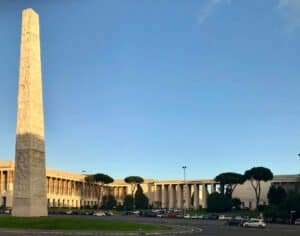
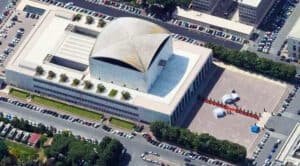
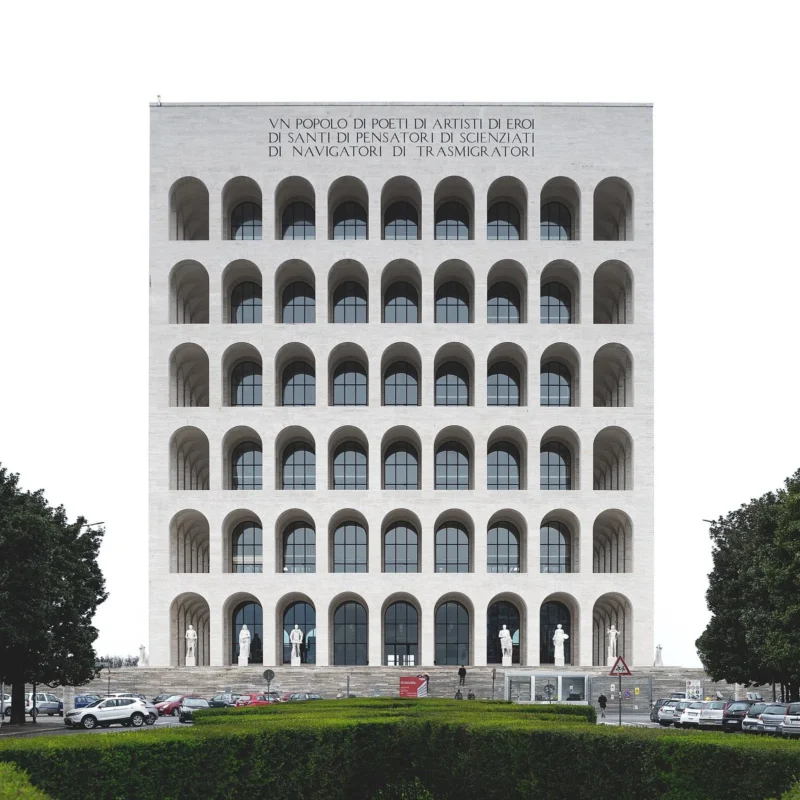
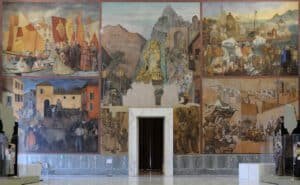
Upcoming events nearby
- Marialba Russo. Immagini della Madonna dell’Arco (After) at MUCIV, September 24 to November 20, 2026100 m
- Più libri più liberi 2026 at Nuvola in EUR, December 4 to 8, 2026300 m
- Roma Arte in Nuvola 2026 at the Nuvola in EUR, November 20 to 22, 2026300 m
- Dialoghi sinfonici – Dietro l’ascolto at La Nuvola, October 4, 2026 to March 14, 2027300 m