Archimede. La solitudine di un genio with Mario Incudine at Teatro di Villa Torlonia, March 18 to 21, 2027
In short. Archimede. La solitudine di un genio, the play by Costanza DiQuattro directed by Alessio Pizzech with Mario Incudine as the Syracusan mathematician, is on at Teatro di Villa Torlonia, at Via Lazzaro Spallanzani 1 in Rome, from Thursday,…

Archimede. La solitudine di un genio, the play by Costanza DiQuattro directed by Alessio Pizzech with Mario Incudine as the Syracusan mathematician, is on at Teatro di Villa Torlonia, at Via Lazzaro Spallanzani 1 in Rome, from Thursday, March 18 to Sunday, March 21, 2027. There are four performances, one a day. On stage with Incudine are Antonio Vasta, who performs live the music composed by Incudine himself, and Tommaso Garré. The theater is inside the park of Villa Torlonia, in the Nomentano neighborhood, and is reached by Metro Line B (Bologna or Policlinico stops, about 10 minutes on foot), by trams 3 and 19, which stop at Viale Regina Margherita/Nomentana, and by the buses on Via Nomentana. Start times and prices are published on the official website of Teatro di Roma, where you buy tickets, along with the foundation's box offices and the authorized presale circuit indicated on the show page. The production is by Centro Teatrale Bresciano and La Contrada Teatro Stabile di Trieste / Teatro della Città, in collaboration with Teatro Donnafugata.
Language: performed in Italian. No English version or English surtitles are announced.
The show tells of Archimedes' last night, during the Roman siege of Syracuse in 212 BC: a monologue that becomes a dialogue with a young soldier who has entered his house. What follows covers the dates, the content, the true story of Archimedes and his link with Rome, the singer and actor Mario Incudine, Teatro di Villa Torlonia and its park, how to get there and how to organize the evening.
Archimede at Teatro di Villa Torlonia: dates and essential facts
Archimede. La solitudine di un genio is on at Teatro di Villa Torlonia for four evenings, from Thursday, March 18 to Sunday, March 21, 2027, in the 2026/2027 season of Teatro di Roma.
The calendar
The performances are Thursday, March 18, Friday, March 19, Saturday, March 20 and Sunday, March 21. The show page doesn't give the start time for each date: check it on the Teatro di Roma website before buying, keeping in mind that on Sundays the foundation's halls often schedule a matinee.
The billing
Text by Costanza DiQuattro, direction by Alessio Pizzech, with Mario Incudine and with Antonio Vasta and Tommaso Garré. Sets and costumes are by Andrea Stanisci, the assistant director is Tommaso Garré himself, the music is by Mario Incudine, performed live by Antonio Vasta.
The production
Produced by Centro Teatrale Bresciano and La Contrada Teatro Stabile di Trieste / Teatro della Città, in collaboration with Teatro Donnafugata. The executive production is by A.S.C. Production Arte Spettacolo Cultura. It is a co-production between the North and Sicily, for a show about a Sicilian.
What Archimede. La solitudine di un genio is about
The show tells of Archimedes' last night during the Roman siege of Syracuse in 212 BC: a young soldier enters the mathematician's house and becomes an unwitting witness to his last hours.
From monologue to dialogue
The Teatro di Roma presentation speaks of a monologue that gradually turns into dialogue. Archimedes retraces his own existence, his discoveries, inventions, passions and wounds, in front of a boy who belongs to the enemy army.
The genius and loneliness
Behind the mathematician, the physicist and the inventor emerges a man forced to deal with incomprehension and isolation, and with the difficult balance between the need for knowledge and the world around him. The subtitle, La solitudine di un genio, meaning “the loneliness of a genius,” already says where the author's gaze rests.
A prophetic Archimedes
Between historical reality and legend, past and present, Costanza DiQuattro's text gives back a prophetic Archimedes, a symbol of a knowledge able to build and not destroy. In the face of the barbarity of war, the scientist asserts the value of thought, beauty and love as tools to preserve humanity.
Live music
The music is by Mario Incudine and is performed live by Antonio Vasta. For a show whose lead is a singer and multi-instrumentalist, the music is not a frame: it is part of the story.
Who Archimedes was: the mathematician of Syracuse
Archimedes of Syracuse, born around 287 BC and dead in 212 BC, is considered one of the greatest scientists and mathematicians in history: he calculated the surface and volume of the sphere, formulated the laws of floating bodies and studied the principle of levers.
Few certain facts
Little is known about his life with certainty. All the sources agree that he was from Syracuse and that he was killed during the Roman sack of Syracuse in 212 BC. The date of birth is derived from a report by the Byzantine scholar John Tzetzes, according to whom he died at 75. Plutarch has him related to King Hiero II, but the claim is disputed.
Friends in Alexandria
Archimedes was in contact with the scientists of Alexandria in Egypt: he was a friend of the mathematician and astronomer Conon of Samos, whose death he mourns in some works, and he dedicated the treatise The Method to Eratosthenes. It remains uncertain if he really stayed in Egypt, as Diodorus Siculus reports.
Eureka
His name is tied to an exclamation that became proverbial. Vitruvius tells that Hiero II asked him to find out if a crown was made of pure gold. Archimedes is said to have found the solution while taking a bath, noticing the rise of the water, and to have run through the streets of Syracuse shouting “eureka,” that is, “I have found it.”
The war machines
Polybius, Livy and Plutarch tell that during the Second Punic War, at the request of Hiero II, Archimedes built war machines to defend the city from Rome, among them the manus ferrea, a mechanical claw able to overturn enemy ships. The burning mirrors that supposedly set the Roman fleet on fire appear instead in much later authors, such as Lucian of Samosata, and remain wrapped in mystery.
Archimedes' last night: history and legend
Archimedes' death in the sack of Syracuse in 212 BC is told by the ancient sources in different versions, and it is precisely on this ground between history and legend that Costanza DiQuattro's text moves.
Plutarch's three versions
Plutarch reports three. In the first a Roman soldier orders Archimedes to follow him to the commander Marcus Claudius Marcellus and, when he refuses, kills him. In the third some soldiers meet him as he carries scientific instruments to Marcellus in a box and kill him thinking it contains gold.
The last words
Legend attributes to him last words in Latin addressed to the soldier who was about to kill him, “noli, obsecro, istum disturbare”: a plea not to ruin the drawing he was tracing. It's the scene everyone has in mind, and the text imagines the night that comes before it.
Marcellus' grief
According to Livy and Plutarch, Marcellus had given the order to capture Archimedes alive, was grieved by it and had him given an honorable burial. Polybius, considered the most authoritative source on the siege, doesn't report this detail.
Archimedes and Rome: Marcellus' planetarium and Cicero's tomb
Archimedes never set foot in Rome, but his story is tied to the city: the consul Marcus Claudius Marcellus, conqueror of Syracuse, brought to Rome after the sack of 212 BC a device built by the scientist that reproduced the motion of the stars.
The planetarium
The testimony is from Cicero, who reports the impressions of Gaius Sulpicius Gallus: a sphere that represented the vault of heaven and a mechanism that predicted the apparent motion of the sun, the moon and the planets. Pappus of Alexandria attributes to Archimedes a lost work on the construction of spheres.
The tomb rediscovered
Cicero also tells that he discovered in Syracuse the tomb of Archimedes thanks to a sphere inscribed in a cylinder carved on the sepulcher, according to the wish of the scientist, proud of having calculated the ratio between the two solids. The historian of mathematics Carl Boyer observed, with a touch of malice, that this discovery was perhaps the greatest contribution of the Roman world to mathematics.
Galileo and the master
Many centuries later, Galileo Galilei called Archimedes his master and drew on his method to describe the fall of bodies. Seeing a show about Archimedes in Rome also means remembering how much ancient Rome admired his machines more than his theorems.
Mario Incudine, the Archimedes on stage
Mario Incudine was born in Enna on June 2, 1981 and is a singer, stage actor and multi-instrumentalist: he is one of the best-known exponents of Sicilian folk music, with forays into world music.
Beginnings
His first artistic experience is his part in the film Vò Vò by Antonio Maddeo, shot in Sicily in the early 1990s. He then joins the company Amici del Teatro, with which he tours Italian theaters as an actor and author of soundtracks. With Pirandello's Il berretto a sonagli he wins the 2004 Premio Finale in Viterbo as best show and best company.
Music
In 1996 he founds with Franco Barbarino the group Janniscuru, and in 1999 the trio I petri c'addumanu. He plays mandolin, mandola and tammorra. His albums include Terra, Abballalaluna, Anime migranti, Beddu Garibbardi, Italia talia, D'acqua e di rosi, La Bella Poesia with Ambrogio Sparagna and, in 2025, Il senso della misura. In 2009 he wins the Festival della nuova canzone siciliana, and the year after the critics' prize of the same festival.
Classical theater
In 2011 he signs the music and performance of Curri l'Aria. In 2015 he is on stage at the Greek theater of Syracuse with Aeschylus' Le supplici, directed by Moni Ovadia and by Incudine himself, who with Kaballà handles the translation into Sicilian and composes the original music. Syracuse, the city of Archimedes, is therefore already a place in his artistic story.
Recent collaborations
In 2018 he collaborates on the video clip of Mio fratello by Biagio Antonacci, directed by Gabriele Muccino. On January 5, 2026 he is a guest at the Auditorium in Rome for the concert La Chiarastella by Ambrogio Sparagna with the Orchestra Popolare Italiana. On August 6, 2026 he receives the Marineo special prize.
Costanza DiQuattro, Alessio Pizzech and the musicians
Archimede. La solitudine di un genio comes from the text by Costanza DiQuattro and the direction of Alessio Pizzech, with the collaboration of Teatro Donnafugata.
The author
Costanza DiQuattro signs a text that, in the words of Teatro di Roma, sits between historical reality and legend, and that makes Archimedes a symbol of knowledge set against the barbarity of war.
The direction
Alessio Pizzech builds the staging around an actor who is first of all a musician: the monologue that becomes dialogue alternates with live-played music.
Antonio Vasta and Tommaso Garré
Antonio Vasta performs Incudine's music live. Tommaso Garré is on stage and is also assistant director. The sets and costumes by Andrea Stanisci recreate the Syracusan house the soldier enters.
Teatro di Villa Torlonia, the hall of Archimede
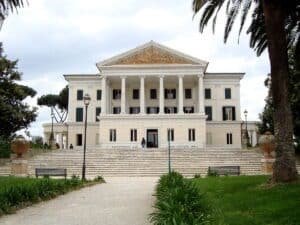
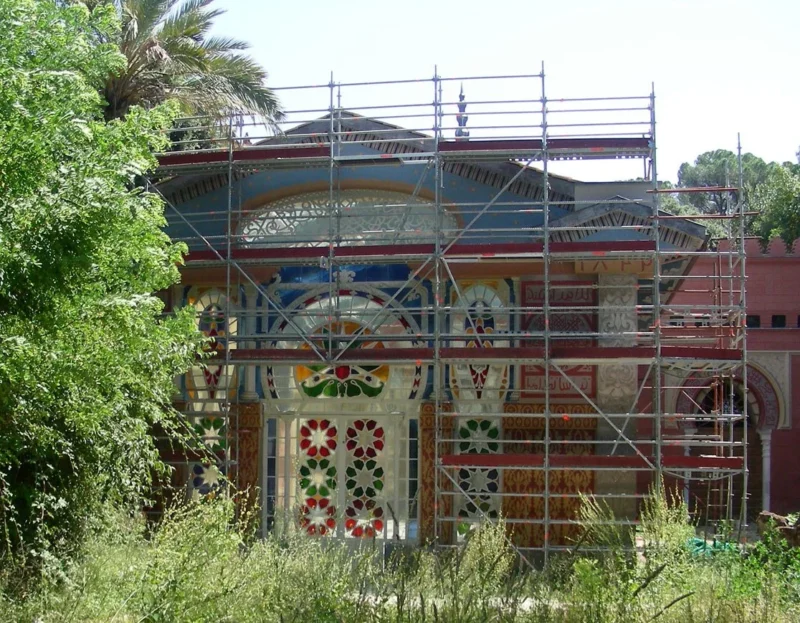
Teatro di Villa Torlonia is the 19th-century theater of the residence of the Torlonia princes, built by Quintiliano Raimondi for Alessandro Torlonia, reopened in 2013 after a long restoration and today one of the three halls of Teatro di Roma.
The princes' theater
From 1832 Alessandro Torlonia turned the family villa into a grand showpiece residence, and Raimondi built for him the Teatro together with the Limonaia. It was a private theater, meant for parties and shows for the guests of the house.
Abandonment and restoration
After the years in which the villa was Mussolini's residence and then the seat of the Allied command between 1944 and 1947, a long abandonment followed. The City bought the complex in 1977. The restorations, begun in 1991, gave the Teatro back in 2013.
A hall for a monologue
The intimate size of the hall suits a text like Archimede, which lives on voice, music and closeness to the audience. A theater built for a Roman prince of the 1800s welcomes the night of a Syracusan killed by the Romans: a reversal not without irony.
Villa Torlonia: the park around the theater
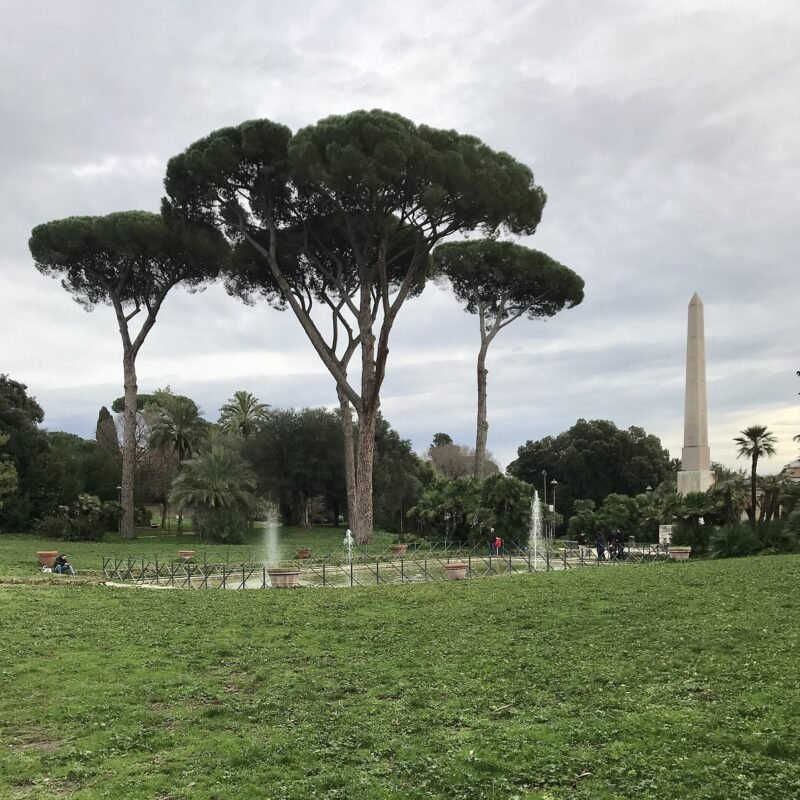
Villa Torlonia is a public park in the Nomentano neighborhood, owned by the City since 1977 and open to the public since 1978, with the main entrance on Via Nomentana and other entrances on Via Lazzaro Spallanzani.
From the Pamphilj to the Torlonia
Between the 1600s and the mid-1700s the estate belonged to the Pamphilj, who used it as a farm. It then passed to Cardinal Girolamo Colonna and in 1797 to the banker Giovanni Raimondo Torlonia. In 1806 Giuseppe Valadier redesigned the park and turned the buildings into the Casino Nobile and the Casino dei Principi.
The buildings of the park
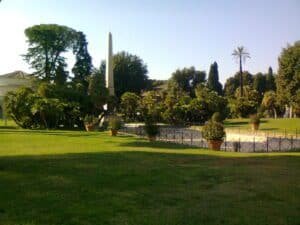
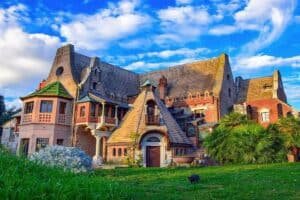
For Alessandro Torlonia worked Giovan Battista Caretti, Giuseppe Jappelli, author of the Capanna Svizzera later turned into the Casina delle Civette and of the Serra Moresca, and Quintiliano Raimondi. In 1842 the obelisks of Villa Torlonia were raised, dedicated to the prince's parents.
The 1900s
In 1919 an underground Jewish cemetery from the Roman era was discovered in the park. From the 1920s to July 1943 the Casino Nobile was the residence of Benito Mussolini. From 1944 to 1947 the villa housed the Anglo-American command.
How to get to Teatro di Villa Torlonia for Archimede
Teatro di Villa Torlonia is at Via Lazzaro Spallanzani 1 and is reached by Metro Line B, by trams 3 and 19 and by the buses that run along Via Nomentana and Via Bari.
By metro
The most convenient stations on Line B are Bologna and Policlinico: from the first you walk toward Via Nomentana, from the second you go up Viale Regina Margherita. In both cases it takes about 10 minutes on foot, heading for the entrances on Via Spallanzani.
By tram
Trams 3 and 19 stop at Viale Regina Margherita/Nomentana, a few steps from the villa: the 19 comes from San Lorenzo and Porta Maggiore, the 3 from the Colosseum and Trastevere.
By bus
On Via Nomentana run, among others, lines 60, 66, 82 and 90. On Via Bari the 61, the 490, the 495 and the 649. In the evening frequencies change: better to check the route on the planner of the Roman transit company.
By car
Nomentano is a residential neighborhood and in the evening parking along Via Nomentana is hard. Metro and tram remain the most practical solution.
A curiosity about Archimede. La solitudine di un genio with Mario Incudine at Teatro di Villa Torlonia, March 18 to 21, 2027
The most surprising curiosity concerns the road that separates Syracuse from Rome, and that Archimedes' story has traveled at least twice. The first is that of the consul Marcus Claudius Marcellus, the commander who conquered Syracuse in 212 BC: according to Cicero's testimony, he brought back to Rome a device built by Archimedes that reproduced the vault of the sky and the motion of the sun, the moon and the planets, a sort of armillary sphere before the term existed. The machines that had held the Roman quinqueremes in check thus became war booty and an object of wonder for the city's aristocracy. The second road was traveled by Cicero himself, in the opposite direction: it was he, according to his account, who found in Syracuse the forgotten tomb of the scientist, recognizing it by a sphere inscribed in a cylinder carved in the stone. There is also a more recent link between Incudine and the city of Archimedes: in 2015 the actor and musician was on stage at the Greek theater of Syracuse with Aeschylus' Le supplici, handling its translation into Sicilian with Kaballà and composing its music. And a curiosity tied to the venue: the show arrives at Teatro di Villa Torlonia, a theater built in the 1800s for the Torlonia princes, a family of bankers, a stone's throw from a park where in 1919 an underground Jewish cemetery from the Roman era was discovered. The ancient Rome that killed Archimedes and the modern Rome that tells of his loneliness, a few meters apart.
Something nobody tells you about Archimede. La solitudine di un genio with Mario Incudine at Teatro di Villa Torlonia, March 18 to 21, 2027
What is rarely said is that the death of Archimedes, the scene everyone knows, with the old man bent over his drawings and the soldier who strikes him, is a story on whose details the ancient sources don't even agree. Plutarch reports three different versions: in one the soldier kills him because he refuses to follow him to Marcellus, in another because he thinks the box of scientific instruments he carries contains gold. Livy and Plutarch tell that Marcellus, who wanted him alive, was grieved and gave him an honorable burial. Polybius, considered the most reliable witness of the siege, doesn't mention it. Even the Latin phrase that tradition puts in Archimedes' mouth, the plea not to ruin the drawing, belongs to legend more than to chronicle. Costanza DiQuattro's text works exactly in this space: it doesn't tell the death, but the night that comes before it, and imagines a young soldier who enters the mathematician's house and becomes its witness. It is an intelligent dramaturgical choice, because it fills with theatrical invention a gap that the sources leave open. The second thing that goes unsaid concerns the hall: Teatro di Villa Torlonia is inside a park, and to reach it in the evening it's best to know in advance which entrance to use. The entrances on Via Spallanzani are the closest to the theater, and the park, in March, closes at sunset: the walk has to be done beforehand.
The advice I give you for seeing Archimede. La solitudine di un genio with Mario Incudine at Teatro di Villa Torlonia, March 18 to 21, 2027
The advice is to arrive at Villa Torlonia in the afternoon and spend a couple of hours in the park and the museums before the show. The Casina delle Civette, the Casino Nobile and the Casino dei Principi, seats of the Musei di Villa Torlonia, tell of the same family that had the theater built, and a visit before the performance gives depth to the evening. In March the park closes early, so it's best to plan ahead and then go out for something to eat on Via Nomentana before coming back in for the show. The second piece of advice concerns listening: Archimede is a show in which live music has a central role, and those who know Mario Incudine know that his voice and his way of playing carry with them the Sicilian folk tradition. It's worth listening beforehand to a few tracks from his records, from D'acqua e di rosi to Il senso della misura, to arrive in the hall with your ear already tuned. The third piece of advice is for those traveling with teenagers who study math or physics in high school: taking them to see the show is a way to bring the lever, buoyancy and the volume of the sphere together with a man of flesh and blood, and with the question the show openly poses, namely what knowledge is for in the face of war. Finally, it's best to choose Thursday or Friday, if possible: in an intimate hall like the one at Villa Torlonia the best seats go quickly on the weekend.
Where to eat before or after Archimede
Inside Villa Torlonia the restored Limonaia serves as a refreshment point. Outside the park, along Via Nomentana and around Piazza Bologna, there are bars, pizzerias and trattorias at every price level.
In the park
The Limonaia, built by Quintiliano Raimondi like the theater, is the most convenient option for a coffee or an aperitivo without leaving the villa. Its hours follow those of the park, which in March closes at sunset.
At Piazza Bologna
Around Piazza Bologna and along Viale XXI Aprile the offer is wide and frequented above all by residents, with lower prices than in the center. On Saturday evening it's best to book.
Toward San Lorenzo
Anyone who prefers a livelier neighborhood after the show can take tram 19 toward San Lorenzo, a university area with osterias and places open late.
Another well-known fact, yet rarely cited
It's well known that Archimedes shouted “eureka,” that is, “I have found it,” after discovering in the bath the principle of buoyancy: the story is Vitruvius', and since then the word has entered almost every language. It's cited less often that an important part of Archimedes' works has come down to us through an almost novelistic chance. In 1906 the Danish philologist Johan Ludvig Heiberg, examining in Constantinople a 13th-century prayer book on goatskin parchment, discovered that under the religious text writings of Archimedes could still be read: the leaves had been scraped and reused, a common practice because of the cost of parchment. We even know the name of the author of the rewriting, Johannes Myronas, who finished his work on April 14, 1229. The palimpsest, stolen in the 1900s, was sold at auction in New York in 1998. There is also a thread that leads to Rome: the Latin translation of Archimedes' works made in 1269 by William of Moerbeke, from codices that were in the library of the papal court at Viterbo, is today kept in the Vatican Library, where it was rediscovered in 1882. The solitary genius of the show, then, survived thanks to copyists, monks, philologists and librarians: a chain of people who saved his thought from oblivion, more or less knowingly. It is the opposite of loneliness.
The right photo to take at Archimede. La solitudine di un genio with Mario Incudine at Teatro di Villa Torlonia, March 18 to 21, 2027
During the show the phone stays off: the music performed live by Antonio Vasta and the voice of Mario Incudine deserve listening without screens. The right photograph is taken beforehand, outdoors, while there is light in the park. The first framing is the facade of Teatro di Villa Torlonia, the 19th-century building by Quintiliano Raimondi set in the green of the park: in the afternoon the March light hits it from the side and brings out its architecture. The second is for those who have time to go around the park: the obelisks of Villa Torlonia, erected in 1842 in memory of Alessandro Torlonia's parents. For a show about a mathematician who wanted a sphere and a cylinder on his own tomb, a photograph that plays with geometric forms, the obelisk, the columns, the lines of the avenues designed by Valadier, makes precise sense. The third is the Casina delle Civette, which began as Giuseppe Jappelli's Capanna Svizzera and was transformed by Giovanni Torlonia, one of the most recognizable buildings of the villa. At sunset, when the park empties, the avenues and the big trees offer clean images, without crowds. After the show the park is dark and the only possible photo is that of the lit entrance: a simple memento of an evening dedicated to the genius of Syracuse.
Some important events that happened here in history
Villa Torlonia begins its history as an agricultural estate of the Pamphilj, between the 1600s and the mid-1700s. It then passes to Cardinal Girolamo Colonna, who starts the construction of the first nucleus of the residence. In 1797 the property is bought by the banker Giovanni Raimondo Torlonia, and in 1806 Giuseppe Valadier redesigns the park with symmetrical, perpendicular avenues. From 1832 his son Alessandro entrusts the works to Giovan Battista Caretti, Giuseppe Jappelli and Quintiliano Raimondi, who builds the Teatro and the Aranciera, today the Limonaia. In 1842 the two obelisks dedicated to the prince's parents are raised. His successor Giovanni transforms the Capanna Svizzera into the Casina delle Civette and has the Villino Medievale and the Villino Rosso built. In 1919 an underground Jewish cemetery from the Roman era is discovered in the park. In the 1920s Giovanni Torlonia grants the Casino Nobile to Benito Mussolini, who lives there with his family until July 1943. From 1944 to 1947 the villa houses the Anglo-American command, followed by a long abandonment. In 1977 the City of Rome buys the villa, which the following year becomes a public park. From 1991 the restorations begin. The Teatro reopens in 2013 and then joins the circuit of the Teatro di Roma halls. From March 18 to 21, 2027 its stage welcomes Archimede. La solitudine di un genio.
Who has passed through Archimede. La solitudine di un genio with Mario Incudine at Teatro di Villa Torlonia, March 18 to 21, 2027
Through Villa Torlonia have passed families and figures who marked the history of Rome. The Pamphilj, who had an agricultural estate here. Cardinal Girolamo Colonna. The banker Giovanni Raimondo Torlonia and his son Alessandro, who turned the villa into a showpiece residence and had the theater built. The architects Giuseppe Valadier, Giovan Battista Caretti, Giuseppe Jappelli and Quintiliano Raimondi, who designed it. In the 1900s Benito Mussolini, who lived in the Casino Nobile from the 1920s to July 1943, and then the Allied commands between 1944 and 1947. After the restoration Teatro di Villa Torlonia became a hall of Teatro di Roma, also frequented by a younger audience: this season shows such as Albert eD io and Charlie Gordon have passed through. From March 18 to 21, 2027 Mario Incudine, Antonio Vasta and Tommaso Garré pass through, with the author Costanza DiQuattro, the director Alessio Pizzech and the set and costume designer Andrea Stanisci. With them, ideally, come Archimedes, King Hiero II, the consul Marcus Claudius Marcellus, Cicero who found his tomb again and Galileo who called him master.
Accessibility, age and practical information
For access to Teatro di Villa Torlonia by people with reduced mobility the reference is Teatro di Roma, which devotes a section of its official website to the accessibility of its halls.
The park in the evening
Villa Torlonia is a historic park with avenues, gravel and a few changes in level: people with mobility difficulties do well to ask in advance which entrance is most convenient for the theater. In March, on the way out in the evening, it's best to have a jacket.
With teenagers
Archimede is a show suited to an adult audience and to high school students: ancient history, science and live music make it an opportunity for those who study math, physics or Latin. The theme of war and death is at the center of the story: with the youngest it's best to talk about it beforehand.
March in Rome
The second half of March brings longer days and mild temperatures, ideal for combining theater with a visit to the Musei di Villa Torlonia.
Frequently asked questions about Archimede at Teatro di Villa Torlonia
When is Archimede with Mario Incudine on in Rome?
Archimede. La solitudine di un genio is on at Teatro di Villa Torlonia in Rome from Thursday, March 18 to Sunday, March 21, 2027, with one performance a day. The start times are published on the official Teatro di Roma website, along with the prices.
Who is on stage in Archimede. La solitudine di un genio?
In Archimede, Mario Incudine performs in the role of the mathematician, with Antonio Vasta, who performs live the music composed by Incudine, and Tommaso Garré. The text is by Costanza DiQuattro, the direction by Alessio Pizzech, sets and costumes by Andrea Stanisci.
What is the show about Archimedes about?
The show about Archimedes tells of the mathematician's last night during the Roman siege of Syracuse in 212 BC: a young soldier enters his house and listens to the story of his discoveries, inventions and wounds, in a monologue that becomes dialogue.
Where is Teatro di Villa Torlonia?
Teatro di Villa Torlonia is at Via Lazzaro Spallanzani 1, inside the park of Villa Torlonia, in the Nomentano neighborhood. You get there by Metro Line B, Bologna or Policlinico stops, by trams 3 and 19 and by the buses on Via Nomentana.
Who is Mario Incudine?
Mario Incudine, born in Enna in 1981, is a singer, actor and multi-instrumentalist, among the best-known names of Sicilian folk music. He has recorded many albums, won the Festival della nuova canzone siciliana in 2009 and performed at the Greek theater of Syracuse in Aeschylus' Le supplici.
Is the show about Archimedes suitable for students?
Archimede. La solitudine di un genio is suitable for high school students: it tells of one of the greatest scientists in history between historical reality and legend, with live music. The theme of war is present and becomes a reflection on the value of knowledge.
Where do you buy tickets for Archimede?
Tickets for Archimede at Teatro di Villa Torlonia are bought on the official Teatro di Roma website, at the foundation's box offices and on the authorized presale circuit indicated on the show page.
The final advice on Archimede
In our view Archimede. La solitudine di un genio is an evening that brings together three rare things in a single show: ancient history told without dust, Sicilian folk music played live and a singing actor who knows Syracuse also from the stage of its Greek theater. The advice is to arrive at Villa Torlonia with the daylight, walk around the park between the Casina delle Civette and the obelisks, and then go into the hall to listen to the last night of a man who, in the face of war, kept drawing circles.
Article written by the editorial team of Tour Leader Pro, contact them for Private/Corporate/V.I.P. Tours and Experiences.
Planning a trip to Rome? The English-language guides for visiting the city are on ItalyPlanner.com.
Contact Information
Nearby
 Jewish Catacombs of Villa Torlonia100 m
- Obelisks of Villa Torlonia100 m
- Casina delle Civette – Villa Torlonia Museums100 m
- Casino Nobile – Villa Torlonia Museums200 m
- Villa Torlonia200 m
- Serra Moresca200 m

Upcoming events nearby
- Il teatro dell’amore e del potere at the Teatro di Villa Torlonia, October 17 to December 20, 2026100 m
- Quartett by Heiner Müller at Teatro di Villa Torlonia, January 21-24, 2027100 m
- Beata oscenità by Serena Sinigaglia at Teatro di Villa Torlonia, March 4 to 7, 2027100 m
- Ritratto d’autore: Igor Stravinsky and Petrushka with Roma Tre Orchestra at Teatro Torlonia, November 12, 2026100 m

You might also like
- Fire of Georgia, Royal National Ballet of Georgia at Teatro Italia, December 10, 2026
- Arteteca in Non tutte le suocere vengono per nuocere at Teatro Italia, April 9, 2027
- Adamo Romano in Maledizioni live a teatro at Teatro Italia, April 3, 2027
- Il Matricomio, Non ti prometto niente
- Una razza in estinzione, a Tribute to Giorgio Gaber at Teatro Italia, November 29, 2026
- Festival delle Favole at Teatro Italia, December 13, 2026