Quartett by Heiner Müller at Teatro di Villa Torlonia, January 21-24, 2027
In short. Quartett by Heiner Müller is on at Teatro di Villa Torlonia, at Via Lazzaro Spallanzani 1 in Rome, for four consecutive nights, from Thursday, January 21 to Sunday, January 24, 2027, with Viola Graziosi and Maximilian Nisi, who also directs.
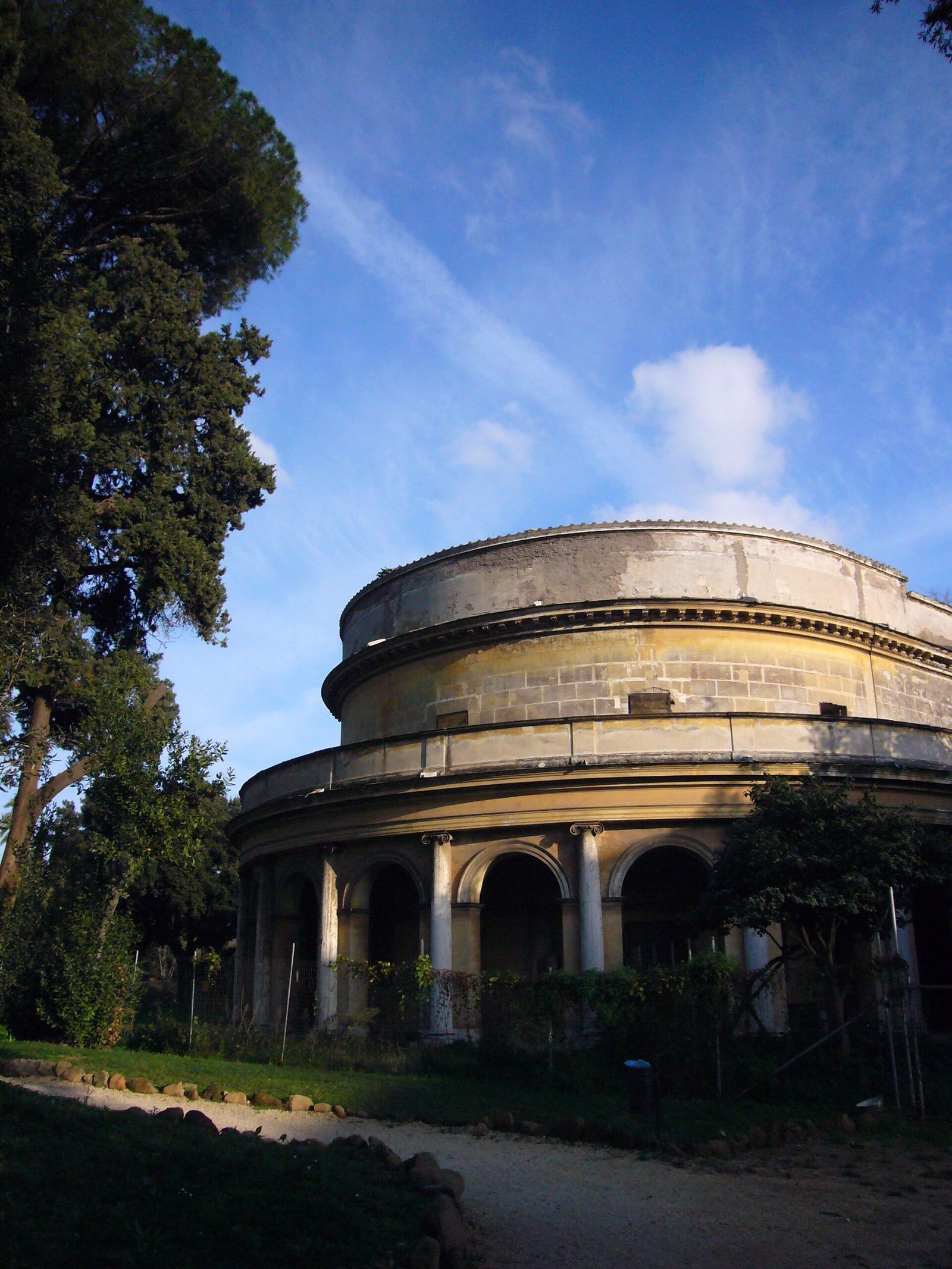
Quartett by Heiner Müller is on at Teatro di Villa Torlonia, at Via Lazzaro Spallanzani 1 in Rome, for four consecutive nights, from Thursday, January 21 to Sunday, January 24, 2027, with Viola Graziosi and Maximilian Nisi, who also directs. The theater stands inside the park of Villa Torlonia, in the Nomentano district, and is reached by metro line B (Bologna or Policlinico stops, about a 10-minute walk), by trams 3 and 19, which stop at Viale Regina Margherita/Nomentana, and by the buses along Via Nomentana. The show is part of the 2026/2027 season of the Teatro di Roma, which publishes start times and prices for the Villa Torlonia hall on its official website: tickets are bought there, at the foundation's box offices and on the authorized presale network that the Teatro di Roma indicates on the show's page. The translation is by Saverio Vertone, the original music by Stefano De Meo, sets and costumes by Vincenzo La Mendola, the production is by Teatro della Città.
Language: performed in Italian. No English version or English surtitles are announced.
Quartett at Teatro di Villa Torlonia: dates, company and essentials
Quartett stays on the bill at Teatro di Villa Torlonia from January 21 to 24, 2027, four performances from Thursday to Sunday, with only two performers onstage.
The dates
The calendar published by the Teatro di Roma lists Thursday the 21st, Friday the 22nd, Saturday the 23rd and Sunday, January 24. That is four chances in all, in a hall that by size is the most intimate of the three run by the foundation: anyone with a specific date in mind, Saturday above all, does well not to wait for the last week.
The credits
The text is by Heiner Müller, in the Italian translation by Saverio Vertone. The direction is by Maximilian Nisi, who acts alongside Viola Graziosi. The original music is by Stefano De Meo, sets and costumes by Vincenzo La Mendola. The production is by Teatro della Città, and Nisi's biography lists this Quartett as a 2026 work born in Catania.
Times and prices
The show's official page does not yet give the start time of the individual performances or the ticket price. The reference remains the Teatro di Roma website, which updates the information and tickets section for each title and also runs the 2026/2027 season subscription campaign.
What Quartett is about: Merteuil and Valmont at the end of the game
Quartett stages the extreme confrontation between the Marquise de Merteuil and the Vicomte de Valmont, the two libertines of Dangerous Liaisons, here portrayed as figures already in decline, closed in a space suspended outside time and history.
Two characters, four roles
The title explains the mechanism. There are two actors onstage, but four roles: through a continual exchange of parts, as the Teatro di Roma's presentation describes, the protagonists transform into each other and also embody their own victims. Valmont becomes Merteuil, Merteuil becomes Valmont, and both lend voice and body to those they seduced and destroyed. The quartet is this: two people who are enough to contain an entire novel.
A duel of words
The official presentation speaks of a verbal and physical duel in which language becomes a weapon and the body a place of transformation. It is the key to entering the show: Müller does not tell a love story, he builds a ruthless ritual in which seduction, domination and memory intertwine. The boundary between identity, gender, desire and power, writes the Teatro di Roma, dissolves until it calls every certainty into question.
A radical text
The season listing defines Quartett as a radical text that questions the nature of power and the fragility of identity and leads the spectator into a relentless confrontation with the darkest zones of the human being. It is worth knowing before sitting down in the hall: it is theater of dense words, little inclined to consolation, which asks for attention and gives a lot back to those who grant it.
From Dangerous Liaisons to Quartett: the source of the text
The source of Quartett is Dangerous Liaisons (Le relazioni pericolose), the epistolary novel by Pierre Choderlos de Laclos published in 1782, one of the most rewritten texts of French literature.
Laclos's novel
In the novel the Marquise de Merteuil and the Vicomte de Valmont, former lovers, challenge each other with seductions, using people as pawns. Everything passes through letters: nobody really speaks, everyone writes, and every letter is a move. Müller keeps the two names and the air of challenge, but removes the context and leaves only the game, taken to its extreme consequences.
The other rewritings
The story has had a long life on stage and screen. In 1959 Roger Vadim made a film of it set in his own time, in 1985 Christopher Hampton wrote the stage adaptation Les Liaisons Dangereuses, and in 1988 Stephen Frears's film came out. Quartett belongs to the same family, but it is its harshest branch: where the others rebuild the 18th century, Müller empties it and keeps only the skeleton.
A reading for today's spectator
Those arriving in the hall with the memory of Frears's film will find something very different. There are no salons, carriages, wigs. There is a room, there are two voices. In our view it is the version that says the most about the present, because it exposes the mechanism of power inside relationships without leaving the spectator the comfortable alibi of period costume.
Heiner Müller, the author of Quartett
Heiner Müller, born in Eppendorf, Saxony, on January 9, 1929 and died in Berlin on December 30, 1995, is considered the most important German playwright after Bertolt Brecht and one of the fathers of postmodern theater.
East Germany
Müller lived and worked in the German Democratic Republic, with which he had a tormented relationship. In 1959 he won the Heinrich Mann Prize, but in 1961 his text Die Umsiedlerin was censored after a single performance and the author was expelled from the Writers' Association. In the following years the authorities blocked the premiere of Der Bau and censored Mauser. He was readmitted to the association only in 1988, shortly before the fall of the Wall.
Success in the West
In the 1970s and 1980s Müller worked for West German theaters, directing in Munich the premieres of some of his best-known works: Germania Tod in Berlin in 1978, Die Hamletmaschine in 1979, Der Auftrag in 1982. International fame led to recognition at home too: in 1984 he entered the East German Academy of Arts, two years later the West Berlin one.
The Berliner Ensemble and the prizes
After 1989 Müller briefly presided over the East German Academy of Arts. In 1992 he joined the directorate of the Berliner Ensemble, the company founded by Brecht, and in 1995, shortly before dying, became its artistic director. In 1990 he received the Kleist Prize and in December 1994 the Europe Theatre Prize in Taormina. Among his best-known works are Medeamaterial, Paesaggio con Argonauti (Landscape with Argonauts), Filottete (Philoctetes), Cemento (Cement), Descrizione di un quadro (Description of a Picture) and, of course, Quartett.
Müller in Italian
In Italy his work has been published mainly by Ubulibri: the first volume of plays, out in 1984, collected Filottete, L'Orazio (Horace), Mauser, La missione (The Mission) and Quartett itself, then titled Quartetto. In the years since the other volumes have followed, the interviews of Tutti gli errori (All the Mistakes) and the poems of Invenzione del silenzio (Invention of Silence).
Viola Graziosi, the Marquise de Merteuil of Quartett
Viola Graziosi is a Roman actress, born on September 24, 1979, who debuted very young as Ophelia in the Hamlet directed by Carlo Cecchi and graduated from the Conservatoire national supérieur d'art dramatique in Paris.
The beginnings with Carlo Cecchi
She was 17 when Carlo Cecchi chose her for Ophelia. With Cecchi, at the Teatro Garibaldi in Palermo between 1997 and 1999, she also acted in A Midsummer Night's Dream and Measure for Measure: a rigorous Shakespearean school, before her Paris training at the Conservatoire, where between 2000 and 2003 she worked with directors such as Alain Françon and Catherine Hiégel.
The great female figures
Onstage she has played Medea, Clytemnestra, Phaedra, Circe and Helen in The Trojan Women at the Greek Theater in Syracuse, directed among others by Paolo Magelli, Giuseppe Dipasquale and Muriel Mayette-Holtz. Her repertoire runs from Six Characters in Search of an Author to Strindberg's Creditors, up to Margaret Atwood's The Handmaid's Tale. With Graziano Piazza she staged the Trilogia del Femminile (Trilogy of the Feminine), giving voice to real women such as Sibilla Aleramo and Simonetta Vespucci.
Voice and screen
Graziosi is also one of the best-known voices of Italian audiobooks: she has read Isabel Allende, Amélie Nothomb, Antonio Tabucchi and Virginia Woolf. In film she was directed by Francesca Comencini and Pupi Avati, on television she acted in Distretto di Polizia, Un passo dal cielo (A Step from Heaven), Nero Wolfe, L'allieva (The Pupil) and in the film on Chiara Lubich. In 2024 she was named Knight of the Order of Merit of the Italian Republic.
Maximilian Nisi, director and performer of Quartett
Maximilian Nisi, born in Faenza on September 15, 1970 and raised in Turin, is an actor and director trained at the School of the Piccolo Teatro di Milano led by Giorgio Strehler, with whom he debuted in 1993 in Goethe's Faust.
Strehler and Ronconi
A graduate of Strehler's school in 1993, in 1995 he moved to Rome for the advanced course of the Teatro di Roma led by Luca Ronconi, working with Peter Stein, Federico Tiezzi and Piero Maccarinelli. From Strehler, his biography says, he learned poetry and rigor, from Ronconi the relationship between a text and the language it is written in. For a text like Quartett, built entirely on language, it is a training that counts.
Roles and prizes
With Theodoros Terzopoulos he was Haemon in Antigone at the Teatro Olimpico in Vicenza, a role that won him the Premio Lauro Olimpico. In 1997 Sandro Sequi chose him as the lead of Billy Budd, the first Italian stage adaptation of Melville's novel. In 2012 he was Oedipus in Oedipus Rex directed by the Russian Anatoly Vasiliev. He has worked with Glauco Mauri, Gabriele Lavia, Maurizio Scaparro, Krzysztof Zanussi, Jérôme Savary, and has received, among others, the Premio Internazionale Bronzi di Riace and the Premio Confcommercio at the Borgio Verezzi Festival.
Directing and television
Since January 2024 Nisi has been artistic director of the Borgio Verezzi theater festival. As a director he has signed Le memorie di un fanciullo (A Boy's Memories) from Elsa Morante, Giuda (Judas) by Raffaella Bonsignori, Donne in fuga (Women on the Run) and, in 2026, Quartett and Sartre's Huis Clos. Television audiences remember him as Marco Altieri in Un posto al sole and as Luigi De Paoli in Incantesimo.
Teatro di Villa Torlonia, the hall of Quartett
Teatro di Villa Torlonia is the 19th-century theater of the residence of the Torlonia princes, built by Quintiliano Raimondi for Alessandro Torlonia, reopened in 2013 after a long restoration and today one of the halls of the Teatro di Roma.
A family theater
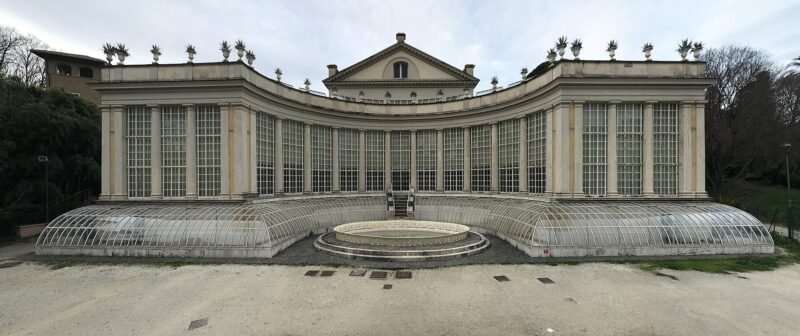
From 1832 Alessandro Torlonia transformed the family villa into a grand residence for display. The Theater, which Raimondi built together with the Limonaia, hosted the parties and shows reserved for the guests of the family, among the richest of papal Rome. It was born as a private theater: it has become public only in our century.
From decay to reopening
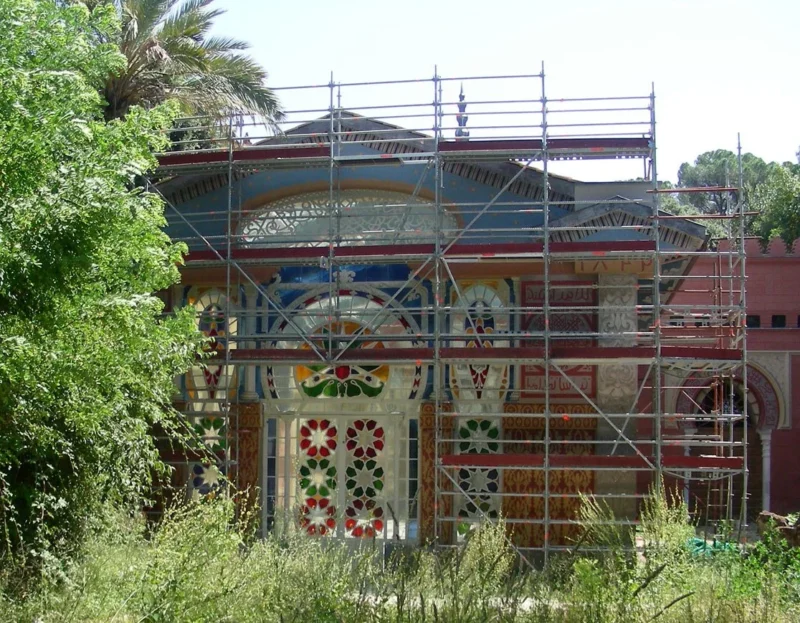
After the years when the villa was Mussolini's residence and then the seat of the Allied command between 1944 and 1947, a long abandonment followed. The city bought the complex in 1977 and since 1991 restorations have recovered one building after another. The Theater reopened in 2013, the Serra Moresca in 2021.
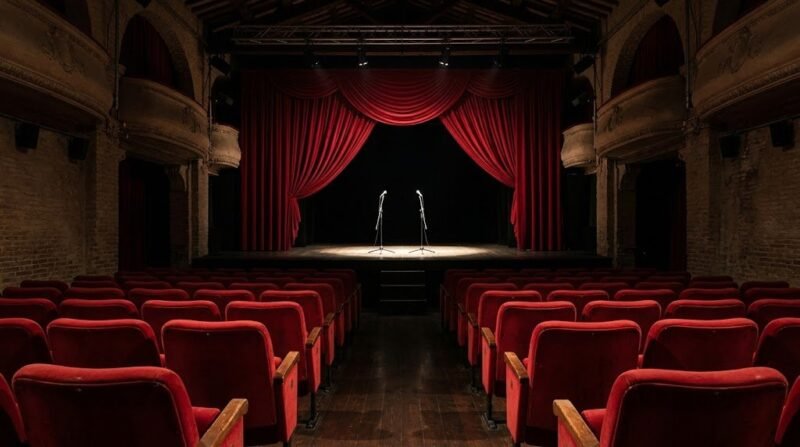
A hall for two actors
For Quartett the size of the hall is an evident advantage. A text that lives on glances, breaths and words whispered or hurled needs the audience to be close, and Teatro di Villa Torlonia offers a closeness big halls do not allow. There is also a curious echo: a theater born for the aristocratic evenings of the 19th century welcomes two 18th-century aristocrats arrived at the end of their game.
Villa Torlonia: the park around Quartett
Villa Torlonia is a public park in the Nomentano district, city-owned since 1977 and open to citizens since 1978, with its main entrance on Via Nomentana and other gates on Via Lazzaro Spallanzani.
From the Pamphilj to the Torlonia
Between the 17th century and the mid-18th the estate belonged to the Pamphilj, who used it as a farm, it then passed to Cardinal Girolamo Colonna and in 1797 was sold to the banker Giovanni Raimondo Torlonia. In 1806 Giuseppe Valadier redesigned the park and transformed the existing buildings into the Casino Nobile and the Casino dei Principi.
Alessandro Torlonia's architects
From 1832 Giovan Battista Caretti, Giuseppe Jappelli, author of the Swiss Hut later turned into the Casina delle Civette and of the Serra Moresca, and Quintiliano Raimondi, who built the Theater and the Limonaia, worked for Alessandro Torlonia. In 1842 the obelisks of Villa Torlonia were raised, dedicated to Alessandro's parents.
The 20th century
In 1919 an underground Jewish cemetery of Roman date was discovered in the park. From the 1920s to July 1943 the Casino Nobile was the residence of Benito Mussolini, who paid the Torlonia a symbolic rent of one lira. From 1944 to 1947 the villa was occupied by the Anglo-American command, then went through a long abandonment until the city's purchase.
The villa today
Today Villa Torlonia is a park open from dawn to dusk, with the Musei di Villa Torlonia spread among the Casino Nobile, the Casino dei Principi and the Casina delle Civette. In late January the park closes early: for a walk before the show it is best to arrive in the early afternoon.
How to get to Teatro di Villa Torlonia for Quartett
Teatro di Villa Torlonia is at Via Lazzaro Spallanzani 1 and is reached by metro line B (Bologna or Policlinico stops), by trams 3 and 19 and by the buses of Via Nomentana and Via Bari.
By metro
The most convenient stations on line B are Bologna and Policlinico. From the first you walk toward Via Nomentana, from the second you go up Viale Regina Margherita: in both cases it takes about 10 minutes on foot. For the theater it is best to aim for the gates on Via Spallanzani.
By tram
Trams 3 and 19 stop at Viale Regina Margherita/Nomentana, a few steps from the villa. The 19 connects the area with San Lorenzo and Porta Maggiore, the 3 with the Colosseum and Trastevere.
By bus
On Via Nomentana run, among others, lines 60, 66, 82 and 90, on Via Bari the 61, 490, 495 and 649. In the evening and on weekends frequencies change: before heading out it is wise to check the route on the Rome transport company's calculator.
By car
Nomentano is a residential district and parking along Via Nomentana, especially in the evening, is difficult. Metro and tram remain the most sensible choice, also because the theater's exit often coincides with evening traffic on Viale Regina Margherita.
A curiosity about Quartett by Heiner Müller at Teatro di Villa Torlonia, January 21-24, 2027
The most interesting curiosity concerns the two faces of this show. Viola Graziosi and Maximilian Nisi come to Quartett from parallel paths: both trained inside the great schools of director's theater, she with Carlo Cecchi and then at the Paris Conservatoire, he with Giorgio Strehler at the Piccolo and with Luca Ronconi at the Teatro di Roma itself. For Nisi, then, this season is a return to the foundation where he trained in the mid-1990s, 30 years later, and with a show directed by him. The second detail concerns the female roles Graziosi has played: Medea, Clytemnestra, Phaedra, Circe, Helen. They are all women who use intelligence as a weapon in a world governed by men, and it is hard not to see in the Marquise de Merteuil the 18th-century heir of those figures. The third detail is bibliographic: the first Italian edition of Müller's plays, published by Ubulibri in 1984, gathered Quartett, then translated as Quartetto, with Filottete, L'Orazio, Mauser and La missione. For over 40 years, then, the text has circulated in our language, yet it remains one of the least staged of its author's on Roman stages.
Something nobody tells you about Quartett by Heiner Müller at Teatro di Villa Torlonia, January 21-24, 2027
What the presentations do not say is that Quartett asks the spectator to know at least in outline Dangerous Liaisons. Müller takes for granted the names, the victims and the challenge between the two libertines: if you arrive in the hall knowing who the women deceived by the two libertines are, the actors' transformations are followed with more pleasure, because you recognize each time who is being evoked. Half an hour with a summary of Laclos's novel, or watching Stephen Frears's 1988 film, is enough to prepare the evening. The second thing concerns the tone. Quartett has a reputation as a dark text, and it is, but inside the ferocity there is a very precise black humor: the cruelest lines are often also the funniest, and it is not rare for a laugh to escape in the audience that freezes right after. The third concerns the hall: Teatro di Villa Torlonia is small, the front rows are a few meters from the actors and in a show that plays on the body and seduction the distance changes the experience a lot. Those who prefer to observe with a little detachment should choose the central rows.
The advice I give you for visiting Quartett by Heiner Müller at Teatro di Villa Torlonia, January 21-24, 2027
The advice is to build the evening in two parts, with the villa as prologue. In late January the Villa Torlonia park closes at sunset, but in the early afternoon you can enter from Via Nomentana, pass the obelisks and the Casino Nobile and reach the Casina delle Civette. It is a way of entering the world of the Torlonia, the same family who had the theater built where you will go that night. Then, leaving the park, a stop at the venues around Piazza Bologna or along Via Nomentana is wise, and the return to Via Spallanzani with a good margin before the start. The second piece of advice concerns preparation: before going, a reread, even partial, of Dangerous Liaisons or a summary of the main events makes the game of disguises much more legible. The third concerns the date: in our view Thursday and Friday are the best nights for those seeking a quieter, more concentrated hall, while Sunday is the most convenient for those coming from outside Rome. In any case it is wise to check the start time on the Teatro di Roma website, which publishes it in the show's page.
Where to eat before or after Quartett
Inside Villa Torlonia the restored Limonaia serves as a refreshment point, outside the park, along Via Nomentana and around Piazza Bologna, you find bars, pizzerias and trattorias at every price level.
Inside the park
The Limonaia, built by Quintiliano Raimondi like the theater, is the most convenient solution for a coffee or an aperitivo without leaving the villa. Its hours follow those of the park, which in January closes early: for an evening performance it is best to dine outside.
In the neighborhood
Nomentano is a residents' district, with venues frequented mostly by those who live there. Around Piazza Bologna and along Viale XXI Aprile the offering is wide and prices are fairer than in the center. On Friday and Saturday it is wise to book, both before and after the show.
Another well-known fact, yet rarely mentioned
It is known that Heiner Müller is considered Bertolt Brecht's heir, less often remembered is that this inheritance was also institutional, concrete. In 1992 Müller joined the directorate of the Berliner Ensemble, the company founded by Brecht, as one of its five members, and in 1995, shortly before his death, became its artistic director. The playwright whom East Germany had censored and even expelled from the Writers' Association in 1961 thus came to lead the company founded by Brecht, a few years after the fall of the Wall. It is a trajectory that helps in understanding Quartett: a text written by an author used to observing power up close, to suffering its prohibitions and then exercising it, knows well that domination passes through language. There is also a second fact, much cited among insiders but almost unknown to the general public: in 1994 Müller received in Taormina the Europe Theatre Prize, one of the most important recognitions in European theater, and the account of his work that he himself gave on that occasion was published by Ubulibri in a volume edited by Franco Quadri and Alessandro Martinez. Franco Quadri, the same critic who held the theater history courses Maximilian Nisi attended at the Teatro di Roma in the mid-1990s.
The right photo to take at Quartett by Heiner Müller at Teatro di Villa Torlonia, January 21-24, 2027
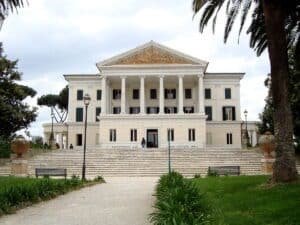
During the show, no photographs. In a two-voice work, built on pauses, glances and transformations, a lit phone screen in so intimate a hall can be seen from the stage and breaks the pact with the actors. The right photo is taken outside, and the park offers at least three. The first is the facade of the Theater among the villa's trees, with the columns and the semicircular body that make it recognizable: in late January, if you arrive before sunset, the low winter afternoon light warms the stone and draws sharp shadows. The second is the granite obelisks near the entrance on Via Nomentana, photographed from below against the sky. The third, for those who love details, is the Casina delle Civette, born as a Swiss Hut: a building that tells of the eccentric taste of the last Prince Torlonia and that, on an evening devoted to two ruined aristocrats, finds a curious visual rhyme. After the show, if the actors come out to greet the audience in the foyer, a photo with the program is the simplest souvenir. No flash, and no shots during the final applause while the performers are onstage.
Some important events that took place here in history
The history of Villa Torlonia begins as the Pamphilj's farm estate, between the 17th century and the mid-18th, and continues with Cardinal Girolamo Colonna, who starts the construction of the villa's first core. In 1797 the property passes to the banker Giovanni Raimondo Torlonia, and in 1806 Giuseppe Valadier redesigns the park with symmetrical, perpendicular avenues. From 1832 his son Alessandro entrusts the work to Giovan Battista Caretti, Giuseppe Jappelli and Quintiliano Raimondi, who builds the Theater and the Orangery, today the Limonaia. In 1842 the two obelisks are raised in memory of the prince's parents. His successor Giovanni transforms the Swiss Hut into the Casina delle Civette and has the Villino Medievale and the Villino Rosso built. In 1919 an underground Jewish cemetery of Roman date is discovered in the park. In the 1920s Giovanni Torlonia grants the Casino Nobile to Benito Mussolini, who lives there with his family until July 1943. From 1944 to 1947 the villa hosts the Anglo-American command, a long abandonment follows. In 1977 the City of Rome buys the villa, which the following year becomes a public park. From 1991 restorations begin, the Theater reopens in 2013. From January 21 to 24, 2027 its stage hosts Quartett.
Who has passed through Quartett by Heiner Müller at Teatro di Villa Torlonia, January 21-24, 2027
Through Villa Torlonia have passed the architects who designed 19th-century Rome: Giuseppe Valadier, Giovan Battista Caretti, Giuseppe Jappelli, Quintiliano Raimondi, who was the Theater's builder. The Torlonia have passed, bankers and then princes, with the guests of their parties, in 1842, at the raising of the first obelisk, Pope Gregory XVI and Ludwig of Bavaria were present. In the 20th century the villa was for almost 20 years the home of Benito Mussolini and his family, and after the war the seat of the Allied command. Since the 2013 reopening the Theater's stage has welcomed the companies hosted by the Teatro di Roma, from contemporary drama to shows for kids. In January 2027 Viola Graziosi and Maximilian Nisi pass through, with them Saverio Vertone, whose translation gives the text its Italian voice, the composer Stefano De Meo and the set and costume designer Vincenzo La Mendola. And, ideally, two authors separated by two centuries pass through: Pierre Choderlos de Laclos, who in 1782 invented the Marquise de Merteuil and the Vicomte de Valmont, and Heiner Müller, who took them up to lead them to the last move.
Accessibility, age and practical information
For access to Teatro di Villa Torlonia by people with reduced mobility the reference is the Teatro di Roma, which devotes a section of its official website to the accessibility of its halls.
The park at night
Villa Torlonia is a historic park, with avenues, gravel and some changes in level. Those with mobility difficulties do well to ask in advance which gate is most convenient for reaching the theater. In January, on the way out in the evening, the temperature drops: a heavy jacket is a must.
Age
Quartett is a show for adults: it talks about seduction, sex and power in explicit, raw language. It may interest university students and the last years of high school who study 20th-century theater, preferably prepared on the text. For younger kids the Teatro di Roma has a dedicated program, which also passes through Villa Torlonia, as in the case of Albert eD io.
January in Rome
Late January is one of the quietest periods of the year in Rome: few crowds, lower hotel prices, museums visitable without queues. For those coming from outside it is the right moment to pair an evening of theater with a visit to the Musei di Villa Torlonia.
Frequently asked questions about Quartett
When is Quartett on at Teatro di Villa Torlonia?
Quartett by Heiner Müller is on at Teatro di Villa Torlonia from Thursday, January 21 to Sunday, January 24, 2027, for four consecutive performances. The start time of each performance is published by the Teatro di Roma in the show's official page, together with ticket information.
Who acts in Heiner Müller's Quartett in Rome?
In Quartett the actors are Viola Graziosi and Maximilian Nisi, who also directs. They are the only two performers onstage, but through the continual exchange of roles they bring to life the Marquise de Merteuil, the Vicomte de Valmont and their victims. The translation is by Saverio Vertone, the music by Stefano De Meo.
What is Quartett about?
Quartett takes up the two protagonists of Choderlos de Laclos's Dangerous Liaisons, the Marquise de Merteuil and the Vicomte de Valmont, and closes them in a space outside time. The two swap roles and also play the people they seduced, in a duel of words on seduction, power and identity.
Where is Teatro di Villa Torlonia?
Teatro di Villa Torlonia is at Via Lazzaro Spallanzani 1, inside the Villa Torlonia park, in the Nomentano district. The nearest metro line B stops are Bologna and Policlinico, trams 3 and 19 stop at Viale Regina Margherita, near Via Nomentana.
Where do you buy tickets for Quartett?
Tickets for Quartett are bought on the official website of the Teatro di Roma, at the foundation's box offices and on the authorized presale network that the Teatro di Roma indicates on the show's page. The show is part of the 2026/2027 season, for which the subscription campaign is active.
Is Quartett suitable for teens?
Quartett is a show conceived for an adult audience, with explicit themes and language about sex, domination and cruelty. It may suit students in the last years of high school and university who study contemporary theater, preferably prepared on the plot of Dangerous Liaisons.
Who was Heiner Müller?
Heiner Müller was a German playwright and poet, born in 1929 and died in Berlin in 1995, considered the most important German theater author after Brecht. Among his best-known works are Die Hamletmaschine, Medeamaterial and Quartett, in his last years he was artistic director of the Berliner Ensemble.
The final advice on Quartett
Quartett is not an easy show, and does not pretend to be. It is a text of sharpened words, with two actors alone and a small hall, in which every change of voice weighs. In our view it is exactly the right combination: a text born to dismantle the theater of costumes and wigs finds in a 19th-century aristocratic theater the ideal contrast, and the closeness of the orchestra turns the spectator into the witness of a private game. The advice is to arrive prepared on Dangerous Liaisons, choose one of the first nights to find a more concentrated hall and devote the afternoon to the Villa Torlonia park. Those who have seen Viola Graziosi in Greek tragedies and Maximilian Nisi in the great classics will find two performers tested by a very different writing, dry, modern, without a net. Those who do not know them will find a good way into Heiner Müller's theater.
Article written by the editorial team of Tour Leader Pro, contact them for Private/Corporate/V.I.P. Tours and Experiences.
Planning a trip to Rome? The English-language guides to visiting the city are on ItalyPlanner.com.
Contact Information
Nearby
 Jewish Catacombs of Villa Torlonia100 m
- Obelisks of Villa Torlonia100 m
- Casina delle Civette – Villa Torlonia Museums100 m
- Casino Nobile – Villa Torlonia Museums200 m
- Villa Torlonia200 m
- Serra Moresca200 m

Upcoming events nearby
- Il teatro dell’amore e del potere at the Teatro di Villa Torlonia, October 17 to December 20, 2026100 m
- Beata oscenità by Serena Sinigaglia at Teatro di Villa Torlonia, March 4 to 7, 2027100 m
- Archimede. La solitudine di un genio with Mario Incudine at Teatro di Villa Torlonia, March 18 to 21, 2027100 m
- Ritratto d’autore: Igor Stravinsky and Petrushka with Roma Tre Orchestra at Teatro Torlonia, November 12, 2026100 m

You might also like
- Fire of Georgia, Royal National Ballet of Georgia at Teatro Italia, December 10, 2026
- Il Matricomio, Non ti prometto niente
- Festival delle Favole at Teatro Italia, December 13, 2026
- Arteteca in Non tutte le suocere vengono per nuocere at Teatro Italia, April 9, 2027
- Adamo Romano in Maledizioni live a teatro at Teatro Italia, April 3, 2027
- Danza… che Passione! 23ª edizione