The Sanctuary Eco Retreat Roma – free* on Sundays by telling the door GOOD VIBES LIST
In short. The Sanctuary Eco Retreat Roma is at Via delle Terme di Traiano 4A, on the Colle Oppio, inside the Monti district and a handful of minutes on foot from the Colosseum.
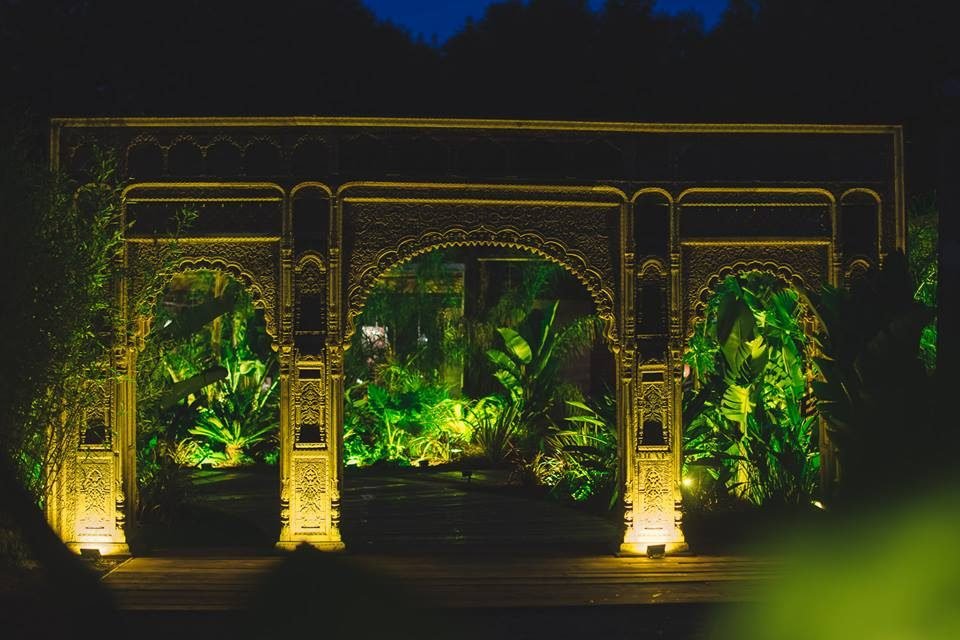
The Sanctuary Eco Retreat Roma is at Via delle Terme di Traiano 4A, on the Colle Oppio, inside the Monti district and a handful of minutes on foot from the Colosseum. It is a private space with a garden, indoor rooms, a pool area, tropical and Asian-inspired cooking and a program of DJ sets, concerts, performances, fashion and art. The formula it has presented for years puts together things that in Rome usually live separately: the exotic bar, the restaurant, the stage, the garden and an area the owners themselves call a healing area. Over your head are the pines of Colle Oppio park, under your feet are the substructures of Nero's Domus Aurea and the walls of the Baths of Trajan, which are the archaeological reason for that park. Before anything else I have to say what, for the writer, is the most important part: hours, opening days, entry conditions, lists, membership cards, kitchen prices and the calendar of events change from season to season and sometimes from month to month. What holds in spring does not hold in November, and what held two years ago may have been replaced. That is why here you find the context, the geography, the history of the place and the way to read it, while the practical conditions of the moment have to be asked directly through the venue's official channels, which remain the only reliable source about itself. If you are moving around the area you can also read the pages on the Domus Aurea, San Pietro in Vincoli and the Arch of Constantine, which are the three closest archaeological neighbors.
Where The Sanctuary Eco Retreat Roma is and how you really get there
The geography of this address is more interesting than the word address suggests. Via delle Terme di Traiano is a short street, almost a recess, running along the northern flank of Colle Oppio park. On one side are the greenery and the archaeological enclosure, on the other a wall of buildings facing Via Labicana and the Esquilino. Number 4A opens in this in-between strip, at a point where the city changes character within 200 meters: behind you the constant traffic of the Colosseum area, in front a piece of hill that becomes silent at night. If you arrive for the first time you expect to find a shopfront and instead you find a discreet entrance, and that is the first thing to take into account.
By metro: which stops you really need
The most immediate stop is Colosseo, on Line B, which comes out on Via dei Fori Imperiali right in front of the amphitheater. From there you walk up along Via Nicola Salvi or cut through Colle Oppio park: it is barely 10 minutes on a gentle uphill, with no demanding stairs. The second useful stop is Cavour, also Line B, which drops you inside the Monti district and forces a slightly longer but much more beautiful route, between Via degli Annibaldi and the climb of San Pietro in Vincoli. On Line A the reference stop is Vittorio Emanuele, which serves the Esquilino side: from Piazza Vittorio you take Via Merulana and in a good quarter of an hour you reach the opposite side of Colle Oppio. If you travel at night you have to consider that the metro has an evening closing time and that on weekends closing can slip: these hours change with the seasons and with construction work, and should be checked on the transport company's website the same day, not the week before.
Buses and trams: the lines that pass nearby
Via Labicana and Via dei Fori Imperiali are two much-served surface routes. Tram 3 connects the area with Trastevere, the lower Gianicolo, Ostiense, San Giovanni and then climbs back toward Porta Maggiore and the university area: it is the line that most often solves the trip back for people staying outside the historic center. On the bus side, the lines running along Via Labicana and Via Merulana lead toward San Giovanni in Laterano, toward Termini and toward Piazza Venezia. The night terminus of reference for almost the whole network remains Termini anyway, reachable on foot in about 20 minutes through the Esquilino. Rome's night network runs with long intervals and has to be planned: for anyone leaving in the small hours it is realistic to count on either a taxi or a walk to Termini or Piazza Venezia.
By car, taxi, bicycle
Arriving by car is the worst choice and it is worth saying so without beating around the bush. The whole area falls inside the limited traffic zone of the historic center, with time bands and rules that change over time and are modified even during the year. Parking on the streets around the park is paid and almost always full, and the nearest garages are toward Via Labicana and toward the Celio. A taxi remains the simplest solution for the trip back at night: the most convenient pickup point is on Via Labicana or near Largo Gaetana Agnesi, because Via delle Terme di Traiano is narrow and not always easy for service stops. A bicycle works very well downhill and much less uphill, because Colle Oppio is still a hill: if you pedal from Termini you face a modest but continuous climb, while if you come from the Circo Massimo the climb is shorter and steeper. Bike racks and scooter stalls are found along the perimeter of the park.
The walk I recommend
If you have time, the best way to arrive is to enter Colle Oppio park from the entrance on Viale del Monte Oppio and cross all of it. You pass by the exedras of the Baths of Trajan, you see the great brick apse emerging from the lawn, you skirt the fenced area of the Domus Aurea and you reach the north side with the Colosseum appearing and disappearing among the pines. It is a five-minute route that works as a prelude to the evening, because it lines up the two things this address holds together: an archaeological hill and a contemporary place for entertainment. In the evening the park is less busy and some parts are dark. The practical advice is to cross it while there is light and to use the lit perimeter when it is late.
What The Sanctuary Eco Retreat Roma really is: a private space with a program
The first thing to clarify is the nature of the place, because everything else depends on it. It is not a museum, a public park or a municipal facility. It is a private space that organizes its own program and decides its own access rules. This means that opening days, hours, any membership requirement, the way you book a table and the entry conditions are decisions of the owners and can change whenever they want. Anyone who arrives thinking they will find a public service with fixed hours is invariably thrown off. Anyone who arrives knowing it is a private place with its own calendar does the right thing, that is, checks first.
The garden, the indoor rooms and the pool area
The identity of the space revolves around the garden, which in the warm season becomes the center of everything. It is a Roman garden of generous size for the historic center, with dense vegetation, separate corners, low seating and a setting built up over time, openly inspired by a tropical imagery. Inside the perimeter there is a pool area, which in the cold season is covered and in the warm season goes back to being the point around which the afternoon is organized. The indoor rooms, which in the winter months carry the whole program on their own, host the bar, the restaurant area and the space where music is played. The practical consequence is that the same address produces two very different experiences: in summer it is a garden with music, in winter it is an indoor venue with a garden to walk through. Anyone who books in November thinking of the pool gets a surprise that nobody is to blame for, except the summer photo seen on social media.
The kitchen: exotic bar and tropical and Asian-inspired cooking
The food offer is presented as a kitchen that mixes tropical and Asian references, alongside a bar with a cocktail list built on the same imagery. It is worth reading it for what it is: the kitchen of an evening venue, designed to accompany the music program and the stay in the garden, not a destination table from a food guide. In practice this means shareable dishes, formulas that change with the evenings and a menu that is revised from season to season. Prices, formulas, set menus, buffets and promotions are exactly the kind of information that ages worst: any figure written here would be wrong within a few months, and that is why you will not find any. Anyone who wants to eat before the music does well to ask directly, when booking, what is planned that evening and until what time food is served.
The so-called healing area: how to read it
Among the definitions the space uses to describe itself there is also that of healing area, and on this point it is only right to be precise. The name describes a setting and an atmosphere, that is, a zone designed for sitting, talking, slowing down compared with the rest of the venue. It does not describe, and should not be read as if it described, a health service, a therapy, a medical treatment or a practice with proven curative effects. None of the activities that take place in an evening venue of this kind cures anything, and anyone looking for answers to a health problem should go to a doctor and not to a garden with music. That said, the real value of a zone like this exists and is of another kind: in a city that mostly offers tight tables and high volumes, a space where you can talk without shouting is a rarity worth pointing out for what it is, that is, comfort and not medicine.
Why you will not find entry conditions, hours and prices here
The title under which this address is known on the site carries a historic promotional formula, and precisely for that reason a clear clarification is needed. Promotions at Roman venues have a short life: they are born to fill a weak evening, they work for a season, then they are changed, narrowed, moved to another day or canceled. Reporting an entry condition as if it were a stable rule means sending someone to a door with the wrong expectation, and it is a real harm to anyone who crossed the city. The rule is simple: access conditions are asked of the venue the same day or the day before, through its official channels, and are considered valid only for the date for which they were confirmed. Everything else, including information circulating in groups and in old flyers saved on the phone, is archive material.

Colle Oppio under your feet: Domus Aurea and the Baths of Trajan
People who come to this address in the evening rarely stop to think about what is underneath. Colle Oppio is one of the three heights that make up the Esquilino and preserves, a few meters down, one of the most important archaeological complexes in Rome. The two layers that matter lie one on top of the other: first Nero's Domus Aurea, then the Baths of Trajan, which used the structures of that residence as a foundation platform, burying them. The park you see today is the lid on this double stratigraphy, and it is the reason why brick walls pop up among the greenery that at first sight look like scattered ruins and are instead the coherent fragments of a single enormous building.
The fire of 104 and the building site of Apollodorus of Damascus
The sequence is documented and worth telling in full. After Nero's death the Domus Aurea was gradually dismantled and reused. On Colle Oppio its structures were partly buried already under the Flavians, when Titus built a bath complex there. Around 104 AD a fire struck the area and finally cleared the ground, and on that ground Trajan had the complex that bears his name built. The project was entrusted to Apollodorus of Damascus, the architect who in those same years was working on the Forum of Trajan and the Markets: the machine that produced the Markets of Trajan and the one that produced these baths are the same. Work finished in 109 and the official inauguration is handed down as June 22 of that year.
The first great baths of Rome
The primacy that scholars recognize in this complex is technical before it is chronological. Public baths already existed in Rome, those of Agrippa, those of Nero, those of Titus, but the Baths of Trajan were the first to be designed according to the scheme that then became canonical for all the great imperial baths, including those of Caracalla and those of Diocletian. The porticoed outer enclosure measured about 330 meters by 315, the central building about 190 by 212, for a total area of more than six hectares. Inside the enclosure were social and cultural spaces, open areas for physical exercise, exedras and service rooms. Inside the central building the bathing sequence took place, with natatio, frigidarium, tepidarium and caldarium arranged symmetrically. The most cited design detail concerns the orientation: the whole complex was rotated by 36 degrees relative to the pre-existing structures, a choice meant to maximize solar radiation on the caldarium in the hours between noon and sunset. A decision of applied physics made 19 centuries ago, and made well.
What remains visible today
Most of the central structure has been lost. What remains are portions of the frigidarium, the apse of one of the gyms and the great northeastern exedra, which is also the most photographed element of the park because it emerges from the lawn like a very tall curved wall. To these are added the cisterns, the service corridors and, on the side toward the Colosseum, the stretch where the complex looks out over the valley. The archaeological enclosure is inside the public park and some parts can be visited only on particular occasions or with organized access. The Domus Aurea area, instead, has its own visiting regime with limited entries that are often reorganized because of restoration and consolidation work. Here too the rule is the same: dates and procedures are checked on the official channels of the archaeological site before setting out.
The park as we see it: 1871, then Raffaele De Vico
The greenery of Colle Oppio is not ancient. The area was designated as a public garden in 1871, right after Rome became the capital, but the layout we see today is much later: it was carried out between 1928 and 1936 under the direction of the landscape architect Raffaele De Vico, as part of the great works that in those years redrew the whole area around the Colosseum. The park covers about 11 hectares and administratively belongs to the Monti district, of which it is in fact the great park. The straight avenues, the basins, the fountains, the pines arranged in rows and the paths that isolate the ruins all belong to that project. Knowing this changes the way you look: when you cross the park to reach a venue you are walking inside a 1930s garden built over a second-century structure built over a first-century residence.
A curiosity about The Sanctuary Eco Retreat Roma - free* on Sundays by telling the door GOOD VIBES LIST
The best curiosity is about the name of the street. Via delle Terme di Traiano is one of those Roman streets that say exactly what is underneath: it is not a generic tribute to an emperor, it is the street sign of a monument that passes literally under the asphalt. Whoever enters number 4A enters a building that rests on the northern edge of the Trajanic porticoed enclosure. The walls of the enclosure measured, as said, a little over 300 meters on a side: this means the entire area between the street, the park and the neighboring blocks falls inside the perimeter of a single ancient building. A garden with a pool built over the perimeter of the first great imperial baths of Rome is a coincidence of land use that is hard to find elsewhere in Europe.
There is also a second curiosity useful for understanding the neighborhood. For much of the twentieth century Colle Oppio was perceived by Romans as a place of passage: a hill you crossed to go from Termini to the Colosseum. The rediscovery of the area as a place you go to on purpose is recent and followed two parallel movements: on one side the transformation of the Monti district into one of the most frequented areas of the city, on the other the opening of private spaces able to keep open in the evening an area that used to empty out. The address on Via delle Terme di Traiano belongs to this second movement, and this explains why in the evening you find people walking toward the park rather than running from it.
Third curiosity, on the name: the word retreat does not indicate a spiritual retreat or a stay. In the language of contemporary venues it indicates an idea of urban refuge, an enclosed and green space inside a dense city. It is marketing that in this case describes a real condition: 200 meters from the Colosseum, having an enclosed, tree-filled garden is rare.
The Monti district and the Esquilino around this address
To really get your bearings you need to understand that this point of the city lies on a border line. Colle Oppio belongs administratively to the Monti district, but geographically it is the western offshoot of the Esquilino, and to the south it looks toward the Celio. Three neighborhoods with three different characters touch within a radius of one kilometer, and whoever organizes the evening would do well to know which of the three they will end up in afterward.
Monti: the side that looks north
Going down from Via degli Annibaldi you enter the heart of Monti, which is the oldest district of Rome by name and today one of the most frequented. Via del Boschetto, Via Panisperna, Via Urbana and Piazza della Madonna dei Monti make up a network of narrow streets with workshops, wine bars, independent clothing shops and a very high density of venues. It is the right place for an aperitivo before and a glass after, and it has the advantage of staying alive until late. The immediate monumental landmark is San Pietro in Vincoli, with Michelangelo's Moses, which you reach from Colle Oppio by climbing a ramp of steps. A little higher up is the Basilica of Santi Silvestro e Martino ai Monti, which preserves under its floor a room from the Roman era and which almost no tourist visits.
Esquilino: the side that looks east
On the other side, toward Piazza Vittorio, the character changes completely. The Esquilino is the most multicultural neighborhood in the center of Rome, with the Nuovo Mercato Esquilino as its center of gravity for food and trade, and with a street life that resembles no other area of the city. On Via Merulana is Palazzo Merulana, which hosts a collection of twentieth-century Italian art and a continuous exhibition program: it is the perfect daytime complement for anyone spending the evening on Colle Oppio. In the summer months Piazza Vittorio hosts a historic outdoor cinema, and those who want to combine a film and an evening will find the reference on the page for Notti di Cinema a Piazza Vittorio.
Celio: the side that looks south
Crossing Via Labicana you enter the Celio, which is the exact opposite of the Esquilino: quiet, green, almost rural in some stretches, with Villa Celimontana, the basilica of Santi Giovanni e Paolo al Celio and the Roman Houses of the Celio, one of the best-preserved complexes of Roman residential building that can be visited in the city. On the border between the two hills is the Basilica of San Clemente, which alone is worth the neighborhood: three superimposed levels, from the medieval church to the early Christian basilica down to the Roman-era mithraeum. Anyone who wants to understand in half a day how the stratification of Rome works finds there the clearest demonstration there is.
Something nobody tells you about The Sanctuary Eco Retreat Roma - free* on Sundays by telling the door GOOD VIBES LIST
The thing nobody says concerns the relationship between this kind of space and the neighbors, and it is the factor that more than any other determines what you can expect on any given evening. A garden with live music and DJ sets placed inside the historic center of Rome, surrounded by residential buildings and set into an archaeological park, lives within a series of constraints the public never sees: noise emission limits, hours within which outdoor music must fall, seasonal authorizations for the use of outdoor spaces, requirements tied to the presence of the archaeological restriction. These constraints are not bureaucratic details: they are the concrete reason why the same evening, in the same place, can take place outdoors in May and indoors in October, or why the music in the garden at a certain point of the night drops in volume or moves inside.
The practical consequence, for anyone coming from outside, is that the calendar of these spaces is not a purely artistic choice. When an evening changes day, when a summer program ends earlier than expected, when the outdoor area stays closed, very often the cause is not the owners' taste but an external constraint. This also explains why the information you find online ages so fast and why a post from two summers ago does not necessarily describe the current situation. People used to city clubs where the program stays identical for years struggle to understand this mechanism. In Rome, in the historic center, the rule is instability.
The second invisible factor: the weather
There is also a more banal element that is just as decisive. A space that lives on its garden depends on the weather almost totally. A rainy evening does not just mean the evening moves indoors: it means capacity shrinks, the type of evening changes, a program designed for outdoors is reorganized at the last minute. In the transitional months, April and May on one side, September and October on the other, this dependence becomes maximal and programs can change within a few hours. Anyone coming from outside Rome with only one evening available should always have a backup plan in the area, and that is why further on you find a list of alternatives a few minutes' walk away.
The third factor: the difference between afternoon and night
Another little-told element is that spaces like this completely change their audience over the course of the same day. The afternoon and early evening have a garden character, with tables, conversation, families and groups of friends. Deep night has a club character, with high volume and a different density of people. They are two worlds that share the same chairs. Anyone looking for the first and arriving at two in the morning finds the second and ends up disappointed. Anyone looking for the second and arriving at seven in the evening finds a quiet garden and thinks they have the wrong address. Knowing in advance which of the two you want is the difference between a good evening and a wasted one, and the exact time band in which the switch happens changes with the season and with the type of event scheduled.
The advice I give you for visiting The Sanctuary Eco Retreat Roma - free* on Sundays by telling the door GOOD VIBES LIST
The main advice is only one and is worth more than all the others put together: write first. Not to groups, not to friends, not to old saved posts: to the official channels of the space. Ask three precise things, and ask them for the exact date you want to go. First: if it is open that evening and what type of evening is planned. Second: what the entry conditions are that day, including any lists, memberships or mandatory reservations. Third: if the outdoor area will be accessible and until what time. With these three answers in hand you have eliminated 90 percent of the ways an evening here can go wrong. Without them, you are gambling.
How to build the evening around the visit
The second piece of advice concerns how to fit this address into the day. The location is too good to be wasted by arriving by taxi at 11 at night. If you have the afternoon free, the sequence that works best is this: visit San Pietro in Vincoli in the late afternoon, go down into Colle Oppio park with the light falling on the exedras of the baths, pass by the fence of the Domus Aurea, arrive at aperitivo time. In 40 minutes you have seen Michelangelo's Moses, a second-century bath complex and the Colosseum from above, and you have reached your destination without taking any transport. It is the kind of day that is rarely built in Rome because almost everything is far apart. Here the distance does not exist.
What to wear and what to bring
The third piece of advice is practical and concerns clothing. A garden on a Roman hill, in the evening, is cooler than the daytime temperature would suggest, even in midsummer: the temperature drop between the afternoon and one in the morning, in June, can exceed 10 degrees, and in the transitional months it is more marked. A light shirt or a thin jacket solves the problem. The ground, where the garden is a real garden, is not always paved: thin heels are a choice you pay for at the end of the evening. If you plan to cross the park on foot in the dark, a flashlight on your phone helps more than it seems, because the internal lighting of Colle Oppio is patchy. Finally, consider cash: many Roman venues regularly accept cards, but the network is not always stable and a reserve in your pocket avoids pointless arguments at the register.
The unpopular advice
The last piece of advice is the one people like least. If you have only one evening in Rome and this evening coincides with your only free slot, do not bet everything on a private address whose program can change. A venue is not a monument: it can close for a private party, for an invitation-only event, for maintenance, for a season that ends early. The Colosseum has been there for millennia and will be there tomorrow, an evening will not. Build the plan around the stable things and treat the evening as the final reward, verified the same day. Whoever reverses this order sooner or later ends up outside a closed door wondering why.

The program: DJ sets, concerts, art, fashion and performances
The feature that distinguishes this address from the other venues in the area is the multiple program. It is not only music: the historic offer puts together DJ sets, live concerts, performances, visual art interventions and fashion shows or presentations, often within the same evening. It is a formula that has had a long tradition in Rome, from the social centers of the 1990s to the hybrid spaces of the 2000s, and that here is offered again in a more polished version, more oriented to the garden.
The music: what to expect
The prevailing musical register in spaces of this kind revolves around electronic club music, with forays into African, Latin, Caribbean and Eastern sounds consistent with the tropical imagery of the space, and with a live part that ranges from emerging Italian projects to international acts passing through. The program changes constantly and the names of individual events live only a few days. That is why you will not find a calendar here, which would be out of date before it was even read. The reference for the recent program is the page dedicated to The Sanctuary Eco Retreat 2026, DJ sets, live music and evenings at Colle Oppio, which follows the current season.
Art and fashion inside a venue
The visual component is the one most often underestimated by people who read in a hurry. Spaces like this regularly host temporary installations, scenographic interventions, projections and displays built specially for an evening or a season, and they involve collectives of artists, set designers and costume designers. Fashion comes in the same way: presentations, informal shows, collaborations with independent Roman brands, DIY markets. The result is that the garden changes appearance several times over a year, and that two visits six months apart can give back two different places. For photographers this is excellent news. For those looking for continuity, it is a variable to take into account.
The audience
The audience is mixed and changes with the type of evening: Romans between 25 and 40, foreign residents living in the city for work or study, travelers who find the address because they are staying nearby. The prevailing language is Italian, but English works without problems. It is not a place for those looking for the Rome of trattorias and travertine tables. It is a place for those looking for the Rome that cares about contemporary music, and the two Romes, within a radius of 300 meters, coexist without looking at each other.
Another well-known fact, yet rarely cited
The well-known fact is that the Domus Aurea lies under Colle Oppio. What is cited far less is the consequence this has for today's neighborhood. The presence of a monument of that magnitude a few meters down imposes on the whole area a regime of protection that conditions any intervention on the surface: excavations for utility networks, building sites, foundations, even the planting of trees. In recent decades Colle Oppio park has been the object of repeated interventions precisely to reduce the load of soil and water bearing on the vaults of Nero's residence, because the infiltration of rainwater through the garden above was for years the main threat to the preservation of the frescoes below.
Put directly: the greenery you cross to reach Via delle Terme di Traiano is also the roof of a monument, and its maintenance is an engineering problem as well as a gardening one. This explains why work sites, fences, off-limits areas and diverted paths periodically appear in the park, and why some entrances can be closed without notice. Anyone planning the walking route should always expect that a gate may turn out to be barred and know at least one alternative access, typically the one from Via Labicana or the one from Viale del Monte Oppio.
The second rarely cited fact: the grotesques
There is also a cultural consequence worth remembering. When, at the end of the 1400s, some rooms of the Domus Aurea were reached by lowering oneself through openings made in the ground of the hill, the artists who went down found wall decorations of a kind they did not know. Since those buried rooms were called grottoes, that decorative repertoire took the name of grotesques, and from there spread through all European art of the Renaissance and the following centuries. Every time you see a frieze with candelabra, hybrid monsters, plant scrolls and suspended little figures, you are looking at a derivative of what was copied under this hill. It is perhaps the most lasting contribution Colle Oppio has made to the history of art, and almost nobody connects it with the park where they are strolling.
The right photo to take at The Sanctuary Eco Retreat Roma - free* on Sundays by telling the door GOOD VIBES LIST
The photograph everyone takes is the one of the lit garden, with warm lights among the vegetation. It is a nice photograph and it works, but it is also the same one that tens of thousands of people have already taken, and that your phone, at night and in low light, will give back noisier than you expect. The photograph that is really worth it is another one and is taken outside, before going in.
The best photo: the exedra of the baths with the Colosseum in the background
Inside Colle Oppio park, on the side that slopes toward the valley of the amphitheater, there is a point where the brick walls of the Baths of Trajan and the silhouette of the Colosseum enter the same frame. It is the image that sums up everything: a second-century structure in the foreground, the most photographed monument in the world in the background, De Vico's pines as a frame. The right time is the last half hour before sunset, when the ancient brick takes on an orange color it does not have by day, and the raking light brings out the texture of the bricks. From there it is only a few minutes on foot to Via delle Terme di Traiano, and you have in memory a photograph that none of the other guests of the evening took.
The second photo: the great apse from the lawn
The second subject is the great northeastern exedra, the very tall curved wall that emerges from the lawn in the upper part of the park. It should be photographed from below, standing about 15 meters in front of it, to let the whole curve in. With the end-of-day sky behind it becomes a silhouette. With the early morning light, instead, it shows the whole stratigraphy of the restorations, with the modern patches recognizable by their different color. It is a photograph that explains the scale of the complex well: that wall is a tiny fragment of a building that covered six hectares.
The third photo: inside, if you have patience
If you really want the photograph of the lit garden, do it well. The rule is to wait for the blue hour, that is, the half hour after sunset when the sky is still dark blue and the artificial lights are already on. At that moment the difference in brightness between the sky and the lamps is at its minimum, and the phone manages to hold both together without burning anything out. Frame it looking for a leading line, for example a small path or a row of seats, and put a human figure in backlight: it solves the composition and gives the scale. Avoid the flash, which in a garden flattens everything and erases exactly the atmosphere you wanted to take home. A note of common sense: an evening space is full of people who did not ask to be photographed, and filming the venue without framing other people's faces is a courtesy that costs nothing.
Some important events that happened here in history
Colle Oppio has a dense chronology and some of its passages have left traces well beyond Rome. It is worth lining them up, because they are events that concern precisely this piece of hill and not the city in general.
64 AD and the Domus Aurea
After the great fire of 64, Nero had a residence of unprecedented size built between the Palatine, the Celio and the Esquilino. The sector on Colle Oppio is the one that has been best preserved, precisely because it was buried to make room for the later complexes. At the emperor's death, in 68, the damnatio that struck his memory led to the progressive dismantling of the complex and the return of the occupied areas to public use: the valley where the artificial lake stood became the site of the Colosseum.
104 and 109: the fire and the inauguration
Around 104 a fire struck the hill, and the cleared ground became the building site of the Baths of Trajan designed by Apollodorus of Damascus. Work was completed in 109 and tradition sets the inauguration on June 22 of that year. With that opening Rome had the first of its great imperial bath complexes, the model on which all the later ones were built, including the Baths of Caracalla a century later.
1506: the discovery of the Laocoon
On January 14, 1506, in a vineyard on the Esquilino not far from the Neronian structures, the sculptural group of the Laocoon came to light. The news reached the Vatican quickly and Giuliano da Sangallo and Michelangelo Buonarroti were sent to the spot. The sculpture was bought by Julius II and became one of the founding nuclei of the Vatican collections. The effect on the art of the 1500s was immediate and profound, and the find spot lies in this quadrant of the hill.
1871 and the years between 1928 and 1936
With Rome as capital, in 1871, the Colle Oppio area was designated as a public garden. The definitive layout came only between 1928 and 1936, however, when Raffaele De Vico designed the park you cross today, as part of the demolitions and new monumental perspectives that in those years redrew the entire valley of the Colosseum. It is the intervention that fixed the current form of the avenues, basins and rows of pines.
The recent twentieth century and the season of evening venues
The last chapter is contemporary and concerns the transformation of the area into one with nightlife. Until the 1980s Colle Oppio emptied out with the dark. The evening filling is a phenomenon of the last three decades, tied to the success of the Monti district and to the opening of private spaces that made the area a destination instead of a crossing. The address on Via delle Terme di Traiano belongs entirely to this recent phase of the hill's history.
Who has passed through The Sanctuary Eco Retreat Roma - free* on Sundays by telling the door GOOD VIBES LIST
On this point honesty is needed, because it is the kind of paragraph in which more lies are written than in any other. Roman evening venues host every year dozens of artists, DJs, bands, visual collectives and fashion projects, and the list of names that have passed through a stage changes constantly. No list written today would remain reliable in six months, and no list copied from old flyers would describe what is happening now. That is why you do not find the names of recent guests here: anyone who wants to know who has played and who will play should look at the archive of evenings on the space's official channels, which is the only source that updates at the same speed as the calendar.
Who really passes through, every evening
What can be said with confidence concerns categories, not names. Roman DJs of the city's electronic scene and international guests in transit pass through here. Growing Italian music projects pass through, who in spaces of this size find an attentive audience. Collectives of visual artists and set designers who use the garden as a medium pass through, and so do independent Roman clothing brands that present collections and self-produced lines here. And above all there passes through a stable audience of residents of the area, who have made this place a fixed reference point of their week.
Who has passed through this hill, over the centuries
If instead we widen our gaze from the address to the hill, the list of names becomes documented and remarkable. Nero passed through here, who built the best-preserved wing of his residence on it. Trajan passed through, who inaugurated the first great imperial baths on it. Apollodorus of Damascus passed through, who designed them in the same years in which he signed the Forum and the Markets and the bridge over the Danube. Giuliano da Sangallo and Michelangelo Buonarroti passed through, sent in 1506 to see the Laocoon just re-emerged from the ground, and Michelangelo came back for other reasons, since his Moses is 200 meters away, in San Pietro in Vincoli. The Renaissance artists who copied the grotesques passed through, lowering themselves with ropes into the cavities of the Domus Aurea. And Raffaele De Vico passed through, who in the 1930s decided where the pines would grow under which people now walk to go and hear music.

When to go and when it is better to postpone
The calendar of a space that lives on its garden follows the seasons much more than it follows the events calendar. Here is how the months behave, with the warning that the specific program remains a matter for the official channels.
May to September: the garden season
This is the period when the place is at its best, because the entire outdoor surface comes into use and the program is spread across afternoon, evening and night. The flip side is that these are also the most crowded and hottest months: Colle Oppio in July, in the early afternoon, is an oven, and it is better to move your arrival to after sunset. August deserves separate mention, because in Rome it is an unpredictable month: some spaces work at full pace for tourists, others close for two weeks. Anyone planning an evening on Ferragosto has to check, no way around it.
October to April: the indoor season
In the cold months the program moves inside and changes nature. The evenings become more intimate, the audience more local, the club character prevails over the garden one. For some it is the worst version, for others the best, because the listening is more focused and the crowd smaller. Anyone coming in winter must however take into account that the outdoor part may not be accessible or only partly so, and that the pool in this season is covered and out of service as such.
The days of the week
Like almost all Roman spaces of this kind, the weekly calendar is not uniform: some days have a historic and consolidated program, others stay closed or host private events. The distribution of opening days has changed several times over the years and will keep changing, which is why the right question to ask is not which days are you open in general but are you open on such-and-such a day of such-and-such a month. The first question produces generic answers that age, the second produces a usable answer.
When it is better to postpone
It is better to postpone in three cases. With rain forecast, because a space that lives on the outdoors loses much of its sense and the indoor capacity fills up. On evenings when the Colosseum area hosts large public events, because mobility around the park becomes complicated and vehicles are diverted. And on dates when the venue hosts a private or invitation-only event, information that almost never appears on public channels and that instead comes out right away if you write directly.
What is around, on foot
The competitive advantage of this address is all here: within a radius of one kilometer there is a concentration of things to see that has no equal in Europe. Here is how to build the surroundings of the evening.
Five minutes away
The Colosseum and the Arch of Constantine are reached by going down through the park. The Domus Aurea has its own entrance on the side of the hill facing the amphitheater, with limited-entry visits and dates to check in advance. San Pietro in Vincoli with Michelangelo's Moses is reached by climbing the ramp of steps on the Monti side, and entry to the basilica follows religious hours that at some times include closure.
10 minutes away
The Palatine and the Forum valley open up beyond the Arch of Constantine, with tickets to be bought in advance in the high-season months. The Basilica of San Clemente is on Via Labicana, toward San Giovanni, and is the visit I recommend most often to anyone with two free hours. On the Celio, the Roman Houses of the Celio and the basilica of Santi Giovanni e Paolo al Celio make up a route that almost no organized group follows.
A quarter of an hour away
To the north you reach the Markets of Trajan and the Museum of the Imperial Forums, which occupy the same complex and tell the story of the Trajanic building site from the opposite side to the baths. To the east you enter the Esquilino, with Palazzo Merulana and the Nuovo Mercato Esquilino. To the south, beyond the Celio, open the Circus Maximus and, a little further on, the Baths of Caracalla, which are the monumental and preserved version of what on Colle Oppio remains only in fragments.
Quick questions about The Sanctuary Eco Retreat Roma
Where exactly is it?
At Via delle Terme di Traiano 4A, on the Colle Oppio, Monti district, a few minutes on foot from the Colosseum and from the Monti district.
What is the nearest metro stop?
Colosseo on Line B. Alternatively Cavour, also Line B, and Vittorio Emanuele on Line A for those arriving from the Esquilino side.
Can you get there by car?
Technically yes, practically it is better to avoid it. The area falls within the limited traffic zone of the historic center and parking around the park is paid and almost always taken.
What are the hours and how much does it cost to get in?
Hours, opening days, entry conditions, any lists or memberships and kitchen prices change from season to season and should be asked of the space's official channels for the precise date you want to go. Any figure or formula reported here would become misleading within a few months.
Is there really a pool?
Within the perimeter there is a pool area that is covered in the cold season. Its accessibility, the conditions and the periods in which it can be used depend on the season and the owners' choices, and should be verified directly.
Is the healing area a wellness or therapeutic service?
No. The name describes a setting and an atmosphere, not a health service. No activity at an evening venue cures, relieves or treats health conditions, and for any health problem the reference is a doctor.
Is it suitable for people who don't speak Italian?
Yes. The audience includes a substantial share of foreign residents and travelers, and English works without difficulty.
What is the difference between going in the afternoon and going at night?
In the warm season they are two different experiences: the afternoon has a garden character, with tables and conversation, deep night has a club character, with high volume and more crowding. It is better to decide in advance which of the two you are looking for.
What can you visit nearby before going in?
Within 10 minutes on foot: the Colosseum, the Arch of Constantine, the Domus Aurea, San Pietro in Vincoli, the remains of the Baths of Trajan inside the park and, a little beyond Via Labicana, the Basilica of San Clemente.
Is Colle Oppio park safe in the evening?
It is an urban park with patchy lighting and dark sectors. Crossing it in daylight is fine. In the small hours it makes more sense to use the lit perimeter or the outer streets.
My verdict, after many evenings spent accompanying groups in this area, is that the value of this address lies not so much in the individual evening as in its position. Rome has many gardens with music and many venues with a good program, but almost none of them sits on top of the city's first great imperial baths, 200 meters from Michelangelo's Moses and five minutes from the Colosseum. Anyone who comes here treating it as an ordinary venue gets an ordinary evening. Anyone who arrives on foot crossing the park, with the sun going down on Apollodorus's exedras, gets something that cannot be bought elsewhere. The only condition for it to work is the most banal one: check beforehand that it is open that evening, and with what rules.
Frequently asked questions about The Sanctuary Eco Retreat Roma, free* on Sundays by telling the door GOOD VIBES LIST
What is The Sanctuary Eco Retreat Roma?
The Sanctuary Eco Retreat Roma is a private space at Via delle Terme di Traiano 4A, on the Colle Oppio, that organizes its own program of DJ sets, live concerts, performances, visual art and fashion. It is not a museum or a public park: being private, it decides for itself the opening days, hours and access conditions, which therefore have to be verified case by case.
Where exactly is The Sanctuary Eco Retreat Roma?
The Sanctuary Eco Retreat Roma is at Via delle Terme di Traiano 4A, on the Colle Oppio, Monti district, a few minutes on foot from the Colosseum. The street runs along the northern flank of Colle Oppio park, between the greenery of the archaeological park and the wall of buildings toward Via Labicana and the Esquilino.
What is the nearest metro stop to The Sanctuary?
The nearest stop to The Sanctuary Eco Retreat Roma is Colosseo, on Line B. Alternatively you can use Cavour, also on Line B, or Vittorio Emanuele, on Line A, for those arriving from the Esquilino side.
Is it a good idea to arrive by car at The Sanctuary Eco Retreat Roma?
Technically it is possible, but reaching The Sanctuary Eco Retreat Roma by car is best avoided. The area is in the historic center of Rome, where traffic and parking are limited, so it is preferable to arrive on foot from the Colosseo stop or from Cavour, both on metro Line B.
What is under The Sanctuary Eco Retreat Roma?
Under Colle Oppio, where The Sanctuary Eco Retreat Roma is located, lie in layers Nero's Domus Aurea and, above it, the Baths of Trajan, which partly reused its structures. Via delle Terme di Traiano takes its name precisely from this monument, and the venue's building rests on the northern edge of the Trajanic porticoed enclosure.
Is it a good idea to book before going to The Sanctuary?
Yes, before going to The Sanctuary Eco Retreat Roma it is a good idea to write to the space's official channels to ask if it is open that evening, what type of evening is planned and what the entry conditions are, including any lists. Since it is a private space with a variable program, information gathered in advance for the exact date is more reliable than what you find online some time earlier.
What is near The Sanctuary Eco Retreat Roma?
A few minutes on foot from The Sanctuary Eco Retreat Roma, going down through Colle Oppio park, are the Colosseum and the Arch of Constantine. The Domus Aurea has its own entrance on the side of the hill facing the amphitheater, with limited-entry visits to be booked separately.
Article written by the editorial team of TourLeaderPro, contact them for Private/Corporate/V.I.P. Tours and Experiences. For a guided walk between Colle Oppio, the Domus Aurea and the Monti district, with a licensed tour guide, start from the TourLeaderPro contact page. Agencies and tour operators who build evening itineraries in Rome will find the consulting service in the section dedicated to tour operators.
Planning a trip to Rome? The English-language guides to visiting the city are on ItalyPlanner.com. Anyone who wants to understand how to organize their days in the capital will find the starting point in the guide to things to do in Rome, while those thinking in terms of excursions out of town will find the guide to the best day trips from Rome.