Sulle tracce di Francesco. Arte, restauro e contemporaneità at Museo del Corso, October 7, 2026 to January 10, 2027
In short. The exhibition Sulle tracce di Francesco. Arte, restauro e contemporaneità is open at the Museo del Corso, in Palazzo Sciarra Colonna (Via Marco Minghetti 22, Rome), from October 7, 2026 to January 10, 2027.
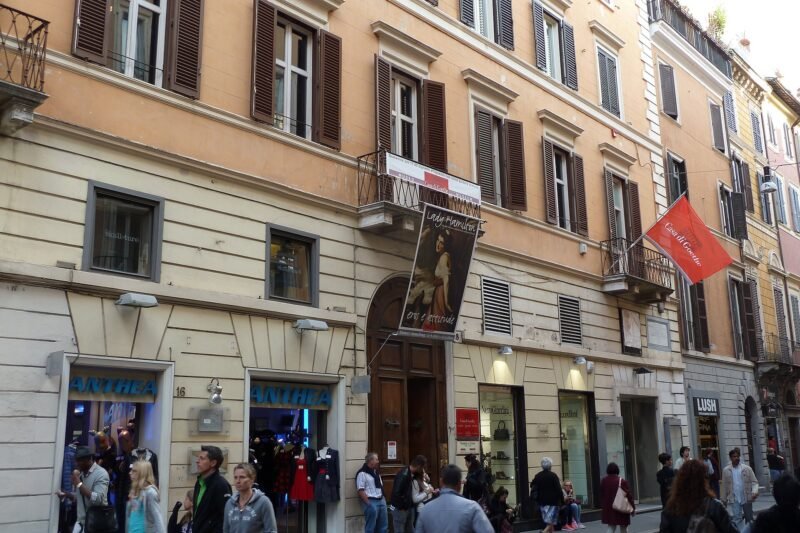
The exhibition Sulle tracce di Francesco. Arte, restauro e contemporaneità is open at the Museo del Corso, in Palazzo Sciarra Colonna (Via Marco Minghetti 22, Rome), from October 7, 2026 to January 10, 2027. The official hours are: Wednesday to Friday 11:00 to 19:00 (last entry at 18:00). Saturday and Sunday 10:00 to 20:00 (last entry at 19:00). Closed Monday and Tuesday. Entry is by time slot with limited places. The museum's website lists entry to the palace as free, with an audio guide. The official guided tour costs €7 per person and requires a reservation. In the same palace, in the Historical Archive, the related exhibition Dalla predicazione francescana ai Monti di Pietà stays open for the same dates. The time slots are chosen and booked on the museum's official ticket office, reachable from the museodelcorso.com website, or by phone at 06 87153157 (Monday to Saturday, 9:30 to 17:30). To get there, the museum points to the Corso/Minghetti bus stop about a minute on foot away and the Barberini or Spagna metro stops (Line A) about 10 minutes away. To build the route from your own starting point, it's best to use the ATAC route calculator.
The exhibition in brief
What you'll see
The project is a journey through images that crosses seven centuries, from the late 13th century to the present day, around the figure of Francis of Assisi. It starts with illuminated manuscripts and arrives at glass sculptures and pastels by living artists, passing through the great names of painting from the 16th to the 18th century and through two voices of the 20th. The organizer is Fondazione Roma, owner of the palace and of the museum, and the curator is Alessandro Zuccari, Academician of the Lincei and professor emeritus at Sapienza.
Why in Rome and why now
The stated occasion is the 800th anniversary of the saint's death. Francis died on the evening of October 3, 1226 at the Porziuncola, at 44 years old. The exhibition therefore opens a few days after the anniversary and right next to the liturgical memorial of October 4. The themes chosen by the museum are peace, universal brotherhood, harmony with nature and care of creation, those that tradition ties to the Canticle of the Creatures.
The three stated ambitions
The museum presents the exhibition as a tool to promote new research, to bring value to subjects that until now have remained little known, and to support the restoration of works by the Foundation. The title therefore contains three working words, art, restoration and contemporaneity, and the path tries to make them speak to each other instead of separating them into watertight sections.
Francis 800 years after his death
A life in a few dates
The essential dates, the ones the exhibition takes for granted, are well known. Francis was born in Assisi in 1181 or 1182 (the historical sources report both hypotheses). The conversion is placed in 1205, in the episode of the Crucifix in the church of San Damiano. In January or February 1206 came the public renunciation of his father's goods before the bishop. February 24, 1208 is remembered as the day of the Gospel of the Porziuncola, from which the vocation to preaching took shape.
Rule, nativity scene and stigmata
The oral approval of the rule by Pope Innocent III is placed between 1209 and 1210. The definitive rule was confirmed by Pope Honorius III with the bull Solet annuere of September 29, 1223. The Greccio nativity scene dates to Christmas of the same year, while the stigmata on Mount La Verna are dated to September 17, 1224. They are three moments that art has taken up without pause and that, in the exhibition, return in the works of the following centuries.
Death and canonization
His last will dates to June 1226, written at the Celle di Cortona. Death followed on October 3. The canonization was pronounced by Gregory IX on July 16, 1228 with the bull Mira circa nos. Many centuries later, on June 18, 1939, Pius XII proclaimed him primary patron saint of Italy together with St. Catherine of Siena. This long sequence explains why Franciscan iconography is one of the vastest in Western art.
The curatorship and the idea of the path
Alessandro Zuccari and the choice of a long view
Entrusting the exhibition to Zuccari means putting art history in the full sense at the center, with a path that runs from the Middle Ages to today instead of stopping at the Baroque age, where Franciscan iconography had its most famous season. The museum specifies that the itinerary is organized by images, and this shapes the reading: what matters is how each era portrayed the same man and what it chose to show.
The role of Fondazione Roma
Fondazione Roma came from the Cassa di Risparmio di Roma, founded in 1836 with the authorization of Pope Gregory XVI. In 1992 its legal personality was transformed into a foundation and in 2007 it took its current name. The body is also the historical and legal continuation of the Monte di Pietà of Rome, whose records are kept in the Historical Archive. This history explains why the Foundation wanted to place alongside an art exhibition a second exhibition of documents: Franciscanism and solidarity credit are two threads that meet in the palace.
The path: the works and the artists
The illuminated manuscripts
The opening is entrusted to illuminated manuscripts of the 14th and 15th centuries. The museum cites in particular a rare Speculum humanae salvationis kept in the Library of Accademia dei Lincei and Corsiniana. The Latin title means Mirror of Human Salvation and it is an illustrated text in which scenes from the Old and New Testament are set side by side. Its presence at the opening signals that the story starts from the book, the word and the miniature, well before the great large canvases.
16th and 17th centuries: mysticism and stigmata
The section on the two central centuries brings together Titian, El Greco, Federico Barocci, Ludovico Carracci, Caravaggio and Murillo, with a declared attention to mysticism and to the scene of the stigmata. Of Caravaggio the museum cites Saint Francis in Prayer, described as an intensely human and contemplative representation. Two versions of the subject are known. According to a 2015 press release on the canvas found in 1968 at Carpineto Romano, now on deposit at Palazzo Barberini, the attribution to Caravaggio was confirmed in 2009. A second version, in Rome at Santa Maria della Concezione, is considered perhaps not autograph. Which example is on show in this exhibition has to be checked on the room panels.
The 18th century: Labruzzi, Miniera and Piazzetta
For the 18th century Carlo Labruzzi, Biagio Miniera and Giovan Battista Piazzetta are named. By Piazzetta the Ecstasy of St. Francis is on show, which the museum describes as the moment immediately after the stigmata, with a more intimate religiosity compared to Baroque theatricality. The comparison with the canvases of the previous century is one of the passages in which the path makes the shift in taste clearly visible.
The 20th century: Cambellotti and De Dominicis
The last century is represented by Duilio Cambellotti, with swallows, larks and other natural motifs chosen as symbols of the bond between Francis and creation, and by Gino De Dominicis. The museum doesn't indicate in detail which De Dominicis works are on show, so it's best to check in the room. The pairing is nonetheless eloquent: from the saint of the stigmata you move to the saint of the birds, a theme Cambellotti tackles with a very recognizable decorative language.
Contemporary art
Four names close the path: Stefano Di Stasio, with the meeting between the saint and the wolf set in a modern city. Omar Galliani, with a pastel in which Francis's love for creation finds a present-day reflection. Fatinha Ramos, with Scar, a Murano glass sculpture with two trees joined at the roots. And Jaume Plensa. The museum's website writes the Portuguese artist's name in two forms, Fatinha and Fathina. This text adopts the first, which also appears on the Turismo Roma page.
Restoration and research on Francis and Rome
Restoration as an act of care
In the title restoration is a voice of its own. The museum presents it as an act of care and conservation of the heritage promoted by Fondazione Roma. The official text does not list, however, which works have been restored. It is information to ask of the room panels or the staff, and for this reason no interventions are attributed here to individual works.
The Colonna Mosaic
One of the announced research elements is the reconstruction of the mosaic altarpiece of the so-called Colonna Mosaic, from the 13th century. From the official information on the guided tours we learn that the mosaic comes from Santa Maria in Aracoeli and that in the 17th century it was moved to Palazzo Colonna at Santi Apostoli. The tie with the family is the reason the exhibition's story often returns to the Colonna, the family of which the Sciarra were a branch, owners of the palace that now hosts the exhibition.
A map of Franciscan places in Rome
Finally, the exhibition offers a map dedicated to the first places and the oldest Franciscan testimonies in Rome. It is a useful complement for anyone who wants to continue outside the museum: the basilica of Santa Maria in Aracoeli, which from 1249-1250 was entrusted to the Franciscans and for centuries hosted the order's general curia, is one of the most natural stops.
The exhibition in the Historical Archive: from the preachers to the Monti di Pietà
A second exhibition, same dates
From October 7, 2026 to January 10, 2027, in the Historical Archive of Museo del Corso, Dalla predicazione francescana ai Monti di Pietà is on, organized by Fondazione Roma likewise for the 800 years since the saint's death. The curator is Lorenzo Turchi. The museum's page was published on September 23, 2026 and updated on October 7.
What it tells
The path reconstructs the origins and spread of the Franciscan movement and its contribution to a civilization founded on charity, solidarity and the dignity of the person. Particular attention is given to the relationship between the preaching of the Friars Minor and the birth of the Monti di Pietà, institutions that arose in 15th-century Italy to counter usury and promote solidarity credit.
The Monti di Pietà in brief
The first Monte di Pietà is remembered in Perugia in 1462, through the work of the Friar Minor Barnaba da Terni and the jurist Fortunato Coppoli, with the support of wealthy Perugians. Other Franciscan friars then spread the model to other cities. The Monspietatis archive records activity for Perugia from 1462 to 1938 and, for Orvieto, Gubbio, Terni and Cascia, start dates between 1463 and 1467, as further proof of the rapid spread.
Documents and loans
The exhibition brings value to the archival fund of the Monte di Pietà of Rome, kept by Fondazione Roma, and includes loans from the Vatican Apostolic Library, the Franciscan and Picene historical library of Falconara Marittima and other national cultural institutions, which the museum does not name. A related path in the Permanent Collection also offers iconographic testimonies on St. Francis, on his main followers and on the spread of Franciscan spirituality between the Middle Ages and the modern age.
Hours and access for the historical exhibition
The exhibition page lists neither prices nor hours of its own: entry falls under the visiting arrangements of Palazzo Sciarra Colonna described on the museum's Visit page, with the same time slots. Booking online remains recommended.
Palazzo Sciarra Colonna: history of a building
The Colonna di Sciarra and the origins
The palace was commissioned in the second half of the 16th century by the Sciarra branch of the Colonna family, holders of the principality of Carbognano. The building arose on the area of two distinct complexes already belonging to the Colonna, called the "palazzo imperfetto" and the "palazzetto." The area, moreover, already hosted in the first centuries of Christianity some of the oldest churches of Rome and, from the 15th century, important noble residences.
Ponzio and Torrioni
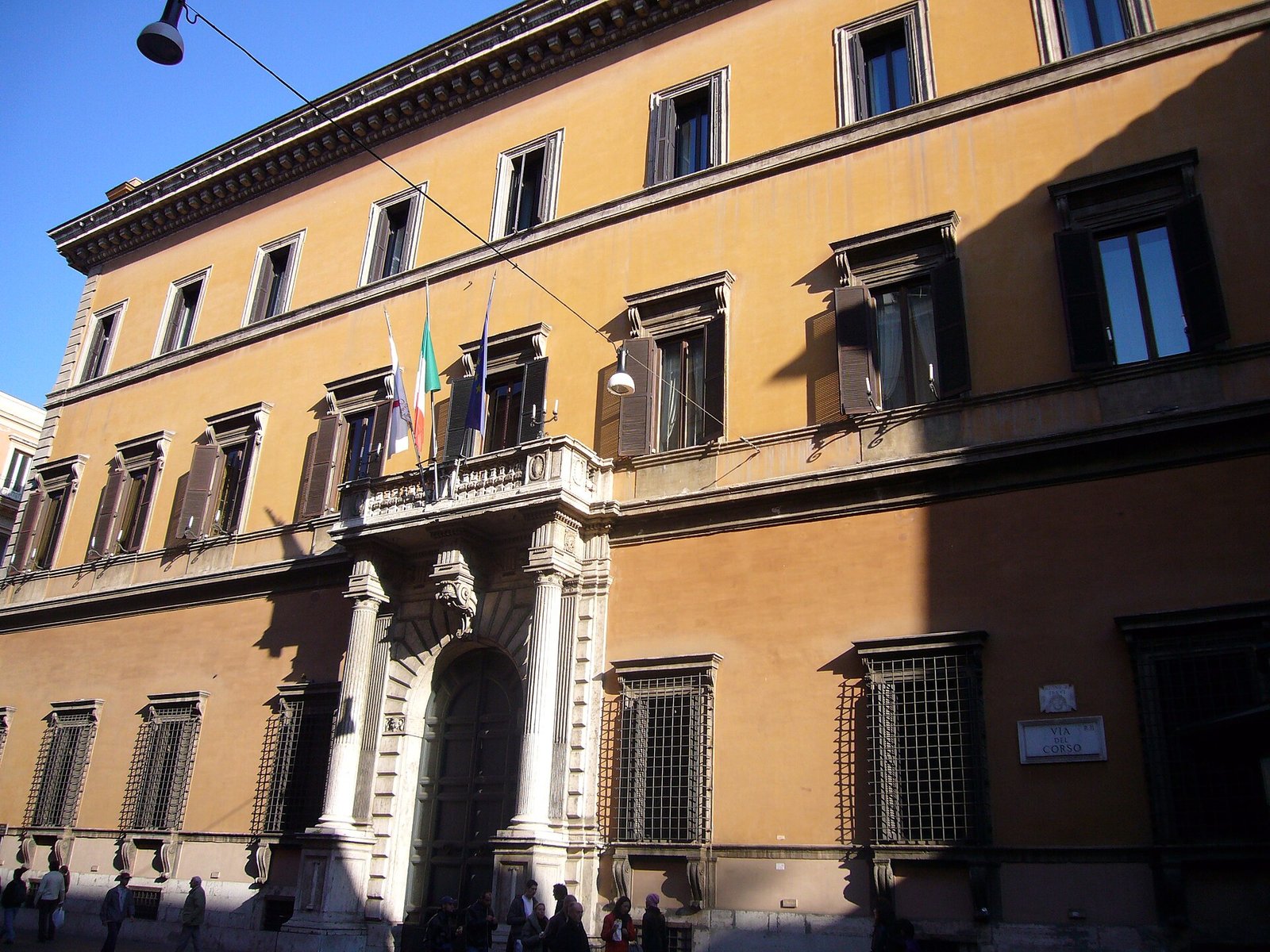
In 1610 the Milanese architect Flaminio Ponzio was commissioned to join the two bodies. In 1641 Orazio Torrioni (the name also appears as Torriani) took over the construction site and made the facade, with rusticated corner blocks, a cornice with brackets and three orders of windows. The portal, with two fluted columns with composite capitals on high plinths supporting the balustraded balcony of the first floor, has reliefs of columns that recall the Sciarra-Colonna kinship.
One of the "four wonders of Rome"
It was precisely for the portal that the palace was counted among the "four wonders of Rome," together with the Borghese harpsichord, the Farnese die and the Caetani-Ruspoli staircase. The fact is reported by the sources of the museum and of the Foundation itself.
Vanvitelli and Cardinal Prospero
In the 18th century Cardinal Prospero Colonna di Sciarra updated the palace to the taste of the time. Luigi Vanvitelli, a friend of the cardinal, designed the work and took part in the architectural and painted decoration. The museum gives the years 1743-1750 for the Rococo decoration of the apartment on the second floor, with the participation of the Roman painter Stefano Pozzi. From it came the Libreria domestica, the small Galleria and the Gabinetto degli Specchi.
The 19th century and Prince Maffeo
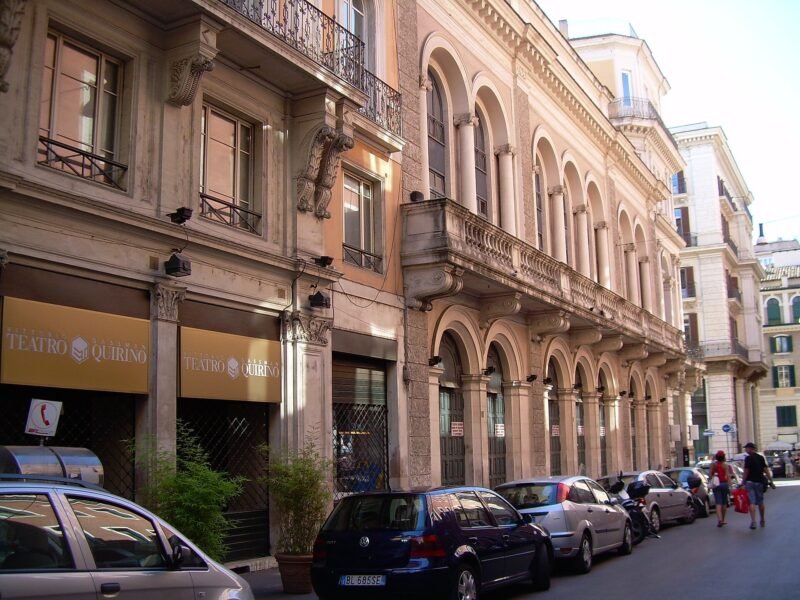
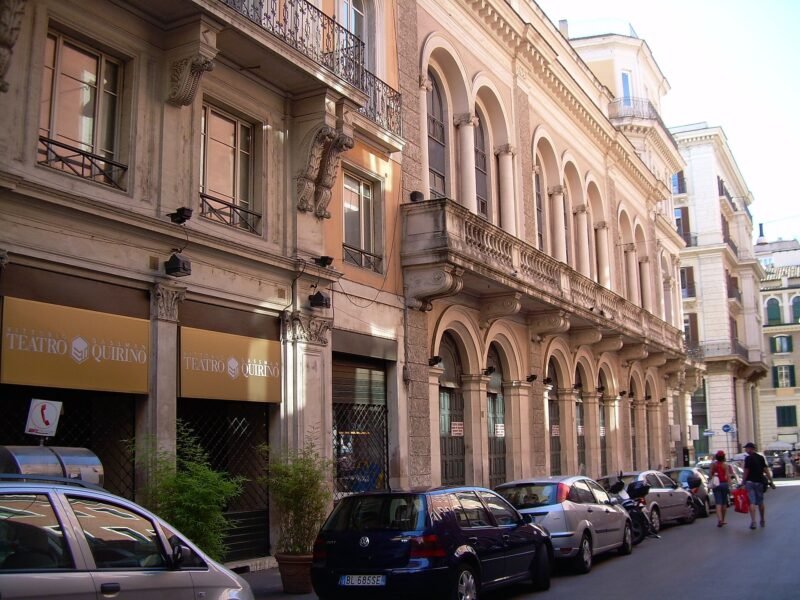
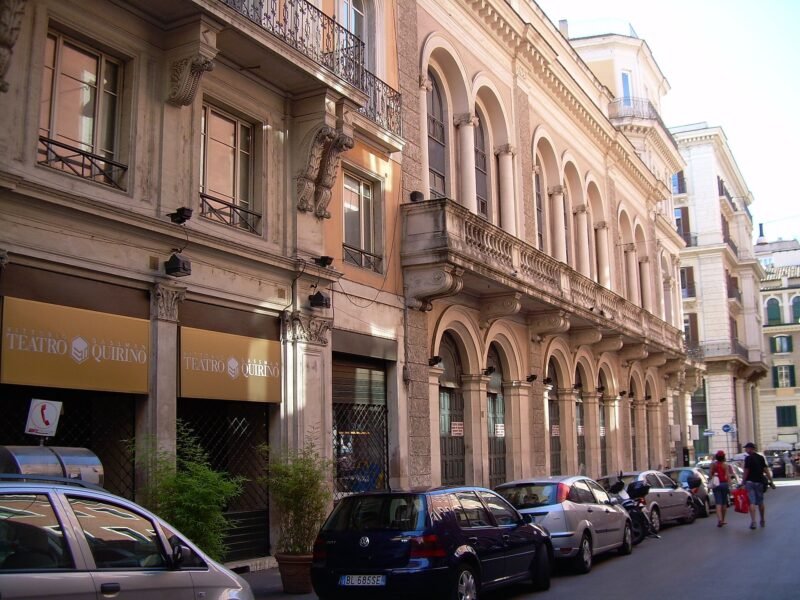
Between 1871 and 1898 the palace was considerably reduced. Prince Maffeo Barberini Colonna di Sciarra commissioned the architect Giulio De Angelis to open Via Minghetti and to build, at the back of the complex, Teatro Quirino and Galleria Sciarra. Francesco Settimi restored the surrounding buildings, enlarged the right wing and rebuilt the courtyard. For the piano nobile the museum recalls a restoration by Settimi himself at the end of the 19th century.
Galleria Sciarra, a short step away
An iron and glass passage
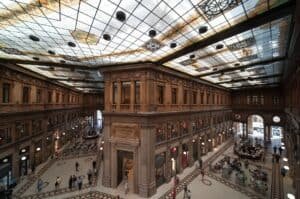
Behind the palace opens Galleria Sciarra, a pedestrian courtyard covered by an iron and glass vault, built between 1885 and 1888. It has cast-iron columns at the entrances and connects Via Marco Minghetti, Vicolo Sciarra and Piazza dell'Oratorio. It is one of the few examples of Liberty architecture in Rome, together with the better-known Galleria Alberto Sordi.
The frescoes about women
The walls were painted in encaustic by Giuseppe Cellini, on an iconographic program by the man of letters Giulio Salvatori, and present a Glorification of Woman, with figures embodying prudence, patience, faith, humility and other virtues. The initials CSS on the shields of the entrances recall Carolina Colonna Sciarra, mother of the prince. A local legend has it that the man in the scene of gallant conversation is Gabriele D'Annunzio: it remains a legend.
How to visit it
The sources describe it as a private courtyard open to the public during office hours, with entrances on Via Marco Minghetti and on Piazza dell'Oratorio. An official access schedule is not published: it's best to go by what you find on the spot.
The Permanent Collection and the Cardinal's Apartment
The piano nobile
The collection has been rearranged in the spaces of the piano nobile, with a rethought layout of rooms and works after renovation. The first historical core comes from the Monte di Pietà of Rome, and one room is dedicated to the Imago Pietatis. Among the artists cited by the guided tours are Ciampelli, Gherardo delle Notti, Régnier, Batoni, Maratti, Van Wittel, Domenichino, Orazio Gentileschi and Jusepe de Ribera: the last three have recently entered the collection.
The Gabinetto degli Specchi and the Library
The cardinal's apartments are the work of Vanvitelli. The Gabinetto degli Specchi and the Library of Cardinal Prospero Colonna are examples of Rococo and rocaille style. The museum describes furnishings designed by Vanvitelli, allegories, chinoiserie and painted mirrors with floral triumphs. The apartments are rooms normally not open to the public, and the ticket office lists them among what is found inside the palace's rooms.
From the 15th to the 20th century
The official ticket office describes the collection as a set of works from the 15th to the 20th century that dialogues with the historic rooms and with the temporary exhibitions. For those who come for Francis, the complete visit builds a small chain of meanings: the exhibition, the collection with its devotional images and the archive with the documents of the Monte di Pietà.
The museum's official guided tours
Two itineraries of about an hour
Every weekend the museum offers guided tours, Saturday at 16:30 and Sunday at 11:30, of about 60 minutes and with a maximum of 25 participants. Booking is mandatory and the cost is €7 per person.
The devotion of Francis, the pity of the Monte, the glory of art
The first itinerary covers the exhibition and the Permanent Collection on the second, fourth and fifth weekends of the month. It follows the life of the saint together with the history of the Colonna, including Cardinal Giovanni, a supporter of the Franciscan rule, and starts from the 13th-century mosaic from the Aracoeli. Dates given by the museum: in October 10, 11, 24, 25 and 31. In November 1, 14, 15, 28 and 29. In December 12, 13, 26 and 27. In January 9 and 10.
Family secrets
The second itinerary combines the exhibition and the Cardinal's Apartment on the first and third weekends. It tells the story of Francis and that of the Colonna di Sciarra, who lived in the palace from the 16th century to the end of the 19th, until the financial crisis that dispersed one of the most important art collections in Rome. Dates: October 17 and 18. November 7, 8, 21 and 22. December 5, 6, 19 and 20. January 2 and 3.
Practical information
Hours
Wednesday to Friday 11:00 to 19:00 with last entry at 18:00. Saturday and Sunday 10:00 to 20:00 with last entry at 19:00. Closed Monday and Tuesday. Special openings reported by Turismo Roma: November 1 and December 8, 2026 from 10:00 to 20:00. December 25 from 14:30 to 20:00. December 26 from 10:00 to 20:00. December 31 from 10:00 to 15:00. January 1, 2027 from 14:30 to 20:00. January 6 from 10:00 to 20:00. For these dates the last entry is one hour before closing, except December 31, when according to the same source it is at 14:00.
Tickets and time slots
Entry is by time slot with limited places. The official ticket office offers booking for a fixed date: you choose the date, the time slot and the number of tickets, and it is possible to enter a discount code. No entry prices appear on the official page. The museum's website says that entry is free with an audio guide.
Accessibility
The museum states that the entrance is accessible to people with reduced mobility. The elevator is reserved for those with mobility difficulties and those accompanying them. For specific needs it is recommended to contact the museum in advance.
Car and ZTL
The area falls within the ZTL of the Historic Center, with access regulated at certain times. Before driving it's best to check the updated rules.
Contacts
Phone 06 87153157 (Monday to Saturday, 9:30 to 17:30), email info@museodelcorso.com. For schools there is a workshop on the theme "San Francesco e le meraviglie del creato," with mandatory booking. The cost given is €135, but the text does not specify if it is per class or per group.
Around the museum
Via del Corso and Piazza Colonna
The palace faces Via del Corso, the ancient Via Lata, built according to tradition by Gaius Flaminius in 220 BC to connect Rome to the Adriatic. The current name comes from the horse race of the Roman Carnival in the 15th century. Piazza Colonna is part of the same area.
Palazzo Cipolla and Palazzo Doria Pamphilj
The other venue of Museo del Corso is Palazzo Cipolla, at number 320 of Via del Corso. On the same street is also Palazzo Doria Pamphilj, for those who want to build a day of noble palaces and galleries.
Trevi Fountain and Piazza di Spagna
The Trevi Fountain is very close, and Piazza di Spagna gives its name to one of the two metro stops the museum indicates, about 10 minutes on foot. The museum gives Barberini and Spagna (Line A) as the reference stops.
Other exhibitions on Francis
For a comparison, San Francesco 800 anni at Museo Crocetti offers another look at the anniversary. For Caravaggio's work, Palazzo Barberini keeps a canvas of the subject on deposit: see Palazzo Barberini. The current location of the works, however, should be checked on the museum's website.
A curiosity about Museo del Corso
An address that also hosted newspapers
Palazzo Sciarra Colonna complex was not only a noble residence. The sources on Galleria Sciarra recall that the building hosted the editorial office of the daily La Tribuna and, later, that of the literary magazine Cronaca Bizantina, directed by Gabriele D'Annunzio. Prince Maffeo Barberini Colonna di Sciarra was a deputy of the Kingdom of Italy and a publisher: the palace of a patron became for a time a place of printed paper.
The portal that entered city legend
The 17th-century portal earned the palace a place among the "four wonders of Rome." A curiosity within the curiosity: the other three are a harpsichord, a die and a staircase, that is, objects and details more than whole buildings, and the Sciarra portal is the only entry you look at from the street.
One thing nobody tells you about Museo del Corso
Inside there are two institutions that talk to each other
Almost everyone comes for the exhibition, but the palace also houses the Historical Archive of Fondazione Roma, which keeps the records of the Monte di Pietà and of the Cassa di Risparmio di Roma. The first historical core of the Permanent Collection comes from the Monte di Pietà. That means the exhibition on Francis and the one on the Monti di Pietà are not side by side by chance: the museum shows how a bank for the poor of Franciscan origin became, over the centuries, an art collection.
The normally closed rooms
The Cardinal's Apartments are described as rooms normally not open to the public. On the weekends indicated by the museum, the second guided itinerary, I segreti di famiglia, includes them in the route. Anyone who limits themselves to the exhibition risks never seeing them.
The advice I give you for visiting Museo del Corso
Book a time slot and leave time for the whole palace
My advice is not to treat the exhibition as a half-hour visit. Entries are by time slot with limited places, so it's best to book the date and time first. Then keep a morning or an afternoon free to see the main exhibition, the Historical Archive with the second exhibition and the Permanent Collection. On weekends the last entries are at 19:00, on weekdays at 18:00.
Choose the day carefully
If you want a story about the Colonna family and the Aracoeli mosaic, look at the dates of the first itinerary. For the cardinal's apartments, those of the second. The tours have mandatory booking and a maximum of 25 people. If you prefer the free visit, the museum offers the audio guide.
Start from the dates, not the artists
Anyone looking only for the famous names, Caravaggio, Titian, El Greco, finds in the official text a list, but no precise indication of the individual works. Read the room panels and let the path through the centuries guide you.
Another well-known fact, yet rarely cited
How much history lies between the death and the feast
That Francis died in 1226 and is remembered on October 4 almost everyone knows. Less often cited is the interval: the canonization came only on July 16, 1228, under Gregory IX, and the title of patron of Italy only on June 18, 1939. An anniversary of 800 years is the sum of these steps.
The Franciscan curia in Rome
Another little-remembered fact is that Santa Maria in Aracoeli was entrusted to the Franciscans by a bull of 1249-1250 and remained the seat of the order's general curia until 1798. Brother Juniper, one of Francis's first companions, is buried there. The Colonna Mosaic that is the object of the research in the exhibition comes precisely from that basilica.
The right photo to take at Museo del Corso
First of all, the rules
The rules on photographs in the rooms are not published on the pages consulted: it's best to ask the staff at the entrance before shooting.
Outside the exhibition
The safest subject is architectural: the portal with the fluted columns on the plinths, the rusticated facade on Via del Corso, or the iron and glass vault of Galleria Sciarra with its Liberty frescoes. If the light is good, look for the shot from below, because the vault with the CSS shields above the entrances is the thing the distracted visitor doesn't see.
Some important events that happened here in history
From the 16th to the 19th century
Second half of the 16th century: the Sciarra Colonna commission the palace. 1610: Flaminio Ponzio designs the union of the two buildings. 1641: Orazio Torrioni makes the facade. 1743-1750: the Rococo decoration of the apartment for Cardinal Prospero Colonna, with Vanvitelli. 1871-1898: the reduction of the palace, the opening of Via Minghetti, the construction of Teatro Quirino and Galleria Sciarra. 1885-1888: the current form of the Galleria.
The history of the owning body
1836: the Cassa di Risparmio di Roma is born, authorized by Gregory XVI on June 20 and opened to the public on August 14 at Palazzo Borghese. 1992: its legal personality becomes a foundation. 2007: it takes the name Fondazione Roma, today the owner of the palace.
The Franciscan dates
1226: death of Francis. 1228: canonization. 1462: in Perugia the first Monte di Pietà remembered by the sources. 2026: the 800th anniversary, the reason for the exhibition.
Who has passed through Museo del Corso
Patrons and architects
The Colonna di Sciarra, Flaminio Ponzio, Orazio Torrioni, Luigi Vanvitelli, Francesco Settimi and Giulio De Angelis are the names the sources link to the construction and transformations of the palace. Cardinal Prospero Colonna di Sciarra and Prince Maffeo Barberini Colonna di Sciarra were its best-known patrons, in the 18th and 19th centuries respectively.
Artists and writers
The Roman painter Stefano Pozzi took part in the decoration of the 18th-century apartment. Giuseppe Cellini painted the frescoes of Galleria Sciarra, on a program by Giulio Salvatori. Gabriele D'Annunzio is tied to the editorial office of Cronaca Bizantina hosted in the complex.
The protagonists of the current exhibition
Today in the rooms, through the works, pass Titian, El Greco, Barocci, Ludovico Carracci, Caravaggio, Murillo, Piazzetta, Cambellotti, De Dominicis, Di Stasio, Galliani, Ramos and Plensa, as well as the documentary witnesses of the Historical Archive.
Frequently asked questions about Sulle tracce di Francesco
When can you visit the exhibition?
The exhibition is open from October 7, 2026 to January 10, 2027. You can enter Wednesday to Friday from 11:00 to 19:00, with last entry at 18:00, and Saturday and Sunday from 10:00 to 20:00, with last entry at 19:00. On Monday and Tuesday the museum is closed. For holidays such as November 1 or December 31 there are special hours.
How much is the ticket?
The museum's website declares entry free, with an audio guide, but access is by time slot with limited places. The official ticket office page does not list entry prices. The official guided tour, on the other hand, costs €7 per person and requires mandatory booking.
Where do you book tickets?
You book on the museum's official ticket office, reachable from the museodelcorso.com website, choosing the fixed date, the time slot and the number of tickets. Alternatively you can call 06 87153157 Monday to Saturday, from 9:30 to 17:30, or write to info@museodelcorso.com.
Who curated the exhibition?
The main exhibition is organized by Fondazione Roma and curated by Alessandro Zuccari, Academician of the Lincei and professor emeritus at Sapienza. The related exhibition in the Historical Archive, Dalla predicazione francescana ai Monti di Pietà, is curated by Lorenzo Turchi and organized by the same Foundation for the same anniversary.
Which artists are in the exhibition?
Among the names cited by the museum are Titian, El Greco, Barocci, Ludovico Carracci, Caravaggio, Murillo, Labruzzi, Miniera, Piazzetta, Cambellotti, De Dominicis, Di Stasio, Galliani, Fatinha Ramos and Jaume Plensa. The path also includes illuminated manuscripts of the 14th and 15th centuries, among them a rare Speculum humanae salvationis.
How do you get to the museum?
The museum gives the Corso/Minghetti bus stop about a minute on foot away and the Barberini or Spagna metro stops, on Line A, about 10 minutes away. To choose the most suitable route from where you are, the ATAC route calculator is useful. The palace is in the ZTL of the Historic Center.
What does the exhibition tell about the Monti di Pietà?
It reconstructs the origins and spread of the Franciscan movement and the relationship between the preaching of the Friars Minor and the birth of the Monti di Pietà, 15th-century institutions that arose to counter usury and promote solidarity credit. It displays documents from the Monte di Pietà of Rome fund and loans from the Vatican Apostolic Library and other institutions.
Final advice on Sulle tracce di Francesco
The exhibition works best if you read it as a story of gazes: Francis seen by the miniaturists, by the masters of the 17th century, by Piazzetta, by Cambellotti and by artists working today. The palace that hosts it, with its Monte di Pietà, the Colonna and the cardinal's mirrors, adds a second level of storytelling. Book the time slot, set aside time for the Historical Archive too, and always check the updated hours on the museum's official website before you leave.
Article written by the editorial team of Tour Leader Pro, contact them for Private/Corporate/V.I.P. Tours and Experiences.
Planning a trip to Rome? The English-language guides for visiting the city are on ItalyPlanner.com.
Contact Information
Nearby
 Galleria Sciarra100 m
- Palazzo Cipolla100 m
- Teatro Quirino Vittorio Gassman100 m
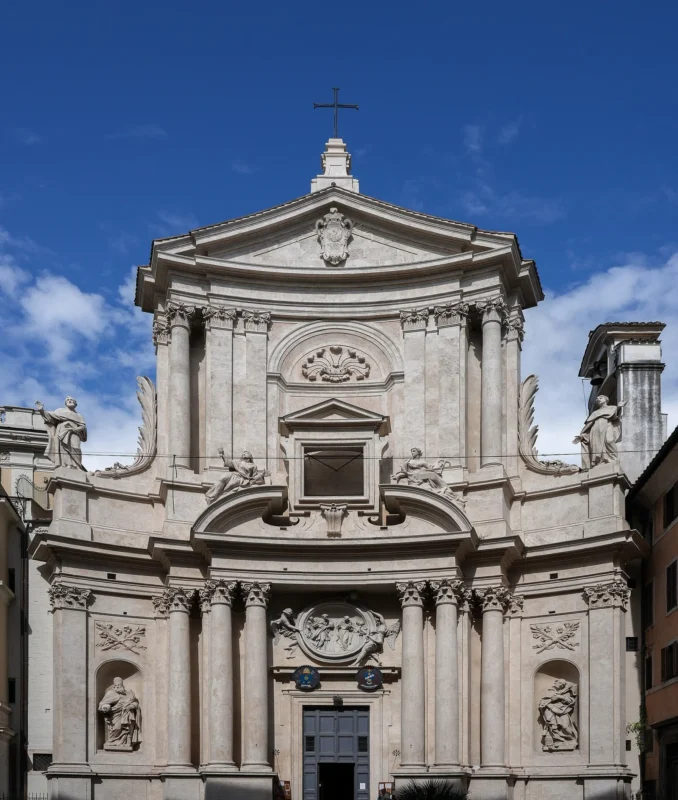
- Church of San Marcello al Corso100 m
- Galleria Alberto Sordi100 m
- San Bartolomeo dei Bergamaschi200 m
Upcoming events nearby
- L’inconveniente with Milena Vukotic at Teatro Quirino, January 19 to 31, 2027100 m
- L’uomo, la bestia e la virtù with Vanessa Gravina at Teatro Quirino, March 16 to 21, 2027100 m
- Le serve with Fioretta Mari at Teatro Quirino, March 9 to 14, 2027100 m
- Rosso Malpelo with Enrico Guarneri at Teatro Quirino, February 2 to 7, 2027100 m

You might also like
- Et in Arcadia ego at Casa di Goethe, December 2, 2026 to April 4, 2027
- Contiamo l’Italia, contiamo per il futuro at Palazzo delle Esposizioni, Oct 14 to Dec 12, 2026
- StenLex Rinascita at Galleria d’Arte Moderna, site-specific mural through Dec 31, 2026
- Fireworks. Ileana Sonnabend and the Contemporary Art Boom at Palazzo Esposizioni Roma
- Picabia, Morellet and Sole Nero at Villa Medici: Exhibitions October 9, 2026 to January 18, 2027
- Keith Haring at Museo di Roma in Palazzo Braschi, from October 6, 2026 to April 11, 2027