Il Ritorno degli Eroi at the Etruscan Museum of Villa Giulia, through December 31, 2026
In short. Il Ritorno degli Eroi is open at the Museo Nazionale Etrusco di Villa Giulia, Piazzale di Villa Giulia 9, 00196 Rome, from July 1 to December 31, 2026, together with the new permanent installation of the frescoes of the François Tomb.
Il Ritorno degli Eroi is open at the National Etruscan Museum of Villa Giulia, Piazzale di Villa Giulia 9, 00196 Rome, from July 1 to December 31, 2026, together with the new permanent installation of the frescoes of the François Tomb. The museum is open Tuesday to Sunday from 8:30 to 19:30 and is closed on Monday. The tomb and the exhibition are included in the museum admission ticket (full price €13, reduced €2), but entries are limited and booking is mandatory. The tomb cannot be visited on free-admission days, that is the first Sundays of the month, April 25, June 2 and November 4. Tickets are booked through the official channels listed on the museum's website, and there is a dedicated call center for groups and schools. The museum lists trams 2, 3 and 19 and Metro line A, Flaminio stop, about a quarter of an hour away on foot.
After more than a century and a half in a private collection, the frescoes of the François Tomb finally belong to the State and can be seen every day the museum is open. It's one of the archaeological events of the year, and I'm not exaggerating: the painted cycle from Vulci is considered the grandest testimony of Etruscan painting. For the first time the François Tomb can be seen at Villa Giulia without waiting for an occasional exhibition. The exhibition Il Ritorno degli Eroi, which accompanies the paintings until December 31, brings together next to them the grave goods scattered in the 1800s among Paris, London, Brussels and Lausanne.
Il Ritorno degli Eroi at Villa Giulia: the essentials
The exhibition is open until December 31, 2026, while the frescoes of the François Tomb remain at Villa Giulia permanently.
Dates
The frescoes have been open to the public since July 1, 2026. The exhibition that accompanies them, with artifacts on loan from foreign museums, closes on December 31, 2026. After that date the permanent installation of the paintings will remain, but the grave goods will go back to their respective museums: this is the window to see everything together.
Hours
Museo Nazionale Etrusco opens Tuesday to Sunday from 8:30 to 19:30 and closes on Monday. Last-entry times can differ between the museum and the tomb: it's best to check them when booking, because access to the tomb is organized in time slots.
Tickets and booking
Visits to the tomb and the exhibition are included in the museum ticket: full price €13, reduced €2. Entries are limited and booking is mandatory. Tickets are booked on the official app of the state museums and on the advance-sales circuit authorized by the museum, both listed on the dedicated page of the website. For groups and schools there is a call center open Monday to Saturday, from 9:00 to 14:00.
Free days
Careful: the tomb cannot be visited on free-admission days, that is the first Sunday of the month, April 25, June 2 and November 4. During the exhibition period the dates to avoid are Sunday, October 4, Wednesday, November 4, Sunday, November 1 and Sunday, December 6. Anyone who comes in free on those days sees the museum, but not the frescoes.
The François Tomb: what it is
The François Tomb is a multi-chamber Etruscan tomb in the Ponte Rotto necropolis, near the ancient city of Vulci, made between 340 and 320 BC for the Saties family, one of the most important of the Vulci aristocracy.
The discovery
The tomb was discovered on May 1, 1857 by the Florentine archaeologist Alessandro François, commissioner of the Grand Duchy of Tuscany, on the lands of Prince Alessandro Torlonia. It has borne his name ever since. It is cut into the tuff and consists of seven chambers gathered around an atrium and a tablinum.
The painted cycle
The decoration is made up of 37 painted panels and two stone cippi found in the access corridor. The museum presents it as one of the highest testimonies of Etruscan painting and, more generally, of the ancient painting that has come down to us.
The detachment of the frescoes
In 1863, by order of Prince Torlonia, the frescoes were detached from the walls, divided into panels and transferred to Rome, to Villa Albani, in the Torlonia collection. Only a few fragments remained in the tomb. After a restoration they were exhibited in full for the first time in 2004, in Hamburg and Vulci, and then went back to the private collection, visible only on rare occasions.
The State purchase
In May 2026 the cycle was acquired by the Italian State, at the end of a process that lasted over 100 years. Since July 1 the paintings have been on display at Villa Giulia in a permanent installation. The museum writes that it is handing them over definitively to the community: the word definitively, after 163 years of private collection, carries weight.
Il Ritorno degli Eroi: what you see in the exhibition
The exhibition sets the great paintings inspired by Greek myth and Etruscan history in dialogue with archaeological finds and documents that belong to the same tomb or tell its story.
The reassembled grave goods
The tomb's funerary goods were scattered in the 1800s among several collections. The exhibition brings part of them together thanks to loans from the Musée du Louvre, the British Museum, the Royal Museums of Art and History in Brussels and the Musée cantonal d'archéologie et d'histoire in Lausanne.
From the Louvre
Among the objects granted by the Louvre are the earrings that belonged to the women of the Saties family, elaborate necklaces in gold leaf, a gold ring with the figure of Cassandra and two scarabs.
From the British Museum
From London come a collection of earrings with garnets and glass-paste animals, some vases, including a lion-shaped askos, and a necklace with butterfly-shaped terminals. The museum calls it beautiful, and it's right: it's one of the pieces you remember on the way out.
Ruspi's copies and Ortis's drawings
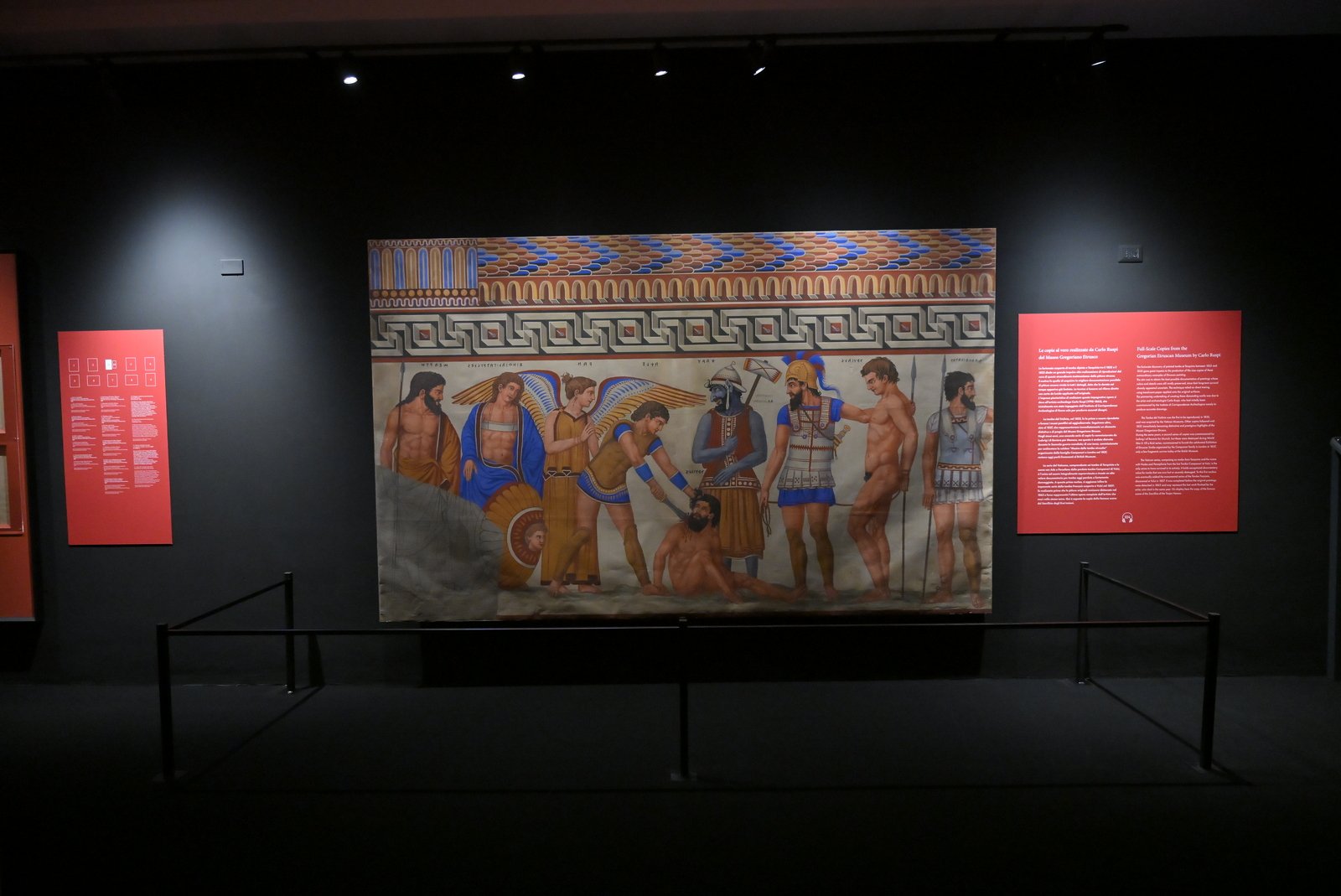
Alongside the originals, the exhibition displays the 19th-century copies of the frescoes painted by Carlo Ruspi, on loan from the Vatican Museums, and the drawings by Nicola Ortis kept at the German Archaeological Institute in Rome. They are the documents that for a century and a half replaced the originals in scholars' knowledge.
The installation
Before the rooms with the frescoes, a multimedia introduction presents the tomb and its context. The paintings are arranged following, as far as possible, the plan of the main underground chamber, so as to give back the perception of the original space.
The heroes of the François Tomb: the painted scenes
The cycle combines themes from Greek myth, from the Trojan cycle and the Theban cycle, with episodes of local heroic history, set against the idea of revenge and redemption.
Achilles and the Trojan prisoners
The most famous scene shows Achilles, in Etruscan Achle, sacrificing Trojan prisoners in honor of Patroclus, killed by Hector. On either side of the hero appear Vanth and Charun, Etruscan deities of death. It's an image of ritual violence of striking force.
Mastarna and the Vibenna brothers
On the opposite wall is Etruscan history. Caile Vipinas, that is Caeles Vibenna, is freed by Macstrna, while other Vulci heroes kill warriors from Volsinii, Sovana and other cities. Macstrna has been identified with Mastarna, whom a tradition reported by the emperor Claudius in a speech to the Senate preserved on the bronze tablets of Lyon identifies with Servius Tullius, the sixth king of Rome.
A Roman Tarquin
Another scene shows Marce Camitlnas threatening Cnaeve Tarchunies Rumach, most likely a Gnaeus Tarquinius of Rome. The frescoes seem to refer to the wars between Etruscans and Romans, and they don't do the Romans a good service.
Vel Saties
Vel Saties also appears in the frescoes, probably the tomb's patron, dressed in the Etruscan triumphal costume, painted toga and laurel crown, as he prepares to take the auspices from the flight of a bird held by his assistant Arnza.
The other myths
Ruspi's copies also document Ajax and Cassandra, Phoenix and Nestor, Eteocles and Polynices, Sisyphus and Amphiaraus. Greek heroes next to heroes of Vulci: the title of the exhibition explains itself.
A curiosity about Il Ritorno degli Eroi at the Etruscan Museum of Villa Giulia, through December 31, 2026
The curiosity is that the François Tomb gives us one of the rare images of the history of Rome seen by the Etruscans, and the view is not flattering. In the historical scene, among the warriors killed by the heroes of Vulci is a Cnaeve Tarchunies Rumach, that is in all probability a Gnaeus Tarquinius of Rome, threatened by Marce Camitlnas. In the same cycle appears Macstrna, the liberator of Caeles Vibenna.
Here an emperor enters the scene. Claudius, the most Etruscologist of the Roman emperors, in a speech to the Senate preserved on the bronze tablets of Lyon, tells that Servius Tullius, the sixth king of Rome, was called Mastarna in Etruscan: a companion of Caeles Vibenna, after changing fortunes he took refuge on the Caelian Hill, and then obtained the kingship by changing his name. A painting from 4th-century BC Vulci and an imperial bronze from Lyon tell the same story from two different sides.
My advice is to look in the gallery for precisely this wall, with the inscriptions in Etruscan next to the figures, and to read the names one by one. You get the rare feeling of seeing the legend of the kings of Rome told by their opponents.
Museo Nazionale Etrusco di Villa Giulia around the exhibition
Museo Nazionale Etrusco di Villa Giulia holds over 6,000 objects in 50 rooms and is considered the most important Etruscan museum in the world. Since 2016 it has been one of the autonomous institutes of the Ministry of Culture.
The Sarcophagus of the Spouses
It is the museum's most famous piece: the terracotta funerary monument with the married couple reclining as if at a banquet. With the François Tomb, Villa Giulia now puts in the same building the two masterpieces of Etruscan funerary art, in terracotta and in painting.
The Apollo of Veii
A painted terracotta sculpture from the late 6th century BC, from Veii: one of the fundamental texts for understanding archaic sculpture in Italy.
The Pyrgi tablets
Three gold tablets with a text in Etruscan and Phoenician, fundamental for the study of the Etruscan language. After the inscriptions of the François Tomb, seeing them helps you understand how little we know and how precious every text is.
Other exhibitions on view
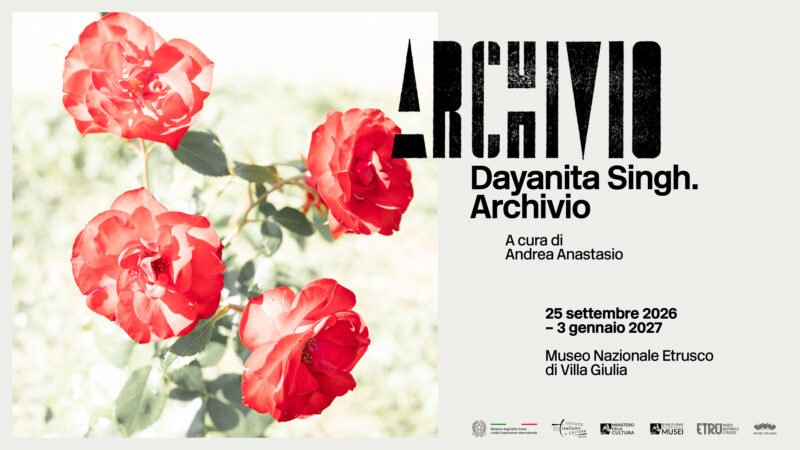
During the same period Villa Giulia also hosts Archivio di Dayanita Singh, through January 3, 2027: a contemporary photography exhibition devoted to Italian archives, also included in the ticket.
One thing nobody tells you about Il Ritorno degli Eroi at the Etruscan Museum of Villa Giulia, through December 31, 2026
What nobody says is that the first Sunday of the month, the day many Romans choose to go to a museum for free, is exactly the wrong day for the François Tomb. The museum says so clearly: on free-admission days the tomb cannot be visited. Anyone who arrives at Villa Giulia on Sunday, October 4 or Sunday, December 6, drawn by the free admission, finds the museum open and the frescoes closed. The same goes for November 4.
The second thing is that entries to the tomb are limited. It's not enough to show up at the museum with a ticket: you need a booking for the time slot. On weekends the best slots sell out, and from now until Christmas demand will grow. My advice is to book a few days ahead and to choose a weekday.
The third is good news. The full-price ticket costs €13 and includes everything: museum, tomb, exhibition and the other temporary exhibitions on view. The reduced ticket costs €2. For what you see, it's one of the best price-to-quality ratios in Rome.
Villa Giulia, the villa of Pope Julius III
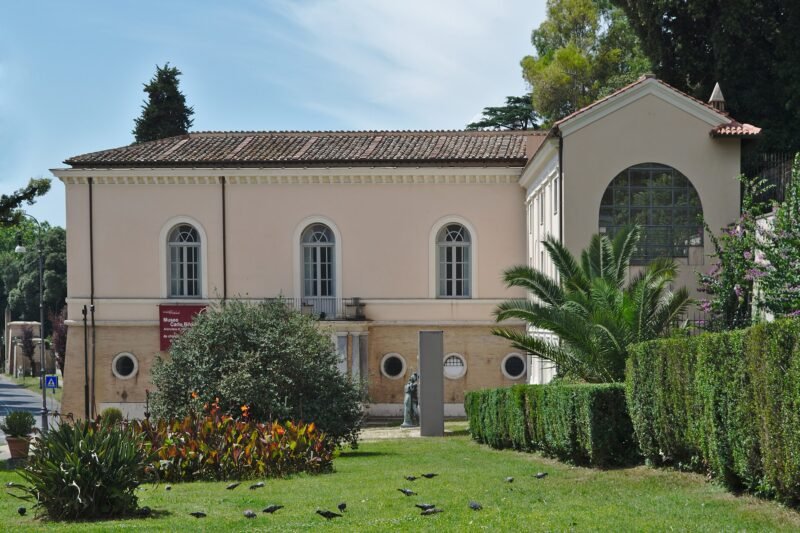
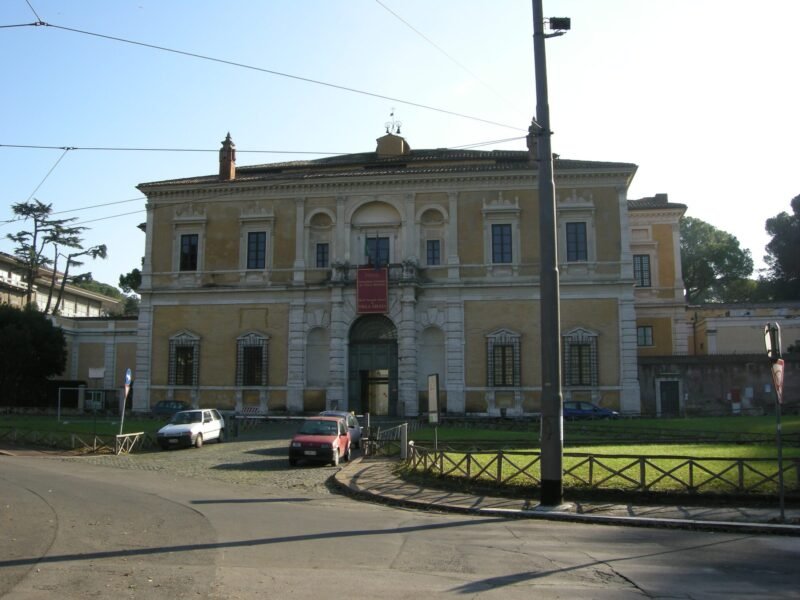
Villa Giulia was built between 1550 and 1555 for Pope Julius III, Giovanni Maria Ciocchi del Monte, as a suburban residence along Via Flaminia, outside the walls. The museum it houses was born in 1889.
Architects and painters
The design of the building is by Jacopo Barozzi da Vignola. The nymphaeum and the garden structures are due to Bartolomeo Ammannati. Michelangelo supplied a design for the casino, and Giorgio Vasari claimed to have been the first to draw the whole conception. The painted decoration was entrusted to Prospero Fontana, with Pietro Venale da Imola and the young Taddeo Zuccari.
The facade and the hemicycle
Facing the city, Vignola's facade is severe, on two floors, with the triumphal arch motif at the center. At the back the building bends into a semicircle, and the hemicycle is painted with light grotesques inspired by the Domus Aurea. The contrast between the flat facade and the concave back is the architectural lesson of the villa.
The nymphaeum
The heart of the complex is the nymphaeum, on three levels of loggias with statues and balustrades, built around a fountain with river gods and caryatids. It was the place for the pope's summer lunches.
From villa to museum
After the death of Julius III the villa went through a long decline. With the Royal Decree of February 7, 1889, at the urging of the archaeologist Felice Barnabei, it became the home of the National Museum devoted to the antiquities of the pre-Roman peoples: Etruscans, Faliscans, Umbrians, Latins, Sabines.
My advice for visiting Il Ritorno degli Eroi at the Etruscan Museum of Villa Giulia, through December 31, 2026
My advice is to start from the end of the story and then work back up. Before entering the rooms with the frescoes, look at the copies by Carlo Ruspi and the drawings by Nicola Ortis: they are the images through which, for a century and a half, scholars knew the tomb. Then move on to the multimedia introduction, and only at the end walk in among the original paintings, arranged according to the plan of the chamber. The effect is that of a restoration happening before your eyes: from the document to the original.
The second piece of advice is about the day. Choose a Tuesday, Wednesday or Thursday morning, book the first available slot after 9:00 and keep the whole morning for Villa Giulia. The tomb, the exhibition and the main rooms of the museum take at least two and a half hours. Skip the first Sunday of the month: the tomb is closed.
The third piece of advice is to read a page first on the story of Mastarna and Servius Tullius. In front of the wall with Macstrna and Caile Vipinas, whoever knows the legend sees a historical scene. Whoever doesn't sees warriors killing each other. It's worth the visit even for those who think they don't like archaeology: the François Tomb is painting, storytelling and politics all at once.
Hours, tickets and closing days
Museo Nazionale Etrusco is open Tuesday to Sunday from 8:30 to 19:30 and is closed on Monday.
The ticket
The museum ticket costs €13 full price and €2 reduced. It includes the François Tomb, the exhibition Il Ritorno degli Eroi and the other temporary exhibitions. Booking for the tomb is mandatory.
Time slots
Entries to the tomb are limited. The booking assigns a time slot: arrive a few minutes early.
Groups and schools
To reserve entry for groups and schools, the museum lists a telephone call center open Monday to Saturday, from 9:00 to 14:00. For schools the tomb is an exceptional teaching opportunity: Greek history, Etruscan history and the history of Rome on the same wall.
Contacts
For information the museum gives the numbers 06 3226571 and 06 3201706.
Another well-known fact, yet rarely cited
That the François Tomb is the masterpiece of Etruscan painting is well known. Rarely cited is the fact that, throughout its modern history, almost no one has been able to see it. Discovered in 1857, it was stripped of its frescoes in 1863, six years later, by order of Prince Torlonia. Since then the paintings have stayed at Villa Albani, in the family's private collection, and the real tomb, at Vulci, has stayed with a few fragments of color. To know the cycle, scholars used for decades the 19th-century copies by Carlo Ruspi and the drawings by Nicola Ortis, the same ones that are now on display in the exhibition next to the originals.
The first complete exhibition of the frescoes happened only in 2004, in Hamburg and Vulci, after a restoration. Then silence again, until the State purchase in May 2026. The ANSA agency spoke of a purchase worth €15 million. Anyone who goes up to Villa Giulia today therefore sees something their grandparents, and almost certainly their parents, never saw. There is also a full-size reconstruction of the tomb with the frescoes, in Canino, in Museo della Ricerca Archeologica di Vulci: useful, but now the original is in Rome.
The right photo to take at Il Ritorno degli Eroi at the Etruscan Museum of Villa Giulia, through December 31, 2026
The right photo in the gallery is the one of the whole, not of the detail. The installation follows the plan of the main chamber of the tomb: stand in the center of the room and look for a framing that holds two walls together, so as to give the feeling of being inside the underground chamber. That's the reason the museum chose this arrangement. Before shooting, ask the staff if photographs are allowed: the limited entries and the foreign loans may bring special rules.
If photos in the gallery are not allowed, the right photo is outside, in the nymphaeum of Villa Giulia. Go down the marble stairs and frame the three levels of the loggias vertically, with the fountain at the bottom. It's the Renaissance stage set of a pope who collected antiquities, and today it guards the largest Etruscan collection in the world.
The third framing is the return: Ruspi's copies next to the originals. A photo that puts the 19th-century copy and the ancient painting side by side, if allowed, tells in a single shot a century and a half of the tomb's history.
How to get to Villa Giulia
Museo Nazionale Etrusco is at Piazzale di Villa Giulia 9, along Viale delle Belle Arti, between Villa Borghese and the Parioli. The museum lists trams 2, 3 and 19 and Metro line A, Flaminio stop.
By metro
From the Flaminio stop on line A the museum calculates about 14 minutes on foot, going up through the Flaminio area toward Valle Giulia.
By tram
Trams 3 and 19 run along Viale delle Belle Arti and are the most convenient solution for those coming from the neighborhoods to the east. Tram 2 leaves from Piazzale Flaminio and goes up Via Flaminia.
On foot from Villa Borghese
Villa Giulia is a few steps from Villa Borghese: coming down from the park toward Valle Giulia you reach the museum on foot. It's the most pleasant way to arrive, and a good solution for anyone combining the François Tomb with the Galleria Borghese.
By car
The museum doesn't list its own parking, and parking in the surrounding area is contested. Better to take public transit.
Around Villa Giulia: Valle Giulia and Villa Borghese
Villa Giulia is in the Valle Giulia area, one of the richest in museums in the city.
Villa Borghese
Going up toward the park of Villa Borghese you meet Galleria Borghese, the Museo Carlo Bilotti and Museo Pietro Canonica. At the start of October the exhibition on Ovid's Metamorphoses is still open at Galleria Borghese, until the 11th: after the Greek heroes painted by the Etruscans, those sculpted by Bernini.
Villa Poniatowski
A few steps away, on Via Flaminia, Villa Poniatowski is the museum's second venue, transformed by Giuseppe Valadier in the early 1800s.
Piazza del Popolo
Heading south, from the Flaminio stop you pass under Porta del Popolo and enter the square: a natural end to the day.
Some important events that happened here in history
340-320 BC: at Vulci the Saties family has its tomb dug and painted in the Ponte Rotto necropolis.
1550-1555: Pope Julius III has Villa Giulia built, with Vignola, Ammannati, Vasari and a design by Michelangelo.
May 1, 1857: Alessandro François discovers the tomb on the lands of Prince Alessandro Torlonia.
1863: the frescoes are detached and taken to Villa Albani, in the Torlonia collection.
February 7, 1889: a Royal Decree, promoted by Felice Barnabei, establishes the museum at Villa Giulia.
From after the Second World War: the nymphaeum becomes the traditional venue of the final evening of the Premio Strega.
2004: after a restoration, the frescoes of the tomb are exhibited in full for the first time, in Hamburg and Vulci.
2016: the museum becomes an autonomous institute of the Ministry of Culture.
May 2026: the Italian State acquires the painted cycle of the François Tomb.
July 1, 2026: the frescoes open to the public at Villa Giulia, accompanied by the exhibition Il Ritorno degli Eroi.
Il Ritorno degli Eroi with children
The François Tomb is a story of heroes, wars and monsters of death: with kids it works very well.
How to tell it
Before going in, tell the story of Achilles avenging Patroclus, and that of the Vibenna brothers. Then ask the kids to find in the gallery Achilles, the two Etruscan demons Vanth and Charun, and the warrior freed from his chains. It works from eight or nine years old and up.
The jewelry
The earrings of the Saties women, the lion-shaped askos and the necklace with the butterflies are objects that children look at willingly: a good way to talk about the life of those buried in the tomb.
The museum for families
Villa Giulia has an ETRUKids section with materials for schools and families. With children, pace the visit: tomb and exhibition, then the Sarcophagus of the Spouses, then the garden and the nymphaeum.
Accessibility at Villa Giulia
Museo Nazionale Etrusco states that it has removed most architectural barriers. Access to some rooms is guaranteed with alternative routes, elevators and stair lifts. A wheelchair is available on request at the entrance.
Visual and hearing disabilities
The museum offers on request tactile reproductions and tactile guided tours, and for deaf people a free video guide in Italian Sign Language.
Before the visit
For the tomb, with its limited entries, it's best to report your needs at the time of booking, using the contacts of the museum's accessibility service. The garden and the nymphaeum have stairs.
Who has passed through Il Ritorno degli Eroi at the Etruscan Museum of Villa Giulia, through December 31, 2026
The François Tomb has had, even before arriving at Villa Giulia, a gallery of figures. Vel Saties, the patron dressed as a triumphant general, and the women of his family, whose earrings are now in the display cases. Alessandro François, the archaeologist of the Grand Duchy of Tuscany who discovered it in 1857. Prince Alessandro Torlonia, owner of the lands, who ordered the detachment of the paintings. Carlo Ruspi, who painted the copies, and Nicola Ortis, author of the drawings now kept at the German Archaeological Institute. Among the scholars who have written about the tomb are Massimo Pallottino, father of modern Etruscology, Mauro Cristofani, Mario Torelli, Filippo Coarelli.
Villa Giulia, for its part, has seen Vignola, Ammannati, Vasari and Michelangelo pass through, the painters Prospero Fontana and Taddeo Zuccari, and then Felice Barnabei, who wanted the museum. Pallottino's library is still kept here. Since the Second World War the nymphaeum has been the venue of the final evening of the Premio Strega, founded in 1947 by Maria Bellonci and Guido Alberti: in this garden were proclaimed, among others, Paolo Volponi, Paolo Cognetti, Helena Janeczek, Antonio Scurati, Sandro Veronesi, Emanuele Trevi, Mario Desiati, Ada D'Adamo, Donatella Di Pietrantonio and Andrea Bajani.
Now, with Il Ritorno degli Eroi, the objects that left Vulci in the 1800s for the Louvre, the British Museum, Brussels and Lausanne have arrived at Villa Giulia. It's a family reunion, after almost 170 years.
Where to eat near Villa Giulia
The museum restaurant is closed pending a renovation, so you have to go out to eat. There are three useful areas.
Flaminio
Along Via Flaminia and toward Piazzale Flaminio there are neighborhood trattorias, pizza-by-the-slice places and bars with hot food counters, at residential-neighborhood prices.
The Parioli
Going up toward the Parioli the offering becomes more refined and more expensive, with restaurants and pastry shops.
Piazza del Popolo
Heading down toward the center, between Piazza del Popolo and the Tridente, is the widest offering, at downtown prices. The museum opens at 8:30: if you finish the visit at noon, lunch comes at just the right moment.
Rome between October and December: the exhibition period
The exhibition closes on December 31, and the three months that remain cover the whole Roman autumn. October is the best month to combine Villa Giulia with a stroll in Villa Borghese. November is quieter, with fewer tourists on weekdays. December brings the Christmas holidays and a predictable rise in bookings. Anyone who wants to see the exhibition at leisure shouldn't wait for the last weeks: the limited entries sell out sooner.
Frequently asked questions about Il Ritorno degli Eroi and the François Tomb
Until when is the exhibition Il Ritorno degli Eroi open at Villa Giulia?
Il Ritorno degli Eroi is open at Museo Nazionale Etrusco di Villa Giulia from July 1 to December 31, 2026. The frescoes of the François Tomb, on the other hand, remain on display permanently. The artifacts on loan from the Louvre, the British Museum, Brussels and Lausanne are on view until the exhibition closes.
How much does it cost to see the François Tomb at Villa Giulia?
The visit to the François Tomb and the exhibition Il Ritorno degli Eroi is included in the ticket of Museo Nazionale Etrusco di Villa Giulia: full price €13, reduced €2. Booking is mandatory and entries are limited.
Can you see the François Tomb on the first Sunday of the month?
No, the François Tomb at Villa Giulia cannot be visited on free-admission days: the first Sundays of the month, April 25, June 2 and November 4. On those days the museum is open free of charge, but the frescoes remain closed to the public.
What is the François Tomb?
The François Tomb is an Etruscan tomb in the Ponte Rotto necropolis at Vulci, made between 340 and 320 BC for the Saties family. It was discovered in 1857 by Alessandro François. Its 37 painted panels are the largest cycle of Etruscan painting.
Why are the frescoes of the François Tomb in Rome?
The frescoes of the François Tomb were detached in 1863 by order of Prince Torlonia and taken to Villa Albani, in Rome. They stayed in the private collection until May 2026, when the State acquired them. Since July 1 they have been on display at Villa Giulia.
Which objects are in the exhibition Il Ritorno degli Eroi?
The exhibition Il Ritorno degli Eroi brings together part of the tomb's grave goods: earrings of the Saties women, necklaces in gold leaf and a ring with Cassandra from the Louvre, a lion-shaped askos and a necklace with butterfly terminals from the British Museum, plus 19th-century copies and drawings.
How do you get to the Etruscan Museum of Villa Giulia?
Museo Nazionale Etrusco di Villa Giulia is at Piazzale di Villa Giulia 9. The museum lists trams 2, 3 and 19 and Metro line A, Flaminio stop, about 14 minutes away on foot. From Villa Borghese you get there on foot by going down toward Valle Giulia.
The final advice
Book a weekday in October, avoid the free days, and give the François Tomb the time it deserves. It's the first time in 163 years that these frescoes belong to everyone, and until December 31 they are accompanied by the gold pieces that complete them. It's an opportunity not to let pass.
Article written by the editorial team of Tour Leader Pro, contact them for Private/Corporate/V.I.P. Tours and Experiences.
Planning a trip to Rome? The English-language guides for visiting the city are on ItalyPlanner.com.
Contact Information
Nearby
 National Etruscan Museum of Villa Giulia100 m
- Japanese Cultural Institute in Rome100 m
- Danish Academy in Rome200 m
- Romanian Academy in Rome200 m
- Villa Poniatowski200 m
- British School at Rome200 m
Upcoming events nearby
- Dayanita Singh at Villa Giulia, Archivio, September 25 to January 3, 2027100 m
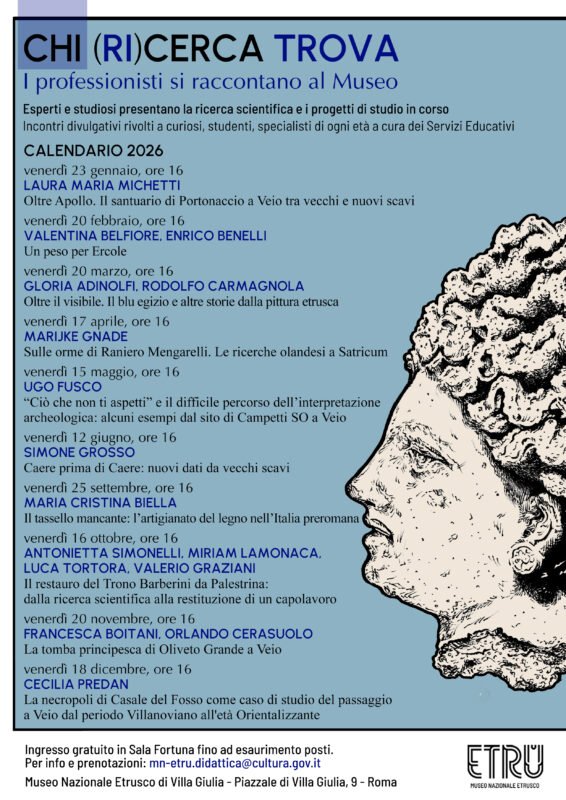
- Chi (Ri)cerca Trova 2026 at the National Etruscan Museum of Villa Giulia, January 23 to December 18, 2026100 m
- L’indovino di Mouna Rebeiz at Museo Nazionale Etrusco di Villa Giulia, from September 16 to November 29, 2026100 m
- Cent’anni a Roma: The Abbey Awards at the British School at Rome, November 4 to December 18, 2026200 m

You might also like
- States of Uncertain Domesticities at Museo Carlo Bilotti, September 19 to November 8, 2026
- Marinella Senatore at the Galleria Nazionale d’Arte Moderna: Artist at GNAMC until December 31, 2026
- Marina Abramović at Galleria Nazionale d’Arte Moderna, November 18, 2026 to April 4, 2027
- Biodiversità Ritratta (Biodiversity Portrayed), the Nabokov exhibition at Museo Civico di Zoologia, Oct 15 to Nov 15, 2026
- Marina Bindella. Cosmografie at Museo Carlo Bilotti, September 26 to November 15, 2026
- Luigi & Iango. Corpi speciali at Galleria Nazionale, from October 13 to November 29, 2026