L’indovino di Mouna Rebeiz at Museo Nazionale Etrusco di Villa Giulia, from September 16 to November 29, 2026
In short. L'indovino di Mouna Rebeiz is open from September 16 to November 29, 2026 at the Museo Nazionale Etrusco di Villa Giulia, Piazzale di Villa Giulia 9, 00196 Rome, Tuesday through Sunday from 8:30 to 19:30 (rooms close at 19:00, last…
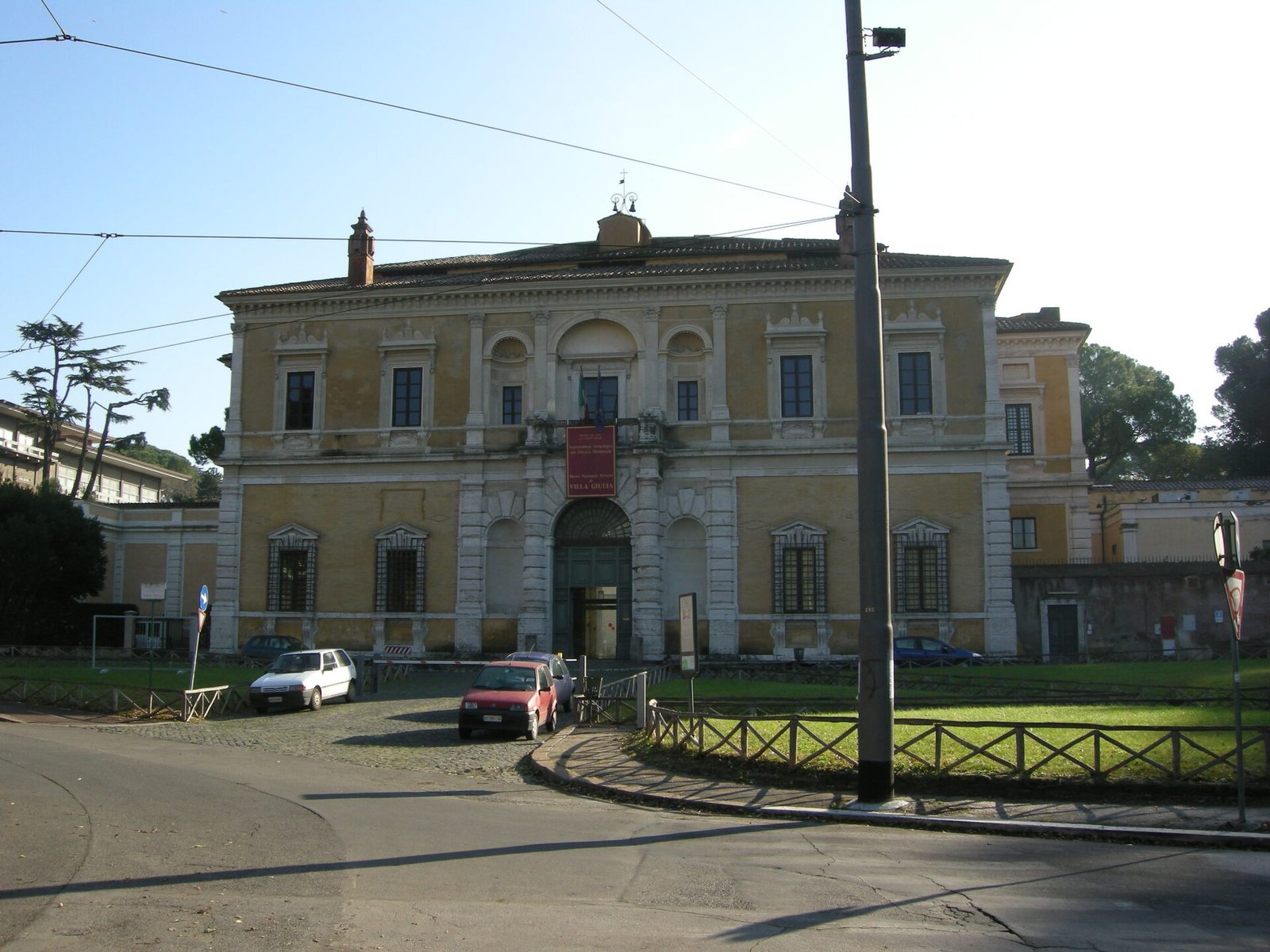
L'indovino di Mouna Rebeiz is open from September 16 to November 29, 2026 at the National Etruscan Museum of Villa Giulia, Piazzale di Villa Giulia 9, 00196 Rome, Tuesday through Sunday from 8:30 to 19:30 (rooms close at 19:00, last entry at 18:30, closed Monday). You get to the museum by tram 2, 3 and 19 or by metro line A, Flaminio stop, from which it's a quarter of an hour's walk. The show is included in the museum ticket: full price €13, reduced €2, free for those entitled and on free-admission days. Tickets are bought at Villa Giulia ticket office or through the authorized presale network indicated on the museum's official site.
22 major arcana painted on large mirrored surfaces, an Etruscan soothsayer speaking from the nymphaeum, a painting more than 16 meters high dedicated to a Vangelis symphony: the Lebanese artist Mouna Rebeiz brings to Villa Giulia the installation she presented at the Venice Biennale in 2022, reworked for the villa of Pope Julius III. The curator is the art critic Roberta Semeraro, and the show is promoted by the museum with the Associazione Culturale RO.SA.M. In our view, the idea of putting tarot in the museum that holds the instruments of the haruspices is one of the few contemporary art operations in an archaeological museum that have a real reason behind them.
L'indovino di Mouna Rebeiz: the essential information
The show stays open for 75 days, from Wednesday, September 16 to Sunday, November 29, 2026, and follows the regular hours of Museo Nazionale Etrusco. It has no separate ticket: you enter the museum and the installation is part of the visit.
Days and hours
The museum is open Tuesday through Sunday, from 8:30 to 19:30. Last entry is at 18:30 and the rooms close at 19:00: anyone arriving at the last moment has half an hour, too little for a route that winds through the semicircular room, the nymphaeum and the zodiac room. On Monday the museum is closed.
How much it costs
The show is included in the museum ticket. Full price is €13, reduced €2, and it's free for those entitled to the Ministry of Culture's concessions. Villa Giulia also accepts the Roma Pass and has an agreement with the FAI. For people who live in Rome there is the annual ETRU Card, in the Individual version at €48 and Young, for ages 18-25, at €10.
The free days during the show
Admission to the museum is free on the first Sunday of the month and on November 4. During L'indovino the dates are Sunday, October 4, Sunday, November 1 and Wednesday, November 4, 2026. On the free days some parts of the museum, such as the Macchina del Tempio, the Ori Castellani room and the François Tomb, can't be visited.
How the Mouna Rebeiz show at Villa Giulia is put together
The installation is made up of 22 cards representing the major arcana of the tarot, made on large mirrored surfaces so that the visitor is reflected inside the work. The museum describes it as a path toward a deeper knowledge of the self, conceived between the globalization of artificial intelligence and symbolic traditions.
The source: Shakespeare and the haruspex Spurinna
The title comes from Shakespeare's Julius Caesar: the soothsayer who warns Caesar not to go to the Senate on the Ides of March. In Roman history that soothsayer has a name, Spurinna, and he was an Etruscan haruspex. Caesar didn't listen to him and died in the most famous conspiracy of antiquity. On her own site, the artist explains that she considers premonition one of the missions of the artist, and that she is interested in the improbable meeting point between artificial intelligence and mysticism.
The semicircular room
The heart of the installation is the museum's semicircular room, where the arcana dialogue with the archaeological finds that document the divinatory knowledge of the Etruscans, to which Spurinna belonged. It's the most successful part of the project, because it puts a modern tradition, that of the Marseille tarot, next to the evidence of a divination from two and a half millennia ago, without claiming to connect them with a direct thread.
Temperance in the nymphaeum
The 14th arcanum, Temperance, represented by a woman pouring water, is placed in the villa's nymphaeum, built on the ancient Roman aqueduct. Here the museum announces a painting and music performance inspired by Vangelis's Mythodea, to which Rebeiz has dedicated a painting more than 16 meters high. The installation is directed by the Slovenian visual artist and director Atej Tutta.
The zodiac room
The route ends in the zodiac room, with panels dedicated to the ecological transition and to saving energy resources. It's the most didactic passage of the show, and also the least necessary: after the nymphaeum you could just as well go out into the garden. The technical design of the installation is by Studio Palinsesto of London, by Simonpietro Salini and Federico Lippi.
Mythodea: Vangelis, Mars and water
Mythodea is the work that the Greek composer Vangelis wrote to accompany NASA's exploration of Mars. The museum recalls that Mars is the only planet where the presence of water suggests some form of past life, and that it could become a refuge for human beings in the future.
Why in the nymphaeum
The link with the nymphaeum is water. Temperance pours water from one vessel to another, the nymphaeum of Villa Giulia was fed by a branch of the Acqua Vergine aqueduct commissioned by Julius III, and Mythodea celebrates a planet sought precisely for traces of water. It's perhaps too long a chain of references for a passing visitor, but in the place it works: the nymphaeum is the coolest and most secluded point of the villa.
Who Mouna Rebeiz is
Mouna Rebeiz is a Lebanese-Canadian painter born in Beirut in 1957, who lives and works in London. Her official site tells of a childhood among musicians, painters and poets, an influence that runs through all her painting.
Training: from psychology to painting
Before painting there is psychology. Rebeiz studied psychology at the Sorbonne and at Saint-Joseph University in Beirut, drawn, the official biography says, by the many faces of the human being and of the psyche. After years of travel, in 1995 she met Alix de la Source, a Louvre lecturer specializing in 18th-century painting, who taught her the techniques of the great masters. She then perfected her use of patinas in courses on Renaissance technique and studied with Abraham Pincas, painter and teacher at the École nationale supérieure des Beaux-Arts in Paris, and with Mohamed El Rawas, a Lebanese painter and engraver who teaches at the fine arts academy in Beirut.
The work: figure and abstraction
Her painting alternates figuration and abstraction. At the center is often the female body, which the official biography calls a universal crucible of emotions. Alongside the paintings are large sculptures that the artist presents as revisited totems. The sources describing her work insist on the double root, Lebanese and French, and on the way both cultures assign women an ambivalent role.
The main series
The catalog of series is long. Hymne à la vie (2006) is a tribute to the female body. The Betty Boop Collection (2012) compares the real beauty of the body with the retouched, commercial kind. Le Tarbouche (2015) takes the fez, a Middle Eastern symbol of virility, and turns it into a comment on the feminine. La voie de l'Opéra (2017) tries to translate opera arias into color. The Trash-ic (2018) reflects on ugliness as the norm of the present. Les Ors du temps (2018) works on gold. Color Power (2021) is a study of pure color. Les Sans visage, begun in March 2020 during lockdown, is dedicated to the homeless people left on the streets of Paris.
Shows and venues
Among the solo shows: Hymne à la vie at the Maison de l'Amérique Latine in Monaco (2006) and at the Galerie Daniel Besseiche in Paris (2008). The Betty Boop Collection at the Galerie Pierre Alain Challier (2012) and at the Galerie Hubert Konrad (2013) in Paris. Le Tarbouche (2015) and The Trash-ic (2018) at the Saatchi Gallery in London. La voie de l'Opéra at the Galerie Pierre Alain Challier (2017). In 2022, Totems at the Leila Heller Gallery in New York, Colour Power at Leila Heller in Dubai and The Soothsayer at the 59th Venice Biennale. Among the group shows: the Salon des Indépendants and Art en Capital at the Grand Palais in Paris, the Fondation Paul Ricard, Togeth'Her at the Monnaie de Paris (2020), the DIFC Sculpture Park in Dubai (2022), Le rêve a ses raisons at the Musée français de la carte à jouer in Issy-les-Moulineaux (2023).
Le Tarbouche at the Saatchi Gallery
The project that made her known to the wider public is Le Tarbouche, in 2015 at the Saatchi Gallery in London. Rebeiz invited artists and designers to reinvent the fez: the participants included Elie Saab, Lanvin, Jean-Charles de Castelbajac, Alber Elbaz, Nathalie Rykiel, Stephen Webster and Zaha Hadid. The pieces were then auctioned by Sotheby's and the proceeds went to the association Innocence in Danger, which works on child protection.
From Venice to Rome: The Soothsayer at the 2022 Biennale
L'indovino wasn't born in Rome. In 2022 Rebeiz presented The Soothsayer at the 59th Venice Art Biennale, in the Pavilion of the Republic of San Marino, set up in the church of San Giorgio.
Three works in dialogue
In the Venice version, according to the artist's description, three works were in dialogue with each other: the series of the 22 revisited major arcana of the Marseille tarot, painted on aluminum plates, a puzzle of colored tiles and an abstract totemic sculpture. The stated goal was to guide the viewer along a path of discovery of the self and of humanity.
What changes at Villa Giulia
In Rome the installation has been reworked in a site-specific key. The substantial difference is the context: in Venice the arcana were contemporary works in a church, at Villa Giulia they sit next to the objects of a civilization for which divination was a science of the State. The idea of bringing them here, the museum explains, is the curator Roberta Semeraro's, precisely because of the link with the Etruscan divinatory tradition.
A curiosity about L'indovino di Mouna Rebeiz at Museo Nazionale Etrusco di Villa Giulia, from September 16 to November 29, 2026
The show arrives at Villa Giulia in the year the museum acquired its most awaited work: the François Tomb of Vulci, which entered the State's patrimony and has been visible to the public since July 1, 2026. The museum itself underlines the coincidence. In the tomb's frescoes, one of the most important cycles of Etruscan painting, there are figures tied to prophecy and divination, such as Amphiaraus and Cassandra, and references to ornithomancy, that is, the art of drawing omens from the flight of birds.
Amphiaraus and Cassandra are two soothsayers of Greek myth, and their presence in the tomb says how much the theme of prophecy mattered to whoever had it painted. It's the same material Shakespeare stages with Spurinna and Caesar: the prophecy nobody listens to. Seeing in the same visit Rebeiz's mirrored tarot and the tomb painted in the 4th century BC gives the show a meaning that, on its own, it perhaps wouldn't have.
Then there is a curiosity about the artist. Before painting, Rebeiz studied clinical psychology at the Sorbonne and in Beirut. The arcana on mirrored surfaces, where the viewer sees their own image inside the card, are at bottom a psychologist's device more than a fortune teller's: they predict nothing, they send the viewer back his own face. My advice is to take them that way, as a mirror and not as an oracle.
Museo Nazionale Etrusco around the show
Museo Nazionale Etrusco di Villa Giulia holds more than 6,000 objects in 50 rooms and is considered the most important Etruscan museum in the world. Since 2016 it has been an autonomous institute of the Ministry of Culture. Since 2024 it has been directed by Luana Toniolo.
The Sarcophagus of the Spouses
It's the piece almost everyone comes to see: the married couple in terracotta, reclining as if at a banquet. The restoration continues, and the museum lets you watch it in the laboratory on Tuesday and Thursday from 10:00 to 13:00.
The Apollo of Veii
A painted terracotta sculpture from the end of the 6th century BC, coming from the sanctuary of Veii. It's one of the fundamental works for understanding archaic sculpture in Italy, and by itself it justifies the ticket.
The Pyrgi gold sheets
Three gold sheets with a text in Etruscan and Phoenician, fundamental for the study of the language. They come from the sanctuary of Pyrgi, on the coast, and remind us that for the Etruscans the sacred, writing and politics were the same thing.
The François Tomb
Discovered in 1857 by Alessandro François in the necropolis of Ponte Rotto at Vulci, made between 340 and 320 BC, it is composed of 37 painted panels and two cippi. The visit is included in the ticket, but entries are limited and booking is required.
The other shows on now
In the same period the museum hosts, from September 25, Archivio by Dayanita Singh, with more than 350 photographs, and Diego Cibelli's permanent installation Il cielo si ricorda degli Etruschi. One ticket, three different ways contemporary art enters an archaeological museum.
Something nobody tells you about L'indovino di Mouna Rebeiz at Museo Nazionale Etrusco di Villa Giulia, from September 16 to November 29, 2026
The free days are tempting, but for this show they're the wrong choice. During the run of L'indovino there are three free-admission days: Sunday, October 4, Sunday, November 1 and Wednesday, November 4. The museum warns that on those days the François Tomb can't be visited, and the Macchina del Tempio and the Ori Castellani room also stay closed. The François Tomb, with Amphiaraus and Cassandra, is precisely the natural complement to the show.
The second thing concerns the nymphaeum. Temperance and the painting for Mythodea are in the open air, or at any rate in the spaces of the nymphaeum, which is dug below garden level and reached by flights of marble stairs. In the rain, which in Rome between October and November isn't lacking, the descent gets slippery and the stay less pleasant. Check the weather and, if you can choose, go on a dry day.
The third is a matter of pace. The installation is spread over three points far from each other: semicircular room, nymphaeum, zodiac room. In between is the whole museum. Anyone who thinks of seeing the show in 20 minutes and running ends up crossing Villa Giulia at a run without looking at either the Etruscans or the arcana. In our view there are no halfway options: either give the whole visit two hours, or it's better to postpone.
Villa Giulia: the villa of Pope Julius III
Villa Giulia was built for Pope Julius III, Giovanni Maria Ciocchi del Monte, between 1550 and 1555, as a suburban residence outside the walls, along Via Flaminia. It is one of the most successful examples of a Renaissance and Mannerist villa in Rome.
The architects
The building is by Jacopo Barozzi da Vignola, whom the pope called architect of His Holiness. The nymphaeum and the garden structures are due to Bartolomeo Ammannati. Michelangelo supplied a design for the casino. Giorgio Vasari claimed to have drawn first the whole invention of the vineyard. The pictorial decoration was entrusted to Prospero Fontana, with Pietro Venale da Imola and the young Taddeo Zuccari.
The facade and the hemicycle
Toward the city, Vignola designed a severe two-story facade, with the triumphal arch motif at the center. At the back the building bends into a semicircle, and the hemicycle is painted with grotesques inspired by the Domus Aurea. The contrast between the flat facade and the concave rear is the villa's architectural lesson.
The nymphaeum
The nymphaeum is reached from the central garden loggia by going down two flights of marble stairs: three levels of loggias with statues and balustrades around a fountain with river gods and caryatids. It was the place where people dined in the cool in summer, and it's here that this fall you find Rebeiz's Temperance.
From villa to museum
After the death of Julius III the villa went through a long decline. In 1889, with a Royal Decree sought by the archaeologist Felice Barnabei, it became the home of Museo Nazionale delle antichità extraurbane, dedicated to the pre-Roman peoples of Latium and Etruria. In the 1930s two wings were added for collections and services.
My advice for visiting L'indovino di Mouna Rebeiz at Museo Nazionale Etrusco di Villa Giulia, from September 16 to November 29, 2026
Go on a Tuesday or Thursday morning, entering shortly after 8:30, and follow a precise order. The museum first, not the show: the room where the evidence of Etruscan divination is displayed, the Sarcophagus of the Spouses (from 10:00, in the laboratory), the Apollo of Veii. Then the semicircular room with the 22 arcana, while you still have the haruspices' objects in your eyes. Only at the end the nymphaeum with Temperance, and the zodiac room if you have time left.
The reason is simple. Rebeiz's arcana, seen on their own, are paintings on mirror with an iconography everyone knows: Death, the Fool, the Wheel of Fortune. Seen after the Etruscan display cases they become something else, a comparison between two ways of questioning the future. That's where the show pays off most.
In front of the mirrors, stop at a distance and then come closer: the reflection changes, and you enter the card. It's the game the artist proposes, and it's worth playing without hurry. If you want to add the François Tomb, book it beforehand, because entries are limited. Allow two and a half hours in all.
Hours, tickets and booking
L'indovino di Mouna Rebeiz follows the hours and fares of Museo Nazionale Etrusco: Tuesday through Sunday 8:30-19:30, full price €13, reduced €2, show included in the ticket.
Where to buy the ticket
The ticket is bought at the museum ticket office, in the bookshop, or online through the authorized presale network indicated on the official site. On an autumn weekday buying on site is no problem. For the François Tomb, however, advance booking is required.
Another well-known fact, yet rarely mentioned
Everyone knows Caesar was killed on March 15, on the Ides. Almost everyone knows the soothsayer's line in Shakespeare's tragedy, the one that tells him to beware the Ides of March. Few remember that the soothsayer really existed and that he was Etruscan. He was called Spurinna, and he was an Etruscan haruspex, that is, a soothsayer of that divinatory tradition that for the Etruscans was a central body of knowledge.
Villa Giulia museum recalls that divination had a central role in Etruscan culture, and that among its finds there is evidence tied to the practices of haruspices and soothsayers.
This is the point that makes the show make sense. Mouna Rebeiz didn't bring tarot into just any museum: she brought it into the museum of the civilization that supplied Rome with its most famous soothsayer. With Shakespeare the Etruscan haruspex became a character of European theater. At Villa Giulia he comes, in a way, home. It's a story that almost always surprises in front of the Etruscan display cases: the best-known facts are often the least known.
The right photo to take at L'indovino di Mouna Rebeiz at Museo Nazionale Etrusco di Villa Giulia, from September 16 to November 29, 2026
Here the right photo is almost obligatory, because the work asks for it. The arcana are painted on mirrored surfaces: photographing the card, you also photograph yourself inside the card. Pick the arcanum that interests you, stand slightly to the side so you don't get your phone's flash reflected, and frame it so that your silhouette overlaps the painted figure. It's a self-portrait inside a tarot card, and it's exactly the game the artist proposes. Before shooting, ask the staff anyway if photographs are allowed in the room.
The second shot is in the nymphaeum. Get to the level of the upper loggia and look down, where Temperance is: the three levels of Ammannati's structure frame the contemporary work. Shoot vertically to keep balustrade, statues and installation together.
The third is for architecture lovers: from the center of the loggia, with your back to the painted hemicycle, the view in depth toward the nymphaeum. It's the classic photograph of Villa Giulia. Three shots, three levels of reading: the work, the dialogue between work and villa, the villa alone.
How to get to Villa Giulia
Museo Nazionale Etrusco is at Piazzale di Villa Giulia 9, along Viale delle Belle Arti, between Villa Borghese and the Parioli. The museum indicates trams 2, 3 and 19 and metro line A, Flaminio stop.
By metro
The nearest stop on line A is Flaminio, next to Piazza del Popolo. The museum counts about 14 minutes on foot to the entrance. Anyone who prefers to avoid the walk can take tram 2 from Piazzale Flaminio.
By tram
Tram 2 leaves from Piazzale Flaminio and goes up Via Flaminia. From there you reach the museum with a short walk toward Valle Giulia. Trams 3 and 19 run along Viale delle Belle Arti and pass by the side of the museum: for those coming from San Lorenzo or the districts to the east they are the solution with no changes.
By car
The museum has no parking of its own. Around the Valle Giulia museums parking is on the street, often paid and highly contested on weekends. My advice is public transport. For the exact route from your starting point use the ATAC route planner.
On foot from Villa Borghese
Villa Giulia is a few steps from Villa Borghese: going down from the park toward Valle Giulia you get there on foot, and it's the most pleasant way to arrive on an October morning.
Around Villa Giulia: Valle Giulia, Villa Borghese and the Flaminio
Villa Giulia is in the area Romans call Valle Giulia, one of the areas with the most museums per square meter in the city. The visit combines with other stops, starting with Villa Poniatowski, the museum's second location.
Villa Borghese and its museums
Going up toward the park you find the Galleria Borghese, the Museo Carlo Bilotti in the Aranciera and the Bioparco. For a family, morning at Villa Giulia and afternoon at the Bioparco is a tried-and-tested combination.
The contemporary Flaminio
To the north, along Via Flaminia, tram 2 takes you to MAXXI and the Auditorium Parco della Musica. Anyone leaving L'indovino wanting more contemporary art finds the next stop there.
Some important events that took place here in history
1550-1555: Pope Julius III has the villa built, to the design of Vignola and Ammannati and with the contribution of Michelangelo and Vasari. It is born as a place of delights outside the gate, with the nymphaeum fed by a branch of the Acqua Vergine aqueduct.
1555: after the death of Julius III, his successor Paul IV Carafa confiscates the goods gathered by his predecessor. The villa is divided and the main building passes to the Camera Apostolica.
1769: Pope Clement XIV has the building restored and assigns it to military uses. The veterinary school is also housed there, and the low fountain of the nymphaeum, where Rebeiz's Temperance now stands, is used to water horses.
February 7, 1889: a Royal Decree, sought by Felice Barnabei, establishes the museum. Between 1889 and 1890 the reproduction of the Etruscan-Italic temple of Alatri is built in the garden.
1930s: the two outer wings are added for collections and services.
From the post-World War II period: the nymphaeum becomes the venue of the final evening of the Premio Strega, on the first Thursday of July, broadcast several times by Rai from the museum's garden.
2016: the museum joins the autonomous institutes of the Ministry of Culture.
July 1, 2026: the François Tomb of Vulci, acquired by the State, becomes visible to the public at Villa Giulia.
September 16, 2026: L'indovino di Mouna Rebeiz opens, and the 22 major arcana enter the museum of the civilization that gave Rome the haruspex Spurinna.
L'indovino with children
The Rebeiz show lends itself to a visit with kids more than many others. The mirrors intrigue them, the tarot has recognizable figures, and the story of the soothsayer who warns Caesar is a tale that works from age eight up.
How to tell it
Start from the story: an Etruscan priest who reads the future and a general who doesn't listen to him. Then show in the museum rooms the objects tied to the Etruscan sacred, and only after that the arcana, asking the kids to find their own image inside the cards. The nymphaeum, with the stairs and the fountain, is the part children remember most.
The museum's tools
The museum offers a game for children to download or to ask for at reception, and an ETRUKids section with activities for schools and families. For Roman families who plan to return, the ETRU Card Family, at €80 for two adults and their minor children, is the most convenient solution.
Accessibility at Villa Giulia
Museo Nazionale Etrusco states that it has removed most architectural barriers: access to some rooms is guaranteed with alternative routes, elevators and stairlifts, the latter not yet approved for motorized chairs. A wheelchair is available at the entrance on request.
The nymphaeum
The nymphaeum, where Temperance is, is reached by flights of marble stairs. Anyone with mobility difficulties should ask at the entrance which parts of the installation can be reached by the alternative routes before starting the visit.
Visual and hearing disabilities
For blind and low-vision visitors the museum offers on request tactile reproductions and tactile tours with specialized staff. For deaf people there is the free VideoguidaLIS. For information the museum gives the number 06 3226571.
Who passed through L'indovino di Mouna Rebeiz at Museo Nazionale Etrusco di Villa Giulia, from September 16 to November 29, 2026
Villa Giulia has had illustrious guests since the building site. Jacopo Barozzi da Vignola, Bartolomeo Ammannati, Giorgio Vasari and, with a design for the casino, Michelangelo Buonarroti worked there: the names that sum up Roman architecture of the mid-16th century. With them the painters Prospero Fontana, Pietro Venale da Imola and the young Taddeo Zuccari.
In the 19th century Felice Barnabei passed through, the archaeologist and politician who wanted the museum and excavated at Alatri the temple later rebuilt in the garden. In the 20th century the villa was the workplace of Massimo Pallottino, one of the fathers of Etruscology, whose library is still kept in the museum.
Then there is the long season of the Premio Strega, founded in 1947 by Maria Bellonci and Guido Alberti. In the nymphaeum and in the garden, among others, the winners were proclaimed: Paolo Volponi with La macchina mondiale (1965), Paolo Cognetti with Le otto montagne (2017), Antonio Scurati with M. Il figlio del secolo (2019), Sandro Veronesi with Il colibrì (2020), Donatella Di Pietrantonio with L'età fragile (2024) and Andrea Bajani with L'anniversario (2025). The same nymphaeum that hosted Italian literature hosts Rebeiz's Temperance this fall.
And then there is the oldest guest, even if he never came in person: Spurinna, the Etruscan haruspex who warned Caesar. The museum keeps the evidence of the world he belonged to, and this fall's show is, at bottom, a way of making him pass through here again. Alongside him, in the story of the frescoes of the François Tomb displayed in the museum, Amphiaraus and Cassandra: the soothsayers of Greek mythology whom the Etruscans painted in their tombs.
How to organize a half day at Villa Giulia
To see L'indovino and the museum properly you need about three hours. A concrete proposal for an autumn weekday.
Morning
Metro line A to Flaminio, then tram 2 or a walk, arriving around 9:00. First the museum rooms with the objects of the Etruscan sacred, the Apollo of Veii and the Pyrgi gold sheets. At 10:00, if it's Tuesday or Thursday, the Sarcophagus of the Spouses laboratory.
Late morning
The semicircular room with the arcana, then the nymphaeum with Temperance. If you have time and interest, the zodiac room. With a booking, the François Tomb and its figures of soothsayers.
Afternoon
Two options: walk up toward Villa Borghese and finish with Galleria Borghese, or take tram 2 toward MAXXI. Anyone who wants another contemporary look in the same museum can add the Dayanita Singh show.
For groups
For a private experience built around the show, with the villa, the museum and the surroundings, Tour Leader Pro organizes tailor-made itineraries.
Where to eat near Villa Giulia
The museum restaurant is closed pending a renovation. To eat you have to go out, and the useful areas are three.
The Flaminio
Along Via Flaminia and in the streets toward the Villaggio Olimpico there are neighborhood trattorias, pizza-by-the-slice shops and bars with hot food counters. Residential-neighborhood prices.
Piazza del Popolo and the Tridente
Going down toward the center, between Piazza del Popolo and Via di Ripetta, the offer is broader, with historic-center prices. On weekdays the Flaminio places fill up between 13:00 and 14:00: eat at 12:30 or after 14:00.
Why L'indovino is worth seeing
Contemporary art shows in archaeological museums are often window dressing: a recent work placed among the finds to attract a different audience. L'indovino is a different case, because it has a precise historical reason: Caesar's haruspex was Etruscan, and Villa Giulia is the museum of the Etruscans. The link isn't invented for the occasion, and it's what gives depth to the installation.
The limit, if you like, is the final part on the ecological transition, which adds a theme foreign to the rest. And Rebeiz's painting, made of known figures and full colors, won't please everyone. But for €13, or €2 for those entitled to the reduced rate, you see the arcana, the Sarcophagus of the Spouses, the Apollo of Veii, the François Tomb and, from September 25, Dayanita Singh too. This Roman fall, it's hard to find a better ratio between price and content.
Frequently asked questions about L'indovino di Mouna Rebeiz
Until when is L'indovino di Mouna Rebeiz open at Villa Giulia?
L'indovino di Mouna Rebeiz stays open at Museo Nazionale Etrusco di Villa Giulia through Sunday, November 29, 2026. The show opened on September 16 and follows the museum's hours: Tuesday through Sunday from 8:30 to 19:30, last entry at 18:30. On Monday the museum is closed.
How much does the ticket for the L'indovino show cost?
L'indovino di Mouna Rebeiz is included in the ticket of Museo Nazionale Etrusco di Villa Giulia: full price €13, reduced €2, free for those entitled. There is no separate ticket for the show. The museum accepts the Roma Pass and offers the annual ETRU Card.
Are there days when the show can be seen for free?
Museo Nazionale Etrusco di Villa Giulia is free on the first Sunday of the month and on November 4, and so is L'indovino. During the show the dates are Sunday, October 4, Sunday, November 1 and Wednesday, November 4, 2026. On those days the François Tomb can't be visited.
What do you see in the Mouna Rebeiz show?
L'indovino di Mouna Rebeiz is an installation of 22 cards representing the major arcana of the tarot, painted on large mirrored surfaces. It is in the museum's semicircular room, continues in the nymphaeum with Temperance and the painting dedicated to Vangelis's Mythodea, and ends in the zodiac room.
Who is Mouna Rebeiz?
Mouna Rebeiz is a Lebanese-Canadian painter born in Beirut in 1957, who lives in London. She studied psychology at the Sorbonne and at Saint-Joseph University in Beirut, then painting with Alix de la Source, Abraham Pincas and Mohamed El Rawas. She has exhibited at the Saatchi Gallery in London and at the 2022 Venice Biennale.
Who is the curator of the L'indovino show?
L'indovino di Mouna Rebeiz at Villa Giulia is curated by the art critic Roberta Semeraro, who had the idea of bringing the project to the Etruscan museum because of the link with the divinatory tradition. The show is promoted by the museum with the Associazione Culturale RO.SA.M. The installation is by Studio Palinsesto of London.
How do you get to Museo Etrusco di Villa Giulia?
Museo Nazionale Etrusco di Villa Giulia, at Piazzale di Villa Giulia 9, is served by trams 2, 3 and 19 and by metro line A, Flaminio stop, from which it's about a quarter of an hour's walk. Trams 3 and 19 pass on Viale delle Belle Arti, next to the museum.
Final advice on L'indovino di Mouna Rebeiz
My advice is to go to Villa Giulia for L'indovino without stopping at the mirrors: first the Etruscan objects, then the arcana, then the nymphaeum and, if possible, the François Tomb, booked. In our view the show can only be understood inside the museum that hosts it. Pick a dry October weekday and allow two and a half hours. And when you see yourself reflected inside the Wheel of Fortune card, remember Spurinna: at Villa Giulia the future has been questioned for two and a half millennia, and nobody has yet had a definitive answer.
Article written by the editorial team of Tour Leader Pro, contact them for Private/Corporate/V.I.P. Tours and Experiences.
Planning a trip to Rome? The English-language guides to visiting the city are on ItalyPlanner.com.