Dayanita Singh at Villa Giulia, Archivio, September 25 to January 3, 2027
In short. Dayanita Singh. Archivio is open from September 25, 2026 to January 3, 2027 at the Museo Nazionale Etrusco di Villa Giulia, Piazzale di Villa Giulia 9, 00196 Rome, Tuesday to Sunday from 8:30 to 19:30 (last entry at 18:30, rooms close at 19:00.
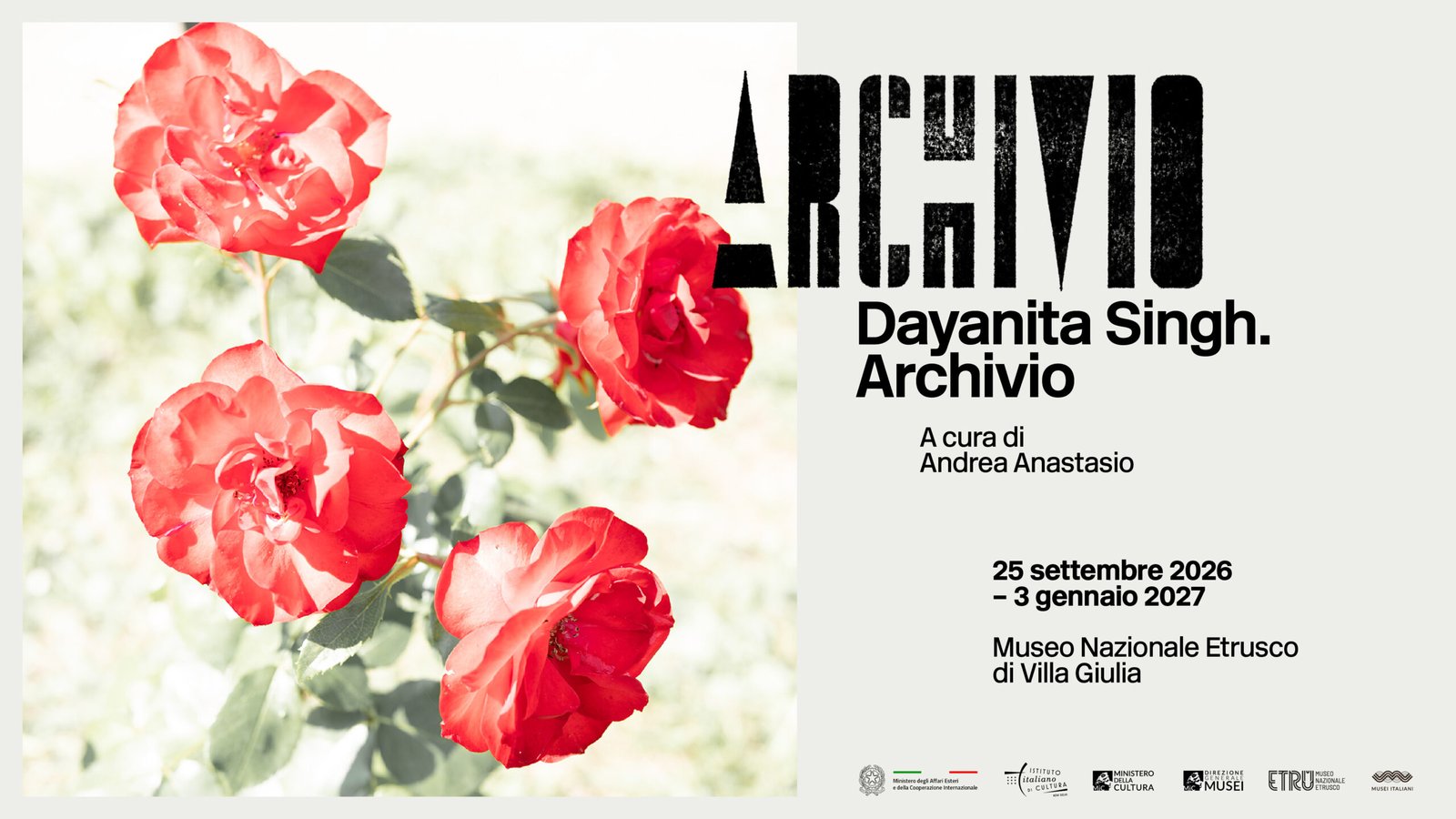
Dayanita Singh. Archivio is open from September 25, 2026 to January 3, 2027 at the National Etruscan Museum of Villa Giulia, Piazzale di Villa Giulia 9, 00196 Rome, Tuesday to Sunday from 8:30 to 19:30 (last entry at 18:30, rooms close at 19:00. Closed Monday, December 25 and January 1). You get there by trams 2, 3 and 19 or by metro A, Flaminio stop, from which the museum indicates a 14-minute walk. The exhibition is included in the museum ticket: full price €13, reduced €2, free for subscribers and those entitled, free admission on the first Sunday of the month and on November 4. Tickets are bought at the Villa Giulia ticket office or online through the advance-sales network indicated on the museum's official website.
Over 350 photographs, 16 wooden structures each holding 20 images, 25 years of travels in Italy and 10 of work inside Italian archives: the Indian photographer Dayanita Singh brings to Rome, in the villa of Pope Julius III, the second stage of a traveling project curated by Andrea Anastasio with the support of the Italian Cultural Institute in New Delhi. Rarely has a temporary exhibition had such a close relationship with the place that hosts it: a museum born in 1889 to order, conserve and show, inside which an artist who has made the archive her working material reshuffles the cards.
Dayanita Singh at Villa Giulia: the essential information
The exhibition lasts 101 days, from Friday, September 25, 2026 to Sunday, January 3, 2027, and follows the regular hours of the Museo Nazionale Etrusco. There is no separate ticket: you enter the museum and the exhibition is part of the route.
Dates and opening days
The museum is open Tuesday to Sunday. It is closed on Monday, and also on December 25 and January 1, two dates that both fall on a Friday during the exhibition period. Those planning to go during the Christmas holidays must take this into account: between Christmas and New Year's there are useful days, but not all of them. The last day, Sunday, January 3, 2027, coincides with the first Sunday of the month, that is, with a free-admission day.
Hours
The hours are 8:30 to 19:30, with last entry at 18:30 and the rooms closing at 19:00. In practice, whoever arrives at 18:30 has half an hour of actual time in the rooms: too little for an exhibition of 350 photographs and for the museum that contains it. The museum warns that some rooms may have temporary closures or limited hours during installations. In September 2026 it reported works in Rooms 11, 12, 13 and 14 with changes to the visit route.
How much it costs
The full-price ticket costs €13, the reduced €2. It is free for subscribers and for those entitled to the concessions provided by the Ministry of Culture. The museum participates in the Roma Pass and in the agreement with the FAI. There is also the annual ETRU Card, in four versions: Individual at €48, Young (ages 18 to 25) at €10, Golden (over 65) at €36, Family (two adults plus minors) at €80. For those who live in Rome and plan to come back several times, between the exhibition, the François Tomb and the museum's activities, it is the most sensible choice.
Archivio: how Dayanita Singh's exhibition is made
The exhibition brings together over 350 photographs organized mainly around 16 wooden structures, each able to hold 20 images. The project interweaves two paths: the work Singh has devoted over the last decade to Italian archives and her personal archive of images taken in Italy over 25 years.
Two archives in conversation
The first strand looks at archives as institutions: reading rooms, shelves, binders, card catalogs, and the people who keep them. The second is a visual diary a quarter of a century long: architecture, interiors, works of art, friends, archivists, flowers, places. Put together, the two strands make up what the museum calls the artist's visual conversation with Italy. The point is not to document Italian archives, which a good photographic catalog would do better, but to show how an archive is built, ordered and can be called into question.
The wooden structures
The 16 structures are not simple supports. In Singh's practice they are devices through which images are placed side by side, recomposed, moved, and each new arrangement changes the meaning of the whole. Those who know her work recognize them right away: they derive from the mobile "museums" that the artist has been building for years, wooden architectures that open and close, inside which the photographs are resequenced at each exhibition. It's an idea of exhibition that overturns the habit of the white wall with the framed print: here you walk around, you bend down, you compare images far apart from each other.
The archive as a living organism
The museum describes the heart of the exhibition as a reflection on the very idea of the archive: not a neutral deposit of the past, but a living and changing form, activated by the sequence of images, their circulation and the encounter with the viewer. The press release for the Venice stage used the same image, speaking of the archive as a living organism continually reordered by the artist's editorial work. It's an idea that resonates in a particular way at Villa Giulia, because the museum itself is an archive of objects: more than 6,000 finds spread over 50 rooms.
A selection conceived for Rome
Each stage of the project is reinterpreted with a site-specific selection, built with the institution hosting the exhibition. The Roman stage, the museum says, does not re-propose the same exhibition seen elsewhere but transforms itself by entering into relation with the context. Those who saw Archivio in Venice will therefore find a different route. Those seeing it for the first time in Rome see it in a version that dialogues with an institution born to conserve, study and make accessible a heritage.
The catalog
On the occasion of the Roman opening, the catalog ARCHIVIO published by Electa was presented. For an artist who considers the book her main format, the catalog weighs more than usual: it's worth leafing through it in the museum bookshop, which keeps the same hours as the rooms.
The journey of Archivio: from Venice to Rome, then Turin and India
Archivio arrived in Rome after being presented at the Archivio di Stato in Venice, from April 17 to July 31, 2026. After Villa Giulia the exhibition will continue to the MAO, Museo d'Arte Orientale in Turin, and to the Italian Cultural Institute in New Delhi, and then be shown in the public museums of Mumbai, Kolkata, Chandigarh and Ahmedabad.
The Venice stage
In Venice the exhibition marked an absolute first: for the first time in its history the Archivio di Stato opened to the public as an exhibition venue. Admission was free, the hours Monday to Friday from 12:00 to 18:00, and the installation had 15 wooden structures scattered through the spaces plus a sixteenth placed at the main entrance, donated by the artist to the institution as thanks. The opening coincided with the 19th edition of the literary festival Incroci di civiltà, with a public program of encounters organized by the artist with Chiara Spangaro together with the two Venetian universities, and with a conversation between Singh and the writer Geoff Dyer.
The Rome photographs in the first version
The Venice press release gave the breakdown of the images: 60 devoted to the Archivio di Stato and other places in Venice, 60 to Rome, 40 each to Florence and Turin, 24 each to Bologna, Naples and Palermo, 60 taken in Indian archives and 20 devoted to patrons and friends who made the work in Italy possible. Rome, in short, already weighed as much as Venice. In the Villa Giulia version the selection changes, but the artist's relationship with the city remains one of the threads of the project.
The Indian horizon
The exhibition's path will close in December 2027, on the occasion of the Kochi-Muziris Biennale, concluding the Year of Italian Culture in India. It's a detail that says a lot about the project: born from an Indian artist's gaze on Italian archives, it will be shown again in India to an audience that has never seen those archives.
Who is Dayanita Singh
Dayanita Singh was born in New Delhi on March 18, 1961, lives and works in her hometown and is considered one of the most original figures of contemporary international photography. In 2022 she received the Hasselblad Award, one of the most prestigious recognitions in the field of photography.
Her training
The eldest of four sisters, Singh studied Visual Communication at the National Institute of Design in Ahmedabad and then photojournalism and documentary photography at the International Center of Photography in New York. Her mother, Nony Singh, was a tireless amateur photographer and the keeper of the family albums: the figure of the archivist, in her life, came before professional photography. Il Giornale dell'Arte also recalls the encounter with the American photographer Mary Ellen Mark, among the decisive stimuli of the early years.
The photojournalism years
In the 1980s Singh was among the first women photojournalists in her country, in a trade considered male, and she worked on commission for over a decade before abandoning photojournalism at the end of the 1990s. From that refusal came her second book, Myself Mona Ahmed (2001), built together with Mona Ahmed, a person marginalized even among the marginalized of Delhi: a hybrid of photobook, biography, autobiography and fiction, born precisely from discomfort with the Western gaze that reduces India to exoticism.
The book as an art form
The book is Singh's main format. About 20 titles, mostly published with the German publisher Gerhard Steidl in Göttingen: Privacy (2004), Chairs (2005), Go Away Closer (2006), Sent a Letter (2008), Blue Book (2009), Dream Villa (2010), File Room (2013), Museum of Chance (2015), Museum Bhavan (2017), Zakir Hussain Maquette (2019), Sea of Files (2022). Steidl, in a 2013 television interview, called her the genius of book packaging. Many of these volumes are "object books", that is, books, works, exhibitions and catalogs all at once.
The mobile museums
From the books came the "museums": large wooden architectural structures that can be reconfigured, opened and closed, and that hold from 70 to 140 photographs each. Singh reorders them at each exhibition, so that only part of the images is seen and the sequence changes. The artist's website lists many of them: File Museum, Little Ladies Museum, Museum of Men, Museum of Furnitures, Museum of Machines, Suitcase Museum, Museum of Embraces, Museum of Shedding. The structures of Archivio come from here.
Exhibitions and recognitions
Museum Bhavan has been shown at the Hayward Gallery in London (2013), at the Museum für Moderne Kunst in Frankfurt and the Art Institute in Chicago (2014), at the Kiran Nadar Museum of Art in New Delhi (2016) and at the Tokyo Photographic Art Museum (2017). In 2013 her works were presented in the German pavilion at the Venice Biennale. Already in 2011 her photographs of archive rooms had been shown in the Biennale's international exhibition. In 2022 the exhibition Dancing with my Camera opened at the Gropius Bau in Berlin, then moved on to Villa Stuck in Munich, the Mudam in Luxembourg and Serralves in Porto. Among her prizes: Prince Claus Award (2008), Robert Gardner Fellowship of Harvard University (2008), Chevalier of the Ordre des Arts et des Lettres (2014), PhotoBook of the Year at the Paris Photo-Aperture Awards for Museum Bhavan (2017), Infinity Award of the International Center of Photography (2018), Hasselblad Award (2022).
In the world's museums
Her works are in the permanent collections of the Museum of Modern Art and the Metropolitan Museum in New York, Tate Modern in London, the Centre Pompidou in Paris, the Art Institute of Chicago, the Moderna Museet in Stockholm, the National Gallery of Modern Art in New Delhi. In Italy the Fondazione MAST in Bologna holds her Museum of Machines. The artist's official website, dayanitasingh.in, gathers books, museums and boxes.
Three Dayanita Singh books to understand Archivio
Those who want to arrive prepared for the exhibition should know at least three titles, because Archivio is the latest chapter of a line of thought that Singh has been pursuing for 20 years on the form of the book and the museum.
Sent a Letter (2008)
Seven small accordion-bound volumes, 126 pages in all, born as photographic letters addressed to travel companions. In 2011 Phaidon included it among the 200 key works of contemporary art of the last quarter century. According to Il Giornale dell'Arte, it is the book that convinced the artist that a book can become an exhibition.
File Room (2013)
The book born from the photographs of archive rooms: papers tied with string, stacked binders, offices that hold the administrative memory of a country. It is the direct precedent of the "institutional" part of Archivio, and already shows the basic choice: no hierarchy between the precious document and the dusty case file.
Museum Bhavan (2017)
A cloth box with nine accordion booklets, each a "museum", which opened in a row make up a gallery of blacks and whites about 2.30 meters long. It's a portable exhibition, and in 2017 it won the photobook of the year prize at Paris Photo. Today it is a sought-after and expensive collector's object.
A curiosity about Dayanita Singh at Villa Giulia, Archivio, September 25 to January 3, 2027
Dayanita Singh's career begins with a shove. As a student, she was trying to photograph the tabla player Zakir Hussain in concert when an attendant moved her away roughly. Hussain saw the scene and invited her to photograph him during rehearsals. From there came a partnership of six winters: Singh followed several of the musician's tours and in 1986 published the images in her first book, titled simply Zakir Hussain. She herself has called him her first real guru, the one who taught her the most important skill of all: concentration.
The second curiosity concerns the instrument. Il Giornale dell'Arte relates that Singh began photographing with a Pentax ME Super mounted with a 50 millimeter lens, a gift from the German publisher Ernst Battenberg. The kit of an advanced amateur, very far from the equipment of the photojournalists of the time, which explains part of her grammar: no telephoto lenses, no safe distance, the photographer at the same height as the people and things.
The third is a return. That first book on Zakir Hussain was republished in 2019 with Steidl as Zakir Hussain Maquette, and in 2025 the National Centre for the Performing Arts in Mumbai devoted a solo exhibition to the artist titled Zakir Hussain: Learning to Learn. Dayanita Singh's first archive, in short, was a musician, and 40 years later she continues to recompose him. Keep that in mind in front of the wooden structures of Villa Giulia: the idea that a series of images is never closed, that it can be reopened and reassembled, comes from that first experience of a portrait extended over time. It's the most useful key to enter the exhibition: don't look for the single masterpiece, look for the sequences.
The Museo Nazionale Etrusco: what surrounds the exhibition
The Museo Nazionale Etrusco di Villa Giulia holds over 6,000 objects in 50 rooms, on an exhibition area of more than 3,000 square meters, and is considered the most important Etruscan museum in the world. Since 2016 it has been one of the autonomous institutes of the Ministry of Culture. Since May 16, 2024 it has been directed by Luana Toniolo.
The Sarcophagus of the Spouses
It's the piece almost everyone comes to see: the terracotta funerary monument with the married couple at almost life size, reclining as at a banquet. The Spouses are back in their display case, but the restoration continues and the museum lets you observe it in the laboratory on Tuesdays and Thursdays from 10:00 to 13:00. If you can choose the day, choose one of these two.
The Apollo of Veii
A painted terracotta sculpture of the late 6th century BC, from Veii. It's the reason many art historians consider Villa Giulia a must for understanding archaic sculpture in Italy.
The Pyrgi gold sheets
Three gold sheets with a text in Etruscan and Phoenician, fundamental to the study of the Etruscan language. Next to them, from the sanctuary of Pyrgi, the reconstructed high-relief pediment with the episode of Tydeus biting Melanippus's skull, a scene from the Theban saga of surprising ferocity.
The François Tomb
Since July 1, 2026 the François Tomb has been visible to the public together with the exhibition Il Ritorno degli Eroi. Discovered on May 1, 1857 by Alessandro François on the lands of Prince Alessandro Torlonia, in the Ponte Rotto necropolis at Vulci, it was made between 340 and 320 BC and consists of 37 painted panels and two cippi. The visit is included in the ticket, but entries are limited and booking is mandatory.
The Alatri temple and the Castellani Gold
In the garden is the full-size reproduction of an Etruscan-Italic temple of the 3rd-2nd century BC, built between 1889 and 1890 for the museum's inauguration on the basis of an excavation conducted by Felice Barnabei at Alatri. Inside today is La Macchina del Tempio, a multimedia route. The Castellani Gold room holds the goldsmithing collection of the family of Roman goldsmiths. Both remain closed on free-admission days, and the Gold room had temporary closures in summer 2026: it's best to check the museum's notices before leaving.
Other exhibitions under way
In the same period the museum hosts, until November 29, L'Indovino by Mouna Rebeiz, curated by Roberta Semeraro, and Diego Cibelli's permanent installation Il cielo si ricorda degli Etruschi. A single visit, then, lets you see three different ways in which contemporary art enters an archaeological museum.
One thing nobody tells you about Dayanita Singh at Villa Giulia, Archivio, September 25 to January 3, 2027
The last day of the exhibition, Sunday, January 3, 2027, is the first Sunday of the month: at Villa Giulia you get in free. It sounds like good news, and for the wallet it is. For the visit, much less so. The museum specifies that on free-admission days the Macchina del Tempio and the Castellani Gold room remain closed, and that the François Tomb cannot be visited on the first Sundays of the month, on April 25, June 2 and November 4. Add the crowd typical of free Sundays close to the holidays and the closing-day effect of an exhibition, which always draws latecomers, and the picture is clear.
The same goes for the other free days that fall during the exhibition: Sunday, October 4, Sunday, November 1, Wednesday, November 4 and Sunday, December 6, 2026. They are excellent occasions for those who want to see only Archivio and are in no hurry. Those who instead want to combine the exhibition with the François Tomb must choose a paid day.
There is a second detail that the portals' listings tend to omit. The reduced ticket costs €2, that is, almost nothing, and is due to several categories under Ministry of Culture rules (typically young people between 18 and 25). For the same age group the ETRU Card Young costs €10 and gives a year of unlimited entries: five reduced visits and you've broken even. Finally, a practical warning: the museum has reported works in Rooms 11-14 with changes to the route. It doesn't mean the exhibition is affected, but whoever wants to see a specific find does well to check the museum's news the day before. The verdict is clear: the free Sunday is for those who live in Rome and come back. Those who come from outside should pay the €13 and go on a weekday.
Villa Giulia: the villa of Pope Julius III
Villa Giulia was built for Pope Julius III, Giovanni Maria Ciocchi del Monte, between 1550 and 1555, as a suburban residence in an area called the Vigna Vecchia, outside the walls, along Via Flaminia. It is one of the most successful examples of a Renaissance and Mannerist villa in Rome.
The architects
The design of the building, dating to 1551-1553, belongs to Jacopo Barozzi da Vignola, whom the pope called "architect of His Holiness". The nymphaeum and the garden structures are due to Bartolomeo Ammannati. Michelangelo supplied a design for the casino, and Giorgio Vasari claimed to have been the first to draw the entire invention of the vineyard. The pictorial decoration was entrusted to Prospero Fontana, with a group of artists including Pietro Venale da Imola and the young Taddeo Zuccari.
The facade and the hemicycle
The front facing the city, by Vignola, is a severe two-story facade of equal height, with the triple triumphal arch motif at the center and symmetrical wings of only two windows each side. At the back, the building changes character: the facade bends into a semicircle and the hemicycle is painted with light grotesques inspired by the Domus Aurea. The contrast between the flat, straight facade and the concave back is the villa's main architectural lesson, and according to architectural historians Vignola's facade set the standard as far as the Georgian villas of the 18th century.
The nymphaeum
The heart of the villa is the nymphaeum, reached from the loggia of the central garden and going down two marble flights of stairs: a composition on three levels of loggias with statues and balustrades, built around a central fountain with river gods and caryatids. It was the place for dining in the cool on summer days. The pope's guests arrived by boat from the Vatican, going up the Tiber to a reserved landing.
From villa to museum
After Julius III's death the villa went through a long decline. In 1889, with the Royal Decree of February 7 and at the urging of the archaeologist and politician Felice Barnabei, it became home to the National Museum devoted to extra-urban antiquities, that is, to pre-Roman peoples such as the Etruscans, Faliscans, Umbrians, Latins and Sabines. In the 1930s two outer wings were added for collections and services. Later the museum also annexed the nearby Villa Poniatowski.
The advice I give you for visiting Dayanita Singh at Villa Giulia, Archivio, September 25 to January 3, 2027
Go on a Tuesday or Thursday morning, entering at 8:30 or shortly after. There are three reasons. The first: the restoration of the Sarcophagus of the Spouses can be observed in the laboratory on precisely those two days, from 10:00 to 13:00, and combining the two things gives the visit meaning. The second: an exhibition built on structures to walk around, with images of modest size, is hard to look at in the middle of a crowd. On a weekday morning the rooms are quiet. The third: the morning light in the garden and the nymphaeum is the best of the day, and after an hour in front of 350 black-and-white photographs the nymphaeum is the right pause.
On the method of visiting, the advice is precise. Don't read the exhibition as a sequence to walk from left to right. There are 16 structures, each with 20 images: stop in front of one, look at it in full, then look in the others for the images that answer it. An archive staircase in Venice, a Roman interior, a vase of flowers on a friend's table, a pile of binders tied up in India: Singh works through visual rhymes, and the exhibition can only be understood if you accept going back. Allow at least an hour for Archivio and another hour and a half for the museum.
If you want to add the François Tomb, book ahead: entries are limited and booking is mandatory, even though the visit is included in the ticket. The museum indicates the Musei Italiani app and the website of the services concessionaire as booking channels. Those bringing a group or a class must go through the museum services call center, active Monday to Saturday from 9:00 to 14:00. One last thing: the museum's restaurant is under renovation, so don't count on a lunch inside Villa Giulia. Eat before or after, outside.
Hours, tickets and free days
Dayanita Singh. Archivio follows the hours and rates of the Museo Nazionale Etrusco: Tuesday to Sunday 8:30 to 19:30, full price €13, reduced €2, exhibition included in the ticket.
The free-admission days during the exhibition
Admission is free on the first Sunday of the month, on April 25, June 2 and November 4. During the exhibition period the dates are: Sunday, October 4, 2026, Sunday, November 1, 2026, Wednesday, November 4, 2026, Sunday, December 6, 2026 and Sunday, January 3, 2027, the last day of opening. On free days the François Tomb, the Macchina del Tempio and the Castellani Gold room cannot be visited.
Where to buy the ticket
The ticket is bought at the museum ticket office, which is in the bookshop, or online through the authorized advance-sales network indicated on the "Plan your visit" page of the museum's website. On regular days, outside the holiday periods, buying on site is no problem. For the François Tomb, however, advance booking is essential.
Roma Pass and agreements
Villa Giulia participates in the Roma Pass and has an agreement with the FAI. For the updated conditions of the city card it's best to consult its official website. The ETRU Card, sold online and at the museum ticket office, lasts one year. Subscriptions already taken out remain valid until they expire.
Audio guide and visit tools
In the bookshop the museum's audio guide is available in Italian, English and French, at €7 (€5 for subscribers). There is also a short guide in Italian and English, a downloadable map and, for deaf people, the free VideoguidaLIS. For Singh's exhibition the museum's audio guide isn't needed: the Electa catalog and the captions are the right tools.
Another well-known fact, yet rarely mentioned
That the Trevi Fountain is fed by the Acqua Vergine almost everyone knows. That the same water flows in the nymphaeum of Villa Giulia few know, and even fewer know that today's Romans also owe something to that water. As in all Renaissance villas in Rome, and all the more in a villa that arose in the middle of vineyards, water was one of the protagonists of the project. Julius III had an underground branch of the ancient Aqua Virgo built, dedicated exclusively to the villa, to feed the nymphaeum's fountains and the gardens.
When the villa passed to other owners, that water also found a public use. At the beginning of Via di Villa Giulia, on Via Flaminia, two drinking-trough fountains were placed: one by Cardinal Borromeo in 1672, the other by Filippo Colonna, Prince of Paliano, in 1701. The villa, which was born as a place of delight reserved for the pope and his guests, thus ended up watering horses and passersby on the busiest consular road north of Rome.
The story of the water continues in the less glorious centuries too. When, from 1769, the villa was restored at the wish of Pope Clement XIV and assigned to military use, the Veterinary School was also based there: for convenience a stepped access was made to the lower fountain of the nymphaeum, used to water horses. Whoever goes down the marble stairs to the nymphaeum today walks in a place that was, two centuries apart, a papal dining room and a barracks watering trough. It is perhaps the best history lesson Villa Giulia offers for free to those who know how to look, and it is in perfect harmony with Archivio: a place too is an archive of uses, layered one on top of the other.
The right photo to take at Dayanita Singh at Villa Giulia, Archivio, September 25 to January 3, 2027
The photograph to take home is not that of Singh's photographs: the images in the exhibition are protected works, and reproducing them with a phone makes little sense when a catalog exists. Before shooting in the rooms, ask the staff anyway if it's allowed. The right photo, at Villa Giulia, is another one, and it respects the spirit of the exhibition.
Step out of Vignola's building and stand in the center of Ammannati's loggia, with your back to the hemicycle, looking toward the nymphaeum. From there you see the sequence of the villa's three levels: the courtyard, the balustrade, the descent toward the fountain. It's a composition built to be looked at in depth, one plane after another, exactly as Singh builds her structures: frames within frames, images that open onto other images. Shoot vertically to keep together the painted vault of the loggia and the back of the nymphaeum.
The second framing I recommend is a detail: the grotesques of the hemicycle, painted on the model of the Domus Aurea. Get close and look for a panel with a pergola and birds. With the raking light of morning the colors hold up well even with a phone. The third is for those who love black and white: the Alatri temple in the garden, from three-quarters, with the long shadows of the autumn afternoon. Three shots, three ways of looking at a place that is itself an archive of forms. The suggestion: leave photographs to the photographs, and use the exhibition to learn how to frame the villa.
How to get to Villa Giulia
The Museo Nazionale Etrusco is at Piazzale di Villa Giulia 9, along Viale delle Belle Arti, at the foot of the Parioli and a short distance from Via Flaminia. The museum indicates trams 2, 3 and 19 and metro A, Flaminio stop.
By metro
The nearest stop on line A is Flaminio, in Piazzale Flaminio, next to Piazza del Popolo. The museum calculates a 14-minute walk to the entrance. The walk goes up through the Flaminio area toward Valle Giulia. If you prefer to avoid it, at Flaminio you can take tram 2.
By tram
Tram 2 leaves from Piazzale Flaminio and goes up Via Flaminia northward: from Via Flaminia you reach the museum with a short uphill walk toward Valle Giulia. Trams 3 and 19 run along Viale delle Belle Arti, that is, they pass right by the side of the museum. For those coming from San Lorenzo, from the Policlinico or from the neighborhoods to the east, it is the most convenient solution, with no changes to the metro.
By car and taxi
The museum does not report its own parking. Viale delle Belle Arti and the streets around the Valle Giulia museums have street parking, often paid and much contested on weekends, when the area also draws the public of Villa Borghese and of the Galleria d'Arte Moderna. The advice, for once without nuance, is public transport. By taxi just say the Villa Giulia Museum: every Roman taxi driver knows it.
On foot from Villa Borghese
Villa Giulia is a few steps from Villa Borghese: coming down from the park toward Valle Giulia you reach the museum on foot, and the walk through the greenery is the most pleasant way to arrive on an autumn morning. It's also a good solution for those combining the exhibition with the Galleria Borghese.
Around Villa Giulia: Valle Giulia, Villa Borghese and the Flaminio
Villa Giulia is in the Pinciano neighborhood, in the area Romans call Valle Giulia, between Villa Borghese and the Parioli. It is one of the areas with the highest concentration of museums in the city, and a morning at Singh's exhibition combines easily with other visits.
Villa Poniatowski
A few steps away, facing Via Flaminia, Villa Poniatowski is the museum's second venue. Giuseppe Valadier turned it into a villa in the early 19th century for Stanislaw Poniatowski, nephew of the last king of Poland. The restorations of 1997 brought to light the 16th-century layout with fountains and decorative cycles. It is closed for PNRR works and reopening is expected in autumn 2026.
Villa Borghese and its museums
Going up toward the park you meet the Galleria Borghese, the Museo Carlo Bilotti in the Aranciera, the Museo Pietro Canonica and the Bioparco. For those coming with children, the combination of a morning at Villa Giulia and an afternoon at the Bioparco is a classic and it works. For photography lovers, the Museo Bilotti has under way Magic Lanterns, photographs from the Valerio De Paolis collection: two photography exhibitions in a day, a quarter of an hour's walk from each other.
The contemporary Flaminio
To the north, along Via Flaminia and tram 2, you reach the MAXXI and the Auditorium Parco della Musica: the Rome of the 21st century, 10 minutes by tram from a 16th-century villa. Those who have seen Archivio and want to continue with contemporary art find here the natural next stop.
Piazza del Popolo
Going south, from the Flaminio stop you pass under Porta del Popolo and enter Piazza del Popolo. A stop in Santa Maria del Popolo is the best way to end the day.
Some important events that happened here in history
1550-1555: Pope Julius III has the villa built, entrusting the design to Vignola and Ammannati with the contribution of Michelangelo and Vasari. Contacts between the pope and the artists often went, Vasari relates, through Monsignor Pietro Giovanni Aliotti, bishop of Forlì and chamberlain of Julius III.
1555: Julius III having died, the new pope Paul IV Carafa, who rose to the throne after Marcellus II's mere 20 days of pontificate, confiscates the properties gathered by his predecessor. The villa is divided: the main building and part of the gardens pass to the Apostolic Camera, and use of the villa is reserved to the Borromeo, nephews of the next pope, Pius IV.
1769: Pope Clement XIV has the building restored and assigns it to the army, as barracks, warehouse and even lazaretto. The Veterinary School is also based there.
1870: with the capture of Rome the villa becomes property of the Kingdom of Italy and begins to collect the materials of the archaeological explorations in the territory of Falerii (1888-1889).
February 7, 1889: a Royal Decree, promoted by Felice Barnabei, establishes the museum. Between 1889 and 1890 the reproduction of the Alatri temple is built in the garden for the inauguration. In 1891 the library begins to form, today more than 20,000 volumes, enriched among other things by Massimo Pallottino's library, recognized as being of significant historical interest in 1995.
1930s: the two outer wings are added for the collections and services.
From the second postwar period: the nymphaeum becomes the traditional venue for the final evening of the Premio Strega, the vote of the Amici della domenica held on the first Thursday of July. From 1965 the ceremony is broadcast several times by Rai from the museum's garden.
March 31, 2013: a theft hits part of the Castellani collection.
January 23, 2016: a ministerial decree places the museum among the 32 institutes of significant national interest endowed with autonomy.
July 1, 2026: the François Tomb, which entered the State's heritage after over a century of negotiations, becomes visible to the public at Villa Giulia.
September 25, 2026: Dayanita Singh's Archivio opens, an Indian artist's gaze on Italian archives inside a museum born to tell the origins of Italy.
Dayanita Singh at Villa Giulia with children
Archivio is not an exhibition designed for children, but it is not hostile either: the wooden structures intrigue, and the game of looking for images that resemble each other from one structure to another works well with kids from eight up.
The museum's tools for families
The museum offers a game for children to download, print and fold into eight parts, or to ask for at the welcome desk, and has an ETRUKids section with materials and activities for schools and families. The ETRU Card Family, at €80 for two adults and minor children, is a good deal for Roman families who expect to come back.
How to pace the visit
With children start from the museum, not from the exhibition: the Sarcophagus of the Spouses, the everyday objects, the Alatri temple in the garden. Then a stop in the nymphaeum. Only at the end half an hour in Archivio, proposing a hunt: find three photographs of staircases, three of flowers, three of rooms full of papers. It's the most honest way to make a kid understand what it means to order an archive.
Accessibility at Villa Giulia
The Museo Nazionale Etrusco states that it has eliminated most architectural barriers. Access to some rooms is guaranteed to people with motor disabilities by alternative routes, elevators and stairlifts, the latter not yet approved for powered wheelchairs. A wheelchair is available at the entrance on request.
Visual and hearing disabilities
For blind and low-vision visitors the museum offers, on request, tactile reproductions and tactile guided tours with specialized staff. For deaf people there is the VideoguidaLIS of Villa Giulia and Villa Poniatowski, free on the Apple and Android stores or available online.
Information and bookings
For accessibility requests the museum indicates the number 06 3226571 and a dedicated address of the accessibility service, listed in the section of the official website. The garden and the nymphaeum have stairs: those with mobility difficulties should ask at the entrance for the alternative routes before starting.
Who has passed through Dayanita Singh at Villa Giulia, Archivio, September 25 to January 3, 2027
Villa Giulia has had illustrious guests since the building site. Working on the site were Jacopo Barozzi da Vignola, Bartolomeo Ammannati, Giorgio Vasari and, with a design for the casino, Michelangelo Buonarroti: four names that alone sum up mid-16th-century Roman architecture. With them the painters Prospero Fontana, Pietro Venale da Imola and the young Taddeo Zuccari, whom the museum's sources remember as still young at the time of the building site.
In the 19th century Felice Barnabei passed through, the archaeologist and politician who wanted the museum and excavated at Alatri the temple later rebuilt in the garden. In the 20th century the villa was the workplace of Massimo Pallottino, one of the fathers of Etruscology, whose library is still kept in the museum, and of the inspectors Raniero Mengarelli and Maria Santangelo, also present with their own book collections.
Then there is the long season of the Premio Strega, founded in Rome in 1947 by Maria Bellonci and Guido Alberti. In the museum's garden, on live television, the winners announced have included Paolo Volponi with La macchina mondiale (1965), Paolo Cognetti with Le otto montagne (2017), Helena Janeczek with La ragazza con la Leica (2018), Antonio Scurati with M. Il figlio del secolo (2019), Sandro Veronesi with Il colibrì (2020), Emanuele Trevi with Due vite (2021), Mario Desiati with Spatriati (2022), Ada D'Adamo with Come d'aria (2023), Donatella Di Pietrantonio with L'età fragile (2024) and Andrea Bajani with L'anniversario (2025). For decades, on the first Thursday of July, Italian literature has met here.
Today, with Archivio, one of the few living photographers to have received the Hasselblad Award arrives at Villa Giulia, in a list that includes Henri Cartier-Bresson, Richard Avedon, Sebastião Salgado and Nan Goldin. To me she seems the most coherent visitor the villa could have received: a person who spends her life looking at how institutions preserve memory, inside an institution that has been doing exactly that for over a century.
How to organize a half day at Villa Giulia
To see Archivio and the museum properly you need three hours. Here is a concrete plan, designed for an autumn weekday, starting from the historic center.
Morning
Take Metro A to Flaminio, then tram 2 or walk to the museum, arriving around 9:00. First an hour in Archivio, when the rooms are still empty. At 10:00, if it's a Tuesday or Thursday, the restoration lab of the Sarcophagus of the Spouses. Then the main rooms of the museum: the Apollo of Veii, the Pyrgi tablets, and the François Tomb if you've booked.
Midday
A break in the nymphaeum and the garden, then out. Lunch has to be outside, because the museum restaurant is closed for renovation.
Afternoon
Two options. The first: walk back up toward Villa Borghese and finish with the Galleria Borghese or the Museo Bilotti. The second: tram 2 north to MAXXI, to stay with contemporary art. Those who prefer Baroque Rome can instead head down toward Piazza del Popolo.
For groups
The museum runs guided visits for adults, schools and groups in Italian, English, French, Spanish and German, bookable through the museum services call center. For a private experience built around the exhibition, with the villa, the museum and the surroundings, Tour Leader Pro organizes tailor-made itineraries.
Where to eat near Villa Giulia
The museum restaurant, a glass structure in the greenery, is closed pending renovation. To eat you have to go out, and there are three useful areas.
Flaminio
Along Via Flaminia and in the streets between Piazzale Flaminio and the Olympic Village there are neighborhood trattorias, pizza by the slice places and bars with hot food counters, used by people who work in the area. Prices of a residential neighborhood, not of the historic center.
Parioli
Going up toward Parioli the offer becomes more refined and more expensive: restaurants, historic pastry shops, bars with outdoor seating. This is the choice for a sit-down lunch after the exhibition.
Piazza del Popolo and the Tridente
Heading down toward the center, between Piazza del Popolo, Via di Ripetta and Via del Babuino, you find the widest choice, at central prices. It makes sense if your day continues that way.
A practical tip
On weekdays the places in Flaminio fill up between 13:00 and 14:00 with office workers from the area. Eat at 12:30 or after 14:00: with a museum that opens at 8:30, it's a natural schedule.
Rome between October and January: the exhibition period
The exhibition covers the Roman autumn and the year-end holidays, two very different seasons for anyone visiting the city.
October and November
This is the best period. The days are still long enough to enjoy the garden and the nymphaeum in good light, and the summer crowds are gone. The free days of October 4, November 1 and November 4 attract Romans: the rest of the month is quiet.
December and the holidays
In December the light fades early and the garden loses some of its appeal after 16:00. The museum is closed on December 25 and January 1. The days between Christmas and New Year's are crowded in all the city's museums, and the last weeks of an exhibition always attract those who put it off.
The last weekend
Saturday, January 2 and Sunday, January 3, 2027 close the exhibition, and Sunday is free. If you really want to see Archivio in peace, don't wait for that weekend.
Why Archivio is worth seeing
Photography exhibitions in Rome are not lacking, and most follow the same pattern: framed prints, walls, captions, a linear route. Archivio is different by design. It asks visitors to move, compare, go back, and it rewards those who are patient. It is also one of the rare chances to see in Rome the work of an artist awarded the Hasselblad, presented in a version designed for the place and not imported as it is.
Then there is a practical argument that carries weight: the exhibition is included in the museum ticket. With €13, or 2 for those entitled to the reduced price, you see Archivio, the Sarcophagus of the Spouses, the Apollo of Veii and, if you book, the François Tomb. In Rome there is no better ratio of price to content than this, this autumn. The limit, if you like, is the scale of the images: photographs of modest size, often in black and white, that don't hold up to a distracted visit. Those looking for a spectacular effect will be disappointed. Those who like to look carefully won't.
Frequently asked questions about Dayanita Singh at Villa Giulia
Until when is the Dayanita Singh exhibition at Villa Giulia open?
Dayanita Singh. Archivio remains open at the Villa Giulia National Etruscan Museum until Sunday, January 3, 2027. The exhibition opened on September 25, 2026 and follows the museum's hours: Tuesday to Sunday from 8:30 to 19:30, with last entry at 18:30. The museum is closed on Monday, December 25 and January 1.
How much is the ticket for the Archivio exhibition?
The Dayanita Singh exhibition Archivio is included in the ticket for the Villa Giulia National Etruscan Museum: full price €13, reduced €2, free for subscribers and those entitled. There is no separate ticket. The annual ETRU Card costs €48 in the Individual version and €10 in the Young version for ages 18 to 25.
Are there days when the exhibition is free?
Villa Giulia is free on the first Sunday of the month and on November 4, so the Dayanita Singh exhibition is too. During the exhibition the dates are October 4, November 1, November 4, December 6, 2026 and January 3, 2027. On those days the François Tomb, the Temple Machine and the Castellani Gold room cannot be visited.
How do you get to the Villa Giulia Etruscan Museum by public transport?
The Villa Giulia National Etruscan Museum, at Piazzale di Villa Giulia 9, is served by trams 2, 3 and 19 and by Metro A, Flaminio stop, from which the museum indicates 14 minutes on foot. Trams 3 and 19 run along Viale delle Belle Arti, and tram 2 starts from Piazzale Flaminio along Via Flaminia.
How many photographs are in the Dayanita Singh exhibition?
Dayanita Singh's Archivio at Villa Giulia brings together over 350 photographs, organized mainly around 16 wooden structures that hold 20 each. The images come from the artist's work on Italian archives over the last decade and from her personal archive of photographs taken in Italy over 25 years.
Who is the curator of the Archivio exhibition?
Dayanita Singh's exhibition Archivio is curated by Andrea Anastasio, with the support of the Italian Cultural Institute in New Delhi. Anastasio also curated the first stop at the State Archives of Venice, from April 17 to July 31, 2026. The catalog is published by Electa.
How much time do you need to visit the exhibition and the museum?
For Dayanita Singh's Archivio it's best to allow at least an hour, because the structures need to be looked at closely and compared with one another. The Villa Giulia National Etruscan Museum takes another hour and a half, more with the François Tomb. Three hours in total is a realistic measure.
Where will the exhibition go after Rome?
After Villa Giulia, Dayanita Singh's Archivio will continue to the MAO, the Museum of Oriental Art in Turin, and to the Italian Cultural Institute in New Delhi, and then be shown in the public museums of Mumbai, Kolkata, Chandigarh and Ahmedabad. The tour will end in December 2027 at the Kochi-Muziris Biennale.
My final advice
Go to Villa Giulia for Dayanita Singh and stay for the Etruscans, or do the opposite: either way you'll leave with the feeling of having seen the same theme twice, the memory that someone has decided to put in order. Choose a Tuesday or Thursday morning in October, book the François Tomb, keep your phone in your pocket in front of the wooden structures and take it out in the nymphaeum. It is the smartest exhibition of this Roman autumn, and also the cheapest.
Article written by the editorial team of Tour Leader Pro, contact them for Private/Corporate/V.I.P. Tours and Experiences.
Planning a trip to Rome? The English guides for visiting the city are on ItalyPlanner.com.