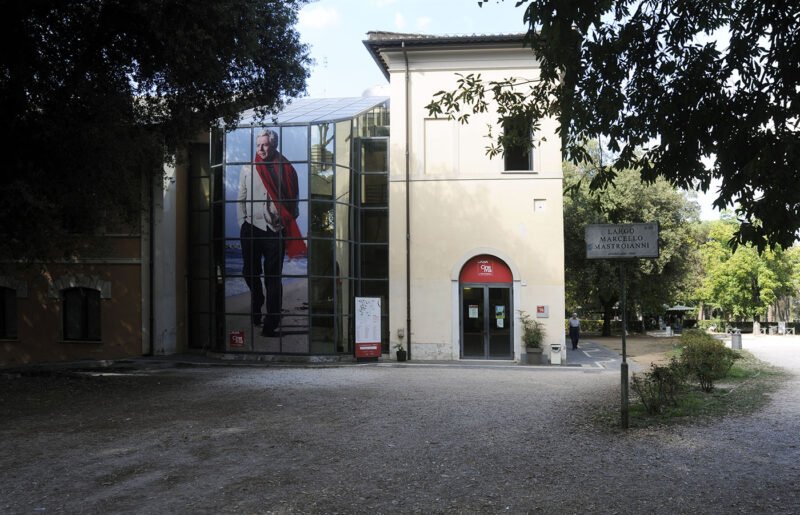
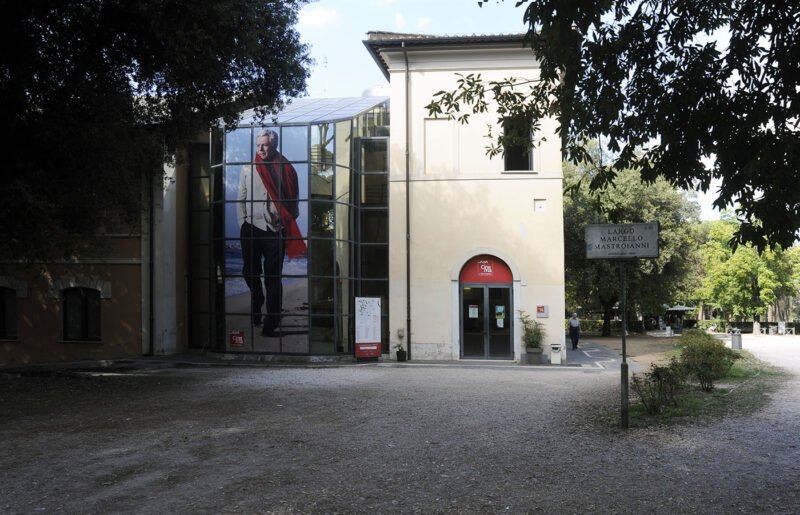
Chi (Ri)cerca Trova 2026 at the National Etruscan Museum of Villa Giulia, January 23 to December 18, 2026
In short. Chi (Ri)cerca Trova 2026 is the series of 10 lectures that the National Etruscan Museum of Villa Giulia (ETRU), piazzale di Villa Giulia 9, 00196 Rome, has spread from Friday, January 23 to Friday, December 18, 2026.
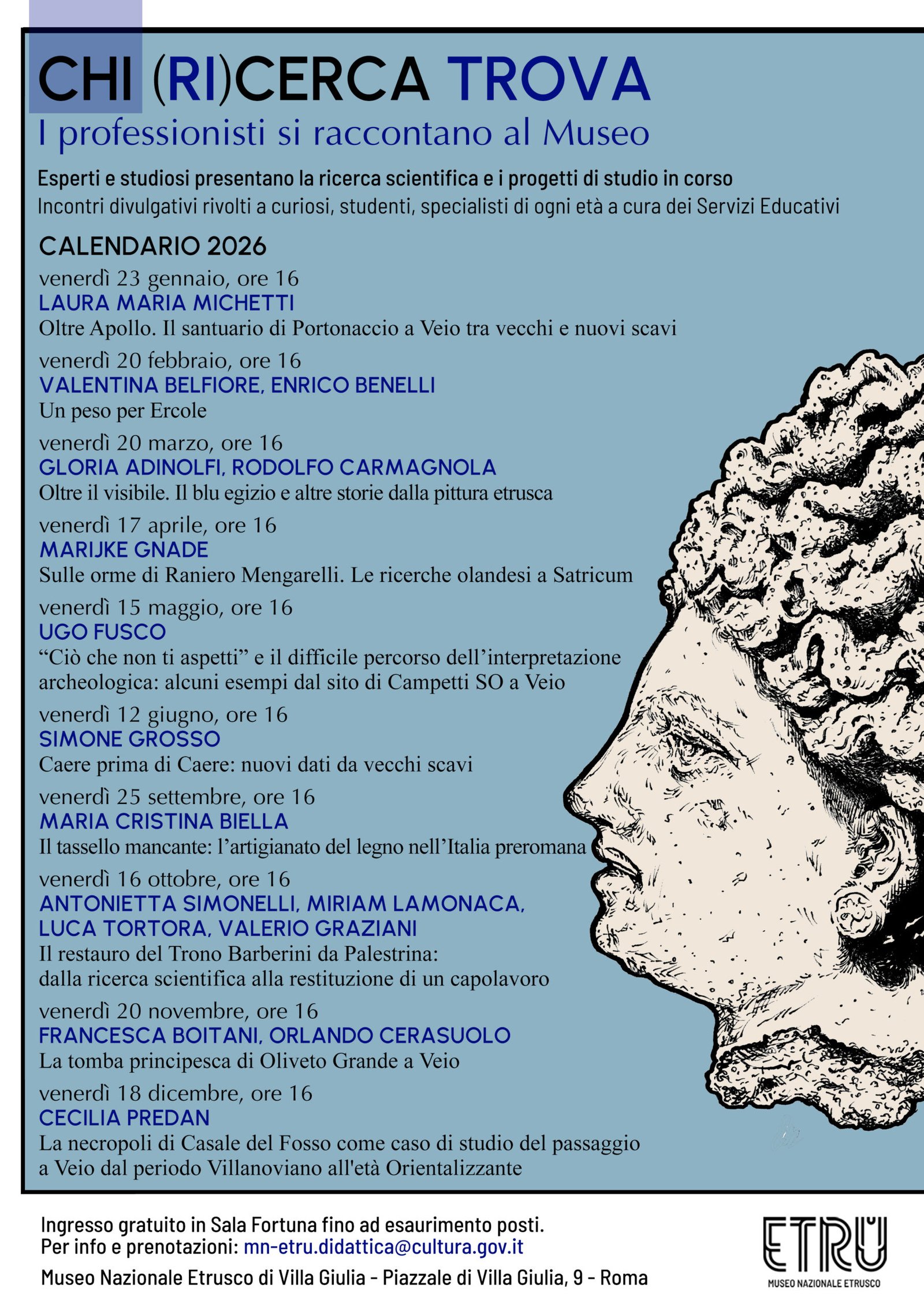
Chi (Ri)cerca Trova 2026 is the series of 10 lectures that the National Etruscan Museum of Villa Giulia (ETRU), piazzale di Villa Giulia 9, 00196 Rome, has spread from Friday, January 23 to Friday, December 18, 2026. The last three dates are Friday, October 16 (already held), Friday, November 20 and Friday, December 18, always at 16:00, in the museum's Sala Fortuna. Admission is free until seats run out, and you book by writing to the Educational Services at mn-etru.didattica@cultura.gov.it. For information the museum gives the number 06 3226571. You get to Villa Giulia by tram 2, 3 and 19 or by Metro A, Flaminio stop, from which the museum counts a 14-minute walk. The full program is on the museum's official website.
Language: performed in Italian. No English version or English surtitles are announced.
The most interesting part of an archaeological museum is often the part the public doesn't see: the storerooms, the labs, the excavation notebooks, the discussions among scholars over an inscription or a color. Chi (Ri)cerca Trova brings exactly that part into the lecture hall. The subtitle of the series says it plainly: professionals tell their story at the Museum. 2026 is the fourth edition, run by the Educational Services, and anyone with a free Friday afternoon in the fall will hardly find an hour better spent in Rome, and free of charge too.
Chi (Ri)cerca Trova 2026: the essential information
The 2026 series has 10 lectures, one a month from January to December with a summer break, all on Fridays at 16:00 in the Sala Fortuna of the National Etruscan Museum of Villa Giulia. Eight have already been held, and two remain.
The dates that remain
Friday, November 20, 2026 and Friday, December 18, 2026 (the one on Friday, October 16 has already been held). The time is the same for all of them: 16:00. Friday is a regular opening day for the museum, which is open Tuesday to Sunday from 8:30 to 19:30, with last entry at 18:30. So if you arrive early you can visit the rooms before the lecture, and if you stay afterward you still have some margin, though a short one.
How much it costs
Attendance at the lectures is free, until the available seats in the Sala Fortuna run out. It's a precise formula: a seat isn't guaranteed to someone who shows up at the last minute, and that's why the museum asks for a reservation. To visit the rooms, the museum's regular ticket applies instead: full price 13 euros and reduced 2 euros, with free admission for those entitled under the Ministry of Culture's rules.
How to book
You write to the Educational Services address, mn-etru.didattica@cultura.gov.it, giving the date of the lecture and the number of people. The city's tourism portal also lists the numbers 06 3226571, 06 3201706 and 06 3201951 as contacts for the museum. The advice is simple: write at least a week ahead.
What Chi (Ri)cerca Trova is: research told to the public
Chi (Ri)cerca Trova is a series of meetings in which experts and scholars present to the public the scientific research and the ongoing study projects around the National Etruscan Museum of Villa Giulia. The wordplay in the title is already a program: whoever searches finds, and whoever researches finds something more.
The floor goes to the professionals
The museum describes the series as an occasion where the floor passes to professionals in the worlds of archaeology, art history and restoration, who are asked to spread knowledge of their studies, tell their findings and share hypotheses, offering new ways to read history. Three different trades, then, and not only excavation archaeologists: the 2026 calendar also includes restorers and specialists in scientific analysis of materials.
Shared research
The formula the museum uses to present the series is one of the best I've read in the communication of a public institution: experiences, investigations and in-depth studies that make research shared, participatory, and therefore useful. It's a convincing idea of a museum: an institution that doesn't just display the final result, the display case with the restored object and its caption, but shows how you get to that result.
The 2026 themes
This year's series deals with Veii, Cerveteri, Satricum, analyses of the colors of Etruscan paintings and new epigraphic discoveries, as well as restoration and craftsmanship. It's a geography that matches that of the Villa Giulia collections: the sites that many of the objects on display in the rooms come from are the same ones the speakers talk about.
The fourth edition
2026 is the fourth edition of the series. On the museum's website you can watch again the lectures from the 2023, 2024 and 2025 editions, and also those already held in 2026: so anyone who discovers the series only now can catch up on the dates they missed before coming to the hall for the fall ones.
The fall program of Chi (Ri)cerca Trova 2026
The three fall lectures cover a restoration, a princely tomb and a necropolis of Veii: October 16 (already held), November 20 and December 18, 2026, always at 16:00 in the Sala Fortuna.
Friday, October 16: the restoration of the Barberini Throne
The first fall date, on October 16, was devoted to the restoration of the Barberini Throne from Palestrina, from scientific research to the return of a masterpiece. Antonietta Simonelli, Miriam Lamonaca, Luca Tortora and Valerio Graziani spoke: four speakers for a single lecture, the highest number in the whole calendar, and that alone says the restoration of an important work is teamwork, in which the people who investigate the materials and the people who work on the object must talk to each other constantly. The title lines up the two phases, first scientific research, then the return to the public: it's the right order, and it's rarely told.
Friday, November 20: the princely tomb of Oliveto Grande at Veii
In November Francesca Boitani and Orlando Cerasuolo present the princely tomb of Oliveto Grande at Veii. Villa Giulia holds some of the most famous Veii materials, starting with the Apollo: hearing about it a few yards from the display cases that house the Veii finds is the best way to understand why that site keeps producing research.
Friday, December 18: the Casale del Fosso necropolis
The last lecture of the year is entrusted to Cecilia Predian and concerns the Casale del Fosso necropolis as a case study of the passage, at Veii, from the Villanovan period to the Orientalizing age. It's the most technical topic of the three, but also the most interesting for anyone who wants to understand how a historical change is studied through tombs: the way a community buries its dead changes when society, contacts with the outside world and wealth change. Closing the year with Veii, after opening it with Veii in January, gives the series a symmetry that seems intentional.
The complete calendar of Chi (Ri)cerca Trova 2026
The seven lectures already held, from January 23 to September 25, 2026, outline the range of themes of the series and can be watched again on the museum's website.
January and February: Veii and an Etruscan text
The series opened on Friday, January 23 with Laura Maria Michetti and a lecture titled Oltre Apollo. Il santuario di Portonaccio a Veio tra vecchi e nuovi scavi. The title plays on the museum's most famous piece, the Apollo of Veii, to shift the gaze from the statue to the place of worship it comes from. On Friday, February 20 Valentina Belfiore and Enrico Benelli presented Un peso per Ercole. Nuova luce su un testo etrusco a trenta anni dalla prima edizione: epigraphy, that is, the study of inscriptions, one of the liveliest frontiers of Etruscology.
March and April: the colors and Satricum
On Friday, March 20 Gloria Adinolfi and Rodolfo Carmagnola spoke about Oltre il visibile. Il blu egizio e altre storie dalla pittura etrusca, the topic of the color analyses that the museum had announced in the presentation of the series. On Friday, April 17 Marijke Gnade talked about Sulle orme di Raniero Mengarelli. Le ricerche olandesi a Satricum, a title that links today's research to one of the historic names of Villa Giulia: Mengarelli was an inspector of the museum, and his book collections are still kept in the library.
May and June: interpreting and re-excavating
On Friday, May 15 Ugo Fusco presented Ciò che non ti aspetti e il difficile percorso dell'interpretazione archeologica: alcuni esempi dal sito di Campetti a Veio. On Friday, June 12 Simone Grosso spoke about Caere prima di Caere: nuovi dati da vecchi scavi. Two titles that say a lot about method: archaeology isn't done only by digging, but also by going back to the materials of excavations already finished and rereading them with new tools.
September: wood
On Friday, September 25 Maria Cristina Biella and Silvia Cristofoli tackled Il tassello mancante: l'artigianato del legno nell'Italia preromana. The title itself, the missing piece, says that they were talking about what you usually don't see in the display cases.
Who organizes it: the Educational Services of Villa Giulia
Chi (Ri)cerca Trova is run by the Educational Services of the National Etruscan Museum of Villa Giulia, the same office that handles reservations through the address mn-etru.didattica@cultura.gov.it.
The role of the Educational Services
At Villa Giulia the educational work shows up in many forms: the museum organizes guided tours for adults, schools and groups in Italian, English, French, Spanish and German, has an ETRUKids section with materials and activities for schools and families, and offers a game for children that you can download or ask for at the reception desk.
A museum that invests in research
The National Etruscan Museum has been one of the autonomous institutes of the Ministry of Culture since 2016, and since May 16, 2024 it has been directed by Luana Toniolo. For many Italian museums autonomy has meant a more recognizable program, made of exhibitions, restorations open to the public and series of meetings. Chi (Ri)cerca Trova belongs to this season: four consecutive editions since 2023, with the recordings published online.
A curiosity about Chi (Ri)cerca Trova 2026 at the National Etruscan Museum of Villa Giulia, January 23 to December 18, 2026
The nicest curiosity in the 2026 calendar is a thread that ties the April lecture to the history of the museum. The title chosen by Marijke Gnade, Sulle orme di Raniero Mengarelli, refers to a man who really worked at Villa Giulia: Mengarelli was one of the museum's inspectors in the 20th century, and his book collections are still kept today in the institute's library, next to those of Massimo Pallottino and Maria Santangelo. The lecture told of the Dutch research at Satricum, but it did so inside the building where those first investigations had been studied and archived.
The second curious detail concerns the hall. All the lectures are held in the Sala Fortuna, and so research on antiquity is told in a 16th-century villa, built for Pope Julius III between 1550 and 1555, which became a museum in 1889. Anyone listening to a talk on Etruscan painting or on a tomb at Veii does so inside a building that is itself a historical document, designed by Jacopo Barozzi da Vignola.
The third curiosity is in the title. Chi (Ri)cerca Trova is a proverb bent with a parenthesis: just add two letters and searching becomes researching, which is the trade of the people who speak in the hall. It seems the most honest name a science outreach series could have chosen, because it doesn't promise sensational discoveries but patient work. And that's also the reason it's worth listening: in archaeology, a discovery is almost always the result of a long piece of research.
The National Etruscan Museum of Villa Giulia: what to see before or after the lecture
The National Etruscan Museum of Villa Giulia holds over 6,000 objects in 50 rooms, on an exhibition area of more than 3,000 square meters. A lecture at 16:00 leaves time for a focused visit before or after.
The Apollo of Veii
A painted terracotta sculpture from the late sixth century BC, coming from Veii. It's the natural starting point for those coming to the November and December lectures, both devoted to Veii, and the reference of the title of the series' opening lecture, Oltre Apollo.
The Sarcophagus of the Spouses
The terracotta funerary monument with the married couple reclining as if at a banquet is the piece almost everyone comes to see. The restoration is continuing and the museum allows you to watch it in the lab on Tuesdays and Thursdays from 10:00 to 13:00: a restoration open to the public that is, in its own way, the everyday version of the spirit of Chi (Ri)cerca Trova.
The Pyrgi Tablets
Three gold tablets with a text in Etruscan and Phoenician, fundamental for the study of the Etruscan language. Anyone who followed the February lecture on epigraphic discoveries will understand why scholars keep going back to Etruscan texts decades after their discovery.
The François Tomb
Since July 1, 2026 the François Tomb, discovered in 1857 in the Ponte Rotto necropolis at Vulci and made between 340 and 320 BC, has been open to the public in the museum. The visit is included in the ticket, but entries are limited and booking is required.
The current exhibitions
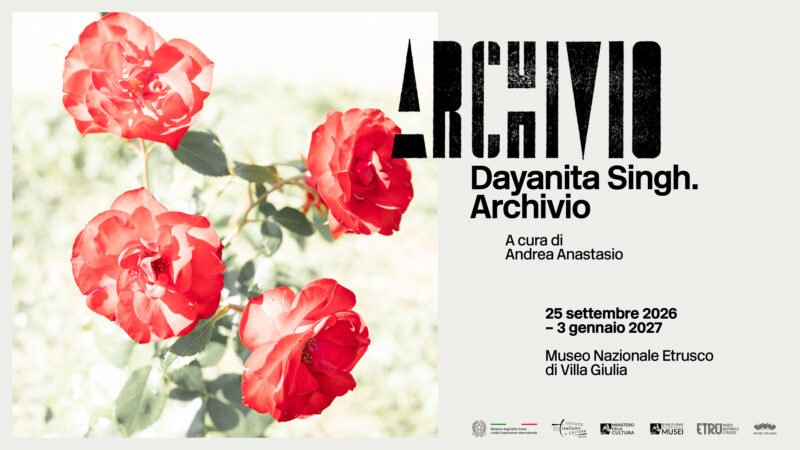
In the fall of 2026 the museum also hosts Archivio di Dayanita Singh, open from September 25, 2026 to January 3, 2027 and included in the ticket. Anyone coming to one of the fall lectures can combine them with the exhibition: a museum that talks about archives and research, in two different languages.
Something nobody tells you about Chi (Ri)cerca Trova 2026 at the National Etruscan Museum of Villa Giulia, January 23 to December 18, 2026
Almost nobody remembers that the Chi (Ri)cerca Trova lectures can be watched again. The museum's website offers the recordings of the 2023, 2024 and 2025 editions, and also those of 2026. It's an archive of four years of research told by the protagonists, free, and almost unknown outside the circle of enthusiasts. Anyone preparing a trip to Rome with archaeological interests, anyone who teaches history, anyone who leads groups should know about it.
The second thing the aggregators' listings don't say is that the date given as the end of the series, December 18, isn't the closing date of an exhibition, but that of the last lecture. The series isn't a continuous event: it's 10 separate afternoons, of which two are still to come. Anyone who reads from January 23 to December 18 and thinks they can drop in on any day will find the Sala Fortuna closed.
The third concerns the audience. The museum talks about the curious, students and specialists, and the hall on a weekday afternoon really is like that: next to the retired professor and the archaeology student sit people who have never opened an Etruscology textbook. Nobody asks questions to show off, and the speakers answer patiently. A firm piece of advice: don't let the titles intimidate you, they're written for insiders. The lectures are meant for everyone, and the naive question at the end is often the most useful.
Villa Giulia: the villa of Pope Julius III
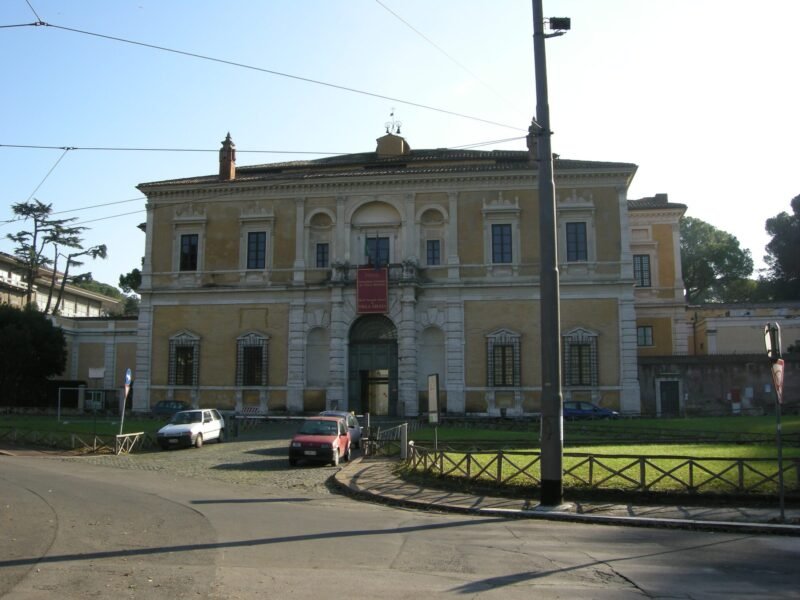
Villa Giulia was built for Pope Julius III, Giovanni Maria Ciocchi del Monte, between 1550 and 1555, as a suburban residence outside the walls, along Via Flaminia.
The architects
The design of the building, from 1551-1553, is due to Jacopo Barozzi da Vignola. The nymphaeum and the garden structures are due to Bartolomeo Ammannati. Michelangelo provided a design for the casino and Giorgio Vasari claimed to have drawn first the invention of the vineyard. The painted decoration was entrusted to Prospero Fontana, with Pietro Venale da Imola and the young Taddeo Zuccari.
The facade and the hemicycle
Toward the city Vignola designed a severe two-story facade, with the triumphal arch motif at the center. At the back the building changes character: the facade bends into a semicircle and the hemicycle is painted with light grotesques inspired by the Domus Aurea. The contrast between the two fronts, one flat and straight and the other concave, is the villa's main architectural lesson.
The nymphaeum
The heart of the villa is the nymphaeum, which you reach from the loggia of the central garden down two flights of marble stairs: three levels of loggias with statues and balustrades around a fountain with river gods and caryatids. It was the place to have lunch in the cool on summer days. The pope's guests arrived by boat from the Vatican, going up the Tiber.
From villa to museum
After the death of Julius III the villa went through a long decline. In 1889, with the Royal Decree of February 7 and at the urging of the archaeologist and politician Felice Barnabei, it became the home of the museum devoted to the antiquities of the pre-Roman peoples: Etruscans, Faliscans, Umbrians, Latins and Sabines. In the 1930s two outer wings were added. Later the museum took in the nearby Villa Poniatowski.
My advice for visiting Chi (Ri)cerca Trova 2026 at the National Etruscan Museum of Villa Giulia, January 23 to December 18, 2026
Get to Villa Giulia around 14:30, not at 15:55. The reasons are practical. The first: your seat in the Sala Fortuna is guaranteed until seats run out, and if you arrive early you take no risk. The second: an hour and a half before the lecture is enough to see the rooms linked to the theme of the day. Look in the museum for the signs of the restorers' work, starting with the Sarcophagus of the Spouses. For November and December, Veii: stop in front of the Apollo and the Veii materials, and you'll arrive in the hall with the right images in your head.
The third reason is the light. In November and December the sun sets early: after the lecture the garden and the nymphaeum will already be in half darkness. If you want to see the villa in daylight, you have to do it before 16:00. I recommend visiting the nymphaeum last, right before going into the hall: 10 minutes among Ammannati's loggias put you in the right frame of mind to listen.
Finally, prepare. Go to the museum's website and watch the recording of one of the lectures already held, ideally on a topic close to the one you'll hear: for November and December, the one from January on the Portonaccio sanctuary. An hour at home will help you understand twice as much in the hall. And bring a notebook: the speakers cite sites, dates and names of excavators that are worth writing down.
How to get to Villa Giulia for Chi (Ri)cerca Trova
The National Etruscan Museum is at piazzale di Villa Giulia 9, along Viale delle Belle Arti, between Villa Borghese and Via Flaminia. The museum gives tram 2, 3 and 19 and Metro A, Flaminio stop.
By metro
The nearest stop on Line A is Flaminio, in piazzale Flaminio, next to Piazza del Popolo. The museum counts 14 minutes on foot to the entrance. For a 16:00 appointment it's a time to allow with a margin.
By tram
Tram 2 leaves from piazzale Flaminio and goes up Via Flaminia. Trams 3 and 19 run along Viale delle Belle Arti, that is, they pass by the side of the museum: for those coming from the neighborhoods east of the city it's the most convenient solution, with no transfer to the metro. For the exact route from your starting point, the ATAC route planner is the most reliable tool.
By car and taxi
The museum doesn't list a parking lot of its own. Around the Valle Giulia museums parking is on the street and often contested. The advice, for once without nuances, is public transportation. By taxi, just say the Villa Giulia Museum.
On foot from Villa Borghese
Villa Giulia is a few steps from Villa Borghese: going down from the park toward Valle Giulia you reach the museum on foot. On a fall day it's the most pleasant way to arrive at a lecture.
Another well-known fact, yet rarely cited
That the nymphaeum of Villa Giulia was for decades the venue of the final evening of the Premio Strega, many people know. That the villa, in the 1700s, was a barracks, few people know. From 1769 Pope Clement XIV had the building restored and assigned it to the army, as quarters, warehouse and even a lazaretto. The Veterinary School was also based there, and for convenience a stepped access was made to the lower fountain of the nymphaeum, used to water the horses.
The story of the villa's water is just as little told. Julius III had a branch of the ancient Acqua Vergine aqueduct built, reserved for the villa, to feed the nymphaeum fountains and the gardens. When the villa passed to other owners, that water found a public use: at the beginning of Via di Villa Giulia, on Via Flaminia, two drinking-trough fountains were placed, one by Cardinal Borromeo in 1672, the other by Filippo Colonna, prince of Paliano, in 1701.
Why remember it in a listing about a lecture series? Because Chi (Ri)cerca Trova talks about archaeology as work on stratifications, and Villa Giulia is itself a stratification: papal residence, barracks, veterinary school, museum, home of a literary prize. Anyone who enters the Sala Fortuna to hear about a Veii necropolis does so inside a building that has changed use five times. It's a free lesson in method, even before the lecture begins.
The right photo to take at Chi (Ri)cerca Trova 2026 at the National Etruscan Museum of Villa Giulia, January 23 to December 18, 2026
In the hall, during the lecture, the phone stays in your pocket: the speakers often show unpublished materials, and photographing the projections makes no sense when the lectures are published on the museum's website. Before shooting, ask the staff anyway. The right photo is taken outside, before going in.
Stand in the middle of Ammannati's loggia, with your back to the hemicycle, looking toward the nymphaeum. From there you see the sequence of the villa's three levels: the courtyard, the balustrade, the descent to the fountain. It's a composition built to be looked at in depth, one plane after another, like an archaeological dig seen in section. Shoot vertically to keep together the painted vault of the loggia and the back of the nymphaeum.
With the light of the early afternoon still high, look for a detail of the hemicycle's grotesques, painted on the model of the Domus Aurea: a pergola, a bird, a vine shoot. In November and December, when at 15:00 the light is already raking, the best choice is the Alatri temple in the garden, the full-size reproduction of an Etruscan-Italic temple built between 1889 and 1890, taken at three quarters, with long shadows. It's the image that sums up the series: research that reconstructs what time has erased.
Around Villa Giulia: Valle Giulia, Villa Borghese and the Flaminio
Villa Giulia is in the area that Romans call Valle Giulia, between Villa Borghese and the Parioli, one of the areas with the highest concentration of museums in the city.
Villa Poniatowski
A few steps away, facing Via Flaminia, Villa Poniatowski is the museum's second site. Giuseppe Valadier turned it into a villa in the early 1800s for Stanisław Poniatowski, nephew of the last king of Poland. It's closed for works and reopening is expected in the fall of 2026: it's worth checking the museum's notices.
Villa Borghese and its museums
Going up toward the park you come to the Galleria Borghese, the Museo Carlo Bilotti in the Orangery and the Bioparco. For those coming with kids, a morning at the Bioparco and an afternoon in the lecture hall is a possible combination, though a demanding one.
The contemporary Flaminio
Toward the north, along Via Flaminia, you reach the MAXXI: the Rome of the 21st century a few minutes by tram from a 16th-century villa.
Piazza del Popolo
Going south, from the Flaminio stop you pass under Porta del Popolo and enter Piazza del Popolo. After a lecture that ends around 17:30, a stop in Santa Maria del Popolo is the best way to close the afternoon.
Some important events that happened here in history
1550-1555: Pope Julius III has the villa built on Via Flaminia, entrusting the design to Vignola and Ammannati, with the contribution of Michelangelo and Vasari. This is when the villa is born as a place of delights reserved for the pope and his guests.
1555: after the death of Julius III, the new pope Paul IV Carafa confiscates the properties gathered by his predecessor. The villa is divided: the main building and part of the gardens go to the Apostolic Chamber, and its use is reserved for the Borromeo family.
1769: Pope Clement XIV has the building restored and assigns it to the army, as quarters, warehouse and lazaretto. The Veterinary School is also based there.
1870: with the capture of Rome the villa becomes property of the Kingdom of Italy and begins to collect the materials of the archaeological explorations in the territory of Falerii, between 1888 and 1889.
February 7, 1889: a Royal Decree, promoted by Felice Barnabei, establishes the museum. Between 1889 and 1890 the reproduction of the Alatri temple is built in the garden. In 1891 the library begins to take shape.
From the post-war period: the nymphaeum becomes the traditional venue of the final evening of the Premio Strega, with the ceremony broadcast several times by Rai from the museum garden starting in 1965.
January 23, 2016: a ministerial decree places the museum among the institutes endowed with autonomy. 2023: first edition of Chi (Ri)cerca Trova. July 1, 2026: the François Tomb becomes visible to the public. January 23, 2026, exactly 10 years after the autonomy decree: the fourth edition of the series opens, with the lecture on the Portonaccio sanctuary at Veii.
Accessibility at Villa Giulia
The National Etruscan Museum states that it has eliminated most architectural barriers. Access to some rooms is guaranteed to people with motor disabilities through alternative routes, elevators and stairlifts, the latter not yet approved for motorized chairs. A wheelchair is available at the entrance on request.
Visual and hearing disabilities
For blind and visually impaired visitors the museum offers, on request, tactile reproductions and tactile guided tours. For deaf people there is the Villa Giulia and Villa Poniatowski VideoguidaLIS, free on the app stores or viewable online.
For the lecture
If you have specific needs for reaching the Sala Fortuna, mention it in the reservation email to the Educational Services, or ask at the entrance for the alternative route before starting: the garden and the nymphaeum have stairs.
Who has come through Chi (Ri)cerca Trova 2026 at the National Etruscan Museum of Villa Giulia, January 23 to December 18, 2026
Villa Giulia has had illustrious guests since the construction site: Jacopo Barozzi da Vignola, Bartolomeo Ammannati, Giorgio Vasari and, with a design for the casino, Michelangelo Buonarroti. With them the painters Prospero Fontana, Pietro Venale da Imola and the young Taddeo Zuccari. Four names of architects and three of painters that by themselves sum up the Rome of the mid-1500s.
In the 1800s Felice Barnabei passed through, the archaeologist and politician who wanted the museum and dug at Alatri the temple later rebuilt in the garden. In the 1900s the villa was the workplace of Massimo Pallottino, one of the fathers of Etruscology, whose library is still kept in the museum, and of the inspectors Raniero Mengarelli and Maria Santangelo. That's why the April lecture on Mengarelli and Satricum carried a particular weight in that hall.
Then there's the long season of the Premio Strega: in the museum garden, on the first Thursday of July, winners proclaimed have included Paolo Volponi, Paolo Cognetti, Helena Janeczek, Antonio Scurati, Sandro Veronesi, Emanuele Trevi, Mario Desiati, Ada D'Adamo, Donatella Di Pietrantonio and Andrea Bajani.
In 2026, with Chi (Ri)cerca Trova, the scholars of the calendar have passed through Villa Giulia: Laura Maria Michetti, Valentina Belfiore, Enrico Benelli, Gloria Adinolfi, Rodolfo Carmagnola, Marijke Gnade, Ugo Fusco, Simone Grosso, Maria Cristina Biella and Silvia Cristofoli. In the fall Antonietta Simonelli, Miriam Lamonaca, Luca Tortora and Valerio Graziani came, and Francesca Boitani, Orlando Cerasuolo and Cecilia Predian will come. In our view they, more than the celebrities, are the visitors who give a museum its meaning.
How to organize the afternoon of Chi (Ri)cerca Trova
For a lecture at 16:00 at Villa Giulia you need half a day, if you also want to see the museum. Here's a proposal designed for a fall Friday.
Lunch
The museum's restaurant is closed pending renovation: eat beforehand, outside, and arrive at Villa Giulia around 14:30.
Before the lecture
An hour in the rooms linked to the theme of the day, then 10 minutes in the nymphaeum. Enter the Sala Fortuna a few minutes early.
After the lecture
The museum closes the rooms at 19:30, with last entry at 18:30: after the lecture there's little time left, but enough to go back to an object that was discussed. Then the walk down to Piazza del Popolo, on foot or by tram to Flaminio.
For groups
The museum organizes guided tours for adults, schools and groups in five languages. For a private experience built around the villa, the museum and the Etruscan sites of Lazio, Tour Leader Pro organizes custom itineraries.
Where to eat near Villa Giulia
There are three useful areas for eating before the lecture, all a few minutes from the museum.
The Flaminio
Along Via Flaminia and in the streets between piazzale Flaminio and the Villaggio Olimpico there are neighborhood trattorias, pizza-by-the-slice places and bars with a hot buffet. Residential-neighborhood prices.
The Parioli
Going up toward the Parioli the offer becomes more refined and more expensive: restaurants, pastry shops, bars with outdoor seating. It's the choice for a sit-down lunch.
Piazza del Popolo and the Tridente
Between Piazza del Popolo, Via di Ripetta and Via del Babuino the offer is the widest, at downtown prices. It makes sense if the evening continues in that direction, after the lecture.
Frequently asked questions about Chi (Ri)cerca Trova 2026
When are the next Chi (Ri)cerca Trova 2026 lectures?
The next two Chi (Ri)cerca Trova 2026 lectures at the National Etruscan Museum of Villa Giulia are Friday, November 20 and Friday, December 18, 2026, always at 16:00 in the Sala Fortuna. The 2026 series has 10 dates in all, starting on January 23.
Are the Chi (Ri)cerca Trova lectures free?
Yes, the Chi (Ri)cerca Trova lectures at Villa Giulia are free admission until seats in the Sala Fortuna run out. The museum asks you to book by writing to the Educational Services at mn-etru.didattica@cultura.gov.it. A visit to the museum's rooms follows the regular ticket instead.
How do you book a seat at Chi (Ri)cerca Trova?
For Chi (Ri)cerca Trova 2026 you book by email at the address mn-etru.didattica@cultura.gov.it of the Educational Services of the National Etruscan Museum of Villa Giulia, giving the date and number of participants. For telephone information the museum gives the number 06 3226571. It's best to write at least a week ahead.
What was the October 16 lecture at Villa Giulia about?
The Chi (Ri)cerca Trova lecture of October 16, 2026 was devoted to the restoration of the Barberini Throne from Palestrina, from scientific research to the return of a masterpiece. Antonietta Simonelli, Miriam Lamonaca, Luca Tortora and Valerio Graziani spoke, at 16:00 in the Sala Fortuna.
Can you watch the lectures already held again?
Yes, the website of the National Etruscan Museum of Villa Giulia publishes the recordings of Chi (Ri)cerca Trova from the 2023, 2024 and 2025 editions and those already held in 2026. It's the best way to catch up on missed dates or to prepare for the fall ones.
How do you get to the Etruscan Museum of Villa Giulia by public transportation?
The National Etruscan Museum of Villa Giulia, at piazzale di Villa Giulia 9, is served by trams 2, 3 and 19 and by Metro A, Flaminio stop, from which the museum gives 14 minutes on foot. Trams 3 and 19 pass on Viale delle Belle Arti.
Do you need to be an archaeology expert to follow Chi (Ri)cerca Trova?
No, Chi (Ri)cerca Trova is aimed by the museum's choice at the curious, students and specialists. The titles are technical, but the speakers tell their own work to a mixed audience. Watching a recording on the museum's website first helps you get your bearings.
The final advice
Pick one of the two dates, write to the Educational Services right away, arrive at Villa Giulia an hour and a half early and use it for the rooms and the nymphaeum. If Veii intrigues you, keep November 20 and December 18 free. There are many lectures in Rome, but few where the speaker has hands dirty with the earth they talk about. This is one of them, and it's free.
Article written by the editorial team of Tour Leader Pro, contact them for Private/Corporate/V.I.P. Tours and Experiences.
Planning a trip to Rome? The English-language guides to visiting the city are on ItalyPlanner.com.
Contact Information
Nearby
 National Etruscan Museum of Villa Giulia100 m
- Japanese Cultural Institute in Rome100 m
- Danish Academy in Rome200 m
- Romanian Academy in Rome200 m
- Villa Poniatowski200 m
- British School at Rome200 m
Upcoming events nearby
- Dayanita Singh at Villa Giulia, Archivio, September 25 to January 3, 2027100 m
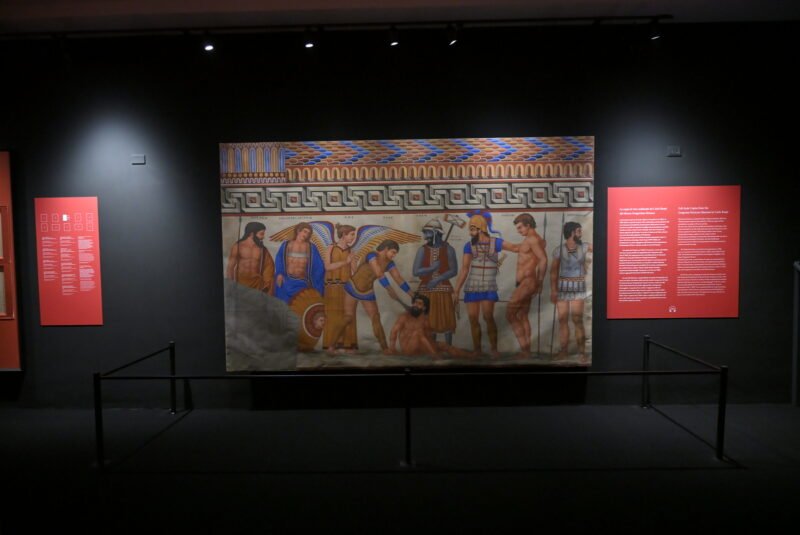
- Il Ritorno degli Eroi at the Etruscan Museum of Villa Giulia, through December 31, 2026100 m
- L’indovino di Mouna Rebeiz at Museo Nazionale Etrusco di Villa Giulia, from September 16 to November 29, 2026100 m
- Cent’anni a Roma: The Abbey Awards at the British School at Rome, November 4 to December 18, 2026200 m

You might also like
- Basta poco with Cornacchione, Quartullo and Faiella at Teatro Parioli Costanzo, March 3 to 7, 2027
- Sex Roulette at Teatro Parioli Costanzo, January 31, 2027
- Parole di Faber, a tribute to Fabrizio De André at Teatro Parioli Costanzo, February 19, 2027
- The Ugly Duckling with Fabio Canino at Teatro Parioli Costanzo, February 3, 2027
- As Film Festival 2026 at Casa del Cinema, November 14 and 15, 2026
- Euro Balkan Film Festival 2026 at Casa del Cinema, October 31 to November 7, 2026