Marina Bindella. Cosmografie at the Museo Carlo Bilotti, September 26 to November 15, 2026
In short. Marina Bindella. Cosmografie is the exhibition the Museo Carlo Bilotti, in the Aranciera of Villa Borghese, dedicates until November 15, 2026 to the recent work of the artist and engraver: about 40 works among paintings, woodcuts,…
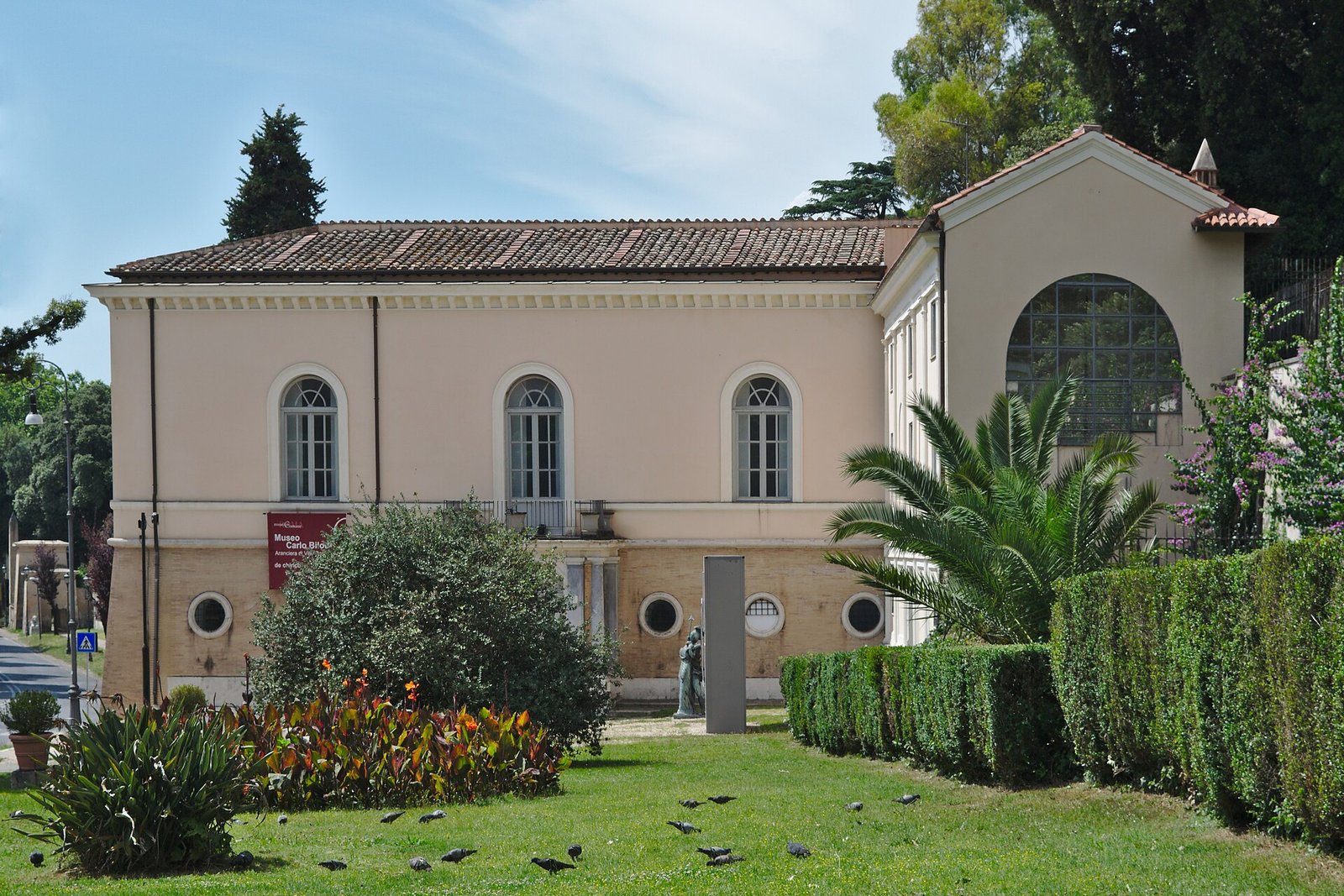
Marina Bindella. Cosmografie is the exhibition the Museo Carlo Bilotti, in the Aranciera of Villa Borghese, dedicates until November 15, 2026 to the recent work of the artist and engraver: about 40 works among paintings, woodcuts, watercolors, artist's books and large polyptych installations, curated by Ilaria Schiaffini. The exhibition is open from September 26 to November 15, 2026, Tuesday to Friday from 10:00 to 16:00, Saturday and Sunday from 10:00 to 19:00. On Monday the museum is closed and the last entry is 45 minutes before closing. The museum has two entrances inside the villa, at Viale Fiorello La Guardia 6 and Viale dell'Aranciera 4, in Municipio II. For public transport the simplest way is the ATAC route planner, allowing for the last stretch on foot in the park. With the MIC card admission is free. The regular prices are published on the Tickets page of the official website of the Museo Carlo Bilotti, where you can also buy online through the Musei in Comune presale network. Information at 060608, every day from 9:00 to 19:00.
An exhibition of tiny marks and immense spaces, in a small museum inside the most beloved park in Rome. Marina Bindella has worked for over 40 years on woodcut, that is, engraving on wood, and from there she moved on to watercolor, painting, graffito, corrugated cardboard. Cosmografie gathers the works from 2020 to today, with a few dives into earlier years, and puts them in dialogue with quantum physics and with the philosophy of Anaximander. It may sound like a difficult program. In front of the works it becomes an experience of light. In our view it is one of the most successful exhibitions you can see this autumn in a municipal space.
Marina Bindella. Cosmografie: what you see
Cosmografie presents about 40 works by Marina Bindella, made mostly from 2020 to today: paintings, woodcuts, watercolors, large polyptych installations and a selection of artist's books, on view at the Museo Carlo Bilotti from September 26 to November 15, 2026.
The meaning of the title
The title alludes to a universe of expanding images. Bindella's cosmographies, the museum explains, are not simple representations of the cosmos: they are inner maps of processes in becoming. Aggregations and rarefactions, weaves, orbits, vibrations that seem to tell of the passage from a primordial, formless matter to a reality that takes shape through invisible relations between the elements.
From the cosmos to quantum physics
Cosmic themes have always been present in the artist's work. In recent years, however, Bindella has pushed toward what the senses do not perceive: on one side the subatomic dimension of quantum mechanics, on the other the stellar immensity explored by astrophysics. Her declared sources are Anaximander, with the concept of apeiron, the boundless, and two protagonists of 20th-century physics, Paul Dirac and Erwin Schrödinger.
Light and time
The curator Ilaria Schiaffini, professor of Contemporary Art History at Sapienza, identifies light and time as the two guiding threads of the works gathered here. The image appears as a fragment of a larger process of aggregation and dispersion of matter: you look at a sheet and have the sensation of seeing an instant of something that continues beyond the edge.
Letters and formulas in the dust of marks
In the Àpeiron series and in some works dedicated to Il mare di Dirac the dust of marks changes nature. It is no longer made only of abstract strokes: there are letters, graphemes, formulas. This is the point where Bindella's research becomes at once scientific, philosophical and poetic, and asks the viewer to question the relationship between man, matter and the universe.
The series on view at Cosmografie
The route of Cosmografie runs through series and groups linked to the origins of matter, the structure of the universe, the perception of time and the generative force of the mark. These are the titles announced by the Museo Carlo Bilotti.
Ab origine
The series that ideally opens the discussion: the origins, matter condensing. It is the starting point for understanding everything else.
Entanglement
Of Entanglement, a title borrowed from the vocabulary of quantum physics, several variants are on view, useful for understanding how the artist works in series and variations.
Il mare di Dirac
The works dedicated to Il mare di Dirac are inspired by the physicist Paul Dirac, cited by the museum among the exhibition's references. Here letters and formulas appear inside the dust of marks.
Materiaoscura and Lunghezza d'onda
Two titles that declare the field of interest: matter you can't see and waves you can't touch. These are works in which light can no longer be clearly told apart from the dark areas, but is built into the matter itself.
Àpeiron, Scripta mutant, Vortex temporis
Àpeiron takes up the concept of Anaximander. Scripta mutant carries in its title the idea of writing that changes. Vortex temporis is a series of watercolors. Among the official materials for the exhibition is Vortex temporis IX, from 2020, a watercolor of 76 by 56 centimeters.
The large-format series at the edges of time and the eyes of the sky
The recent large-format series are the most spectacular moment of the route. The museum describes them as immersive, chromatically intense works that unfold along the walls like musical polyphonies. Sui bordi del tempo I, from 2023, is mixed media on corrugated cardboard: eight framed panels for a total of 70 by 780 centimeters. Almost eight meters of image, to be walked along.
The Artist's Books
A selection of artist's books completes the route. For those who don't know this world, it is the most revealing section: Bindella has worked for decades with small art publishers, and her books are objects in which poetry, engraving and typography merge.
Marina Bindella's Technique: From Woodcut to Corrugated Cardboard
Marina Bindella started out with woodcut, engraving on a wooden matrix, and gradually widened her field to watercolor, painting, graffito and unusual supports such as corrugated cardboard, nets and modular surfaces.
The Mark as a Principle
The exhibition is founded on the investigation of the mark as the principle that generates form, light and space. In Bindella's works the image is born from the accumulation of tiny, dense, dust-like strokes that from a distance become nebulae, orbits, tides.
Unusual Matrices
In recent years the artist has begun to use matrices other than wood: nets, modular surfaces, corrugated cardboard. The result, the museum explains, is that the layers of the image can no longer be located precisely and light is not separated from the dark areas. It is a technical consequence that becomes poetic: light inhabits matter.
Why Woodcut Still Matters
Those who look at the large installations might forget that everything began with a piece of wood and a gouge. In woodcut every mark is obtained by removing material from the matrix, and every mistake is final. The rigor you see in Bindella's freest works comes from there.
Who Is Marina Bindella: Biography and Career
Marina Bindella, born in Perugia, is an artist and engraver. She teaches Woodcut and History of Printing at the Accademia di Belle Arti di Roma, in the city where she lives and works, and she has been exhibiting since 1980.
Training
After a classical high school diploma she earned a degree in Letters, with a focus on art history, at Sapienza. In 1980 she held her first solo show. In 1986 she graduated in Engraving from the Scuola delle Arti Ornamentali di San Giacomo. In 1987, while working on her specialization thesis, she met Alina Kalczynska and Vanni Scheiwiller and studied Polish engraving, a subject she would write about repeatedly: it was the beginning of her work as a scholar of graphic art.
The 1990s and Abstraction
In the first half of the 1990s she spent time with artists of the abstract area such as Guido Strazza, Carlo Lorenzetti, Enrico Della Torre and Giulia Napoleone, with whom collaborations began. Her work focused on woodcut. In 1993 she published Il poema della montagna by Marina Cvetaeva with Il Buon Tempo of Milan, the start of a long collaboration with Lucio Passerini.
Germany and the Museums
From 1997 she exhibited at the Monika Hoffmann gallery in Paderborn, where she published editions on texts by Ingeborg Bachmann and taught three woodcut courses at the Sommer Akademie. In 1998 the Städtisches Kunstmuseum Spendhaus in Reutlingen, the Rheinisches Landesmuseum in Bonn and the Sächsische Landesbibliothek in Dresden acquired her woodcuts.
Awards
In 1999 she exhibited at the Biblioteca Sormani in Milan and received the special jury prize at the 14th Biella International Engraving Prize. In 2000 she won the Triennale Prize at the 3rd International Print Triennial in Cairo, where in 2003 she also received an honor prize. Among her other awards are the special prize for linocut at the Máximo Ramos competition in Ferrol (1995) and the special jury prize at the Chieri Triennial (2003).
Artist's Books and Poets
Her collaboration with Italian private presses is a constant. With Alessandro Zanella's Ampersand editions she published in 2009 Poesie verticali, 21 woodcuts for 14 poems by Maria Luisa Spaziani. She has worked on texts by Elio Pecora, Biancamaria Frabotta, Jolanda Insana, Patrizia Cavalli and Valerio Magrelli.
Public Collections
In 2007 the Gabinetto delle Stampe antiche e moderne in Alessandria acquired 15 woodcuts. In 2009 the Istituto Nazionale per la Grafica in Rome received a donation of 16 works. In 2011 the Silesian Museum in Katowice bought two woodcuts. In 2017 she exhibited her donation at the Museo di Castelvecchio in Verona.
Exhibitions in Rome
In Rome she has exhibited, among other places, at the Biblioteca Vallicelliana, at the Ricerca d'Arte gallery with Luce d'altura (2010), at the Porta Latina gallery with Corpi celesti (2013) and in 2015 at MLAC, the Museo Laboratorio di Arte Contemporanea of Sapienza, in a solo show curated by Ilaria Schiaffini and Claudio Zambianchi. In 2013 she created an installation for the dining hall of the Policlinico di Tor Vergata.
The Curator and the Catalog of Cosmografie
The exhibition is curated by Ilaria Schiaffini, professor of Contemporary Art History at Sapienza, who has followed Marina Bindella's work for more than 15 years: as early as 2010 she wrote a catalog introduction for Luce d'altura.
The Catalog
The catalog is published by De Luca Editori d'Arte. Besides reproductions of the works, it contains an institutional introduction by Federica Pirani, the curator's essay, critical contributions by Claudio Zambianchi and Beatrice Peria, an interview with the artist by Carlo Alberto Bucci and a critical biography by Arianna Mercanti. The texts are translated into English by Emma C. Gainsforth.
Who Is Behind the Exhibition
Cosmografie is promoted by Roma Capitale, Department of Culture, and by the Sovrintendenza Capitolina ai Beni Culturali. It is organized by Marina Bindella herself, with the patronage of the Accademia di Belle Arti di Roma for the publication of the catalog. Museum services are provided by Zètema Progetto Cultura.
The Museo Carlo Bilotti and the Aranciera of Villa Borghese
The Museo Carlo Bilotti is the contemporary art museum of Roma Capitale in the Aranciera of Villa Borghese, established in 2006 around the collection donated by the Italian-American entrepreneur and collector Carlo Bilotti.
The Permanent Collection
The most important core is 18 works by Giorgio de Chirico, including Archeologi misteriosi (1926), Mobili nella stanza (1927), Cavalli in riva al mare (1927-28), L'archeologo solitario (1937) and Orfeo solitario (1973). Outside stands the sculpture Ettore e Andromaca. The collection is completed by L'estate by Gino Severini (1951), Andy Warhol's portrait Madre e figlia: Tina e Lisa Bilotti (1981), Carlo con Dubuffet sullo sfondo by Larry Rivers (1994) and the bronze Grande cardinale by Giacomo Manzù.
A Building Older Than the Villa
The building already existed before the works of Scipione Borghese. In 1650 Manilli described it as having two floors, with a small tower, loggias, a courtyard painted in graffito and a boat-shaped fountain. At the end of the 18th century Marcantonio IV Borghese enlarged it together with the Giardino del Lago. It was known as the Casino dei giuochi d'acqua and from 1776 it was frescoed by Cristoforo Unterperger and Giuseppe Cades.
Destruction and Rebirth
In 1849, during the defense of the Roman Republic, the casino was destroyed. It was rebuilt to shelter citrus plants in winter, hence the name Aranciera. In 1903 Villa Borghese passed to the city. Until 1982 the building housed a religious institute and then municipal offices. Restored, it now has a red-painted exterior.
In the Musei in Comune
The Bilotti is part of the Musei in Comune system and of the Parco dei musei di Villa Borghese. It is an intimate museum, visited without hurry and without crowds: in 2022 visitors numbered just over 33,000 in a year.
How to Get to the Museo Bilotti for Cosmografie
The Museo Carlo Bilotti has two addresses inside Villa Borghese, Viale Fiorello La Guardia 6 and Viale dell'Aranciera 4. In any case, the last stretch is on foot in the park.
By Public Transport
To find the best combination from your own starting point, the ATAC route planner is the right tool. It's best to choose the villa entrance closest to your line and allow for a walk of a few minutes to the Aranciera.
On Foot in the Villa
Villa Borghese is a pleasure to cross on foot, and arriving at the museum is part of the visit. If you're coming from the center, you can go up from the Pincio, above Piazza del Popolo, and continue into the park.
By Car
The museum is inside the park and the website doesn't indicate dedicated parking: public transport and a stretch on foot are better.
Hours, Tickets and Length of the Visit to Cosmografie
Cosmografie can be visited Tuesday to Friday from 10:00 to 16:00, Saturday and Sunday from 10:00 to 19:00, with last entry 45 minutes before closing. The museum is closed on Monday.
Watch the Weekday Hours
On weekdays the museum closes at 16:00: if you're thinking of a visit after work, you have to choose the weekend. Last entry on weekdays is at 15:15.
Tickets
With the MIC card, the card for the civic museums, admission is free. Regular rates and reductions are on the Tickets page of the museum's website, where you can also buy online.
Before You Go
The museum recommends always checking the Notices page before planning your visit: extraordinary closures and events can change the hours.
How Much Time You Need
For about 40 works and de Chirico's permanent collection, an hour or an hour and a half is enough. If you want to read the artist's books at leisure, add a quarter of an hour.
A Curiosity About Marina Bindella. Cosmografie at Museo Carlo Bilotti, from September 26 to November 15, 2026
The curiosity is in the name of the building that hosts Cosmografie. Today we call it the Aranciera, but for a large part of its history it was the Casino dei giuochi d'acqua: a pavilion of delights, with loggias and fountains, frescoed from 1776 by Cristoforo Unterperger and Giuseppe Cades. The current name comes from a practical need: after the destruction of 1849 the building was rebuilt to protect the villa's citrus plants in winter. A place of water games turned into a greenhouse, then a religious institute, offices and finally a museum.
There is another coincidence that makes you smile when you look at Bindella's works. The museum holds 18 paintings by de Chirico, the painter of motionless skies and timeless squares. On the floor next door, for seven weeks, works are on show that speak of expanding time, of vortices and waves. Two opposite ways of portraying the same mystery, a few meters from each other. It's worth walking through the two rooms one after the other, to feel the difference.
One Thing Nobody Tells You About Marina Bindella. Cosmografie at Museo Carlo Bilotti, from September 26 to November 15, 2026
What nobody says is that the Museo Bilotti closes at 16:00 on weekdays, and last entry is at 15:15. Many people arrive at Villa Borghese in the afternoon, after a walk, and find the door closed. If you want to see Cosmografie during the week, you have to go in the morning or at lunchtime. Otherwise, go on Saturday or Sunday, when the hours stretch to 19:00.
The second thing is that the exhibition, although it is by an artist who built her career on engraving, is not a show of prints to look at with a magnifying glass. The large-format series, Sui bordi del tempo and Gli occhi del cielo, take up entire walls: Sui bordi del tempo I measures almost eight meters. Whoever imagines small sheets in a display case will be surprised.
The third concerns the ticket: with the MIC card you get in free. For a Roman, or for anyone who has lived in Rome for a while, it's time to get one, because it is valid for all the civic museums.
Finally, the museum invites you to check the Notices page before setting out. It's not a formality: in a historic villa, events and extraordinary closures are not rare.
The Advice I Give You for Visiting Marina Bindella. Cosmografie at Museo Carlo Bilotti, from September 26 to November 15, 2026
My advice is to see Cosmografie twice, within a few minutes: the first time from far away, the second from up close. From far away Bindella's works are nebulae, tides, skies. Up close you discover that they are made of thousands of marks, some of which are letters and formulas. The passage from one distance to the other is the heart of the experience, and the large-format series make it obvious.
Second piece of advice: start with the artist's books, not at the end. Understanding how Bindella works with poets, with typography and with engraving helps you read the large installations too.
Third: choose a Sunday morning in October. The museum opens at 10:00, the villa is still quiet, and at 11:30 you come out with the whole park in front of you. After the exhibition, a walk toward the Giardino del Lago, which Marcantonio IV Borghese created together with the enlargement of the building, closes the circle: you leave the museum and find again the water that once gave the casino its name.
Last piece of advice: don't skip the permanent collection. 18 de Chiricos in a museum that is free with the MIC card are a treasure that many Romans don't know.
Another Well-Known Fact, Yet Rarely Mentioned
It is well known that Villa Borghese is Rome's park of museums. It is mentioned much less that, in the Aranciera, a municipal museum holds 18 works by Giorgio de Chirico. It is the collection donated by Carlo Bilotti, an Italian-American entrepreneur and collector, around which the museum was born in 2006. Among the works are Archeologi misteriosi, from 1926, and Orfeo solitario, from 1973: almost half a century of painting by the same artist, in a few rooms.
A second fact rarely mentioned concerns the history of the Aranciera. The building was destroyed in 1849, during the defense of the Roman Republic. Those who stroll in the park today rarely remember that the history of the Risorgimento passed through here too. The reconstruction as a greenhouse for citrus plants is the sign of a villa that, after the war, returned to its function as a garden.
Finally: Villa Borghese has belonged to the City of Rome since 1903. The museum that now hosts Cosmografie is, to all intents and purposes, a possession of all Romans.
The Right Photo to Take at Marina Bindella. Cosmografie at Museo Carlo Bilotti, from September 26 to November 15, 2026
The right photo is the one of Sui bordi del tempo I, the installation of eight panels on corrugated cardboard that runs for almost eight meters. The museum chose it as the image of the exhibition, and you can see why: the panels, side by side, form a band of color that reads like a musical score. Photograph it at an angle, from one end, so that the perspective lets you feel the length. If your phone has a panorama function, you can try to capture it whole, from the front.
The second photo is a detail. Get close to a work from the Àpeiron or Il mare di Dirac series until you can make out the letters and marks inside the dust: it is the proof that those nebulae are writing. A detail like that tells the story of the exhibition better than any overall view.
The third is outside: the red facade of the Aranciera among the trees of Villa Borghese, best in the low light of a weekend afternoon. Before shooting inside, ask the staff if there are restrictions: every exhibition has its own rules, and flash should be avoided in any case.
Some Important Events That Took Place Here in History
In 1650 Manilli describes the building that now houses the Museo Bilotti: two floors with a small tower, loggias, a courtyard painted in graffito and a boat-shaped fountain. It was already there before the works with which Scipione Borghese transformed the family property into the great villa we know.
At the end of the 18th century Marcantonio IV Borghese enlarges the building together with the creation of the Giardino del Lago. This is the era of the Casino dei giuochi d'acqua: from 1776 the rooms are frescoed by Cristoforo Unterperger and Giuseppe Cades.
In 1849, during the defense of the Roman Republic, the casino is destroyed. In the rebuilding that followed it becomes the winter shelter for citrus plants: the Aranciera is born.
In 1903 Villa Borghese passes to the City of Rome. Until 1982 the building houses a religious institute, then municipal offices. After the restoration, in 2006 the Museo Carlo Bilotti is established, with the collection donated by the Italian-American collector. Since then the Aranciera has been a space for modern and contemporary art, and in the autumn of 2026 it hosts Marina Bindella's Cosmografie.
Who Has Passed Through Marina Bindella. Cosmografie at Museo Carlo Bilotti, from September 26 to November 15, 2026
Through the Aranciera have passed, first of all, the Borghese. Scipione Borghese, who built the villa around the preexisting building. Marcantonio IV Borghese, who enlarged it at the end of the 18th century with the Giardino del Lago. With them the painters called to decorate it from 1776, Cristoforo Unterperger and Giuseppe Cades, and Manilli, who left its description in 1650.
In the 20th century and the new century the decisive name is that of Carlo Bilotti, the collector who donated to the city the works from which the museum was born. With him, on the walls, came Giorgio de Chirico, Gino Severini, Andy Warhol, who portrayed Bilotti's wife and daughter, Larry Rivers, who painted Bilotti himself with Dubuffet in the background, and Giacomo Manzù with his Grande cardinale.
For Cosmografie, ideally, the names that Marina Bindella evokes in her works also pass through the Aranciera: Anaximander, Paul Dirac, Erwin Schrödinger. And those of the poets with whom she built her artist's books, from Maria Luisa Spaziani to Patrizia Cavalli and Valerio Magrelli. Few museums manage to put in the same room a Greek philosopher, two physicists of the 20th century and contemporary Italian poetry.
What to See Around the Museo Bilotti
The Museo Bilotti is one of the museums of the Parco dei musei di Villa Borghese, and the visit can easily be completed with other stops in the park.
The Galleria Borghese
The Galleria Borghese requires dedicated time: don't add it to Cosmografie in the same hour, but in the same day, yes.
The Giardino del Lago and the Pincio
The Giardino del Lago is tied to the history of the Aranciera, which was enlarged together with it. From the Pincio you walk down to Piazza del Popolo.
The Casa del Cinema and the Secret Gardens
The Casa del Cinema and the secret gardens complete the map of the villa.
The Bioparco
With children, the Bioparco is the natural stop after the museum.
Where to Eat Near Villa Borghese
For a real meal it's best to leave the villa toward the nearby neighborhoods, where trattorias and restaurants are not in short supply.
Toward Piazza del Popolo
Coming down from the Pincio you reach Piazza del Popolo and the streets of the center: as always in Rome, prices drop as you move away from the most famous squares.
An Autumn Picnic
On mild October days, a sandwich bought before going in and eaten on a park bench remains the most Roman solution.
Accessibility and Children at Cosmografie
For accessibility at the Museo Bilotti, it's best to call 060608, open every day from 9:00 to 19:00, before the visit.
With Children
Bindella's works, with their nebulae and their vortices of color, work with children too, especially if you suggest the distance game: from far away a sky, up close thousands of marks. The visit is short and the park is a step away.
Frequently Asked Questions About Marina Bindella. Cosmografie
When can you see the Marina Bindella exhibition in Rome?
The exhibition Marina Bindella. Cosmografie is open at the Museo Carlo Bilotti in Villa Borghese from September 26 to November 15, 2026. Hours are Tuesday to Friday from 10:00 to 16:00, Saturday and Sunday from 10:00 to 19:00. It is closed on Monday.
How much does a ticket to Cosmografie cost?
For Cosmografie at the Museo Bilotti, admission is free with the MIC card, the card for Rome's civic museums. Regular rates and reductions are published on the Tickets page of the museum's website, where you can also buy online.
Where is the Museo Carlo Bilotti?
The Museo Carlo Bilotti is in the Aranciera of Villa Borghese, with entrances at Viale Fiorello La Guardia 6 and Viale dell'Aranciera 4, in Municipio II. The last stretch is covered on foot in the park.
How many works are on show?
Cosmografie displays about 40 works by Marina Bindella: paintings, woodcuts, watercolors, large polyptych installations and a selection of artist's books, made mostly from 2020 to today, with some works from earlier periods.
Who is the curator of the exhibition?
The exhibition Cosmografie is curated by Ilaria Schiaffini, professor of Contemporary Art History at Sapienza Università di Roma. The catalog is published by De Luca Editori d'Arte, with texts by Federica Pirani, Claudio Zambianchi, Beatrice Peria, Carlo Alberto Bucci and Arianna Mercanti.
Who is Marina Bindella?
Marina Bindella is an artist and engraver born in Perugia, who teaches Woodcut and History of Printing at the Accademia di Belle Arti di Roma. She has exhibited since 1980 and has won, among other awards, the Triennale Prize at the International Print Triennial in Cairo in 2000.
Can you also visit the de Chirico collection?
At the Museo Carlo Bilotti you can also visit the permanent collection, with 18 works by Giorgio de Chirico and works by Severini, Warhol, Larry Rivers and Manzù. It is the ideal complement to the exhibition Cosmografie.
The Final Advice on Marina Bindella. Cosmografie
At Villa Borghese almost everyone rushes to the Galleria Borghese, and few enter the Aranciera: in our judgment that is a mistake. Cosmografie is a serious and beautiful exhibition, in a small, quiet municipal museum, with de Chirico next door and the park outside the door. My advice is to go on a weekend morning, look at the works from far away and then up close, and leave toward the Giardino del Lago: autumn Rome is at its best like this.
Article written by the editorial team of Tour Leader Pro, contact them for Private/Corporate/V.I.P. Tours and Experiences.
Planning a trip to Rome? The English guides for visiting the city are on ItalyPlanner.com.