Franciscan Museum – Capuchin Historical Institute
In short. The Franciscan Museum - Capuchin Historical Institute is at Circonvallazione Occidentale 6850, on the Grande Raccordo Anulare at kilometer 65.050, in the Bravetta district, 00163 Rome, inside the Collegio Internazionale San Lorenzo da Brindisi.
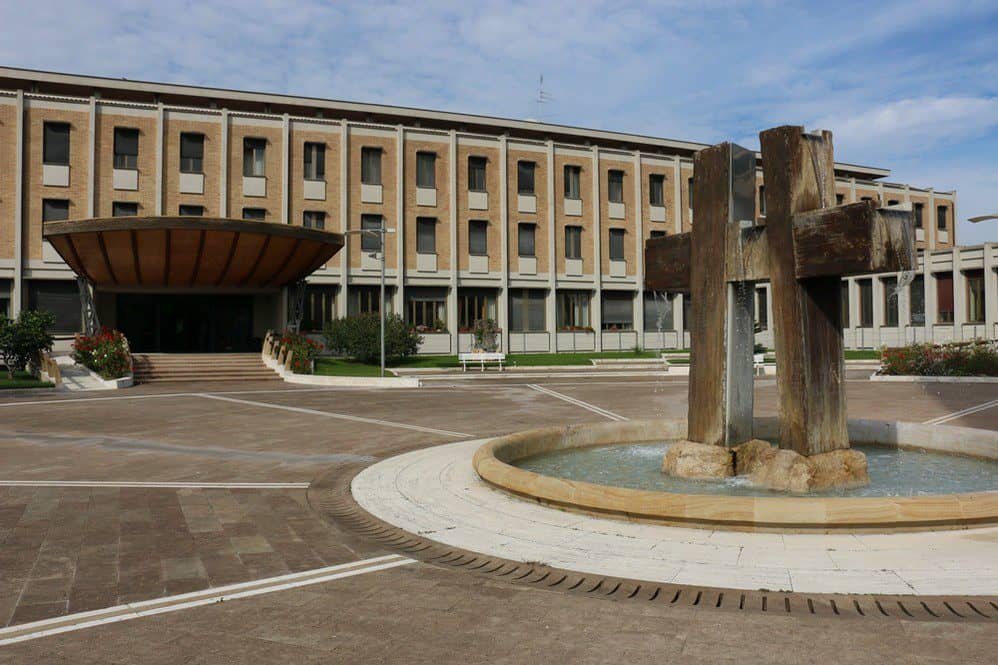
The Franciscan Museum - Capuchin Historical Institute is at Circonvallazione Occidentale 6850, on the Grande Raccordo Anulare at kilometer 65.050, in the Bravetta district, 00163 Rome, inside the Collegio Internazionale San Lorenzo da Brindisi. You don't get in by walking through the main door: visits are by appointment only, and the guided visit is free. You book through the switchboard at +39 06 660521 or by writing to museo@istcap.org, and the institution's website is istcap.org. The window within which appointments are arranged is Monday 16:00-18:30, Tuesday, Wednesday and Friday 9:00-12:30 and 16:00-18:30, Saturday 9:30-12:30. On Thursday and Sunday the museum doesn't receive visitors, and July and August show up as closing months. There's no ticket: admission is free, and so is the guided tour. By car you leave the GRA at exit 32 Pisana and continue on the inner service road. The GPS point of the Collegio is 41.858044, 12.377125. By public transit, from Termini take line H to Capasso, then the 808 toward Ponte Galeria, get off at the request stop at via della Pisana 1100 and walk eight minutes. Confirm time and day when you book, because in a religious house the calendar also follows the life of the community.
If this is the first time you're finding your way among Rome's collections, the general map is on the page of Rome's museums: the Franciscan Museum is one of the few you visit by asking permission, and precisely for that reason it remains one of the most intact.
Where the Franciscan Museum - Capuchin Historical Institute is and how to get there
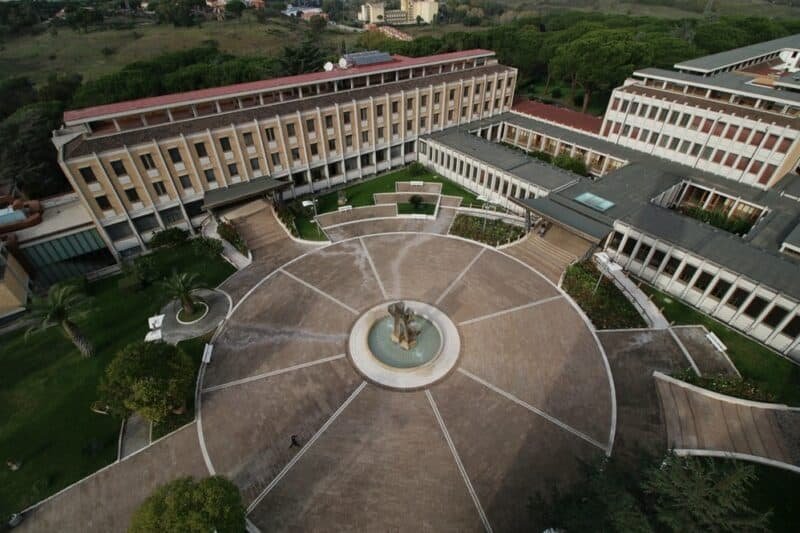
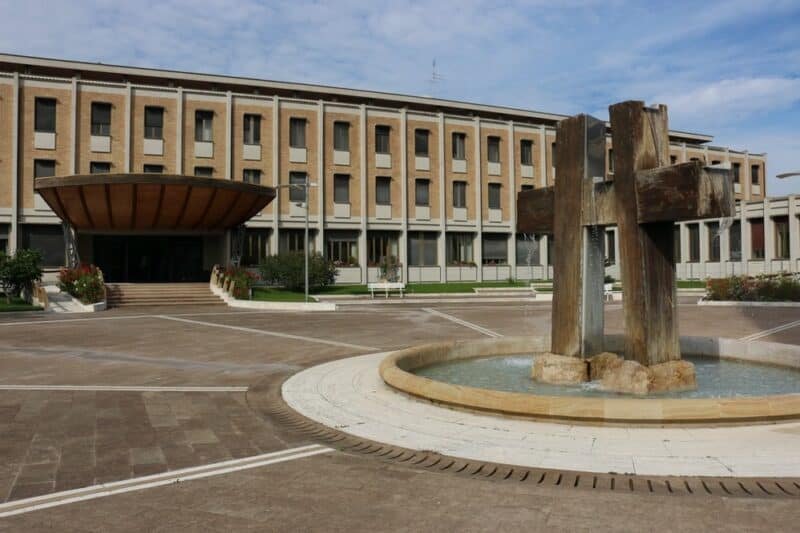
Geography matters more than usual here. The museum isn't downtown, isn't in a noble palace and has no sign you can see from the street: it occupies two levels of the Collegio Internazionale San Lorenzo da Brindisi, a large conventual building facing the Raccordo Anulare, in that corner of western Rome that Romans call Bravetta and that cab drivers call, more simply, the Pisana. Anyone who arrives expecting to find a city museum is thrown off: in front there is a house of study, with the gatehouse, the inner cloister, the library and friars passing by with folders under their arms. That is exactly why the detour is worth it.
By car to the Franciscan Museum
Coming from the south, that is, from the Naples motorway, you take the branch of the Raccordo toward exits 30, 31, 32 and 33 and continue on the service road. About 400 meters after exit 32, before the gas station, you turn right. Coming from the north, from via Aurelia or the Florence-Rome route, you make a U-turn on the overpass of exit 32 Pisana, come down onto the inner service road of the GRA following the sign for Civitavecchia on state road 1, and after 500 meters turn right. The GPS, if you search only for the name of the museum, often doesn't find it: enter the coordinates 41.858044, 12.377125 or the name of the Collegio San Lorenzo da Brindisi, which is the name under which the house is registered. The internal parking lot exists, but it is the courtyard of a religious community: ask at the gatehouse and don't assume you can leave the car in front of the entrance.
By public transit to the Franciscan Museum - Capuchin Historical Institute
The classic route starts from Termini: line H to the Capasso stop, transfer to the 808 toward Ponte Galeria, get off at the request stop at via della Pisana 1100, the one marked as Pisana G.R.A., and then about eight minutes on foot. Anyone coming from the via Gregorio VII area takes instead the 881 toward via Avvanzini, gets off on via della Pisana and from there transfers to the 808 with the same pattern. Two warnings on that stretch: the 808 is a low-frequency line, so allow plenty of margin, and the stop is on request, which means the button has to be pressed in time, otherwise you end up half a kilometer further on a road without a continuous sidewalk. If there are three or four of you, a car or a shared taxi is the honest solution.
The last eight minutes on foot
The last stretch is the most unpleasant of the whole trip, and nobody ever says so: you walk along a road designed for cars, with the noise of the Raccordo accompanying the whole way. Comfortable shoes, no suitcases, and in summer a hat. Then you pass through the gate of the Collegio and something curious happens: the traffic disappears, what remains is the green of the inner pine grove and the silence of a house of study. The contrast between the two minutes before and the two minutes after the gate is the first thing to notice.
Why the Franciscan Museum is not the Capuchin Crypt on via Veneto
Let's clear up right away the most frequent misunderstanding, the one that confuses half of Rome. In the city there are two Capuchin places that search engines happily mix up. The first is the Museum of the Capuchin Friars on via Veneto, the one under the church of the Immacolata Concezione, famous all over the world for its chapels lined with the friars' bones: it is open every day, you pay for a ticket, there are audioguides and a line. The second is the Franciscan Museum - Capuchin Historical Institute, which is on the other side of the city, has no bones, has no ticket office, has no line and opens only to those who have made an appointment.
They are two institutions of the same religious family with opposite missions. The crypt on via Veneto is a Baroque memento mori that has become a mass attraction. The museum in Bravetta is a study collection created to document, through objects, seven centuries of Franciscan history. Anyone who arrives in Bravetta expecting the macabre is disappointed. Anyone who arrives on via Veneto looking for a 13th-century painting on a gold ground is disappointed in the same way. Without mincing words: the crypt is the more overrated of the two experiences, the Franciscan Museum the most underrated in all of western Rome.
What the Franciscan Museum - Capuchin Historical Institute really is
The most honest definition comes from the Order itself, and it's worth quoting because it is programmatic: the Franciscan Museum is not an art, history or archaeology museum, even though it includes many objects of high artistic quality and great historical value. It belongs instead to the category of specialized museums. The specialization is Franciscanism in all its branches: Capuchins, Conventuals, Observants, Tertiaries, the women's families, the missions. The subject is not art, it is the Order. Art is the instrument through which the Order is told.
This changes the way you look at the rooms. In a picture gallery the criterion is the quality of the brush, and the mediocre panel is taken off the wall. Here the criterion is documentary capacity: a second-tier popular print, if it shows how a Capuchin blessed was depicted in a German province in the 17th century, is worth as much as an important oil. It's a museum that thinks in series and comparisons, and for this reason it has a strange effect on those who walk through it: after an hour you start to recognize the way a saint is constructed visually, decade after decade, until becoming a standard image.
The museum covers the span from the 13th to the 21st century and brings together painting, sculpture, drawing, engraving, ceramics, medallic art, early books, metalwork, textiles and vestments. It occupies two levels, traditionally called the Lower Gallery and the Upper Gallery, and has a historical archive, a library and a photo library, plus an in-house restoration laboratory.
The history of the Franciscan Museum: from Marseille to the Grande Raccordo Anulare
Few Roman collections have such an eventful biography. This museum was born in France, was broken up by an auction, emigrated clandestinely, crossed Italy twice, lived 13 years inside crates and came to rest only in 1968, in a house built to measure on the Raccordo Anulare. Anyone who knows it looks at the rooms with different eyes.
The 1884 book and the collection of Louis-Antoine de Porrentruy
At the origin there is a Swiss-French Capuchin friar, Father Louis-Antoine de Porrentruy, who in 1884 publishes a book on Saint Francis of Assisi. To illustrate it he gathers iconographic material: prints, drawings, holy cards, reproductions. It's the classic mechanism of the 19th-century scholar, whereby the documentation of a work ends up becoming more important than the work itself. At the end of the research Father Louis-Antoine finds himself holding a collection, and understands that this collection has a value of its own. That is how one of the most complete Franciscan museums in the world was born, out of an apparatus of notes.
Marseille 1885, the 1889 inauguration
In 1885, in the Capuchin convent of Marseille, the collection is organized as a proper Franciscan Museum. The official inauguration comes in October 1889 and is performed by the minister general of the Order, Bernardo d'Andermatt, the same person whose marble bust, the work of Giuseppe Sartorio, greets visitors today in the Roman atrium. That bust, which at first sight looks like any commemorative portrait, is in fact the museum's birth certificate turned into stone: it is the institutional founder placed at the entrance door.
Leo XIII's brief and excommunication for anyone who carries off a piece
In 1895 Pope Leo XIII signs an apostolic brief, the Minime nos latet, which protects the collection by forbidding the removal of the works under penalty of excommunication. It's not a courtesy formula: it is the harshest legal instrument the Church had available, applied to a museum. It served to prevent individual convents from taking back the pieces they had lent or donated, and to lock down the unity of the collection. That a pope puts excommunication in defense of an inventory says how seriously that collection was already considered at the end of the 19th century.
The French law, the flight and the 1905 auction
Papal protection could do nothing against French politics. After the 1901 law on associations and the anticlerical season that followed it, religious houses were stripped, and in 1905 part of the objects ended up at auction. Between 1903 and 1904 the most important pieces had already been taken out of France in secret, saved one load at a time. It's the most novelistic chapter of the story and the one least talked about: a religious collection dismantled in secret to keep it from public sale, with the friars playing the smugglers.
Rome 1912, via Boncompagni
Toward the end of 1912 the museum reopens in Rome, at the Capuchins' General Curia on via Boncompagni, with the pieces that escaped. In the same year the library of the Franciscan Museum is incorporated into what would become the Central Library of the Order: books and objects take parallel paths, and since then have never separated again.
Assisi 1927 and the solemn opening of November 29, 1929
In 1927 the collection is transferred to Assisi, where the Order was building its own center for historical studies, and it is solemnly opened on November 29, 1929. Assisi was the obvious symbolic choice: the museum of Saint Francis in the city of Saint Francis. It lasted a little over a decade.
The return to Rome in 1940 and the 13 years in crates
In 1940 everything returns to Rome, between via Sicilia and via Boncompagni, and here the story turns bitter: the museum stays closed until 1953. 13 years of crates, of war, of postwar and of reconstruction, with one of the richest Franciscan collections in Europe invisible to everyone. When it finally reopens, Italy is a different country and Rome is expanding toward the outskirts.
The summer of 1968 and the move to kilometer 65.050
In the summer of 1968 the Historical Institute and its museum move to the current site, the Collegio Internazionale San Lorenzo da Brindisi, on the Grande Raccordo Anulare at kilometer 65.050. The collections are distributed across about 40 rooms. It's the moment when the collection stops being a series of rooms carved out inside a curia and becomes a designed museum: routes, storerooms, drawings cabinet, restoration laboratory. In 1973 the catalog comes out, Il museo francescano. Catalogo, printed by the Istituto Storico Cappuccino itself, which remains the reference tool for anyone who wants to study the collections.
The Capuchin Historical Institute, home of the Franciscan Museum
The museum doesn't live alone. The full name of the place combines two realities, and the second is the one that explains the first: the Capuchin Historical Institute is a scientific research center, and the Franciscan Museum is its material section, the part you can look at instead of read.
November 14, 1930, Assisi
The Institute was born on November 14, 1930 in Assisi under the name Collegio di San Lorenzo da Brindisi in Assisi, at the wish of the Order's minister general, Melchiorre da Benisa. The first president was fra Cuthbert da Brighton, an English historian of the Order. The stated purpose is twofold and has not changed: scientific research and the care of publications in the Franciscan field, mainly Capuchin, and the promotion of cultural initiatives of interest to the life of the Order. In 1940 the Institute follows the museum to Rome, first between via Sicilia and via Boncompagni, then from the summer of 1968 at the site on the Raccordo. The current statute dates from 1995.
Collectanea Franciscana and Bibliographia Franciscana
Anyone who studies Franciscanism knows two titles that come out of this house. Collectanea Franciscana is the Institute's journal. Bibliographia Franciscana is the annual volume that surveys the world's scholarly production on the subject. Alongside them are series and reference works, including the Lexicon Capuccinum. Put brutally: while you look at a gold-ground panel in the Upper Gallery, downstairs someone is compiling the bibliography that will allow a researcher in Buenos Aires to find that panel in 10 years. The museum is the showcase of a knowledge factory, and this is its rarest trait.
The Capuchin Central Library
In the same Collegio is the seat of the Capuchin Central Library, formed in the second half of the 19th century and grown by absorption: the library of the Collegio San Fedele for the Missions in 1911, that of the Franciscan Museum in 1912, that of the Order's Historical Institute in 1940. Today it holds a heritage of about 120,000 cataloged units and about 2,200 periodical titles, of which more than 600 are still current. It's not a tourist library and you don't visit it out of curiosity, but knowing it's there changes the perception of the museum: the works are not orphans, they have behind them the tools to be understood.
How the Franciscan Museum - Capuchin Historical Institute is organized
The route is arranged over two levels and four sections. The division is not chronological but by type, and at first it throws you off: you go from the 20th century to the 13th and back, following the nature of the objects instead of the calendar. You get used to it quickly, and in the end you understand why the criterion is the right one for a museum that documents an institution and not an era.
Section I. The atrium and the vestibule of the Franciscan Museum
You start from the upper floor, in the atrium and the vestibule, where 20th-century paintings and sculptures are gathered. Two pieces hold the space. The first is the marble bust of Bernardo d'Andermatt, the work of Giuseppe Sartorio, datable to the first quarter of the 20th century: the minister general who inaugurated the museum in Marseille, put to act as the guardian at the entrance of the Roman one. The second is the polychrome stained-glass window with Capuchin Saints and Blesseds, from the second half of the 20th century, by fra Ugolino da Belluno. A practical tip: ask to cross the vestibule on a day of full sun, because a stained-glass window without light behind it is half a window.
Fra Ugolino da Belluno, the friar who painted
It's worth spending two lines on him, because his name comes back twice in the route. Fra Ugolino da Belluno, born Silvio Alessandri, was born in Belluno on December 15, 1919 and died in Rome on May 24, 2002. He was a religious, painter and sculptor, with a predilection for mosaic, sgraffito on fresco, fresco, etching and woodcut. He worked in dozens of Italian churches, from the apse of the parish church of Rocca Priora in 1972 to the sanctuary of San Gabriele dell'Addolorata at Isola del Gran Sasso, from the cathedral of San Benedetto del Tronto to the sanctuary of the Immacolata in Barletta. In the museum he appears twice, with the atrium stained-glass window and with a bronze in the Lower Gallery: it's proof that this house continues to produce the art it collects, instead of limiting itself to preserving it.
Section II. The Cabinet of Drawings and Prints
This is the most imposing section and the least visitable: 2,207 drawings and about 40,000 prints among engravings, etchings and woodcuts, from the 16th to the 21st century, all with Franciscan subjects. Access is reserved for scholars, and the reason is technical before it is hierarchical: paper is looked at sheet by sheet, in a controlled environment, with clean hands and with someone who knows how to put it back where it was. If you have a research project underway, you ask in writing and arrange it. If you are an occasional visitor, know that the museum continues even behind the doors you won't open. 40,000 prints mean that every Franciscan image that circulated in Europe over four centuries has here, in all likelihood, a copy or a close relative.
Section III. The Lower Gallery of the Franciscan Museum
The lower level includes a corridor, a large inner atrium and four rooms. It's the most varied part of the museum, the one where painting lives side by side with objects of liturgical use. Four pieces hold the stage. The Martyrdom of Saint Lawrence, oil on canvas from the second half of the 17th century, is by Guillaume Courtois, the French painter whom everyone in Rome called il Borgognone and who worked in the circle of Pietro da Cortona and Bernini: a solid hand, a theatrical layout, exactly the language that Baroque Rome asked of an altar canvas. Fidelis of Sigmaringen in Glory, oil on canvas from the first half of the 18th century, is by Sebastiano Conca, one of the most sought-after painters in the Rome of those years, Neapolitan-trained: the choice of subject is not accidental, because the Capuchin saint was beatified in 1729, and glories are painted when there's something to celebrate.
Then there are two pieces very different from each other. A lithograph of 1832 by V. Battistelli and Francesco Cilleni Nepis shows the basilica of Santa Maria degli Angeli in Assisi collapsed after the earthquake: it's a document, not a painting, and it serves as a reminder that this museum also collects the wounds of Franciscan places. And finally Saint Francis of Assisi Preaching to the Birds, a sculpted bronze from the second half of the 20th century, again by fra Ugolino da Belluno: the most overused subject of Franciscan iconography, treated by a friar with a dryness that removes all the sugar from it.
The liturgical furnishings and textiles of the Lower Gallery
The part that visitors always underestimate, and that enthusiasts should look at first, is the furnishings. There is a holy water bucket in chased copper from the 17th century, an object poor in material and very rich in work. There is a white stole that belonged to Pope Alexander VII, silk and silver, Italian manufacture of the mid-17th century: a papal textile that ended up in a Capuchin collection is already a story of relations between the Curia and the Order. There is an altar frontal with Saint Francis of Assisi, oil on gilded leather from a Neapolitan workshop, early 17th century: gilded and painted leather is a technique that almost nobody can read anymore, and that for two centuries was the elegant way to dress an altar without spending on silverware. And there is an 18th-century nativity scene in glazed terracotta, again from a Neapolitan workshop, which is the piece where children stop the longest.
A clear opinion, and I defend it: anyone who visits the Franciscan Museum looking only at the paintings misses half the museum. The objects of everyday use tell the Order much better than the canvases, because they show how people prayed, with what, and how little was enough.
Section IV. The Upper Gallery of the Franciscan Museum
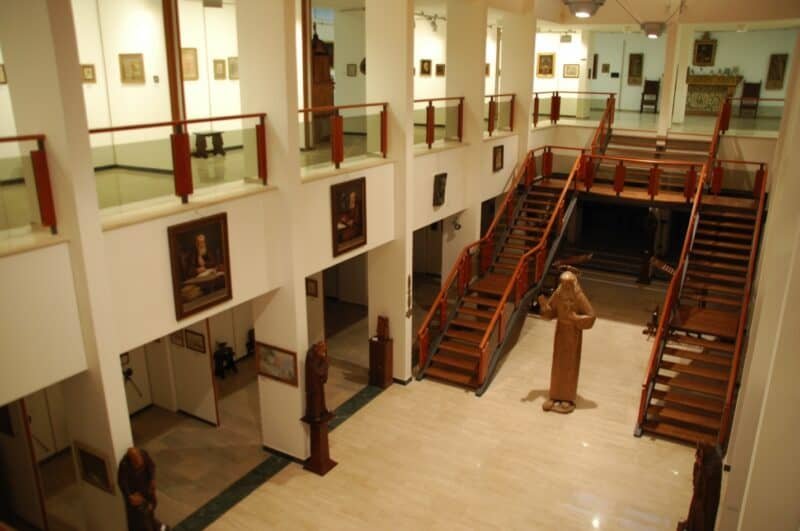
The large atrium of the upper floor, seven rooms and the small drawing rooms house the largest historical-artistic core. Here the chronology really unfolds, from the 13th to the 19th century, and here you understand what it means to document the image of a saint across six centuries. It's the part of the museum that by itself justifies the trip out to the Raccordo.
The works to look at first at the Franciscan Museum
If you have an hour and a half, and a guided visit generally lasts about that, it's worth knowing in advance where to concentrate. Here is the recommended order.
Saint Francis Showing the Rule and the Stigmata, last quarter of the 13th century
The tempera on panel by an anonymous Umbrian painter is the oldest and most important piece in the collection, and the Order's source describes it as a gold-ground panel by a Tuscan or Lazio master depicting Saint Francis of Assisi with the Rule. The double indication of the area, Umbrian in one entry, Tuscan or Lazio in another, is not an oversight: it is the correct way to say that the attribution remains open, as almost always happens with 13th-century panel painting lacking signature and documents. What is certain, instead, is the iconographic layout: Francis frontal, the book of the Rule displayed toward the viewer, the stigmata shown as credentials. In the 13th century this image is a legal document as well as a devotional one, because it asserts together the legitimacy of the approved Rule and the authenticity of the sign received at La Verna. Stop for at least five minutes: the gold ground is not decoration, it is the non-earthly space in which the saint is placed.
The 15th century: Fabriano, Saint Bernardino's monogram, the 1489 polyptych
Three panels tell the following century. A Saint Francis of Assisi and Devotees by an anonymous Fabriano painter, referred to the second or third quarter of the 15th century, with the classic disproportion between the saint and the kneeling patrons, which says everything about who really counted in that relationship. A Saint Bernardino of Siena with the IHS monogram on a book, dated 1450 and assigned to a pupil of Carlo Crivelli: the radiant monogram invented by Bernardino for his preaching was one of the most effective religious communication operations of the 15th century, and seeing it painted a few years after the preacher's death is like seeing a logo that has just been registered. And finally a compartment of a cusped polyptych with Saint Francis of Assisi and Saint Louis of Anjou, dated 1489, by the so-called Master of the Crivellesque Polyptychs: the conventional name signals an artistic personality that is recognizable but without documents, and it is one of the most honest labels that art history knows how to produce.
The portable triptych attributed to Ludovico Brea
On display in the Upper Gallery is a portable triptych altarpiece with the Madonna and Child, the Annunciation, the Nativity of Jesus and the Presentation of Jesus at the Temple, tempera on panel attributed to Ludovico Brea, the painter from Nice active between Liguria and Provence. On the altarpiece the labels oscillate between direct attribution and circle, and the proposed dating should be looked at with caution: here we are in the territory of traditional attribution, not of documents. Look at it for what it is, a travel altar: it was closed, carried in a saddlebag, opened in any room, and that room became a chapel. It's the object that explains better than any text how people prayed away from home in the 16th century.
Paul Bril, Saint Francis Receives the Stigmata, 1583
A curt date, 1583, on a canvas by Paul Bril, the Fleming from Antwerp who in Rome taught all of Italy how to paint a landscape. In the stigmata painted by him the protagonist risks being the mountain: rocks, trees, sky, and inside the landscape the sacred scene. It is exactly the revolution that the Flemish brought to Roman painting at the end of the 16th century, and finding a dated example in a Franciscan collection is a stroke of luck. Anyone who knows northern landscape should stop here more than anywhere else.
Trophime Bigot, Saint Francis of Assisi in Prayer, 1630-1634
My favorite piece. Trophime Bigot, a Provençal active in Rome, is the painter whom scholars long called the Master of the Candle for his obsession with artificial light sources inside the picture. A Francis in prayer painted by him means almost total darkness, a low light source, the hollowed face and the hands emerging from the shadow. It's second-generation Caravaggism, the kind that gives up the theatrical gesture and keeps only the silence. If I had to save a single canvas in this museum, I would save this one.
The Cavalier d'Arpino, the Pomarancio, Gerard Seghers
The Upper Gallery also gathers three names that any enthusiast of Roman 17th-century art recognizes. Giuseppe Cesari, known as the Cavaliere d'Arpino, signs a Saint Francis of Assisi in Ecstasy Supported by Angels, oil on canvas from the first half of the 17th century: late Mannerist elegance, polished bodies, no concession to realism, that is, the exact opposite of what Caravaggio was doing, who had nonetheless worked in Cesari's workshop as a very young man. Cristoforo Roncalli, known as the Pomarancio, signs a Saint Francis of Assisi Receives the Stigmata placed between the last quarter of the 16th century and the first quarter of the 17th. Gerard Seghers, a Fleming, signs a Saint Francis and Saint Clare of Assisi Adoring the Infant Jesus from the first half of the 17th century: the pair of Francis and Clare together is less frequent than you would think, and is worth the stop.
Cosimo da Castelfranco, a painted marble
Then there is a Saint Francis of Assisi Consoled by Angelic Music on painted marble, assigned to Cosimo da Castelfranco and placed between the end of the 16th century and the beginning of the 17th. The support is the oddity: painting on a slab of marble was a learned and expensive fashion, practiced in Rome between the 16th and 17th centuries, which exploited the veining of the stone as sky or as cloud. Cosimo da Castelfranco is the religious name of a painter from the Veneto who entered the Capuchins, and this explains the presence of the work in a collection of the Order: that is not a commission, it is a vocation.
Francesco Gessi and Francesco Grandi
Closing the survey are two works on paper and on canvas that tell of two distant centuries. A Madonna and Child with Saint Francis of Assisi, a drawing from the first half of the 17th century by Francesco Gessi, a Bolognese pupil of Guido Reni: the drawings on display are few compared with the 2,207 held, so every sheet in the case should be looked at as a privilege. And a Saint Lawrence of Brindisi in the Battle at Alba Reale, a sketch from the second half of the 19th century by Francesco Grandi, a Roman painter of the time of Pius IX. The sketch is the phase in which the painter decides, and for this reason it is almost always more alive than the finished picture.
The numbers of the collections of the Franciscan Museum
The figures help to understand the proportion between what is seen and what is kept. The museum holds about 500 paintings, 230 between sculptures and statues, over 600 between ceramics and porcelains, 1,993 between medals and coins, 2,207 drawings and about 40,000 prints. This means that the displayed part is a minimal fraction of what is owned, and that most of the Franciscan Museum - Capuchin Historical Institute lives in the storerooms and in the drawers of the Cabinet. It's not a flaw: it's the normal condition of every documentation museum, where the storeroom is the museum and the room is the anthology.
The medal collection in particular is a section that would deserve an exhibition of its own. Almost 2,000 medals and coins mean jubilees, canonizations, foundations of convents, anniversaries, missions: the history of the Order told in metal, one event at a time. If you have a specific interest, state it when you book: in a house of study a reasoned request is heard far more than in a museum with a turnstile.
Who the Capuchins were: the Order as told by the Franciscan Museum
A museum that documents an Order can only be understood if you know where that Order comes from. The story of the Capuchin friars minor is one of the most interesting of the Italian religious 16th century, and the rooms in Bravetta illustrate it object by object.
Matteo da Bascio and 1525
It all begins around 1525 with an Observant friar minor ordained a priest in the Marche, Matteo da Bascio, convinced that his religious family had drifted away from the original way of life of Saint Francis. His was not a theological polemic but a question of form of life: real poverty, itinerant preaching, eremitism. In the Marche of the early 16th century this was an uncomfortable position, and Matteo was forced to flee.
Religionis zelus, 1528
In 1528 comes the approval of Pope Clement VII with the bull Religionis zelus, obtained thanks to the mediation of Caterina Cybo, duchess of Camerino. It's one of the cases in which a woman of the Italian nobility determines the fate of a religious order, and it's worth remembering, because in the current narratives she always disappears. Without that mediation, in all probability the movement would have been reabsorbed.
The chapter of Acquarella, April 15, 1529
On April 15, 1529, in the hermitage of Acquarella near Fabriano, the first general chapter of the Order is held. It is the institutional birth date of the Capuchins. The hermitage, not the basilica: the place states the program.
The hood and the beard
The first Capuchins found refuge with the Camaldolese monks and from them adopted the hood, which in the Marche was the recognizable sign of the hermit, together with the use of the beard. Hence the popular name, which later became official. It's worth fixing in mind, because it's one of the rare cases in which a nickname given by ordinary people ends up inside canon law: the friars did not choose to call themselves Capuchins, it was the Romans and the people of the Marche who called them that, looking at the habit.
The distinguishing marks of the Order
The characteristics the Order gave itself and that still define it today are few and sharp: a particular attachment to prayer, care of the poor and the sick, itinerant preaching in the rural areas that no one else reached, the habit with the hood, the beard, and a vow of poverty interpreted in a radical sense. In the rooms of the Franciscan Museum this choice can be read in the objects: copper instead of silver, terracotta instead of fine porcelain, painted leather instead of goldsmithing. When a precious piece appears, it is almost always a gift received, not a commission.
The crisis of 1542 and the recovery
Not everything went smoothly. In 1542 the vicar general of the Order, Bernardino Ochino, one of the most listened-to preachers in Italy, joined the Protestant Reformation and left Italy. For a newly born order it was a very hard blow, and there were those who asked for its suppression. The Capuchins survived, and their reaction was to close in on popular preaching and on assistance, that is, on what they knew how to do best.
1574: Gregory XIII's permission
In 1574 Pope Gregory XIII allowed the Order to settle in France and in all other parts of the world and to erect there houses, places, custodies and provinces. Until then the Capuchins had been in effect confined to the Italian peninsula. From that date on, Capuchin Franciscanism becomes a worldwide phenomenon, and this explains why in the display cases in Bravetta Italian, Spanish, German, French and non-European mission artifacts live side by side.
The Order's numbers between the 16th and 18th centuries
During the 16th century the Order came to count about 14,000 friars in almost a thousand convents. Between 1600 and the middle of the 18th century the numbers rose to about 34,000 friars and 1,700 convents. These are figures that seem incredible today and that explain the quantity of iconographic material preserved: every convent produced images, every province celebrated its own blesseds, every canonization generated a campaign of prints.
The saints you will meet in the rooms of the Franciscan Museum
Three names recur more than the others, and knowing them in advance makes the visit much denser. Saint Felix of Cantalice, born on May 18, 1515 and died in Rome on May 18, 1587, on the day of his 72nd birthday, was the first canonized Capuchin: a peasant, the questing friar of the convent of San Bonaventura from 1547, he went barefoot around Rome with a sack on his shoulder greeting people with a Deo gratias that earned him his nickname. Beatified in 1625 by Urban VIII, canonized on May 22, 1712 by Clement XI. Saint Fidelis of Sigmaringen, whose birth name was Mark Roy, born on October 1, 1577, a lawyer before being a friar, was killed at Seewis in the Grisons on April 24, 1622 during an uprising, a few weeks after being appointed by the newly founded Congregation of Propaganda Fide as superior of the missions in that region: beatified in 1729, canonized in 1746. Saint Lawrence of Brindisi, whose birth name was Giulio Cesare Russo, born in Brindisi on July 22, 1559 and died in Lisbon on July 21, 1619, polyglot, exegete, vicar general of the Order from 1602: beatified in 1783, canonized on December 8, 1881 by Leo XIII and proclaimed a doctor of the Church in 1959 by John XXIII with the title of doctor apostolicus. It is he who gives his name to the Collegio inside which the museum stands, and it is he who is the protagonist of Francesco Grandi's 19th-century sketch.
A curiosity about the Franciscan Museum - Capuchin Historical Institute
The curiosity that no guide tells concerns a document from 1895. In that year Pope Leo XIII signed an apostolic brief titled Minime nos latet with which he forbade the removal of works from the Franciscan Museum under penalty of excommunication. It was not a rhetorical hyperbole: it was the gravest canonical sanction, applied to anyone who carried off a drawing, a print, a statuette. A museum protected by excommunication is an absolute rarity in the history of European collecting, and it says two things at once.
The first is that at the end of the 19th century the collection was already considered a unitary asset and not a warehouse of objects lent by convents. The friars who had given up a piece to the Marseille collection tended, as is human, to want it back when the guardian or the province changed. The papal brief served to stop exactly that hemorrhage. The second is that legal defense was not enough against politics: a few years later, French anticlerical legislation did what no friar would have dared, and in 1905 part of the objects ended up at auction. Excommunication could stop a religious, not an auctioneer.
From here comes the character of today's Franciscan Museum, which is a defensive character in the best sense of the term. The objects that escaped were taken out of France secretly between 1903 and 1904, put back together in Rome in 1912, transferred to Assisi in 1927, brought back to Rome in 1940, shut in crates until 1953 and finally settled on the Raccordo in 1968. When you look at a display case in Bravetta, you are looking at material that has gone through a law of suppression, an auction, a clandestine expatriation, two international moves and a world war. This is the reason why, in this house, works are not lent lightly and the room opens only to those who have asked.
Something nobody tells you about the Franciscan Museum - Capuchin Historical Institute
That admission is free, almost nobody knows. And above all almost nobody knows that the guided visit is also free: you don't pay a ticket, you don't pay for the guide, and there's no bookshop acting as a disguised cash desk. Put like that it sounds like an advantage, and it is, but it comes with a consequence that has to be understood before leaving: with no ticket there's no time slot, and with no time slot there's no guaranteed schedule. Everything goes through the appointment. Anyone who shows up at the gate without having written or called seriously risks making the trip for nothing, and the disappointment has nothing to do with the friars' discourtesy: simply, in a house of study there are no gallery staff waiting for visitors.
The second little-known piece of information concerns response times. The switchboard is that of the Collegio, +39 06 660521, and the museum's email address is museo@istcap.org. Anyone writing on a summer weekend may wait quite a while, because July and August show up as closing months and the community thins out in that period. The operational suggestion for anyone bringing groups: write at least two weeks ahead, indicate number of people, language, specific interests and two or three alternative dates. A precise request gets a precise answer. A generic request ends up at the bottom of the pile.
The third thing nobody tells you concerns the Cabinet of Drawings and Prints. 40,000 prints and 2,207 drawings are not accessible to the ordinary visitor, and not out of jealousy: displayed paper degrades, handled paper gets ruined, and a holding of that size is consulted with a library procedure. If you have a research project underway, even an amateur but serious one, the way exists and goes through a reasoned request to the Historical Institute. It's a door that opens to someone with a question, not to someone with generic curiosity: an unpleasant distinction, but it's the same as in any drawings cabinet in the world.
Last note, and it concerns expectations. In ministerial listings this museum appears under the bureaucratic formula of minor, diocesan or religious museum. The word minor, here, is an administrative category, not a judgment: it means non-state. The Franciscan Museum - Capuchin Historical Institute owns a 13th-century gold-ground panel, a dated Paul Bril of 1583 and a Bigot from the 1630s. In any European capital it would be a small picture gallery with a line outside.
The advice I give you for visiting the Franciscan Museum - Capuchin Historical Institute
Advice number one is banal and nobody follows it: book before buying the train ticket, not after. It happens that you organize a Roman day around this visit and discover at the last minute that the chosen day is a Thursday, when the museum doesn't receive visitors, or that the period is August. Fix the appointment, then build the day.
Advice number two concerns the time slot. Between the two available windows, the afternoon one of 16:00-18:30 and the morning one of 9:00-12:30, the morning is always better, and for a technical reason: the Upper Gallery lives on natural light and the 13th-century gold-ground panel changes completely depending on how the light hits the gold. The gold ground is not a flat surface, it is a structured mirror: with raking light you see the punch marks, with frontal light you lose everything. If instead your goal is fra Ugolino da Belluno's stained-glass window in the atrium, then an afternoon full of sun beats any morning.
Advice number three is to declare in advance what interests you. This is not a museum with a single mandatory route: it's a house of study, and whoever accompanies you is almost always someone who knows the subject from the inside. If you say you're interested in 17th-century painting, the visit takes one turn. If you say you're interested in the Capuchin missions or the medal collection, it takes another. A 40-minute visit can become two hours just because someone asked the right question at the start.
Advice number four is logistical and worth gold: don't squeeze this visit between two appointments downtown. Between going, coming back and changing buses you need at least three and a half hours door to door, and if the museum grabs you, you need four. Build the half day around Bravetta and the Pisana, not the other way around. Advice number five, finally: bring a notebook. In a museum where you don't buy a catalog at the register, because there is no register, your notes are the only souvenir you're left with.
Another well-known fact, yet seldom mentioned
The fact is this: by ministerial decree of September 15, 1965, the Franciscan Museum is registered among Italy's non-state museums as minor, diocesan or religious museum number 246. You find it written everywhere, in the listings, in the directories, on the panels, and almost nobody stops to ask what it really entails. It entails a lot, and it concerns directly anyone organizing the visit.
First consequence, the practical one. The Franciscan Museum - Capuchin Historical Institute is not a civic museum and not a state museum: it belongs to the Order of Friars Minor Capuchin, that is, to an ecclesiastical body. So the MIC Card of the Comune di Roma is of no use, the Roma Pass is of no use, ministerial cards are of no use, the free Sunday at state museums has nothing to do with it. They aren't needed because there's nothing to discount: you get in free anyway, by appointment. Anyone who arrives with a card in hand thinking of skipping a line discovers that neither the line nor the turnstile exists.
Second consequence, the historical one. The 1965 registration comes at a precise moment in the life of the institution: three years before the 1968 move to the Raccordo. It's the public recognition of a collection that, at that moment, was still housed in the spaces of a general curia in the city. The ministerial decree photographs a museum that was about to be reborn and certifies that what the Capuchins were keeping was of interest to the Italian State as well.
Third consequence, the cultural one, and the most interesting. The category of religious museums in Italy gathers some of the richest and least visited collections in the country: diocesan museums, cathedral treasuries, collections of religious orders. They are places with little staff, little communication, difficult hours, and with works inside that in public picture galleries would be in the first room. The Franciscan Museum is the textbook case: a dated Paul Bril, a Bigot, a Conca, a Courtois, a Cavalier d'Arpino, and a 13th-century panel, in a place you reach with two buses and a phone call. If you want to compare, look at how the city's great museums are organized on the page of Rome's state museums: the difference in apparatus is abysmal, the difference in the quality of the individual works much less.
The right photo to take at the Franciscan Museum - Capuchin Historical Institute
First rule, and it's worth more than any technical advice: ask permission at the start of the visit, not at the end and not after the shot has already been taken. In an ecclesiastical museum with no ticket office the conditions for photographing are set by whoever accompanies you, and they can vary from room to room, because some pieces are on loan or in delicate conservation condition. A question well asked at the gatehouse is worth 10 apologies afterward.
That said, the photograph that brings home the sense of the place is not the close-up of the masterpiece. You'll find the close-up of the painting already done better in the catalogs, and under reflective glass what you'll bring home is mostly your own face. The right photo is the one that holds work and context together: the Upper Gallery seen in perspective along the enfilade of rooms, with the frames chasing each other and the light diminishing in intensity as it recedes. It's the image that tells what a documentation museum is, that is, a series, not a piece.
The second framing I recommend is fra Ugolino da Belluno's stained-glass window in the atrium, shot against the light with the sun behind. The polychrome glass of the late 20th century has a saturation that modern cameras render beautifully, and the Capuchin saints and blesseds depicted become a palette. Underexpose by two-thirds of a stop, otherwise the white of the haloes burns everything out.
The third is the bust of Bernardo d'Andermatt by Giuseppe Sartorio, photographed three-quarter with side light. The early 20th-century marble has a rendering of the beard and the habit that disappears in frontal light and explodes in raking light. And if you have patience, the fourth photo, the best: the gate of the Collegio with the Raccordo Anulare behind. A museum that holds a 13th-century panel facing Rome's ring road is a visual short circuit that explains the city better than a thousand postcards of the Colosseum.
One thing not to do: flash. On paper, textiles and painted wood it's forbidden almost everywhere and here all the more so, with a holding of 40,000 prints that is preserved precisely by avoiding light. If the room is dark, raise the sensitivity and lean on the doorframe: a tripod, in a religious house and in tight spaces, is almost always too much.
Some important events that happened here in history
The first event in chronological order did not happen in Rome but in Marseille, in October 1889, and it is the official inauguration of the Franciscan Museum by minister general Bernardo d'Andermatt. Four years earlier, in 1885, the collection of Father Louis-Antoine de Porrentruy had been organized as a museum inside the city's Capuchin convent. In 1889 it becomes an institution. These are the two founding dates, and without them Bravetta would not exist.
The second event is from 1895 and is Leo XIII's apostolic brief Minime nos latet, with the ban on removing works under penalty of excommunication. In the life of a 19th-century European museum it is an exceptional fact, and it's worth repeating because it is the reason a substantial part of the collection has come down to us united.
The third event is dramatic and falls between 1903 and 1905. After the French law of 1901 on associations and the season of suppressions that followed, the most important pieces were transferred out of France in secret between 1903 and 1904. In 1905 what remained was sold at auction. It is the only moment in which the collection truly loses a part of itself, and those who study the museum today also work to reconstruct what was scattered in that sale.
The fourth event is the Roman rebirth of the end of 1912, at the General Curia on via Boncompagni. In the same year the museum's library merges into the holdings that will become the Capuchin Central Library: from then on, books and objects travel together.
The fifth event is November 29, 1929 in Assisi, with the solemn opening of the museum in the new seat of the Historical Institute, where the collection had been transferred in 1927. It was the moment of maximum symbolic coherence in its history: the Franciscan museum in the city of the saint. A year later, on November 14, 1930, the Capuchin Historical Institute is formally born in Assisi under the name Collegio di San Lorenzo da Brindisi, at the wish of minister general Melchiorre da Benisa, and the first president is fra Cuthbert da Brighton. Museum and Institute become one thing, and have remained so.
The sixth event is the return to Rome in 1940, with the very long period of closure that follows: the museum stays inaccessible until 1953. 13 years of silence that coincide with the war and the reconstruction. Anyone entering the Upper Gallery today should know it: in that stretch of the century those panels spent more time in crates than they have spent on walls.
The seventh event is the ministerial decree of September 15, 1965, by which the museum is registered among Italy's non-state museums at number 246 in the category of minor, diocesan or religious museums. It is the Italian public recognition after 80 years of life.
The eighth and last event is the summer of 1968, the move to the Collegio Internazionale San Lorenzo da Brindisi on the Grande Raccordo Anulare and the distribution of the collections across about 40 rooms. Five years later, in 1973, the catalog published by the Istituto Storico Cappuccino comes out, which remains to this day the fundamental tool of consultation. Since then the history of the Franciscan Museum - Capuchin Historical Institute has been the quieter one of a museum that studies, restores, catalogs and opens the door to whoever knocks in advance.
Who passed through the Franciscan Museum - Capuchin Historical Institute
Anyone expecting the list of Grand Tour travelers will be left empty-handed: this museum, in its current location, is less than 60 years old, and its story is one of scholars more than celebrities. But the names are there, and they are names that carry weight.
The first is Father Louis-Antoine de Porrentruy, the Capuchin who in 1884 published the book on Saint Francis and who, gathering the material to illustrate it, found himself the founder of a museum. He is the man without whom none of this would exist, and his figure sums up an entire season of European religious erudition.
The second is Bernardo d'Andermatt, minister general of the Capuchins, who inaugurated the collection in Marseille in October 1889. He passed through here in a literal sense, because his portrait sculpted by Giuseppe Sartorio is the first thing you meet entering the atrium of the Roman museum. It's hard to find a more physical continuity between founder and institution.
The third is Pope Leo XIII, who in 1895 signed the brief Minime nos latet. He never set foot in the rooms, but his signature on paper protected those rooms for decades: he passed through here by way of a legal act, which in an ecclesiastical institution is a way of being present no less concrete than a visit.
The fourth is fra Cuthbert da Brighton, English historian of the Order and first president of the Institute founded in 1930, together with minister general Melchiorre da Benisa, who wanted it. They are the two who turned a collection into a research center, that is, the move that saved the museum from being a deposit of memories.
The fifth is fra Ugolino da Belluno, born Silvio Alessandri, 1919-2002. He didn't pass through here: he worked here. The atrium stained-glass window and the bronze of Saint Francis preaching to the birds are his, and they make him the only contemporary artist who in the Franciscan Museum is both author and element of the collection.
The sixth chapter concerns those who passed through this house without ever having entered it: the artists whose works arrived here. Guillaume Courtois, the Borgognone of Roman 17th-century art. Sebastiano Conca, prince of the Accademia di San Luca in the full 18th century. Paul Bril, the Fleming who rewrote the Italian landscape. Trophime Bigot, the Provençal of the candles. Giuseppe Cesari, Cavalier d'Arpino, in whose workshop the young Caravaggio passed. Cristoforo Roncalli, known as the Pomarancio. Gerard Seghers, from Antwerp. Francesco Gessi, a pupil of Guido Reni. A pupil of Carlo Crivelli and the Master of the Crivellesque Polyptychs for the Marche 15th century. And the anonymous Umbrian painter of the 13th century who left the oldest panel of all. A list that in any public gallery would be the poster of the exhibition of the year.
The seventh and last group is the one that keeps passing through: scholars. The Cabinet of Drawings and Prints, the historical archive, the photo library and the Capuchin Central Library with its 120,000 cataloged pieces make this house a necessary stop for anyone working on Franciscanism, from the history of the Order to the iconography of saints, from the history of the missions to devotional medallic art. None of them will end up on a plaque. They are, however, the reason the museum still exists.
How long the visit to the Franciscan Museum takes and how to organize it
On duration you have to be realistic. The free guided visit of the Franciscan Museum generally lasts between an hour and an hour and a half, which is the right time to go through the atrium, the Lower Gallery and the Upper Gallery calmly. If you have specific interests and declared them at the booking stage, it can easily reach two hours. Add the trip: from Termini, by public transit, allow at least an hour each way, and don't do the math on the theoretical times of the lines, because the 808 is not the subway.
A tested scheme for a half day: appointment in the morning at 9:30, visit until 11, exit around noon, long lunch along the Pisana or in Monteverde, afternoon dedicated to Trastevere and the Janiculum, which from the area you reach without crossing the whole city. Alternatively, an afternoon appointment at 16:00 and return to the center at dinner time. What I advise against is trying to squeeze Bravetta between the Vatican Museums and the Colosseum on the same day: you arrive in a rush, you look badly and you waste one of the quietest visits Rome offers.
The Franciscan Museum with kids and with groups
With kids it works better than you'd expect, on two conditions. The first is to say so when you book, because a visit designed for scholarly adults and a visit for a family with eight-year-olds are not the same job. The second is to focus on objects and not on paintings: the 18th-century nativity scene in glazed terracotta from a Neapolitan workshop, the chased copper bucket, the medals, the textiles. Kids read objects of everyday use very well and get bored in front of a row of dark canvases. The bronze of Saint Francis preaching to the birds is the other piece that always works.
With groups the picture changes. There are no large rooms here and not many staff: a group of 15 people is already demanding, one of 30 is unrealistic without a precise agreement. If you accompany a professional group, write introducing yourself, indicate the language, the exact number and the specific interest, and propose alternative dates. And prepare people before they get on the coach: anyone arriving knowing they will enter a house of study behaves accordingly, anyone arriving thinking of a museum with an audioguide does not.
Accessibility and services at the Franciscan Museum - Capuchin Historical Institute
On this point there's only one rule: ask when you book, and ask specifically. The museum is laid out on two levels, Lower Gallery and Upper Gallery, inside a conventual building of the 1960s. There is no detailed public information on elevators, ramps and equipped restrooms, and in a place that opens by appointment the correct answer comes directly from whoever opens the door. Anyone who gets around in a wheelchair or with mobility difficulties should mention it in the first communication, also indicating if they are traveling by car: vehicle access to the Collegio, in that case, radically changes the feasibility of the visit.
As for services, the picture is that of a research body: historical archive, library, photo library, restoration laboratory, guided visits. Don't expect a cafeteria, cloakroom, luggage storage or shop. Bring little with you, because there's nowhere to leave bags, and don't count on a bar at the exit: the area is that of the Raccordo, not of the historic center.
How much the Franciscan Museum costs and why the Rome cards aren't needed
Cost: zero. Admission is free and so is the guided visit. It is one of the very few places in Rome of this caliber where the word free doesn't hide a clause, and the reason is simple: the museum belongs to an ecclesiastical body, the Order of Friars Minor Capuchin, and is not run as a commercial activity. Being neither civic nor state, the Franciscan Museum - Capuchin Historical Institute stays outside the card circuits: the city's MIC Card is valid in the Comune's museums, ministerial discounts are valid in the State's museums, and here neither is needed because there is nothing to pay. The same goes for the free-admission initiatives of the public calendar: anyone looking for the complete picture of the free-admission days in the city will find it on the page of free museums in Rome, but for Bravetta the entry is always the same, all year round.
A note on manners, which with religious places is never superfluous. Free doesn't mean without costs: the staff who accompany you are time taken away from research, and the upkeep of 40,000 prints doesn't pay for itself. An offering left at the exit, if there is a way to leave one, is the gesture that makes the difference between a visitor and a guest.
What to see around the Franciscan Museum
The area is not the historic center, and anyone who comes this far does well to build a sensible half day instead of running off. To the north, past the Pisana, opens the Pineto park, one of the most beautiful and least trodden green valleys of western Rome, with the historic pine grove and the farmhouse. Not far away, the Tenuta dei Massimi preserves a piece of the Roman countryside with its ditches and farmhouses, and is the right place to understand what this quadrant was before the building expansion.
To the south, along the Portuense, the archaeological quadrant is surprising: the necropolis of via Portuense and the museum of the Generosa catacombs tell of funerary and early Christian Rome away from the usual routes. They are places with particular opening regimes, often by reservation or on special openings: check beforehand, as for Bravetta.
If instead you want to end the day in style, the advice is to head down toward the Janiculum and Trastevere. From the Janiculum promenade you reach in a few minutes the basilica of Santa Maria in Trastevere and the cloisters of San Cosimato. It's the right way to follow the concentration of the museum with the breath of the city.
Other Franciscan and Capuchin places in Rome
Anyone who gets passionate about the subject has plenty to continue with. The Capuchin place par excellence, after Bravetta, is the church of San Felice da Cantalice at Centocelle, dedicated to the first saint of the Order, that barefoot questing friar who died in Rome in 1587 and whose iconographic memory the museum keeps. On the Franciscan but non-Capuchin side, the church of San Francesco a Ripa in Trastevere holds the cell in which, according to tradition, the saint lodged during his Roman stays, plus Bernini's Blessed Ludovica Albertoni. And the basilica of Santa Maria in Aracoeli on the Capitoline is the great Franciscan church of the center, with its Cosmatesque floor and tombs.
For anyone who instead wants to compare the painting seen in Bravetta with that of the city's great collections, the two natural terms of comparison are Palazzo Barberini, for the Roman 17th century, and the Galleria Borghese, for the relationship between collecting and devotion. Anyone who has fallen in love with the glazed terracotta of the Neapolitan nativity scene can continue to the Roman collection dedicated to ceramics. And anyone who wants to understand how much Franciscan patronage weighs in Roman sacred building has only to cross the river and look at the side chapels of Saint Peter's Basilica.
When to go to the Franciscan Museum and when to avoid it
The best period is spring, from March to June, and full autumn, from October to November: good light, reasonable temperatures for the eight-minute walk from the bus, community at full strength. July and August show up as closing months, so the summer window simply doesn't exist. Between December and January you have to take into account the liturgical calendar, which in a religious house conditions availability much more than civil holidays: Christmas, Epiphany and the days immediately around them are to be avoided when making the request.
On the day of the week, Tuesday or Friday morning is better. Monday it opens only in the afternoon, Saturday has a short window crowded with commitments, Thursday and Sunday the museum doesn't receive visitors. Tuesday and Friday mornings are the moments when the house is at the height of its working rhythm and when you are most likely to find someone willing to tell you more than the minimum. One last recommendation, which counts as a rule: confirm the appointment the day before. A confirmation message costs nothing and spares you the only truly irreparable thing about this visit, which is the wasted trip out to kilometer 65 of the Raccordo.
Quick questions about the Franciscan Museum - Capuchin Historical Institute
Where exactly is the Franciscan Museum - Capuchin Historical Institute?
At Circonvallazione Occidentale 6850, on the Grande Raccordo Anulare at kilometer 65.050, Bravetta district, 00163 Rome, inside the Collegio Internazionale San Lorenzo da Brindisi. The coordinates of the Collegio are 41.858044, 12.377125. The institution's P.O. box, number 18382, often appears in mailing lists and is not the postal code: that is 00163.
How much is a ticket to the Franciscan Museum?
Nothing. Admission is free and the guided visit is free too. There is no ticket office and no reduced rate, because there is no rate.
Do you need to book to visit the Franciscan Museum - Capuchin Historical Institute?
Yes, and it's the most important thing on the whole page: visits are by appointment only. You call +39 06 660521 or write to museo@istcap.org at least two weeks ahead, indicating date, time, number of people and language.
What are the opening hours of the Franciscan Museum?
The window within which appointments are arranged is Monday 16:00-18:30, Tuesday, Wednesday and Friday 9:00-12:30 and 16:00-18:30, Saturday 9:30-12:30. On Thursday and Sunday the museum doesn't receive visitors. July and August show up as closing months. Always confirm the exact time when you book.
Is the Franciscan Museum the same thing as the Capuchin Crypt on via Veneto?
No, and the mix-up is extremely common. The crypt with the bones is under the church of the Immacolata Concezione on via Veneto, opens every day and has a ticket. The Franciscan Museum - Capuchin Historical Institute is in Bravetta, on the Raccordo, is free and opens only by appointment. Same religious Order, very different places and purposes.
How long does the visit to the Franciscan Museum take?
Generally between an hour and an hour and a half. With specific interests declared in advance it can reach two hours. Add at least two hours of travel if you are coming from the center.
How do you get to the Franciscan Museum by public transit?
From Termini take line H to Capasso, then the 808 toward Ponte Galeria to the request stop at via della Pisana 1100, marked as Pisana G.R.A., and walk eight minutes. From the via Gregorio VII area you can use the 881 toward via Avvanzini to via della Pisana and from there change to the 808.
How do you get to the Franciscan Museum by car?
From the south you take the GRA branch toward exits 30-33 and continue on the service road, turning right about 400 meters after exit 32, before the gas station. From the north you make a U-turn on the overpass of exit 32 Pisana, come down onto the inner service road following the sign for Civitavecchia and after 500 meters turn right.
Can you take photographs at the Franciscan Museum - Capuchin Historical Institute?
Ask permission at the gatehouse at the start of the visit: in an ecclesiastical museum the conditions are set by whoever accompanies you and can change from room to room. Flash is always to be ruled out, for the conservation of paper, wood and textiles.
Are the MIC Card or the Roma Pass valid at the Franciscan Museum?
No, and they aren't needed. The museum belongs to the Order of Friars Minor Capuchin, so it falls outside both the civic museums circuit and the state museums circuit. Besides, there is nothing to discount, because you get in free.
What do you see at the Franciscan Museum?
Paintings, sculptures, drawings, engravings, prints, illuminated codices, ceramics, medals, textiles and liturgical furnishings that document the history of the Franciscan Order in all its branches, from the 13th to the 21st century. The route is arranged in atrium and vestibule, Cabinet of Drawings and Prints, Lower Gallery and Upper Gallery.
What is the oldest work in the Franciscan Museum?
A gold-ground panel from the last quarter of the 13th century with Saint Francis of Assisi showing the Rule and the stigmata, attributed to an anonymous Umbrian painter and, in other entries, to a Tuscan or Lazio master. The attribution remains open, the 13th-century dating does not.
How many works does the Franciscan Museum - Capuchin Historical Institute hold?
About 500 paintings, 230 between sculptures and statues, over 600 between ceramics and porcelains, 1,993 between medals and coins, 2,207 drawings and about 40,000 prints. The displayed part is a fraction of what is owned.
Can you access the Cabinet of Drawings and Prints?
Only scholars, with a reasoned request to the Historical Institute. The reason is conservation: it is a matter of 40,000 prints and 2,207 drawings, and paper does not withstand continuous exposure or free consultation.
Is the Franciscan Museum suitable for kids?
Yes, if you say so when you book and if you focus on the objects: the 18th-century nativity scene in glazed terracotta, the chased copper bucket, the medals, the bronze of Saint Francis preaching to the birds. In front of a sequence of dark canvases, on the other hand, the little ones get lost.
Is the Franciscan Museum wheelchair accessible?
There is no detailed public information on accessible routes. The museum occupies two levels of a conventual building: the thing to do is to ask the question explicitly when you book, also indicating if you are arriving by car.
Is there a bookshop or a cafeteria at the Franciscan Museum?
No. There's no shop, no cafeteria, no cloakroom. There is, however, a historical catalog of the collections, published by the Istituto Storico Cappuccino in 1973, which remains the reference tool for study.
Why is the museum called the Capuchin Historical Institute?
Because the museum is the material section of a research center founded on November 14, 1930 in Assisi as the Collegio di San Lorenzo da Brindisi, moved to Rome in 1940 and to the Raccordo in 1968. The Institute publishes the journal Collectanea Franciscana and the annual volume Bibliographia Franciscana.
What is the Capuchin Central Library?
It is the Order's library, housed in the same Collegio, born in the second half of the 19th century and grown by absorbing the library of the Collegio San Fedele for the Missions in 1911, that of the Franciscan Museum in 1912 and that of the Historical Institute in 1940. It holds about 120,000 cataloged units and about 2,200 periodical titles.
Since when has the Franciscan Museum existed?
The collection was organized as a museum in 1885 in the Capuchin convent of Marseille and officially inaugurated in October 1889. Rome from 1912, Assisi from 1927 with a solemn opening on November 29, 1929, Rome again from 1940 with reopening in 1953, current seat since the summer of 1968.
Why is the museum registered under number 246?
Because by ministerial decree of September 15, 1965 it was registered among Italy's non-state museums in the category of minor, diocesan or religious museum, with that number. The word minor indicates an administrative category, not a judgment on the quality of the collections.
Can you visit the Franciscan Museum in summer?
July and August show up as closing months, so plan between September and June. If your trip to Rome falls in midsummer, the visit to Bravetta has to be postponed.
Is it worth going all the way out to the Raccordo Anulare for this museum?
If you are interested in religious history, the iconography of saints, 17th- and 18th-century painting or simply in seeing a museum without crowds, yes, without hesitation. If you are looking for an hour-long attraction between two stops in the center, no: you would be in the wrong place and you would waste one of the most intense visits the city can offer.
What is the difference between the Franciscan Museum and Rome's other religious museums?
Specialization. A diocesan museum tells a territory, a basilica treasury tells a church. The Franciscan Museum - Capuchin Historical Institute tells a religious order in all its families and on all continents, from the 13th century to today, and does so with a research apparatus behind it that few others have.
Here is the overall verdict. This is the museum to recommend to anyone who says they have seen everything in Rome. Not because it is exotic, but because it overturns habits: you phone instead of standing in line, you enter a house instead of a monument, you don't pay and so you are not a customer, you are accompanied by someone who lives that subject instead of repeating it. Leaving, on the forecourt, you hear the noise of the Raccordo and you think that 200 meters from there is a gold-ground panel painted when Francis had been dead for only a few decades, and that this panel has gone through an excommunication, an auction, a clandestine expatriation and half of the 20th century in crates to end up here. Take your time. And write ahead: it is all they ask of you.
Article written by the editorial team of TourLeaderPro, contact them for Private/Corporate/V.I.P. Tours and Experiences.
Planning a trip to Rome? The English guides for visiting the city are on ItalyPlanner.com.