Church of San Felice da Cantalice
In short. Piazza San Felice da Cantalice 20, 00172 Rome. Prenestino-Centocelle district, Municipio V, and if you get off at the Mirti stop on Metro C you've practically arrived.
Piazza San Felice da Cantalice 20, 00172 Rome. Prenestino-Centocelle district, Municipio V, and if you get off at the Mirti stop on Metro C you've practically arrived. The Church of San Felice da Cantalice is not a church for a list of masterpieces. It is a brick shed 14 meters high, built between 1934 and 1935 in the middle of a borgata that was just being born, and since then it has served as the parish of a piece of Rome that tourists have never seen. Free admission. No ticket, no reservation, no turnstile. The practical information below comes from the parish website and from Turismo Roma, the official tourism portal of Roma Capitale, and refers to August 2026.
Mass times, as the parish publishes them: weekdays at 8:00 and 18:00. Sundays and holidays at 7:30, 9:30, 11:00 and 18:00, with the 11:00 Mass suspended in July and August. So in those two months, if you arrive on Sunday at noon thinking you'll slip into the main Mass, you find the church but not the service. The rosary is listed at 17:30 and vespers at 18:30. The parish office receives visitors on Monday from 17:00 to 19:00 and on Saturday from 9:00 to 12:00, while Tuesday to Friday you go by phone appointment. The Caritas desk opens on Wednesday from 16:00 to 18:00. The phone is 06 2305791, with a second number 06 23231748 and the Caritas number 06 23231646.
On one point the sources disagree. The parish website gives the Sunday evening Mass at 18:00 all year round. The Turismo Roma listing reports the same times but adds that in summer the evening Mass moves to 18:30. Half an hour of difference between two sources. If you're going for the Mass and not for the architecture, call: half an hour in Centocelle in August is the difference between going in and standing in the churchyard looking at the bricks.
Why Centocelle and not St. Peter's
Because the Church of San Felice da Cantalice is one of the very few places where you understand how Rome expanded in the 20th century without telling itself stories. The historic center explains the popes to you. This square explains the real city to you, the one where people live. The land that is now Piazza San Felice da Cantalice was donated to the Vicariate on November 14, 1929 by the Marquis Achille Muti Bussi: the date and the name are given in the ArchiDiAP listing, the digital archive of the Department of Architecture of Sapienza University. From there on it is a story of friars, shacks, bricks and a borgata that doubled every year.
The opposite is also true. If you come to Rome for three days and have the Colosseum, the Vatican Museums and Trastevere on your list, this church should not enter your program. There is no Caravaggio, no Bernini, no Cosmatesque floor. There is an apse mosaic from the 1960s that, once you understand what it depicts, stays with you longer than quite a few altarpieces. But it takes time and it takes interest. Anyone who comes to Centocelle with no desire to walk around the neighborhood goes back disappointed, and he's right.
Where exactly is the Church of San Felice da Cantalice
Piazza San Felice da Cantalice 20, postal code 00172, Prenestino-Centocelle district. The address with the street number is the one the parish publishes on its own website and that the Cathopedia listing repeats. Turismo Roma writes the same thing in the abbreviated form "Piazza di S. Felice da Cantalice, 20". The coordinates you find on the place-name listing of info.roma.it are 41.877046 and 12.566283, and Cathopedia expresses them as 41 degrees 52 minutes 37 seconds north and 12 degrees 33 minutes 59 seconds east: they are the same point. Centocelle is urban zone 7A of Municipio Roma V and includes the whole Prenestino-Centocelle district plus a southern slice of the Collatino, as the encyclopedia entry on the district puts it.
How to get to the Church of San Felice da Cantalice by public transportation
Metro C, Mirti stop. The station is under Piazza dei Mirti, at the intersection of Via dei Platani and Via dei Castani, and has been open since June 29, 2015. From there you walk, and you walk very little. Alternatively there are the trams: since May 26, 2025, as local news outlet Canale Dieci reported, lines 5 and 19 are back running along Via dei Castani in the stretch between Via delle Acacie and Via degli Ulivi, with the terminus at Piazza dei Gerani. The 5 runs Gerani-Termini, the 19 runs Gerani-Valle Giulia. For the numbers of the surface buses that touch the square, check the same day on the official app, starting from the exact address.
How much it costs to enter the Church of San Felice da Cantalice
Zero. It's a working parish, not a museum, and the parish website shows no price list, no fees, no reservation requirement for the individual visitor. There is no ticket office and no paid audio guide indicated by the parish. The only coin worth having on you is the one for the offering box, because here alms are not folklore: the parish runs a shelter and a Caritas desk, and the money ends up there.
How long it takes to visit the Church of San Felice da Cantalice
20 minutes inside, if you just look. An hour if you stand in front of the apse and try to read what Ugolino da Belluno put into it. Half a day if, as you should, you combine the church with a tour of the neighborhood: Via dei Castani, Piazza dei Mirti, the former Platino cinema across from the church, the archaeological park a few stops away. On its own the church doesn't justify a metro ride. With the neighborhood around it, it becomes one of the most honest Roman half days you can give yourself.
Who Saint Felix of Cantalice was, the friar who said Deo gratias to everyone
Before talking about bricks we have to talk about him, because the church and the square and half the street names of this piece of Centocelle depend on an illiterate shepherd boy from the province of Rieti. Felix was born in Cantalice around 1515 and died in Rome on May 18, 1587: these two dates are given by the listing of the Dicastery for the Causes of Saints on the causesanti.va site, which is the most institutional source one can cite on a Catholic saint. He spent 40 years of his life as an alms collector on the streets of Rome, with a knapsack on his shoulder, and the same Vatican listing calls him by the nickname the city had given him: "frate Deo gratias", because that was his habitual greeting.
He slept two or three hours a night and spent the rest in prayer. On the street he assisted the sick and the poor. The causesanti.va listing adds that he was a friend of Philip Neri and of Pope Sixtus V, and does not mention Charles Borromeo. Cathopedia, instead, tells that Charles Borromeo submitted the Rule of the Oblates to him and that the suggestions of this man who couldn't read were accepted. These are two different levels of authority, and they must be kept separate. Beatified on October 1, 1625 by Urban VIII, canonized on May 22, 1712 in the Vatican basilica by Clement XI, liturgical memorial on May 18.
One thing that is forgotten here in Rome: the body of Saint Felix is not in Centocelle. His relics are venerated in the church of Santa Maria della Concezione dei Cappuccini, below Via Veneto, the one with the ossuary crypt that everyone knows for its skulls. If you want to close the circle after seeing the Church of San Felice da Cantalice, the missing piece is there: the Museo dei Frati Cappuccini at Via Vittorio Veneto 27 publishes a full ticket at €10.00 and a reduced one at €6.50, with groups of at least 10 people at €7.50 and an online advance-sale fee of €1.50 per ticket. It's free under six, for people with disabilities, for national tour guides and for Capuchin friars. The hours given are 9:30-13:30 with last entry at 12:30 and 14:30-18:30 with last entry at 17:30.
Why the church in Centocelle is dedicated precisely to Saint Felix of Cantalice
Because the parish was entrusted to the Capuchin Friars Minor, and Felix is the first canonized saint of the Capuchin Order as well as the Roman alms collector par excellence. Putting his name on a borgata church in the 1930s meant writing on the facade who the church was addressed to: people who came from the countryside of Lazio with nothing in their hands. The decree establishing the parish bears the date of March 29, 1935 and the signature of Cardinal Vicar Francesco Marchetti Selvaggiani. Cathopedia also gives the title of the decree, "Sollicitudo omnium ecclesiarum". The saint, the neighborhood and the friars tell the same story, and for once it isn't rhetoric.
When Saint Felix of Cantalice joined the Capuchin Order
Here the sources quarrel. The listing of the Dicastery for the Causes of Saints writes that in 1544 he decided to join the Capuchins, that he did his novitiate at Fiuggi and that he took his vows in 1545 at the convent of San Giovanni Campano. Cathopedia writes instead that in 1533, after giving away his possessions to the poor, he asked to be admitted to a Capuchin convent near Cittaducale, and that he professed on May 18, 1543. The Centocelle parish itself, on its page dedicated to the saint, places the vows between the end of 1543 and the start of 1544 at Anticoli di Campagna and the religious profession in 1545 at Monte San Giovanni. Three versions, three dates. What they all agree on is the end: death in Rome on May 18, 1587, beatification in 1625, canonization in 1712.
Why Saint Felix called himself the donkey of the Capuchins
Because he carried the loads. Cathopedia reports that he described himself that way, the donkey of the Capuchins, and for a man who for 40 years went around Rome with the alms bag on his shoulders it was not a spiritual metaphor: it was the description of the job. Popular devotion then stuck another title on him, "saint of the children", for the healings of children attributed to him: so says the page of the Centocelle parish dedicated to the saint. The parish also tells the miracle of the silkworms, an infected breeding farm and the blessed leaves that supposedly multiplied the animals. It's hagiography, not chronicle.
Does Saint Felix's crucifix really exist inside the church
Yes, and it's in a chapel that bears that name. The official site of the Diocese of Rome, in an article of May 12, 2022, places an exhibition dedicated to the saint precisely in the "Cappella del Crocifisso detto di San Felice" inside the Centocelle parish. That exhibition, open from May 8 to 18, 2022, presented for the first time the so-called crown of Brother Felix, a full-size ceramic reproduction of the rosary the saint used, originally made of peach pit. The article cites the ceramist Barbara Lancia, the collector Eliseo Patacchiola and Vincenzo Scasciafratti of the Ilex cultural association of Cantalice. The exhibition ended years ago. The chapel did not. Ask in the sacristy where it is, because it has no big sign.
A curiosity about the Church of San Felice da Cantalice
The church is 14 meters high and not one meter more, because of airplanes. It's not a joke: the ArchiDiAP listing, the archive of the Department of Architecture of Sapienza, explicitly writes that the height of the building was limited to 14 meters because of the proximity of the Centocelle airport. So the very shape of the Church of San Felice da Cantalice, that low, wide gabled profile that looks like a Franciscan choice of humility, is in large part an aeronautical easement. Paniconi and Pediconi had to lay the church out horizontally because they couldn't raise it up.
This also explains why the bell tower is not a bell tower. Anyone expecting the Roman tower, the one you see from afar and which serves as your compass, is left disappointed: above the eaves line of the left wing there is a low structure, almost a kiosk with a flat roof, and that's it. In the rest of Rome the bell tower exists to be seen. Here the bell tower above all had to not be seen by the pilots.
The Rome-Centocelle airport was the first airport in Italy. The encyclopedia entry on the district dates it to April 15, 1909, when Wilbur Wright carried out demonstrations of his Flyer there. The Capitoline Superintendency, on the official listing of the archaeological park, writes that in 1909 the Rome Aviators' Club rented the area precisely on the occasion of the Wright brothers' visit, that in the 1920s it became the first Italian airport and that it was closed at the end of the 1950s. When the friars were putting the roof on the church, airplanes really did pass over their heads.
Why the Church of San Felice da Cantalice looks like a shed
Because in part it is one, by constraint and by choice. The Italian encyclopedia entry describes the church as "hut-shaped, clad on the outside in brick", and the word hut here is not an insult: it is the primitive form of the Christian basilica, the gabled roof on a rectangular box, proposed again in a rationalist key by two architects who in 1934 were barely 30. Mario Paniconi was born in 1904 and died in 1973. Giulio Pediconi was born in 1906 and died in 1999. Cathopedia sums up the style as Neo-Romanesque and Rationalist together, with a structure in reinforced concrete and brick. The English listing on the wiki dedicated to the churches of Rome speaks of Neo-Romanesque influenced by Modernism. These are three ways of saying the same thing: it is an ancient church conceived by people who had reinforced concrete in their heads.
Is the brick cladding of the Church of San Felice da Cantalice original
No, and this is one of those details that change the way you look at a facade. ArchiDiAP writes that originally the exterior was rough-plastered in ivory color and that the brick cladding came later, as a replacement. So the church you see today, all red brick and arches, is not the church the first parishioners saw in 1935: that one was light, almost sandy. Try to imagine it ivory in the middle of the packed earth of a borgata and you understand that the effect was completely different, much more Mediterranean and much less severe.
The facade, the arch and the saint painted above the door
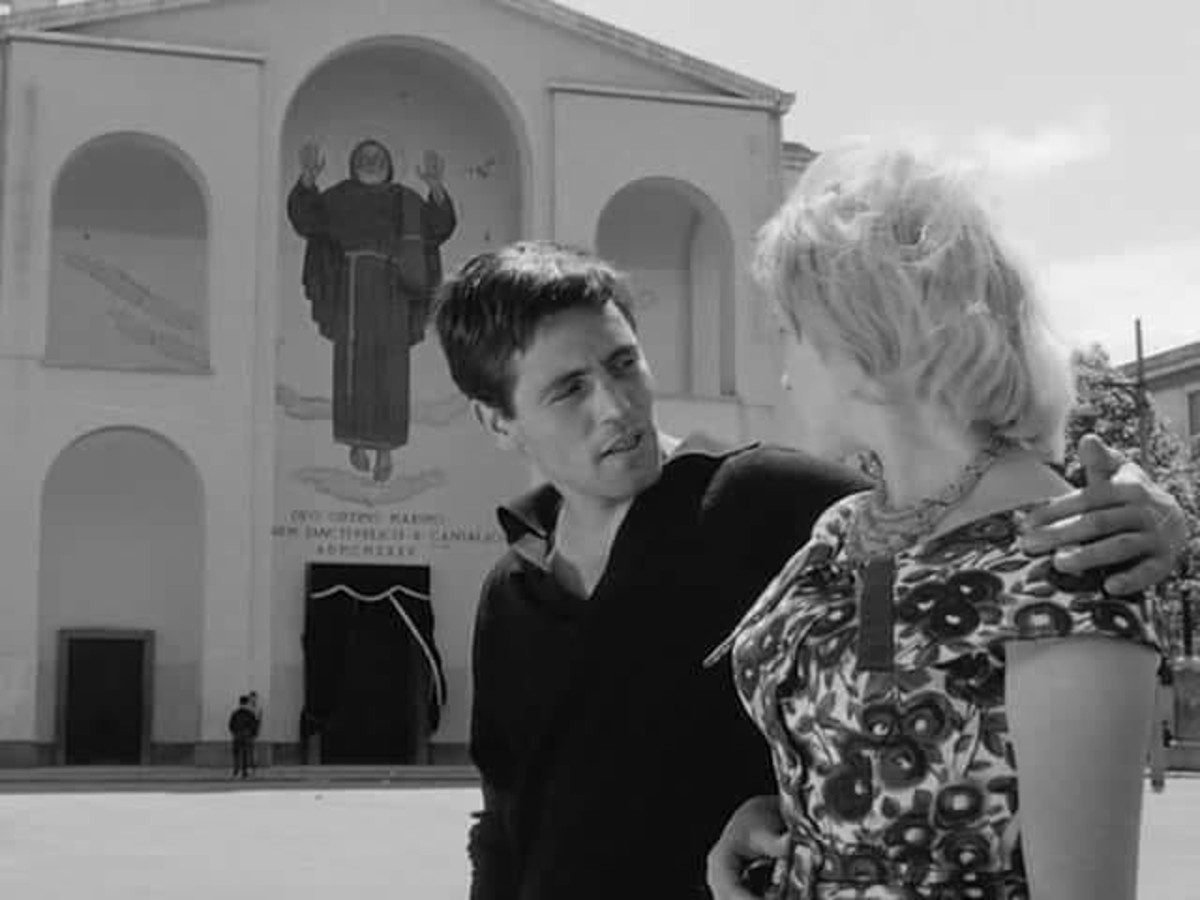
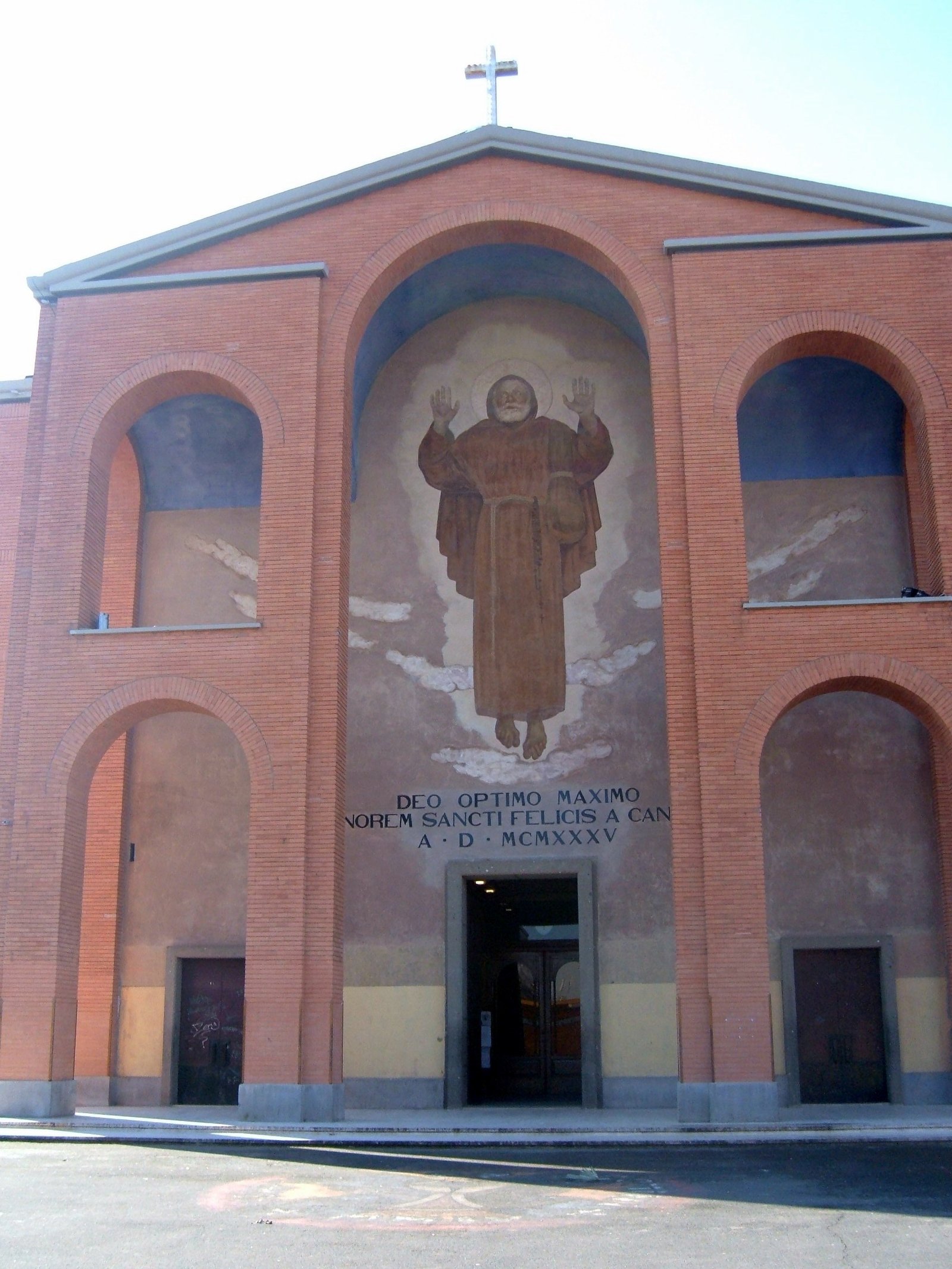
The facade of the Church of San Felice da Cantalice is a tall portico, and ArchiDiAP defines it with a precise formula: a diaphragm marked out by arches. It is not a classical pronaos with columns, and it is not a solid wall with three portals. It is a brick wall pierced by arches that acts as a filter between the square and the nave, and on sunny days it gives you a zone of deep shade right in front of the doors. In the central front, inside the large arch, there is the piece nobody looks at: a painting of 1935 of Saint Felix of Cantalice praying, the work of Rodolfo Villani. It has been there for exactly 90 years, outdoors, exposed to the Centocelle sun.
Below, the dedicatory inscription. Cathopedia gives it like this: DEO OPTIMO MAXIMO / HONOREM SANCTI FELICIS A CANTALICIO / A. D. MCMXXXV. 1935. It's the date the patron wanted carved, and it doesn't coincide with the consecration: that would come six years later, in the thick of the war.
Next to the entrance there is an out-of-place object and it's worth looking for it: an ancient column in cipollino marble with a wrought-iron cross on top. Cathopedia writes it and the Rerum Romanarum listing confirms it. A shaft of Roman marble, so reused material, planted in front of a church of 1935 in a neighborhood built over an imperial villa. If you're looking for the point where time overlaps in Centocelle, that's it, and it's less than two meters high.
Who painted the Saint Felix on the facade
Rodolfo Villani, in 1935. The name and the date are given both by Cathopedia and by the Italian encyclopedia entry, which speaks of a painting of Saint Felix praying on the facade, and by the Rerum Romanarum listing, which calls it a fresco. On the exact technique the sources use different words, some saying fresco and some simply painting, and no expert report that settles it appears to have been published. What is certain is that it's there, that it dates from 1935, that it is by Villani. The technical question remains open. Look at it in the low sun of late afternoon, when the arch doesn't cast its shadow over it.
What the inscription on the facade of the church means
It is the most classic Latin dedicatory formula there is, applied to a Capuchin saint. DEO OPTIMO MAXIMO means to God, best and greatest. HONOREM SANCTI FELICIS A CANTALICIO indicates the honor of Saint Felix of Cantalice. A. D. MCMXXXV is the year of the Lord 1935. Cathopedia gives it in the listing dedicated to the church. The interesting thing is not the translation, it's the choice: in 1935, in Rome, on a building of declaredly modern architecture, they write in Latin with Roman numerals. This church lives exactly on the fault line between the two things.
One thing nobody tells you about the Church of San Felice da Cantalice
In the apse mosaic there are the children of Biafra and the Jewish children of Terezin. Rita Randolfi writes it in an article published on February 5, 2023 on About Art on line, dedicated precisely to the apse mosaic of this parish. In the lower register of the work, according to that reading, the children of Biafra, victims of the war that broke out in Nigeria between 1967 and 1970, are commemorated, along with the Jewish children, dressed in striped pajamas, who died in the Terezin camp. Above, angels whose bodies are depicted as ships offering flowers to the Virgin.
Pause a moment on this piece of information. We are in a Roman suburban parish, in a church where every Sunday families come to give their children catechism, and above the altar there is a memorial to the children killed in the 20th century. It is not a devotional work with saints in a row. It's something uncomfortable, placed in the most visible spot of the building, in the years when Biafra was still on the evening news.
There's more, and here it becomes local to the point of hurting. According to the same article, the composition includes the portrait of Marco Dominici, a six-year-old boy who disappeared on April 26, 1970 in the neighborhood. A child of the district, painted in the apse, next to the children of Biafra and of the camps. If you go to Centocelle and look at that mosaic knowing this, the apse stops being decoration. It becomes a memorial plaque.
No tourist guide brings you here. No sign at the entrance explains it. It's the main reason the Church of San Felice da Cantalice deserves your hour, much more than its facade.
Who Ugolino da Belluno was, the author of the apse
A Capuchin friar who worked as an artist by trade. Cathopedia gives the dates 1919-2002. The About Art on line article of February 5, 2023 adds the secular name, Silvio Alessandri, and writes that he studied sacred art at the Istituto Beato Angelico, specializing in fresco, etching and woodcut. In this church he worked for a good 15 years and in different techniques: the graffito on concrete of the apse, the mosaics of the transept, the stained-glass windows. He is the reference artist of the building, much more than the architects.
The technique of the apse is what makes it special. Turismo Roma describes it as a graffito obtained by scraping layers of concrete, an ancient technique applied to a 20th-century material. Cathopedia speaks of graffito wall paintings on concrete. It is not paint laid on top: it is material taken away. Look at it from the side and you see the grooves.
What year is the apse mosaic of the Church of San Felice da Cantalice
The sources do not agree, and the spread is three years. The Italian encyclopedia entry dates the apse graffiti to 1968-1969 and adds that they were blessed by Paul VI in 1970. Cathopedia dates the graffito wall paintings of the apse to 1971. Rita Randolfi's article on About Art on line of February 5, 2023 gives 1969. The English listing on the wiki on the churches of Rome speaks of colored concrete reliefs completed in 1970. Four sources, four different years: 1969, 1970, 1971, plus the range 1968-1969. What can be said is that the work dates from the late 1960s or the early 1970s, and that the portrait of the child who died in April 1970 suggests a long construction job: an observation, not a documented fact.
Are there other works by Ugolino da Belluno inside the church
Yes, at least three groups. Cathopedia lists in the transept two mosaics by the same friar: a Sacred Heart of Jesus Christ of 1960 and a Saint Francis of Assisi receiving the stigmata of 1975. Then the stained-glass windows: 10 polychrome windows of 1958 on the theme of the Canticle of the Creatures, likewise attributed to him. The English listing on the wiki on the churches of Rome notes in the chapel dedicated to Saint Francis a relief with the Vision of Christ with angels, that too by Brother Ugolino. If you count the dates, between 1958 and 1975 this man worked in here for 17 years.
What the stained-glass windows of the Church of San Felice da Cantalice depict
Saint Francis's Canticle of the Creatures, spread over 10 polychrome windows. The number 10 is given by both ArchiDiAP and Cathopedia, which dates them to 1958. The Italian encyclopedia entry confirms the theme. The English listing on the churches of Rome describes them as colored glass with abstract motifs, which is a different way of saying the same thing: there are no narrative figures to read like a comic strip, there are colors and fields that correspond to the sun, the moon, water, fire. Go on a sunny morning and stand in the side aisle: the light falling on the floor is the real show of this church, and it costs nothing.
Inside: three aisles, mosaic columns and a cantilevered pulpit
The plan is basilican, three aisles divided by cylindrical columns. Turismo Roma specifies that the side aisles are very narrow compared to the central one, and it's true: on entering you get the impression of a single large volume with two corridors at the sides, not of three parallel spaces. The columns are covered in mosaic, which you almost never see in Rome and which here produces a strange, almost Byzantine effect inside a building of the 1930s. The interior base is in polished travertine. The ceiling is of exposed beams, that is, the beams show, and the English listing on the wiki on the churches of Rome describes them as concrete ribs creating an undulating effect.
On the number of side chapels the sources contradict each other again: Cathopedia writes six chapels per side, the English listing on the wiki on the churches of Rome counts five per side. Count them yourself when you go in, it's the only way to settle it, and if someone tells you that counts in a church are always clear, they have never tried counting chapels in a building that has undergone remodeling.
Two elements to look for carefully, because they are the most 20th-century of the whole interior. The first is the pulpit: ArchiDiAP describes it as a cantilevered concrete pulpit, so hung on the wall with no support on the ground. In 1935 it was a technical gesture to show off, not a liturgical furnishing. The second is the semicircular skylight above the apse, also noted by ArchiDiAP: the natural light that reaches the mosaic is not an accident, it is designed. Go when the sun is high and you'll understand why.
What the baptistery of the Church of San Felice da Cantalice is like
Circular, with the baptismal font in peperino. Cathopedia describes it that way and also gives the inscription carved on the font: "Sume fidem", take the faith. On top there is a lid with a bronze cross. Peperino is the gray volcanic stone of the Castelli Romani, the one that in Rome has always been used for service things and for door jambs: choosing it for a baptismal font in the 20th century, instead of marble, is a statement. It's the same Capuchin logic that wanted a hut-shaped church instead of a cathedral.
Is there an organ inside the Church of San Felice da Cantalice
Yes, and it's a Tamburini of Crema from 1956, placed on the choir loft on the inside of the facade. On the number of stops the sources differ: the Italian encyclopedia entry describes it as opus 364 of 1956 with 27 stops on two manuals and pedalboard, while Cathopedia and ArchiDiAP speak of 24 actual stops on two keyboards. 27 against 24. It's not a small difference for anyone who knows organs, and the question remains open. The parish, in its list of news, reports at least two concerts in the month of December: one on the 6th and one on the 8th. If you're interested in hearing it played, that's the period to look at the parish calendar.
The advice I give you for visiting the Church of San Felice da Cantalice
Go on a Saturday morning, around 10:30, and not on Sunday. On Sunday the church is full and in use: there's the 9:30 Mass, then the 11:00 one when it isn't suspended for the summer, and in between there's the comings and goings of families. You can't stand half an hour rooted in front of the apse studying a mosaic while someone is celebrating: it's rude. On Saturday morning, instead, the parish office is open from 9:00 to 12:00, so you find someone to ask, and the church is not occupied by the main services.
Second part of the advice: go in, and before looking at anything go and stand at the back of the central nave, on the axis. From there you see at the same time the semicircular skylight, the apse and the mosaic columns that act as wings. It's the only point in the church where Paniconi and Pediconi's project can be read all at once. Then get close to the apse and stay there until you recognize the children.
Third part, and this is the one nobody will tell you. Don't end the visit inside the church. Go out, cross the square and turn the corner toward Via delle Camelie: at number 19a/b, across from the church, is what used to be the Platino cinema. The Church of San Felice da Cantalice and the former Platino are the two halves of the same story, the sacred and the profane of the borgata, built two years apart. If you look only at the church you've seen half the film.
Fourth and last: bring small change in cash and leave it. Not out of superstition. Because this parish runs Casa San Felice, a shelter, and a Caritas desk that opens on Wednesday afternoon. Nobody sells tickets for this church, so the least that someone who comes in out of curiosity can do is leave something for those who come in out of need.
Centocelle around the church: the neighborhood is half the visit
Here the main attraction is the neighborhood. Centocelle is urban zone 7A of Municipio Roma V and includes the whole Prenestino-Centocelle district plus a southern part of the Collatino. The name comes from far back: it derives from the Roman villa Ad Duas Lauros, that is, at the two laurels, which because of its size was called Centum Cellae, the 100 rooms. The name is attested from 1523 with the Torre di Centocelle. So the name of the district is the popular nickname of a ruin.
Walk for five minutes and you notice: the street names here are botanical. Via dei Castani, Via delle Robinie, Via delle Acacie, Via degli Ulivi, Via delle Camelie, Via dei Platani, Piazza dei Mirti, Piazza dei Gerani. Trees and flowers, one after another, like in a nursery. It's a typical trait of the district and it helps with orientation: if you get lost, ask for the plant and not the street. In between, however, there are also the names of the martyrs of the Resistance and of the battles of the war, because this area in 1943 and 1944 did not just stand by and watch.
The commercial and social spine of the district is Via dei Castani, and in the 1940s the two centers were already Piazza dei Mirti and Via dei Castani. Not much has changed: it's still where people shop, stroll, wait for the bus and argue over parking. The difference from 80 years ago is that today the tram runs on Via dei Castani again, since May 26, 2025, and under Piazza dei Mirti there is Metro C since June 2015.
What kind of neighborhood Centocelle is today
It's a working-class neighborhood that in the last 10 years has become one of the evening-out zones of east Rome, with everything that follows, good and bad. The good part: you eat and drink decently at prices that no longer exist in the center, and there is a grassroots cultural life made of clubs, self-managed spaces, bookshops. The uncomfortable part: pressure on rents and housing has increased and those who have always lived there feel it. On this transition there are serious journalistic investigations and very heated public debates, and if you come in the evening and find the streets full, it's not folklore: it's a process under way.
Our opinion: Centocelle is overrated as a food destination and underrated as a history destination. Plenty of people come in the evening to eat and nobody in the morning to look. And yet two metro stops away you have an archaeological park of 126 hectares with three Roman villas underneath, which is something that in Paris they would charge 20 euros for.
What to see in Centocelle besides the Church of San Felice da Cantalice
The Centocelle Archaeological Park, first of all. The official listing of the Capitoline Superintendency lists three complexes: the Villa ad duas lauros, a late-antique complex of about two hectares with a garden decorated with sculptures and a funerary structure in the form of a small temple from the third century. The Villa della Piscina, with a pool from the end of the first or the beginning of the second century AD. And the Villa delle Terme, which preserves bath rooms with remains of floors including a mosaic with a robin. The archaeological protection order was placed in 1992 and in 1995 the administration designated the area as an urban park.
Then the neighborhood itself: the former Platino cinema in front of the church, Via dei Castani, Piazza dei Mirti, the murals. And if you have a car or the patience for public transportation, the whole eastern belt of Rome around it: the Castagneto Prenestino and the Casa della Cultura di Villa De Sanctis are in the same direction, and in summer the Casilino Urban Fest 2026 and the screenings of Cinema sul tetto, visioni periferiche al Casilino Sky Park give you a reason to stay until evening.
Can the Centocelle archaeological park be visited in 2026
Precision is needed here. A Radio Roma report of March 31, 2026 takes stock: the park measures 126 hectares and serves Centocelle, Don Bosco, Torpignattara and Quadraro, with the goal of bringing the green space standard to 10 square meters per inhabitant. The recreational areas and the so-called Casa del Parco were expected for spring or summer 2026. On the archaeological side, however, that same report gives the position of Luca Scarnati of the PAC Libero committee, according to whom the villas have been backfilled and the planned openings concern greenery and sports, not the Roman excavations. On funding, the report recalls an original allocation of 2 million euros announced in 2015 and records no clear confirmation in the 2026 budget for the excavations.
Translation for whoever has to organize a day: don't go to Centocelle expecting to walk inside an excavated Roman villa. According to that source, that's not what you'll find. Go for the lawn, for the runway of the historic airport and for the church. If the villas reopen, all the better, but check first instead of trusting an old guidebook.
What the former Platino cinema across from the church was
A third-run cinema opened in 1937 at Via delle Camelie 19a/b, exactly across from the Church of San Felice da Cantalice. The listing of the Ecomuseo Casilino ad Duas Lauros tells it with details worth more than 10 pages of urban history: wooden chairs, smoking allowed inside, and next to it an open-air arena with concrete benches, in what is today the storeroom of a hardware store. The cinema operated until the early 1970s, then became a jeans factory, because in the 1970s Centocelle was sewing. For some years now the space has been divided and converted into a supermarket.
Church in 1935, cinema in 1937, one across from the other. On Sunday morning you went to Mass and on Sunday afternoon you went to the Platino, and in the same square there was everything a borgata needed to feel like a town. Today where the cinema was you buy detergent. It's not nostalgia: it's the most honest thing you can say about how a periphery changes.
Another well-known fact, and yet rarely cited
That this church is a cardinal's titular church, and that the titular cardinal today is one of the best-known men in the universal Church. The title is called San Felice da Cantalice a Centocelle and was established by Paul VI on April 29, 1969. The first holder was Stephen Kim Sou-hwan, archbishop of Seoul, from April 30, 1969 until his death on February 16, 2009. Then the title stayed vacant for three years. Since November 24, 2012 the holder has been Luis Antonio Tagle.
Pause a second on what that means. A Roman borgata church, built for families who came from the countryside of Lazio with a cardboard suitcase, has as its titular holders, in order, the cardinal of Seoul and then a Filipino cardinal. The cardinal's title is the institution by which cardinals from all over the world are formally parish priests of Rome: it's an ancient mechanism, almost technical, and it usually falls to famous churches in the center. Here it fell to Centocelle. Every time you read Tagle's name in a newspaper, you are reading, without knowing it, the name of the holder of a church that stands at the intersection of Via delle Camelie and Via dei Castani.
The fact is well known in the sense that it's written in every encyclopedia listing on the Church of San Felice da Cantalice. But try asking around Rome who the titular cardinal of Centocelle is and see how many answers you get. Zero. It's a piece of ecclesiastical geography that nobody ever connects to the real place.
What exactly a cardinal's title is
It is the formal link between a cardinal and a church in Rome. Every cardinal, from wherever in the world he comes, receives a Roman church as his title, and this makes him in the legal sense part of the clergy of the city of Rome, that is, an elector of the bishop of Rome. It is not a pastoral office: the titular holder does not celebrate the 9:30 Mass in Centocelle. It is a symbolic and legal bond. In the case of the Church of San Felice da Cantalice, the title was created by Paul VI in 1969, and the date is worth noting: the church was 34 years old. Becoming a cardinal's title 34 years after construction, in a peripheral neighborhood, was not something that happened often.
Has the church been visited by a pope
The Italian encyclopedia entry writes that the apse graffiti of Ugolino da Belluno were blessed by Paul VI in 1970. Blessed by a pope almost certainly means in person, but the text does not specify the place of the blessing nor does it describe a pastoral visit with a procession. One encyclopedic source reports the papal blessing of 1970 on the apse work, the rest is not documented. If someone tells you about a visit by Paul VI with the crowd in Piazza San Felice, ask them for the source before repeating it.
The right photo to take at the Church of San Felice da Cantalice
The right photo is not the frontal facade. It's the mistake everyone makes: you stand in the middle of the square, frame the big arch and take home a rectangle of bricks that could be anywhere in Italy. That photo is useless.
The right photo is just one and it has to be taken from under the portico, looking out. You stand in the deep shade of the arches, with your back to the portals, and frame the square through the arch: the portico works as a frame, the darkness of the bricks acts as a dark border and in the center you are left with Centocelle lit up, the cars, the people, the low buildings with balconies. That's the photograph that tells this church, because it tells the relationship between the building and the neighborhood. ArchiDiAP defines the portico as a diaphragm, and a diaphragm serves exactly this purpose: to frame.
If you have time for a second shot, go outside and look for a side spot where you can keep in the frame the ancient cipollino marble column with the wrought-iron cross and, blurred behind it, the brick wall. Roman column in the foreground, church of 1935 in the background. Two millennia in a single image, and no filter needed.
Third option, for those with patience. Inside, on a sunny morning, stand in the side aisle and photograph the floor where the patches of color from the 10 windows of the Canticle of the Creatures fall. Don't photograph the window: photograph what the window does to the floor. It's the difference between the postcard and the photograph.
Can you take photos inside the Church of San Felice da Cantalice
A photography policy from the parish does not appear to be published, so there is no formal yes or no. The common-sense rule in all working Roman parishes: never any flash, no tripod without permission, no photographs during services and no filming of people who are praying. If there's someone in the sacristy, 10 seconds is enough to ask. In a church where nobody makes you pay for a ticket, asking permission is the only decent form of payment.
What is the best time to photograph the Church of San Felice da Cantalice
Late afternoon for the exterior, morning for the interior. The exterior is brick: red brick in the warm light of late afternoon becomes a color that doesn't exist at noon, while under the overhead sun it goes dead in a flat brown. The painting by Rodolfo Villani with the praying Saint Felix is inside the arch, so in shade for a good part of the day: with the low sun it catches light reflected from the square and reads better. The interior, on the other hand, lives off the stained-glass windows, and the windows want high sun: full morning, even better if clear. With an overcast sky, inside, no photo holds up.
Some important events that took place here in history
The history of the Church of San Felice da Cantalice fits in a handful of dates, and they are dates worth reading in a row because they tell a piece of 20th-century Rome better than a book.
- November 14, 1929. The Marquis Achille Muti Bussi donates to the Vicariate the area that is today Piazza San Felice da Cantalice. The date and the name are in the ArchiDiAP listing.
- Late 1920s, early 1930s. The Capuchin Friars Minor arrive. On exactly when, the sources do not agree, and it is discussed further on.
- 1934. Construction of the church begins, to a design by Mario Paniconi and Giulio Pediconi.
- March 29, 1935. Cardinal Vicar Francesco Marchetti Selvaggiani establishes the parish and entrusts it to the Capuchins. Cathopedia also gives the title of the decree: Sollicitudo omnium ecclesiarum.
- March 31, 1935. Inauguration of the church, according to Cathopedia. Two days after the decree.
- 1935. Rodolfo Villani paints the praying Saint Felix on the facade. The dedicatory inscription bears the year MCMXXXV.
- October 2, 1941. Consecration. The Italian encyclopedia entry, Cathopedia and Turismo Roma all give the same date and the same name, Cardinal Luigi Traglia, who lived from 1895 to 1977.
- 1956. The Tamburini organ of Crema is installed.
- 1958. The 10 polychrome windows with the Canticle of the Creatures. In the same year, according to the English listing on the wiki on the churches of Rome, the high altar in red marble.
- 1960. The Sacred Heart mosaic in the transept, by Ugolino da Belluno.
- 1961. Pier Paolo Pasolini's Accattone is released, shot here too.
- Between 1968 and 1971. The great apse work by Ugolino da Belluno. The exact dating is disputed among the sources.
- April 29, 1969. Paul VI establishes the cardinal's title of San Felice da Cantalice a Centocelle.
- 1970. The Italian encyclopedia entry reports that Paul VI blesses the apse graffiti.
- 1975. The mosaic with Saint Francis receiving the stigmata, again by Ugolino da Belluno.
- November 24, 2012. Luis Antonio Tagle becomes the holder of the cardinal's title.
- May 2021. On the wall of Casa San Felice, in the square, the mural dedicated to Claudio Baglioni appears.
- May 8-18, 2022. In the Cappella del Crocifisso detto di San Felice the exhibition on the saint is held, with the crown of Brother Felix reproduced in ceramic.
Look at the sequence. Land donated in 1929, church in 1935, consecration in 1941 while Italy is at war, artistic furnishings between 1956 and 1975, cardinal's title in 1969, pop mural in 2021. It's the biography of a Roman periphery told by a single building.
What happened in Centocelle during the war
The neighborhood took an active part in the resistance against the Nazi occupation between 1943 and 1944, and left a trace of it in the street names: many streets are named after martyrs of the Resistance and battles of the Second World War. This reading is proposed by the Centocelle listing of the public history association Giano, which is a cultural association and not an institutional archive. The neighborhood was also weighed down by the military airport, and anyone who knows the history of the bombings of Rome knows what it means to have an airport next door. Specific details on the bombings of Centocelle are not documented in the sources cited.
When the Capuchins arrived in Centocelle
Here too the sources do not agree, and they give three different years. Cathopedia writes that the Capuchins arrived in the neighborhood in 1930. The listing of the Ecomuseo Casilino ad Duas Lauros has them arriving around 1929 and adds a detail nobody else reports: at the beginning they celebrated in a temporary structure, a shack that served as a church. Vatican News, in the report of May 16, 2021 on Casa San Felice, writes that the parish has been entrusted to the Capuchin Friars Minor of the Roman Province since 1928. Rerum Romanarum, in a listing from 2025, writes that the Capuchin convent next to the church was begun in 1930. Putting it all in a row you understand how things went: the friars arrive between 1928 and 1930, celebrate in a shack, the land is donated in November 1929, the convent starts in 1930 and the church in 1934. The exact date of arrival, however, does not appear.
Why the shack that stood before the church matters
Because it is the real beginning of this parish and because nothing of it remains. The Ecomuseo Casilino listing tells that the Capuchins, who arrived at the end of the 1920s, celebrated in a temporary structure, a shack. In the Rome of those years the borgate were born like this: first the people, then the shack, then the masonry church, then the paved road, then the bus stop. The brick Church of San Felice da Cantalice is the third chapter of that story, not the first. When you look at it, keep in mind that under those 14 meters of brick there is the memory of a lean-to.
Why the consecration came only in 1941
Because inaugurating and consecrating are not the same thing, and in a borgata parish the distance between the two is measured in money. The church was opened for worship in 1935, when people needed it. It was consecrated on October 2, 1941, when the construction site was considered complete enough for the solemn rite. The Ecomuseo Casilino listing, not by chance, writes that construction started in 1935 and ended in the postwar period. So the date of 1941 is a liturgical milestone, not the end of the works. Suburban churches in Rome take decades to finish.
Who has passed through the Church of San Felice da Cantalice
Pier Paolo Pasolini, with a movie camera. Accattone is from 1961 and is his first film as a director, shot almost entirely in the eastern belt of Rome: Pigneto, Borgata Gordiani, Tor Pignattara, the Casilina. That the church appears in the film is written by the Italian encyclopedia entry, Cathopedia, the Ecomuseo Casilino ad Duas Lauros listing and Turismo Roma. The reconstruction of the locations by Roma Slow Tour adds which scene: in front of this church, in Centocelle, Accattone declares his love to Stella. If you know the film, you know that is one of the few scenes in which the protagonist is not cheating someone.
The Ecomuseo Casilino listing notes that the church also appeared in other films: I giorni contati of 1962 and Fortunata of 2017. That is 55 years between the first and the last, and in between there is a neighborhood that in Italian cinema keeps serving as a backdrop for stories of the periphery. This is a fact, not a judgment. The judgment, instead: Centocelle in Italian cinema is almost always used as scenery for misfortune, and the people who live there are thoroughly fed up with it.
Then there is Claudio Baglioni, and this is the story that in Centocelle they tell you first. In May 2021, for his 70th birthday, a mural appeared on the wall of Casa San Felice at Piazza San Felice da Cantalice 20 depicting him in close-up together with notes and words from a song of his from 1981. The author is Mauro Palotta, known as Maupal. The newspaper Il Tempo, on May 16, 2021, reports the words with which Baglioni reacted: the mural is "in the neighborhood where I was a boy and a teenager" and "in the square where I climbed, for the first time, onto a stage". The same story is told by Vatican News on May 16, 2021.
Reread that sentence: it's the reason to come all the way here. On this square, in front of this church, a kid from Centocelle climbed onto a stage for the first time. It's not a neighborhood legend: it is a statement by the person concerned, picked up by the national press. The Church of San Felice da Cantalice looks at that wall every day.
Where the Claudio Baglioni mural is in Centocelle
On the wall of the family home Casa San Felice, at Piazza San Felice da Cantalice 20, that is, at the same street number as the parish. Il Tempo writes it in the article of May 16, 2021, which also specifies that it is the wall of the facility run by the pastor of the church of the same name. The artist is Maupal, the stage name of Mauro Palotta. If you reach the square and don't see it right away, turn your gaze toward the parish buildings and not toward the facade of the church: it's there. And it's free, like everything else in this square.
What Casa San Felice is
A hospitality facility run by the parish. Vatican News, in the report of May 16, 2021, describes it as a center for homeless people, migrants and families fleeing conflicts, carved out of renovated parish spaces. At the time of that article the indicated capacity was 12 people, reduced to four by the distancing imposed by the pandemic, while the canteen service provided about 50 meals. The pastor cited in that report is Father Mario Fucà. Careful: those numbers are from 2021, so take them as a snapshot of that time and not as current data.
Who the pastor of the Church of San Felice da Cantalice is today
On the parish website the name of the current pastor does not appear prominently. The only name given by a reliable source is that of Father Mario Fucà, indicated as pastor by Vatican News in May 2021. In parishes entrusted to a religious order the pastors rotate, so it's not a given that it's still him. The number of the parish office is 06 2305791: a phone call settles the matter in 30 seconds.
Is the titular saint buried in this church
No, and this is the most common confusion. The relics of Saint Felix of Cantalice are venerated in the church of Santa Maria della Concezione dei Cappuccini in Rome, the one on Via Veneto: both Cathopedia and the page of the Centocelle parish dedicated to the saint write it, the latter speaking of the "little church of the Capuchins of Via Veneto". So the Church of San Felice da Cantalice is a church dedicated to him, not his tomb. If your goal is to see the body of the saint, the right place is the other part of the city.
The connection with Via Veneto: the second half of the story
A two-part itinerary that almost nobody does and that works very well. Morning in Centocelle, afternoon on Via Veneto. The same religious family, the Capuchins, in two opposite settings: the borgata parish of the 1930s and the 17th-century church in the middle of the Rome of the Dolce Vita, with the ossuary crypt below. The Museo dei Frati Cappuccini is at Via Vittorio Veneto 27, with a full ticket at €10.00 and a reduced one at €6.50 according to the official site, and hours 9:30-13:30 and 14:30-18:30 with last entry at 12:30 and 17:30 respectively.
Why does it work? Because it shows you the same spirituality in two different sizes. On Via Veneto the Capuchins are a tourist phenomenon of thousands of visitors a year. In Centocelle they are the friars who keep a Caritas desk open on Wednesday afternoon. The distance between the two is the real content of the day. And in the middle, if you think about it, there is a man of the 16th century who walked around Rome on foot begging alms for his confreres and thanking everyone.
Frequently asked questions about the Church of San Felice da Cantalice
Is the Church of San Felice da Cantalice worth the metro ride out to Centocelle
It depends on how many days you have. If you're in Rome for the first time and for three days, no: stay in the center, there's no discussion. If it's your second or third time in Rome, or if you live here, then yes, and it pays you back in a way the churches of the center no longer do: no line, no barriers, no groups with little flags. Today the historic center is so saturated that a morning in Centocelle has become the rational choice, not the eccentric one.
Do you need to book to enter the Church of San Felice da Cantalice
No. On the parish website there is no booking system for the individual visitor, no ticketing platform and no timed entry. You go in when the church is open, and the church is open around the services. The case of groups is different: if there are 20 of you, phone first at 06 2305791, because walking into a working parish as a group of 20 without warning is rude and exposes you to finding yourselves in the middle of a funeral.
Is the church open all day
A continuous opening window does not appear to be published by the parish. The parish website gives the times of the services with certainty: weekdays at 8:00 and 18:00, Sundays and holidays at 7:30, 9:30, 11:00 (suspended in July and August) and 18:00, with the rosary at 17:30 and vespers at 18:30. The Roman practical rule, which holds for 90 percent of parishes, is that the church opens shortly before the morning Mass, closes around noon or a little after and reopens in the afternoon before the rosary. Plan around that and phone if you have to make a trip on purpose. The hours change often, check before leaving.
What the difference is between the August Masses and those of the rest of the year
Only one, but a heavy one for those arriving on Sunday: the 11:00 Mass on Sundays and holidays is suspended in July and August. The parish writes it explicitly next to the time. The others remain: 7:30, 9:30 and 18:00 on Sundays and holidays, 8:00 and 18:00 on weekdays. And here comes back the point on which the sources do not agree: Turismo Roma indicates that in summer the Sunday evening Mass is at 18:30 instead of 18:00. Half an hour. If you go in August for the evening Mass, show up at 17:55 and wait: it's the only way to be sure with two conflicting sources.
Are there confessions at the Church of San Felice da Cantalice
A confession schedule does not appear to be published by the parish. In Roman Capuchin parishes it is customary that someone is available before the main Masses, but custom is not a schedule. Ask at 06 2305791 or show up half an hour before the 18:00 Mass and ask in the sacristy.
Are weddings celebrated in the Church of San Felice da Cantalice
It is a fully active parish with an office, catechesis and Caritas, so the sacraments are celebrated regularly: they are the ordinary functions of a parish. The conditions, timing and paperwork do not appear to be published. The parish office receives visitors on Monday from 17:00 to 19:00 and on Saturday from 9:00 to 12:00, and from Tuesday to Friday by phone appointment: that's where you ask.
Is the Church of San Felice da Cantalice accessible to people with disabilities
An official statement on accessibility does not appear to be published. There are, however, two verifiable geometric elements that help give an idea. The church is a building of the 1930s with an entrance portico and side aisles that are very narrow compared to the central one, and this second fact is written by Turismo Roma. Narrow aisles mean difficult maneuvering with a wheelchair in the side lanes, while the central nave is wide. On the presence of steps at the entrance and accessible facilities, phone: 06 2305791.
Can you go to the Church of San Felice da Cantalice with children
Yes, and for two reasons it works even better than in many churches in the center. First: there's no ticket, so if the child gets bored after 10 minutes you haven't thrown away 30 euros. Second: the windows of the Canticle of the Creatures are pure color, and with small children the play of colored patches on the floor holds the floor far more than any explanation. Third, and this is delicate: if you decide to tell them what is in the apse mosaic, namely the children of Biafra and those of Terezin, consider their age. It's not neutral content.
How big the Church of San Felice da Cantalice is
The only dimensional figure documented by a precise source is the height: 14 meters, limited by the proximity of the Centocelle airport, according to ArchiDiAP. Length and width in meters do not appear to be published. On the scale something qualitative can be said: it is a large parish church for a borgata, with three aisles, a transept and side chapels, whose volume however does not dominate the square in height. It's wide and low. In a city where all the important churches push upward, this is the one thing you'll notice right away.
What architectural style the Church of San Felice da Cantalice has
Neo-Romanesque and Rationalist together, and that is precisely its identity. Cathopedia uses both labels. The English listing on the wiki on the churches of Rome speaks of derived Neo-Romanesque influenced by Modernism. It means that the general form, the basilican hut with the arched portico and the exposed bricks, cites Romanesque architecture, while the structure, the reinforced concrete, the cantilevered pulpit, the skylight and the total absence of figured capitals belong to the 20th century. The interior columns, according to the English listing, are in yellow marble without capitals: it's the detail that settles the question. A Romanesque without capitals is a Romanesque of 1934.
Who Mario Paniconi and Giulio Pediconi were
Two Roman architects who worked together for decades and who at the time of this project were very young. Cathopedia gives the years: Paniconi 1904-1973, Pediconi 1906-1999. In 1934, when the construction site of the Church of San Felice da Cantalice starts, they were respectively 30 and 28. What matters here is that the pair existed as a firm and that this church is an early work of theirs, documented by the digital archive of the Department of Architecture of Sapienza.
A half day in Centocelle
The program, with times: you can copy it wholesale.
- 9:15. Metro C, get off at Mirti. The station is under Piazza dei Mirti, at the intersection of Via dei Platani and Via dei Castani, open since June 29, 2015.
- 9:20-9:50. Breakfast on Via dei Castani. Pick the cafe with the retirees inside and not the one with photos of pastries in the window.
- 9:50-10:10. On foot to Piazza San Felice da Cantalice. Look at the street names: acacias, olive trees, camellias, locusts. It helps you understand the neighborhood before entering the church.
- 10:10-10:20. The square, the exterior of the church, the cipollino column with the iron cross, Villani's painting in the arch, the Baglioni mural on the wall of Casa San Felice.
- 10:20-11:15. Inside. First the axis of the central nave, then the apse, then the windows, then the side chapels, counting how many there are.
- 11:15-11:30. Outside, Via delle Camelie 19a/b, the former Platino cinema across from the church.
- 11:30-13:00. Centocelle Archaeological Park, the runway of the historic airport and the meadows. Keeping in mind what was said above about the state of the works in 2026.
- 13:00. Lunch in the neighborhood and then Metro C again, with the choice of going back to the center or continuing on.
If you have the whole day and want to stay in east Rome, the natural direction is that of Via Casilina and Via Prenestina. Heading toward the center you meet, in order, very different things: the Underground Basilica of Porta Maggiore, the Basilica of Santa Croce in Gerusalemme and then the Basilica of San Giovanni in Laterano. Heading southeast instead there are the Aqueducts Park and Cinecittà Studios, which with Pasolini close a rather obvious circle. Anyone who wants to stay on the thread of the periphery told well can stop by Snodo Mandrione.
Is it worth pairing the Church of San Felice da Cantalice with the archaeological park
Yes, and it's the most sensible pairing of all, as long as you know what to expect. Church and park are in the same neighborhood and tell the story of the same area 18 centuries apart: the Roman villa Ad Duas Lauros, from which the name Centum Cellae comes, and the parish built over the land of that countryside in 1934. In between there is the airport, which limited the height of the church to 14 meters. Three layers of the same story within half a kilometer. The warning applies, though: according to the Radio Roma report of March 31, 2026, the villas have supposedly been backfilled and the planned openings concern the green and sports areas.
Is it dangerous to go to Centocelle
No. Centocelle is a populous residential neighborhood with a metro, two tram lines, shops, schools and parishes. During the day you walk there as in any neighborhood of Rome, and you use the same caution you use at Termini or Piazza Vittorio: bag in front, phone not in hand on the sidewalk. In the evening Via dei Castani area fills with people going out, which is exactly the opposite of abandonment. If you're looking for someone to confirm your prejudice, you won't find them here.
Where to park near the Church of San Felice da Cantalice
Badly, as in all of residential east Rome, and that's the reason it's better to come by metro. On parking rules, the striped spaces and any paid zones around Piazza San Felice da Cantalice, reliable data is lacking. The reasoning is simple: it's a dense neighborhood, built when cars were few, with grid streets and rows of cars on both sides. Metro C with the Mirti stop has existed since 2015 precisely for this reason.
How long it takes from the center of Rome to Centocelle
The exact time depends on where you start and on the frequency of the service. Geography counts: Metro C, according to the encyclopedia entry on the district, was inaugurated in May 2014 on the stretch from Pantano Borghese to Parco di Centocelle and completed in May 2015 from Mirti to Lodi. In the district there are three stations of line C. If you're on a line that connects with C, it's a simple trip with no absurd changes. If you start from Trastevere or the Vatican, count on one change and a walk.
Is there anything to do in Centocelle in the evening
Yes, and it's the reason this neighborhood has been in the newspapers in recent years. The area around Via dei Castani and Piazza dei Mirti is one of the evening-out areas of east Rome, with bars, brewpubs and restaurants. In summer, however, the scheduled events are another matter and should be checked: take a look at the Casilino Urban Fest 2026 and the screenings of Cinema sul tetto, visioni periferiche al Casilino Sky Park, which are in the same part of the city.
Is the Church of San Felice da Cantalice the same as the church of Cantalice in the province of Rieti
No, and it's a misunderstanding that comes from online searching. There is a church dedicated to Saint Felix of Cantalice in the town of Cantalice, in the province of Rieti, which is the saint's birthplace. This one is another: it's in Rome, at Piazza San Felice da Cantalice 20, in the Prenestino-Centocelle district, and it is the 1934-1935 building by Paniconi and Pediconi. If you search for addresses or hours and results appear with the Rieti postal code, you have changed region without noticing. The right postal code for this one is 00172.
Is there another church of San Felice da Cantalice in Rome
None appear: the sources treat the one in Centocelle as the Roman church named for the saint. Be careful, though, about two different things that carry the same name. The first is the cardinal's title, which is called in full San Felice da Cantalice a Centocelle and which refers precisely to this building. The second is the church where the saint is buried, which is called Santa Maria della Concezione dei Cappuccini and is on Via Veneto: it's dedicated to the Madonna, not to him, and that's the reason many people get lost.
The practical listing in a table
Data as of August 2026. Where it says n/a the datum does not appear to be published.
| Item | Datum | Source |
|---|---|---|
| Address | Piazza San Felice da Cantalice 20, 00172 Rome | Parish website, Cathopedia |
| Neighborhood | Prenestino-Centocelle, urban zone 7A, Municipio Roma V | Encyclopedia entry on Centocelle, info.roma.it |
| Coordinates | 41.877046, 12.566283 | info.roma.it |
| Phone | 06 2305791, 06 23231748, Caritas 06 23231646 | Parish website |
| parrsanfeliceroma@libero.it | Cathopedia | |
| Admission | Free, no ticket published | Parish website |
| Weekday Masses | 8:00 and 18:00 | Parish website, Turismo Roma |
| Sunday and holiday Masses | 7:30, 9:30, 11:00 (suspended in July and August), 18:00 | Parish website |
| Summer Sunday evening Mass | Sources disagree: 18:00 or 18:30 | Parish website versus Turismo Roma |
| Rosary and vespers | Rosary 17:30, vespers 18:30 | Parish website |
| Parish office | Monday 17:00-19:00, Saturday 9:00-12:00, Tuesday to Friday by phone appointment | Parish website |
| Caritas | Wednesday 16:00-18:00 | Parish website |
| Metro | Line C, Mirti stop, under Piazza dei Mirti | Encyclopedia entry on Mirti station |
| Tram | Lines 5 and 19, terminus Piazza dei Gerani, on Via dei Castani since May 26, 2025 | Canale Dieci, May 26, 2025 |
| Bus | n/a, check on the official app | n/a |
| Continuous opening hours | n/a, not published | Parish website |
| Architects | Mario Paniconi (1904-1973) and Giulio Pediconi (1906-1999) | Cathopedia, ArchiDiAP |
| Construction | 1934-1935 | Italian encyclopedia entry, ArchiDiAP |
| Establishment of the parish | March 29, 1935 | Italian encyclopedia entry, Cathopedia |
| Consecration | October 2, 1941 | Italian encyclopedia entry, Cathopedia, Turismo Roma |
| Height | 14 meters, limited because of the airport | ArchiDiAP |
| Religious order | Capuchin Friars Minor | Italian encyclopedia entry, Vatican News |
| Cardinal's title | San Felice da Cantalice a Centocelle, since April 29, 1969 | Encyclopedia entry on the title |
| Current holder | Luis Antonio Tagle, since November 24, 2012 | Encyclopedia entry on the title |
What is overrated and what is worth the line
Below is our opinion, declared as such.
Overrated: the facade. All the few people who write about this church start from the arched portico and the brick, and treat it as the main attraction. It isn't. It's a handsome, honest, well-proportioned facade, but you've already seen it in 20 Italian churches of the 1930s. If you come all the way here for the facade, you go home with little.
Spectacularly underrated: the apse. The work of Ugolino da Belluno, with the children of Biafra and those of Terezin in the lower register according to Rita Randolfi's reading on About Art on line of February 5, 2023, is one of the most political things you'll find inside a Roman church, and nobody talks about it. In the center, a work like that would have its line.
Worth the line: nothing here, because there is no line. And that is exactly the point. In 2026, in Rome, luxury is not getting into the Colosseum: it's spending 50 minutes alone in front of a work of art with nobody pushing you from behind. The Church of San Felice da Cantalice gives you that. If your relationship with Rome has reached the point where crowds ruin everything for you, this is the cure.
The trap: coming here without looking at the neighborhood. Whoever arrives by taxi, goes in, photographs the apse, comes out and leaves again by taxi has thrown away the day and understood nothing about Centocelle. This is a church that without the streets around it means nothing. The opposite of the basilicas of the center, which stand on their own.
Is the Church of San Felice da Cantalice one of the most beautiful churches in Rome
No, and anyone who says so is kidding you. In Rome there are hundreds of churches and this one does not make the ranking of the most beautiful for artistic quality: it has no Caravaggio, no Bernini, no early Christian mosaics, no Cosmatesque floor. It does make another ranking, much shorter, the one of Roman churches where you understand something about the contemporary city. On that list, in our judgment, it's in the top 10. They are two different things and it's best to keep them separate when you decide how to spend your days.
Is it worth going to the Church of San Felice da Cantalice in the rain
Less. The main attraction of the interior is 10 polychrome windows, and windows without sun are dark glass. With an overcast sky you lose the light on the floor, you lose the color on the mosaic columns and you lose the cut of light from the semicircular skylight above the apse. What remains are the apse graffiti, which can be read even in flat light, and the neighborhood, which in the rain becomes inconvenient but not ugly. If you have only one morning and it rains, postpone: here there is no deadline and no ticket to burn.
Are there guided tours of the Church of San Felice da Cantalice
A guided tour service organized by the parish or by a public body on this building does not appear to exist. It's no accident. Suburban parish churches rarely have a structured educational service, because their function is another. If you're interested in a guided reading, the only sensible channel is to phone the parish during office hours and ask whether someone can accompany you. In places like this, asking kindly works much better than booking online.
What to bring with you to visit the Church of San Felice da Cantalice
- Small change for the offering box, because there is no ticket office here and the parish runs the shelter and Caritas.
- Decent clothing: shoulders covered and no beachwear. It's a working parish, not a museum.
- Your phone with the transit app updated, for the surface lines.
- The number 06 2305791 saved in your contacts, for the hours.
- Walking shoes, because the best part of this outing is done on foot in the neighborhood.
- No tripod, unless they've given you permission.
What is the worst time to go to the Church of San Felice da Cantalice
Sunday at 11:00 the rest of the year, when there's the big Mass and the church is full of parishioners, and in August in the middle of the afternoon, when the heat of east Rome is fierce and the church is presumably closed between services. The second case is a probability, not a fact, because the continuous opening time is not published. The rule is simple: early morning or late afternoon, and never during a service if your aim is to look rather than pray.
Are there particular festivals or events at the Church of San Felice da Cantalice
The feast of the titular saint falls on May 18, which is the liturgical memorial of Saint Felix of Cantalice according to the listing of the Dicastery for the Causes of Saints. In the list of news published by the parish there is an item titled San Felice 2026, which presumably concerns precisely that anniversary. In the same list there are notices for Pentecost 2026, for Palm Sunday 2026, for the Prefecture Way of the Cross and for two concerts in December, on the 6th and the 8th. If you want the right date, the parish calendar on the website is the only source to look at.
What the neighborhood of the Church of San Felice da Cantalice is called
Centocelle, and in administrative terms the Prenestino-Centocelle district, the 19th district of Rome, inside urban zone 7A of Municipio Roma V. The urban zone of Centocelle includes the whole Prenestino-Centocelle district plus a southern part of the Collatino. They are distinctions that seem bureaucratic and yet they matter, because when you search for information on the neighborhood you find listings headed in three different ways and risk reading data that concern another area.
Why Centocelle is called that
Because of a ruin. The place name derives from the Roman villa Ad Duas Lauros, that is, at the two laurels, which because of its vast size was called Centum Cellae, the 100 rooms, to indicate the presence of extensive ancient ruins. The name is attested from 1523 with the Torre di Centocelle. So the name of one of the most populous neighborhoods of east Rome comes from the nickname the peasants gave to a mass of Roman walls in the middle of the countryside. The Villa ad duas lauros today is one of the complexes listed by the Capitoline Superintendency inside the archaeological park: a late-antique complex of about two hectares, with a garden that was decorated with sculptures and a funerary structure in the form of a small temple from the third century.
East Rome, the Capuchins and the trade of begging alms
There's a thread that holds this whole story together and it's worth pulling it all the way, because it explains why a church like this stands right here and not elsewhere.
Saint Felix of Cantalice was an alms collector in Rome for 40 years. He was not a preacher, he was not a theologian, he couldn't read. He went around with the alms bag, asked, thanked, assisted the sick on the street. The listing of the Dicastery for the Causes of Saints describes him that way and gives the nickname the city had given him: frate Deo gratias. Four centuries later, his confreres open a parish in a borgata that is just being born, in a place where there is no asphalt yet, and name it after him. It's not a decorative choice: it's a declaration of what the work will be.
That work is still there. Casa San Felice, the hospitality facility described by Vatican News in May 2021, is the latest chapter of a line that begins with a man who in the 16th century carried other people's loads and had himself called a donkey. The Wednesday afternoon Caritas desk is the same trade with office hours. And the Baglioni mural is on the wall of that house, not on just any building, which means that when fans looked for the right wall in Centocelle they chose that one.
In two sentences, the Church of San Felice da Cantalice is this. A church that has never had aesthetic pretensions and has always had a precise social function, and in the one moment when it allowed itself a big artistic gesture, the apse, it chose to depict children dead in war and in the extermination camps instead of saints in glory. Whoever looks at this building looking for beauty gets bored. Whoever looks at it looking for coherence stays impressed.
What distinguishes the Capuchins from the other Franciscans
What counts here is the part that directly concerns this church: the Capuchin Friars Minor are a Franciscan order that the Ecomuseo Casilino ad Duas Lauros describes as known for its attention to the poor, and Vatican News ties Casa San Felice to what it calls the Capuchin charism of hospitality. In Centocelle they were the first to arrive, to celebrate in a shack and then to build the convent and the church. The difference between one order and another, in a neighborhood, is measured by this: who was there when there was nothing.
Why the outskirts of Rome have such big churches
Because in the 1920s and 1930s the borgate grew faster than any public service, and the parish was often the first stable institution to arrive. The Ecomuseo Casilino listing on this church says it explicitly for Centocelle: the parish was born from the rapid population growth of the village in the first decades of the 20th century, which took in many families coming from the Lazio countryside looking for work and lacked adequate religious services. Church, oratory, school, meeting room: the English listing on the wiki on the churches of Rome notes that the San Felice complex includes precisely a school, meeting rooms and the friars' convent. They were not cathedrals out of vanity: they were civic centers disguised as churches.
What remains today of the borgata of Centocelle
The street grid and the names. The orthogonal form of the neighborhood, with streets crossing at right angles and names taken from trees, is that of the original subdivision, and it has remained perfectly legible. The buildings have changed, the metro and the cars have arrived, the people have changed. But if you stand in Piazza San Felice da Cantalice and look toward Via delle Camelie, you are looking at the same geometry a worker saw in 1937 coming out of the Platino cinema. It is a kind of continuity that in central Rome, where everything has been gutted and rebuilt 20 times, you almost never find.
Which is worth more, the church or the neighborhood
The neighborhood, without hesitation. The Church of San Felice da Cantalice is the best pretext you have for going to Centocelle, and it's an excellent pretext: it has a documented origin, it has a work of art worth the trip, it has a story that crosses with Pasolini and with Baglioni, it has a cardinal's title nobody would expect. But if you had to give up one of the two things, better to give up the interior and keep the streets.
Last three things before you leave
First: phone. The number is 06 2305791. The two uncertainties about hours, the summer Sunday evening one and the continuous opening one that nobody publishes, are resolved with a 30-second phone call and save you a wasted trip. Hours change often, check before leaving: it's the most boring sentence and also the most useful.
Second: count the chapels and tell whoever is with you. Cathopedia says six per side, the English wiki on the churches of Rome says five. It's a figure you can verify in person, and it's a nice way to enter a church with an assignment instead of a guidebook in your hand.
Third: look at the apse for at least 10 minutes before photographing it. You know what is in it: the children of Biafra, the children of Terezin in striped pajamas, and the portrait of a six-year-old boy of the neighborhood who died in April 1970. That mosaic is not made to be consumed in 30 seconds. And if after those 10 minutes you still think Centocelle is a periphery with nothing to say, then you're right.
Piazza San Felice da Cantalice 20, 00172 Rome. Metro C, Mirti stop. Free admission. Weekday Masses at 8:00 and 18:00, Sundays and holidays at 7:30, 9:30, 11:00 (suspended in July and August) and 18:00. Phone 06 2305791. Data as of August 2026, sources indicated in the text.
Contact Information
Piazza di San Felice da Cantalice, 20
Roma Roma Città, Roma Città