Third Coast Percussion, Philip Glass: Aguas da Amazonia at Auditorium Parco della Musica, November 15, 2026
In short. Third Coast Percussion: practical file. The Chicago quartet Third Coast Percussion performs Philip Glass's "Aguas da Amazonia" on Sunday, November 15, 2026 at 18:00, in Sala Petrassi at Auditorium Parco della Musica Ennio Morricone,…
Third Coast Percussion: practical file. The Chicago quartet Third Coast Percussion performs Philip Glass's "Aguas da Amazonia" on Sunday, November 15, 2026 at 18:00, in Sala Petrassi at Auditorium Parco della Musica Ennio Morricone, Viale Pietro de Coubertin 30. It's the event that closes the "Philip Glass Afternoon Sessions", the afternoon with which Romaeuropa Festival 2026 ends its edition and anticipates the composer's 90th birthday. On stage are Sean Connors, Robert Dillon, Peter Martin and David Skidmore. Tickets cost from 20 to 25 euros and fall under the festival's Passepartout 2 category, and the running time is not published. You can buy them online through the channel indicated on the concert page on romaeuropa.net or through the festival box office, by phone at 06 4555 3050 or on WhatsApp at +39 334 348 8894, on Monday from 14:00 to 18:00 and Tuesday to Sunday from 10:00 to 13:00 and from 14:00 to 18:00. The Auditorium suggests metro line A to Flaminio and then tram 2, or buses 910, 53, 982 and 168, and for the route it's best to use the ATAC journey planner.
Aguas da Amazonia: Glass's rivers in the hands of four percussionists
"Aguas da Amazonia" is, in Romaeuropa's words, one of Philip Glass's most hypnotic and visionary scores, reinterpreted by Third Coast Percussion through a wide, shifting and immersive world of timbres. The work comes from the long artistic dialogue between the American composer and the Chicago quartet and was relaunched in 2025 in a new version made for Twyla Tharp's dance company. The festival describes it as a liquid geography of pulses, reverberations and layers, in which minimalism becomes living, organic, almost ritual matter.
The concert closes an afternoon entirely devoted to Glass, who will turn 90 on January 31, 2027. At 15:00, in the same hall, the pianist Vanessa Wagner performs the complete 20 Etudes for piano, and at 18:00 it's the percussionists' turn. Romaeuropa calls the program a crossing of Glass's universe that is at once tribute, revival and promise.
A concert between dance and listening
"Aguas da Amazonia" was born as music for a ballet, and the Third Coast Percussion version is tied to a new choreographic project. In Rome, though, the score is presented in concert form: the dance is implicit in the rhythm, in the continuous pulse that runs through the different movements, and the audience feels it even without dancers on stage.
The thread with the 15:00 concert
There's a direct link with the previous event. On the original album of "Aguas da Amazonia", the piece named after the Amazon River is a version of Etude no. 2 from Glass's first piano book. If you attend both concerts you'll hear the same musical idea first given to a solo piano, then transformed by marimbas, drums and purpose-built instruments.
The story of Aguas da Amazonia
The full title in Portuguese is "Águas da Amazônia, Sete ou oito peças para um balé", that is, waters of the Amazon, seven or eight pieces for a ballet. Glass wrote it between 1993 and 1999 as a score for Grupo Corpo, the dance company of Belo Horizonte, in Brazil. The first recording was made by the Brazilian instrumental group Uakti, whom the composer had met through Paul Simon.
The first time for an arrangement
Uakti performed the music under the artistic direction and with the arrangements of their founder, Marco Antônio Guimarães. According to the magazine Classical Music Daily, it was the first time Glass's music was arranged by another composer. Glass himself described the result as a true fusion of his music with the group's sensibility. The album came out in 1999.
The Uakti musicians
On the original recording, alongside Marco Antônio Guimarães, who also played the string instruments, Paulo Sérgio dos Santos and Décio de Souza Ramos Filho were on percussion and Artur Andrés Ribeiro on winds, and Regina Stela Amaral and Michael Riesman, a Glass collaborator who also transcribed his music for The Hours, completed the performance on keyboards.
A piece for each river
Each movement bears the name of a river in the Amazon basin: Tiquiê, Japurá, Purus, Negro, Madeira, Tapajós, Paru, Xingu and finally the Amazon. The Uakti album closes with a last piece, "Metamorphosis", which steps outside this naming scheme but shares its style. The variety of titles suggests the idea of a sound map, a journey along the waters of a continent.
Other versions
The score has seen several reinterpretations. In 2017 Charles Coleman released an orchestral arrangement with the MDR Leipzig Radio Symphony Orchestra and the Absolute Ensemble conducted by Kristjan Järvi. The Third Coast Percussion version is therefore the latest in a series that shows how flexible this music is.
The Third Coast Percussion version
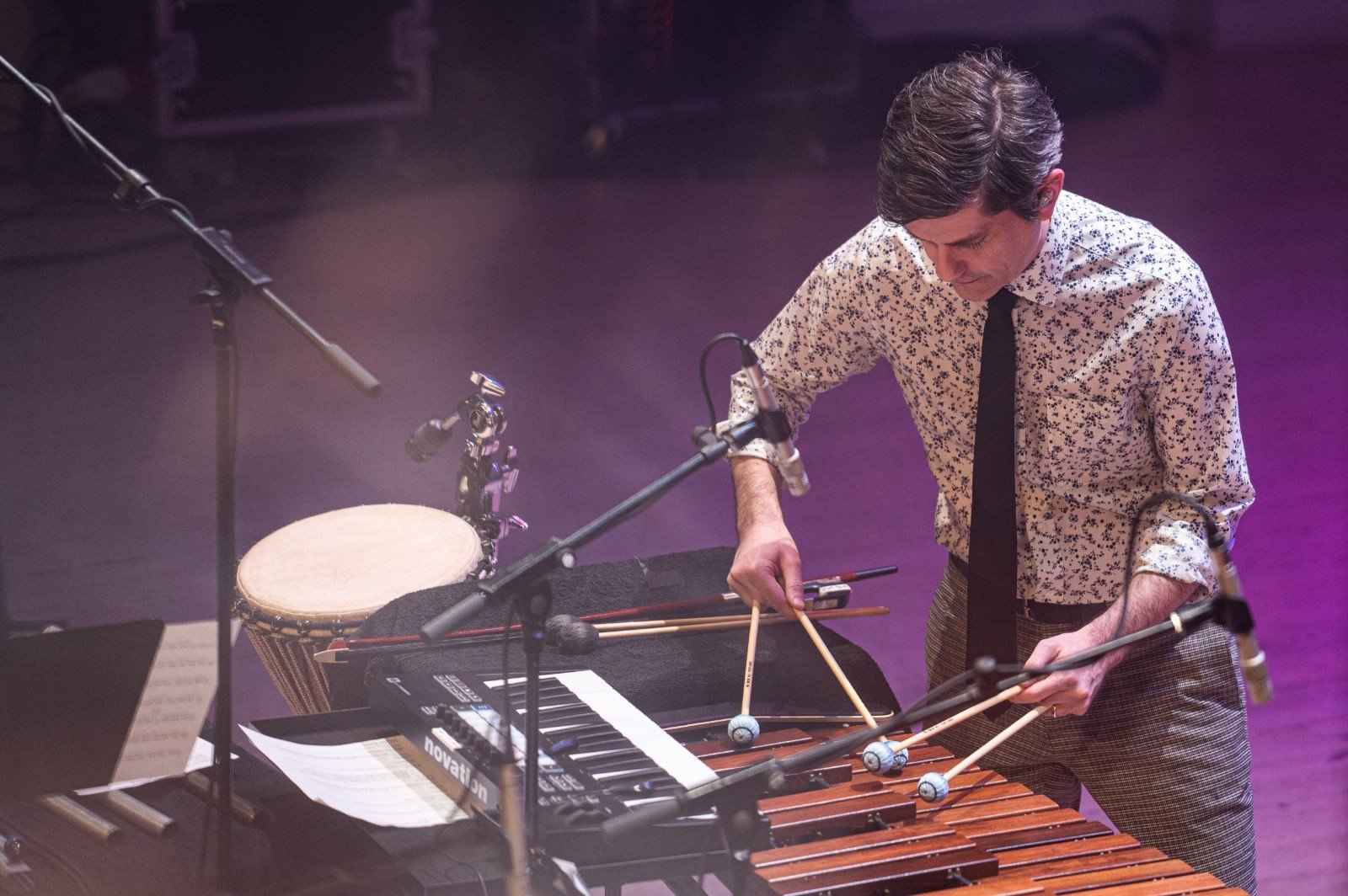
Third Coast Percussion got to know the work through the Uakti record and was struck by it, so much so that they arranged it and performed it with their own instruments, including almglocken, glockenspiel, marimba, melodica, vibraphone and synthesizer. In 2023, Classical Music Daily reports, the choreographer Twyla Tharp asked the quartet to rearrange the music for a new dance project, with a different set of unusual, custom-built instruments.
Invented instruments
The new version features two marimbas, one with red oak bars and one of glass, chromatically tuned PVC pipes, a West African djembe, a tunable tongue drum and several synthesizers. Many of these instruments were found, designed, built and amplified by Colin Campbell, the quartet's production manager. The album also features the flute of Constance Volk, who designed the cover.
The 2025 album
In January 2025 Third Coast Percussion released the album "Aguas da Amazonia by Philip Glass" on the Rockwell Records label. Volk is the flutist of Ensemble Dal Niente. The record is the starting point of the Rome concert, although the festival page doesn't say which movements will be performed or the instrumentation.
Who Third Coast Percussion are
Third Coast Percussion is a percussion ensemble based in Chicago, specializing in contemporary classical music. Today it is made up of Sean Connors, Robert Dillon, Peter Martin and David Skidmore. The Romaeuropa page notes that the quartet was founded in 2005 and celebrated 20 years of activity in 2025, establishing itself as one of the most inventive ensembles on the international scene.
The origins
In 2004 the four original members, Anthony Calabrese, Robert Dillon, Jacob Nissly and David Skidmore, were percussionists in the Civic Orchestra of Chicago and students at Northwestern University, and they formed a chamber group that played in the city's public schools as part of educational programs. The first concerts for the general public were held in the summer of 2005 at Northwestern and at the Music Institute of Chicago in Evanston. Over time the lineup changed: Peter Martin replaced Nissly, and Sean Connors arrived in 2013.
The Grammy
In 2017 Third Coast Percussion won the Grammy Award for Best Chamber Music/Small Ensemble Performance with the album devoted to Steve Reich, released by Cedille Records for the composer's 80th birthday. It was the first percussion group to win in a chamber music category. The quartet performed at the Grammy ceremony with the saxophonist Ravi Coltrane and later received four more nominations.
Steve Reich's words
When he heard the quartet's record of his music, Steve Reich said he had never heard his pieces played that way, and that listening literally required leaning in. A compliment that also works as an instruction for tonight's audience.
Commissions and collaborations
Since 2012 the quartet has commissioned works from composers such as Philip Glass, Missy Mazzoli, Jlin, Tyondai Braxton, Devonté Hynes, Georg Friedrich Haas and Donnacha Dennehy, and has worked with engineers from the University of Notre Dame, architects from the Frank Lloyd Wright Foundation, the dancers of Hubbard Street Dance Chicago and mbira players from the Shona tradition of Zimbabwe. From 2013 to 2018 it was ensemble in residence at the DeBartolo Performing Arts Center at Notre Dame.
The quartet's repertoire and records
Third Coast Percussion doesn't just perform other people's music. Its members compose: David Skidmore, Robert Dillon and Peter Martin have written pieces that entered the group's repertoire, and the quartet has written works collectively such as "Paddle to the Sea" and "Niagara". The discography includes, among others, "Ritual Music" from 2008, the second volume of John Cage's percussion works in 2012, "Paddle to the Sea" from 2018, "Fields" from 2019 with Devonté Hynes, "Archetypes" from 2021, "Perspectives" from 2022 and "Between Breaths" from 2023.
An open workshop
The quartet has recorded for several independent labels, including Cedille, New Amsterdam and New Focus, and has worked with composers very far apart, from the rigor of Georg Friedrich Haas to the electronics of Jlin. It's this openness that makes the dialogue with a composer like Glass natural, someone able to move from opera to film and from dance to chamber music.
How to listen to a percussion concert
A contemporary percussion concert is also a show for the eyes. The performers move among marimbas, drums and sound objects, and every gesture produces a sound: watching who plays what helps you understand the structure of the music, recognize the different layers that add up and follow the passage from one movement to the next.
Rhythm and repetition
In Glass's music repetition is never identical: small variations of accent, harmony or timbre slowly transform the material. With percussion these transformations become especially clear, because each instrument has a recognizable color. The tip, if you're listening for the first time, is to let yourself be carried by the pulse without looking for a melody to follow.
Twyla Tharp and dance
Twyla Tharp, born in 1941, is an American choreographer, dancer and writer. It was she who asked Third Coast Percussion, in 2023, for a new version of "Aguas da Amazonia" for her company. The Romaeuropa page confirms that the version for Twyla Tharp Dance was launched in 2025.
Glass and dance
The bond between Glass's music and dance goes back a long way: the score itself was born as music for Grupo Corpo, and the composer's catalog shows a certain preference for stage forms, from theater to dance to performance. Listening to "Aguas da Amazonia" in concert means entering music conceived for movement.
Philip Glass, 90 years of repetition and invention
Philip Glass was born in Baltimore on January 31, 1937. Considered one of the leaders of musical minimalism together with Steve Reich, La Monte Young, Terry Riley and John Adams, he later distanced himself from that label, keeping a style based on repetition but opening up more and more to non-European music. This interest goes back to the start of his career, when in Paris he worked with the Indian musician Ravi Shankar.
Glass and percussion
Glass's relationship with the world's rhythms is one of the threads of his work: from the discovery of the hypnotic qualities of Indian rhythms, at the root of his style, to his collaborations with Brazilian musicians such as Uakti. Third Coast Percussion, which has commissioned new works from the composer, is the most recent heir to this line.
The best-known works
Among the most famous titles in his catalog are the operas "Einstein on the Beach", "Satyagraha" and "Akhnaten", Godfrey Reggio's Qatsi film trilogy and scores such as those for "Kundun" and "The Hours". It's also worth remembering that "the CIVIL warS", written with Robert Wilson, premiered at Teatro dell'Opera di Roma.
Toward 90
On January 31, 2027 Glass will turn 90. Romaeuropa chose to anticipate the anniversary with two concerts that show two sides of his writing: the intimacy of solo piano, which the composer has called his most personal work, and the collective and physical dimension of percussion. In between there's a whole career, from the minimalism of the 1960s to today's commissions.
Practical information
Tickets cost from 20 to 25 euros. The Passepartout 2 category given on the page isn't explained in detail: to find out if it lets you combine this concert with the 15:00 one it's best to ask the Romaeuropa box office. The Auditorium FAQ point out that you enter the hall from 30 minutes before until five minutes before the start, and that entry is not allowed once the concert has begun.
Between one concert and the next
Vanessa Wagner's concert lasts about three hours and starts at 15:00: if you attend both you'll have only a few minutes' break. It's best to plan ahead, perhaps with a snack at the complex's food spots, where there are a bar, a café and a bar-restaurant.
How to get there
From Flaminio station on metro line A take tram 2 toward Piazza Mancini, or the Roma-Nord train to Piazza Euclide. Buses 910, 53, 982 and 168 stop in front of the entrance, and the 168 is a weekday line. There are two paid parking lots, accessible from Viale Pietro de Coubertin and Viale Maresciallo Pilsudski.
After the concert
At 20:00, in Sala Santa Cecilia, Enrico Melozzi's Classical Rave Party begins, the festival's last event. If you want to end the day with a party you can stay at the Auditorium.
The day before: Vernacular with Jlin
Third Coast Percussion is in Rome for two separate events. On November 14 the quartet presents the show Vernacular at the Auditorium with the producer Jlin. Jlin is among the composers the group has commissioned new works from: her "Perspectives" from 2020 was commissioned by the Boulanger Initiative. If you follow both evenings you'll see two sides of the quartet, the research into electronics and the dialogue with a great master of the 20th century.
A curious fact about Auditorium Parco della Musica
The Auditorium stands in a neighborhood born for the Olympics. When in 1955 the International Olympic Committee awarded Rome the 1960 Games, the city had almost no suitable facilities. It was decided that the area between Via Flaminia and the Parioli hills, facing the Foro Italico across the Tiber, would host some of the facilities and the athletes' housing. That's how the Villaggio Olimpico, the Palazzetto dello Sport and Stadio Flaminio were born. The Renzo Piano Building Workshop explains that the complex was placed here partly because the area was already planned to handle large crowds.
Nervi's Palazzetto
The Palazzetto dello Sport, designed in 1956 by the architect Annibale Vitellozzi and the engineer Pier Luigi Nervi, was built between 1956 and 1957 and hosted the basketball and weightlifting events at the Olympics. Its prefabricated reinforced concrete dome, with an outer diameter of about 78 meters, rests on 36 Y-shaped supports. After closing in 2018 and renovation work, it reopened in October 2023.
The Palazzetto and basketball
The Palazzetto, sometimes called PalaTiziano because it's near Viale Tiziano, was at different times the home of Pallacanestro Virtus Roma until 2018 and has hosted volleyball teams such as Roma Pallavolo and Club Italia.
Something nobody tells you about Auditorium Parco della Musica
To build the Auditorium a street was closed to car traffic. When the archaeological finds forced a radical change to the project, two of the three hall volumes were moved west, until they almost touched the Corso Francia viaduct that cuts the Villaggio Olimpico in two, and to fit them in Viale De Coubertin had to be closed. The viaduct, in turn, is the work of Pier Luigi Nervi, who was one of the protagonists of the Olympic development of the area.
A parking problem
There's also an unresolved problem: the few parking spaces inside the Auditorium are considered expensive by the public, and cars parked for concerts often end up invading the Villaggio Olimpico. One more reason to choose the tram and bus.
My tip for visiting Auditorium Parco della Musica
My tip is to arrive while it's still light, in the early afternoon, and take a walk around the complex before going in. Stadio Flaminio and the Palazzetto dello Sport, both tied to Nervi, are a short distance away, and the park of Villa Glori borders the Auditorium area. If you have more time you can go as far as MAXXI or Milvian Bridge: our page on Flaminio collects the main stops.
For the concert
In a percussion concert the visual side matters as much as the sound: the musicians move between different instruments, and if the instruments built for the 2025 record appear in the hall they will be truly unusual objects. A seat with a good view of the whole stage is worth more than one very close up.
Another well-known fact, yet rarely mentioned
Stadio Flaminio, next to the Auditorium, is known as the historic home of the Italian national rugby team. Less often remembered is that it was designed by the architect Antonio Nervi, son of Pier Luigi, with structural input from his father, and built between 1957 and 1958 on the site of the old Stadio Nazionale, demolished in 1957. It was opened on March 19, 1959 to host the 1960 Olympic soccer tournament. The name Flaminio was chosen by the City in January 1958, while work was underway, causing controversy in Turin, because the old stadium had been dedicated to the Grande Torino. Since July 2018 it has been protected by the heritage authority.
The Flaminio today
Initially able to hold more than 40,000 spectators, later reduced for safety rules, Stadio Flaminio has gone unused for national rugby matches since 2011, when the Six Nations moved to the Olimpico. Since February 26, 2014 it has been run by the Italian Football Federation and is the subject of a renovation study by the architecture faculty of La Sapienza.
A neighborhood of large venues
The Renzo Piano Building Workshop describes the Auditorium as the largest multipurpose performing arts complex in Europe and one of the 10 largest in the world: a record consistent with a neighborhood that, since 1960, has been designed to host large events.
The right photo to take at Auditorium Parco della Musica
The most representative photograph is from the cavea, the open-air theater around which the three halls are arranged symmetrically. From there you see the three large volumes together, which the Fondazione Renzo Piano compares to upturned mandolins. At 18:00 in mid-November it's already dark: if you want daylight you need to shoot before the 15:00 concert or in the early afternoon.
A shot with the Villaggio
Heading out toward Viale Pietro de Coubertin you can look for a spot from which to frame the complex together with the buildings of the Villaggio Olimpico: it's the image of two eras of modern Rome, the Olympic one of 1960 and the musical one of the early 2000s, side by side.
Some important events that happened here in history
The history of the area where the Auditorium stands spans antiquity, the Olympics and the era of major cultural projects.
1955-1960: the Olympics
The awarding of the 1960 Games transformed the area between Via Flaminia and Parioli: the Palazzetto was built between 1956 and 1957, Stadio Flaminio opened in 1959.
1992: choosing the site
After a long debate, in 1992 Rome's city council chose the Villaggio Olimpico area for the new Auditorium. Not everyone considered it ideal, partly because of the distance from the metro, whose nearest station is in Piazzale Flaminio.
2002: the opening
On April 21, 2002 Sala Sinopoli opened, and on December 21 the rest of the complex. Since 2006 the Auditorium has also hosted the Rome Film Fest.
Who has passed through Auditorium Parco della Musica
The Auditorium is the home of the Accademia Nazionale di Santa Cecilia's season and of the program of Fondazione Musica per Roma, which ranges from rock to jazz, from contemporary music to electronic music, from theater to dance to literature. Romaeuropa brings part of its program here every year: in the same 2026 edition, on November 14, Third Coast Percussion presents Vernacular here with Jlin. On the stage of Sala Petrassi, on the same day as this concert, the pianist Vanessa Wagner sits at the piano at 15:00.
Big numbers
In 2014 visitors to the Parco della Musica were counted at more than 2 million, and in 2016 Fondazione Musica per Roma alone organized 608 events there, with 287,109 tickets sold. To follow the program there's our page on Auditorium Parco della Musica.
The Rome Film Fest
Since 2006 the Auditorium has also been the home of the Rome Film Fest, born as "Cinema. Festa internazionale di Roma" and recognized by FIAPF, the international federation of film producers, as a competitive festival. For a few days every autumn the cavea and the halls turn into movie theaters.
Frequently asked questions about Third Coast Percussion and Aguas da Amazonia
When does Third Coast Percussion play in Rome?
On Sunday, November 15, 2026 at 18:00, in Sala Petrassi at Auditorium Parco della Musica Ennio Morricone, Viale Pietro de Coubertin 30. It's the concert that closes the Philip Glass Afternoon Sessions of Romaeuropa Festival. The quartet is also in Rome the day before, Saturday, November 14, for the show Vernacular with the producer Jlin.
How much is a ticket?
Tickets cost from 20 to 25 euros and fall under the festival's Passepartout 2 category. You can buy them online from the Romaeuropa website or through the box office, by phone at 06 4555 3050 or on WhatsApp at +39 334 348 8894. For combinations with other concerts on the same day it's best to ask the festival box office directly.
What is Aguas da Amazonia?
It's a composition by Philip Glass written between 1993 and 1999 for the Brazilian dance company Grupo Corpo and first recorded by the group Uakti. Each movement is devoted to a river in the Amazon basin. Third Coast Percussion has made a new version of it, released on record in January 2025 and tied to a Twyla Tharp project.
Who are Third Coast Percussion?
A Chicago percussion quartet founded in 2005, today made up of Sean Connors, Robert Dillon, Peter Martin and David Skidmore. In 2017 it won a Grammy with an album devoted to Steve Reich, the first percussion group to win in a chamber music category. It has commissioned works from Philip Glass, Jlin, Missy Mazzoli and many others.
How long is the concert?
The running time is not given on the festival page. The 2025 album can give an idea of the scale of the work, but the page doesn't say which movements will be performed. If you need to plan your trip home, or want to catch the 20:00 Classical Rave Party too, you can ask the Romaeuropa box office.
Can you attend all the concerts of the Glass afternoon?
Yes. At 15:00 Vanessa Wagner performs the complete 20 Etudes for piano by Glass in the same hall, with a stated running time of about three hours, and this concert starts at 18:00. The two events have separate tickets, each from 20 to 25 euros. The time between one concert and the next will be very short.
Do you need to know contemporary music?
No. Glass's music is built on regular pulses and repetitions that are easy to listen to, and the percussion version adds a strong visual and physical impact. It's a concert suitable even for those coming to this repertoire for the first time or who know Glass only through film.
How do you get to the Auditorium?
By metro line A to Flaminio and then tram 2 toward Piazza Mancini, or by the Roma-Nord train to Piazza Euclide. Buses 910, 53 and 982 stop in front of the entrance. The paid parking lots are accessible from Viale Pietro de Coubertin and from Viale Maresciallo Pilsudski.
Which instruments will you hear?
The festival page doesn't give the instrumentation. On the 2025 album Third Coast Percussion uses two marimbas, one of red oak and one of glass, tuned PVC pipes, a djembe, a tongue drum and synthesizers, plus Constance Volk's flute. The Rome performance won't necessarily use the same instruments, but the record gives a reliable idea of them.
The final tip on Third Coast Percussion and Aguas da Amazonia
The Third Coast Percussion concert is the most festive way to close an afternoon devoted to Philip Glass: after three hours of solo piano, the same music opens up to the colors of oak and glass marimbas, tuned pipes and drums, in the hands of one of the most awarded percussion ensembles in the world. My suggestion is not to miss the link between the two concerts, listening first to the Etudes and then to the waters of the Amazon, and to arrive while it's light to discover the Olympic neighborhood around the Auditorium too. If you still have energy, at 20:00 you'll find the Classical Rave Party in Sala Santa Cecilia, the festival's last act. And if you can't be there on Sunday you have another chance to hear the Chicago quartet the day before, with Vernacular: two evenings that together give a complete portrait of one of the most curious ensembles on the contemporary scene.
Article written by the editorial team of Tour Leader Pro, contact them for Private/Corporate/V.I.P. Tours and Experiences.
Planning a trip to Rome? The English guides for visiting the city are on ItalyPlanner.com.
Contact Information
Nearby
 Museum of Musical Instruments (MUSA)100 m
- Auditorium Parco della Musica100 m
- Villa Glori500 m
- Fountain of Anna Perenna500 m
- MAXXI – National Museum of 21st Century Arts700 m
- Flaminio700 m
Upcoming events nearby
- Roma Jazz Festival 2026, November 1 to 24 at the Auditorium and Casa del Jazz100 m
- Evgeny Kissin and András Schiff at Santa Cecilia, November 9, 2026100 m
- Roma Gospel Festival 2026 at Auditorium Parco della Musica, December 13, 2026 to January 1, 2027100 m
- Santa Cecilia 2026/2027 Concert Season at Auditorium Parco della Musica, October 21, 2026 to June 5, 2027100 m



You might also like
- Paolo Jannacci, Jannacci arrenditi! La città ascolta at Auditorium Parco della Musica, November 3, 2026
- Buenos Aires Tango with Daniel Binelli at Auditorium Parco della Musica, November 28, 2026
- Laudato sii at Auditorium Parco della Musica, November 17, 2026
- In memory of Mauro Bortolotti and Franco Evangelisti at Teatro Studio Borgna, November 6, 2026
- Vanessa Wagner, Philip Glass: The Complete Piano Etudes at Auditorium Parco della Musica, November 15, 2026
- Voices by Henze at Auditorium Parco della Musica, November 4, 2026