Voices by Henze at Auditorium Parco della Musica, November 4, 2026
In short. Voices by Henze, the cycle of 22 songs composed by Hans Werner Henze in 1973, is performed by the New European Ensemble conducted by Carlo Boccadoro on Wednesday, November 4, 2026 at 20:00 at the Teatro Studio Gianni Borgna of…
Voices by Henze, the cycle of 22 songs composed by Hans Werner Henze in 1973, is performed by the New European Ensemble conducted by Carlo Boccadoro on Wednesday, November 4, 2026 at 20:00 at the Teatro Studio Gianni Borgna of Auditorium Parco della Musica Ennio Morricone, Viale Pietro de Coubertin 30, 00196 Rome, as part of the Romaeuropa Festival 2026. The concert is co-produced with the Accademia Nazionale di Santa Cecilia and is part of the events marking 75 years since Italy and Germany resumed diplomatic relations. The festival gives a running time of 90 minutes, and the official page states that the performance is in German with surtitles in German and Italian. Tickets cost €20 (the festival's Passepartout 2 category). They're sold from the Romaeuropa website, which links to its official sales network, or by contacting the festival box office at 06 4555 3050 (Monday 14:00-18:00, Tuesday to Sunday 10:00-13:00 and 14:00-18:00). The page doesn't name the solo singers: that information hasn't been published. To reach the Auditorium by public transport, use the ATAC route planner with the complex's address.
Voices: what you'll hear
Voices isn't an opera, nor a cantata in the traditional sense. It's a collection of 22 independent songs that Henze wrote between January and June 1973, which can also be performed individually with reduced forces. In the complete version, the one offered in Rome, the songs follow one another in two parts of 11 numbers each, for a running time of about 90 minutes.
Romaeuropa's presentation describes the work as a mosaic of poetic and political texts that turn into music theater: 22 independent but ideally connected scenes in which the word takes the lead and the music amplifies its force. Lyrical singing, declamation and speech alternate in a fluid style able to move from intimacy to denunciation.
The forces
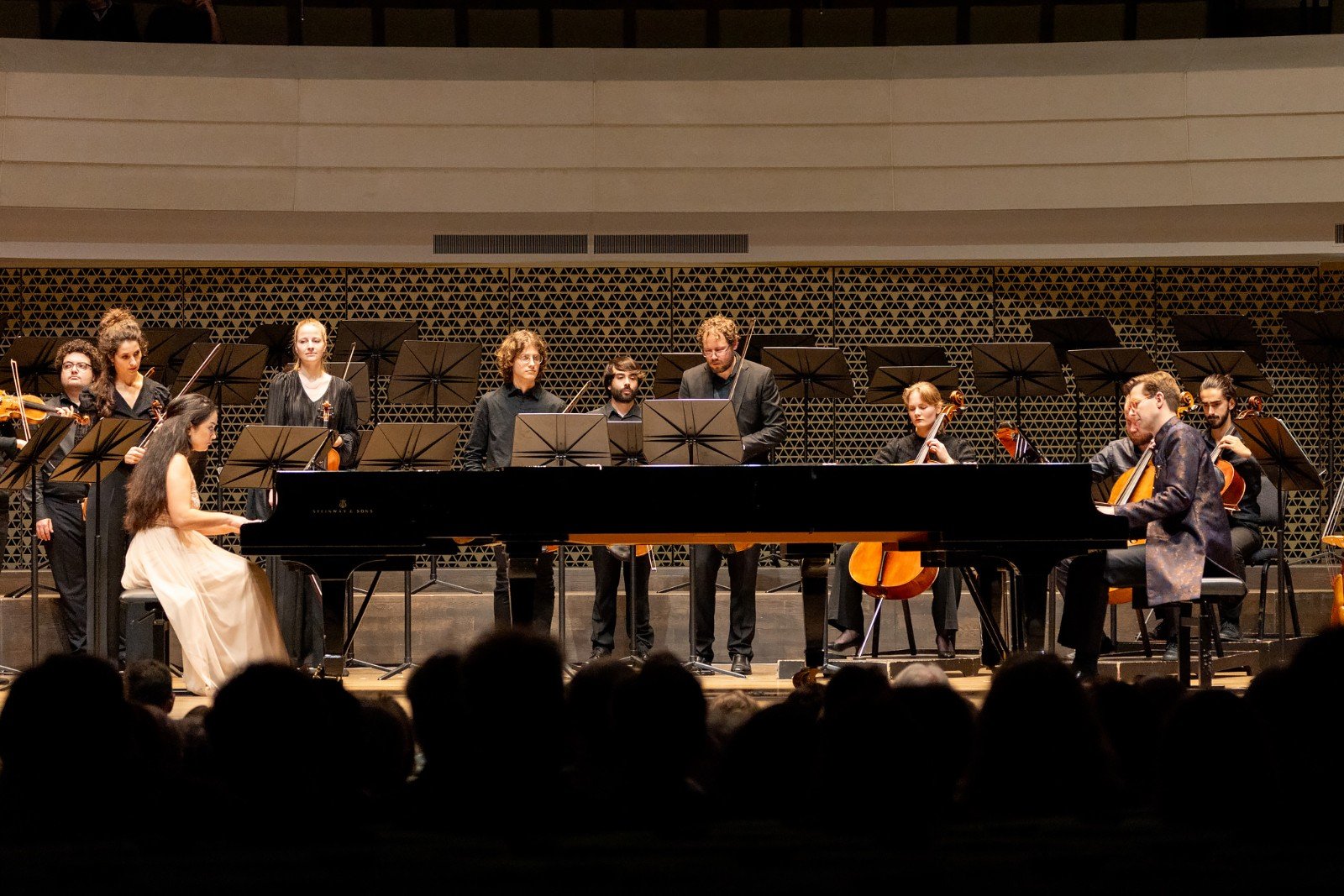
The complete version of Voices calls for a mezzo-soprano and a tenor, an electronic part and 15 instrumentalists playing about 70 instruments from different traditions around the world. It's one of the things that make hearing it live especially interesting: the palette of timbres changes constantly, and the players switch from one instrument to another during the evening.
A common theme
The thread linking the songs is alienation and oppression, and almost all the texts belong to the 20th century. There's no plot, but a succession of situations and voices: prison, war, the condition of workers, racial discrimination, exile, the memory of one's homeland.
The ensemble as a partner
Romaeuropa stresses that the ensemble doesn't just accompany the voices but converses with them, creating soundscapes full of tension and color. Boccadoro's conducting, according to the same presentation, focuses on clarity of text and balance between sound and word: a necessary choice in a work where the meaning of the words is essential.
The poets of Voices
The choice of texts is the work's manifesto. It's useful to know the full list before the concert, also to find your way through the sequence of numbers.
Part one
It opens with Los poetas cubanos ya no sueñan by Heberto Padilla, followed by Prison Song by Ho Chi Minh, Keiner oder alle by Bertolt Brecht, The electric cop by Victor Hernandez Cruz, The distant drum by Calvin C. Hernton, 42 Schulkinder by Erich Fried, Caino by Gino de Sanctis, Il Pasi by Mario Tobino, Heimkehr by Heinrich Heine, Grecia 1970 by Giuseppe Ungaretti and the Legend of the Origin of the Book Tao Te Ching on Lao Tzu's Road into Exile, again by Brecht.
Part two
The second half includes another Brecht, the thoughts of a revue girl during a striptease, then Das wirkliche Messer by Hans Magnus Enzensberger, Recht und Billig by Fried, Patria by Miguel Barnet, the interlude Screams by Walton Smith, The worker by Richard W. Thomas, Para aconsejar a una dama by Padilla, Roses and revolutions by Dudley Randall, Vermutung über Hessen by F. C. Delius, Schluss by Michalis Katsaros and finally Das Blumenfest by Enzensberger.
A political geography
A glance at the names shows the breadth of Henze's horizon in the early 1970s: the Cuban poets evoked from the very first title, Ho Chi Minh's prison song, verses in English by American writers, Greece recalled by Ungaretti in 1970, the Germans Brecht, Heine, Fried and Enzensberger, and two Italian voices, De Sanctis and Tobino. It's an atlas of the struggles and wounds of that time, built across different languages and traditions.
The question of language
The original texts are in several languages: Spanish, English, German, Italian, as well as translations from other traditions. Romaeuropa's page lists German for this performance, with surtitles in German and Italian. It doesn't say if all the songs will be performed in German or if the note refers to the main language: if you want to know for sure, ask the festival box office.
The premiere in London
Voices was first performed on January 4, 1974 at the Queen Elizabeth Hall in London, with tenor Paul Sperry, mezzo-soprano Rose Taylor and the London Sinfonietta conducted by Henze himself. In 1978 the work was recorded with the same performers, except for the mezzo-soprano part, sung by Sarah Walker.
52 years later
The Rome concert comes more than half a century after that premiere. Over such a long time some of the texts' political references have become history, while others remain surprisingly relevant. Romaeuropa calls the work a civic and poetic fresco of great relevance, and it's precisely the distance that makes hearing it today interesting.
A work to hear in full
Since the songs can also be performed separately, complete performances aren't frequent. Hearing the whole sequence of 22 numbers, with the full forces, lets you grasp the overall design Henze had in mind: a route that goes from the Cuban poet's exile to Enzensberger's festival of flowers.
Hans Werner Henze, a German in Italy
Hans Werner Henze was born in Gütersloh on July 1, 1926 and died in Dresden on October 27, 2012, aged 86. He was one of the most important composers of the second half of the 20th century, also known for his Marxist political views and the influence they had on his music.
The move to Italy
In 1953, sensing in Germany a climate of intolerance toward his left-wing ideas and his homosexuality, Henze moved to Italy, to Ischia, and spent most of his life in this country. He was a member of the Italian Communist Party and wrote works dedicated to Ho Chi Minh and Che Guevara. Henze is buried in Marino, in the province of Rome, beside his partner Fausto Moroni: a tie to the Rome area that makes this concert also a tribute to a composer who chose to live here.
Works and commitment
In 1966 he had a great success at the Salzburg Festival with the opera The Bassarids. A few years later, the premiere of his oratorio Das Floß der Medusa, dedicated to the memory of Che Guevara, was canceled in Hamburg because of a portrait of the revolutionary and a red flag on stage. The Sixth Symphony of 1969, the Second Violin Concerto of 1971 and El Cimarrón, about runaway slaves in colonial Cuba, belong to the same creative season that produced Voices.
Later years
His civic commitment didn't fade even in his later works: the Ninth Symphony, from 1997, on texts by Anna Seghers, recalls the darkest moments of German history. His last stage work, L'Upupa, based on a Syrian folk tale, was staged at the Salzburg Festival in 2003.
The performers
The New European Ensemble, according to Romaeuropa's presentation, was founded in 2009 in the Netherlands and devotes itself to contemporary music, often combined with film, theater, dance and the visual arts. It's a multidisciplinary calling that suits a work like Voices, halfway between concert and music theater.
Carlo Boccadoro
Carlo Boccadoro was born in Macerata on July 20, 1963. A composer, conductor and musicologist, he graduated in piano and percussion and studied jazz improvisation with Giorgio Gaslini. With Filippo Del Corno and Angelo Miotto he founded Sentieri selvaggi, a contemporary music ensemble in residence at Teatro Elfo Puccini in Milan. Since 2018 he has been artistic director of the Concerti della Normale in Pisa.
The popularizer
Boccadoro is also the author of many books popularizing music, including Musica Coelestis, Lunario della musica, Analfabeti sonori, Bach e Prince. Vite parallele and a volume devoted to Franco Battiato. His attention to clarity of text, highlighted by Romaeuropa, is consistent with a career that has always sought to bring today's music to a wide audience.
The voices
The festival page doesn't name the mezzo-soprano and the tenor. It's information to look for in the program on the night of the concert, or to ask the box office in advance.
A concert for friendship between Italy and Germany
The concert is part of the events for the 75th anniversary of the resumption of diplomatic relations between Italy and Germany. The choice of Henze is especially meaningful: a German composer who lived most of his life in Italy, joined an Italian party and is buried in the province of Rome is a figure who embodies the dialogue between the two cultures.
The collaboration with Santa Cecilia
The co-production with the Accademia Nazionale di Santa Cecilia, whose main home is the Auditorium, ties the concert to the city's leading music institution. If you follow the symphony season, the page on the Santa Cecilia 2026-2027 season helps you plan other evenings at the Auditorium.
The festival
Voices is part of the Romaeuropa Festival 2026 program, which in November brings contemporary music, dance and theater to the city. The page on Romaeuropa Festival 2026 gives an overview of this edition.
How to prepare for the concert
90 minutes of 20th-century music, with partly political texts, may sound demanding. A few tips help you enjoy the evening even if you don't usually listen to contemporary music.
Read the titles
Knowing the order of the 22 songs in advance, with the names of the poets, lets you follow the route without getting lost. The surtitles will help you understand the texts, and knowing who wrote each one and from which country makes the shift in mood from one number to the next clearer.
Listen to the timbres
With about 70 instruments for 15 players, Voices is a catalog of colors. A good exercise is to watch the instrumentalists: switching from one instrument to another is part of the show, and the small Teatro Studio lets you see it up close.
Accept the contrasts
The writing moves from lyrical melody to speech, from tenderness to anger. There's no single style to recognize: variety is the very principle of the work, and if you accept it you'll find a surprisingly diverse and accessible piece.
Who the concert is for
The concert is for people who love 20th-century music and music theater, but also for anyone interested in poetry and in the political history of the postwar years. The texts by Brecht, Ungaretti, Heine and Enzensberger are an invitation even if you spend more time in bookstores than in concert halls.
For young people
The €20 price and the moderate length make the evening affordable. For students of music, literature or history it's a rare chance to hear a work that brings the three disciplines together.
For visitors
The Auditorium is one of the most interesting places in contemporary Rome, also for its architecture: if you're in the city for a few days, you can pair the concert with an afternoon visit to the complex.
Tickets and practical information
Tickets cost €20, in Romaeuropa's Passepartout 2 category. The festival also offers subscription packages for seeing several shows at a reduced price. You can buy from the festival website, which links to the official sales network, or through the phone box office.
The festival box office
The festival lists the number 06 4555 3050 and a WhatsApp contact at +39 334 3488894, with hours on Monday from 14:00 to 18:00 and Tuesday to Sunday from 10:00 to 13:00 and 14:00 to 18:00. For information you can also write to promozione@romaeuropa.net.
Arriving on time
The concert starts at 20:00. The Teatro Studio is one of the halls of the complex, and the Auditorium is large: plan to arrive at least half an hour early to find your way among the entrances and halls.
Auditorium Parco della Musica in brief
Auditorium Parco della Musica Ennio Morricone is the complex designed by Renzo Piano for music and cultural events. It covers an area of 55,000 square meters between Villa Glori, the Villaggio Olimpico, the Corso di Francia viaduct and Viale Maresciallo Pilsudski. The three main halls, whose shape recalls a beetle, are clad in lead sheets and arranged in a fan around an open-air theater, the cavea.
The halls
Sala Santa Cecilia has 2,756 seats, Sala Sinopoli 1,133 and Sala Petrassi 673, while the cavea, named after Luciano Berio, holds about 3,000. The Teatro Studio, named after Gianni Borgna, is the smallest hall: sources disagree on its capacity, with some giving 308 seats and others 304. The page on Auditorium Parco della Musica describes the complex in detail.
Who runs it
The complex is run by Fondazione Musica per Roma and since 2003 has been the permanent home of the Accademia Nazionale di Santa Cecilia's season. Since 2006 it has also hosted the Rome Film Fest.
The halls as musical instruments
Piano conceived the three halls as sound boxes, each with a different acoustic behavior. Knowing these differences helps explain why a work like Voices was placed in the Teatro Studio and not in one of the larger halls.
Santa Cecilia, the large hall
Sala Santa Cecilia, the largest, has a ceiling made of 26 American cherry wood shells, each with an average surface of 180 square meters. Its reverberation time is 2.2 seconds, a feature designed for symphonic music and for acoustic instruments in a space with more than 2,700 seats.
Sinopoli and Petrassi
Sala Sinopoli is designed to adapt its interior to the number of performers and the type of event. Sala Petrassi, the smallest of the three, has an orchestra pit and movable side walls on stage for the needs of theater, opera and dance.
The Teatro Studio
The Teatro Studio is the most intimate space in the complex, with about 300 seats. For a song cycle in which the words must come across clearly and 15 players keep switching instruments, the closeness between audience and stage is an obvious advantage.
A curious fact about Auditorium Parco della Musica
The hall where you'll hear Voices bears the name of a man who played a decisive role in Rome's cultural life in the 1990s and 2000s. Gianni Borgna, born in Rome on June 13, 1947 and died on February 20, 2014, was the city's councilor for culture from 1993 to 2006, under mayors Francesco Rutelli and Walter Veltroni, the years when the Auditorium was built and opened. From December 27, 2006 he was president of Fondazione Musica per Roma.
The historian of Italian song
Borgna was also an essayist: among other things he wrote a history of the Sanremo Festival, La grande evasione, published in 1980, and books on singer-songwriters and on Pier Paolo Pasolini. He is buried in the Non-Catholic Cemetery of Rome, in the Testaccio district.
Something nobody tells you about Auditorium Parco della Musica
An ancient villa lay under the Auditorium, and its discovery changed the design. During construction, remains came to light that forced Renzo Piano to substantially change the original plan. The finds are displayed in a small museum built under the cavea, and the remains can be seen from the terrace, between Sala Santa Cecilia and Sala Sinopoli.
Roman or older?
Sources disagree on the dating. Some speak of the remains of a Roman villa. Others describe the foundations of a villa and an olive oil press dating to the 6th century BC, older than the Roman era in the strict sense, and add that the discovery delayed construction by a year. Either way, the fact remains surprising: one of the symbols of contemporary Rome stands on top of a settlement more than 2,000 years old.
My tip for visiting Auditorium Parco della Musica
My advice is to arrive an hour early and go up to the terrace that runs around the complex. From there you can see the remains of the ancient villa, the three halls with their lead roofs and the cavea in the middle. At a November sunset, shortly before the 20:00 concert, the light on the metal surfaces changes minute by minute.
The museum under the cavea
If you arrive even earlier, look for the small archaeological museum under the cavea, which displays the finds from the villa. Check opening hours on the Auditorium website.
The bookstore and the bars
Inside the complex there's a bar, a café, a bar-restaurant also reachable from the street and a large bookstore: for a concert built on poetry, browsing the shelves for an anthology of Brecht or Ungaretti is a fitting way to prepare.
Another well-known fact that rarely gets mentioned
Everyone knows the Auditorium was designed by Renzo Piano. Fewer people know it was opened twice. On April 21, 2002 Sala Sinopoli opened, and on December 21 of the same year the rest of the complex opened and Sala Santa Cecilia was inaugurated, with a concert by the Accademia's orchestra conducted by Chung Myung-whun.
Morricone's name
The dedication to Ennio Morricone also has a precise date. Wanted in Rome reports that on July 6, 2021, the first anniversary of the composer's death, Mayor Virginia Raggi announced that from that day the Auditorium would bear his name, unveiling a plaque in the presence of his family and friends such as Giuseppe Tornatore. The city council resolution dates to 2020.
The right photo to take at Auditorium Parco della Musica
The classic shot is from the cavea toward the three halls, which look like three large shells arranged in a fan. The nickname many people use for them, the beetles, comes from exactly this view. In the evening, with the foyer lights on, the volumes stand out against the dark sky.
The lead detail
For a less obvious photo, get closer to the roofs and frame the texture of the lead strips, which change color with the light. During the concert, on the other hand, photos aren't welcome: in an intimate hall like the Teatro Studio, even a phone screen is distracting.
Some important events that happened here
1993: the competition
Renzo Piano won the 1993 invited competition for Rome's new auditorium. With this project, more than 60 years after the demolition of the Augusteo hall, Rome once again had a hall designed specifically for classical music.
2002: the two openings
Sala Sinopoli opened on April 21, and Sala Santa Cecilia and the rest of the complex on December 21.
2003: the home of Santa Cecilia
The Auditorium became the permanent home of the Accademia Nazionale di Santa Cecilia's concert season. The Accademia also keeps its media library and the Museum of Musical Instruments here.
2006: the Film Fest
The complex hosted the Rome Film Fest for the first time, and it has been the festival's main venue ever since.
2014: 2 million visitors
In 2014 visitors to Parco della Musica passed 2 million, a figure that placed it first in Europe among music venues and second in the world after Lincoln Center in New York.
Who has passed through Auditorium Parco della Musica
Goffredo Petrassi's name is tied to the history of the complex: the hall that now bears his name was first called Sala Settecento, after its number of seats, and was named after him following his death in 2003. Despite his advanced age, the composer insisted on attending the opening. Giuseppe Sinopoli and Luciano Berio are also remembered in the names of the halls.
Henze in Rome
With Voices, the music of a composer who had a deep bond with Rome and Lazio comes to the Auditorium. It's an ideal return: Henze lived in Italy for a long time, and his grave is a few kilometers from the city.
Other festival guests
The Auditorium has been one of the Romaeuropa Festival venues for years. In 2022, for example, Sala Petrassi hosted on September 28 and 29 Jan Martens' show for 17 dancers inspired by civil disobedience, any attempt will end in crushed bodies and shattered bones.
Before or after the concert: Flaminio and the surrounding area
The Auditorium is in a part of the city rich in 20th-century architecture. The page What to see in Flaminio suggests a route through the area.
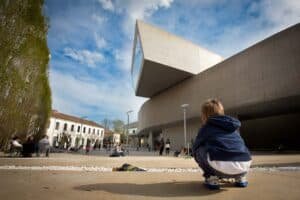
MAXXI
In the same area is MAXXI, the national museum of 21st-century arts. If you arrive in the afternoon you can pair a visit to the museum with the evening concert, after checking opening hours.
The Villaggio Olimpico
The complex borders the Villaggio Olimpico. The page on the exhibition devoted to the Villaggio Olimpico tells the story of that neighborhood.
Milvian Bridge
For dinner after the concert, the Milvian Bridge area, in the same northern part of the city, offers plenty of choice.
Frequently asked questions about Voices by Henze
When and where can you hear Voices?
On Wednesday, November 4, 2026 at 20:00, at the Teatro Studio Gianni Borgna of Auditorium Parco della Musica Ennio Morricone, Viale Pietro de Coubertin 30. The concert is part of the Romaeuropa Festival 2026 and is co-produced with the Accademia Nazionale di Santa Cecilia. The festival gives a running time of 90 minutes, so the evening ends around 21:30.
How much is a ticket?
Tickets cost €20, in the festival's Passepartout 2 category. The price is given on Romaeuropa's official page, which links to its sales channel. For information on the festival's subscription packages, which let you see several shows, contact the box office at 06 4555 3050.
Who performs the concert?
The New European Ensemble, founded in 2009 in the Netherlands and devoted to contemporary music in dialogue with the other arts, conducted by Carlo Boccadoro, a composer and conductor born in Macerata in 1963. The official page doesn't give the names of the mezzo-soprano and tenor called for in the score: that information isn't published.
What language is it sung in?
The festival lists German, with surtitles in German and Italian. The original texts Henze chose, however, are in several languages, including Spanish, English, German and Italian. If you want to know exactly which language each song is performed in, ask the festival box office or check the program on the night of the concert.
What is Voices?
It's a cycle of 22 songs composed by Hans Werner Henze between January and June 1973, for mezzo-soprano, tenor, electronics and 15 instrumentalists playing about 70 instruments. The texts, almost all from the 20th century, share the theme of alienation and oppression. The premiere took place in London on January 4, 1974, conducted by the composer.
Do you need to know contemporary music to enjoy it?
Not necessarily. The variety of styles and the presence of the texts make Voices more accessible than a lot of late 20th-century music. Reading the list of poets and titles in advance helps you follow the route. The intimate Teatro Studio also lets you see the instrumentalists up close, which makes listening more engaging.
How do you get to the Auditorium?
The Auditorium is at Viale Pietro de Coubertin 30, in the north of the city, between Villa Glori and the Villaggio Olimpico. For the public transport route, use the ATAC route planner with the address as your destination. The complex is large: arrive half an hour early so you can find the Teatro Studio calmly.
Final advice on Voices
Voices is a rare chance: a complete performance of a work that is seldom heard in full, in the hall named after the man who built the cultural policy of contemporary Rome, with a conductor who has made clarity his method. My advice is to read the list of poets beforehand, arrive in time for a walk on the Auditorium terrace and let yourself be surprised by the range of timbres. For €20 you hear an hour and a half of music that tells, through poetry, the hopes and wounds of a decade.
Article written by the editorial team of Tour Leader Pro, contact them for Private/Corporate/V.I.P. Tours and Experiences.
Planning a trip to Rome? The English-language guides for visiting the city are on ItalyPlanner.com.
Contact Information
Nearby
 Museum of Musical Instruments (MUSA)100 m
- Auditorium Parco della Musica100 m
- Villa Glori500 m
- Fountain of Anna Perenna500 m
- MAXXI – National Museum of 21st Century Arts700 m
- Flaminio700 m
Upcoming events nearby
- Roma Jazz Festival 2026, November 1 to 24 at the Auditorium and Casa del Jazz100 m
- Evgeny Kissin and András Schiff at Santa Cecilia, November 9, 2026100 m
- Roma Gospel Festival 2026 at Auditorium Parco della Musica, December 13, 2026 to January 1, 2027100 m
- Santa Cecilia 2026/2027 Concert Season at Auditorium Parco della Musica, October 21, 2026 to June 5, 2027100 m



You might also like
- Paolo Jannacci, Jannacci arrenditi! La città ascolta at Auditorium Parco della Musica, November 3, 2026
- Buenos Aires Tango with Daniel Binelli at Auditorium Parco della Musica, November 28, 2026
- Laudato sii at Auditorium Parco della Musica, November 17, 2026
- In memory of Mauro Bortolotti and Franco Evangelisti at Teatro Studio Borgna, November 6, 2026
- PMCE Huellas 2: new music from Spain at Teatro Studio Borgna, Auditorium, Nov 13, 2026
- Atlantico Reunion by Enzo Favata at the Roma Jazz Festival, Auditorium Sala Petrassi, Nov 16, 2026