Spazio Museo Vespa
In short. The Spazio Museo Vespa is in Rome at Via Cavour 302, at the low end of the street, the one that descends toward Largo Corrado Ricci and the Imperial Forums, and occupies the basement floor of the Bici e Baci shop.
The Spazio Museo Vespa is in Rome at Via Cavour 302, at the low end of the street, the one that descends toward Largo Corrado Ricci and the Imperial Forums, and occupies the basement floor of the Bici e Baci shop. Entry is free and you do not need to book. It is open every day, Sunday included: from November 1 to March 31 from 9:00 to 18:00, from April 1 to October 31 from 9:00 to 19:00. On December 24 and 31 it closes at 13:00, on December 25 it stays closed, and on January 1 it opens only from 9:00 to 13:00. The telephone is 06 94539240, the email museo@bicibaci.com. You get there by metro line B, stops Cavour and Colosseo, both a few minutes' walk away, and by buses 75 and 117, which run along Via Cavour. One warning that matters more than all the rest: the exhibition space is below street level and you go down a staircase to reach it, so it is not accessible to wheelchair users and should be considered carefully by anyone with mobility difficulties. Since it is a private space attached to a commercial business, the hours can change for events and extraordinary closures: a phone call before setting out is time well spent.
If you are building your itinerary in the central archaeological zone, the right page to slot this stop into is the one on the Colosseum: from the door at Via Cavour 302 to the Flavian Amphitheater it is less than 10 minutes' walk, and the detour into the museum costs 20 minutes on the clock.
What the Spazio Museo Vespa really is
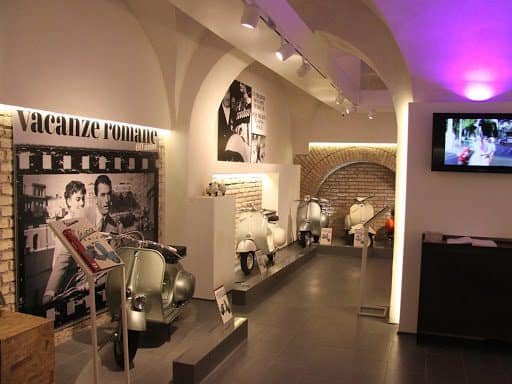
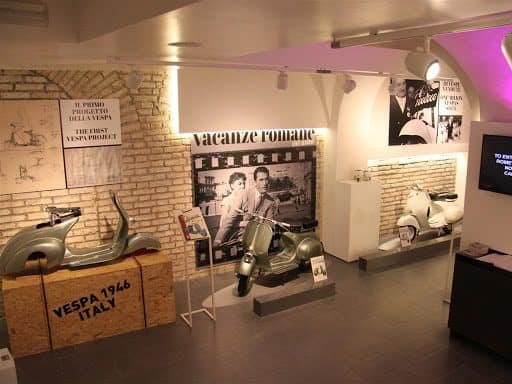
Calling it a museum is correct for what it contains and generous for the space it occupies. The Spazio Museo Vespa is a permanent exhibition of a single room, carved out of the basement of a bicycle and scooter rental shop, with a good dozen original vehicles, a wall of memorabilia and a wall of posters. Anyone arriving expecting the halls of the Piaggio Museum in Pontedera will be thrown by the square meters. Anyone arriving knowing what they are looking at leaves with the feeling of having seen a serious collection, put together by people who can tell a VBB from a VBA with the naked eye.
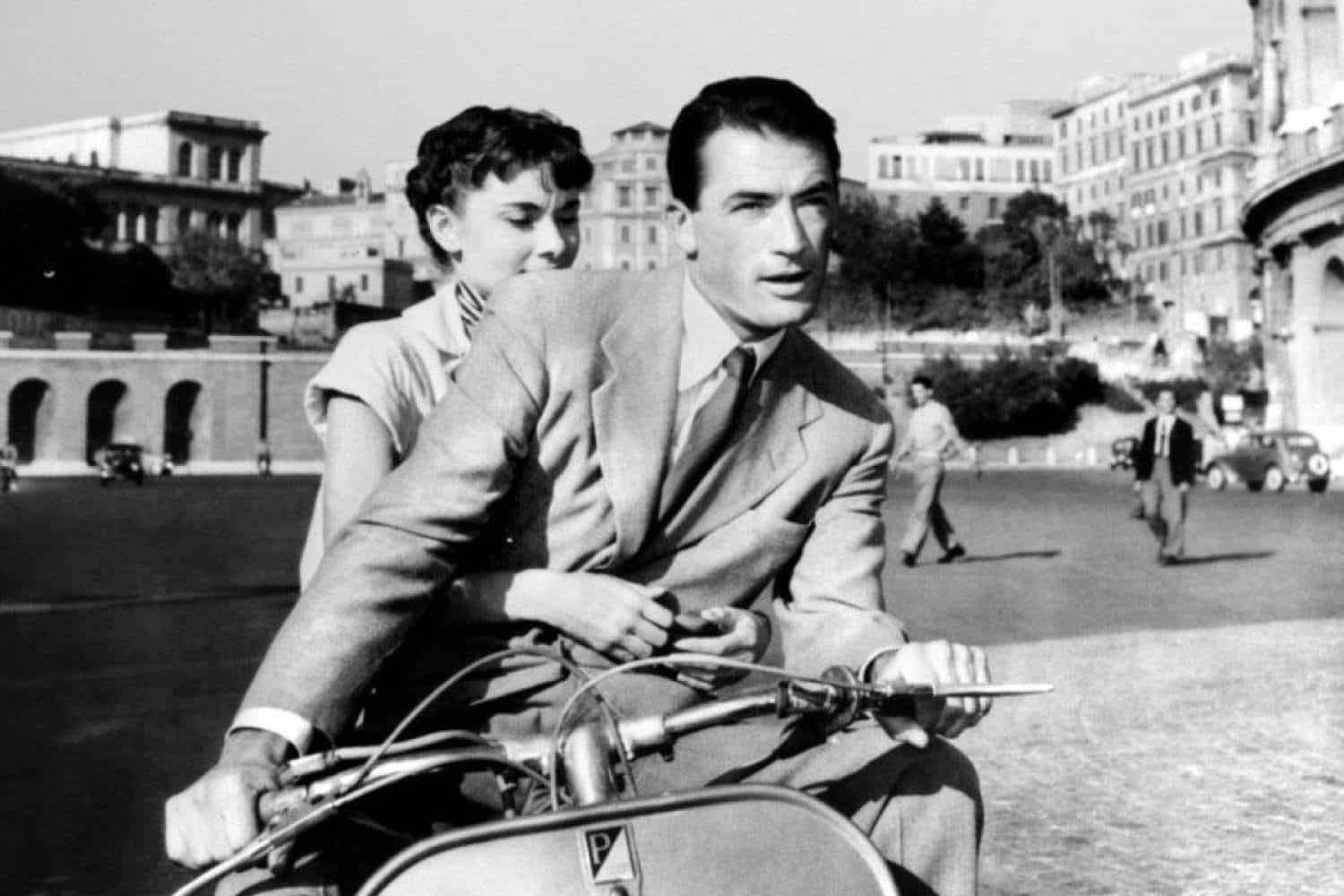
The logic of the display is chronological and thematic at once. On one side the evolutionary line of the civilian Vespa, from the 1946 frame to the P series of the 1970s. On the other the bizarre deviations that made this scooter a platform good for everything, from racing to war to the microcar. The relationship between the Vespa and Rome, which is the reason the place is a short walk from the Forums and not in Pontedera, can be read in the pictures on the walls: actors, actresses and extras crossing the city on two small wheels.
A blunt opinion: the Spazio Museo Vespa does not hold up a whole morning on its own, but it holds up very well as 20 minutes wedged between the Colosseum and Santa Maria Maggiore, and for a teenager bored by ruins it is worth three basilicas.
Who created the Spazio Museo Vespa and when
The space was inaugurated on Friday, July 12, 2013. Behind the idea are three people with three different skills: Claudio Sarra, founder and chief executive of Bici e Baci, the Roman rental and tour company that owns the premises. Roberto Leardi, president of the Vespa Club d'Italia. Michele Piacentini, an event organizer. The date is not random: 1953 is the year Roman Holiday came out, and 2013 marked its 60th anniversary. The choice to tie the opening to the film rather than to an industrial anniversary says it all about the slant of the place, which is cultural before technical.
The official website states that in the following years the space received more than 30,000 enthusiasts and tourists. For an underground room with free entry and no ticket office, this figure is explained by the location: anyone walking along Via Cavour toward the Colosseum sees the sign and goes down.
Bici e Baci, the company that keeps the Spazio Museo Vespa open
Bici e Baci is a Roman rental and tour company with two addresses in the city: Via del Viminale 5, in the Repubblica area, and Via Cavour 302, the one that interests us. It rents bicycles, scooters, Vespas, electric kick scooters, and organizes guided itineraries by Vespa, by bicycle, in an electric Fiat 500 and in an Ape Calessino. The museum is the non-commercial piece of the whole, and this has to be said without hypocrisy: you enter for free a place that belongs to the people who rent you the vehicle. Nobody will come at you to sell you something, but know where you are.
The visit to the Spazio Museo Vespa, piece by piece
What follows is the thread worth following as you go down the stairs. The vehicles do not all have an extended label, and without context many of these machines look like just old scooters. With context they become chapters of Italian industrial history.
The 1946 body shell, the piece that justifies the Spazio Museo Vespa
The oldest piece is also the least showy: a bare frame of the Vespa 98, the model that opens everything. It is not a complete vehicle, it is a load-bearing body without engine and without wheels, and precisely for this reason it reads better than any restored example. The revolution of the Vespa is in there: the shell is frame and bodywork at once, in stamped sheet steel, an idea taken wholesale from aeronautics and carried onto two wheels. Before that piece, a motorcycle was a lattice of tubes with the engine hung in the middle and the rider straddling the mechanics. After that piece, there is a machine you sit on like a chair, with your legs protected and the engine hidden.
The patent bears the date of April 23, 1946 and was filed at the Central Patent Office of the Ministry of Industry and Commerce, in Florence, for a motorcycle with a rational assembly of components and elements, with a frame combined with fenders and a hood covering the whole mechanical part. The public debut had however already taken place a month earlier, on March 24, 1946, at the Mechanics and Metallurgy Show in Turin, where the first purchase contracts were signed. The 98 had a two-stroke engine of 98 cubic centimeters, three gears, 3.2 horsepower at 4,500 rpm, a top speed of 60 kilometers an hour. It cost 55,000 lire, 61,000 in the deluxe version with odometer and side stand. In 1946, 2,181 were sold out of 2,500 produced.
The Vespas of the 1950s in the collection
The first intact scooter in the collection is a Vespa 125 from 1950. Behind it line up a 150 from 1956 and a 150 GS from 1959. The 125 from the start of the decade is the machine that takes the Vespa from curiosity to mass phenomenon: in 1947, 10,535 are sold, in 1948 it reaches 19,822 vehicles, and in the 1950s the figures run to tens of thousands a year. The 125 of the 1951 model, the one available from December 1950, has a self-supporting shell in sheet steel, a single-cylinder two-stroke with single transfer port and deflector piston, bore 56.5 millimeters by stroke 49.8, actual displacement of 124.789 cubic centimeters, 70 kilometers an hour, coil spring suspension with hydraulic shock absorber on both wheels and drum brakes. It is the model that the Piaggio Museum indicates as the Roman Holiday Vespa.
The 150 GS from 1959 is another matter. GS stands for Gran Sport, the designation appears in 1955 and stays in production until 1961 through five series, and it is the first Vespa designed to reach a hundred an hour. Anyone of a certain age recognizes it by the cast handlebar and the long saddle. If you have to look at a single vehicle in this room with a collector's eye, look at that one.
The Vespas of the 1960s and 1970s at the Spazio Museo Vespa
The sequence continues with a 160 GS from 1962, a 150 GL from 1963, a 125 Super from 1965, a 50 L from 1966, a 180 Rally from 1968, a 50 Special and a 125 GTR from 1969, and finally the P series of 1977, the 125 X and the 200 E. Lined up, they tell the passage of Italy from the boom to the energy crisis, and they tell it in sheet metal.
The Vespa 50, born in 1963 to get around the license plate requirement for 50cc bikes, is the vehicle that motorized three generations of Italian 14-year-olds. The 50 Special, produced from 1969 to 1982 in three series, is recognized by its rectangular headlight and is considered by Vespa riders practically indestructible: 40 years later, a song from 1999 would name a chorus after it that everybody in Italy knows. The 125 Primavera from 1968, a close sister of this family, gave 5.56 horsepower at 5,500 rpm and 92.3 kilometers an hour. The ET3 from 1976, with Ducati electronic ignition and three transfer ports in the cylinder, reached 98. The PX of 1977 closes the classic story and reopens it: it left the price lists in January 2008 and went back into production in 2011 in a Euro 3 version.
The racing and record Vespas told at the Spazio Museo Vespa
Here the collection takes off its neighborhood-museum hat. Among the pieces on display are a Vespa 125 Circuito from 1950 and a Vespa Montlhéry, the faired record variant. The name comes from the French racetrack of Montlhéry, where on April 7, 1950 the Vespa won 17 world records in 10 hours of racing with three riders taking turns: the hour record at an average of 134 kilometers an hour, 100 miles at 129.7, 500 miles at 123.9, 1,000 kilometers at 124.3, for a total of 1,049 kilometers in 10 hours. These are numbers that, for a vehicle born four years earlier as a two-wheeled economy car, remain astonishing.
A year later, on February 9, 1951, Piaggio went further. On the Rome-Ostia motorway, between kilometer 10 and kilometer 11, the Vespa Siluro covered the flying kilometer at an average of 171.02 kilometers an hour, with a time of 21 seconds and 4 tenths, 174.418 on the outward run and 169.910 on the return. At the handlebars, crouched inside the aluminum fairing, was the test rider from Empoli Dino Mazzoncini, with an elongated aerodynamic helmet. The engine, designed by Corradino D'Ascanio with Vittorio Casini, was an opposed-piston twin-cylinder of 124.69 cubic centimeters, with two crankshafts connected by gears, 21 horsepower at 9,500 rpm, compression ratio 11 to 1, liquid cooling and two Dell'Orto carburetors. 168 horsepower per liter, in 1951, with the technology of a miniaturized aircraft engine. That this record was set on a Roman road is a detail nobody tells and that in Rome should be taught.
The Vespa 150 TAP, the surprise of the Spazio Museo Vespa
The piece that makes visitors stop is an olive green Vespa with a long tube pushed through the body shell. It is the Vespa 150 TAP, a military anti-tank scooter commissioned from Piaggio by the French Ministry of Defense and built by ACMA, the group's French subsidiary, between 1956 and 1959 after the presentation at the Milan show of December 1955. The tube is a 75 millimeter M20 recoilless gun of American manufacture, able to pierce armor up to 100 millimeters thick.
500 units were built in two versions, the TAP 56 with a 100 cubic centimeter engine and the TAP 59 with a 150. The rear rack held six shells, the front one two jerrycans of fuel mix. The shell had a perimeter bumper, steel protections and reinforcements to withstand parachute drops, because the vehicle was designed to be air-transported: two paratroopers, two Vespas, one with the gun and one with the ammunition. The idea was born for Indochina, against the Soviet T 34s in service with the Viet Minh, and ended up used in Algeria. Green or sand paint, depending on the theater. In front of this object the rhetoric of carefree lambrettismo melts away quickly.
The Vespa 400 and the licensed Vespas
Another piece that throws you is the ACMA Vespa 400 from 1957, which has nothing of a scooter about it: it is a two-seat microcar, built in France by the same ACMA, with the Vespa brand applied to a real automobile. It is the side branch of the genealogy, the one that recalls how much postwar Piaggio was a company moving on every front of popular mobility. Alongside are examples built under license in Germany, proof that the D'Ascanio formula was bought and replicated abroad as soon as it was understood that it worked. The Vespa, in 80 years, has been produced under license in half the world, and the rival Lambretta did the same in Germany, Great Britain, Argentina, Brazil, Chile, India and Spain.
Andy Leeano's Vespa, the most moving piece of the Spazio Museo Vespa
At the back of the room there is a Vespa that no restorer would touch. It is a VBB from 1961, and it belongs to an Indonesian mechanic and restorer from Yogyakarta, Andy Leeano, who set out from home on that machine and reached Italy. The journey lasted about a year, from departure in the summer of 2012 to arrival in Pontedera on July 27, 2013, for over 35,000 kilometers. First the crossing by sea to Malaysia, then overland through Thailand, Burma, Bangladesh, Nepal, India, Pakistan, Iran and Turkey. Leeano has stated that he prepared the trip for four years and dreamed of it for a lifetime.
The machine that ended up in this room is therefore not an industrial relic: it is a vehicle that went around half the world with a two-stroke of 150 cubic centimeters. If you have 15 minutes and a kid with you, stop in front of this one and tell him the geography of that route. It works better than an atlas.
The memorabilia, the racing suits and the posters on the walls
The walls are worth as much as the vehicles. There are film posters, period advertisements, photographs of actors and actresses in the saddle, mannequins dressed in the fashion of the time, and a display case with stickers and badges from Vespa Clubs all over the world. That display case is a sociological document: organized Vespa riding was born in Viareggio on October 23, 1949 with the first Vespa Club, the same year the Vespa Club d'Italia was formed, and already at the Italian Vespa Day of 1951 20,000 Vespa riders turned up. In 1953 there were over 10,000 Piaggio service stations in the world. Today the Vespa Club d'Italia groups more than 600 clubs in all the regions and states 77,000 members.
Among the memorabilia there is also material tied to Roberto Leardi, one of the three promoters of the space, who understands Vespa riding like few others: born in 1943, a Vespa rider at 18 following in the footsteps of his older brother Pierluigi, a member of the Vespa Club Roma, a regularity rider with a regional team title in 1968, present at almost all the editions of the Eurovespa and the Vespa World Days since 1960, president of the Vespa Club Roma since 1981, on the national board since 1977 and at the head of the Vespa Club d'Italia since 1984, president of the Vespa World Club from 2006 to 2012 and today honorary president. His first Vespa was a 125, then he moved on to the GS, which has remained his favorite.
Corradino D'Ascanio, the engineer who hated motorcycles
The story told in front of the 1946 body shell begins with a paradox. Enrico Piaggio, in the summer of 1945, had to convert a bombed aeronautical industry into something Italians could buy. He looked, in his own words, for a designer whose mind was free of any constructive concept concerning a motorcycle. He chose Corradino D'Ascanio precisely because he hated motorcycles.
D'Ascanio was born in Popoli on February 1, 1891, graduated from the Regio Istituto Tecnico Ferdinando Galiani in Chieti in 1909, and earned a degree in industrial mechanical engineering at the Politecnico di Torino in 1914. Before the Vespa he had built helicopters: the D'AT3 prototype in October 1930 set three international records, including eight minutes and 45 seconds of flight and 1,078 meters in a straight line, with coaxial rotors and a Fiat engine. He came to Piaggio in 1932 as a technical consultant for variable-pitch propellers, an invention that spared him economic collapse when the helicopter project ran aground. He died in Pisa on August 5, 1981.
The way he tackled the assignment is the reason a museum room exists in Rome today. D'Ascanio did not try to improve a motorcycle: he designed a vehicle for people who feared the motorcycle. Hence the load-bearing body that hides the mechanics and does not dirty your clothes, the gear change operated at the handlebar instead of by foot pedal, the front wheel mounted cantilevered on a single arm like an airplane's landing gear, the small interchangeable wheels replaceable like those of a car. Every choice answers a defect of the motorcycle of the time, and every choice comes from aeronautics. The result has sold 16 million units in 130 versions, and in 2021, at the 75th anniversary, cumulative production came close to 19 million.
Why it is called Vespa
The name is a company anecdote that at the Spazio Museo Vespa is worth telling precisely. Legend has it that Enrico Piaggio, in front of the MP6 prototype, exclaimed that it looked like a wasp, because of the narrow waist between the saddle and the wide rear body and because of the buzz of the two-stroke. The name was born from there. Italians saw it for the first time on the black and white cover of the magazine La Moto of April 15, 1946, and touched it at the Milan Fair of the same year, where Cardinal Schuster stopped, curious, to look at it. The society debut took place at the Circolo del Golf in Rome, in the presence of the American General Stone. The social baptism of the Vespa too, in short, is Roman.
Vespa against Lambretta, the Italian civil war of two wheels
Half of the myth told in this room cannot be understood without the adversary. The Lambretta was born in Milan, in the Lambrate district, produced by Innocenti from 1947 to 1972, and takes its name from the Lambro river that flowed near the plants. It was designed by two aeronautical engineers, as on the other side: Pier Luigi Torre for the mechanics and the reconstruction of the factory, Cesare Pallavicino for the frame and the lines. The Model A came out in 1947, and the visual difference is immediate: the early Lambretta has exposed mechanics and a beam frame, the Vespa has everything under the sheet metal.
The rivalry was commercial, sporting and social. Two months after the Roman record of the Vespa Siluro, a Lambretta Siluro with a supercharged engine took the record back. Italian production of the Lambretta stops in the early 1970s and the assembly line is bought by the Indian government in 1972 for three billion lire, with Scooters India continuing to produce until 1997. The Vespa, instead, never stopped. Anyone who enters the Spazio Museo Vespa and asks why there is no room dedicated to the competitor has understood perfectly what is at stake.
The Vespa, Rome and the movies
The founding pretext of the space is cinematic and is worth telling properly. Roman Holiday came out in 1953 directed by William Wyler, with Gregory Peck and Audrey Hepburn. The screenplay was credited to Ian McLellan Hunter and John Dighton, but it had been written by Dalton Trumbo, who in those years was excluded from the industry for political reasons: official recognition came to him many years later. The film won the Oscar for best actress in a leading role for Audrey Hepburn, the one for the story and the one for Edith Head's costumes.
Rome appears in it in full: the Mouth of Truth, the Pantheon, Castel Sant'Angelo, the Trevi Fountain, Piazza Venezia, Piazza di Spagna, the Colosseum, the Tiber, Via Margutta, Palazzo Barberini, Palazzo Colonna, Palazzo Brancaccio and Cinecittà. In the famous scene of the escape by scooter, Audrey Hepburn's stunt double was Elide Moretti, one of the first stuntwomen in Italian cinema: a name almost nobody knows and that would deserve a plaque.
The other Vespas of the big screen
The filmography continues: La dolce vita by Federico Fellini in 1960, Quadrophenia by Franc Roddam in 1979, which hands the Vespa to the British mod subculture to the notes of the Who's rock opera, The Talented Mr. Ripley, Good Morning Vietnam, and in 2021 the animated film Luca by Enrico Casarosa for Disney Pixar. In between, the most Roman chapter of all: Caro diario by Nanni Moretti, 1993. The first of the three episodes, titled In Vespa, is a summer crossing of the city from Garbatella to Spinaceto, and ends at Ostia, at the spot where Pier Paolo Pasolini was killed and where the monument to his memory stands. Moretti won the award for best director at Cannes in 1994. Among songs, the 50 Special by Lùnapop and Cesare Cremonini from 1999 reached quadruple platinum and gave the scooter a second youth on record.
Via Cavour and the Monti district around the Spazio Museo Vespa
It is worth knowing what street you are on. Via Cavour is not an ancient street: the go-ahead for its construction was given in a council session of May 1880 and the works went on until the 1910s. It was born as a link between Termini station and the Forums, and to make its way it crosses the valley of the Suburra, steep and full of changes in level, forcing the building of many embankments to regularize the slope. To let the street through, the little church of San Salvatore ad tre imagines was also demolished. The street crosses the rioni of Castro Pretorio and Monti.
Number 302 is at the lower end, the one that opens onto the archaeological zone. It means that leaving the museum, in 10 minutes on foot, you reach the Markets of Trajan, the Museum of the Imperial Forums, the Mamertine Prison, the Basilica of Maxentius and the climb to the Capitoline Hill. Going back up Via Cavour toward the top you reach instead San Pietro in Vincoli with Michelangelo's Moses and, higher up, Santa Maria Maggiore. Few other doors in Rome have a similar density of alternatives within a radius of a quarter of an hour.
A curiosity about Spazio Museo Vespa
The curiosity lies in a date, and it is not the one you expect. The space was born in 2013 for the 60th anniversary of Roman Holiday, and everybody says so. What almost nobody connects is that in the same month, while in Rome the inauguration was being prepared, an Indonesian mechanic was finishing a journey of a year and 35,000 kilometers with a 1961 Vespa VBB: Andy Leeano arrived in Pontedera on July 27, 2013, 15 days after the opening of Via Cavour 302, which had taken place on Friday, July 12. His Vespa, the real one, with the marks of Thailand, Burma, Bangladesh, Nepal, India, Pakistan, Iran and Turkey on it, ended up on display in this room.
There is a symmetry that Rome likes: the museum was born celebrating a fake Vespa, the one from the movies, ridden by an imaginary princess and an American journalist, and in the same month it brings in an authentic Vespa, ridden by a man who truly crossed two continents. The two machines live a few meters from each other. One is a myth built at the drawing table by Hollywood and made true by being told over and over. The other is a true story nobody has ever put in a film. If you are looking for a reason to go down that staircase besides mechanical curiosity, this is it: in a single underground room of 20 square meters there are both faces of the Italian industrial myth, the glossy one and the sweaty one, and for once they look each other in the face without hierarchies of importance.
Something nobody tells you about Spazio Museo Vespa
Nobody tells you, and yet it is the first piece of information to have: the room is underground and you reach it only by a staircase. There are no elevators, no ramps. Anyone who moves in a wheelchair, who has a walker, who carries a bulky stroller or who has knee problems has to know it before crossing half of Rome. It is a fact that almost never appears in tourist listings, and that can ruin the morning of someone who comes specially.
The second thing nobody will tell you is that this is not a civic museum, it has no dedicated floor staff and no ticket office: you enter by passing through the rental shop, you ask, you go down. At peak times, with the counter busy handing scooters to groups of tourists, you may have to wait a few minutes before someone opens up for you or points you to the staircase. It is not rudeness, it is the nature of the place. The practical corollary is that the real hours of the space are those of the shop, and that on a day of extraordinary closure of the commercial business the room does not open, even if online you keep reading free entry every day. Before making a long detour, call 06 94539240 and ask for confirmation. 30 seconds of phone call are worth 20 minutes of walking.
My advice for visiting Spazio Museo Vespa
The advice is to slot it in, not to dedicate an outing to it. The Spazio Museo Vespa works best as an interval within a heavy archaeological day, when the group starts to confuse a Corinthian capital with an Ionic one and needs 20 minutes of different air. The sequence that almost always works: morning at the Forums and the Colosseum, back up Via Cavour, stop at the museum, lunch in the Monti district, afternoon at San Pietro in Vincoli and Santa Maria Maggiore. The museum falls at the right point of the attention curve.
Second piece of advice, more technical: go in knowing what to look for, because the labeling is minimal and the value of the pieces is not evident to the naked eye. If you have read the three lines about the 150 TAP, that green tube becomes the most memorable piece of the day. If you have not read them, it is just any military scooter. Third piece of advice, the most unpopular: do not come here by Vespa. The lower stretch of Via Cavour, with the traffic of buses 75 and 117 and the queue toward Largo Corrado Ricci, is not the place to look for parking for the sake of thematic consistency. Come by metro B, get off at Cavour or Colosseo, walk five minutes. The Vespa, if anything, rent afterward, and take it out of the historic center where it makes sense to ride it.
Another well-known fact, yet rarely cited
Everybody knows the Vespa was born in 1946 in Pontedera. Almost nobody mentions that one of its most clamorous sporting moments took place on a Roman road. On February 9, 1951, on the Rome-Ostia motorway, in the stretch between kilometer 10 and kilometer 11, the Vespa Siluro covered the flying kilometer at an average of 171.02 kilometers an hour, doing it in 21 seconds and 4 tenths, with 174.418 in one direction and 169.910 in the other. The rider was Dino Mazzoncini, a test rider from Empoli, lying inside an aluminum fairing 238 centimeters long, 90 high and 60 wide, with a rear stabilizing fin and a front spoiler.
The engine was an opposed-piston twin-cylinder of 124.69 cubic centimeters, with two crankshafts connected by gears, 21 horsepower at 9,500 rpm, compression ratio 11 to 1, liquid cooling, two Dell'Orto SSI 23 carburetors, three gears, 3 by 10 inch Pirelli tires developed specially. 168 horsepower per liter of displacement, in 1951. The record lasted two months, then the Lambretta Siluro took it away with a supercharged engine. The original example is kept at the Piaggio Museum in Pontedera. But the road where it was set is the same one that still takes Romans to the sea today, and this, in Rome, nobody tells.
The right photo to take at Spazio Museo Vespa
The wrong photo is the one everybody takes: the whole scooter, from the front, with the flash bouncing off the shiny sheet metal and the glass of the display cases. In a basement with a low ceiling and spotlights, the flash is your enemy. Turn it off, raise the sensitivity, rest your elbow or phone on a steady surface.
The right photo at the Spazio Museo Vespa is the bare shell of the 1946 98 shot in three-quarter view from below, at floor height, so that the curve of the sheet metal reads against the wall. It is the image that tells the idea instead of the object: you see the load-bearing body without engine, without wheels, without saddle, and you understand that this shape was born from an aeronautical engineer and not from a coachbuilder. The second framing to take home is the recoilless gun of the 150 TAP shot from the side with the scooter blurred in the background: the juxtaposition between the weapon and the domestic luggage rack is the most effective portrait of the Italian twentieth century you will find in this block. The third, for those with patience, is the detail of the display case with the stickers of the Vespa Clubs: dozens of emblems from all over the world, which in a tight frame become a mosaic of colors. Vertical works better than horizontal here, because the room is narrow.
Some important events that happened here in history
The history of this address as an exhibition venue is short and has precise dates. The first event is the inauguration: Friday, July 12, 2013, with the room open to the public in the basement of the shop at Via Cavour 302, at the wish of Claudio Sarra, Roberto Leardi and Michele Piacentini. The anniversary chosen as a frame was the 60th of Roman Holiday, which came out in 1953. Since then the space has become a reference point for Roman Vespa riding, which in Rome has a long history: the Vespa Club Roma is the association Roberto Leardi joined at 18 and which he has chaired since 1981.
The second event is the arrival of Andy Leeano's Vespa, the vehicle with which the restorer from Yogyakarta ended in Pontedera on July 27, 2013 a journey of about a year and over 35,000 kilometers across two continents. The third is less spectacular and more significant: the donation of material by Roberto Leardi, including his racing suit, which brings into the room the memory of the Vespa regularity races of the 1960s, when Leardi won the regional team title in 1968. The official website states over 30,000 visitors over the years. For an underground room without a ticket office, in a country where private museums quietly close after two seasons, staying open for over a decade is already an event in itself.
Who has passed by Spazio Museo Vespa
The question has to be turned twice, because in this room there are two kinds of passage. There are those who physically came through the door at Via Cavour 302: the tens of thousands of enthusiasts and tourists that the official website counts from 2013 to today, and the protagonists of Italian Vespa riding who wanted the space or supplied it. Roberto Leardi, president of the Vespa Club d'Italia since 1984, president of the Vespa World Club from 2006 to 2012 and today honorary president, editor-in-chief of the club's magazine: his racing suit came in here along with his story. Claudio Sarra, who made the premises available. Michele Piacentini, who organized the opening. And Andy Leeano, who left at this address the machine of a lifetime.
Then there is the passage by image, which in a museum of myth counts as much as the physical one. On the walls and in the display cases parade Audrey Hepburn and Gregory Peck, who in 1953 put the Vespa on the world map by crossing Rome under William Wyler's direction, and Charlton Heston, photographed in the saddle in the years of the big American productions at Cinecittà. In the background also pass Corradino D'Ascanio, the Abruzzo engineer who designed all this without loving motorcycles, Enrico Piaggio, who gave him the assignment, and Dino Mazzoncini, the test rider who took a Vespa to 171 kilometers an hour on the Ostia motorway. Whoever goes down that staircase falls in line behind them, if they know it or not.
How to get to the Spazio Museo Vespa
The address is Via Cavour 302, in the final stretch of the street toward the Forums. By metro you use line B: the Cavour stop is the most convenient going downhill, the Colosseo stop is almost equivalent and has the advantage of making you arrive looking at the amphitheater. By bus, lines 75 and 117 run along Via Cavour, and at night line nMB. On foot from Piazza Venezia it is about 10 minutes' walk along Via dei Fori Imperiali. From Termini station, going all the way down Via Cavour, it takes a good 25, but it is a walk that passes in front of Santa Maria Maggiore and is worth the time.
By car, simply, do not come. We are inside the limited traffic zone of the historic center, parking does not exist and the cameras give no discounts. If you arrive on a two-wheeled vehicle, parking in the area is difficult anyway in the middle hours.
How much the Spazio Museo Vespa costs and if you need to book
Entry is free. There is no ticket office, no advance sales, no obligation to book. There are no reduced, cumulative or combined tickets with other museums, for the simple reason that there is no ticket at all. Anyone who wants to support the place does so in the most obvious way, that is, by renting a vehicle or booking a tour from the company that keeps it open, but nobody will ask you. The museum does not belong to the circuits of the Roman civic museums and is not part of the municipal free-entry initiatives, because it is already free all year.
The Spazio Museo Vespa with kids
It works, and it works better than the word museum suggests. The vehicles are within sight, the shapes are recognizable, the colors are lively and the visit is short: three conditions that with children are worth more than any caption. The piece that wins them over is almost always the Vespa with the gun, followed by the Vespa 400 microcar, which looks like a toy and is instead a road-approved automobile.
Two warnings. The first is the staircase: with a stroller it becomes a problem, better a baby carrier or backpack carrier, or leave the stroller upstairs. The second is that the vehicles are not touched and you do not climb on the saddle: it is best to explain it before going down, to avoid bargaining halfway through the room. If you have a long day, the pairing I recommend is this room in the morning and the Museo Storico della Motorizzazione Militare on another day: two opposite ways of telling the Italian engine, and kids hold on to both.
Accessibility of the Spazio Museo Vespa
It has to be said without beating around the bush: the room is on the basement floor and is reached exclusively by a staircase. There appears to be no alternative access with an elevator or stairlift. Wheelchair users cannot enter, and those with walking difficulties must allow for a flight of stairs going down and one going up, in a tight space. It is not a choice of sloppiness: it is the layout of a historic basement inside a building in the center. Before planning the visit for a person with reduced mobility, call and ask which solutions are possible.
When to go to the Spazio Museo Vespa
The worst moment is the slot between 10 and 12 in high season, when the rental counter hands the vehicles to the groups and the ground floor is crowded. The best moment is early afternoon, roughly between 14 and 16, when the tours have left and the shop empties: you go down, look calmly, come back up. In winter the hours shorten by one hour, so with closing at 18:00 it is best to arrive by 17:00 if you want to look carefully.
There is then a seasonal consideration that concerns the whole neighborhood. Between July and August the lower stretch of Via Cavour is a furnace with no shade, and this underground room is one of the few cool and free spaces a short walk from the Forums. As an anti-heat strategy, it deserves serious consideration.
What to see around the Spazio Museo Vespa
Within a 10 minute walk there is a concentration of monuments that few capitals can afford. Downhill: the Markets of Trajan and the Museum of the Imperial Forums, the Palatine, the Domus Romane of Palazzo Valentini and the Museo Nazionale del Palazzo Venezia. Toward the Colle Oppio, just up Via degli Annibaldi, the Domus Aurea. Toward the Celio, the Basilica of San Clemente with its three superimposed levels and the Roman Houses of the Celio. Toward the south, the Circus Maximus.
The Monti district, behind Via Cavour, is the right place for lunch and for coffee: narrow alleys, craftsmen, workshops, and a neighborhood life that survives despite the tourist pressure. Go up by the Salita dei Borgia, the covered stairway that opens onto Via Cavour a little above the museum, and you will find yourself in another Rome within 30 meters.
Quick questions about Spazio Museo Vespa
Where exactly is the Spazio Museo Vespa
At Via Cavour 302, in Rome, in the final stretch of the street toward Largo Corrado Ricci and the Imperial Forums. Access is through the Bici e Baci shop, and the exhibition room is on the basement floor.
How much is the ticket for the Spazio Museo Vespa
Nothing. Entry is free, there is no ticket office and there are no reduced rates because there is no ticket at all.
What are the hours of the Spazio Museo Vespa
Every day, Sunday included: from November 1 to March 31 from 9:00 to 18:00, from April 1 to October 31 from 9:00 to 19:00. On December 24 and 31 closing at 13:00, on December 25 closed, on January 1 open from 9:00 to 13:00.
Do you need to book
No. You enter freely during opening hours. For large groups it is best to notify by phone, because the space is small.
Is the Spazio Museo Vespa wheelchair accessible
No. The room is underground and is reached only by a staircase, with no elevator or stairlift.
How long does the visit last
Between 15 and 30 minutes. Anyone who stops to read every piece and to photograph can get to 40.
Can you take photographs
Yes. Better without flash, both out of respect for other visitors and because in a closed space the flash ruins the images by bouncing off the sheet metal and the glass.
How many Vespas are on display at the Spazio Museo Vespa
A good dozen vehicles, besides the 1946 shell and the memorabilia. The number may vary, because it is a private collection subject to rotations and loans.
What is the oldest piece at the Spazio Museo Vespa
The frame of the 1946 Vespa 98, the first production model. The oldest intact vehicle is a 1950 Vespa 125.
Is the Spazio Museo Vespa suitable for children
Very. The visit is short, the vehicles are colorful and recognizable, and pieces like the military Vespa with the gun or the Vespa 400 microcar capture attention. Watch out for the staircase with strollers.
Who runs the Spazio Museo Vespa
Bici e Baci, a Roman rental and tour company, based at Via Cavour 302 and Via del Viminale 5. The project was born in 2013 from Claudio Sarra, Roberto Leardi and Michele Piacentini.
How do you get to the Spazio Museo Vespa by public transport
Metro line B, stops Cavour or Colosseo. Buses of lines 75 and 117 on Via Cavour, night line nMB.
Is there a cloakroom or luggage storage
No. Not being a museum with structured museum services, there is no cloakroom or luggage storage. With large suitcases the staircase is awkward.
Is there a queue to enter
Normally no. You may have to wait a few minutes in the rental peak hours, when the staff is busy at the counter.
Is there a bookshop
Not a museum bookshop in the proper sense. In the shop above, merchandise tied to the business is available.
Does the Spazio Museo Vespa also display Lambretta
The space is dedicated to the myth of the Vespa and the Lambretta in Italy, but the core of the exhibition is made up of Vespas. Anyone looking for a systematic Lambretta collection must look elsewhere.
What is the difference between the Spazio Museo Vespa and the Piaggio Museum in Pontedera
A difference of scale and nature. The Piaggio Museum is the company museum, with hundreds of pieces and archives. This is a single room of a private Roman collection, free, conceived as a story of the relationship between the Vespa and Rome.
Can you rent a Vespa at the Spazio Museo Vespa
The rental belongs to the shop that hosts the room, not to the museum. They are two distinct things: the visit is free and independent of any purchase.
Why was the Spazio Museo Vespa opened precisely in 2013
For the 60th anniversary of Roman Holiday, the 1953 film that made the Vespa a world symbol by tying it to the image of Rome.
Which Vespa is seen in Roman Holiday
The Piaggio Museum traces the film's cinematic fame to the 125 model of 1951, available from December 1950. Audrey Hepburn's stunt double in the scenes in the saddle was Elide Moretti.
Is the room air-conditioned
Being a basement space, the temperature is naturally lower than in the street. In midsummer it is one of the coolest stops in the area.
Are there guided tours
A structured guided visit service is not provided. The staff, when the counter allows, gladly answers questions.
How long does it take to get from the Colosseum to the Spazio Museo Vespa
Less than 10 minutes on foot, on a slight uphill along Via degli Annibaldi or skirting Via dei Fori Imperiali as far as Largo Corrado Ricci.
Is it open on Sundays too
Yes, opening is daily and includes Sunday, with the same seasonal hours as the other days.
Can you bring animals
For a private space of this size the rule is decided by the operator: it is best to ask at the counter before going down.
Is it worth visiting the Spazio Museo Vespa if you are not a motor enthusiast
Yes, provided you consider it a chapter of the history of Italian industrial design and not a scooter exhibition. The 1946 shell and the military Vespa interest even those who have never ridden anything on two wheels.
One last thing. Rome teaches you to distrust small rooms, because in this city abundance has accustomed you to demand the colossal. Here the yardstick has to change: 20 square meters of basement that tell how an engineer who hated motorcycles designed the most exported Italian object of the twentieth century are worth the detour. Go down that staircase with the slowness you reserve for a frescoed chapel, look at the bare 1946 shell as you would look at a wooden model by Michelangelo, and you will notice that the museum is not small: it is concentrated.
Article written by the editorial team of TourLeaderPro, contact them for Private/Corporate/V.I.P. Tours and Experiences.
Planning a trip to Rome? The English-language guides for visiting the city are on ItalyPlanner.com.