Mario Venuti & Tony Canto in Rome, November 29, 2026
In short. The event. Mario Venuti & Tony Canto in Rome: they'll bring "Mai come ieri" to the city on Sunday, November 29, 2026, at the Teatro Studio Gianni Borgna of Auditorium Parco della Musica Ennio Morricone.
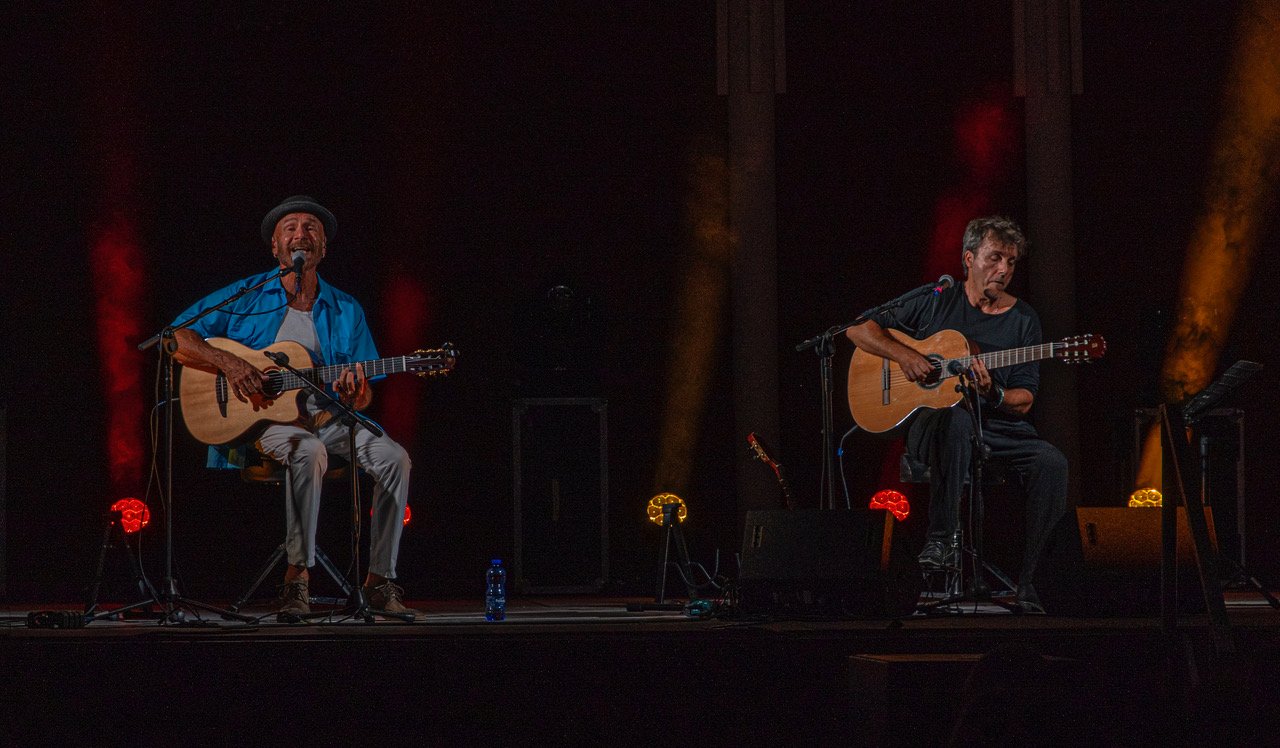
The event. Mario Venuti & Tony Canto in Rome: they'll bring "Mai come ieri" to the city on Sunday, November 29, 2026, at the Teatro Studio Gianni Borgna of Auditorium Parco della Musica Ennio Morricone. It will be a concert in a small lineup, built on the shared repertoire of the two Sicilian musicians, between singer-songwriter music and Mediterranean sounds, in the smallest and most intimate hall of the complex on Viale Pietro de Coubertin.
Who they are. Mario Venuti is a singer-songwriter from Syracuse with 40 years of work behind him, first with Denovo in Catania and then solo, in a zone of singer-songwriter pop shot through with Brazilian influences. Tony Canto is a guitarist, songwriter and producer: the two have known each other and worked together for decades, and the very name of the evening refers to a 1998 album on whose credits Canto appears on guitars.
The hall. The Teatro Studio Gianni Borgna is the most intimate space of Auditorium Parco della Musica, the complex designed by Renzo Piano in the area between Flaminio and Parioli: a little over 300 seats, a low, elongated plan, designed from the start for the spoken word and for small ensembles. It's the right choice for a concert that rests on two guitars and a voice, and not on a wall of amplification.
What this concert will really be
It's worth saying right away, because it helps you understand what evening to expect: the one on November 29, 2026, won't be an arena concert with sets, costume changes and a setlist written at a desk to get 3,000 people singing. It will be a theater evening, in a hall with a little over 300 seats, where the distance between those playing and those listening is measured in meters and not in numbered sections. That changes everything: it changes the way they play, it changes the way you listen, it even changes the way it's best to dress and arrive.
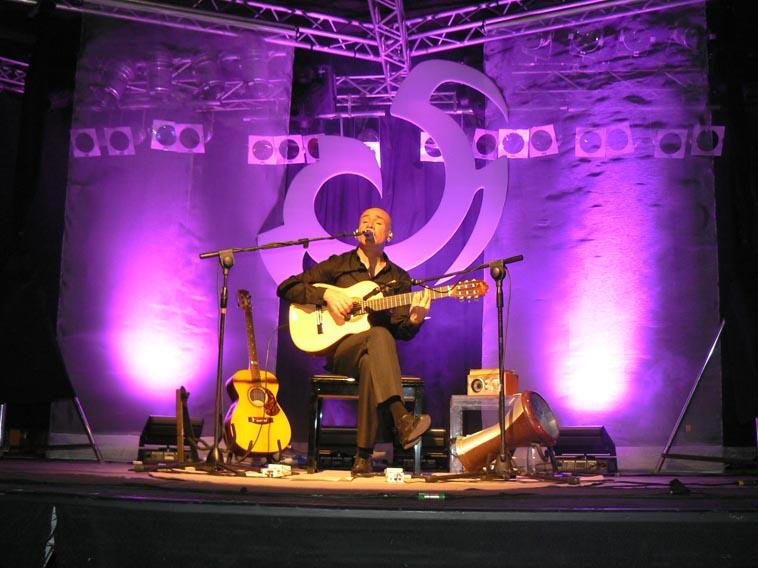
The title of the evening, "Mai come ieri", is the same as that of Mario Venuti's third solo album, released in 1998. That record had a double structure that was rather unusual for its time: a section of new songs and a section of earlier songs revisited and redone acoustically, including some from the Denovo period. In the credits of that album, on electric and acoustic guitars, slide and harmonica, is Tony Canto. It doesn't take much imagination to understand why two musicians who share that past choose that title today for an evening as a duo.
One thing needs to be said clearly here, because the web is full of pages promising lists of songs and surprises: the setlist of an evening like this isn't public information and won't be until the lights go down. Anyone writing that this or that song "will be performed" is making a guess, not giving information. The only honest thing to say is that the repertoire available is vast, because it covers 40 years between Denovo and a solo career, and that the acoustic format allows them to move through it with a freedom that doesn't exist on a tour with a band.
Why a duo format works well with this repertoire
Venuti's songs have a solid melodic structure: they hold up when pared down. Many pages of his catalog, born with layered arrangements of horns, percussion and keyboards, have a backbone of chords and words that keeps working when you take everything else away. That's exactly why an album like the 1998 one made sense: putting the same songs in two different lights and seeing what remains. An evening with two guitars is the same operation done live, with the advantage that the audience hears the slips, the breaths and the on-the-fly corrections that get removed in the studio.
There's also a practical reason. The Teatro Studio Gianni Borgna isn't a hall that forgives excessive volume. It's low, it's intimate, its acoustics are designed for the spoken voice and small ensembles. Bringing in a fully amplified drum kit would mean fighting the space. Bringing in two guitars and a voice means going along with it. Those who know the hall know that the best evenings in there are the ones where the sound arrives almost acoustic and the sound system only fills in the gaps.
What this concert won't be
It won't be a nostalgic evening in the strict sense. Venuti has kept releasing albums up to recent years and has never turned into an artist who celebrates the past. A concert that carries the name of a 1998 album in its title may suggest a revival operation, but the logic of the acoustic format is different: not repeating the album, but using that method on everything else.
It won't be a greatest-hits-only evening either. People who go to a concert in a 300-seat theater do so because they accept the risk of the side track, the thing never played live, the spoken digression between one song and the next. It's part of the deal. If instead you're only looking for the well-known songs and want the certainty of hearing them all, you'll probably find more satisfaction at a summer festival, where the repertoire is necessarily concentrated.
And it won't be a very long evening. Evenings in the Auditorium's theaters normally have a limited length compared to club concerts, because the complex hosts several events on the same day and the exit times have to be respected. If you're coming from outside Rome and have to catch a train the same evening, you should still check the start time on the event's official page, because the only reliable source for that information is the Auditorium's calendar.
Who Mario Venuti is
Mario Venuti was born in Syracuse on October 28, 1963. It's a fact that says little on its own, but it becomes interesting if you look at where he ended up: in Catania, in the early 1980s, inside a music scene that within a decade would change the sound of Italian pop much more than Rome and Milan were willing to admit.
Denovo and 1980s Catania
Denovo formed in Catania in 1982. The first lineup brought together Mario Venuti on guitars, sax and vocals, Toni Carbone on bass and the brothers Luca Madonia, guitars and vocals, and Gabriele Madonia on drums. The band's name has no hidden meaning: it comes from a Dunlop tire model, chosen because it sounded good. It's a detail that tells the story of the era better than many analyses: a generation that took words wherever it found them and put them back together by ear.
Denovo's discography is short and dense. "Unicanisai" came out in 1985, "Persuasione" in 1987, "Così fan tutti" in 1988, "Venuti dalle Madonie a cercar Carbone" in 1989. In 1988 Raffaele Fazio replaced Gabriele Madonia on drums for a while, and between 1988 and 1990 keyboardist Dino Scuderi joined the lineup. The band broke up in 1990. Four albums in five years, then the end.
The weight of that band, though, isn't measured in copies sold. In those years Catania earned the nickname of Italy's Seattle, and the label, however journalistic, captures something true: a city on the periphery of the record industry's centers produced in a few years a density of musicians nobody expected. Names like Carmen Consoli and Roy Paci came in Denovo's wake. A book has also been written about it, "Tempi di libero rock", which tries to put that season in order.
There were two reunions. In 1997 Denovo got back together for a short run of four dates in Sicily. In 2008 they shared the same stage again at the Sanremo Festival, more than 20 years after their debut. In 2014 came "Kamikaze Bohemien", an album under the Denovo name released 24 years after the breakup.
The solo career
The first record under the name Mario Venuti is "Un po' di febbre", from 1994. Then came "Microclima" in 1996 and "Mai come ieri" in 1998, the one that gives the Rome evening its title. Then "Grandimprese" in 2003, "Magneti" in 2006, "Recidivo" in 2009, "L'ultimo romantico" in 2012, "Il tramonto dell'Occidente" in 2014, "Motore di vita" in 2017, "Soyuz 10" in 2019 and "Tra la carne e il cielo" in 2024.
11 albums in 30 years is a steady, almost methodical pace, which tells of an artist who has never stopped and never forced things. Among the recognizable traits of that path is a constant relationship with Brazilian music: not quoted as exotic color, but used as rhythmic grammar, in the way the guitars accompany and the way the voice sits off the beat.
His Sanremo appearances
Venuti came to Sanremo in 1996 with "Amore di plastica", sung together with Carmen Consoli, in the category for young artists. In 2004 he competed among the big names with "Crudele": he came 10th and won the Mia Martini Critics' Award, which at that festival is often the award that matters most for singer-songwriters. In 2006 he returned with "Un altro posto nel mondo" together with Arancia Sonora, in the groups category, without getting past the first round. In 2008, as mentioned, he was on stage with the reunited Denovo.
On Sanremo a note of method is worthwhile: the festival rankings say very little about the songs' later life. "Crudele" remained in the live repertoire well beyond that 10th place, and the Critics' Award weighs much more in how an artist is perceived than the final position.
What kind of artist he is, live
People who have never seen him play often expect a stern singer-songwriter. That's not him. Live, Venuti talks, tells stories, teases himself and the audience, changes register from one song to the next. Acoustic evenings, in particular, tend to become conversations punctuated by songs, more than concerts with introductions. It's a format that only works if the hall is small enough to allow the normal tone of the speaking voice, and the Teatro Studio Gianni Borgna is.
It should be added that Venuti's voice has a particular placement: light, nasal in the upper register, not inclined to shouting. In a badly amplified hall it becomes fragile. In an intimate, well-tuned hall it becomes the center of everything. The choice of the Teatro Studio, from this point of view, is consistent.
Who Tony Canto is
Tony Canto is the name that often appears on credit pages and almost never on posters. He's a guitarist, songwriter and producer, and he belongs to that category of musicians whose work is recognized more from the sound of other people's records than from a personal discography in the spotlight.
The bond with Venuti
The oldest verifiable point of contact between the two runs precisely through the album that gives the evening its title. In the credits of "Mai come ieri", from 1998, Tony Canto is listed on electric guitar, acoustic guitar, slide and harmonica. Four instruments, which already says something about his role: not the session man called in for one part, but the musician who builds the sonic fabric of the album.
Also playing on that album are Toni Carbone on bass, who came from Denovo, Massimo Roccaforte on electric guitar, Aldo Franco on drums, Gionata Colaprisca on percussion, Luca Madonia on backing vocals. Carmen Consoli sings on the song that opens the album and gives it its title. It's a precise snapshot of a musical circle: people who know each other, who have played together, who meet up in the same studio.
In the following years the relationship between Canto and Venuti grew stronger on the production side: Canto is among the producers of Venuti's most recent work. If you listen to the records in chronological order you hear a continuity in the treatment of the guitars that isn't accidental.
What a producer does, in practice
It's worth explaining, because it's a word the public uses without knowing what it means. A producer, in Italian songwriting, isn't the one who puts up the money. It's the one who decides the sound: which tempo, which key, which instruments come in and when, how much space to leave between one phrase and the next, if the vocals should be recorded standing or sitting, if a second guitar is needed or taking one away works better. It's a job of choices by subtraction, almost always invisible to the listener, and decisive.
When the producer is also the guitarist who'll play those parts live, the distance between record and concert shrinks. That's exactly the situation of a duo evening like the one on November 29: the person who designed the sound of the records sits next to the person who sings them, and the result tends to be more consistent than on tours where the band is put together for the occasion.
The guitarist
On the instrumental side, the 1998 credits describe a precise profile: electric, acoustic, slide, harmonica. The slide, in particular, is an instrument that carries a precise imagery, between blues and American music, and in Venuti's Mediterranean context it creates an interesting friction. The harmonica, then, is the instrument that in a small lineup replaces the horns without needing a section.
In a duo evening, one of the two has to do the work of accompaniment and of color at the same time. It's an awkward and little-recognized position, which requires knowing when to disappear. The guitarists who know how to do it are fewer than you'd think, and they're generally the ones who have spent years in the studio deciding what to take away.
The craft of staying in the background
In Italy there's a generation of musicians born around the 1960s who chose, more or less consciously, to build a career on the less exposed side of the trade. They play on other people's records, produce them, write arrangements, and when they go on stage they do so next to someone whose name is written bigger on the poster. Tony Canto belongs to that category.
The public tends to consider it a second-tier position. From the inside the matter looks the opposite: those who work this way go through, in 30 years, a number of records, genres and situations no solo artist can accumulate, and develop an adaptability worth as much as a songwriting credit. In a duo evening, that ability becomes visible: there's a single instrument covering all the space that on record was taken by five or six, and the difference between a successful evening and a labored one depends almost entirely on that.
It should be added that in a format like this the boundary between the two roles dissolves. There isn't a singer and an accompanist: there are two musicians sharing the same sonic space who have to decide, bar by bar, who keeps time and who moves. That's why this kind of evening works well between people who have known each other for decades and almost never between brilliant strangers.
The Teatro Studio Gianni Borgna, the hall
The Teatro Studio Gianni Borgna is the fourth indoor hall of Auditorium Parco della Musica Ennio Morricone, and the smallest. There are a little over 300 seats: sources give 308, the complex's page rounds to 300. Either way it's a scale that in a city like Rome means one thing only, that the hall fills up without big campaigns and that anyone who goes in sees the stage from any seat.
Where it is inside the complex
Anyone arriving at the Auditorium for the first time faces a complicated organism: three large beetle-shaped halls, an open-air cavea in the middle, a series of covered walkways, shops, cafés, exhibition spaces. The Teatro Studio doesn't have the bulk of the three main halls and doesn't announce itself from outside: it's a service hall in the noblest sense of the term, carved out of the body of the complex and designed for drama, talks, chamber music and concerts in small lineups.
The practical consequence is that you have to look for it. If you enter from Viale Pietro de Coubertin and head toward the cavea, follow the internal signs, not your instinct. On evenings with several events at the same time the staff at the entrance direct the public, but on evenings when the Teatro Studio has the only show on the bill the signage is less visible. 10 extra minutes of margin solve the problem.
The other halls, to understand the proportions
A comparison is needed to understand what we're talking about. The Sala Santa Cecilia, the largest, has about 2,700 seats and is the complex's symphony hall, designed for orchestra and chorus. The Sala Sinopoli, named after conductor Giuseppe Sinopoli, has 1,133. The Sala Petrassi, dedicated to composer Goffredo Petrassi, 673. The open-air Cavea, which in summer becomes the heart of the program, reaches around 3,000 spectators.
The Teatro Studio, with its 300, is an order of magnitude below the Petrassi and almost 10 times smaller than the Santa Cecilia. If you've seen a concert in the Cavea in summer and then come in here in November, it's hard to believe you're in the same complex: the scale changes, the relationship with the stage changes, even the background noise of the audience changes, because in a small hall you hear all of it.
Who it's named after
The hall bears the name of Gianni Borgna, a music critic. It's a dedication with its own logic: a space devoted to the spoken word and small-scale music named after someone who told the story of Italian popular music and studied it. Anyone who knows Rome's cultural history of recent decades knows how much weight that name carries in the story of the city's cultural policies.
The complex and Renzo Piano
Auditorium Parco della Musica Ennio Morricone is the work of Renzo Piano. It was inaugurated in two stages: the Sala Sinopoli on April 21, 2002, the rest of the complex on December 21 of the same year. The area occupied is about 55,000 square meters, and the roof gardens named after Claudio Abbado extend over a much larger surface.
The three main halls have the shape everyone knows, with those lead shells that from afar look like insects resting on a lawn. The reason isn't ornamental: the shells are independent acoustic boxes, structurally separated from one another, so that the sound of one hall doesn't pass into the others. That's why you can hold a rock concert in the Santa Cecilia and a reading in the Teatro Studio at the same hour without either disturbing the other.
The Roman villa under the cavea
During excavations for the construction of the complex a Roman villa came to light. The find forced a change to the design and the finds are now displayed in a small museum under the cavea. It's one of those cases where Rome behaves like Rome: you dig to build an auditorium and a piece of antiquity comes out that has to be incorporated into the design instead of being removed.
If you arrive early on the evening of the concert, that area is one of the smartest things to see. It doesn't take much time, it's inside the Auditorium's perimeter and it tells a story that no standard tourist guide includes in its routes through the center.
How to get there
The address is Viale Pietro de Coubertin 30, postal code 00196, Rome. The complex is in the strip of the city between Flaminio and Parioli, close to the Tiber, in an area that until the 1950s was a sports outskirt and that today concentrates a cultural density the historic center doesn't have.
By metro and tram
The most common combination is metro line A to Flaminio station, and from there tram 2 heading north up Via Flaminia. The useful stops are those in the Reni and Apollodoro area, a few minutes' walk from the entrance. The route is short, runs frequently in the evening and has the advantage of being readable even for those who don't know Rome: you get off the metro, cross Piazzale Flaminio, get on the tram, get off when the sign tells you.
The downside is the return trip. At the end of a concert that finishes late in the evening, tram 2 may run less often, and the flow of people leaving the Auditorium's halls at the same time fills the first vehicles to arrive. If you have a train to catch at Termini you should allow a generous margin, or head straight for a taxi.
By bus
There are several surface lines serving the area: among the most useful are the 910, the 982, the 168 and the 53. The 910 in particular connects the area with Termini via the Salario neighborhood, and it's the choice for those arriving by train who don't want to change. Evening times should be checked in advance, though, because Rome's night service thins out quickly after a certain hour.
On foot, from the center
If you're staying in the Popolo or Flaminio area you can reasonably walk. From Piazzale Flaminio to the Auditorium entrance you walk along Viale Tiziano or, alternatively, along the Lungotevere, a walk of about 30 minutes at a normal pace. In the evening the route along Viale Tiziano is lit and busy. The one along the Lungotevere is more atmospheric but lonelier.
There's also a more beautiful route, if you have time and are coming from the opposite bank: the Ponte della Musica, for pedestrians and cyclists, which connects Flaminio to the Foro Italico. Crossing it at sunset, with the river below and Monte Mario ahead, is one of the best ways to arrive at a concert in this city.
By car and taxi
The Auditorium has an underground parking garage, but on evenings with a packed program, when several halls have shows at the same time, it fills up fast. If you decide to come by car you should allow for the time getting in and out of the garage, which on full evenings becomes the slowest part of the night.
A taxi is the simplest solution but not the fastest: Viale de Coubertin gets congested on concert evenings, and on the way out the line of waiting cars can be long. If you want to avoid the wait you can book the return ride somewhat in advance, giving as the pickup point not the main entrance but a side street in the area.
By bike
Flaminio is one of the few areas of Rome where cycling really makes sense: the path along the Tiber comes almost to the entrance, the Ponte della Musica is bike-friendly, and the difference in level is minimal. On November evenings, though, you have to allow for the damp cold that rises from the river after sunset, which in Rome is always sharper than the thermometer suggests.
How the evening works
The Auditorium's unwritten rules are few and fairly constant over time. Knowing them avoids most of the problems you see every evening at the entrances.
Before entering the hall
The theater doors usually open half an hour before the start. Before then the audience spreads out along the complex's covered walkways, which are handy on cold evenings because they're sheltered. If you arrive very early you'll find cafés and spaces where you can wait sitting down, something many Roman theaters don't have.
The practical advice for a hall like the Teatro Studio is not to show up at the last minute. In a 300-seat hall entering after the show has started is much more visible than in a 3,000-seat hall, and in many cases entry is allowed only at a suitable moment, so as not to disturb. A five-minute delay can turn into a much longer wait outside the door.
The seats
The Teatro Studio has a low, elongated plan. In a hall like this there are none of the truly bad seats you find in large halls: the maximum distance from the stage stays limited. There are, though, differences in sight lines, linked to the gentle rake of the stalls. If height is an issue or you want to be sure of a clear view, aim for the central rows rather than the very front ones, where the viewing angle to the stage is unfavorable.
Another thing that applies to small halls: the best sound is almost never in the front row. In the front row you mostly hear the direct sound of the instruments on stage, which is unbalanced compared to the mix made at the desk. The point where the engineer sets the sound is the point the sound was designed for, and that point is in the middle of the hall.
During the concert
In the Auditorium's indoor halls video recording is normally restricted and using your phone during the performance is frowned upon, all the more so in a small hall. It's not a question of rules: it's that in 300 seats a lit phone screen can be seen from the whole audience, and the musicians two meters away see it better than anyone.
The inside bar stays open during shows in the common areas, but you can't take glasses into the hall. If you need a drink it's best to have it before or during the intermission, if there is one.
Afterward
Leaving a 300-seat hall is quick. The problem, if anything, is that it coincides with the other halls' exit, if the evening has several shows at the same time. The exit toward Viale de Coubertin gets crowded for about 20 minutes on full evenings, then empties. If you're not in a hurry you can wait that quarter of an hour in the inside walkways instead of standing in line.
Tickets and entry, in general
Few words are needed here and no promises. Tickets for Auditorium shows are sold through the official circuit indicated by the Auditorium itself on the event page, as well as at the complex's physical box office. Prices, discounts and availability aren't information worth giving here, because they change over time and the only reliable version is the one on the official page at the moment you read it.
The physical box office
The Auditorium box office is open continuously, in the winter season, from October to March, between 11:00 and 20:00, every day including Sundays and holidays. In summer the hours change slightly and on days with shows in the Cavea it closes earlier. Since November 29, 2026, falls fully within winter hours, the useful window is 11:00 to 20:00.
If you're in Rome in the days before, going to the box office is often the cleanest solution: you avoid the online circuits' fees and have a person to ask which seat really corresponds to which view, information that online maps convey poorly.
Contacts
The venue's reference email address is info@musicaperroma.it. For requests about reserved seats, special needs or groups, writing a few weeks ahead is much more effective than trying to phone in the days just before.
A recommendation on channels
Around concerts by well-known artists, pages crop up reselling tickets at inflated prices and sites imitating the look of the official channels. The rule is simple and admits no exceptions: always start from the event page on the Auditorium website and follow the link that page gives. Any other route exposes you to a risk that isn't worth saving two minutes.
Accessibility
Auditorium Parco della Musica is one of Rome's recently built cultural complexes, and you can tell: unlike the historic theaters of the center, born between the 18th and 19th centuries and adapted with difficulty, here accessibility was part of the design and not a later correction.
Routes and entrances
The inside routes are level or served by elevators and ramps, and getting from the entrance level to the halls doesn't require stairs. The outdoor surfaces, in the area between the shells, are even. Wheelchair users will therefore find a situation clearly better than the average for performance venues in this city.
Reserved seats
The complex's halls have spaces for wheelchair users and their companions. The correct practice is to state your needs when buying or to write in advance to the venue's email address: reserved spaces are limited for obvious capacity reasons, and in a 300-seat hall the margin is tighter than elsewhere. Booking a few weeks ahead is the difference between finding a place and not finding one.
People with hearing or vision difficulties
An acoustic evening in a small hall is, paradoxically, one of the most favorable situations for people with partial hearing: the volume is moderate, the dynamics are natural, the voice isn't covered by a band. People who use hearing aids generally find the central section of the stalls the best position, away from the side speakers. For specific needs the same recommendation applies: state them in writing and in advance.
Children and families
It's not a concert designed for small children, and a 300-seat hall amplifies any background noise. For teenagers who listen to Italian music, on the other hand, it's one of the best formats of all: you see how a song is built, something you don't grasp at a stadium concert.
What's around it
One of the advantages of this address is that it doesn't force you to choose between the concert and the rest of the day. The area around the Auditorium concentrates a quantity of things to see that in other parts of Rome would be spread over kilometers.
MAXXI, a short walk away
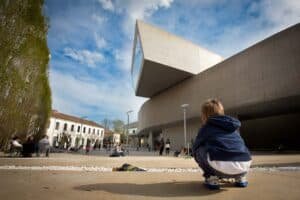
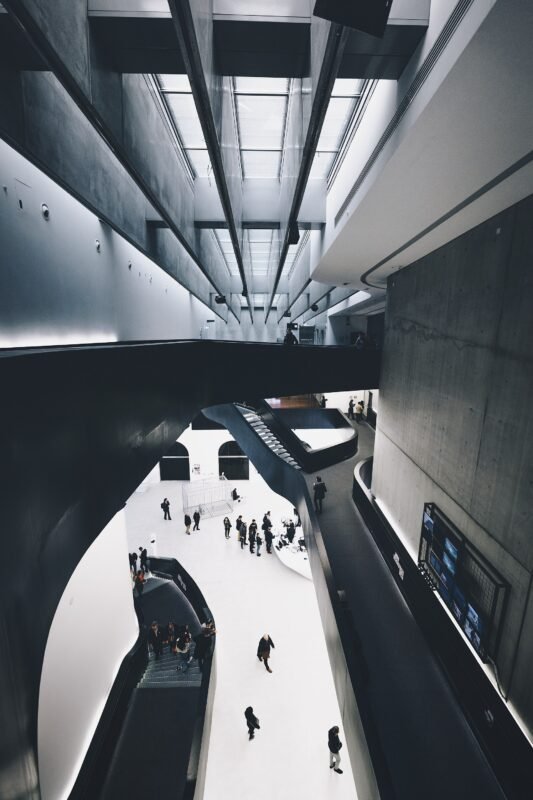
MAXXI, the national museum of 21st-century arts, is a few hundred meters away, on Via Guido Reni. The building is by Zaha Hadid and is, together with the Auditorium, the other big contemporary addition to this area. An afternoon at MAXXI and an evening at the Teatro Studio is a combination that works: you cover the distance on foot in less than 10 minutes, and the museum's closing times leave a comfortable margin before the theater doors open.
Villa Borghese and Casa del Cinema
Heading south you reach Villa Borghese, which from this side is quick to get to. If you have a whole afternoon you can combine the park with Casa del Cinema, which hosts screenings and talks and in winter works indoors.
The Villaggio Olimpico
The neighborhood immediately north of the Auditorium is the Villaggio Olimpico, built for the 1960 Games and then turned into a residential district. It's one of the most interesting and least visited pieces of postwar Italian architecture in the city: apartment buildings on pilotis, continuous green spaces between one building and the next, a planning logic nobody would build today. If you arrive an hour early and feel like walking you'll find a stroll here that appears in no tourist itinerary.
Where to eat, without made-up recommendations
The area has a reasonable density of places, concentrated mainly along Via Flaminia and on the streets of the Villaggio Olimpico. The complex has its own food service. Rather than recommending an address that may have changed hands, it's better to say the useful thing: on Sunday evening, in this area, many kitchens close earlier than in the center, and coming out of a concert late you risk finding little. If you want to eat well, do the opposite of what everyone does, that is, eat before the concert and not after.
Rome's other music venues
If you're staying in the city for several days, it's worth knowing that the Auditorium isn't isolated. Casa del Jazz, in the park on Via di Porta Ardeatina, and Auditorium Conciliazione, a short walk from St. Peter's, cover different and complementary program niches. Rome's concert circuit, lined up, offers in a November week a choice few European capitals have.
The Auditorium season around that date
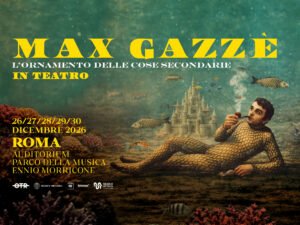
November and December are busy months for the complex: the program of the three main halls runs at full speed and the symphony season intertwines with jazz, singer-songwriters and drama. At the end of December, for example, the complex hosts Max Gazzè with a series of evenings between December 26 and 30. In autumn the venue is also home to the Rome Film Fest, which takes over the whole complex for about 10 days. In summer everything moves outdoors with the Roma Summer Fest in the Cavea.
Frequently asked questions about Mario Venuti & Tony Canto in Rome, November 29, 2026
When is the Mario Venuti and Tony Canto concert?
The concert is on Sunday, November 29, 2026, in the Teatro Studio Gianni Borgna, inside Auditorium Parco della Musica Ennio Morricone.
Where exactly is it?
The address is Viale Pietro de Coubertin 30, 00196 Rome. The Teatro Studio Gianni Borgna is the fourth indoor hall of the Auditorium complex, the smallest of the four.
How many seats does the hall have?
The hall has a little over 300 seats: sources give 308, while the complex's page rounds to 300.
What kind of concert will it be?
Not an arena concert with sets and costume changes, but an acoustic theater evening for two, with Mario Venuti and Tony Canto, in a hall where the distance between those playing and those listening is measured in meters and not in numbered sections.
How do you get to the Auditorium for the concert?
The most common combination is metro line A to Flaminio station, followed by the tram heading up to the Auditorium complex on Viale Pietro de Coubertin.
Where do you buy tickets?
Tickets are sold through the official circuit indicated by the Auditorium on the event page, as well as at the complex's physical box office.
Is the Auditorium accessible to people with mobility difficulties?
Yes, unlike Rome's historic theaters born between the 18th and 19th centuries, here accessibility was part of the design: the inside routes are level or served by elevators and ramps.
Knowing this serves a practical purpose: if you're planning a trip to Rome around a concert you can easily build two or three evenings around it, instead of spending a whole weekend for 90 minutes of music. If you're organizing the trip from outside Italy you'll find a general overview of the city in the English guides on ItalyPlanner.com.
A curious fact about Mario Venuti & Tony Canto in Rome, November 29, 2026
The curious fact concerns the name of the evening, and almost nobody tells it in full. "Mai come ieri" isn't just a song title: it's the title of a 1998 album built on a logic that was rare at the time and has almost become a fashion today. That record was split in two: on one side new songs, on the other songs already released and redone in acoustic versions, including some from the Denovo period.
Today acoustic reinterpretations are an established genre, and every artist sooner or later releases their own stripped-down version. In 1998 it was a gamble: it meant admitting that songs could exist in several forms and that the first one released wasn't necessarily final. It also meant exposing yourself, because a stripped-down song shows the writing flaws that the arrangement hides.
The detail that closes the circle is that in the credits of that album, on electric and acoustic guitars, slide and harmonica, is Tony Canto. The evening of November 29, 2026, therefore doesn't pick a random title from the catalog: it goes back to the exact moment when those two musicians first experimented, on record, with the idea of paring their repertoire down to the bone. 28 years later, that same idea becomes the format of a concert.
One last note: the song that gives the album its title, and opens it, is sung together with Carmen Consoli. Two years earlier, in 1996, Venuti and Consoli had been on the Sanremo stage together with "Amore di plastica". That's how the Catania scene worked: the same people kept crossing paths, without anyone treating it as an event.
Something nobody tells you about Mario Venuti & Tony Canto in Rome, November 29, 2026
That the hall matters more than the artist, on an evening like this. It's a sentence that sounds exaggerated and isn't.
An acoustic duo concert is, technically, the most exposed situation there is. There's no drum kit to cover mistakes, no bass to hold the harmonies together, no bed of keyboards to rest intonation slips on. There are two instruments and a voice, and everything that happens can be heard. In the wrong hall, a format like this becomes a struggle for the players and a disappointment for the listeners: the sound disperses, the reverberation eats the words, the audience at the back stops following and starts talking.
The Teatro Studio Gianni Borgna is one of the Roman halls where this doesn't happen. Not because it's beautiful to look at, because it isn't particularly: it's a plain, almost bare space. But it's small, it's low, it has a ratio between volume and number of spectators that keeps the sound compact. In a hall like this a well-miked acoustic guitar reaches the back without needing to be pushed, and the speaking voice between songs is understood without more miking than necessary.
The practical consequence for the reader is this: if the only criterion for choosing is the artist, you end up seeing the same artist in settings that give very different versions of them. The same repertoire, in a summer piazza with 3,000 people and in an indoor hall with 300, produces two evenings that have little in common. Those who choose the small hall already know what they'll take home. Those who don't think about it are often surprised.
An extra note almost nobody considers: in small halls the audience is part of the instrument. 300 people listening in silence produce a silence you can hear, and the musicians use it. When that silence isn't there, the evening changes. That's why regulars of these spaces have very low tolerance for people who chat, and why it's best to arrive aware of the deal.
My advice for seeing Mario Venuti & Tony Canto in Rome, November 29, 2026
My advice is to treat the evening as an outing in a neighborhood, and not as a trip to a venue. The whole difference lies in when you arrive.
Rome in winter gets dark early: on November 29 the sun sets shortly after half past four. If you get to the Auditorium at 15:00, you have an hour and a half of daylight in one of the most interesting parts of the contemporary city, and then the rest of the evening indoors. With that hour and a half you can do the Villaggio Olimpico, or cross the Ponte della Musica and look down at the Tiber at sunset, or go into MAXXI if you feel like staying warm.
Then, around 18:00, you head back inside the Auditorium's perimeter. The complex is open and walkable even without a ticket for the halls: the covered walkways, the bookshop, the cafés, the archaeological area under the cavea. It's one of the few places in Rome where waiting is pleasant rather than boring.
The second part of the advice concerns clothing, and it's not trivial. The hall is intimate and warms up quickly with 300 people inside. The complex's outdoor walkways, on the other hand, are open and breezy, and the wind coming off the river in November is cold. The solution is to dress in layers and allow for the fact that a heavy coat, in the hall, becomes a nuisance. The cloakroom, when it's open, solves it. When it isn't, the coat ends up on your knees.
Third part: choose your seat thinking about listening and not about closeness. In a 300-seat hall row one isn't a privilege, it's an acoustically unbalanced position. The central rows give the right mix, the best viewing angle and the right distance to see the hands on the strings, which at a guitar concert is half the show.
Fourth and last: don't take the train home right after. If you're coming from Naples, Florence or Milan you're tempted to squeeze in the last train. On an evening that ends late, with the crowd leaving, the tram and the traffic on Viale de Coubertin, the margin gets used up fast. A night in Rome costs less than the stress of watching the clock during the last song.
Another well-known fact, yet rarely mentioned
That Auditorium Parco della Musica was born on top of a Roman villa, and that the villa changed Renzo Piano's design.
The news itself is known: during the construction excavations a residential complex from the Roman era came to light, whose finds are now displayed in a small museum carved out under the cavea. What's rarely mentioned is the consequence. An archaeological find during construction, on a site of that size, isn't a curiosity: it's an event that rewrites the schedule, the costs and the plan of the building. The three shell halls everyone photographs are arranged as they are partly because the design had to make room for what was underneath.
This says something that goes well beyond the Auditorium and that visitors to Rome should keep in mind: in this city there's no virgin ground. Any excavation, in any area, has a high chance of finding something. That's why public works in Rome take times that would seem absurd elsewhere, and it's also why the city keeps producing discoveries without anyone looking for them.
The second rarely mentioned fact concerns the acoustics. The lead shells of the three main halls are structurally independent boxes. They don't rest on one another and don't share foundations with the rest of the complex: they're isolated, so vibrations aren't transmitted. That's the technical reason why you can hold a rock concert in the Santa Cecilia while someone reads poetry in the Teatro Studio, and neither hears the other. It's also why the complex cost what it cost.
The third, the simplest and most ignored: the roof gardens named after Claudio Abbado, which surround the complex, are an enormous green surface, tens of thousands of square meters, and you can walk on them. Almost none of the Romans who go to concerts use them. A walk up there, on a November day with a clear sky, is one of the cheapest ways to spend a good hour in this city.
The right photo to take at Mario Venuti & Tony Canto in Rome, November 29, 2026
It's not the one of the stage. That needs saying right away, because the temptation is strong and the result is almost always disappointing: a theater hall with low lights and two seated musicians produces, with a phone, a dark rectangle with two bright spots. It tells nothing, and taking it makes you miss the moment.
The right photo is taken outside, before going in, and it's the one of the lead shells. At sunset at the end of November, around 16:30, the raking light hits the curved surfaces of the three halls and transforms them: the lead goes from dull gray to a range of warm reflections that lasts a few minutes. Stand in the space between the Sala Sinopoli and the Sala Petrassi, point upward so the shells fill the frame and the sky forms the background, and wait for a person to cross the shot to give scale. Without a human figure, those volumes look like a model.
The second photo, if you have more time, is taken from the Ponte della Musica. From mid-span, looking upstream, you have the river below, the green of the banks on either side and the bulk of the complex glimpsed beyond the trees. It's a view people almost never associate with Rome, and it works precisely for that reason: nobody immediately recognizes where it was taken.
The third, which almost nobody takes, is inside: the archaeological area under the cavea. Finds from a Roman villa displayed under a contemporary building, with the geometry of concrete above and ancient stone below. It's the image that tells better than any caption what building in Rome means.
Finally, a rule of behavior worth more than any technical tip: during the performance the phone stays in your pocket. In a 300-seat hall a lit screen can be seen from the back row and from the stage. Photos are taken before, after and in the common areas.
Some important events that happened here in history
The complex's history is short but dense, and it has a few dates worth pinning down.
April 21, 2002
It's the inauguration date of the Sala Sinopoli, the first of the three large halls to come into operation. It's no coincidence that it was April 21: it's Rome's birthday, and the choice was clearly symbolic. The city opened its new music infrastructure on the day of its mythical founding.
December 21, 2002
Eight months later the rest of the complex opened. From that moment Rome had, for the first time in its modern history, a symphonic facility suited to the size of the city. Before then Accademia Nazionale di Santa Cecilia, one of the oldest musical institutions in the world, played in makeshift venues.
The discovery of the Roman villa
It happened during construction, it predates the opening and it shaped the design. It's the least spectacular and most Roman event of the story: the city that, while the future is being built, gives back a piece of the past and forces everyone to stop.
The naming after Ennio Morricone
The complex today bears the name of Ennio Morricone, the Roman composer who died in 2020, whose work tied this city's name to film music all over the world. The naming turned the Auditorium from a neutral container into a place with a name of its own.
The dedication of the hall to Gianni Borgna
The Teatro Studio took the name of Gianni Borgna, a music critic. It's the dedication that most directly concerns those going to the concert on November 29, because it's the name written on the door of the hall they'll enter.
The outdoor season
A recurring event more than a date: since it opened, the Cavea has gradually changed the way Rome experiences its music summer, moving a large share of the big international program from the traditional venues to this area. It's a transformation that happened without announcements, over the years, and that seems obvious today only because people have got used to it.
Who has passed through Mario Venuti & Tony Canto in Rome, November 29, 2026
The question, in this case, should be turned around: not who has passed through the concert, which has yet to happen, but who has passed through the story leading to that concert and through the hall that will host it.
On the musicians' side
Luca Madonia, Gabriele Madonia and Toni Carbone passed through Denovo, as well as Mario Venuti. Then drummer Raffaele Fazio and keyboardist Dino Scuderi, in the final phase. Through Venuti's solo records passed Carmen Consoli, featured on the song that opens the 1998 album, and the musicians who played on that record: Massimo Roccaforte, Aldo Franco, Gionata Colaprisca, as well as Toni Carbone and Tony Canto.
In the broader story of the Catania scene of those years, names intertwine that later took very different paths: Carmen Consoli, Roy Paci, and a great many musicians who stayed in the recording studios. Those who went through that season often share one trait: the ability to play more than one instrument and to stand as easily in front of the microphone as behind it.
On the hall's side
The Teatro Studio Gianni Borgna, in more than 20 years of activity, has hosted drama, talks, presentations, chamber music, small-lineup jazz, singer-songwriter series, readings and experimental projects. It's the hall the complex uses for everything that doesn't need a large sound box and does need closeness. The list of names who have passed through it is very long and largely not documented systematically, because it's precisely the side evenings that nobody catalogs.
On the audience's side
This needs saying too, because it's the part nobody usually considers. The 300-seat hall has a regular audience: Romans who follow the complex's smaller program, subscribers who come in without checking who's playing, students, people from the neighborhood. On an evening like this, the artist's specific audience will join that core, also coming from out of town. The result is a mixed crowd, which generally produces better evenings than a homogeneous one.
Quick questions about the Mario Venuti and Tony Canto concert
When will the concert be
Sunday, November 29, 2026.
In which hall
In the Teatro Studio Gianni Borgna, inside Auditorium Parco della Musica Ennio Morricone.
What's the address
Viale Pietro de Coubertin 30, 00196 Rome.
How many seats does the hall have
A little over 300. Sources give 308 seats, the complex's presentation rounds to 300.
What time does it start
The start time is the one given on the event's official page on the Auditorium website. It's the detail to check last, because it's the one that can change.
How long is it
Evenings in the complex's indoor halls generally have a limited length. If you have time constraints for getting home, refer to the information on the official page.
Is the setlist known
No, and anyone publishing it in advance is guessing. The repertoire available covers 40 years between Denovo and a solo career.
Will there be guests
No announcement has been made to that effect. The evening is presented as a concert by the two musicians.
What kind of concert will it be
An evening in a small lineup, built on guitars and voice, in a small hall. Not a concert with a full band.
Where can you buy tickets
From the official circuit indicated on the event page and from the complex's box office. It's best to always start from the Auditorium website and avoid alternative routes.
What are the box office hours
In the winter season, which includes November, the box office is open continuously from 11:00 to 20:00, every day including holidays.
What's the venue's contact
The reference email address is info@musicaperroma.it.
How do you get there by public transportation
Metro line A to Flaminio and then tram 2 heading north, with stops in the Reni and Apollodoro area. Alternatively the surface lines 910, 982, 168 and 53.
Is there parking
The complex has an underground parking garage, which fills up early on evenings with a packed program.
Is the hall wheelchair accessible
The complex is designed with accessible routes and has reserved spaces. They should be requested when buying or by email, in advance, because they're limited in number.
Can you take photos
In the indoor halls recording during the performance is normally restricted. In a 300-seat hall phone use can be seen from every row.
Is it suitable for children
It's not designed for the very young. For young people already interested in Italian music it's a much more instructive format than a stadium concert.
What can you see on the same day
MAXXI on Via Guido Reni, the Villaggio Olimpico, the Ponte della Musica and, if you have more time, Villa Borghese. All within walking distance or nearly.
What's the weather like in Rome at the end of November
Cold, damp evenings, dark from late afternoon. It's best to dress in layers, because the hall warms up quickly while the complex's outdoor walkways are breezy.
Is it better to have dinner before or after
Before. On Sunday evening, in this area, many kitchens close early and when you come out of the concert the choice shrinks considerably.
Where does the title "Mai come ieri" come from
It's the same as that of Mario Venuti's third solo album, released in 1998, half new songs and half acoustic reinterpretations, in whose credits Tony Canto is listed on guitars, slide and harmonica.
Final advice
Evenings like this are the part of Rome's program that delivers and that almost nobody talks about. Three halls out of four, at the Auditorium, deal with big numbers. The fourth deals with what big numbers don't allow. A duo concert, in a 300-seat hall, on a Sunday at the end of November, is exactly what that space was built for.
If you're interested in Mario Venuti's repertoire, this is the best form in which you'll be able to hear it: no amplification covering things up, no distance to bridge, the real chance to see how a song is held up by two instruments. If instead you don't know him, and you happen to be in Rome that day, consider that an evening like this costs much less in time and effort than a concert on the outskirts and gives back much more: 40 minutes of neighborhood before sunset, an hour and a half of music a few meters away, and the chance to walk back toward Flaminio with the river beside you.
One last practical recommendation, valid for any event at the Auditorium: check the time and hall on the official page before leaving home. In a complex with five active spaces, the most common mistake isn't arriving late, it's arriving at the wrong hall.
Article written by the editorial team of TourLeaderPro, contact them for Private/Corporate/V.I.P. Tours and Experiences.
Planning a trip to Rome? English guides for visiting the city are on ItalyPlanner.com.
Contact Information
Nearby
 Museum of Musical Instruments (MUSA)100 m
- Auditorium Parco della Musica100 m
- Villa Glori500 m
- Fountain of Anna Perenna500 m
- MAXXI – National Museum of 21st Century Arts700 m
- Flaminio700 m
Upcoming events nearby
- Max Gazzè in concert in Rome at Auditorium, December 26 to 30, 2026100 m
- Glen Hansard in Concert in Rome, December 14, 2026100 m
- Steve Hackett tells the story of Genesis in Rome, November 21, 2026100 m
- Noemi in concert in Rome, December 22, 2026100 m
You might also like
- Shiva at Palazzo dello Sport in Rome, November 27, 28 and 29, 2026
- Talco Freek Tour 2027 at Hacienda Roma, April 2, 2027
- The Devon Allman Project at CrossRoads Live Club: March 26, 2027
- Il medico dei pazzi by Eduardo Scarpetta with Gianfelice Imparato at Teatro Tor Bella Monaca
- Tutti Satelliti – Ugo Borghetti | Podcast Live at Alcazar Live: Sunday, November 8, 2026
- Il bambino nella valigia at Teatro Ciak: Sunday, November 8, 2026