L’ultima notte di Giordano Bruno at Teatro Vittoria, November 10 to 22, 2026
In short. Practical dossier on L'ultima notte di Giordano Bruno. "L'ultima notte di Giordano Bruno" (Giordano Bruno's last night), written and directed by Stefano Reali, is on stage at Teatro Vittoria from November 10 to 22, 2026.
Practical dossier on L'ultima notte di Giordano Bruno. "L'ultima notte di Giordano Bruno" (Giordano Bruno's last night), written and directed by Stefano Reali, is on stage at Teatro Vittoria from November 10 to 22, 2026. The official calendar has 13 performances: Tuesday the 10th, Wednesday the 11th, Thursday the 12th and Friday, November 13 at 21:00, Saturday the 14th at 19:00, Sunday the 15th at 17:30, Tuesday the 17th at 21:00, Wednesday the 18th at 17:00, Thursday the 19th at 21:00, Friday the 20th a double performance at 17:00 and 21:00, Saturday the 21st at 19:00, Sunday the 22nd at 17:30. On stage are Gianluca Guidi, Stefano Messina and Giulia Ricciardi. The theater is at Piazza di Santa Maria Liberatrice 10, in the Testaccio district. The 2026/27 season price list gives 27 euros in the orchestra and 21 in the gallery, with a 3-euro presale fee on bookings and purchases made up to an hour before the start. For this title the MeglioPrima formula also applies, a single price of 18 euros, with 100 tickets per performance on the first two days of the run, sold only at the box office. The length isn't published. Tickets are sold at the theater box office (phone 06 5740170 and 06 5740598) or online from the channel listed on the show's official page on teatrovittoria.it. The nearest metro stop is Piramide, on line B. For the route, use the ATAC journey planner.
Language: performed in Italian. No English version or English surtitles are announced.
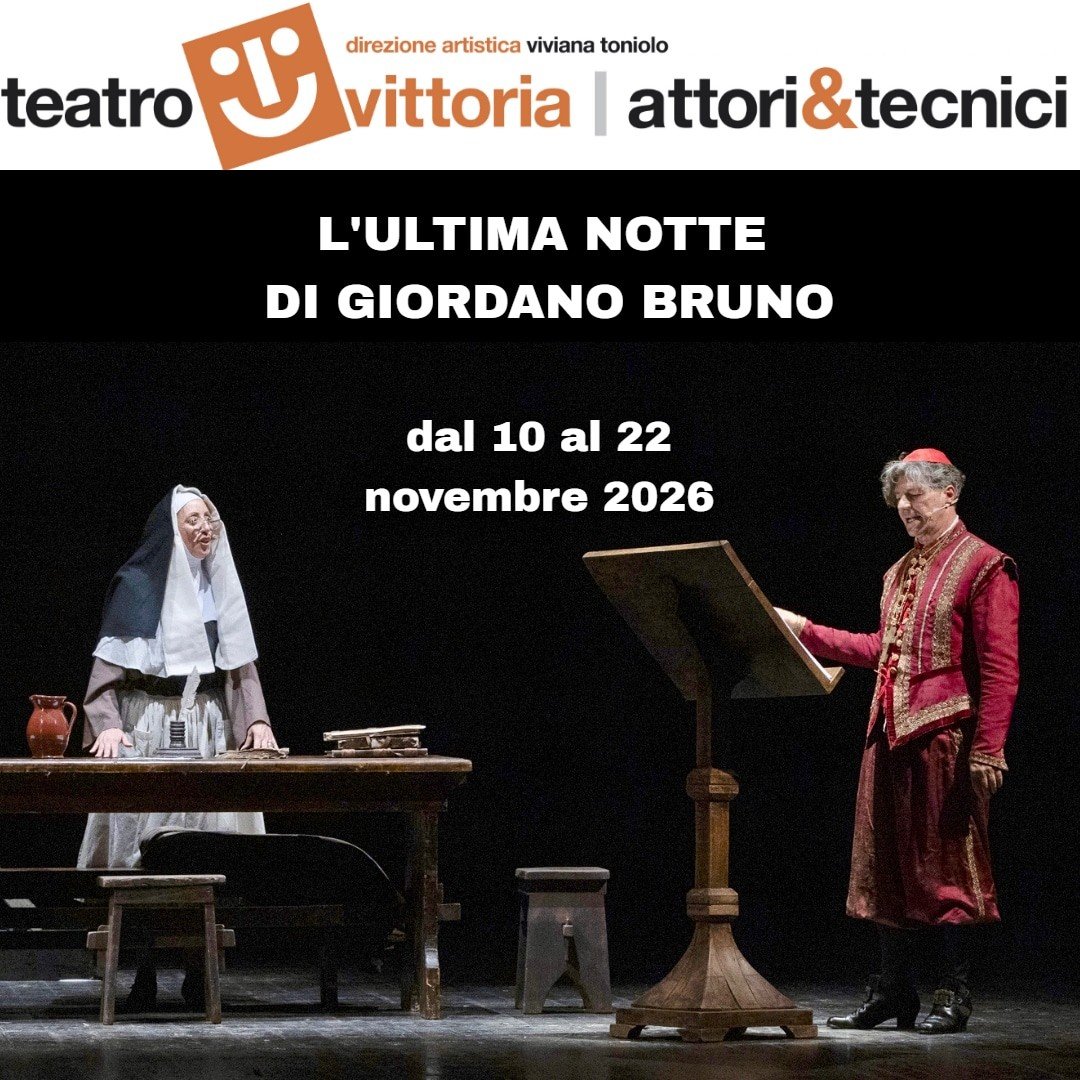
L'ultima notte di Giordano Bruno: a duel before dawn
The show takes a precise date, February 17, 1600, and narrows it to a few hours. It's still the dead of night in the Roman prison of Tor di Nona, where the philosopher from Nola is waiting to be taken to the stake prepared in Piazza Campo de' Fiori. A hooded visitor appears. Bruno discovers that it's Cardinal Robert Bellarmine, his most dogged accuser, who has come to offer him one last chance: if he agrees to recant at least eight of the 13 heretical theses for which he was condemned, his life will be spared. He'll get life imprisonment, but not the flames.
From this starting point Stefano Reali builds what the theater's presentation calls a "fierce, brilliant and surprising" duel. The cardinal has deep intellectual respect for the prisoner and tries to convince him that recanting would suit them both: Bruno, who would avoid a horrible death, and the Church, which would gain an enormous boost to its image. If Europe's most famous heretic recanted, the news would travel around the continent.
A negotiation that turns upside down
The dramatic mechanism is that of a negotiation. Bruno immediately understands how badly the cardinal needs to leave the cell with a success and starts asking for something in return. With each concession he raises the stakes, and he pushes it to the point of the implausible. The conversation thus turns into an all-out clash between a great theologian, a loyal servant of the papacy, and a biting, provocative and highly learned philosopher who refuses to accept the version of events imposed by the Holy Office on him as on anyone else.
Today's language for yesterday's trial
The official presentation deliberately uses words of our time: for the Vatican of the day, the theater writes, the plurality of worlds, the Copernican theory and the rejection of dogma were just "fake news". The choice of words suggests the tone of the show, which looks at the most famous trial of Counter-Reformation Rome through the eyes of people living in an age obsessed with truth and its manipulation. This is an editorial reading, not a statement by the authors: in any case, the text invites reflection on the relationship between power and freedom of thought.
What the documents say and what the theater invents
The nighttime meeting between Bruno and Bellarmine is a dramatic invention, but it rests on documented facts. According to the standard reconstruction of the trial, on January 12, 1599 Bruno was called on to recant eight propositions judged heretical: among them the denial of divine creation, the idea of an infinite universe, the motion of the Earth, which in his view had a soul, and the idea that the stars were angels.
The eight propositions
The numbers in the script and those of historians don't fully match: the show speaks of 13 theses, of which at least eight are to be retracted, while historians mention eight propositions. It's the normal freedom of theater, which condenses and recombines. More interesting is the cardinal's role: according to the historical reconstruction, on August 24, 1599 the Jesuit reported to the Congregation that Bruno had admitted six of the eight propositions as heretical, while his position on the other two remained ambiguous. A full admission would have spared him death.
The final refusal
Bruno wavered for a long time. On September 10, 1599 he still declared himself ready to recant, on the 16th he changed his mind, and on December 21 he rejected any retraction, declaring he had nothing to repent. On February 8, 1600 he heard on his knees the sentence that handed him over to the secular arm. According to the testimony of Caspar Schoppe, he stood up and said to the judges a sentence that became famous: "Maiori forsan cum timore sententiam in me fertis quam ego accipiam", that is, perhaps you tremble more in pronouncing it than I do in hearing it.
Tor di Nona and the Holy Office
The script sets the last night in the Tor di Nona prison. The biography records that from February 27, 1593, after his extradition from Venice, the philosopher was held in the Roman prisons of the Palace of the Holy Office. The move to Tor di Nona for the last hours is the frame chosen by the show, which doesn't claim to be an archival reconstruction.
Who Giordano Bruno was
Filippo Bruno was born in Nola in 1548, in the Kingdom of Naples, then ruled by the Spanish crown. He was baptized with the name of the heir to the throne, Philip II. At about 15 he took the Dominican habit at the convent of San Domenico Maggiore in Naples and took the name Giordano. In 1576, denounced for some statements about Arianism, he left Naples and went to Rome, where he stayed at the Dominican convent of Santa Maria sopra Minerva. A few months later he abandoned the habit and fled. So began a long wandering across Europe: Genoa, Venice, Geneva, Toulouse, Paris, London, Prague, Frankfurt.
The London years
Between 1584 and 1585, as a guest of the French ambassador Michel de Castelnau, Bruno published in London six dialogues in Italian that form the heart of his philosophy: "La cena de le ceneri", "De la causa, principio et uno", "De l'infinito, universo e mondi", "Spaccio de la bestia trionfante", "Cabala del cavallo pegaseo" and "De gli eroici furori". In these pages takes shape the idea of an infinite universe, populated by countless worlds, the most radical and modern thesis of his thought.
The playwright
Even before the dialogues, in 1582, during his Paris years, Bruno had published "Il Candelaio", a comedy in five acts set in late 16th-century Naples, written in a colloquial Italian mixed with Latin, Tuscan and Neapolitan. The fact that the show's protagonist was also a man of the theater makes his stage voice especially believable: it's no surprise that a contemporary author puts sharp, paradoxical lines in his mouth.
The arrest in Venice
In 1591 Bruno returned to Italy, perhaps hoping for a chair in Padua. In Venice he was the guest of the patrician Giovanni Francesco Mocenigo, who wanted to learn the arts of memory from him. When the philosopher announced he wanted to leave for Frankfurt, Mocenigo had him locked up in his house and on May 23, 1592 denounced him to the Inquisition. That same evening Bruno was arrested. From there began a trial that lasted almost eight years.
February 17, 1600 in Campo de' Fiori
On February 17, 1600, with his tongue clamped by a gag so he couldn't speak, Bruno was taken to Piazza Campo de' Fiori, stripped, tied to a stake and burned alive. He had refused religious comfort and the crucifix. His ashes were thrown into the Tiber. On August 7, 1603 his works were placed on the Index, but they kept circulating in European libraries.
Ettore Ferrari's monument
In the center of Campo de' Fiori today stands the most important monument dedicated to the philosopher, by the sculptor Ettore Ferrari, inaugurated on June 9, 1889 despite strong hostility from church circles. The idea was born in 1876 from a committee of republican university students, joined by intellectuals from all over the world such as Victor Hugo, Ernest Renan, Henrik Ibsen and Walt Whitman. Those who see the show can round off the experience by going to see it, perhaps in the morning, when the square hosts its market. Since 1869 the square has hosted a market, depicted in the 1943 film "Campo de' fiori" with Anna Magnani and Aldo Fabrizi, two artists who according to the theater's history had also performed on the stage of the first Vittoria. A few steps away is the Palazzo della Cancelleria, one of the great buildings of the Roman Renaissance.
Four centuries later
On February 18, 2000, in a letter from Vatican Secretary of State Angelo Sodano sent to a conference in Naples, the Holy See expressed "deep regret" for the philosopher's atrocious death, without however rehabilitating his doctrine. Bruno is also remembered in the sky: a lunar crater and two asteroids are named after him. In Italy there are many monuments and plaques in his name, from Nola, his hometown, to Sestri Ponente.
Robert Bellarmine, the adversary
Robert Bellarmine was born in Montepulciano on October 4, 1542 and died in Rome on September 17, 1621. A Jesuit, theologian and one of the most authoritative polemicists of the Counter-Reformation, he was a nephew on his mother's side of Pope Marcellus II. In the consistory of March 3, 1599, right in the years of Bruno's trial, Clement VIII made him a cardinal. He lived soberly despite his rank, and gave most of his income to the poor.
From Bruno's trial to the Galileo case
His name is linked to both great trials of the new science. He was involved in Bruno's case from 1597, as a consultant to the Holy Office, and had several conversations with the philosopher in an attempt to obtain his recantation. Years later, in 1616, Pope Paul V charged him with dissuading Galileo from teaching heliocentric theses. Sources recall, however, a 1615 letter in which Bellarmine didn't rule out heliocentrism in principle, asking for caution until there was definitive proof.
A saint as antagonist
Bellarmine was beatified in 1923, canonized by Pius XI on June 29, 1930 and proclaimed a Doctor of the Church in 1931. Putting a saint on stage as an antagonist, and moreover as a man moved by sincere respect for his adversary, is the most interesting gamble of Reali's text: neither is a caricature, and the conflict arises from opposing and respectable convictions.
Stefano Reali, writer and director
Stefano Reali was born in Frosinone on November 3, 1957. In 1978 he earned a diploma in jazz music at the Licinio Refice conservatory in his hometown, and in 1980 one in directing and screenwriting at the Centro Sperimentale di Cinematografia. In 1982 he was assistant director to Sergio Leone on "Once Upon a Time in America". With Pino Quartullo he made the short film "Exit", based on a story by Luigi Malerba, nominated for an Oscar in 1987.
Television and music
The general public knows him mostly for TV drama: "Ultimo" with Raoul Bova, "Le ali della vita" with Sabrina Ferilli and Virna Lisi, "L'uomo sbagliato", "Lo scandalo della Banca Romana", "Caruso, la voce dell'amore". For many of his films Reali also composed and orchestrated the soundtracks. For the show at the Vittoria he does, besides the script and direction, the music. Since 2007 he has played piano in a swing quintet.
Theater and John Florio
In theater Reali wrote the comedy "Operazione", staged for five years and then produced in England by Alan Ayckbourn at the Stephen Joseph Theatre. In 2022 he brought "Doctor Faust e la ricerca dell'eterna giovinezza" with Giampiero Ingrassia to the Sala Umberto. In 2024 he presented his first novel, "Shakespeare Aenigma", devoted to John Florio. The detail is curious: Florio appears among the characters of Bruno's "La cena de le ceneri", because in the London of 1584 he was tutor to the daughter of the ambassador who hosted the philosopher.
Gianluca Guidi and the company
Gianluca Guidi was born in Milan on March 24, 1967, the son of Johnny Dorelli and Lauretta Masiero. He made his stage debut in 1992 with the musical "Parole d'amore parole" and has since alternated musical comedy and spoken drama. In 2000 he founded the production company Salieri Entertainment and in 2001 directed his first show, "Serial killer per signora". In 2022 he received the Premio Flaiano for best musical with "Aggiungi un posto a tavola".
Film and television
On screen Guidi has worked in, among others, "Il peccato. Il furore di Michelangelo", "La scuola cattolica" and the series "The Young Pope". His career, between musicals and drama, makes him a performer used to sustaining fast pacing and long dialogues, the stuff a text like this is made of.
Stefano Messina and Giulia Ricciardi
Alongside him are Stefano Messina, an actor and director tied for many years to the Attori e Tecnici company, which has its home right at the Vittoria, and Giulia Ricciardi. The official page doesn't give the casting: with three performers and two declared protagonists, the third character is a surprise the audience will discover in the hall.
Sets, costumes and production
Sets are by Carlo De Marino, costumes by Laura De Navasques, music by Stefano Reali himself. The production is by Virginy L'Isola Trovata.
Practical information
Teatro Vittoria has 560 red velvet seats according to the figure given on the theater's website for the 1986 reopening. The sections on sale are orchestra and gallery. CRAL discounts (22 euros in the orchestra, 17 in the gallery, plus presale fee) are reserved for under-35s, over-65s, people with disabilities of at least 75 percent and holders of affiliated cards, Tuesday to Friday and while promotional seats last. For under-18s the price is 13 euros in the orchestra and 11 in the gallery, with a 2-euro presale fee.
Box office hours
The box office is open on Monday from 10:00 to 13:00 and from 15:30 to 19:00, Tuesday to Saturday from 11:00 to 20:00 without a break, and on Sunday and holidays from 10:00 to 13:00 and from 15:30 to 19:00, for the afternoon show only. The theater specifies that it doesn't accept American Express or Diners, and that tickets are not refundable unless the show is canceled.
Getting there
Besides metro line B at Piramide, the theater's website lists tram 3 and several bus lines, including 170, 781, 83, 75, 23 and 280. The district is a limited traffic zone: check times and exemptions on romamobilita.it. If you're coming by car there's an agreement with the covered MuoviAmo garage at Via Galvani 57, behind the new Testaccio market, with a 1-euro discount: ask for the voucher at the box office before the start.
A taxi at the exit
A little-known service: in collaboration with radio taxi 3570, the theater can book a car to wait at the exit. The request must be made before the show or during the intermission.
Testaccio, the district around the theater
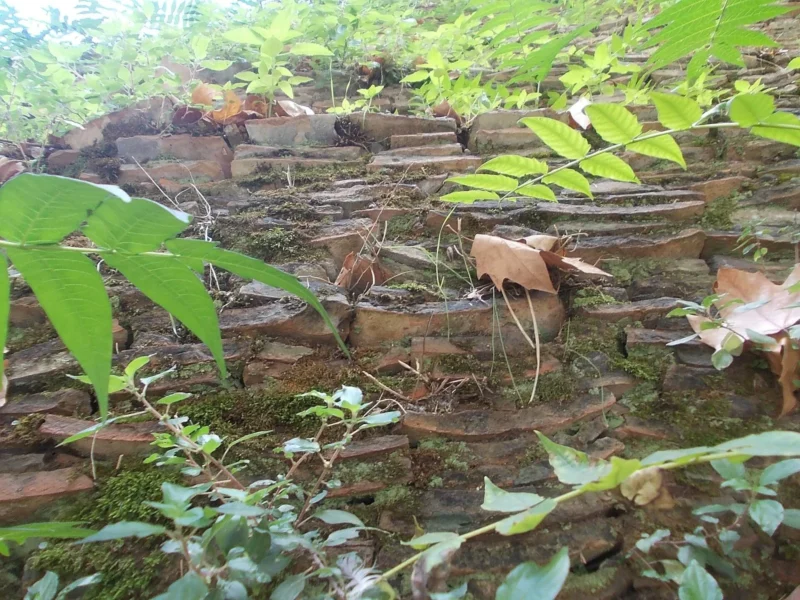
Testaccio is Rome's 20th district. The name comes from Monte dei Cocci, an artificial hill about 35 meters high formed from fragments of amphorae that the Romans dumped here after emptying them in the warehouses of the nearby river port. It's estimated to contain about 25 million amphorae. After 1870 the first master plan of Rome as capital assigned the area to productive activities, and the neighborhood was born for the workers of the Mattatoio, the wholesale markets and the Ostiense workshops.
A neighborhood to discover before or after the show
Within a short walk are the Pyramid of Cestius, Porta San Paolo and the Non-Catholic Cemetery, on Viale del Campo Boario. For a full itinerary in the district there's our page Testaccio: what to see.
A curious fact about Teatro Vittoria
The theater's name is older than the theater itself. Today's Vittoria was born in December 1986 in a neighborhood movie theater, but at the beginning of the 20th century a Vittoria already existed on this same square: a two-story building facing a still-unpaved open space, opposite a large and then brand-new church. Variety shows were staged there, the genre that a few decades later would be called avanspettacolo, and according to the theater's website Aldo Fabrizi, Totò and Anna Magnani performed on that stage. When in 1986 Attilio Corsini decided to turn the movie theater into a drama theater, he revived the name.
A square with two souls
Piazza di Santa Maria Liberatrice is considered the social heart of Testaccio. In the middle is a tree-lined garden named after the Di Consiglio family, massacred at the Fosse Ardeatine. On one side is the church, on the other the theater. The memorial to the district's fallen completes a square that tells the history of the neighborhood in a few meters.
Something nobody tells you about Teatro Vittoria
The cheapest way to see this show can't be found online. The MeglioPrima formula puts on sale 100 tickets at 18 euros, single price, for each performance on the first two days of the run: for "L'ultima notte di Giordano Bruno" that means Tuesday, November 10 and Wednesday, November 11, both at 21:00. These tickets are sold only at the box office, can't be booked and can't be exchanged for another date. If you live in Rome, or pass through Testaccio in the days before, you can save compared with the full orchestra price.
The parking agreement
The parking discount voucher must be picked up before the show, not after: the website warns that the box office is already closed when the performance ends. A detail that makes a difference if you come by car.
My advice for visiting Teatro Vittoria
My advice is to choose one of the two weekday afternoon performances, Wednesday the 18th at 17:00 or Friday the 20th at 17:00, and to arrive in Testaccio an hour early. In November darkness falls early, but at four in the afternoon there's still enough light to walk up toward Monte dei Cocci, look at the Pyramid from outside and come back to the square. Leaving the theater around dinnertime, the district offers trattorias, osterias and restaurants a few steps from the square.
Reread before going in
Before the performance it's worth rereading a few pages of "La cena de le ceneri" or "De l'infinito, universo e mondi": they're dialogues in Italian, written with surprising theatrical liveliness, and they prepare your ear for the character you'll see on stage.
Another well-known fact, yet one that is rarely mentioned
Everyone in Rome associates the Vittoria with "Rumori fuori scena", Michael Frayn's Noises Off, which the Attori e Tecnici company has been reviving for decades with constant success. Less well known is that the Italian staging was born before the theater: Attilio Corsini directed it in 1983, three years before the hall opened. Frayn himself, visiting Rome in October 2008, recalled seeing it for the first time in 1983. The company, the theater's website says, was born with that show, and in the current season "Rumori fuori scena" returns to the program from January 21 to February 14, 2027.
A cooperative without stars
Attori e Tecnici is a cooperative founded in 1977 by Attilio Corsini and Viviana Toniolo. It has always bet on its own brand rather than on the names of individual star actors, involving its members in its choices.
The right photo to take at Teatro Vittoria
The best shot is taken from the garden in the middle of the square, looking toward the church of Santa Maria Liberatrice, with the theater behind you or to the side. The church, built in the early 20th century as the parish of the new district, inherited the title of a church of the same name in the Roman Forum demolished in those years: the facade mosaic reproduces one of its decorations. On November evenings the theater's lit sign and the church facade face each other, and a wide photo takes in both.
Inside the hall
Before the lights go down, from the gallery you get a good view of the expanse of red seats in front of the large stage. During the show, of course, no photos.
Some important events that happened here in history
The Vittoria's history follows that of the district, born for workers and transformed in recent decades into one of Rome's liveliest neighborhoods.
Early 20th century: variety
Testaccio's first public housing was assigned mainly to carters and slaughterhouse workers. The first Vittoria was their place of entertainment, with variety as its main genre.
After the war: cinema
During the postwar rebuilding the old building was demolished. In its place the businessman Amati, owner of many movie theaters, built an apartment block with a movie theater on the ground floor, with orchestra and gallery. For years it was the neighborhood's main place of entertainment. In the late 1970s, by then in poor condition, it closed.
1986: the drama theater is born
In May 1986 work began to turn the movie theater into a theater, designed by architect Enrico Nespega. In December of the same year the hall opened to the public in its current form.
2008: Corsini's death
In 2008 Attilio Corsini died suddenly. Artistic direction passed to Viviana Toniolo, and the theater got through this test too, having already withstood eviction attempts, economic crises and competition from television and multiplexes.
Who has passed through Teatro Vittoria
In the theater's first life, according to the history published by the Vittoria, Aldo Fabrizi, Totò and Anna Magnani passed through. Since 1986 the hall has hosted Italian and foreign companies and great performers, as well as the productions of Attori e Tecnici. Michael Frayn has sat in the audience to see his own comedy. Stefano Messina, now on stage with Guidi, was already among the nine actors of "Rumori fuori scena" in 2008 and directed Eduardo's "L'arte della commedia" for the company. In the 2026/27 season the program includes titles such as Da Cervantes a Gaza and Erotico Veneziano.
A nursery for young talent
The theater organizes the Salviamo i Talenti series, named after Attilio Corsini: the winning show of the 17th edition will close the season at the end of May 2027.
Frequently asked questions about L'ultima notte di Giordano Bruno
When is L'ultima notte di Giordano Bruno on?
At Teatro Vittoria from November 10 to 22, 2026, with 13 performances. Evening shows are at 21:00 on Tuesday, Wednesday the 11th, Thursday and Friday the 13th. On Saturday it starts at 19:00 and on Sunday at 17:30. On Wednesday the 18th the performance is at 17:00, while on Friday the 20th there are two performances, at 17:00 and 21:00. There are no performances on Monday the 16th.
How much is a ticket?
The full price is 27 euros in the orchestra and 21 in the gallery, plus a 3-euro presale fee for bookings and advance purchases. There are discounts for under-35s, over-65s and under-18s. With the MeglioPrima formula, at the November 10 and 11 performances, 100 seats per evening cost 18 euros and are sold only at the theater box office.
Who are the performers?
On stage are Gianluca Guidi, Stefano Messina and Giulia Ricciardi. Script, direction and music are by Stefano Reali, sets by Carlo De Marino and costumes by Laura De Navasques. The official page doesn't say who plays Bruno and who plays Bellarmine, so the casting will be discovered in the hall. The production is by Virginy L'Isola Trovata.
Is the show faithful to history?
The nighttime conversation between the philosopher and the cardinal is a dramatic invention, but it's based on documented facts: Bellarmine took part in the trial as a consultant to the Holy Office and tried repeatedly to obtain Bruno's recantation. The text takes some liberties, for example on the number of contested theses, and uses deliberately contemporary language to bring the clash to life.
How long is the show?
The theater hasn't published the length. The website, regarding the taxi service, mentions the possibility of booking a car during the intermission, but this applies to the hall in general and doesn't confirm that the show has one. If you have timing needs, you can ask the box office at 06 5740170 and 06 5740598.
How do you get to Teatro Vittoria?
The theater is at Piazza di Santa Maria Liberatrice 10, in Testaccio. The nearest metro is Piramide, on line B. Tram 3 and several bus lines also serve the neighborhood. The district is a limited traffic zone, so if you come by car you can use the affiliated garage at Via Galvani 57, asking for the discount voucher at the box office before the show.
Is it suitable for teens?
The theater doesn't give a recommended age. The theme, a heresy trial and a sentence to the stake, is historically demanding but handled as a verbal duel, with irony and tension. For high school students it can be an excellent complement to studying Renaissance philosophy, and there's a dedicated reduced price for under-18s.
Where can you see the statue of Giordano Bruno?
In the center of Piazza Campo de' Fiori, the very site of the burning, stands the monument made by the sculptor Ettore Ferrari. From Teatro Vittoria you can reach it by public transportation or with a long walk along the Tiber. In the morning it hosts one of the best-known markets in Rome's historic center.
Final advice on L'ultima notte di Giordano Bruno
The trial of Giordano Bruno is one of the great turning points of Roman history, and it's rare to see it told not as an edifying tragedy but as a match between two minds of equal strength. Stefano Reali's show takes exactly this route, and entrusts the confrontation to performers able to sustain a tight dialogue. If you want to save, the first two evenings with the MeglioPrima formula are the right chance. If you prefer the afternoon, the 17:00 performances let you combine the show with a walk in Testaccio. Either way, an hour in Campo de' Fiori in front of the philosopher's statue, before or after, makes the evening complete. To follow the theater's program, there's our page on Teatro Vittoria.
Article written by the editorial team of Tour Leader Pro, contact them for Private/Corporate/V.I.P. Tours and Experiences.
Planning a trip to Rome? The English guides for visiting the city are on ItalyPlanner.com.
Contact Information
Nearby
 Teatro Vittoria100 m
- Testaccio: What to See in the Monte dei Cocci Neighborhood100 m
- Museo diffuso del rione Testaccio100 m
- Monte dei Cocci, Monte Testaccio300 m
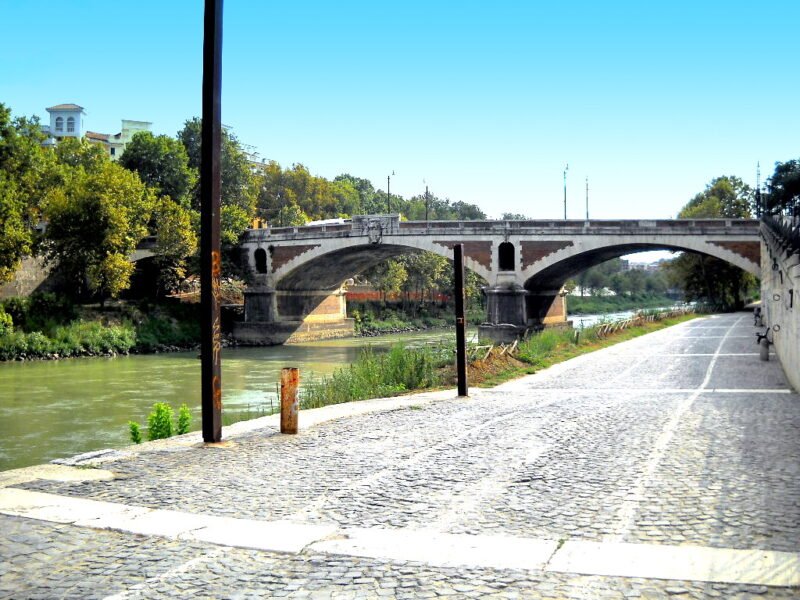
- Ponte Sublicio400 m
- Nuovo Mercato Testaccio400 m

Upcoming events nearby
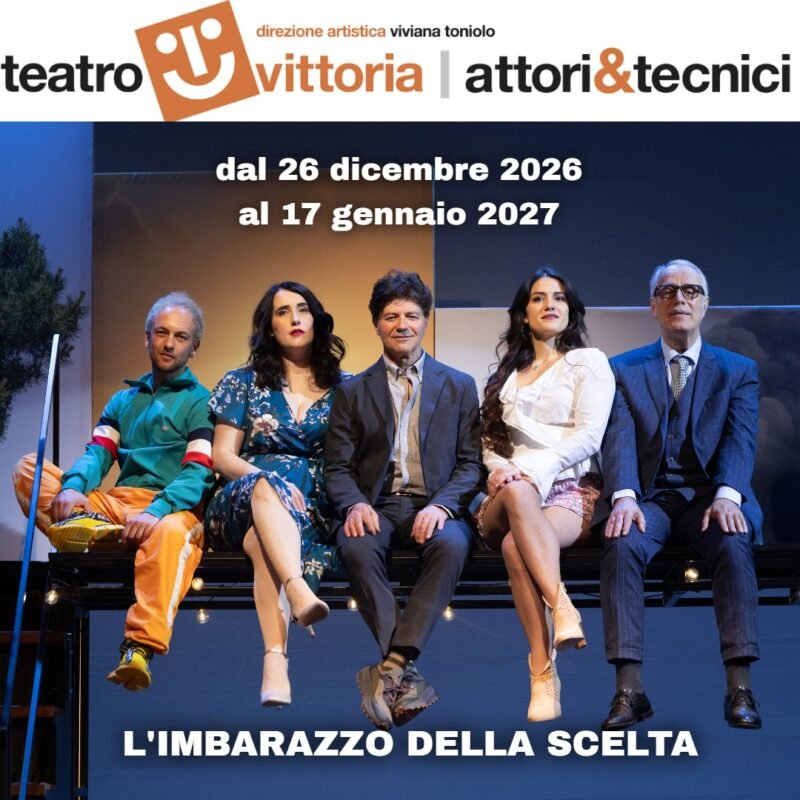
- L’imbarazzo della scelta at Teatro Vittoria, December 26, 2026 to January 13, 2027100 m
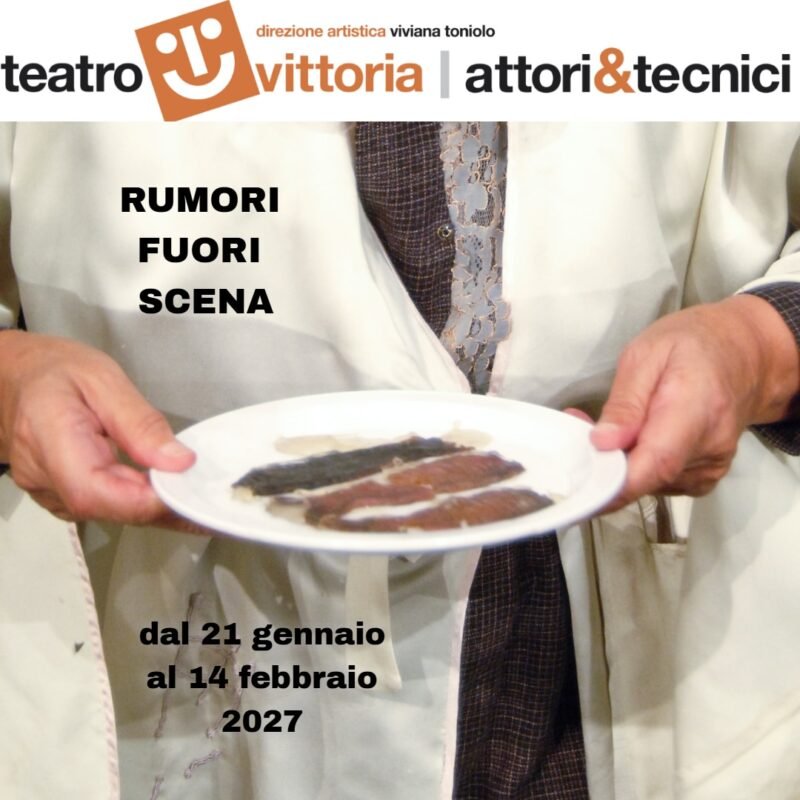
- Rumori fuori scena with the Compagnia Attori e Tecnici at Teatro Vittoria, January 21 to February 14, 2027100 m
- Non c’è due senza me at Teatro Vittoria, March 16 to 21, 2027100 m
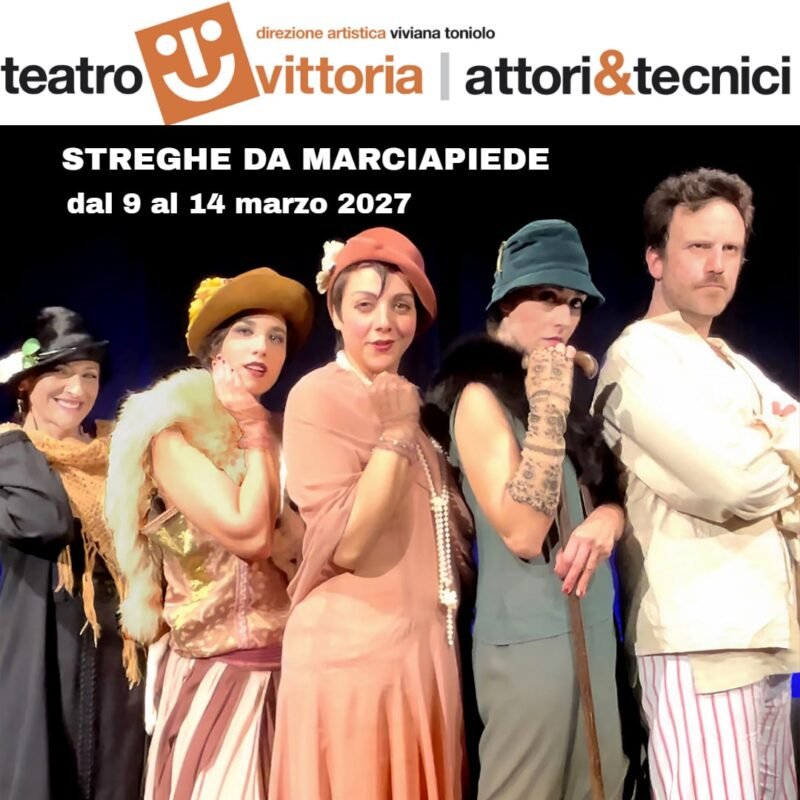
- Streghe da marciapiede at Teatro Vittoria, March 9 to 14, 2027100 m

You might also like
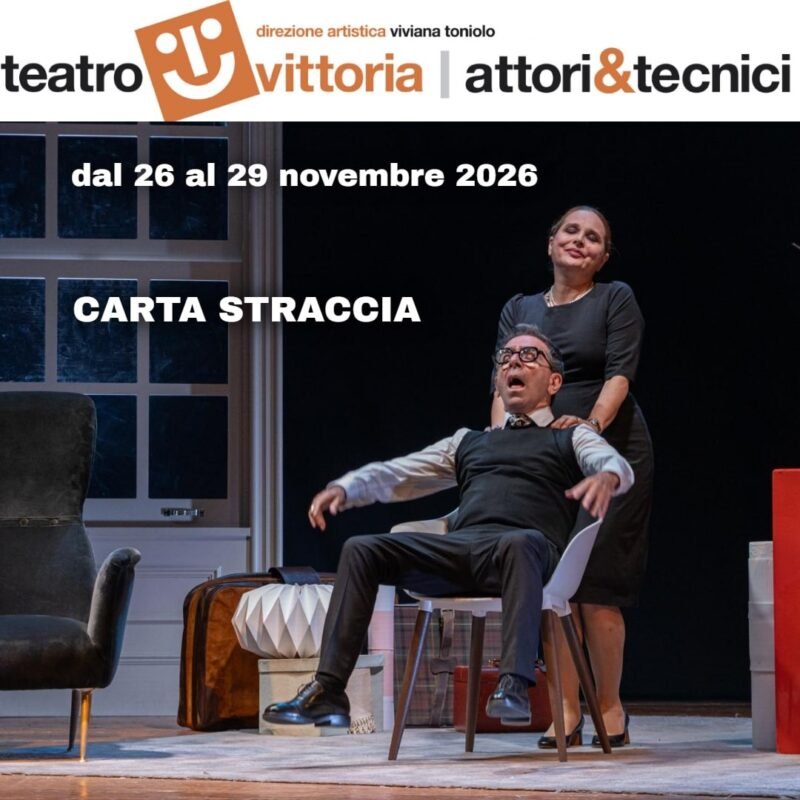
- Carta straccia with Pino Strabioli and Sabrina Knaflitz at Teatro Vittoria, November 26 to 29, 2026
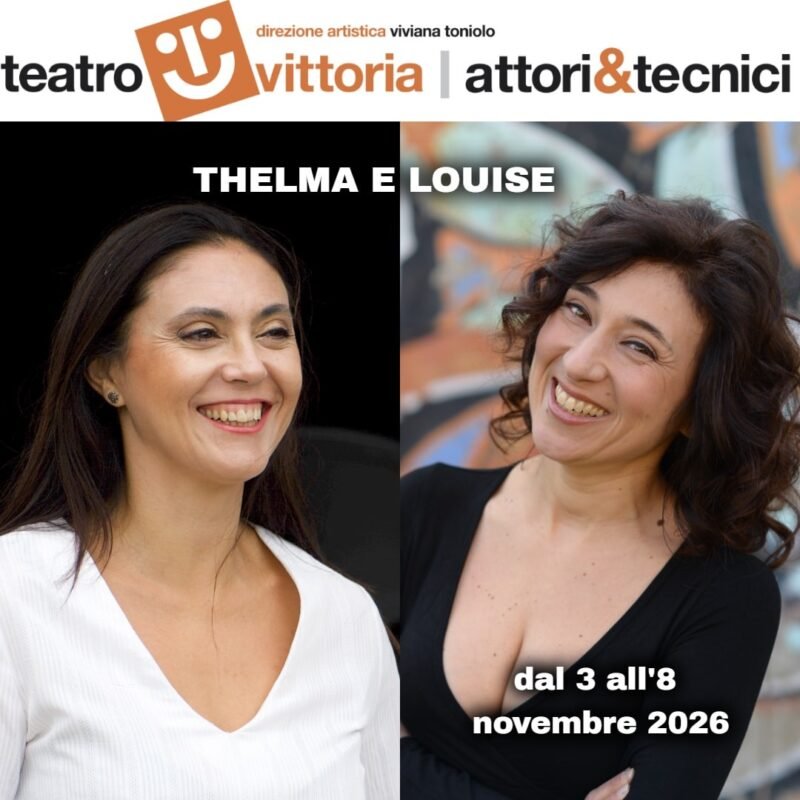
- Thelma e Louise at Teatro Vittoria, from November 3 to 8, 2026
- Di isole e di città with Giuseppe Cederna and Giorgio Ieranò at Teatro Vittoria, March 2 to 7, 2027
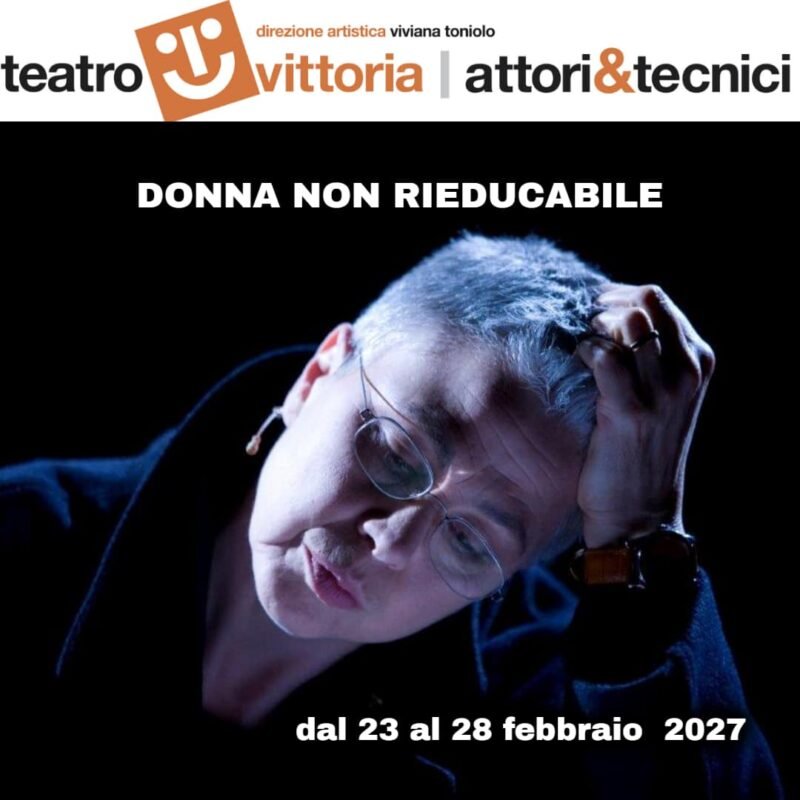
- Donna non rieducabile with Ottavia Piccolo at Teatro Vittoria, February 23 to 28, 2027
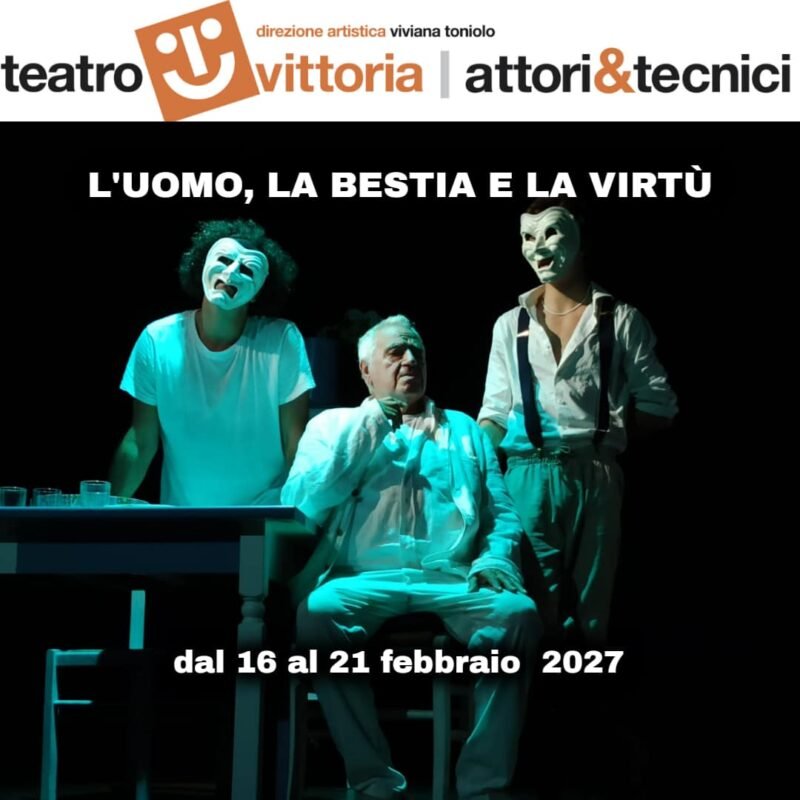
- L’uomo, la bestia e la virtù by Augusto Zucchi at Teatro Vittoria, February 16 to 21, 2027
- Giallo sai!, Faccestamagia at Teatro Vittoria, May 12, 2027