L’uomo, la bestia e la virtù by Augusto Zucchi at Teatro Vittoria, February 16 to 21, 2027
In short. L'uomo, la bestia e la virtù by Luigi Pirandello, in a free adaptation and directed by Augusto Zucchi, who is also on stage with Emanuele Durante, Anita Torrasi, Giuseppe Briganti, Augusto Mario Zucchi and Leonardo Zucchi, plays at…

L'uomo, la bestia e la virtù by Luigi Pirandello, in a free adaptation and directed by Augusto Zucchi, who is also on stage with Emanuele Durante, Anita Torrasi, Giuseppe Briganti, Augusto Mario Zucchi and Leonardo Zucchi, plays at Teatro Vittoria, Piazza di Santa Maria Liberatrice 10 (00153 Rome), from February 16 to 21, 2027, for six performances: Tuesday the 16th at 21:00, Wednesday the 17th at 17:00, Thursday the 18th and Friday the 19th at 21:00, Saturday the 20th at 19:00 and Sunday the 21st at 17:30. The production is by A&A Produzioni Zucchi. Vittoria is in the heart of Testaccio, about a 10-minute walk from the Piramide stop on Metro B. According to the 2026/2027 season price list published by the theater, the full-price ticket costs €27 in the orchestra and €21 in the gallery, plus a €3 presale fee. Tickets are bought on the official Teatro Vittoria website, on the presale circuit named by the theater or at the box office on Piazza di Santa Maria Liberatrice.
Language: performed in Italian. No English version or English surtitles are announced.
L'uomo, la bestia e la virtù at Vittoria: dates, times and tickets
L'uomo, la bestia e la virtù plays at Teatro Vittoria for only one week, from February 16 to 21, 2027, with six performances and a different start time almost every day.
The schedule
Tuesday, February 16 at 21:00, Wednesday the 17th at 17:00, Thursday the 18th at 21:00, Friday the 19th at 21:00, Saturday the 20th at 19:00 and Sunday the 21st at 17:30. This is the schedule of performances published by the theater on the show's page.
Prices
The season price list published by Vittoria sets the full price at €27 in the orchestra and €21 in the gallery, plus a €3 presale fee. The reduced price, reserved for under 35, over 65, people with a disability of at least 75 percent and holders of affiliated cards, costs €22 in the orchestra and €17 in the gallery plus presale, Tuesday through Friday. For under 18 the ticket costs €13 in the orchestra and €11 in the gallery, plus a €2 presale fee.
The box office
The theater's box office is open Mondays from 10:00 to 13:00 and from 15:30 to 19:00, Tuesday through Saturday from 11:00 to 20:00, Sundays and holidays from 10:00 to 13:00 and from 15:30 to 19:00, with the afternoon opening only on show days. Information at 06 5781960 and at info@teatrovittoria.it.
L'uomo, la bestia e la virtù according to Augusto Zucchi
Augusto Zucchi's L'uomo, la bestia e la virtù is a free adaptation inspired at once by Pirandello's play, by the short story it comes from, Richiamo all'obbligo, and by the film Steno made of it, with Totò and Orson Welles.
Three sources
Drawing on three different sources is the hallmark of the show. The play gives the structure, the short story the original core of the plot, Steno's film a farcical and popular tone. Zucchi fuses them into a single staging.
Music and songs
Music and a few songs are added to the adaptation, with lyrics taken from Pirandello's own stage directions. It's a way of giving voice to the author's stage directions, turning them into sung material.
A show for students too
In the presentation published by the theater, the director judges the show, by its nature, particularly suitable for a student audience as well. The Wednesday the 17th afternoon performance at 17:00 is the most convenient time for schools and families. For students who have read Pirandello in class, seeing his funniest side on stage is a good antidote to the image of an author who is only cerebral, and the under-18 ticket makes the evening accessible.
L'uomo, la bestia e la virtù: the plot of the play
L'uomo, la bestia e la virtù is a play, or as the author himself defined it an apologue in three acts, written by Luigi Pirandello in 1919 and drawn from the short story Richiamo all'obbligo of 1906.
Three masks
The title says it all. The man is Professor Paolino, who hides his affair with Signora Perella under an ostentatious respectability. The virtue is she, a restrained and modest mother of a family, in fact abandoned by her husband. The beast is the husband, a naval captain, who in everyone's eyes wears the mask of the brute: in Naples he lives with another woman and avoids any intimacy with his wife.
The problem
Signora Perella is pregnant by Professor Paolino. The scandal would be the end of both their respectability. The only solution is for the captain, who stays home one night only before leaving again for two months, to have relations with his wife, so that the child can be recognized as his.
The plan
Paolino has a doctor prepare a powerful aphrodisiac, to be hidden in some pastries, and forces his shy lover to put on heavy makeup and wear a low-cut dress. He agrees on a signal with the wife: a vase on the balcony, the next morning, will tell him if the plan worked. The dinner is a series of tragicomic disasters. In the end the captain eats the pastries and flees in disgust.
The reversal
At dawn, the signal seems not to be there. A clash follows between Paolino and the captain, in which the husband unmasks the professor's hypocrisy and claims his own life as more honest than that of someone who defends appearances at all costs. The plot, as the Vittoria presentation says, ends up overturning the order of things, in a game of roles typical of Pirandello.
The characters of L'uomo, la bestia e la virtù
Around the three masks of the title, Pirandello builds a small gallery of supporting figures that make the farce richer: the pharmacist, the doctor, the housekeeper, the child, the maid.
Professor Paolino
A private teacher, he defends his moral integrity with arrogance, to the point of throwing out of the house anyone who questions it. He is willing to do anything to save appearances, even, in his intentions, to kill the captain if the plan failed.
Totò and Nino Pulejo
Totò Pulejo is a pharmacist, a friend of the professor, who never misses a chance to scrounge a coffee off him and to insinuate doubts about his restraint. His brother Nino is the doctor who prepares the aphrodisiac. It's Totò who brings the prepared pastries into the Perella house, taking a tasty moral revenge on the professor.
Signora Perella and Nonò
Signora Perella is the mother of Nonò, Paolino's pupil. She is the virtue of the title: modest, submissive, forced by the professor to put on makeup and expose herself to seduce her own husband.
The captain and the maid Grazia
Captain Perella has other children with a woman in Naples and doesn't want any more from his wife. In a bad mood, he criticizes the house and his wife's appearance. The next morning it's the old maid Grazia, once obedient, who scolds him for what happened during the night.
Planning the evening in Testaccio
A February week in Testaccio lends itself to different evenings depending on the time you choose: the six performances of L'uomo, la bestia e la virtù cover the afternoon, the early evening and the full evening.
Afternoon and dinner
With the afternoon performances on Wednesday the 17th at 17:00 and Sunday the 21st at 17:30 you get out around 19:00: the right time for dinner at the neighborhood trattorias, before they fill up.
Saturday at 19:00
The Saturday performance starts at 19:00: you get out around 21:00, and the evening continues in Testaccio, one of the liveliest neighborhoods in Rome on the weekend.
The evening shows at 21:00
On Tuesday, Thursday and Friday the start is at 21:00. It's best to have dinner beforehand, unhurried, and go home on Metro B from Piramide, checking the last-run time on the Atac website.
Who is Augusto Zucchi: his biography
Augusto Zucchi, born in Varazze on March 9, 1946, is an actor, director, screenwriter and playwright: he graduated as an actor from the school of the Teatro Stabile di Genova with Luigi Squarzina in 1968 and as a director from the Accademia d'arte drammatica Silvio d'Amico in 1971.
Theater
He has directed and performed in many shows from classic and contemporary texts, with cooperatives, companies and repertory theaters, and is the author of plays such as La memoria e l'oblio and Il ventre. With the critic and writer Italo Moscati he founded a company dedicated to theater of civic commitment. From 1979 to 1981 he was co-director of the Stabile di Bolzano with Alessandro Fersen, and collaborated with the Stabile di Roma. In 1982 he won the IDI prize for directing Terroristi.
Film and television
He has written stories and screenplays for film and television: the best known, with Carlo Lizzani, is Caro Gorbaciov from 1988, with Harvey Keitel, presented at the Venice Film Festival. He directed films for Rai 2 and documentaries for Rai 3, and in 2009 the film La voce, with Rocco Papaleo.
The actor
As an actor he already appears in the early Seventies in Steno's films, then in Il caso Moro by Giuseppe Ferrara and in La monaca di Monza. The general public knows him from the films of Aldo, Giovanni and Giacomo: he's the big-shot professor in Tre uomini e una gamba, the police commissioner in Così è la vita, the head clerk in Chiedimi se sono felice. He also acted in Sole a catinelle with Checco Zalone, in Sotto una buona stella by Carlo Verdone, in I Cesaroni, in Rex as police chief Gori, and in 2024 in the TV movie Com'è umano lui!, in which he is Ettore Villaggio, Paolo's father.
Producer and teacher
Since 1992 he has been artistic director, with Paola Maffioletti, of Auroville, a company producing theater, film and television. He taught acting and directing for many years at a school he founded at Teatro Agorà in Rome.
A curiosity about L'uomo, la bestia e la virtù by Augusto Zucchi at Teatro Vittoria: February 16 to 21, 2027
The best curiosity links the director to the film. Zucchi's free adaptation is also inspired by Steno's film with Totò and Orson Welles. And Zucchi, very young, acted in Steno's films: Il trapianto in 1970, L'uccello migratore and La polizia ringrazia in 1972. The director who today stages Pirandello through Steno's filter is an actor who knew Steno on set. It's a thread running through more than 50 years of Italian entertainment.
The second curiosity concerns a name. In the original short story, Richiamo all'obbligo, the captain isn't called Perella but Petella: according to a hypothesis reported by the sources, a probable reference to Giuseppe Petella, captain of the Carabinieri of the Kingdom of Italy. Pirandello changed the surname in the passage from the short story to the play.
Third curiosity: the premiere of the play, on May 2, 1919 at Teatro Olimpia in Milan, with Antonio Gandusio's company, went badly. The audience, who perhaps didn't expect such farcical and risqué tones from Pirandello, did not receive it well. Later reassessed by critics and audiences, it has become one of the most frequently staged plays of his output.
Teatro Vittoria, the Testaccio hall
Teatro Vittoria is the drama theater of Testaccio, at Piazza di Santa Maria Liberatrice 10, opened in its current form in December 1986 with 560 red velvet seats.
From variety to cinema
In the early 1900s Vittoria was a two-story small building facing a still unpaved square, with a church just built across from it: variety was performed. After World War II the building was torn down and in its place rose an apartment building with a large cinema on the ground floor, with orchestra and balcony, built by the entrepreneur Amati.
The birth of the drama theater
In May 1986 work began to turn the cinema into a drama theater, to a design by the architect Enrico Nespega, wanted by Attilio Corsini and by the cooperative Attori e Tecnici, founded in 1977 with Viviana Toniolo. In December the new Vittoria opened to the public. Since 2008 the artistic direction has been Viviana Toniolo's.
Beyond drama
Vittoria organizes the literary teas, now in their 30th edition, the series Salviamo i Talenti with the prize named after Attilio Corsini, and a school for spettAttori from ages 5 to 105. For some shows it offers an audio description service.
Something nobody tells you about L'uomo, la bestia e la virtù by Augusto Zucchi at Teatro Vittoria: February 16 to 21, 2027
What is rarely said is that, on the stage of Vittoria, Steno's film and the Testaccio theater meet twice. The free adaptation is inspired by the film with Totò. And on the stage of the first Vittoria, the variety house of the early 1900s, according to the history published by the theater, Totò himself performed, along with Aldo Fabrizi and Anna Magnani. Zucchi's show brings back to Piazza di Santa Maria Liberatrice, by a roundabout route, an actor who had already performed on that square.
The second thing concerns the tone. Pirandello is often associated with cerebral dramas. L'uomo, la bestia e la virtù is instead an open farce, with an aphrodisiac in the pastries and a vase on the balcony as a signal. Zucchi adds music and songs: anyone arriving expecting a solemn Pirandello will find a show closer to popular comedy, and in our view that is exactly its strength.
Third thing: on stage, next to Augusto Zucchi, are Augusto Mario Zucchi and Leonardo Zucchi, and the production is called A&A Produzioni Zucchi. The theater doesn't explain the ties among the performers, but the shared surname gives the show the character of a company gathered around a name.
How to get to Teatro Vittoria
Teatro Vittoria, at Piazza di Santa Maria Liberatrice 10, is most easily reached by Metro B, Piramide stop, about a 10-minute walk away.
Metro B, Piramide stop
From the Piramide stop you cross Piazzale Ostiense, take Via Marmorata and turn toward the center of Testaccio until Piazza di Santa Maria Liberatrice. Piramide is also the junction for Roma Ostiense station and for the train to Lido.
Tram and bus
Tram 3 runs along Via Marmorata and drops you a few steps from the center of the neighborhood. For buses, use Atac's route planner.
By car
Parking in the evening in Testaccio is difficult, especially on weekends, when the neighborhood fills up for the trattorias. Better to leave the car and use the metro, which from the Piramide stop connects Testaccio to Termini without changes.
My advice for seeing L'uomo, la bestia e la virtù by Augusto Zucchi at Teatro Vittoria: February 16 to 21, 2027
The advice is to choose the date according to who comes with you. For a couple or for friends, the 19:00 performance on Saturday the 20th is the most convenient: you get out in time for dinner in Testaccio, the neighborhood of Roman cooking. For a family with teenagers, the afternoon performance on Wednesday the 17th at 17:00 or the one on Sunday the 21st at 17:30 leave the evening free. For anyone who wants the most intimate hall, the weekday evening shows at 21:00.
The second piece of advice concerns the film. Anyone who has seen Steno's L'uomo, la bestia e la virtù with Totò and Orson Welles will arrive in the hall with some images in mind. Anyone who hasn't can catch up after the show, to compare the two readings. In our view the thing to do is this: see the theater first, with no expectations, and then the film.
Third piece of advice: take advantage of the reduced price. From Tuesday to Friday Vittoria applies reduced prices to under 35, over 65 and holders of affiliated cards, and for under 18 there is a dedicated rate: for a family the difference is significant.
Another well-known fact, yet rarely mentioned
It's well known that L'uomo, la bestia e la virtù is one of Pirandello's most frequently staged plays. Less remembered is that the text was published first in a magazine, in September 1919 in Comoedia, and only in 1922 in book form with the publisher Bemporad. Three years between stage and book: the sign of a text that was born for the stage and found its printed form only after its success.
A second known and rarely cited fact concerns the subtitle. Pirandello did not call the text a comedy, but an apologue: a tale with a moral. The moral, though, is turned upside down. The professor who preaches virtue is the real hypocrite, the beast is the only one who tells the truth about his own life, and virtue is a mask worn out of necessity.
Finally, a fact about the hall. On January 5, 1990 Teatro Vittoria hosted the world premiere of Michael Frayn's Spettattori, in the presence of the author: a neighborhood stage that had, at least once, the eyes of international theater on it.
Around Teatro Vittoria: Testaccio
Piazza di Santa Maria Liberatrice is the center of Testaccio, the working-class district between the Tiber, the Aventine and Monte dei Cocci. An overview is on the page about what to see in Testaccio.
The Mattatoio
A few minutes from the theater is the former Mattatoio, today a space for contemporary art: the place that gave the neighborhood its working-class identity. In front of the first Vittoria, the theater recalls, the first public housing went up, assigned to cart drivers and slaughterhouse workers.
The Pyramid and the Non-Catholic Cemetery
On the way to the metro you come to the Pyramid of Cestius and, right behind it, the Non-Catholic Cemetery, one of the quietest places in Rome.
The neighborhood museum
The Museo diffuso del Rione Testaccio tells the story of the neighborhood in its places, from public housing to the market. Heading up toward the Aventine, the page on what to see on the Aventine suggests a walk before a matinee.
The right photo to take at L'uomo, la bestia e la virtù by Augusto Zucchi at Teatro Vittoria: February 16 to 21, 2027
The right photo is taken in the square, not in front of the theater. From Piazza di Santa Maria Liberatrice you frame together the facade of the church, the houses of the district and the entrance of Vittoria: it's the same square the theater tells about in its history, once unpaved, with the brand-new church and the variety house across from it. With the show's poster in the foreground, the shot puts Pirandello inside Testaccio.
In the hall, no photos during the show. With music and songs on stage, the temptation of a video is strong: respect for the actors and the audience says to resist. At the end, during the applause, it's best to ask the staff if shots without flash are allowed.
The second photo is taken at the Pyramid of Cestius, on the way back toward the metro: lit up in the evening, the pyramid has an unreal look, suited to closing an evening of masks and disguises.
Some important events that happened here in history
The history of Teatro Vittoria follows that of Testaccio. In the early 1900s Vittoria is a two-story small building on a still unpaved square, in front of a newly built church and the district's first public housing, the product of an international competition and assigned to cart drivers and slaughterhouse workers. Variety is performed, and on that stage Aldo Fabrizi, Totò and Anna Magnani perform.
After World War II the old theater is torn down. The entrepreneur Amati builds in its place an apartment building with Cinema Vittoria on the ground floor, with orchestra and balcony, for years a landmark of the neighborhood's entertainment.
In May 1986 work begins to turn the cinema into a drama theater, wanted by Attilio Corsini and the cooperative Attori e Tecnici, to a design by the architect Enrico Nespega. In December the new Vittoria opens with 560 red velvet seats. On January 5, 1990 the theater hosts the world premiere of Michael Frayn's Spettattori, in the presence of the author. In 2008, after Corsini's death, the artistic direction passes to Viviana Toniolo. The company's emblematic title remains Rumori fuori scena, also on stage this season right before Pirandello.
Who has passed through L'uomo, la bestia e la virtù by Augusto Zucchi at Teatro Vittoria: February 16 to 21, 2027
From the stage of the first Vittoria, the variety one, Aldo Fabrizi, Totò and Anna Magnani passed, before becoming the faces of Italian cinema. Through the new Vittoria, since 1986, have passed the productions of Attori e Tecnici, many guest companies and, in 1990, Michael Frayn, who came to Testaccio for the world premiere of his play Spettattori.
Through the history of Pirandello's play, before it reached Testaccio, passed Antonio Gandusio and his company, at the 1919 Milan premiere, and then Steno, Totò and Orson Welles with the film. Through Augusto Zucchi's career pass Luigi Squarzina, his teacher in Genoa, Alessandro Fersen, Carlo Lizzani, Harvey Keitel, Aldo, Giovanni and Giacomo, Carlo Verdone and Checco Zalone.
In the 2026/2027 season Vittoria also hosts Addue and the revival of Rumori fuori scena by Compagnia Attori e Tecnici, which precedes Pirandello in the lineup. From February 16 to 21 pass Augusto Zucchi, Emanuele Durante, Anita Torrasi, Giuseppe Briganti, Augusto Mario Zucchi and Leonardo Zucchi, and with them Professor Paolino, Signora Perella and the captain: the man, the virtue and the beast.
The farcical Pirandello
L'uomo, la bestia e la virtù shows a side of Pirandello less known to the general public: the farcical, almost risqué one, which at the 1919 premiere threw the spectators off.
Social masks
Even in farce, Pirandello works on his favorite theme: the masks everyone wears to be accepted. Here the masks are three, declared from the title, and the comic game consists in making them fall one after another.
The game of roles
The Vittoria presentation speaks of a plot that ends up overturning the order of things, in a game of roles dear to the Sicilian author. The respectable professor turns out the most hypocritical, the brutal husband the most sincere.
The songs
The addition of music and songs, with lyrics taken from the stage directions, brings Zucchi's adaptation closer to the tradition of popular theater and variety: the same tradition from which Vittoria was born in the early 1900s.
With teenagers and practical information
According to the director himself, L'uomo, la bestia e la virtù is particularly suitable for a student audience as well. The themes are adult, an affair, a hidden pregnancy, an aphrodisiac, but treated in a farcical key.
Age
In our view the show is suitable from age 14 up, especially for teenagers who study Pirandello. The under-18 ticket costs €13 in the orchestra and €11 in the gallery, plus a €2 presale fee.
Accessibility
For access to the hall and the seats dedicated to people with disabilities, contact the box office at 06 5781960. People with a disability of at least 75 percent are entitled to the reduced price also for the person assisting them, according to the theater's price list.
Where to eat before or after the show
Testaccio is the neighborhood of traditional Roman cooking, known for the dishes of the quinto quarto, a legacy of the nearby slaughterhouse: coda alla vaccinara, tripe, rigatoni with pajata.
Before 21:00
For the evening shows, a dinner at 19:00 leaves enough margin. On weekends the neighborhood trattorias fill up: booking is essential.
After the matinees
Wednesday the 17th at 17:00, Saturday the 20th at 19:00 and Sunday the 21st at 17:30: in all three cases you get out in time for dinner a short walk from the theater. For lunch before the matinee there's Nuovo Mercato Testaccio, on its opening days.
Frequently asked questions about L'uomo, la bestia e la virtù at Vittoria
When does L'uomo, la bestia e la virtù play at Teatro Vittoria?
Augusto Zucchi's L'uomo, la bestia e la virtù plays at Teatro Vittoria in Rome from February 16 to 21, 2027, with six performances: Tuesday the 16th, Thursday the 18th and Friday the 19th at 21:00, Wednesday the 17th at 17:00, Saturday the 20th at 19:00, Sunday the 21st at 17:30.
How much do tickets cost?
At Teatro Vittoria the full price is €27 in the orchestra and €21 in the gallery, plus a €3 presale fee. The reduced price, Tuesday through Friday, is €22 and €17 plus presale. Under 18s pay €13 and €11 plus €2 presale, according to the season price list.
Who is in the cast?
In L'uomo, la bestia e la virtù at Teatro Vittoria the performers are Augusto Zucchi, Emanuele Durante, Anita Torrasi, Giuseppe Briganti, Augusto Mario Zucchi and Leonardo Zucchi. Adaptation and direction are by Augusto Zucchi, the production by A&A Produzioni Zucchi.
What is L'uomo, la bestia e la virtù about?
Pirandello's L'uomo, la bestia e la virtù tells of Professor Paolino, lover of Signora Perella, who has become pregnant: to avoid scandal, the two must get the husband, a naval captain, to spend the night with his wife. An aphrodisiac in the pastries complicates everything.
Is it faithful to Pirandello's text?
Augusto Zucchi's L'uomo, la bestia e la virtù is a free adaptation: it's inspired by the play, by the short story Richiamo all'obbligo and by Steno's film with Totò and Orson Welles, and adds music and songs with lyrics taken from Pirandello's stage directions.
How do you get to Teatro Vittoria?
Teatro Vittoria, at Piazza di Santa Maria Liberatrice 10 in Testaccio, is reached by Metro B, getting off at Piramide and walking about 10 minutes, or by tram 3 along Via Marmorata. In the evening parking is difficult.
Who is Augusto Zucchi?
Augusto Zucchi, born in Varazze in 1946, is an actor, director and playwright, trained with Luigi Squarzina and at the Accademia Silvio d'Amico. He won the IDI prize for directing Terroristi and is known in film for the films of Aldo, Giovanni and Giacomo.
Final advice on L'uomo, la bestia e la virtù at Vittoria
The most farcical Pirandello, reread by a director who acted for Steno and who recovers his film with Totò and Orson Welles, with songs born from the author's stage directions, in a Testaccio theater on whose first stage Totò had already performed. The advice is to choose the 19:00 performance on Saturday the 20th for an evening with dinner in the neighborhood, or a matinee if you go with teenagers, to take advantage of the reduced price on weekdays and to leave at home the idea of a solemn Pirandello: this is a comedy for laughing at masks, your own included.
Article written by the editorial team at Tour Leader Pro. Contact them for Private/Corporate/V.I.P. Tours and Experiences.
Planning a trip to Rome? English-language guides for visiting the city are on ItalyPlanner.com.
Contact Information
Nearby
 Teatro Vittoria100 m
- Testaccio: What to See in the Monte dei Cocci Neighborhood100 m
- Museo diffuso del rione Testaccio100 m
- Monte dei Cocci, Monte Testaccio300 m
- Ponte Sublicio400 m
- Nuovo Mercato Testaccio400 m

Upcoming events nearby
- L’imbarazzo della scelta at Teatro Vittoria, December 26, 2026 to January 13, 2027100 m
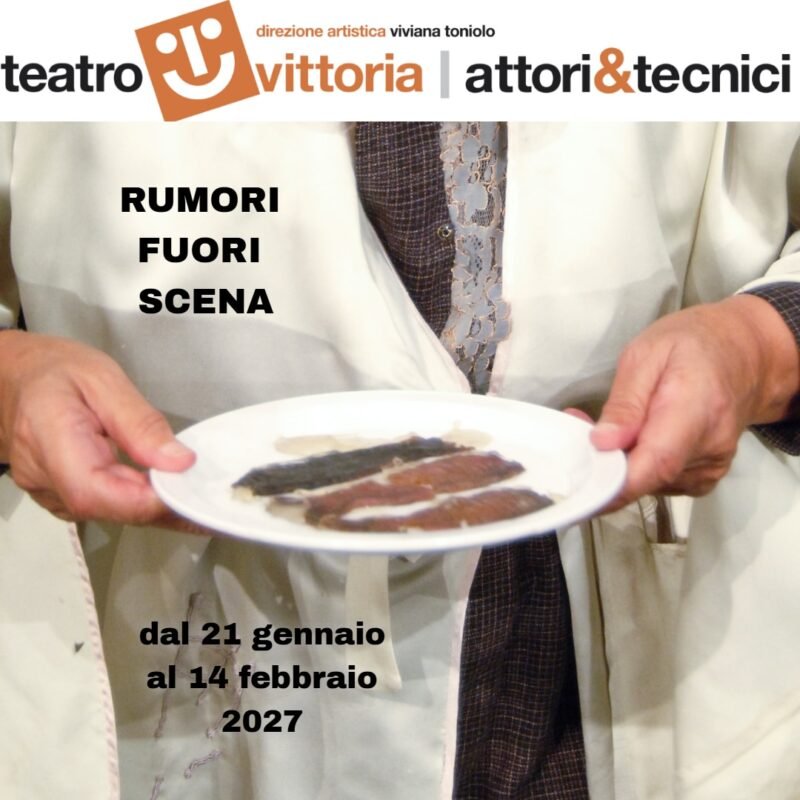
- Rumori fuori scena with the Compagnia Attori e Tecnici at Teatro Vittoria, January 21 to February 14, 2027100 m
- Non c’è due senza me at Teatro Vittoria, March 16 to 21, 2027100 m
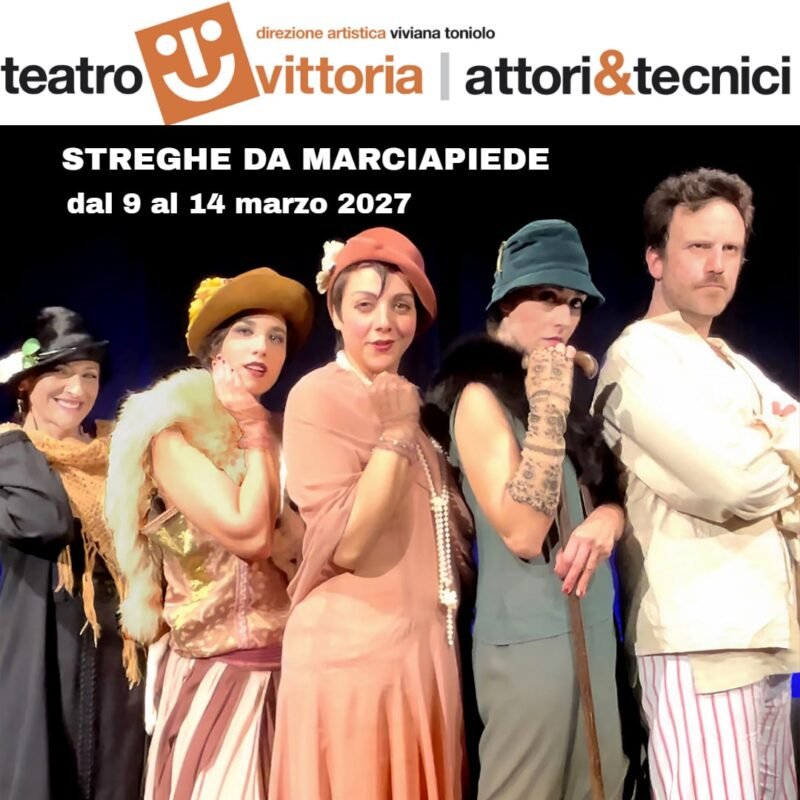
- Streghe da marciapiede at Teatro Vittoria, March 9 to 14, 2027100 m


You might also like
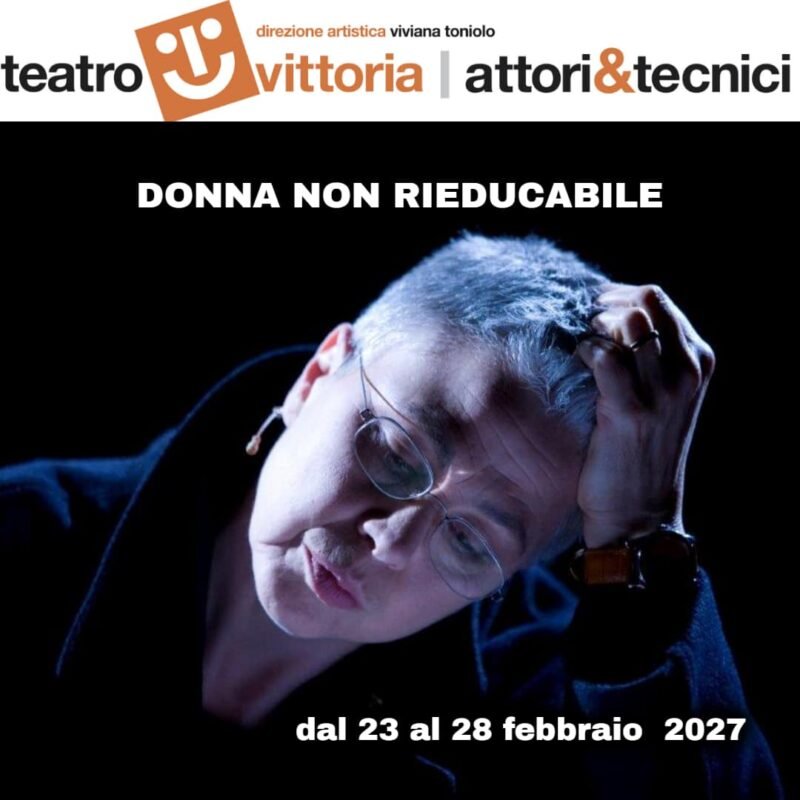
- Donna non rieducabile with Ottavia Piccolo at Teatro Vittoria, February 23 to 28, 2027
- Giallo sai!, Faccestamagia at Teatro Vittoria, May 12, 2027
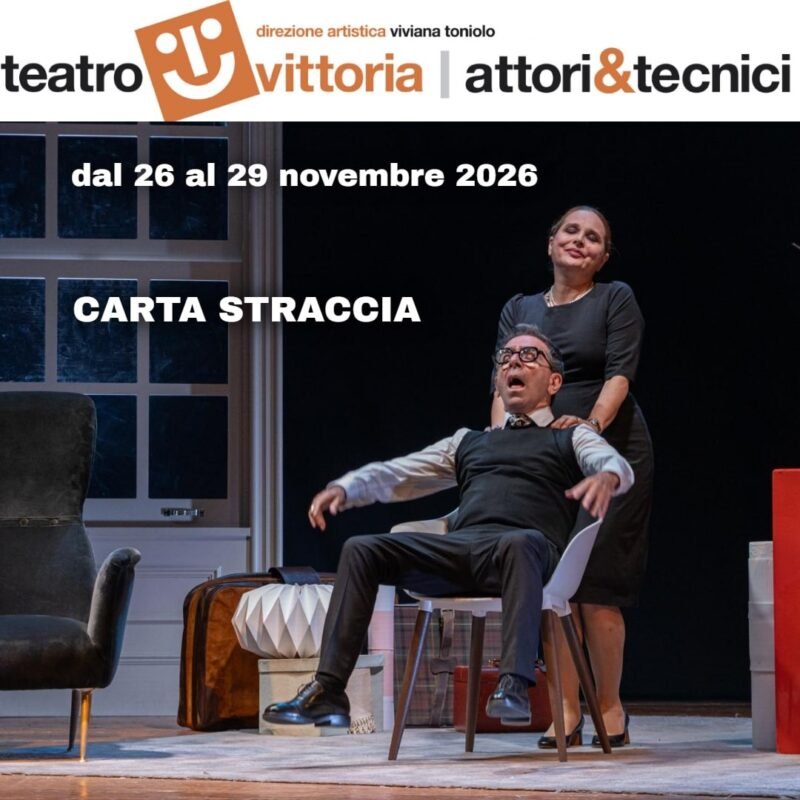
- Carta straccia with Pino Strabioli and Sabrina Knaflitz at Teatro Vittoria, November 26 to 29, 2026
- Di isole e di città with Giuseppe Cederna and Giorgio Ieranò at Teatro Vittoria, March 2 to 7, 2027
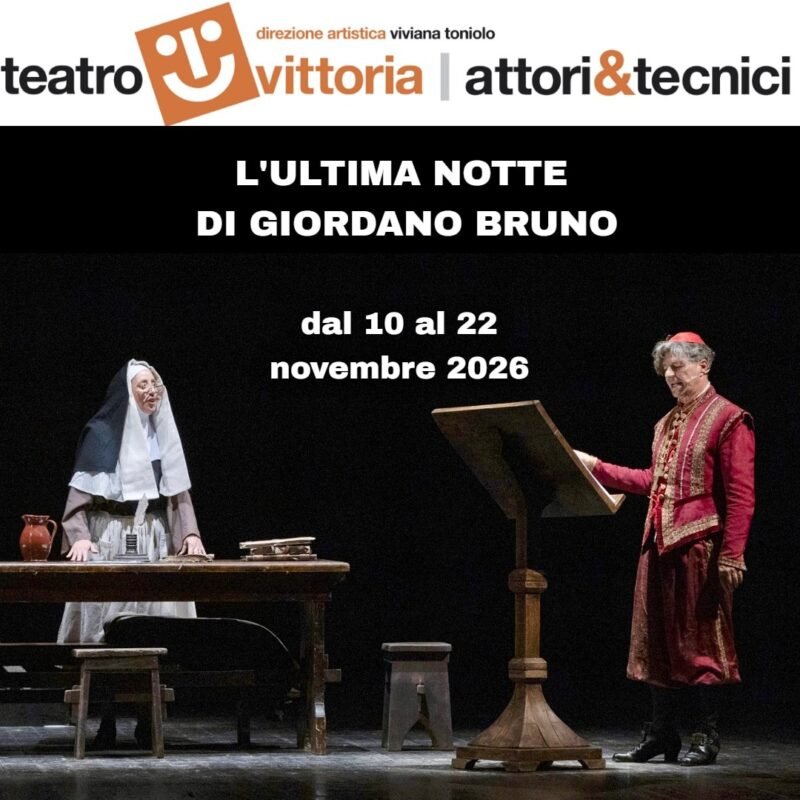
- L’ultima notte di Giordano Bruno at Teatro Vittoria, November 10 to 22, 2026
- Adrian Tranquilli. Tomorrow Remember Yesterday at Mattatoio, Nov 11, 2026 to Jan 17, 2027