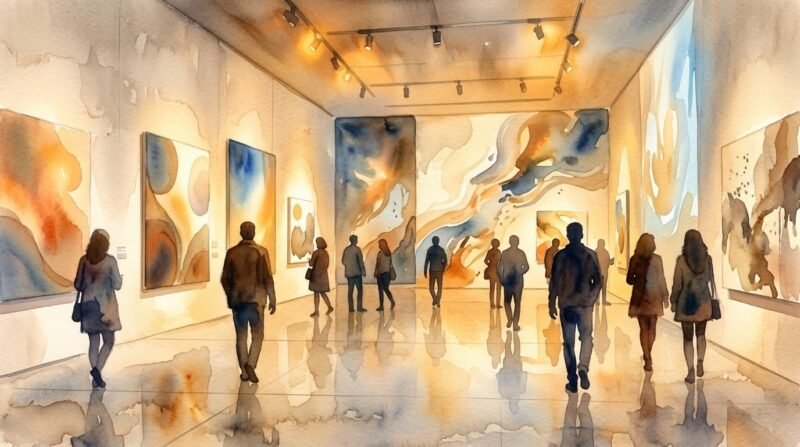
Hypothèse de lecture at Trinità dei Monti, September 19 to November 7, 2026
In short. Hypothèse de lecture is open at Trinità dei Monti from September 19 to November 7, 2026, in the convent's Old Library, with the entrance through the green main door at Piazza della Trinità dei Monti 3, to the left of the church, at the top of the Spanish Steps.
Hypothèse de lecture is open at Trinità dei Monti from September 19 to November 7, 2026, in the convent's Old Library, with the entrance through the green main door at Piazza della Trinità dei Monti 3, to the left of the church, at the top of the Spanish Steps. According to the official Trinità dei Monti website, the show is open Wednesday, Thursday and Friday from 17:00 to 20:00 and Saturday from 12:00 to 20:00, with entry allowed until 19:20. Access is free, with no reservation, but ID is asked for at the entrance. The nearest metro station is Spagna. For the full route from your starting point, the ATAC planner is the best option. For information, the Trinità dei Monti office answers at 06 6792245.
For the first time after a long restoration, Trinità dei Monti opens to the public the library that the Minim friars built above the presbytery of the church, with one of the most monumental painted wooden ceilings in Rome. To inaugurate it, it has chosen not a show of antique books, which no longer exist anyway, but 40 Italian and French artists called to fill a void. It is the most interesting opening of this fall in the center, and its strength lies entirely in the place.
Hypothèse de lecture: what the show is
Hypothèse de lecture is a group contemporary art show curated by Gaia Bobò and Teresa Ranchino, which inaugurates the Old Library of Trinità dei Monti until November 7, 2026. The French title means reading hypothesis.
A library without books
Until the end of the 1700s, the old library of the Minim convent held about 9,000 volumes. In 1798 that heritage was dispersed: the books were sold or destroyed. The space has remained empty. The show starts precisely from this irrecoverable loss and imagines a rewriting: the works of the invited artists reinterpret, in an imaginative way, the void left by the collection.
Olivier Goethals's ghost architecture
The heart of the installation is a ghost architecture inspired by a library, conceived by the Belgian architect Olivier Goethals. This is the reading hypothesis of the title: a structure that evokes shelves and books without containing them, and on which the works take the place of the vanished volumes.
Rome and Paris, emerging research
The show presents a selection of artists from the Italian and French scenes, with particular attention to the contexts of Rome and Paris and to emerging research. It is part of the program for the anniversary of the twinning between Rome and Paris, 70 ans d'amitié, 70 years of twinning.
A new direction for Trinità dei Monti
Hypothèse de lecture inaugurates a new cultural direction for Trinità dei Monti, wanted by the director Marie-Pierre Dabadie, who entrusts contemporary art and culture with the task of interpreting the historical traces of the place. It is a courageous choice for a religious complex: it is worth supporting it by going.
The themes of Hypothèse de lecture
The works of Hypothèse de lecture resonate with the history of the library through four critical axes: loss of memory, word and image, destruction and fragmentation, echo of the Baroque.
Loss and dispersion of memory
The first axis is the relationship with the processes of loss and dispersion of memory. In a room that has lost its 9,000 books, the theme needs no explanation: you breathe it.
Word and image
The second concerns the relationship between word and image, with attention to writing practices and literary influences. It is the most direct thread to the original function of the space: a library was, first of all, a place of words.
Spolia, destruction and fragment
The third axis is the generative dimension of destruction and fragmentation. The reference is to the concept of spolia, fragments of ancient buildings reused in new constructions, which in Rome, a city of archaeological layers, has a particular meaning. The idea that something is born from ruin is the key to the whole show.
The echo of the Baroque
The fourth axis highlights the echo of Baroque aesthetics in contemporary creation, with processes of metamorphosis of matter and body and the use of specific aesthetic devices. Under a 1600s ceiling painted in trompe l'oeil, the comparison is inevitable and, in our opinion, it is the most successful part of the operation.
The artists of Hypothèse de lecture
Hypothèse de lecture brings together 40 artists and collectives from the Italian and French scenes, according to the list published by Trinità dei Monti.
The complete list
The exhibitors are Alberte Agerskov, Edoardo Aruta, Charlie Aubry, Alix Boillot, Dario Carratta, Valeria Carrieri, Giulio Catelli, Henri Chetaille, Taisiia Cherkasova, Ginevra Collini, Max Coulon, Giulia Crivellaro, Anna de Castro Barbosa, Federica Di Pietrantonio, Marco Emmanuele, Marco Eusepi, Elisa Florimond, Clédia Fourniau, Pierre Gaignard, Luca Grechi, Carla Gueye, Ruoxi Jin, Charlie Jouan, Amalia Laurent, Giuseppe Lo Cascio, Guglielmo Maggini, Matisse Mesnil, Paul F. Millet, Diego Miguel Mirabella, Pietro Moretti, Alexandre Nitzsche Cysne, Lulù Nuti, Flavio Orlando, Francesca Pionati, Andrea Polichetti, Valentine Prissette, Alexander Raczka, Luca Resta, Théophile Stern and Vaste Programme.
One generation, two cities
The list mixes names from the Roman scene and the Parisian one, in line with the declared attention to emerging research. It is not a show of famous signatures: it is a snapshot of what is being done today between the two twinned capitals, and it should be visited in this spirit, ready to discover. Next to the individual names there is also a collective name, Vaste Programme: a sign that the show welcomes different ways of working, from the single author to the group.
A thread to the Società delle Api
Valentine Prissette, among the artists in the show, was in residence in the summer of 2026 at the Società delle Api, the foundation on Via Gregoriana that collaborates on the show's public program and that from October 9 hosts The Flowers of Evil by Chiara Camoni. The two venues are a few steps from each other.
Curators, partners and public program
Hypothèse de lecture is curated by Gaia Bobò and Teresa Ranchino, promoted by Trinità dei Monti with the patronage of Roma Capitale and accompanied by a program of meetings with three institutions of the neighborhood.
The program of meetings
The exhibition is accompanied by an articulated public program of meetings and conferences, developed in collaboration with the Bibliotheca Hertziana, Max Planck Institute for Art History, with the French Academy in Rome at Villa Medici and with La Società delle Api. Three institutions that are all a few minutes' walk from the library.
Supporters
The show is made with the support of CONTEMPORALIS, Association Amis Art Contemporain France-Italie, in partnership with Carré sur Seine. Among the sponsors is Casale del Giglio.
The direction of Trinità dei Monti
Trinità dei Monti is one of the five French churches in Rome that belong to the Pieux Etablissements de la France à Rome et à Lorette. The choice to open the library with a contemporary show is the director Marie-Pierre Dabadie's.
The Old Library of Trinità dei Monti
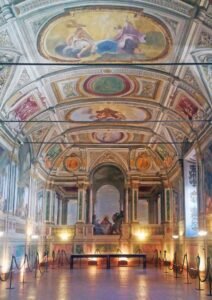
The Old Library of Trinità dei Monti is above the presbytery of the church and is decorated with a wooden ceiling painted in 1693, one of the most monumental in Rome. It opens to the public for the first time after a long restoration.
The noblest library in Rome
In 1699 a source of the period, cited by the Trinità dei Monti website, described it as the noblest, airiest, most comfortable, most ornate, brightest and most cheerful library in Rome. In the 1600s the intellectual life of the convent was flourishing: among the French Minims there were philosophers, theologians, scientists, botanists, musicians.
A library above the altar
The choice to build the library above the presbytery of the church says a lot about the link between science, art and faith in the convent. Besides study, the library offered an extraordinary view over the city: the windows open onto the roofs of Rome, as far as the domes.
The 1693 ceiling
In 1693 the Minims had a trompe l'oeil painted on the wooden ceiling, the work of artists who in all likelihood belonged to the circle of Andrea Pozzo. The decoration represents the glory of Saint Francis of Paola, flanked by portraits of famous Minims and by the coat of arms of the kings of France.
Napoleon and the dispersal
In 1798 Napoleon's army settled in the convent and caused heavy damage. The 9,000 books that had made the library's glory were sold or destroyed. Since 2003 a major restoration project, carried out in collaboration with the laboratories of the Vatican Museums, has given the ceiling back its beauty and legibility.
Trinità dei Monti: the church and the convent
The complex of Trinità dei Monti, at the top of the Spanish Steps in the rione Campo Marzio, is made up of two adjoining buildings: the church and the convent. It was founded by the king of France Charles VIII in 1493.
A Gothic church in Rome
Work on the first part of the church probably began in 1502. Designed by Annibale Lippi and Gregorio Caronica, it was built with stone from Narbonne. The cross vault, in late French Gothic style with interlaced ribs, is the only example of that style in Rome.
The facade and the bell towers
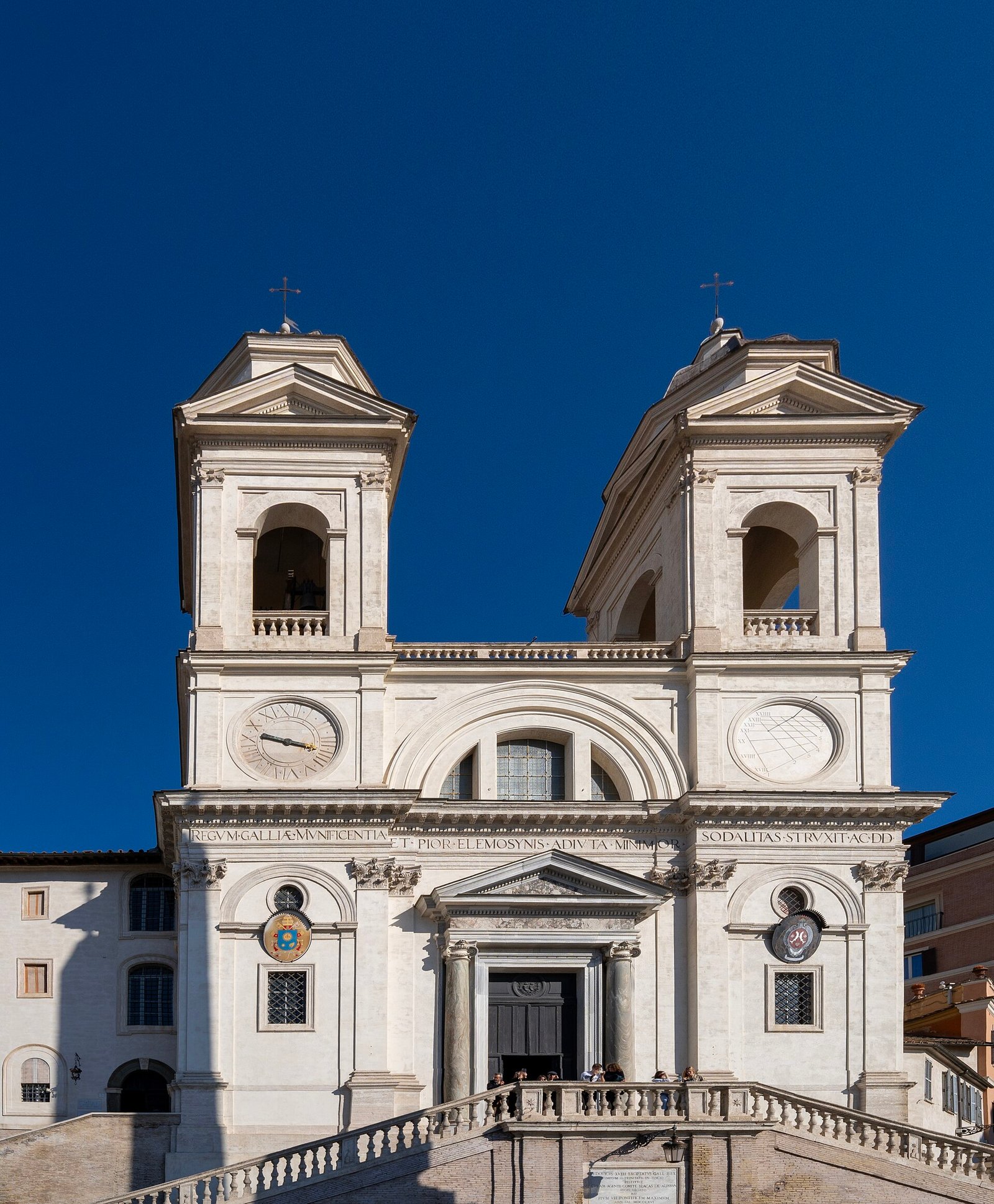
After the damage of the Sack of Rome in 1527, the French cardinals financed the enlargement. The facade, designed by Giacomo Della Porta and Carlo Maderno, was completed in 1570 with the two symmetrical bell towers. On the bell towers are a clock and a sundial, which according to tradition show the hours of Rome and of Paris. The church was consecrated in 1585 by Sixtus V.
Daniele da Volterra and the others
Inside, in one of the first chapels on the left, Daniele da Volterra painted the Deposition in 1541, considered one of the peaks of Mannerism. In the Della Rovere Chapel is his Assumption. There are cycles by Perin del Vaga, completed by the Zuccari brothers, and by Giovanni Battista Naldini.
The wonders of the convent
The convent preserves the Perspective Gallery with an anamorphosis painted in 1642 by Emanuel Maignan depicting Saint Francis of Paola, a second anamorphosis by Jean François Niceron with Saint John writing the Apocalypse, a reflection sundial by Maignan and the Room of Ruins by Charles-Louis Clérisseau, from the late 1700s.
Hypothèse de lecture and France in Rome
Hypothèse de lecture is part of the program for the 70 years of twinning between Rome and Paris, and it could not have a more fitting venue: for five centuries Trinità dei Monti has been a piece of France on top of Rome.
The five French churches
Trinità dei Monti, where services are also held in French and which is entrusted to the Emmanuel Community, is one of the five French-speaking Catholic churches in Rome, together with San Luigi dei Francesi, San Nicola dei Lorenesi, Sant'Ivo dei Bretoni and Santi Claudio e Andrea dei Borgognoni. All belong to the Pieux Etablissements de la France à Rome et à Lorette.
The square of France
French claims on this area date to the 1500s, when the church was under the protection of the French crown. For a long time the northern part of the square below was also called of France. In the 1800s the French Academy moved to Villa Medici, not far away: the same institution that today collaborates on the show's program of meetings.
A twinning you can see
A show of Roman and Parisian artists, inside a library built by French friars, a few steps from the French Academy: the twinning between the two capitals, here, stops being a formula and becomes a place.
How to get to the Old Library of Trinità dei Monti
The entrance to the show Hypothèse de lecture is through the green main door at Piazza della Trinità dei Monti 3, to the left of the church. The church can be reached from Spagna metro station.
By metro
Spagna station is the nearest. To combine metro, bus and tram from your starting point, the ATAC route planner is the best option.
On foot from the Steps
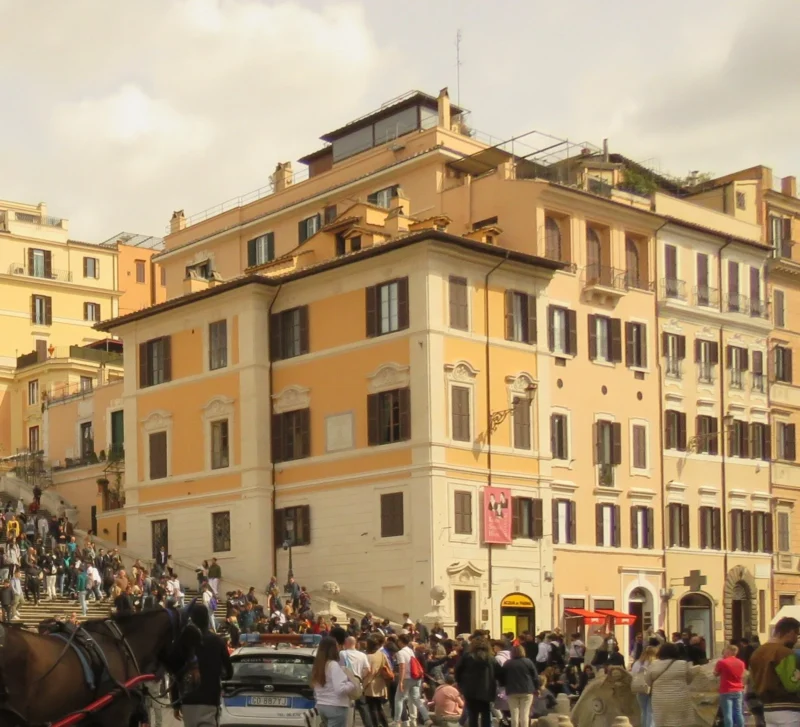
From Piazza di Spagna you climb the steps up to the church. It is the most scenic arrival, but at peak hours the steps are very crowded: allow a few extra minutes.
By car
The historic center is largely a limited traffic zone. For this visit it is best to leave the car and use the metro.
Hours, admission and visiting rules
Hypothèse de lecture has free admission, with no reservation, Wednesday to Friday from 17:00 to 20:00 and Saturday from 12:00 to 20:00, with last entry at 19:20. On Sunday, Monday and Tuesday the show is closed.
ID at the entrance
Access is free, but ID is required at the entrance. Bring it with you: the rooms are in a private area of the convent.
The route
For safety and heritage protection reasons you have to follow the route indicated by the staff and the signs. It is not a show where you wander freely.
Accessibility and services
The official website warns that, because of the historic nature of the complex and the layout of the spaces, the route has architectural barriers and is not suitable for people with reduced mobility. There are no restrooms available to the public: better to take that into account before going up.
Contacts and visits to the complex
For general information and for visits, the Trinità dei Monti office answers at secretariat.tdm@emmanuelco.org and at 06 6792245. The official website points out that the Trinità dei Monti complex can also be visited outside the show: whoever is left curious about the anamorphoses of the convent and the Perspective Gallery can ask there about visiting arrangements, and come back on another day with more time.
How to plan the evening at Trinità dei Monti
On weekdays Hypothèse de lecture opens from 17:00 to 20:00: it is a late-afternoon show, perfect to combine with sunset on the Steps.
When to go
On Saturday, the opening from 12:00 allows a visit in the full light of day, the best for the ceiling. On weekdays, after 17:00, the light fades early in October: you gain atmosphere, you lose something in reading the details.
With children
The route is guided, has architectural barriers and has no restrooms. With small children the visit is impractical. With teenagers curious about contemporary art it can work well, also because the show is short.
Where to eat
Around Piazza di Spagna the offer is wide but often expensive and touristy. It is worth walking a few streets away to find trattorias and wine bars at more honest prices.
What to see around Trinità dei Monti
Trinità dei Monti is at the center of one of the most visited quadrants of Rome, between Piazza di Spagna, the Pincio and Via Gregoriana.
Villa Medici
A few steps away, Villa Medici, home of the French Academy that collaborates on the show's program, opens from October 9 the fall shows dedicated to Picabia, Morellet and Sole Nero.
Palazzetto Zuccari and Via Gregoriana
On Via Gregoriana is the Palazzetto Zuccari, the House of Monsters, home of the Bibliotheca Hertziana, another partner of the show.
The Steps and the Barcaccia
In Piazza di Spagna, the Barcaccia Fountain and the Keats-Shelley House complete the walk.
The Pincio
A little beyond Villa Medici opens the terrace of the Pincio, the other great viewpoint of this part of Rome.
A curiosity about Hypothèse de lecture at Trinità dei Monti, September 19 to November 7, 2026
The best curiosity concerns the very name of the church. Trinità dei Monti is a wrong plural. The original title, S. Trinitatis in Pincio, referred to a single hill, the Pincio, and originally the church was called Trinità del Monte. The mistaken translation from the singular Latin Trinitatis montis to the current plural dates to the 1800s.
It is a detail that suits a show titled Reading Hypothesis perfectly. The name of this place is itself the fruit of a wrong reading, an interpretation that overlaid the original text until it replaced it. Exactly what the works on display do with the vanished books of the library: they reinvent them.
And there is a second curiosity, about the bell towers. One has a clock, the other a sundial, and according to tradition they show the hours of Rome and of Paris. In the year in which the two cities celebrate 70 years of twinning, a Franco-Italian show under those two dials has the flavor of a prophecy coming true.
One thing nobody tells you about Hypothèse de lecture at Trinità dei Monti, September 19 to November 7, 2026
What almost nobody says is that the show has reduced hours and precise rules. It opens only Wednesday to Saturday, and on weekdays only from 17:00 to 20:00. On Sunday, when the center is full of people, it is closed. Whoever passes through Piazza di Spagna on a Sunday or a Monday finds the green main door barred.
The second thing is about ID. Entry is free, but without ID you don't get in: the library is in a private area of the convent. It seems like a formality, but whoever goes out in the evening without a wallet risks staying outside.
The third is about comfort. The official website says it frankly: the route has architectural barriers and there are no restrooms for the public. It is not a show for people with mobility difficulties, and it is worth organizing beforehand. These are limits due to the nature of the place, which remains a convent and not a museum: accepting them is part of the privilege of getting in.
My advice for visiting Hypothèse de lecture at Trinità dei Monti, September 19 to November 7, 2026
My advice is to go on Saturday at noon. It is the only time slot in which the library is open in the full light of day, and the 1693 ceiling deserves to be seen well. The windows open onto the roofs and domes of Rome: with the sun high, the view is the best possible.
Before going in, look at the works with a precise question in mind: what do they replace? Every work, in Olivier Goethals's ghost architecture, occupies the place of a book that no longer exists. Reading the show this way, as an imaginary library, makes coherent a list of 40 names that might otherwise be disorienting.
On your way out, don't go straight back down the Steps. Go into the church to see Daniele da Volterra's Deposition and the Gothic vault of the crossing, the only one in Rome. A one-hour visit that crosses five centuries, from French Gothic to emerging research, without paying for a ticket.
Another well-known fact, yet rarely mentioned
It is well known that the steps of Trinità dei Monti are one of the symbols of Rome. It is less often remembered who paid for them. The steps, inaugurated by Pope Benedict XIII in 1725 and finished in 1726 to a design by Francesco De Sanctis, were built essentially with the bequest of the diplomat Etienne Gueffier, and not by the French royal family, as the marble inscription recalls.
Just as rarely mentioned is the fact that the staircase giving direct access to the church is older. When Sixtus V had Strada Felice opened, which connected the Pincio to Santa Maria Maggiore, the earthworks created a sharp difference in level in front of the church. Domenico Fontana then designed the monumental two-ramp staircase that still leads to the entrance today.
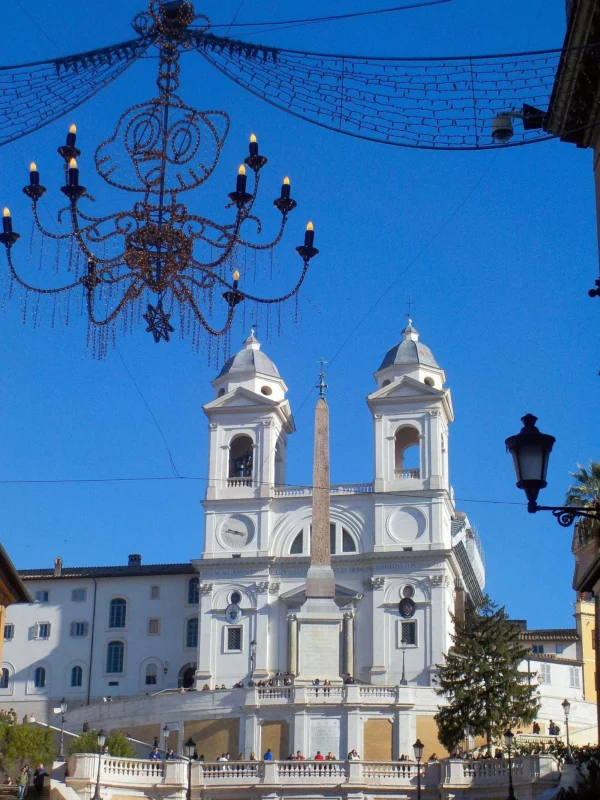
And a third fact, about the square: the obelisk in front of the church, the Sallustiano, was raised in 1788 by order of Pius VI by the architect Antinori. It is a Roman obelisk from the imperial age, made in imitation of Egyptian ones: it too, in its way, a reading hypothesis.
The right photo to take at Hypothèse de lecture at Trinità dei Monti, September 19 to November 7, 2026
The right photo is taken from the library's windows, if the route allows and the staff permits. The official website recalls that the library offered the friars an extraordinary view over the city: from the height of the presbytery you see the tiled roofs, the balustrade of the square, the domes. It is a frame that few Romans have ever seen.
The second photo is of the ceiling: a 1693 trompe l'oeil with the glory of Saint Francis of Paola, the portraits of the illustrious Minims and the coat of arms of the kings of France. Photograph it from the center of the room, with the wide-angle lens, trying to include Goethals's ghost architecture: the contrast between the Baroque forms and the contemporary structure is the meaning of the show.
The third is taken outside, on your way out, in the sunset light: the facade with the two bell towers, the clock and the sundial. Put the Sallustiano obelisk in the frame too. Three centuries of history in one shot.
Some important events that happened here in history
The history of Trinità dei Monti begins in 1493, when the king of France Charles VIII founds the church with the title S. Trinitatis in Pincio. Work starts around 1502. In 1527 the Sack of Rome damages the complex. After the conclave of 1549-1550 the French cardinals finance the enlargement, and in 1570 the facade with the two bell towers is completed.
In 1585 Sixtus V consecrates the church and has Strada Felice opened. Domenico Fontana builds the two-ramp staircase in front of the entrance. In 1642 Emanuel Maignan and Jean François Niceron paint their anamorphoses in the convent. In 1693 the Minims have the library ceiling decorated. In 1725 Benedict XIII inaugurates Francesco De Sanctis's steps.
In 1788 Pius VI has the Sallustiano obelisk raised. 10 years later, in 1798, Napoleon's army installs itself in the convent: the library loses its 9,000 volumes. From 2003 the restoration begins, with the laboratories of the Vatican Museums. In September 2026, with Hypothèse de lecture, the library opens to the public for the first time.
Who has passed through Hypothèse de lecture at Trinità dei Monti, September 19 to November 7, 2026
Kings, popes and great artists have passed through Trinità dei Monti. Charles VIII of France founded it. Sixtus V consecrated it. Benedict XIII inaugurated its steps and Pius VI had the obelisk raised there. Giacomo Della Porta and Carlo Maderno designed its facade, Domenico Fontana the access staircase, Francesco De Sanctis the steps.
In the church worked Daniele da Volterra, Perin del Vaga, Taddeo and Federico Zuccari, Giovanni Battista Naldini, Paris Nogari. Originally there was also an altarpiece by Jean-Auguste-Dominique Ingres. In the convent painted Emanuel Maignan and Jean François Niceron, and the Frenchman Charles-Louis Clérisseau, who ended his days in Saint Petersburg, at the court of the tsars. In 1844 Pauline Perdrau painted the fresco of the Mater admirabilis there.
In 1798 Napoleon's soldiers passed through, less welcome. This fall, passing through the library are 40 Italian and French artists, the curators Gaia Bobò and Teresa Ranchino, the architect Olivier Goethals and the director Marie-Pierre Dabadie, who wanted to reopen this place with today's art.
Frequently asked questions about Hypothèse de lecture
Until when is Hypothèse de lecture open at Trinità dei Monti?
Hypothèse de lecture is open in the Old Library of Trinità dei Monti until November 7, 2026, according to the official Trinità dei Monti website. The show opened to the public on September 19, after the inauguration on September 18 at 18:00.
What are the hours of the Hypothèse de lecture show?
Hypothèse de lecture is open Wednesday, Thursday and Friday from 17:00 to 20:00 and Saturday from 12:00 to 20:00. Entry is allowed until 19:20. On Sunday, Monday and Tuesday the show is closed.
How much does it cost to enter Hypothèse de lecture?
Access to Hypothèse de lecture is free and no reservation is needed, according to the Trinità dei Monti website. At the entrance, however, ID is asked for, because the library is in a private area of the convent.
Where do you enter the show?
You enter the show Hypothèse de lecture through the green main door at Piazza della Trinità dei Monti 3, to the left of the church, at the top of the Spanish Steps. The nearest metro station is Spagna.
Is the show accessible to people with reduced mobility?
No, the route of Hypothèse de lecture has architectural barriers and is not suitable for people with reduced mobility, as the Trinità dei Monti website warns. There are also no restrooms available to the public.
Who are the artists of Hypothèse de lecture?
Hypothèse de lecture brings together 40 Italian and French artists and collectives, among them Edoardo Aruta, Dario Carratta, Giulio Catelli, Marco Emmanuele, Luca Grechi, Pietro Moretti, Lulù Nuti, Valentine Prissette, Théophile Stern and Vaste Programme. The curators are Gaia Bobò and Teresa Ranchino.
What is the Old Library of Trinità dei Monti?
The Old Library of Trinità dei Monti is the library of the Minim convent, above the presbytery of the church, with a wooden ceiling painted in 1693. It held about 9,000 volumes, dispersed in 1798. Restored since 2003 with the Vatican Museums, it opens to the public with this show.
The final advice on Hypothèse de lecture
Usually, for those visiting Piazza di Spagna, the convent stays closed. For seven weeks it is not so. Hypothèse de lecture is the chance to see a room that stayed closed for centuries, under a Baroque ceiling restored with the Vatican Museums, free and with young art. It is worth going on a Saturday at noon, with ID in your pocket, and keeping half an hour for the church.
Article written by the editorial team of Tour Leader Pro, contact them for Private/Corporate/V.I.P. Tours and Experiences.
Planning a trip to Rome? The English guides to visiting the city are on ItalyPlanner.com.
Contact Information
Nearby
 Trinità dei Monti100 m
- Obelisco Sallustiano100 m
- Keats-Shelley House100 m
- Babington’s Tea Room100 m
- Casa dei Mostri - Palazzetto Zuccari100 m
- Piazza di Spagna100 m
Upcoming events nearby
- Un mondo sull’orlo del baratro. L’ultimo uomo di Mary Shelley at the Keats-Shelley House, May 20 to November 21, 2026100 m
- AURA by Valentino Garavani and Ewa Juszkiewicz at PM23, October 18, 2026 to February 21, 2027100 m
- Chiara Camoni, I fiori del male at Società delle Api, October 9, 2026 to January 26, 2027200 m
- Picabia, Morellet and Sole Nero at Villa Medici: Exhibitions October 9, 2026 to January 18, 2027200 m



You might also like
- Diego Rivera at the Capitoline Museums: the Big Exhibition on 20th-Century Mexican Art
- Il non finito at the Capitoline Museums, the Unfinished Paintings of the Pinacoteca
- Thursdays at the GNAMC, evening openings at the Galleria Nazionale d’Arte Moderna, from September 10 to December 17, 2026
- I cattivi pensieri at Teatro Elsa Morante, performances from October 24 to November 6, 2026
- Troia e Roma. Miti, leggende, storie del Mediterraneo antico (Troy and Rome): through Sunday, November 8, 2026
- Shiva at Palazzo dello Sport in Rome, November 27, 28 and 29, 2026