AURA by Valentino Garavani and Ewa Juszkiewicz at PM23, October 18, 2026 to February 21, 2027
In short. AURA is the exhibition that sets the paintings of the Polish painter Ewa Juszkiewicz against the dresses of Valentino Garavani, hosted by PM23, the cultural space of the Valentino Garavani and Giancarlo Giammetti Foundation, at Piazza…
AURA is the exhibition that sets the paintings of the Polish painter Ewa Juszkiewicz against the dresses of Valentino Garavani, hosted by PM23, the cultural space of the Valentino Garavani and Giancarlo Giammetti Foundation, at Piazza Mignanelli 23, 00187 Rome, a few steps from Piazza di Spagna. The exhibition is open from October 18, 2026 to February 21, 2027. According to the official website the hours are from 11:00 to 18:30, with last entry at 18:00. The exhibition is closed on Monday (with the exception of October 19, 2026) and on December 24, 25 and 31, 2026 and January 1, 2027. The full ticket costs €18 (€16 if bought online). Until October 17 a presale at €15 is in effect. Over-65s pay €15, university students up to age 26 pay €12, kids between 8 and 18 pay €10, while under 8 admission is free. Tickets are bought from the ticket office page linked to the official website piazzamignanelli23.com. To get there it's best to build the route with the ATAC route planner, entering Piazza Mignanelli or Piazza di Spagna as the destination. In the same place, in front of PM23, you can also see the installation Selva by Edoardo Tresoldi.
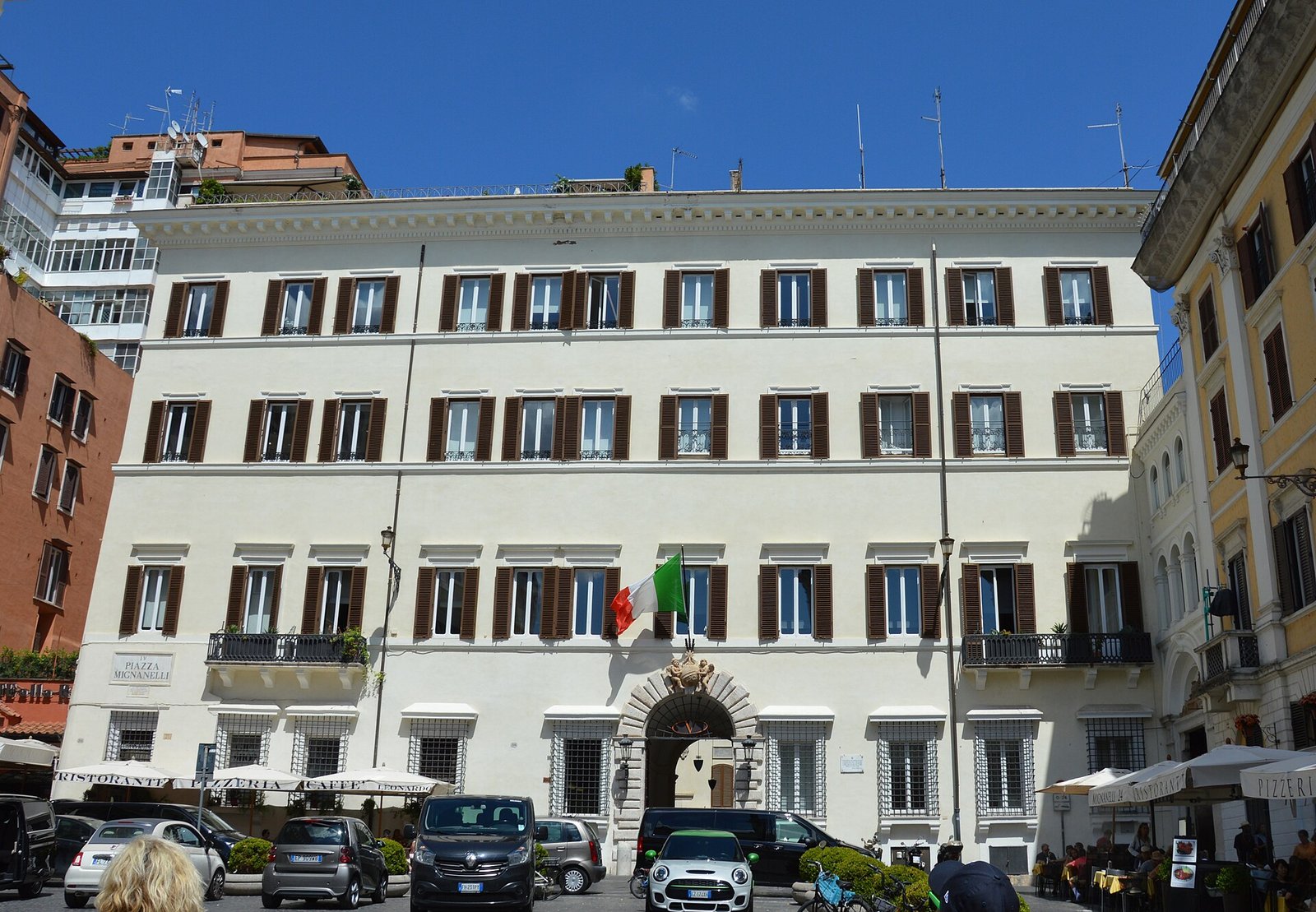
AURA in brief
The exhibition brings together 27 paintings by Ewa Juszkiewicz, including one made specifically for the occasion, and 37 dresses chosen from the archives of the Maison Valentino. It is not a fashion exhibition with a few paintings around it, nor a painting exhibition with clothes used as scenery: the project builds a dialogue between two languages that share the female body, fabric, volume and color.
The numbers and the theme
27 canvases and 37 dresses: these are the figures reported by the Gagosian gallery and by the magazine JL Interviews, which agree. The common thread is metamorphosis, understood as the capacity of a figure to be continually reshaped by history, by material, by nature and by imagination.
Who organizes it
The exhibition is produced by PM23, on behalf of the Valentino Garavani and Giancarlo Giammetti Foundation. The name of a curator does not appear in the official pages or in the sources consulted: the information is not published.
What is not yet known
The complete list of paintings and dresses is not published, and the official website presents the images without captions. It remains to be discovered, therefore, which archives and which periods of the maison will be represented. For this reason the text that follows describes the project as it has been presented, without anticipating installation choices that no source has made known.
The title and the idea of metamorphosis
The title, according to the presentation picked up by JL Interviews, points to an intangible quality that ties a work to its own history, a dress to the person who wears it, a face to its representation. It is an idea closer to presence than to definition: aura is what remains when you take away the label of object.
A quality you can't see
That a canvas and a dress share an aura means that both carry a time with them: the one in which they were made, the one in which they were seen, the one in which they are looked at now. The exhibition seems to invite us to read objects through their later lives more than through their date of birth.
The female figure as a form in motion
The declared theme is the female figure as a form that history, matter, nature and imagination endlessly reshape, and not as a fixed image. It is an interesting choice of side, because both the portraits of the 18th and 19th centuries and haute couture have often fixed woman in an ideal image: here the fixity is cracked from both sides.
Between homage and critique
According to JL Interviews, Juszkiewicz's painting is respectful toward the old masters and at the same time critical of their gaze. The exhibition sits in this ambiguity: it celebrates and reinterprets, admires and questions.
What you see: paintings and dresses in dialogue
The sources specify that paintings and dresses are not simply placed side by side: they dialogue through correspondences of fabric, volume, color and detail. It is best, then, to arrive in the room prepared to look for subtle similarities, more than obvious quotations.
The 27 paintings
They are works by Ewa Juszkiewicz, who has developed over time a recognizable visual language starting from the history of European female portraiture. One of the paintings was made for this exhibition. The cover image circulated by Gagosian is Untitled (after Jan Adam Kruseman), from 2020: the title names the Dutch painter from whose portrait the artist started.
The 37 dresses
They come from the archives of the Maison Valentino. The JL Interviews text recalls that Valentino's designs are read as volume, sculpture and second skin. The individual dresses, years of creation and collections are not listed in the sources.
The correspondences
A painted drapery can find an echo in a taffeta skirt, a corolla of flowers in an embroidery, a background color in a seasonal hue. This is a key of interpretation offered by the official description (fabric, volume, color, detail), not a list of documented pairs: visitors are free to look for their own.
The weight of the new work
The painting made specifically for the exhibition is the only element known for certain not to have existed before this project. Every further detail, subject, format and title, is not published.
Ewa Juszkiewicz, the painter of covered faces
Ewa Juszkiewicz was born in Gdansk in 1984 and works in Warsaw, as reported by Artribune, which presented her in December 2020 on the occasion of her solo show at the Gagosian gallery in New York.
Training
According to the English Wikipedia entry she studied at the Academy of Fine Arts in Gdansk between 2004 and 2009 and then attended the academy in Krakow. The sources consulted do not allow us to specify the path further.
The method: near copies
Artribune describes a precise procedure: the painter studies female portraits of the 18th and 19th centuries and makes nearly faithful replicas of them, paraphrasing, among others, paintings by Élisabeth Vigée Le Brun, Jan Adam Kruseman, Joseph Karl Stieler and Adolf Ulrik Wertmüller. The tone changes toward the end of the subject, with surreal inserts.
Hidden faces
The official presenter speaks of faces modified or concealed with fabrics, hair, flowers, leaves and other organic forms. Her canvases, writes Artribune, show young women in period dress whose faces are hidden by drapery, plants, insects or knots of hair. To the newspaper the painter said that, looking at these paintings, she feels a "sort of dissonance in my perception."
A critical reading
Critics read in these interventions the challenge to an ideal of female beauty imposed by the society of the time and an attempt to free the vitality of women, left for centuries in canonical poses. Artribune also notes the influence of contemporary fashion, in colors and cuts, above all in the most recent works: a fact that explains why the dialogue with Valentino is not forced.
Market and recognition
According to Wikipedia she won the Grand Prix of the Biennale Bielska Jesień in 2013. In 2022 a portrait of hers, Portrait of a Lady (After Louis Leopold Boilly), was sold for $1.56 million with the proceeds donated to the POLIN museum in Warsaw, and in 2023 one of her paintings became the design of a Louis Vuitton bag from the Artycapucines collection.
How to read the exhibition: portrait and dress
Portrait and dress seem distant disciplines, yet they have a long history of closeness. A portrait from an earlier era shows a person through what they wear. A dress designed for a body defines its silhouette even before the face is visible. AURA works in this in-between space, and the official sources present it with words like correspondence, fabric, volume.
Fabric as subject
In Juszkiewicz's paintings as described by Artribune, fabrics and drapery are an active part of the painting: they cover the face, replace it, transform it. In dresses, instead, fabric is structure. Setting the two functions side by side lets us observe how the same material can hide or build a figure.
Volume
The JL Interviews text reads Valentino's designs as volume, sculpture and second skin. In painting volume is an illusion, obtained with light. In tailoring it is a concrete fact. The exhibition sets a painted volume against a sewn volume, and invites us to recognize where the two come close.
Color
Artribune observes that in the painter's most recent works one senses the influence of contemporary fashion in colors and cuts. On Valentino, on the other hand, the sources recall the 1968 collection of only whites, beiges and ivory: a way of working by chromatic subtraction that offers a point of comparison with painting.
The absent face
One difference that leaps to the eye is the face. In the paintings the face is often hidden. In the dresses, by definition, the face belongs to the wearer and is missing from the room. In both cases the person is evoked more than shown, and this is perhaps the real reason for a pairing that at first sight seems merely aesthetic.
The portrait and the gaze of the old masters
The painters Juszkiewicz starts from, according to Artribune, are Élisabeth Vigée Le Brun, Jan Adam Kruseman, Joseph Karl Stieler and Adolf Ulrik Wertmüller. They are different names, united by belonging to the European portrait tradition.
Copying to understand
Making nearly faithful replicas means accepting the rules of the model: the pose, the light, the composition. The intervention comes afterward and for that very reason is effective, because it inserts itself into an image that still looks familiar.
The gesture of covering
Covering a face with flowers, leaves or hair is a double gesture. On one hand it denies the portraitist his prerogative, that of making a person recognizable. On the other it replaces identity with a plant or material presence. The result can be read as irony, as liberation or as unease: the choice among these readings is up to the viewer.
The vocabulary of fashion
Since the chosen portraits show young women in period dress, the dress is already in the painting before the exhibition even brings it into the room. It is not surprising that a painter who starts from the fashion of past centuries finds a natural interlocutor in a haute couture archive.
Valentino Garavani: the designer and his archive
Valentino Garavani was born in Voghera on May 11, 1932 and died in Rome on Monday, January 19, 2026, at 93, in his Roman home, according to Domani. Il Post reports the news the same day without giving the place.
Paris and Rome
At 17 he moved to Paris, where he studied at the École des Beaux-Arts and at the Chambre Syndicale de la Couture Parisienne. He worked for five years for Jean Dessès and for two for Guy Laroche. Back in Italy he opened an atelier on Via Condotti, in Rome. Il Post places it at the end of the 1950s, Domani gives the first boutique as 1957.
Meeting Giammetti and the maison
On July 31, 1960 he met Giancarlo Giammetti at the Café de Paris, on Via Veneto. In 1960 they founded Maison Valentino together: the designer handled the creative side, Giammetti the business and organization. The first show in Italy was held in 1962 at Palazzo Pitti, in Florence.
The white of 1968 and ready-to-wear
In 1968 he presented a collection of only white, beige and ivory dresses, against the grain of the era. In the same year, Domani recalls, he made the wedding dress of the former American first lady for her marriage to Aristotle Onassis. The first ready-to-wear line came out in 1970.
Warhol's portrait
In the 1970s Andy Warhol portrayed him in a series of works, as Domani recalls. It is a useful detail for an exhibition that questions the portrait: Valentino was also a subject of portraiture, as well as a creator of dresses for other people's images.
The retirement
Il Post places the farewell to the role of creative director in January 2008, with the last show at the Rodin Museum in Paris. Domani speaks of a commitment left in 2007 with a three-day party between Rome and Paris. The sources do not agree on the year: 2008 for Il Post, 2007 for Domani.
The Valentino Garavani and Giancarlo Giammetti Foundation
The Foundation was established in 2016. Recognition came on May 30, 2017, with registration in the Milan Prefecture register on June 7, 2017. It has a mission that the website defines as exclusively philanthropic, founded on the principle "Beauty Creates Beauty."
The four areas of activity
The official website lists Legacy, that is, Valentino's heritage, artistic and cultural enhancement, philanthropic and social initiatives, education and support of talent. AURA fits mainly in the first two: heritage and enhancement.
Voghera
Artribune recalls that the Foundation helped keep accessible Teatro Valentino Garavani in Voghera, the designer's hometown: a sign that its activity is not limited to Rome.
Who manages the activities
The operational activities are entrusted to FVG Services Srl, on behalf of the Foundation, which develops the cultural and educational programming, forms partnerships with institutions and companies and handles the staff.
PM23: the space hosting the exhibition
PM23 is the wing of Palazzo Gabrielli Mignanelli, at number 23 of the square, built at the end of the 19th century as a school and printing house of Propaganda Fide, restored for over a year and turned into a hub for arts, fashion and culture. The project is by the studio Nemesi Architects. Artribune reported its opening to the public in an article from February 2025.
The program of the spaces
PM23 hosts exhibitions, events, workshops and educational initiatives on arts, fashion and creativity. The current program can be consulted in the Exhibition section of the official website.
VENUS
The second exhibition at PM23 was VENUS. Valentino Garavani attraverso gli occhi di Joana Vasconcelos, from January 18 to July 19, 2026, with 12 works by the Portuguese artist and a selection of 33 creations by Valentino Garavani curated by Pamela Golbin. The comparison with AURA is instructive: there an artist reread the designer, here a painter meets his dresses starting from the portrait.
The lying in state
After the designer's death, PM23 hosted the lying in state on Wednesday, January 21 and Thursday, January 22, 2026, from 11:00 to 18:00. The foundation's venue thus also received the public farewell to its founder.
Selva and the square
Since September 30, 2026, in front of PM23 stands the installation by Edoardo Tresoldi, a forest of wire-mesh columns. For details, see the page devoted to Selva at Piazza Mignanelli.
Two exhibitions, one visual entrance
The same facade can thus be looked at through the transparent columns before entering the rooms of AURA. The pairing is not declared by the sources as a single project: it is an opportunity offered by the calendar, not a conceived route.
The theme of transparency
Tresoldi's wire mesh lets you glimpse what lies behind it. Juszkiewicz's covered faces hide what lies in front. They are two opposite ways of playing with the gaze, and it's best to keep both in mind.
Palazzo Gabrielli Mignanelli
According to Wikipedia, around 1575 Alessandro Moschetti built the palace for Count Girolamo Gabrielli, of a noble family from Gubbio.
From the Gabrielli to the Mignanelli
In 1615, after the marriage of Carlo Gabrielli to Maria Mignanelli, the palace passed to the Mignanelli, who held it until 1871 and gave the square its name.
The Holy See and the maison
From the late 18th century the building was rented to several institutions. In 1887 the Holy See bought it and Andrea Busiri Vici restored and expanded it. It later became the Roman seat of the Valentino maison, whose dates for that transition the sources do not give.
Practical information
Dates and hours
From October 18, 2026 to February 21, 2027, from 11:00 to 18:30, last entry at 18:00. Closed Monday, except October 19, 2026, and on December 24, 25 and 31, 2026 and January 1, 2027. An events portal gives February 23, 2027 as the closing date. The sources don't agree: the official website says February 21, and that is the date to go by.
Tickets and discounts
Full €18, online €16. Presale until October 17 at €15, online and on site. Over-65 €15. University students up to age 26 €12. Kids between 8 and 18 €10. Under 8 free. People with disabilities enter free and the companion pays €15. For groups and schools the website gives the address ticketing@piazzamignanelli23.com. To enter, consulting the visitor rules is required, published by the website in PDF format.
Where it is
PM23, Piazza Mignanelli 23, 00187 Rome, in the Campo Marzio district, right next to Piazza di Spagna.
How to get there
The route depends on the starting point: the ATAC route planner is the most reliable tool to build the itinerary by public transport.
A curiosity about PM23
The wing where an exhibition on portrait and dress now opens was built as a school and printing house: a place where people taught and printed. Before becoming a seat of fashion and art, PM23 was a workspace on the word and the reproduced image. In an exhibition that questions how images are transmitted and transformed, the coincidence is hard to ignore.
The square carries the name of a family, the Mignanelli, who owned the palace until 1871, and not that of a saint or a monument, as happens more often in Rome.
Something nobody tells you about PM23
Anyone going in for the first time often imagines a gallery with one work per room and a label beside it. The description of the project, instead, speaks of dialogue through correspondences and not of explicit pairs. For this reason it's best to slow down in front of individual works and ask what unites them, because the game of the exhibition lies precisely in the search for similarities that no caption guarantees.
Another thing the official account leaves out: the curator is not named and the list of works is not published. The real declared protagonist is the theme, metamorphosis, even more than the authors.
My advice for visiting PM23
My advice is to choose a time away from peak crowds and to go in with the idea of first looking at the paintings as a whole, then at the details of fabric and color, and only afterward looking for the correspondences with the dresses. Last entry is at 18:00 and closing at 18:30: anyone who arrives right at closing risks giving the exhibition too little time for a patient reading.
Check the visitor rules on the official website first, because what you can bring with you and how to behave in the rooms depends on them. Before or after, treat yourself to a walk among Piazza di Spagna, Via dei Condotti and Trinità dei Monti, to look at the city again with different eyes.
Another well-known fact, yet rarely mentioned
Everyone knows Valentino was one of the most celebrated designers in the world. Less often cited is that, according to Il Post, the maison was born in 1960 from a meeting at the Café de Paris on Via Veneto, on July 31 of that year, and that its first Italian show was held two years later at Palazzo Pitti, in Florence.
Even less often cited is that the painter in dialogue with him today, according to Artribune, starts from portraits of the period and makes nearly faithful copies before intervening. The method recalls, from afar, that of tailoring: you study a model, reproduce it with precision, then decide where to shift the axis.
The right photo to take at PM23
The preliminary question is if photography is allowed in the rooms: the visitor rules are published on the official website and their content should be checked beforehand. The text of the pages consulted says nothing on the matter.
Outside the rooms
Outside, the most interesting photograph is the facade of the space seen through the columns of Selva: the wire mesh lets you read the architecture as if veiled, in dialogue with the covered faces of the paintings.
From the square toward the stairway
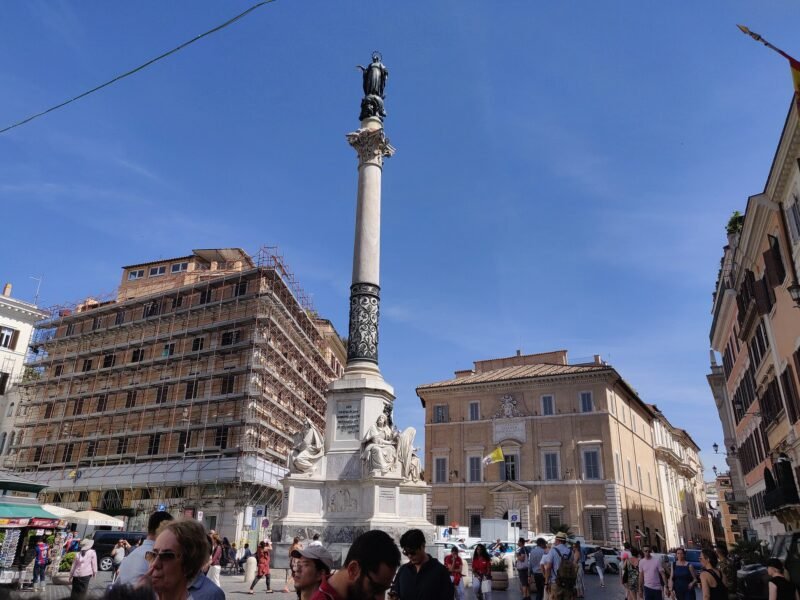
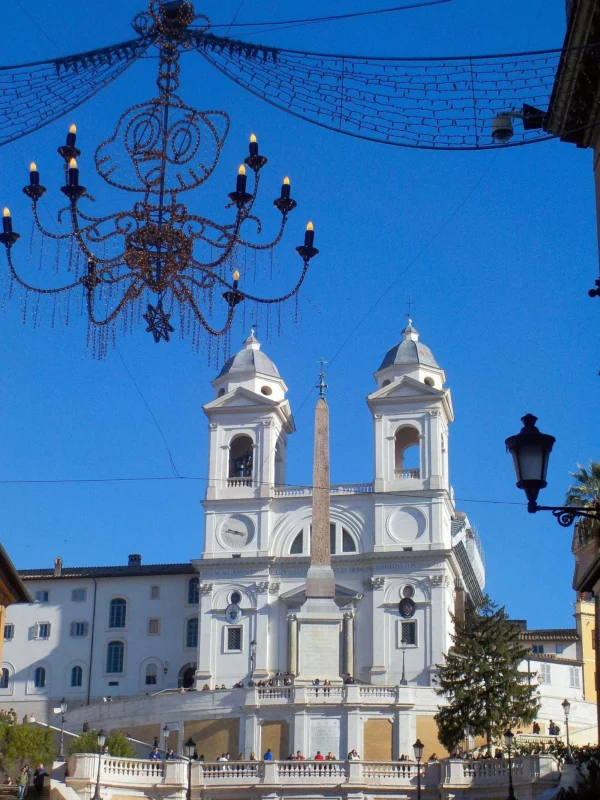
From the square it takes just a few steps to find the Column of the Immaculate Conception and the Propaganda Fide side, a framing that shows the contrast between papal Rome and the Rome of fashion.
The mental image
Inside, if the rules don't allow it, the best photo is the one you take from memory: a dress and a painting that resemble each other, held together for a few seconds.
Some important events that happened here in history
1575, 1615, 1871, 1887
Around 1575 the palace is built for Girolamo Gabrielli. In 1615 it passes to the Mignanelli. In 1871 the family's ownership ends. In 1887 the Holy See buys it and Andrea Busiri Vici restores it.
2016 and 2017: the Foundation
In 2016 the Valentino Garavani and Giancarlo Giammetti Foundation is established, recognized on May 30, 2017.
2025: the opening of PM23
In 2025, after a restoration lasting over a year, the wing of Palazzo Gabrielli Mignanelli becomes PM23, on a design by Nemesi Architects.
January 2026: the lying in state
Valentino Garavani dies on January 19, 2026. PM23 hosts the lying in state on January 21 and 22. The funeral is held on Friday, January 23, 2026 at 11:00 in the Basilica di Santa Maria degli Angeli e dei Martiri, in Piazza della Repubblica.
2026: VENUS, Selva, AURA
On January 18, 2026 VENUS opens. On September 30, 2026 Selva opens in the square. On October 18, 2026 AURA opens.
Who has passed through PM23
Designers and patrons
Valentino Garavani and Giancarlo Giammetti are the two names that tie the place to the history of fashion. On the culture and design side recur Pamela Golbin, curator of the archive selection for VENUS, and the studio Nemesi Architects.
Artists
Joana Vasconcelos with VENUS, Edoardo Tresoldi with Selva, and Ewa Juszkiewicz with AURA are the contemporary artists the sources link to PM23 in 2026.
Politics and institutions
After Valentino's death, Domani recalls the comments of Prime Minister Giorgia Meloni, Deputy Prime Minister Matteo Salvini, Minister Antonio Tajani, M5S leader Giuseppe Conte and the mayor of Rome Roberto Gualtieri.
Figures of the 20th century
Among the clients and faces tied to the maison, Domani cites Elizabeth Taylor and Julia Roberts, and recalls Andy Warhol, who portrayed him in the 1970s.
The nearby neighborhoods
A few steps away are the Keats-Shelley House, Babingtons Tea Room and Villa Medici, places where the cultural history of Rome meets that of shopping and fashion.
Frequently asked questions about AURA
What is AURA?
It is an exhibition devoted to the dialogue between the paintings of Ewa Juszkiewicz and the dresses of Valentino Garavani, hosted by PM23 in Rome. It presents 27 paintings, one of them new, and 37 dresses chosen from the archives of the Maison Valentino, united by the theme of metamorphosis and by correspondences of fabric, volume, color and detail.
When can you visit?
From October 18, 2026 to February 21, 2027, from 11:00 to 18:30, with last entry at 18:00. The exhibition is closed on Monday, except October 19, 2026, and on December 24, 25 and 31, 2026 and January 1, 2027. It's always best to recheck the official website before the visit.
How much does the ticket cost?
The full price is €18, €16 if bought online. The presale until October 17 is €15. Over-65 €15, university students up to age 26 €12, kids between 8 and 18 €10, under 8 free. People with disabilities enter free and the companion pays €15.
Where do you buy tickets?
From the ticket office page linked to the official website piazzamignanelli23.com, which points to the dedicated section. For groups and schools the website gives the address ticketing@piazzamignanelli23.com as the contact. Before the visit it is also useful to read the rules in PDF published by the website.
Who is Ewa Juszkiewicz?
She is a Polish painter born in Gdansk in 1984, who works in Warsaw. She starts from European female portraits of the 18th and 19th centuries and reworks them by covering the faces with fabrics, hair, flowers, leaves and other organic forms. Her painting is at once homage and critique of the gaze of the old masters.
What is the relationship between Valentino and the exhibition?
The 37 dresses come from the archive of the maison founded by Valentino Garavani and Giancarlo Giammetti in 1960, and the space hosting the exhibition belongs to the Foundation named after them. Valentino died on January 19, 2026: AURA opens in the same year as his passing, in a PM23 program already started with VENUS.
Are there other exhibitions in the same place?
In front of PM23 you can see the installation Selva by Edoardo Tresoldi, open from September 30, 2026 until January, with a closing date that is not published. The previous exhibition in the rooms, VENUS, ran from January 18 to July 19, 2026.
How do you get to PM23?
PM23 is at Piazza Mignanelli 23, right next to Piazza di Spagna. To get there by public transport it's best to use the ATAC route planner, entering Piazza Mignanelli or Piazza di Spagna as the destination, so you have the updated route from your starting point.
Final advice on AURA
Go in without hurry and without necessarily looking for the answer: AURA proposes an idea, metamorphosis, and leaves visitors the task of testing it by comparing a painted fabric and a sewn fabric. Give the paintings adequate time, because the covered faces are the heart of Ewa Juszkiewicz's work, and then look at the dresses as sculptures around a body. Before leaving, check the official website for hours, closures and rules, and if you have time close the day between Piazza di Spagna and the Pincio.
Article written by the editorial team of Tour Leader Pro, contact them for Private/Corporate/V.I.P. Tours and Experiences.
Planning a trip to Rome? The English-language guides for visiting the city are on ItalyPlanner.com.
Contact Information
Nearby
 Column of the Immaculate Conception100 m
- Casa dei Mostri - Palazzetto Zuccari100 m
- Gregory’s Jazz Club100 m
- Keats-Shelley House100 m
- Piazza di Spagna100 m
- Obelisco Sallustiano100 m

Upcoming events nearby
- Chiara Camoni, I fiori del male at Società delle Api, October 9, 2026 to January 26, 2027100 m
- Un mondo sull’orlo del baratro. L’ultimo uomo di Mary Shelley at the Keats-Shelley House, May 20 to November 21, 2026100 m
- Hypothèse de lecture at Trinità dei Monti, September 19 to November 7, 2026100 m
- Vittorio Cuculo Quintet and Lucia Filaci at Gregory’s Jazz Club, November 7, 2026200 m


You might also like
- Et in Arcadia ego at Casa di Goethe, December 2, 2026 to April 4, 2027
- Contiamo l’Italia, contiamo per il futuro at Palazzo delle Esposizioni, Oct 14 to Dec 12, 2026
- StenLex Rinascita at Galleria d’Arte Moderna, site-specific mural through Dec 31, 2026
- Fireworks. Ileana Sonnabend and the Contemporary Art Boom at Palazzo Esposizioni Roma
- Picabia, Morellet and Sole Nero at Villa Medici: Exhibitions October 9, 2026 to January 18, 2027
- Keith Haring at Museo di Roma in Palazzo Braschi, from October 6, 2026 to April 11, 2027