BNL Italy Major Premier Padel 2027 at Foro Italico, June 1 to June 6, 2027
In short. The BNL Italy Major Premier Padel 2027 is played at Foro Italico, in the Complesso del Foro Italico (Viale dei Gladiatori 31, Rome), from June 1 to 6, 2027.
The BNL Italy Major Premier Padel 2027 is played at Foro Italico, in the Complesso del Foro Italico (Viale dei Gladiatori 31, Rome), from June 1 to 6, 2027. The official ticketing portal lists eight sessions: Tuesday, June 1 and Wednesday, June 2 with admission listed as Ground, then Thursday 3, Friday 4 (day session and evening session), Saturday 5 (day and evening) and Sunday, June 6 with access to the Center Court and all courts. Sessions start at 10:00 on June 1, 2, 3 and 4 (day), at 16:30 on the evening of the 4th, at 13:00 and 18:00 on the 5th and at 18:00 on the 6th, with the official warning that times may change. Turismo Roma also writes that "the program may be subject to change". Individual ticket prices aren't given on the event list page, which only specifies that a 10% presale fee and a service charge are added to the price. Tickets are sold on the tournament's official portal, linked to the website bnlitalymajorpremierpadel.com. To get there, it's best to plan your route with the ATAC journey planner, because on tournament days traffic conditions and access to the complex may change.
The tournament at a glance
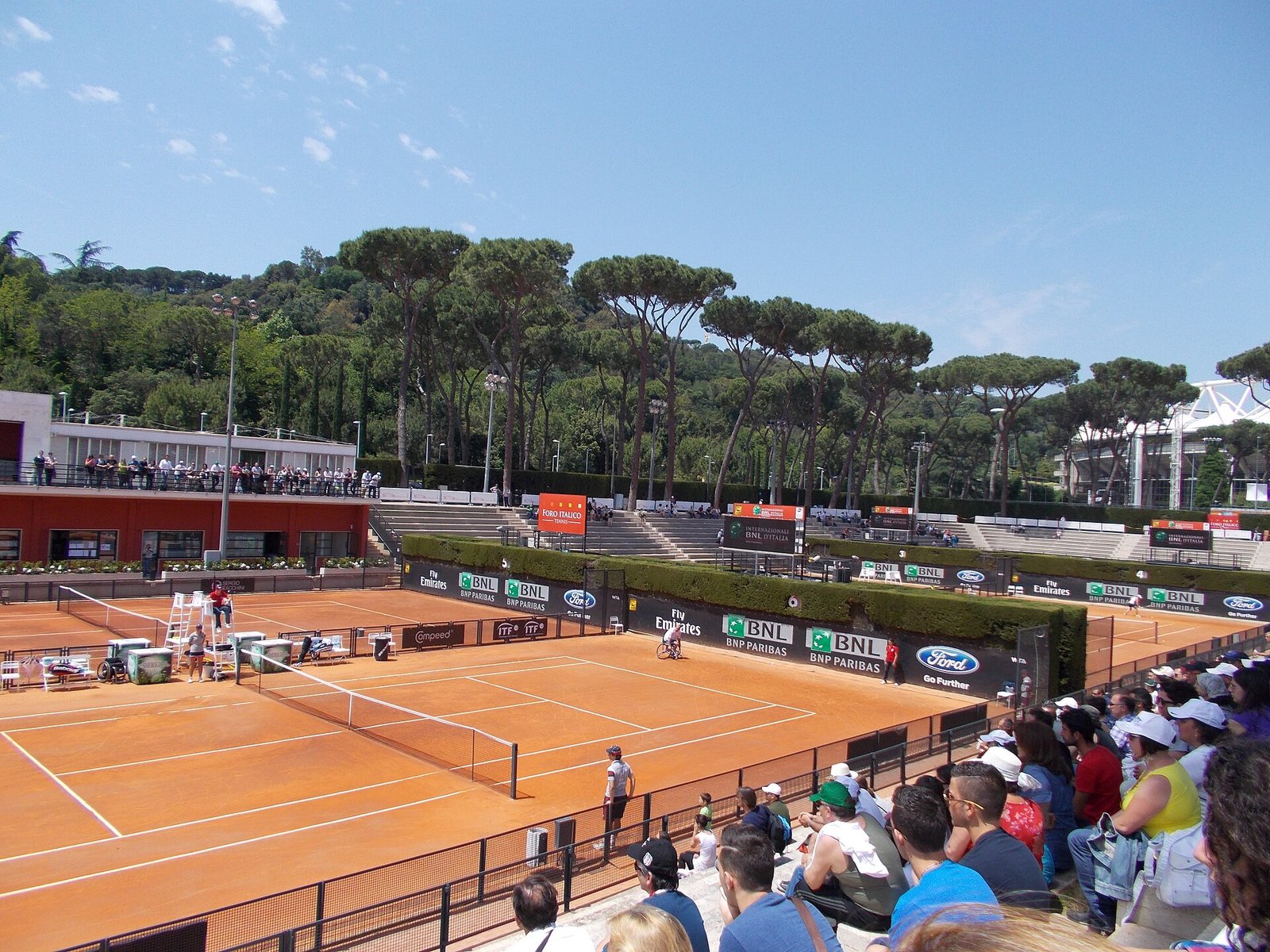
The BNL Italy Major is the Rome stop of the Premier Padel tour and belongs to the Major category, the highest level of the calendar. It has always been played at Foro Italico, the big sports complex at the foot of Monte Mario, and for six days it turns part of the park into a village dedicated to a sport that in Rome now counts thousands of players.
What you see on court
The Major brings the men's and women's draws together in the same event. It's played in doubles, the format in which padel lives at the professional level, and the pairs face each other in best-of-three-set matches on a court enclosed by walls. If you've never seen a match live, you quickly discover the difference from tennis: the ball can bounce off the glass and come back into play, and the best points often come from a recovery after the back wall.
Dates and length of the week
According to the Turismo Roma listing the event runs from June 1 to 6, 2027. The 2026 edition was described by the tour's official sources with slightly different dates: the international federation speaks of a tournament from May 31 to June 7, while Red Bull's report gives the period from June 1 to 7. For 2027, the calendar published by the box office applies, the one the sessions listed at the top come from.
The draw and the points at stake
For the 2026 edition the international federation announced more than 150 pairs entered and almost 250 players, with 2,000 points for the winners, 1,200 for the finalists and 720 for the semifinalists, and prize money of over 1 million euros, with equal prizes for men and women. These figures refer to 2026: for 2027 the information isn't published.
The Premier Padel tour
Premier Padel is the professional padel tour recognized by the International Padel Federation (FIP). Launched in 2022, it has had the support of the professional players' association and of Qatar Sports Investments. In 2023 the tour absorbed the company that ran the World Padel Tour, bringing the best players in the world together under a single banner.
Major, P1, P2 and Finals
The events are divided into Major, P1 and P2, plus the end-of-season Finals. The Majors are the most prestigious events: in 2022, the inaugural year, there were four, in Doha, Rome, Paris and Monterrey. Rome is therefore among the cities that opened the tour's history, and it has stayed with a continuous presence.
Men and women in the same tournament
Women's tournaments were added to the calendar in 2023, and that very year the Rome tournament became the first Major with a combined format, men and women together.
The 2026 edition as a starting point
The fifth edition of the Major ended in June 2026 with two very different finals, both won by the world number one pairs.
The men's final
Arturo Coello and Agustín Tapia beat Alejandro Galán and Federico Chingotto 7-5, 7-6, with the second-set tiebreak closed by a Tapia smash. For the international federation it was the pair's second Rome title, after the 2023 one, and their return to the top of the season rankings.
The women's final
Delfi Brea and Gemma Triay beat Ariana Sánchez and Andrea Ustero 6-1, 7-5, taking their second consecutive title in Rome. Triay had already won in Rome in 2023 with Marta Ortega.
The record semifinal
The day before, on the Center Court, Sánchez and Ustero had beaten Paula Josemaría and Bea González 5-7, 7-6, 7-6 after 4 hours and 12 minutes of play, the longest match ever played on the Premier Padel tour. The previous record was exactly four hours, set in Milan in 2024.
The crowd
According to the international federation's report, Foro Italico was full, with over 9,000 spectators. An attendance figure that confirms how the Major has become one of Rome's June sporting events.
The Rome Major roll of honor
The tour's sources show a list of winners among the most recognizable in world padel.
The men
In 2022 the first title went to Juan Lebrón and Alejandro Galán. In 2023 Agustín Tapia and Arturo Coello won. Galán and Federico Chingotto then won in 2024 and 2025, while in 2026 Coello and Tapia won again.
The women
The women's roll of honor starts in 2023 with Gemma Triay and Marta Ortega. In 2024 Ariana Sánchez won with Paula Josemaría, while in 2026 the title went to Delfi Brea and Gemma Triay. For the 2025 women's edition the information isn't given in the sources consulted.
An Italian presence
In 2026 Giulia Dal Pozzo reached the first Major semifinal for an Italian player, according to the international federation. An important sign for a growing national movement.
Padel in a nutshell
If you arrive at Foro Italico without ever having played, you can count on rules that are easy to grasp and on a sporting culture that's now very widespread in Rome.
The origins
According to historical accounts, padel was born in 1969 in Acapulco, Mexico, on the initiative of Enrique Corcuera, who built a court in his garden using the nearby walls as part of the playing area and then formalized the game under the name padel.
The court and the rules
The court measures about 20 meters by 10 and is enclosed by walls on four sides, except for the two entry openings. The side walls are about three meters high, the back wall about four, and on most courts they're made of glass, with the sections near the net in metal mesh. You use a solid-face paddle and a ball similar to a tennis ball but with lower internal pressure. The serve is always underhand, diagonal, and the ball must bounce before landing in the opponent's service box. After the first bounce on the ground the ball can touch the walls as many times as it likes, while a second bounce on the ground ends the point. Once it has crossed the net the ball must bounce on the ground before being played: so you can't volley it after it hits a wall.
Padel in Italy
The Federazione Italiana Gioco Padel was founded in February 1991, with associations from the Bologna area promoting the game, and the first facility opened that year in Costabissara, in the province of Vicenza. Growth came in Emilia-Romagna in the 1990s and in Rome from 2013. Today the sport is governed by the Federazione Italiana Tennis e Padel.
Rome's numbers
In June 2026 the FIP data cited on the tournament page speak of 10,352 courts in Italy, with almost one new court a day over the last 12 months, and of 1,570 facilities in Rome. The tournament website devotes a news item to this record. According to the international federation, Rome is the third city in the world for padel, after Madrid and Barcelona.
The program day by day
The official box office organizes the tournament in sessions, and each session corresponds to a ticket.
Tuesday, June 1 and Wednesday, June 2
The first two days are sold as Ground, starting at 10:00. Details of which courts this ticket gives access to aren't published on the event list page.
Thursday, June 3
From June 3 the wording changes to Center Court and all courts, starting at 10:00.
Friday, June 4
The day is split into a day session, from 10:00, and an evening one, from 16:30, sold separately.
Saturday, June 5
Saturday also has two sessions: the day one from 13:00 and the evening one from 18:00.
Sunday, June 6
The final is in Sunday's only session, starting at 18:00. Which matches are played in each session isn't published. The order of play depends on the draw and how the rounds go.
Tickets and prices
Tickets are sold on the tournament's official ticketing portal, reachable from the event website. The list page specifies that a 10% presale fee and a service charge, which varies depending on the type of ticket bought, are applied to the price of each ticket.
What's published
The list shows eight sessions, the name of the venue, the start time and the warning about possible time changes. The amount of individual tickets isn't given on the page consulted: that information isn't published.
What to do before buying
Choose the session based on the kind of experience you want: the first two days with Ground admission let you see the tournament in an early phase, the sessions from June 3 include the Center Court. The cost and conditions of each ticket should be checked directly on the official page.
The venue: Foro Italico
The complex is on the slopes of Monte Mario, next to the Tiber, on an area reclaimed from marshland. Turismo Roma describes it as a sports complex built to train young people in discipline through sport, according to the ideals of the Fascist regime. Today it hosts international competitions, sports offices and a university. Turismo Roma's official listing gives two entrances: Piazza Lauro De Bosis, where the obelisk stands, and Viale dei Gladiatori, the tournament's address. For the complex see also the page dedicated to Foro Italico.
From Foro Mussolini to Foro Italico
The project was by Enrico Del Debbio, who designed it in 1927 and built it between 1927 and 1933 at the urging of Renato Ricci, undersecretary of National Education and founder of the Opera Nazionale Balilla. The original name was Foro Mussolini. In August 1943, after Mussolini's fall, CONI permanently renamed it Foro Italico.
The first works
The first works inaugurated, on November 4, 1932, were Palazzo H, the Mussolini Stele, Stadio dei Marmi and Stadio dei Cipressi, the latter later becoming Stadio dei Centomila and then today's Stadio Olimpico.
The buildings of the complex
Among the historic buildings are Palazzo H, seat of the Fascist men's academy of physical education and occupied by CONI since 1951, Palazzo delle Terme with the indoor pools, by Costantino Costantini, and Luigi Moretti's Fencing Academy, built between 1934 and 1936. The higher institute of physical education became the Università degli Studi di Roma Foro Italico in 2008.
The sports played here
Tennis has been played on the complex's courts since 1949: the Internazionali d'Italia is held here, to which the page on the Internazionali BNL d'Italia 2027 is dedicated. Padel is therefore a relatively new guest in a place that has been dedicated to sport for almost a century.
How to get there and what to know before going in
The sources consulted don't describe transportation services for the tournament, and don't publish information on parking or shuttles: that information isn't published.
Planning with ATAC
The most reliable way is to use the ATAC journey planner, entering Viale dei Gladiatori 31 as the destination and the time of the chosen session. The coordinates given by Turismo Roma are 41.928143 north and 12.456272 east.
A neighborhood of bridges
Foro Italico faces the Tiber. Nearby are Milvian Bridge and Ponte Flaminio, two crossings that let you combine the tournament with a walk along the river. For the neighborhood you can also check the guide to Flaminio.
Accessibility and information
Turismo Roma refers to its own Accessible Rome section for accessibility information. For the tournament the organizers list as contacts the number 06 36851 and the address info@sportesalute.eu.
A curious fact about Foro Italico
The obelisk at the monumental entrance is a single block of Carrara marble. Turismo Roma describes it as the largest marble block ever quarried from the Apuan Alps. Its story is worthy of an epic building site: the block was brought down to the valley starting on January 26, 1929 with 36 pairs of oxen, an operation that took about five months, then loaded onto a pontoon specially built in La Spezia and taken toward Fiumicino. It went up the Tiber on the flood and reached Rome on May 6, 1932. It was raised and inaugurated on October 29, 1932.
How tall it is
Here the sources disagree: the general entry on Foro Italico and Turismo Roma give 17.5 meters not counting the base, while the entry dedicated to the obelisk gives about 19 meters and about 300 tons.
The golden tip
The pyramidion was pure gold and weighed about 32 kilos: it was stolen in the days following July 25, 1943, the fall of Mussolini.
Something nobody tells you about Foro Italico
Almost all visitors walk along the avenue and look at the obelisk without noticing that the pavement is the real work of art of the complex. The old Piazzale dell'Impero, today Viale del Foro Italico, is covered entirely in black and white tiles, and Turismo Roma attributes to Gino Severini the mosaics depicting symbols and sports.
The mosaics you walk on
The tiled pavement is the most recognizable feature of the route and often goes unnoticed because you walk on it. There are segments with the symbols of sport and, according to Turismo Roma, marble blocks with key dates of the regime along the avenue.
Other mosaics in the complex
Angelo Canevari designed eight athletics figures at the entrance to Stadio dei Marmi and the wall mosaics of the indoor pool at Palazzo delle Terme. Giulio Rosso made the mosaics of the pool floor and, from his cartoons, the black and white marine mosaics around the Fontana della Sfera.
The program may change
Another less obvious aspect concerns the day of play: both the box office and Turismo Roma warn that times and program may change, so it's best not to plan the day too tightly.
My tip for visiting Foro Italico
My tip is to arrive ahead of the start of the session and spend the first half hour on the complex instead of the courts.
First the avenue, then the tournament
From the obelisk side, Viale del Foro Italico offers a sight no match can replace: black and white tiles, Carrara marble, the bulk of Stadio Olimpico in the background. The main entrance to the complex, according to historical sources, is aligned with Ponte Duca d'Aosta.
Which session to choose
The Friday and Saturday evening sessions start at 16:30 and 18:00 respectively, and the Sunday one at 18:00: but the official time may change. From June 3 access includes the Center Court and all courts.
What to bring
For a day outdoors in early June you need a hat, sunscreen and comfortable shoes. Entry rules, permitted items and internal services aren't published on the pages consulted: check them on the official website before the date.
Another well-known fact, yet one that's rarely mentioned
It's well known that Foro Italico hosted the 1960 Olympics. It's less often mentioned that the complex, born as the gym of the regime's physical education, was built and completed in several phases: the main phase between 1927 and 1933, then a further arrangement between 1956 and 1968, after the war.
The provinces' statues
Stadio dei Marmi is surrounded by 60 marble statues, almost all donated by the Italian provinces, which in 1935 numbered 94. The name of the donor province appears on the pedestal. Four bronze statues and four more in the niches of Palazzo H complete the picture.
A name for a sprinter
Since September 12, 2013 the stadium has borne the name of Pietro Mennea, who held the 200-meter world record for 17 years.
The walk of champions
Since May 7, 2015 the Walk of Fame Le Leggende dello Sport Italiano has been open on Viale delle Olimpiadi, with 100 plaques dedicated to the greats of Italian sport chosen by the CONI athletes' commission.
The right photo to take at Foro Italico
The most recognizable photograph of the complex lines up three elements: the white obelisk, the black and white tiled avenue and the June sky. For a clean image, move around at the least crowded hours, early in the morning or at the end of the day.
The obelisk from a distance
From the avenue the obelisk is framed along the axis of the complex. The inscription with the names on the shaft is part of the history of the place and of the controversy that in 2015 led the then president of the Chamber of Deputies, Laura Boldrini, to propose erasing the words Mussolini and Dux, an idea later dropped after objections from historians and architecture experts.
Stadio dei Marmi
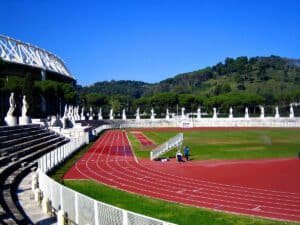
From the top of the marble tiers, with the statues arranged along the perimeter, you get a geometric perspective that also works well against the light. The tiers are made of Carrara marble and come from raising the ground by 5.50 meters.
The detail of the mosaics
A shot from above or at ground level of the avenue's black and white mosaics tells the decorative logic of the complex better than any panorama.
Some important events that happened here in history
Foro Italico has been the stage for major sporting events for almost a century. The list below follows the sources consulted.
The 1932 inaugurations
On October 29, 1932 the obelisk was raised and inaugurated for the 10th anniversary of the March on Rome. On November 4 of the same year the first buildings were inaugurated. The obelisk and the first works mark the beginning of the complex's history.
The 1960 Olympics
In 1960 Rome hosted the Games of the XVII Olympiad. Stadio Olimpico hosted the opening and closing ceremonies and the athletics events, including Wilma Rudolph's sprint victories and Livio Berruti's gold in the 200 meters. Stadio dei Marmi hosted the qualifying matches and semifinals of the field hockey tournament.
European Championships, World Championships and soccer
The list of events at the complex includes the 1968 European soccer championship, the 1974 European Athletics Championships, the 1975 Universiade, the 1980 European soccer championship, the 1983 European Aquatics Championships and the 1987 World Athletics Championships. In 1990 the stadium was rebuilt with a roof for the soccer World Cup and on July 8, 1990 it hosted the final, won by West Germany over Argentina.
The European finals
Stadio Olimpico hosted the 1996 Champions League final, won by Juventus on penalties over Ajax after a 1-1 draw, and the 2009 one, won 2-0 by Barcelona over Manchester United in front of 62,467 spectators.
Euro 2020 and beyond
The stadium hosted the opening ceremony of the European soccer championship postponed to 2021, Italy's group matches and a quarterfinal. Since 2012 Italy's home Six Nations rugby matches have been played here: the page on the Six Nations 2027 at Olimpico is dedicated to this topic.
Tennis, since 1949
The Internazionali d'Italia, founded in Milan in 1930, were played in Rome at the Foro Mussolini in 1935 and, after a break between 1936 and 1949, returned to the complex. The only exception was 1961, when they were played in Turin for the centenary of the Unification of Italy.
Who has passed through Foro Italico
The list of leading figures who have frequented the complex is long and spans different sports.
The tennis champions
At the Internazionali d'Italia the winners have included, among others, Rod Laver in 1962, Nicola Pietrangeli in several editions, Thomas Muster, Pete Sampras in 1994 and Rafael Nadal, who holds the record with nine titles. Among women, the first champion was Lilí de Álvarez in 1930, then Chris Evert with five titles, Serena Williams and Iga Świątek in 2021.
Athletics and the Olympics
In 1960 Wilma Rudolph and Livio Berruti ran at Stadio Olimpico. Stadio dei Marmi bears the name of another sprinter, Pietro Mennea.
Pietrangeli's stadium
Stadio Pietrangeli, the oldest venue in the complex, was inaugurated in 1934 with the Davis Cup tie between Italy and Switzerland. Costantino Costantini designed it, while Eugenio Baroni made 17 of the 18 Carrara marble statues that surround it. Since 2006 it has been named after Nicola Pietrangeli.
The padel stars
In recent years Foro Italico has welcomed Lebrón, Galán, Tapia, Coello, Chingotto, Brea, Triay, Sánchez, Ustero, Josemaría and González, the stars of the roll of honor and of the longest matches on the tour. Giulia Dal Pozzo has represented the Italian movement.
Rugby and soccer
Stadio Olimpico has been the home of Lazio and Roma since 1953, with the only break being one season at the Flaminio, 1988-89, during the renovation work. For the stadium's evenings and events see the page dedicated to Stadio Olimpico. For the hill behind it, the Monte Mario Nature Reserve and the Monte Mario Observatory.
Frequently asked questions about the BNL Italy Major Premier Padel 2027
When is the BNL Italy Major Premier Padel 2027 played?
The tournament runs from June 1 to 6, 2027 at Foro Italico in Rome. The official box office lists eight sessions, from Tuesday, June 1 to Sunday, June 6. Both the box office and Turismo Roma warn that times and program may change, so before you leave it's best to check the information again on the tournament's official website.
Where is the tournament?
It's in the Complesso del Foro Italico, at Viale dei Gladiatori 31, in Rome, on the slopes of Monte Mario and next to the Tiber. The complex also has a monumental entrance from Piazza Lauro De Bosis, where the obelisk stands. For the most convenient route, the advice is to use the ATAC journey planner.
How much do tickets cost?
The price of individual tickets isn't given on the event list page consulted, so that information isn't published. The page specifies that a 10% presale fee and a service charge, which depends on the type of ticket, are applied to the price. For exact amounts you need to open the official box office page.
What time do matches start?
According to the box office, sessions start at 10:00 on June 1, 2 and 3 and in the day session of the 4th, at 16:30 on the evening of the 4th, at 13:00 and 18:00 on the 5th and at 18:00 on June 6. Times may change, and the order of play of individual matches isn't published: it's set during the tournament.
Who won the 2026 edition?
In 2026 Arturo Coello and Agustín Tapia won among the men, 7-5, 7-6 over Alejandro Galán and Federico Chingotto, and Delfi Brea and Gemma Triay among the women, 6-1, 7-5 over Ariana Sánchez and Andrea Ustero. Sources: the international federation and Red Bull's report on the Major.
What is the Premier Padel tour?
It's the professional padel tour recognized by the International Federation, launched in 2022 with the support of the players' association and Qatar Sports Investments. It includes Major, P1 and P2 events and the end-of-season Finals. In 2023 it absorbed the company that ran the World Padel Tour.
Is the tournament suitable for people who don't know padel?
Yes, because the rules are simple: it's played in doubles on a court enclosed by walls, the serve is underhand and the ball can bounce off the glass after the first bounce on the ground. The pace of the rallies, with recoveries after the back wall, makes matches easy to follow even if you're seeing the game for the first time.
How do I get to Foro Italico?
The sources consulted don't publish a specific transportation plan for the tournament. The safest way is to enter Viale dei Gladiatori 31 in the ATAC journey planner and choose the session time, keeping in mind that on match days attendance at the complex increases.
My final tip on the BNL Italy Major Premier Padel 2027
Choose the session first of all based on your own pace: the Saturday evening session or Sunday's final are the most charged with anticipation, while the first days let you move around the park more calmly. Check the official time shortly before leaving, because it can change, and leave some margin to walk through Foro Italico at ease: tiles, marble and statues are worth as much as a match on the Center Court. If you love sports history, you can calmly retrace the stages told on these pages: the 1932 obelisk, Stadio dei Marmi with its 60 statues, the 1934 Stadio Pietrangeli and Stadio Olimpico, where pages of sport have been written from 1953 to today.
Article written by the editorial team of Tour Leader Pro, contact them for Private/Corporate/V.I.P. Tours and Experiences.
Planning a trip to Rome? The English-language guides for visiting the city are on ItalyPlanner.com.
Contact Information
Nearby
 Ponte della Musica – Armando Trovajoli300 m
- Hotel Butterfly300 m
- Stadio Olimpico500 m
- Foro Italico500 m
- Teatro Olimpico500 m
- Villa Mazzanti600 m

Upcoming events nearby
- Internazionali BNL d’Italia 2027 at Foro Italico, April 27 to May 16, 2027100 m
- The Nutcracker by Balletto di Roma at the Teatro Olimpico, December 17 to 20, 2026500 m
- La Sera dei Miracoli, Tribute to Lucio Dalla at Teatro Olimpico, December 15, 2026500 m
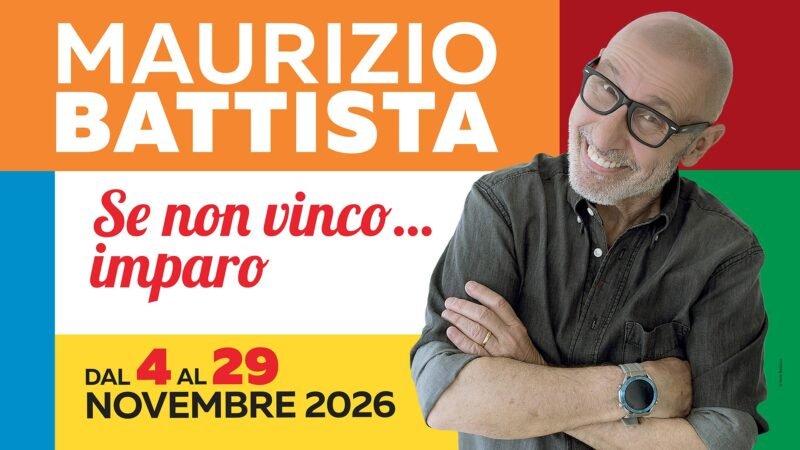
- Maurizio Battista at Teatro Olimpico, Se non vinco… imparo, November 4 to 29, 2026500 m



You might also like
- Primavera Unplugged at Auditorium Parco della Musica, April 9, 2027
- Tommaso Primo at Auditorium Parco della Musica, March 31, 2027
- Nubras Ensemble at Auditorium Parco della Musica, February 27, 2027
- Simone Avincola canta Carella at Auditorium Parco della Musica, February 26, 2027
- Mauro Di Maggio at Auditorium Parco della Musica, December 10, 2026
- Sergio Caputo, Effetti personali at Auditorium Parco della Musica, April 1, 2027