Maurizio Battista at Teatro Olimpico, Se non vinco… imparo, November 4 to 29, 2026
In short. Maurizio Battista is on stage at Teatro Olimpico in Rome, Piazza Gentile da Fabriano 17, from November 4 to 29, 2026, with his new one-man show Se non vinco...

Maurizio Battista is on stage at Teatro Olimpico in Rome, Piazza Gentile da Fabriano 17, from November 4 to 29, 2026, with his new one-man show Se non vinco... imparo. Shows are on Wednesday and Thursday at 20:30, Friday and Saturday at 21:00, Sunday at 17:30. You get there on metro A to Flaminio and then tram 2 to Piazza Mancini terminus, from where you walk about 500 meters along Viale del Pinturicchio. Alternatively bus 910 from Termini to the Pannini stop, about 300 meters away. The prices published by the theater range from 25.50 euros (side balcony with balustrade, restricted view) to 43.50 euros (poltronissima gold), plus the presale fee, which ranges from 3:50 to 6.50 euros depending on the section. Tickets are bought on the venue's official website, with a 2.50-euro online fee, or at the theater's box office, open every day from 10:00 to 19:00 without a break. On December 31 Battista returns to the same stage with a separate New Year's Eve Special, at 21:45.
Language: performed in Italian. No English version or English surtitles are announced.
November in Flaminio, then, has a host. The theater has entrusted Battista with opening the subscription shows of the 2026/2027 season, and has done so with a run of almost a month, something few comedians in Rome can afford without leaving empty rows in the stalls. The reason is simple: Battista is Roman, he speaks to his audience in his audience's language, and for almost 50 years he has been making people laugh starting from things everyone knows, the line at the post office, the apartment building, the oddities in the newspapers. Below you'll find everything you need to choose the evening, the seat and the way to get there, then the story of an artist and that of a hall that, born as a movie theater in the 1930s, has become one of the homes of Roman comic theater.
Se non vinco... imparo: what kind of show it is
Se non vinco... imparo is a one-man show of about two hours in which Maurizio Battista is alone on stage, one-on-one with the audience of Teatro Olimpico. The theater's official presentation describes it as a show able to lay bare the vices and virtues of the human soul, built around a very simple and very Roman idea: in life you fall and don't come first, but the fall is a lesson, and from there you have to get back up.
The theme: defeat as a lesson
The title already says a lot (roughly, "If I don't win... I learn"). Battista doesn't stage a story with a plot, but a long conversation that starts from a thought and widens to memories, small everyday defeats, missed opportunities. The theater speaks of a moment of collective fun in which every memory becomes the cue for a joke and emotion mixes with laughter. Anyone who knows his repertoire knows that the material comes from everyday life, pushed to excess until it becomes paradox. It's the same key that made him popular on television and that in the theater, where there's no editing, works even better.
The relationship with the audience
In the show's presentation the theater quotes a line that Battista, the note says, often repeats: «We make the real show together. The real show is you!». It's not a polite formula. In his shows the audience is a conversation partner: you laugh because you recognize yourself, and the comedian works a lot on complicity, on dialect, on questions addressed to those sitting in front. If you sit in the front row, factor that in, and if you love this kind of evening you'll seek it out on purpose.
A monologue, not a variety show
As for the official format, the theater's definition is clear: one-man show. That means a single performer holding the stage for the whole length, with the rhythm of the comic monologue. Some event portals have described guests and musicians on stage. The theater, in the show's listing, doesn't mention them, and it's best to stick to what the venue has published. If there are surprises, you'll find out in the hall.
A new show
Se non vinco... imparo is the new title following a long series of Battista's theater shows, almost one a year. The season presentation lists it as new, and the theater has put it at the top of the program. If you've seen the earlier shows you'll find the same style and tone, but not the same material.
Dates and times of Maurizio Battista at Teatro Olimpico
Maurizio Battista is at Teatro Olimpico from Wednesday, November 4, to Sunday, November 29, 2026, with shows from Wednesday to Sunday. The times change with the day of the week, a detail to keep in mind when planning the evening.
Wednesday and Thursday at 20:30
On weeknights the curtain rises at 20:30. With two hours of show you come out around 22:30, a time that lets people who work the next day get home without staying out late. These are also the evenings when central seats are usually easier to find.
Friday and Saturday at 21:00
On the weekend it starts at 21:00. If you want to eat beforehand you have to do it early, or put off dinner until after the show, which is easy to do in Flaminio and the nearby neighborhoods. These are the most requested evenings, and the first to fill up.
Sunday at 17:30
On Sunday the show is in the afternoon, at 17:30. It's the ideal time if you're coming from outside Rome, if you want to bring your parents or grandparents, if you don't like driving at night. You come out around 19:30 and still have time for dinner.
The weeks of the run
The calendar covers four full weeks of November. The first week opens on Wednesday the 4th. The last performance is Sunday the 29th. For exact dates and availability for each evening, the reference is the theater's box office, which publishes the performances on sale and the seats still free.
Tickets and prices for Se non vinco... imparo
Tickets for Maurizio Battista at Teatro Olimpico cost from 25.50 to 43.50 euros depending on the section, plus the presale fee. The theater specifies that the presale fee is always charged when the ticket is issued, and that there's a 2.50-euro fee for buying online.
Sections and prices
- Poltronissima gold: 43.50 euros, presale fee 6.50 euros.
- Side poltronissima: 37.50 euros, presale fee 5.50 euros.
- Poltrona: 35 euros, presale fee 5.30 euros.
- Balcony: 35 euros, presale fee 5.30 euros.
- Balcony with balustrade, restricted view: 33 euros, presale fee 5 euros.
- Side balcony: 28 euros, presale fee 4 euros.
- Side balcony with balustrade, restricted view: 25.50 euros, presale fee 3.50 euros.
Where to buy them
There are two channels: the online box office linked to the official Teatro Olimpico website and the box office on Piazza Gentile da Fabriano, open every day from 10:00 to 19:00. The theater also answers by email at biglietti@teatroolimpico.it and at 349 2378200. The show is also on sale on the presale circuit authorized by the organizers. If you buy from that channel, the theater warns, for any issue you have to contact the circuit itself.
Groups and companies
Teatro Olimpico has a promotion office for groups and company recreation clubs, reachable at ufficiopromozione@teatroolimpico.it. For a group of friends, an association or a company outing it's best to write before buying: you avoid splitting the group across different sections and find out about any special conditions.
The restricted-view balustrade
Two of the seven sections are labeled restricted view: they're the balcony seats right against the balustrade. They cost less, and for a spoken-word show like this one the drawback weighs less than for dance or a musical, where you lose the lower part of the stage. For a comic monologue, with a single performer standing center stage, it's an acceptable compromise if you want to spend little.
Maurizio Battista's New Year's Eve Special at Teatro Olimpico
On December 31, 2026, at 21:45 Maurizio Battista returns to Teatro Olimpico with the New Year's Eve Special 2026/2027, an evening separate from the November run. The theater's box office presents it as a night of music and laughter, with Battista in charge until midnight, and specifies that the program for the evening is still being finalized.
Prices for the December 31 evening
The prices are those of a holiday night: from 110.50 euros for the side balcony with balustrade up to 172.50 euros for the poltronissima gold, by way of 152 euros for the side poltronissima, 139.50 euros for poltrona and balcony, 134.50 euros for the balcony with balustrade and 126.50 euros for the side balcony. It's a separate ticket from the November one: if you want to see both evenings you have to buy them separately.
November or New Year's Eve?
If the goal is to see the show, November is the right choice, at a price about a quarter of the New Year's one. The evening of the 31st is something else, a way to spend midnight in company, indoors, without looking for a restaurant with a set menu. It makes sense for those looking for exactly that, and for those who love Battista enough to want to toast with him.
Who Maurizio Battista is
Maurizio Battista is a Roman comedian, cabaret artist, actor, TV host and theater director, born in Rome on June 29, 1957, on stage since 1978 and on television since 1989. His comedy targets people's behavior in everyday life, pushing it to excess, and often pokes fun at bizarre newspaper articles and ads, all of them actually published.
San Giovanni, the family bar, the Ciociaria roots
Battista was born in the San Giovanni neighborhood, where he still lives today, into a family with roots in Ciociaria: his father, Antonio, was from Arce. As a young man he worked in the family bar, and anyone who has spent time in a Roman neighborhood bar knows how much comic material passes in front of the counter every morning. There's no need to romanticize: it's enough to know that his repertoire was born there, from close observation of ordinary people, their quirks and their stock phrases.
The beginnings: theater from 1978, Fantastico in 1989
He started doing theater in 1978. His TV debut came in 1989, in the 10th edition of Fantastico, Rai 1's Saturday night variety show, where he was the comedian alongside Massimo Ranieri, Anna Oxa and Giancarlo Magalli. In the early 1990s Pippo Baudo wanted him for Partita doppia, also on Rai 1. Then, for a few years, television took a back seat: Battista took part in the TV movie Caramelle, in 1995, and returned to the small screen in 1996 with the Sanremo Dopofestival, where he was well received.
From the Seven Show to his first theater show
In 1999 he landed on Europa 7 with the satirical Seven Show, and the same year he decisively resumed his theater work. From 2001 he began staging shows entirely his own: the first was Vatte a fidà. From then on his career has been divided between stage and television, with a regularity few colleagues of his generation have kept up.
Colorado, Buona Domenica, Quelli che il calcio
In 2003 he hosted Assolo on LA7. In 2004 Rai 2 broadcast his one-man show Era meglio da piccoli in two episodes. The same year he joined the cast of Colorado, on Italia 1, where he stayed until 2007 and then returned for some later editions. In the 2006/2007 season he was co-host of Buona Domenica on Canale 5, and in the same years he took part in two editions of Quelli che il calcio, until 2009. It's the period when his face became familiar outside Rome too.
The Rai 2 years: Sempre più convinto
From 2009 to 2011 Rai 2 gave him a show of his own for three editions, Sempre più convinto, the same title he was taking around theaters. In 2010 he was on Domenica in, Voglia d'aria fresca and Ballando con le stelle, as a contestant: eliminated in the first episode, he still managed to carve out a comic slot in the program. Then came Il mio secondo matrimonio, in 2012, and Tutte le strade portano a..., in 2013, also on Rai 2. In September 2014 he co-hosted Striscia la notizia for a week with Leonardo Pieraccioni.
Battistology, DiMartedì and prime time
From 2016 his partnership with Comedy Central began, where he brought Battistology. In 2017 he was given the comic opening segment of DiMartedì, on LA7. In 2018 he was a contestant on the third edition of Grande Fratello VIP, from which he withdrew on October 13, and on December 27 of the same year Io sono Battista aired on Italia 1. In 2019 came Natale a casa Battista on Rai 2. In 2020 he returned to prime time on the same network with Poco di tanto, produced by Ballandi Entertainment. In the following years came Ve ne siete mai accorti?, Made in Sud, Only Fun on Nove, an appearance on I migliori anni on Rai 1 in 2024 and Risate sotto l'albero.
Film: from Pupi Avati to Pieraccioni
Alongside television, a filmography broader than you'd think. Battista has acted in Rosso Malpelo by Pasquale Scimeca (2007), in Il figlio più piccolo by Pupi Avati (2010), in Finalmente la felicità (2011) and Un fantastico via vai (2013) by Leonardo Pieraccioni, in L'ultima ruota del carro by Giovanni Veronesi (2013), in Una cella in due by Nicola Barnaba (2011), in Fausto e Furio, Nun potemo perde by Lucio Gaudino (2017). More recently he was in Tu quoque by Gianni Quinto (2025) and co-directed Maledetto tempo (2026) with Quinto himself. On television he had parts in Distretto di Polizia, Notte prima degli esami '82 and 4 misteri e un funerale.
A career made of Roman theaters
What strikes you, going through the list of his shows, is his loyalty to Rome. Teatro dei Satiri, Sala Umberto, the Sistina, the Brancaccio, Auditorium Conciliazione, the Olimpico: Battista has played almost all the city's big stages, and has done so almost every year. Among the titles are Qualcuno dovrà pur dirglielo (2007), Faccio tutto da solo dalla A alla L (2008), Io e voi (2012), Oggi non è giornata (2013), Ero felice e non lo sapevo (2015), Che sarà? Boh! (2016), Scegli una carta... (2017), 30 anni e non li dimostra (2019), Tutti contro tutti (2021), Nato il 29 giugno (2022), Ai miei tempi non era così (2023), Qualcosa non mi quadra (2024), Uno... Nessuno... Centomila (2024-2026), up to Se non vinco imparo. In 2016 he also released a comic audiobook, Senti, senti, senti.
Maurizio Battista and Teatro Olimpico: a long association
Maurizio Battista has already brought his shows to Teatro Olimpico, starting with Cari amici miei... come giochi, giochi male! in 2008 and Sempre più convinto in 2009. The theater itself, on the page telling its own story, puts him on the list of leading figures who have trodden its stage, alongside Gigi Proietti, Enrico Brignano, Vincenzo Salemme, Lillo e Greg and Max Giusti.
From the Olimpico to the Sistina
There's a passage in his career that reads well precisely through the theaters. Sempre più convinto was born at the Olimpico in 2009, then moved to Teatro Sistina in 2010 with a telling subtitle, from the cellar to the Sistina, and became a Rai 2 show. It's the typical trajectory of the successful Roman comedian: the audience grows, the halls get bigger, television comes after. The Sistina years followed, with Io e voi, Il mio secondo matrimonio and Oggi non è giornata, then Teatro Brancaccio with Combinati per le feste.
A run that opens the season
In 2026 the Olimpico gives him the opening of the subscription shows, right after Fabio De Luigi's return to the stage on November 2. It's a programming choice that says a lot: a run of almost a month, Wednesday to Sunday, is an investment a theater with more than 1,400 seats only makes with a name that fills the hall night after night. Battista, in Rome, is one of them.
A curious fact about Maurizio Battista at Teatro Olimpico, Se non vinco... imparo, November 4 to 29, 2026
One of the most recognizable traits of Maurizio Battista's comedy is reading out bizarre newspaper ads and articles, all of them actually published. It's a technique that seems easy and isn't at all: the comedian doesn't invent the joke, he finds it. He takes a true news item, a badly written classified ad, an unintentionally absurd headline, and reads it to the audience with the face of someone who can't believe it. The laughter comes from reality, and the comedian just points it out.
This choice has a precise consequence for theatergoers: the show changes, at least in part, from one evening to the next, because the material the news offers changes. In a run of almost a month, with performances from Wednesday to Sunday, it's fair to expect some passages to adapt to what's happening in the city and the country.
Then there's another curious fact, this time linked to the hall. Teatro Olimpico was built as a movie theater and for decades hosted, in the intervals between screenings, variety acts. That's why from the start the building had dressing rooms and theater equipment alongside the film projectors. A Roman comedian talking alone to the audience, in that hall, in some way picks up a tradition born there almost 90 years ago: the live joke between two films. Battista, who started doing theater when variety shows were already a memory, finds himself taking up their legacy in one of the few places in Rome where that tradition really lived.
Teatro Olimpico: from 1930s movie theater to the stage of comedy
Teatro Olimpico on Piazza Gentile da Fabriano has been active as Cine-Teatro Olimpico since 1936 and as Teatro Olimpico since 1981. It's on the Lungotevere Flaminio, level with the Ponte della Musica, and is the venue for most of the shows organized by Accademia Filarmonica Romana.
Construction, 1935-1936
The whole block the theater belongs to was built in 1935 and 1936 by the firm Garbarino, Sciaccaluga e Mezzacane for Società Generale Immobiliare, which had bought the area from Banca Commerciale Italiana in 1935. Those were the years when the Flaminio neighborhood and the Foro Italico were born, and Rome was stretching north along the Tiber. The complex occupies the northern part of the block between Piazza Gentile da Fabriano, Lungotevere Flaminio, Viale del Vignola and Via Giorgio Vasari.
Cinema and variety
From the late 1930s to the 1950s, with the interruption of the war, the hall worked mainly as a movie theater. Management passed from Gestim to Esercizi Cinematografici Italiani, and variety artists performed during the intervals. It's this double nature that explains the shape of the hall: a large movie theater with the facilities of a theater.
Accademia Filarmonica Romana and Adriana Panni
After the Second World War Accademia Filarmonica Romana rented the theater for its music season. Under the presidency of Adriana Panni the Accademia went through a period of great vitality, with personal relationships with the leading musicians of the time. Until the late 1970s the hall alternated music and cinema. Then, the theater says, the company that owned the building and the film company went bankrupt and the Olimpico was put up for sale.
1980: the theater bought by citizens
This is the decisive step. Adriana Panni promoted a large subscription and brought many citizens together in a joint-stock company, Teatro Olimpico spa, which in 1980 bought the building from Società Generale Immobiliare. Panni was its first president, from 1980 to 1994. Since then the theater has been the permanent home of the Filarmonica's concerts and, at the same time, a full-time theater with its own program. From 1981 the program opened decisively to drama, dance and big-draw comedy.
Audience numbers
In the 2009/2010 season, according to Agis rankings, the Olimpico was the second theater in Rome and the seventh in Italy by number of spectators. The theater itself claims to have been among the top in Italy for attendance for many years. Its artistic director is Lucia Bocca Montefoschi, a founding member of the company.
What the Teatro Olimpico hall is like
The Teatro Olimpico hall has 1,410 seats: 966 in the stalls and 444 in the gallery. It's a wide hall, with the seats arranged like an amphitheater, designed for theater, music and, originally, cinema.
The amphitheater stalls
The 966 seats in the stalls are arranged in the sloping cavea, in rows at constant height, like an amphitheater. In practice, the stalls rise toward the back, and those sitting in the rear rows see over the heads of those in front. For a spoken-word show it's a clear advantage over the flat stalls of many historic theaters.
The horseshoe gallery
The gallery, which corresponds to the balcony sections at the box office, has a wide horseshoe shape, with the tiers arranged along curved lines: 444 seats in all. The side sections look at the stage at an angle, the central ones face it.
The stage
The stage measures about 10 meters deep by 12 wide, with a removable wooden floor and an orchestra pit. For a monologue it's a huge space, and a solo comedian's skill is also measured by how well he manages to fill it.
The architecture
The building is in reinforced concrete, with facades in the taste of the time and extensive use of travertine in the very high base band and in the frames of doors and windows. A recent restoration brought back the original appearance, in late rationalist style. Inside there's a round foyer, wide corridors and spaces both on the ground floor and in the gallery. The theater describes its own architecture as unusual, halfway between a variety theater and a movie theater, and quotes an opinion attributed to Orson Welles: the Olimpico would be the only place in Rome able to recall the atmosphere of Broadway theaters.
Something nobody tells you about Maurizio Battista at Teatro Olimpico, Se non vinco... imparo, November 4 to 29, 2026
In the foyer and corridors of Teatro Olimpico are sets made by great 20th-century artists for shows staged right there. Most of the audience walks past them ticket in hand, looking for the right row, without knowing what they have in front of them.
There are the golden forms Corrado Cagli made for Igor Stravinsky's Mass, performed at the Olimpico on October 29, 30 and 31, 1975. There's the backdrop Giacomo Manzù painted for Stravinsky's Histoire du soldat, staged from October 11 to 14, 1966. There's Alfred Silbermann's set for another performance of the Mass, on December 6, 2001, and there's Mirko's sculpture for Chordination, from Niccolò Castiglioni's Tre misteri, on October 2, 3 and 4, 1968.
They're works born for the stage, meant to last a few evenings, and instead they stayed. They tell of an Accademia Filarmonica that in the 1960s and 1970s called on sculptors and painters to work for music, with an ambition few organizations can afford today.
The practical advice is this: arrive 20 minutes early and take a look around before sitting down. With a Roman comedian on stage and the hall full of families and groups, the foyer is noisy and crowded, but you only need to look up. Few halls in Rome keep a Manzù and a Cagli in the corridor. The Olimpico does, and nobody points them out to you.
Where to sit to see Maurizio Battista
For Se non vinco... imparo at Teatro Olimpico the best seats are in the central stalls, in the poltronissima gold and poltrona sections. A comedy show lives on facial expressions, pauses, glances at the audience, and distance matters more than at a concert.
Stalls: close but not too close
The poltronissima gold is the choice if you want to see Battista up close. The front rows, though, are also the ones a comedian who talks with the audience addresses most often. If you'd rather laugh without becoming part of the show you can aim for the central rows, which thanks to the amphitheater slope still offer a clear view.
Central balcony: the best value
The central balcony costs the same as the poltrona, 35 euros plus presale fee, and offers a frontal overall view. For a full-figure monologue it's a good solution, especially if you're farsighted.
Side and balustrade sections: for those who want to spend little
The side sections and those with restricted-view balustrade cost less. For a spoken-word show the sacrifice is limited: you hear everything, you see a bit less. It's the right solution for a large group or for those who want to come back more than once.
My advice for seeing Maurizio Battista at Teatro Olimpico, Se non vinco... imparo, November 4 to 29, 2026
It's best to choose a weeknight performance, Wednesday or Thursday at 20:30, and book a seat in the central stalls well in advance. It's the evening with the most Roman and least casual audience, the one that knows Battista's repertoire and laughs before the joke is even finished. For a comedian who lives on complicity, it's the ideal condition.
The second piece of advice concerns how to get there. Teatro Olimpico isn't in the center, and the temptation to drive is strong. But on show nights the Lungotevere and the streets around Piazza Gentile da Fabriano fill up, and looking for parking at the last minute is the surest way to enter the hall with the lights already down. The combination of metro A and tram 2 to Piazza Mancini, then five minutes on foot along Viale del Pinturicchio, is more reliable.
Third: eat beforehand at leisure or afterward. Two hours of show are long on an empty stomach, and Flaminio has restaurants and trattorias a few minutes' walk away. On weekend evenings, with the 21:00 start, dinner after the show is a Roman tradition worth respecting.
Finally, if you're going as a group, write to the theater's promotion office before buying: there are dedicated channels for groups and company clubs, and sitting together changes the evening. A Battista show is best enjoyed in company, because half the fun is looking at each other and saying: that's exactly how it is.
Another well-known fact, yet rarely mentioned
Teatro Olimpico doesn't belong to a public body or a big group: it belongs to a joint-stock company born in 1980 from a subscription by citizens. Many people in Rome know it, but it's rarely remembered, and it deserves to be told to those who go in to laugh with Battista.
At the end of the 1970s the theater risked disappearing. The company that owned the building and the film company that ran it had gone bankrupt, the building was for sale, and in Rome, in those years, a big neighborhood movie theater could easily become something else. Adriana Panni, then president of Accademia Filarmonica Romana, promoted a fundraising drive among professionals, entrepreneurs, intellectuals and ordinary music lovers. That's how Teatro Olimpico spa was born, widely held and with the Accademia among its shareholders, which bought the building from Società Generale Immobiliare and still owns it today.
The consequence shows in the program. A private theater that has to stand on its own feet needs full halls, and that explains the opening, from 1981, to big-draw comedy, international dance, pop music concerts. The theater describes itself as a house for everyone, and the phrase isn't rhetoric: Battista in November, Momix in February, the Filarmonica all year round, Galimberti and Carofiglio with their lectures. It's a model with few parallels in Rome, and it has held up for more than 40 years.
When you sit down in the stalls, then, you're the guests of a hall saved by a group of citizens. That's no small thing.
How to get to Teatro Olimpico for Se non vinco... imparo
Teatro Olimpico can be reached on metro A to Flaminio and then tram 2 to Piazza Mancini terminus, from where it's about 500 meters on foot. These are the directions the theater itself gives, and they're the simplest if you're coming from the center or from Termini.
Metro A and tram 2
From Flaminio station on line A, in Piazzale Flaminio, take tram 2 to Piazza Mancini terminus. From there walk along Viale del Pinturicchio to Piazza Gentile da Fabriano: about 500 meters, five minutes on foot. From Termini the pattern is identical: metro A to Flaminio, then tram 2.
Bus
The lines stopping near the theater listed by the Olimpico are 220, 232, 233, 280, 301, 446, 48, 910 and 911, plus tram 2. The 910 leaves from Termini toward Mancini: get off at the Pannini stop, turn left onto Viale del Pinturicchio and walk about 300 meters. Lines 200, 201, 53 and the night line n24 also arrive at Piazza Mancini terminus. The 271, toward Via di San Giuliano, stops on Lungotevere Maresciallo Cadorna: from there cross Ponte Duca d'Aosta and continue right along Lungotevere Flaminio for about 700 meters.
Roma-Viterbo railway
If you're arriving on the Roma Nord line, get off at Flaminio and take tram 2 to Piazza Mancini, then follow the same route on foot along Viale del Pinturicchio.
By car
From the center and Termini take Viale del Muro Torto toward Piazzale Flaminio, continue along Via Luisa di Savoia, turn right onto Lungotevere Arnaldo da Brescia and continue on Lungotevere delle Navi to Lungotevere Flaminio. From the south follow the whole Lungotevere to Lungotevere Flaminio. From the north follow Lungotevere Maresciallo Diaz to the Foro Italico, cross Ponte Duca d'Aosta and, at the end of the bridge, turn right to Piazza Gentile da Fabriano. From outside Rome, from the Raccordo take Via Salaria or Via Flaminia toward Stadio Olimpico and Foro Italico. Parking, on show nights, is the real problem: better to leave early or leave the car at home.
The right photo to take at Maurizio Battista at Teatro Olimpico, Se non vinco... imparo, November 4 to 29, 2026
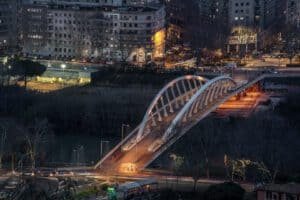
The right photo, if you're going to see Battista at the Olimpico, is taken outside the theater, on the Ponte della Musica, right in front of Piazza Gentile da Fabriano. The theater itself mentions it as part of the cultural hub Flaminio has become in recent years, together with the Auditorium and MAXXI.
The bridge crosses the Tiber in front of the theater and connects Flaminio to the Foro Italico bank. On a November evening, with the lights on and the river dark below, it offers a double shot: on one side the theater's rationalist facade, with its travertine base, on the other the opposite bank, toward the Foro Italico. It's the photo that tells where you've been better than any selfie in front of the poster.
The second photo, easier, is of the lit theater facade, with the sign and people waiting on the sidewalk. The best moment is about 20 minutes before the start, when the square fills up and groups look for each other. Shoot from the opposite side of the square, to get the whole building and some movement in front.
Inside, during the show, no photos and no video: it's a rule of good manners even before it's the theater's. A comedian works on timing and surprise, and the glow of a phone in the stalls ruins both. If you want a memento of the hall, photograph the foyer and the historic sets before going in, when the lights are still on and the doors to the stalls aren't open yet.
Some important events that happened here in history
On March 4, 1965, Pierre Boulez conducted at Teatro Olimpico a concert with the Italian premiere of Igor Stravinsky's Abraham and Isaac and the European premiere of his Elegy for J.F.K. It's perhaps the most important date in the hall's musical history, and it says how much weight Accademia Filarmonica Romana had in the city's cultural life in those years.
In the following years the Olimpico hosted productions in which art and music met. Stravinsky's Histoire du soldat, from October 11 to 14, 1966, with Giacomo Manzù's backdrop. Niccolò Castiglioni's Tre misteri, from October 2 to 4, 1968, with Mirko's sculpture. Stravinsky's Mass, from October 29 to 31, 1975, with Corrado Cagli's golden forms.
1980 is the year of the corporate turning point: Teatro Olimpico spa is born and buys the building. From 1981 the hall changes name and calling, and dance enters the program permanently: Moses Pendleton's Momix made their Olimpico debut in April 1982 with Dance Theatre and would become regular guests. The Lindsay Kemp Company brought A Midsummer Night's Dream in February 1989 and Dream and the big parade in February 1993.
In the 1990s the big names arrived. Mikhail Baryshnikov with the White Oak Dance Project, from October 10 to 15, 1995. The Bolshoi Ballet, from September 23 to 26, 1996. In 2004 the Béjart Ballet Lausanne. In the 2009/2010 season, finally, the Agis rankings placed the Olimpico second in Rome and seventh in Italy for audience: the recognition, in numbers, of a bet made 30 years earlier by a group of citizens.
Who has passed through Maurizio Battista at Teatro Olimpico, Se non vinco... imparo, November 4 to 29, 2026
Teatro Olimpico's stage has seen musicians like Arturo Benedetti Michelangeli, Jessye Norman, Zubin Mehta and Giuseppe Sinopoli, and comedians like Gigi Proietti, Enrico Brignano and Vincenzo Salemme. It's hard to find a hall in Rome with such a varied list of guests.
For classical music, linked to Accademia Filarmonica Romana, the theater's memory holds the names of Benedetti Michelangeli, Jessye Norman, Zubin Mehta, Giuseppe Sinopoli, Luigi Dallapiccola and Pierre Boulez. For pop and singer-songwriter music, Marillion in February 1988, Pooh with Musica dentro from October 25 to 30, 1994, Lucio Dalla with Henna from April 5 to 7, 1994, Nomadi, Giorgio Gaber with Un'idiozia conquistata a fatica on January 28, 1998.
Dance brought Baryshnikov, Joaquín Cortés, Lindsay Kemp, Maurice Béjart, the Bolshoi, Antonio Gades and Momix here. Among the leading figures of its history the theater also remembers Dario Fo and Nicola Piovani. Comedy, which is the reason you're reading these lines, brought Gigi Proietti with A me gli occhi in May 1996, and then Enrico Brignano, Vincenzo Salemme, Aldo, Giovanni e Giacomo, Neri Marcorè, Ale e Franz, Gioele Dix, Cinzia Leone, Lillo e Greg, Max Giusti, Massimo Ranieri. The theater also mentions Marco Travaglio among the leading figures of its history.
And Maurizio Battista, who appears in all these lists. His name is next to Proietti's, and it's no chance pairing: they're two different ways of being Roman comedians, the cultured showman and the neighborhood cabaret artist, but both found at the Olimpico a stage suited to them. In November Battista adds another line to a story he has already helped write.
Flaminio around Teatro Olimpico
Teatro Olimpico is in the Flaminio neighborhood, north of Piazza del Popolo, in an area that over the last 20 years has become one of Rome's cultural hubs. The theater itself stresses it, citing Auditorium Parco della Musica, MAXXI and the Ponte della Musica as the new places that have changed the face of the neighborhood.
The Ponte della Musica and the Foro Italico
In front of the theater the Ponte della Musica leads to the other bank of the Tiber, where the Foro Italico opens up, built in the same years as the theater. If you arrive an hour early you can cross the river and take a walk among the 1930s sports architecture, which shares era and language with the Olimpico building.
Auditorium and MAXXI
A short distance away, toward the inside of the neighborhood, are Auditorium Parco della Musica and MAXXI. In November the Auditorium has a packed program. Combining an exhibition in the afternoon and Battista in the evening is a sensible idea if you're coming from out of town.
Milvian Bridge
Going up the Tiber to the north you reach Milvian Bridge, with its square full of bars and restaurants. It's the natural destination if you want to stay out late after the show, especially on Friday and Saturday.
Toward the center: Villa Giulia and Piazza del Popolo
In the opposite direction, along Via Flaminia, you come to the National Etruscan Museum of Villa Giulia, on the edge of Villa Borghese, and then Piazza del Popolo, next to Piazzale Flaminio, where tram 2 starts. If you want to reach the theater with a long walk you can start from there, with the evening lights on the Tiber.
Where to eat before or after the show
Around Teatro Olimpico, between Piazza Mancini, Via Flaminia and Piazza Gentile da Fabriano, there are pizzerias, trattorias and bars frequented by the audiences of the theater and the Auditorium. You don't need to book far away: the area has a wide neighborhood offer without touristy pretensions.
Before the show
For the 20:30 performances a quick dinner at 19:00 is the most practical solution: a pizza, a plate of pasta, a sandwich at the bar. For the 21:00 performances you have a bit more margin. Either way, avoid arriving in the hall at the last minute with the check still to pay.
After the show
Dinner after the theater is a good Roman habit. After the Friday and Saturday performances you come out around 23:00, and at Ponte Milvio, a few minutes away by car or taxi, places are open late. After the Sunday matinee, on the other hand, you come out at 19:30: the perfect time for an unhurried dinner in a trattoria.
With a large group
For a group it's best to book the table before buying tickets for the right time, or choose the Sunday afternoon and have dinner after at leisure. The neighborhood is residential, and on show nights the places closest to the theater all fill up in the same half hour.
How to plan the evening with Maurizio Battista
For Se non vinco... imparo at Teatro Olimpico it's best to arrive at least half an hour before the start, to collect any tickets, find your seat and take a look at the foyer. With 1,410 seats and a full house, entry in the last few minutes is always crowded.
The weeknight
Wednesday or Thursday, starting at 20:30. You leave work, metro A to Flaminio, tram 2, quick dinner at Piazza Mancini, show, and at 23:00 you're already on your way home. It's the simplest formula, and also the one with the most devoted audience.
The weekend
Friday or Saturday at 21:00. The afternoon at MAXXI or the Auditorium, a walk on the Ponte della Musica at sunset, the show, dinner at Ponte Milvio. If you're coming from outside Rome it's a full day in the same neighborhood, without needing to cross the city.
Sunday afternoon
At 17:30 the show becomes a family outing. It's the best time if you're going with elderly parents, if you have to get back out of town, if you work early on Monday morning. And it leaves the evening free for dinner.
What to bring
Not much: the ticket, on your phone or printed, ID if the ticket is in your name, a light coat to leave on the seat. In November in Rome the evenings get cool and often rainy, and the walk from Piazza Mancini is short but uncovered: a folding umbrella doesn't hurt.
Accessibility at Teatro Olimpico
If you have reduced mobility and want to see Maurizio Battista at Teatro Olimpico, contact the box office before buying, at biglietti@teatroolimpico.it or 349 2378200. It's the surest way to find out about suitable seats, how to access the hall and any special conditions for companions.
The stalls are arranged like a sloping amphitheater, and the gallery is on the upper floor: these are things to consider when choosing a section. The box office is open every day from 10:00 to 19:00, and a phone call resolves in a few minutes doubts that remain unanswered online.
Maurizio Battista with children and teenagers
Se non vinco... imparo is a comedy show designed for an adult audience, with two hours of monologue in Roman dialect and references to adults' everyday life. Older kids, who know Battista from television, can enjoy it. For small children the length and the kind of comedy make the evening tiring.
If you want to bring the family, the Sunday performance at 17:30 is the best suited in terms of time. For an outing with children, the Teatro Olimpico season also includes family shows, and before Christmas Balletto di Roma's The Nutcracker. For minimum ages and discounts, the reference remains the theater's box office.
November in Rome: the right season for theater
November is the month when the Roman theater season gets into full swing, and Maurizio Battista's run at Teatro Olimpico, from the 4th to the 29th, takes up almost all its weeks. It's a month of shorter evenings, first rains, a city returning indoors after the summer of open-air arenas.
If you're coming from out of town it's a good time to visit Rome: fewer crowds than in spring, museums open and full programs. A day between Flaminio and the center, with Battista in the evening, is a way of seeing the city you won't find in the guidebooks. The same month, in Rome, the season of big indoor concerts opens, and theater programs overlap: it's best to decide early.
The rest of the 2026/2027 season at Teatro Olimpico
Teatro Olimpico's 2026/2027 season, which began on September 24, counts more than 50 shows, with 16 subscription titles and more than 40 one-off events. Battista opens the season shows. Around him the program mixes comedy, dance, music and talks.
Before and after Battista
On October 3 and 4 Vinicio Capossela and Pierpaolo Capovilla presented E Morte non avrà dominio, as part of the Romaeuropa Festival. On November 2 Fabio De Luigi returns to the stage with BIOL, In carne e ossa tour, just before Battista arrives. In December Umberto Galimberti on the 2nd, Fratello Sole, Sorella Luna from the 4th to the 6th, Alessandro Cattelan on the 7th with Benvenuto nell'AI, No Gravity Theatre with Avantgarde from the 9th to the 13th, La sera dei miracoli, a tribute to Lucio Dalla, on the 15th, Balletto di Roma's The Nutcracker from the 17th to the 20th, Maccio Capatonda on the 21st and 22nd.
2027
In the new year come Angelo Pintus, Riccardo Rossi with the world premiere of Non ho l'età!, Compagnia Finzi Pasca with Titizé, Slava's Snowshow, Momix with Botanica, Pink Floyd Legend with Guy Pratt, Federico Buffa with his story of Michael Jordan, Lillo e Greg with MOVIe ERCULeO from May 7 to 15 and Angelo Duro on May 24. If you get a taste for the hall, there's plenty to come back for.
Frequently asked questions about Maurizio Battista at Teatro Olimpico
When is Maurizio Battista at Teatro Olimpico?
Maurizio Battista is at Teatro Olimpico in Rome from November 4 to 29, 2026, with Se non vinco... imparo. Shows are Wednesday to Sunday: Wednesday and Thursday at 20:30, Friday and Saturday at 21:00, Sunday at 17:30. On December 31 there's also a New Year's Eve Special at 21:45, with separate tickets.
How much are Maurizio Battista tickets in Rome?
Tickets for Se non vinco... imparo at Teatro Olimpico range from 25.50 euros in the side balcony with balustrade to 43.50 euros in the poltronissima gold, plus a presale fee from 3:50 to 6.50 euros. Poltrona and central balcony cost 35 euros plus a 5.30-euro presale fee. Online there's an additional 2.50-euro fee.
Where do you buy tickets for Se non vinco... imparo?
Tickets for Maurizio Battista at Teatro Olimpico are bought from the online box office on the theater's official website or at the box office at Piazza Gentile da Fabriano 17, open every day from 10:00 to 19:00. For information the theater answers at biglietti@teatroolimpico.it and 349 2378200.
How long is Maurizio Battista's show?
Se non vinco... imparo lasts about two hours, according to Teatro Olimpico's presentation. It's a one-man show: Battista is alone on stage and talks with the audience. With a 20:30 start you come out around 22:30, with a 21:00 start around 23:00, on Sunday around 19:30.
How do you get to Teatro Olimpico by public transportation?
Teatro Olimpico can be reached on metro A to Flaminio and then tram 2 to Piazza Mancini terminus, from where you walk about 500 meters along Viale del Pinturicchio. From Termini there's also bus 910 to the Pannini stop, about 300 meters from the theater.
Is there a Maurizio Battista show on New Year's Eve?
Yes, Teatro Olimpico has scheduled the New Year's Eve Special 2026/2027 with Maurizio Battista on December 31 at 21:45. Tickets cost from 110.50 to 172.50 euros depending on the section. The theater says the program for the evening is still being finalized.
How many seats does Teatro Olimpico in Rome have?
Teatro Olimpico in Rome has 1,410 seats: 966 in the stalls, arranged like a sloping amphitheater, and 444 in the horseshoe gallery. Born as a movie theater in 1936, it became Teatro Olimpico in 1981 and is owned by a joint-stock company founded in 1980.
Is Battista's show suitable for children?
Maurizio Battista's Se non vinco... imparo is designed for an adult audience: two hours of comic monologue in Roman dialect about everyday life. Older kids may appreciate it, small children less so. For minimum ages and discounts it's best to ask at the Teatro Olimpico box office.
One last word. Battista should be seen in a full hall, and the Olimpico in November will be one: buy early, choose a weeknight, take the central stalls and arrive by public transportation. He does the rest, with the complicity of an audience that laughs at itself even before it laughs at the comedian.
Article written by the editorial team of Tour Leader Pro, contact them for Private/Corporate/V.I.P. Tours and Experiences.
Planning a trip to Rome? English guides for visiting the city are on ItalyPlanner.com.
Contact Information
Nearby
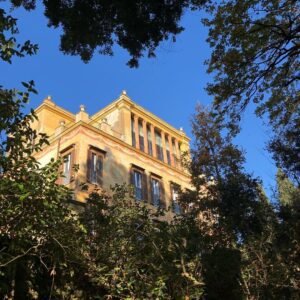
 Teatro Olimpico100 m
- Ponte della Musica – Armando Trovajoli200 m
- Flaminio400 m
- MAXXI – National Museum of 21st Century Arts500 m
- Alberto Moravia House Museum700 m
- Villa Mazzanti700 m

Upcoming events nearby
- Angelo Pintus at Teatro Olimpico, Loro non sanno niente, January 14 to February 14, 2027100 m
- Slava’s SnowShow at Teatro Olimpico, January 27 to February 7, 2027100 m
- MOMIX Botanica at Teatro Olimpico, February 23 to March 7, 2027100 m
- Giorgia Fumo, Out Of Office at Teatro Olimpico, November 16 and 17, 2026100 m
You might also like
- Le Coliche in 10 anni di Coliche e siamo ancora vivi at Teatro Olimpico, March 25 and 31, 2027
- Marta e Gianluca in Io e Gianlu at Teatro Olimpico, March 23 and 24, 2027
- PanPers, Terapia di coppia at Teatro Olimpico, March 16 and 17, 2027
- Coppia aperta quasi spalancata with Chiara Francini at Teatro Olimpico, March 12 to 14, 2027
- Io Marte Tu Mercole with Scintilla and Federica Camba at Teatro Olimpico, March 10, 2027
- Alessandro Bergonzoni Arrivano i Dunque at Teatro Olimpico, February 20 and 21, 2027