Slava’s SnowShow at Teatro Olimpico, January 27 to February 7, 2027
In short. Slava's SnowShow, the clown show created by Russian artist Slava Polunin, returns to Teatro Olimpico in Rome, Piazza Gentile da Fabriano 17, Flaminio district, from Wednesday, January 27 to Sunday, February 7, 2027, for 15 performances:…
Slava's SnowShow, the clown show created by Russian artist Slava Polunin, returns to Teatro Olimpico in Rome, Piazza Gentile da Fabriano 17, Flaminio district, from Wednesday, January 27 to Sunday, February 7, 2027, for 15 performances: January 27, 28 and 29 and February 2, 3, 4 and 5 at 20:30. Saturday, January 30 and Saturday, February 6 at 16:30 and 20:30. Sunday, January 31 and Sunday, February 7 at 15:00 and 18:30. Monday, February 1 is a rest day. The theater is reached by Metro Line A to Flaminio and then tram 2 along Via Flaminia toward Piazza Mancini. From the line it is a few minutes' walk toward the Tiber, near Ponte della Musica. The price list published by the theater runs from 31 euros plus 4.70 presale (side balcony with railing) to 51.50 euros plus 7.50 presale (Poltronissima Gold). For children under 12 there is a reduced rate in all sections except Poltronissima Gold, and online purchase adds a 2 euro fee per ticket. The show is not recommended for children under 8. Tickets are bought on the official Teatro Olimpico website, at the box office in Piazza Gentile da Fabriano, open every day from 10:00 to 19:00, and on the presale network authorized by the organizer.
Language: performed in Italian. No English version or English surtitles are announced.
15 performances in 12 days, in the dead of winter: Polunin's snow arrives in Rome when real snow is almost never seen in the city. There are few shows able to bring together the grandfather, the 10-year-old grandson and the parent tired from a Friday evening. This is one of them, and I say it plainly: if there is one title of the Roman season worth booking well in advance, it is this one.
What Slava's SnowShow is
Slava's SnowShow is a show without words, made of clowning, pantomime, music and stage effects, created by Slava Polunin and first staged in Moscow in October 1993. The Roman theater presents it as a genre of its own, able to bring adults back to childhood. The definition is promotional, but it is also accurate.
A show without language
Nobody speaks on stage. The story proceeds through gestures, glances, silences, sounds and images, and for this reason audiences from any country understand it the same way. Polunin has explained many times that the international success of his work depends on exactly this: the clown who gives up language is understood everywhere. For a Roman theater that in the same weeks welcomes tourists, families and school groups, it is a concrete advantage: nobody is left out of the story.
The characters
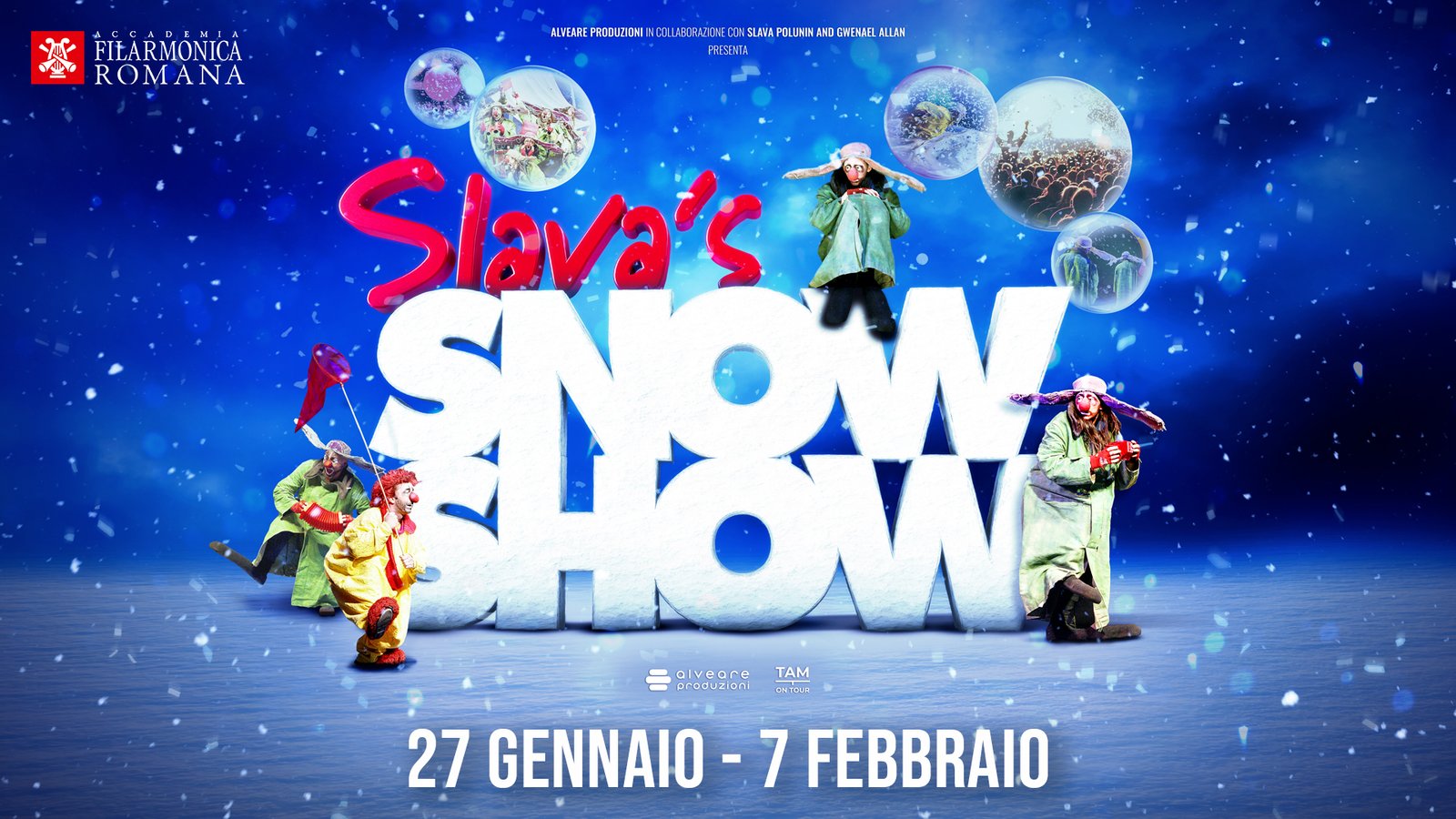
At the center is a clown in yellow, Asissai, the character Polunin built in the early 1980s, surrounded by a company of clowns dressed in green. The official descriptions speak of a troupe of mad, poetic, mischievous and unpredictable characters. The yellow clown is melancholy and tender. The green ones are energy, disorder, play.
The effects
The show is built as a sequence of stage effects. The theater lists a storm of paper confetti that invades the whole hall and enormous light, colorful balloons that glide over the audience's heads. The stage photos released by the production also show a huge spiderweb stretching over the orchestra seats, the blue fog, the yellow clown's telephone. And above all there is the snow, which in the finale literally overwhelms the orchestra. It sits, writes the theater, between a happening and immersive theater.
The tone
Free, lyrical, ironic, imaginative, tender, at times tinged with melancholy: these are the adjectives the production uses, and anyone who has seen it recognizes them all. The laughter is there, but it is not TV sketch laughter. It is the kind that comes from wonder, and that sometimes mixes with a lump in the throat. Polunin has never hidden that his comedy comes from the sad clown.
The dates and times of Slava's SnowShow at Teatro Olimpico
Slava's SnowShow is on at Teatro Olimpico from January 27 to February 7, 2027, with 15 performances spread over 11 show days. The calendar alternates weekday evenings and double performances on the two weekends.
The first week
Wednesday 27, Thursday 28 and Friday January 29 at 20:30. Saturday, January 30 a double performance, at 16:30 and 20:30. Sunday, January 31 a double performance, at 15:00 and 18:30. That is seven shows in five days.
The second week
On Monday, February 1 the company rests. Tuesday 2, Wednesday 3, Thursday 4 and Friday February 5 at 20:30. Saturday, February 6 at 16:30 and 20:30. Sunday, February 7, the last day, at 15:00 and 18:30. Eight shows in all.
How long it lasts
For the Roman tour of March 2025 Teatro Olimpico gave a running time of 80 minutes plus intermission. For the 2027 season the running time is not yet published, either by the theater or by the distributor. It is best to count about an hour and three quarters between entry, first half, intermission and finale, which the audience tends to linger over happily.
Which performance to choose
For families with children I recommend without hesitation the Sunday 15:00 or Saturday 16:30 performances: you leave in the late-afternoon light or at dinnertime, with no late-night return. For an adult audience, the weekday evening has a precise advantage: the hall is less full of small children and the balloon finale becomes a game among adults, which is perhaps the most moving version of the show.
Tickets and prices for Slava's SnowShow
Tickets for Slava's SnowShow at Teatro Olimpico cost from 31 to 51.50 euros full price, plus the presale fee, from 4.70 to 7.50 euros, according to the price list published by the theater. The theater specifies that the presale fee is always required when the ticket is issued.
The full price list
Poltronissima Gold: 51.50 euros plus 7.50 presale, 59 euros in all. Side Poltronissima: 43 euros plus 6.50, 49.50 in all. Poltrona: 37 euros plus 5.60. Balcony: 35 euros plus 5.30. Balcony with railing: 34 euros plus 5.10. Side balcony: 32 euros plus 4.80. Side balcony with railing: 31 euros plus 4.70, that is 35.70 euros in all. For online purchase a 2 euro fee per ticket is added.
The under-12 rate
For children under 12 the theater publishes a reduced rate in six of seven sections. Side Poltronissima: 25.80 euros plus 3.90 presale. Poltrona: 22.20 plus 3.40. Balcony: 21 plus 3.20. Balcony with railing: 20.40 plus 3.10. Side balcony: 19.20 plus 2.90. Side balcony with railing: 18.60 plus 2.80. Poltronissima Gold has no reduced rate. Given that the show is not recommended under 8, the discount in practice concerns children between 8 and 11.
Where to buy
The direct channel is the Teatro Olimpico website, with the online sales system linked to the show page. The box office at Piazza Gentile da Fabriano 17 is open every day from 10:00 to 19:00, nonstop, and answers at biglietti@teatroolimpico.it and 349 2378200. Tickets are also on sale on the presale network authorized by the organizer: for those bought there, the theater says to contact the network itself.
Groups, schools and Cral
Teatro Olimpico has a promotion office for groups and Cral, reachable at ufficiopromozione@teatroolimpico.it. For a company outing with families, a catechism group or an association, it is best to write there before buying: the conditions for groups are not published on the show page and must be asked for directly.
Which section to choose
In this show the usual rule is turned upside down. Usually you pay to be close to the stage. Here a decisive part of the action takes place in the hall, above and around the audience. The orchestra seats are inside the storm, get the snow and play with the balloons. The balcony watches the scene from above and sees the whole hall transform. For children I recommend the orchestra, even in the cheaper sections: being inside the snow is half the experience.
Who Slava Polunin is: his biography
Vyacheslav Ivanovich Polunin, Slava to everyone, is a Russian clown and artist born on June 12, 1950 in Novosil, a small town in the Oryol region. The Roman theater presents him as "the most famous clown in the world," and his career, more than half a century long, explains why the phrase is not just advertising.
Childhood and studies
The son of a shop assistant, at school he stood out in school theater by imitating Charlie Chaplin. He left Novosil for Leningrad, the city he had imagined through geography lessons. He tried to get into the theater institute but was rejected because of pronunciation problems. He enrolled in an engineering and economics institute, dropped out despite his mother's hopes of having an engineer son, and finally graduated from the Leningrad Institute of Culture, where he would later teach.
Pantomime
In 1967 he entered the mime studio of the Lensovet Palace of Culture, led by Edward Rozinsky. His first success came as the lead performer of pantomime pieces in a show created by his teacher. His eccentric pantomime, which he himself ironically called "expressive idiocy," soon brought him popularity.
The birth of Asissai
In 1980 Asissai was born, his clown: yellow work overalls, soft red slippers, a thoughtful, gentle air. The character debuted before millions of television viewers on the New Year's Eve episode of 1980-1981 of the Soviet TV program Goluboy Ogonyok, in a sketch with two enormous inflatable telephones. That sketch is still in the SnowShow today.
The Licedei
Around Asissai Polunin built a theater of clowns, the Licedei, a word that in old Russian means street actors. Each facet of his character became a clown of its own. The group created hugely successful shows across the Soviet Union and became the workshop from which many of the clowns still touring the world today would emerge.
The great undertakings
In 1982 he organized in Leningrad a parade of mimes with more than 800 artists from across the country, in years of tight control over every artistic event. In 1985, during the World Festival of Youth in Moscow, he brought foreign mimes and clowns to the city. In 1987 he organized a street theater festival: more than 200 participants lived on an uninhabited island in the Gulf of Finland and reached Leningrad by boat.
The Licedei's funeral
In 1988, for the group's 20th anniversary, the Licedei celebrated their own funeral. Convinced, with Stanislavsky, that a theater dies after 20 years of life, they staged funeral speeches, a procession of coffins through the streets of Leningrad and finally burning coffins left to drift down the Neva. It was the real end of that theater, and the beginning of another season.
The Caravan of Peace and the Academy of Fools
In 1989 he led the Caravan of Peace, a traveling festival that for six months took street artists from Moscow to Paris, living in campers and performing in squares and under tents, three months before the fall of the Berlin Wall. He then founded the Academy of Fools, devoted to the rebirth of carnival culture. In the summer of 2001 he presented his "New Carnival" at the World Theater Olympics, in the Hermitage gardens in Moscow.
The Moulin Jaune and the circus
Alongside the tours, Polunin founded the Moulin Jaune, a creative workshop near Paris, and chairs the International Academy of Fools. From 2013 to 2016 he directed the Great State Circus of Saint Petersburg, the oldest circus in Russia. He also created "Diabolo," described as a comic meditation on life, death and the beauty of the universe.
Film
His filmography includes, among others, "Clown" (2002), of which he is also producer, "Snow Show 3D" (2012) and the voice of a character in "Hoffmaniada" (2018), a Russian animated feature. They are minor stops compared with theater, but they tell of an artist who has always tried to take his world off the stage.
Slava Polunin's teachers: from Engibarov to Totò
Slava Polunin names four teachers: Leonid Engibarov, Marcel Marceau, Charlie Chaplin and Totò. The Italian production expressly cites Prince De Curtis, and anyone who watches the green clowns closely finds something of his loose-jointed marionette.
Leonid Engibarov, the sad clown
Engibarov is the Soviet clown of poetry and melancholy: from him Polunin takes the clown's right to be sad, and the idea that laughter can be born from solitude. Asissai is the child of that poetic sadness.
Marcel Marceau and Chaplin
From Marceau comes the refined philosophy of pantomime, the body that tells without objects. From Chaplin, the humanity and comic bitterness, and the first exercise of the young Slava, who imitated him at school. The result is a theater where the gesture weighs as much as a joke.
Totò
The reference to Totò is not a courtesy to the Italian audience: Polunin's theater shares with the great Neapolitan the mask, the body as a comic instrument, the everyday absurd.
The history of Slava's SnowShow around the world
Slava's SnowShow debuted in Moscow in October 1993 and since then has been performed in more than 80 countries. The Times of London, according to the biography released by the production, called it a classic of 20th-century theater.
The 1990s: Edinburgh and London
In August 1996 the show arrived at the Edinburgh Fringe, where it won the Festival Critics Award. In 1997 it landed at the Old Vic in London and in 1998 received the Laurence Olivier Award. It was the consecration in British theater, which has welcomed it back several times since, at the Royal Festival Hall in the holidays of 2012 and 2017.
New York
On September 8, 2004 it debuted Off-Broadway at the Union Square Theatre, where it stayed until January 7, 2007: more than two years of performances. In 2005 it won the Drama Desk Award as a unique theatrical experience. From December 7, 2008 to January 4, 2009 it played on Broadway, at the Helen Hayes Theatre, and received a Tony nomination as a special theatrical event. It returned to Broadway from November 11, 2019 to January 5, 2020, at the Stephen Sondheim Theatre.
The medal table
Among the honors listed by the production: the Time Out Award in London (1994), the Golden Nose at the Barcelona international clown festival (1995), the Herald Angel Award in Glasgow and the Festival Critics Award in Edinburgh (1996), the Olivier (1998), the Stanislavsky prize in Moscow (2001), the Drama Desk (2005), the appointment as Chevalier dans l'ordre des Arts et des Lettres in France (2008) and the Tony nomination (2009).
Italy
The official biography recalls that the show likes to return to countries that already know it and welcome it like a party, and expressly cites Italy alongside Russia, the United Kingdom, France, Mexico and Korea. In Italy it is distributed by TAM ON TOUR in collaboration with the Gaap agency. The Milan stop at the Piccolo Teatro Strehler was staged again on the occasion of Milano Cortina 2026.
The 2027 Italian tour
After Rome, according to the distributor's calendar, the show continues to the Politeama Genovese from February 23 to 28, 2027, to Teatro Duse in Bologna from March 2 to 7 and to the Politeama Rossetti in Trieste from March 9 to 14. Rome therefore opens the Italian winter tour, and is the longest stop.
The company and the soundtrack of Slava's SnowShow
Slava's SnowShow is created by Slava Polunin, who signs the direction with Viktor Kramer, the sets with Viktor Plotnikov, the sound with Roman Dubinnikov, and alone the costumes and special effects. It is an almost total signature: few productions in the world bear so entirely the mark of a single artist.
Who is on stage
The theater's page does not list the performers of the Roman performances. It lists Polunin as creator, director, set designer and author of costumes and effects, not as an actor. If you are going to see him physically on stage, you would do well to ask the box office before buying, so as not to be disappointed.
The music
The soundtrack is a collage of recorded music that the audience recognizes at the first chord. Among the pieces documented in SnowShow productions are works by Vangelis, "Chariots of Fire" included, the "Peter Gunn" theme by Henry Mancini, Ravel's "Bolero," Bach's Toccata and Fugue in D minor, "O Fortuna" from Orff's Carmina Burana, Rodrigo's Concierto de Aranjuez, Beethoven's "Moonlight" sonata, pieces by Yello and Stéphane Grappelli, and "Krasivaya" by Roman Dubinnikov himself.
Sound as direction
In the SnowShow the music does the work that in another show would be done by words. The final crescendo, when the snowstorm hits the orchestra seats, is built on sound even before the stage machinery: those sitting in the orchestra feel it coming down on them.
Slava's SnowShow with kids: age and advice
Teatro Olimpico clearly states that Slava's SnowShow is not suitable for children under 8. It is an indication to take seriously, and one that many parents, used to thinking of clowns as a show for the very young, underestimate.
Why not under 8
The show alternates tender scenes with moments of darkness, loud noise, wind and fog. The final storm is powerful, with a jet of paper snow that hits the whole hall. For a small child it can be more frightening than wonderful. Besides, the first part lives on silences and slow rhythms, which require a certain ability to pay attention.
From 8 and up
From 8 on it is, in our view, one of the best possible first theater shows: no words, so no barriers, full of images, with a finale in which the children become protagonists and play with the giant balloons together with the adults. The reduced rate for under-12s goes exactly in this direction.
How to prepare them
Two things help. Tell the children there will be darkness and that at some point a storm will arrive in the hall, but that it is paper snow. And dress them comfortably: those in the orchestra seats go home with white confetti in their hair, in their collar, in their pockets. A bag for the coat doesn't hurt.
For adults without children
It would be a mistake to consider it a show for childhood. The production says it catapults adults back into childhood, and the adult audience is often the one that reacts with the most emotion.
A curiosity about Slava's SnowShow at Teatro Olimpico, January 27 to February 7, 2027
The sketch of the two giant telephones, one of the best-loved moments of Slava's SnowShow, is more than 45 years old: Asissai first presented it on television on New Year's Eve between 1980 and 1981, before millions of Soviet viewers. The show you will see at the Olimpico in 2027 therefore keeps a number born before most of the audience in the hall came into the world.
The biography released by the production tells that in that sketch the audience heard for the first time Polunin's speech on love, on loneliness, on the wish to be understood, on the happiness of discovery and the bitterness of loss. All this without a single word: two enormous inflatable telephones, two clowns, an impossible conversation. It is a scene that works today exactly as it did then, and in an age when we all talk on the phone without listening to each other it has gained an extra meaning.
The second curiosity concerns the name of the yellow clown. In the Italian materials it appears written in several ways, Asisyai or Asissai. Polunin himself calls him "my Asissai" in the text the Roman theater publishes on the show page. Whichever spelling you choose, the character has been the same for more than 40 years.
The third: Asissai has a battle cry, a "Zya!" full of pride, which the official biography recalls as the sign of his most ironic side. The character was not born merely tender: at the beginning he was also arrogant, capricious, swaggering. From each of these sides Polunin then drew a different clown, and it is from that multiplication that the company of green clowns seen on stage was born.
Teatro Olimpico: the home of Slava's SnowShow
Teatro Olimpico in Rome, at Piazza Gentile da Fabriano 17, has been active as a cinema-theater since 1936 and as a theater since 1981, and has a hall of about 1,400 seats. It is on Lungotevere Flaminio, in front of the Ponte della Musica, and is the home of most of the shows of the Accademia Filarmonica Romana, which co-produces Polunin's performances. For the full page on the venue I refer you to the page dedicated to Teatro Olimpico.
A 1930s building
The entire block was built between 1935 and 1936 by the firm Garbarino, Sciaccaluga and Mezzacane on behalf of the Società Generale Immobiliare. These are the years in which the Flaminio district and the Foro Italico took shape. The structure is reinforced concrete, with facades in the taste of the time and wide use of travertine in the base and in the frames of doors and windows.
Between variety and cinema
The theater describes its own architecture as conceived between the idea of the variety theater and that of the movie house. From the late 1930s to the 1950s it functioned mostly as a cinema, with variety acts during intermissions. For a clown like Polunin, who grew up between pantomime and television variety, it is an almost natural home.
The hall
The orchestra has 966 seats arranged amphitheater-style on a sloping cavea. The gallery, wide and horseshoe-shaped, has 444. The stage measures about 10 meters deep and 12 wide, with an orchestra pit. The hall is very wide: for a show that expands to invade the audience, it is a perfect size, because the storm reaches almost everyone.
The foyer
The foyer is a circular rotunda, with wide corridors on the ground floor and in the gallery. Stage elements from historic productions are kept there: Corrado Cagli's gilded sets for Stravinsky's Mass (1975), Giacomo Manzù's backdrop for the "Histoire du soldat" (1966), Alfred Silbermann's set for Stravinsky's Mass (2001), Mirko's sculpture for Niccolò Castiglioni's "Chordination" (1968).
Broadway on the Tiber
The theater reports a judgment attributed to Orson Welles, according to which the Olimpico would be the only place in Rome able to recall the atmosphere of Broadway theaters. The SnowShow has really been on Broadway, twice. Finding it again in this hall has a coherence of its own.
One thing nobody tells you about Slava's SnowShow at Teatro Olimpico, January 27 to February 7, 2027
In Slava's SnowShow the most expensive seat is not necessarily the best, and this changes the way you buy the ticket. The show has two halves. The first takes place on the stage, with the clown numbers, the telephones, the spiderweb, the lights. The second leaves the stage and invades the hall, with the snowstorm, the confetti and the giant balloons passed from hand to hand over people's heads.
Those in central Poltronissima see the first half better, but in the second they find themselves at the center of the storm, and at that point they look up more than ahead. Those in the front balcony see the first half a bit farther away, but in the finale they watch the most beautiful show of all: the whole hall transforming, the 966 people of the orchestra covered in snow, the balloons bouncing from one row to another. The price difference between Poltronissima Gold and the front balcony is almost 19 euros per person, presale included: for a family of four it comes to almost 75 euros.
The second thing nobody says concerns the exit. At the end of the show the audience does not leave. The production writes it almost like a slogan, "nobody wants to go home," but it is an exact description: the balloons keep circulating, children throw snow at each other, adults take photos. It is worth taking into account when organizing the evening. If you have a tram to catch or a dinner booked, leave a margin of at least 20 minutes beyond the stated running time.
Third point: the paper snow gets everywhere. In open bags, in hoods, in the folds of coats left on laps. If you bring a dark leather bag or a good coat to the orchestra, be aware of it. The coat check, if available, is a good idea.
How to get to Teatro Olimpico for Slava's SnowShow
Teatro Olimpico is reached by Metro Line A to the Flaminio stop and then tram 2 along Via Flaminia, toward Piazza Mancini. The theater is at Piazza Gentile da Fabriano 17, facing Lungotevere Flaminio, in the northern part of the block bounded by Viale del Vignola and Via Giorgio Vasari.
Metro and tram
Metro Line A stops at Flaminio, in Piazzale Flaminio, next to Porta del Popolo. From there tram 2 runs along Via Flaminia north to Piazza Mancini. From Via Flaminia to the theater it is a few minutes' walk toward the river. In the evening hours it is best to check the frequencies on the transit company's website before going out.
On foot from the Ponte della Musica
The Ponte della Musica, reserved for pedestrians, bicycles and public transport, connects Lungotevere Cadorna, on the bank of the Foro Italico, with Piazza Gentile da Fabriano. If you come from the Della Vittoria district or from Prati, you cross the Tiber on foot and find yourself in front of the theater. The bridge can also be reached from the area of the Lepanto stop on Metro Line A.
On foot from the center
From Piazza del Popolo you can walk up Via Flaminia or the Lungotevere. It is a long but flat walk. At the end of January, with short days and the wind off the river, I recommend it only for the afternoon performances and with a real coat.
By car
The theater is well connected through the Lungotevere with the whole city. Parking on the streets of the Flaminio is contested on show nights, though, and with 1,400 people leaving at the same moment traffic jams up. With the double performances on Saturday and Sunday the situation gets worse, because the audience of the second arrives while the first one is leaving.
By taxi
For the evening shows the taxi remains the most convenient solution, especially for the return. On exit it is best to move a few dozen meters away from the square, where traffic clears sooner.
The advice I give you for visiting Slava's SnowShow at Teatro Olimpico, January 27 to February 7, 2027
For Slava's SnowShow at Teatro Olimpico, it is best to choose the Sunday 15:00 performance, sit in the orchestra and build a day in the Flaminio around it. With a show that ends in a collective party, the afternoon time lets you stay in the hall playing without watching the clock, and leave when it is still light enough outside for a walk along the Tiber.
The sequence I recommend with children is this. Morning at the MAXXI, which is a few minutes' walk away, or a stroll in Villa Borghese. Early lunch in the neighborhood. Entry to the theater at 14:30. The show. Exit around 17:00 with the Ponte della Musica lighting up. For a group of adults, instead, the Wednesday or Thursday evening: a quieter hall, the finale played among grown-ups, dinner afterward.
Second piece of advice: buy early. In March 2025 the Roman performances were seven in five days. In 2027 the theater has scheduled 15 in 12 days, more than double. It is a sign that Roman demand, after a 10-year gap between one visit and the next, proved higher than expected. The weekend double performances are the ones that sell out first.
Third: arrive 15 minutes early and look at the foyer. The sets by Manzù and Cagli have been there for decades, and almost nobody notices them. For a child entering a real theater for the first time, explaining that those gilded panels were the scenery for Stravinsky is a way of starting the show before the lights go down.
Finally: keep your phone in your pocket during the first part. The finale, instead, go ahead and photograph discreetly: everyone does, and it is part of the ritual.
How to organize your day with Slava's SnowShow
With performances at 15:00, 16:30, 18:30 and 20:30, Slava's SnowShow allows four different ways of experiencing the Flaminio on a winter day. The choice depends on who you are and how much time you have.
Sunday at 15:00
This is the families' slot. Lunch, show, exit in the late afternoon with the light fading over the river. The rest of the evening is free, and the children go to bed at the right time. I recommend it to those coming from outside Rome who have to return the same day.
Saturday at 16:30
It is the most versatile: morning downtown or at a museum, show, and the evening free for dinner. You come out around 18:30, in the dark. The lit Ponte della Musica is the best way to finish.
Sunday at 18:30
For those who want a full day in the city and the show as the last stop. It ends around 20:30, a Sunday dinner time. It is a good choice for couples and groups of adults who want to avoid the crowd of families.
The 20:30 evening show
For those who live in Rome. You eat before, early and light, or after, with a place already chosen. You come out around 22:30. With school-age children, Friday is better than the weekdays.
Pairing a museum
The MAXXI is a few minutes' walk away. Farther south, toward Valle Giulia, are the Villa Giulia Etruscan Museum and the Galleria Nazionale. On the other side of Via Flaminia is the Auditorium Parco della Musica. Museum hours should be checked on their respective official websites.
Another well-known fact, yet rarely mentioned
Slava's SnowShow is tied to Rome through the Accademia Filarmonica Romana, one of the city's oldest music institutions, which hosts it in its own season and co-produces it with Teatro Olimpico. It is a fact written on the poster, "in collaboration with Accademia Filarmonica Romana," but it is rarely noticed: in Rome the world's most famous clown show enters the program of a music academy.
The thing has a precise logic. The SnowShow is, first of all, a show of music and sound: the soundtrack that runs from Bach to Vangelis, from Ravel to Mancini, holds up the entire dramaturgy. And the Filarmonica has had a relationship with Teatro Olimpico lasting 80 years. It rented it for its own season from the postwar period, and it was its president, Adriana Panni, who in 1980 promoted the citizens' subscription that saved the theater from sale and turned it into Teatro Olimpico spa.
The March 2025 Roman tour too was a guest of the Filarmonica's season, and the press of the time greeted it as Polunin's return to the capital after 10 years. The Filarmonica presented it in its own program with a bilingual formula, Italian and English, and with the same warning as today: not recommended for children under 8.
Put together, these facts explain why the 2027 performances have doubled. The Filarmonica's audience, the families' audience and Teatro Olimpico's audience add up. And the late-January schedule, far from the holidays, finds the city with less competition from family shows.
The right photo to take at Slava's SnowShow at Teatro Olimpico, January 27 to February 7, 2027
The right photo of Slava's SnowShow is taken in the finale, from the balcony, when the giant colorful balloons float over the orchestra seats white with snow. It is the only moment when photographing is part of the ritual, and the shot from above captures the whole transformed hall, much more than any close-up.
During the first part, instead, the phone should stay in your pocket. The show lives on darkness, precise lights, silences: a lit screen in the orchestra ruins the scene for those seated behind, and a flash photo ruins the clowns' work. In the finale the house lights come up and the game involves everyone: there a discreet photo, without flash, disturbs no one.
Those in the orchestra have another chance: the children under the snow, with confetti in their hair and hands raised toward a balloon. It is the photo parents keep for years. The advice is to shoot it in burst mode, because the balloons move fast and the children even faster.
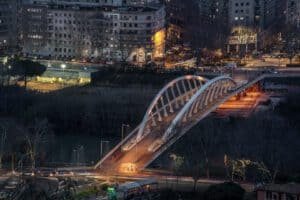
Outside, the photo to take is on the Ponte della Musica, 190 meters long, with its two large lowered steel arches tilted slightly outward. From the middle of the bridge, looking toward Piazza Gentile da Fabriano, you get the theater's facade framed by the arches. With the Sunday 15:00 performance, on the way out the late-January sunset light falls on the Tiber and on Monte Mario: for photography lovers it is the best hour. One last detail: check your companions' hair before the shot. Polunin's snow stays on for a long time.
The Flaminio district around Slava's SnowShow
The Flaminio is the first district of Rome, squeezed between Via Flaminia and the left bank of the Tiber, and in the 20th century it became a hub of culture, sport and entertainment. The theater itself cites the Auditorium, the MAXXI and the Ponte della Musica as the new places that made it a reference point for art.
The MAXXI
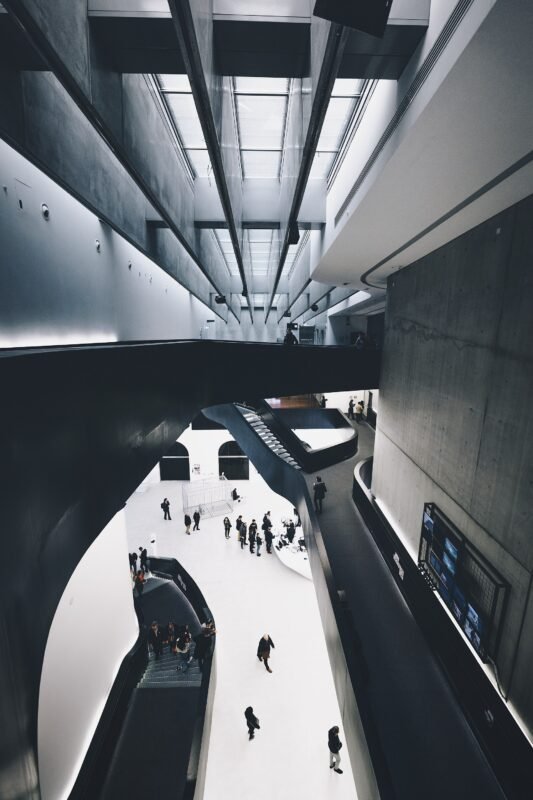
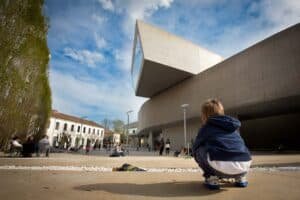
The MAXXI, the national museum of 21st century arts, is on Via Guido Reni, a few minutes' walk from the theater. Opened in 2010 to a design by Zaha Hadid, it has wide, bright spaces that children like as much as adults: it is the natural complement to a day with Polunin.
The Auditorium Parco della Musica
On the other side of Via Flaminia is Renzo Piano's Auditorium Parco della Musica. Even without a concert on the program, a walk around the halls is a lesson in contemporary architecture.
The Ponte della Musica
Inaugurated on May 31, 2011 and named two years later after the composer Armando Trovajoli, the bridge connects the theater to the Foro Italico. The project came out of an international competition in 2000, won by the London firm Buro Happold with Kit Powell-Williams Architects. The work was already foreseen in the 1929 master plan.
The Foro Italico and the Stadio Olimpico
On the other bank, crossing the bridge, you reach the Foro Italico and a little farther the Stadio Olimpico. The 1930s sports complex is the same age as the theater: same urban planning season, same Rome growing toward the north.
Milvian Bridge
Going up Via Flaminia to the north you reach Milvian Bridge, the Roman bridge over the Tiber, today at the center of one of the liveliest evening areas in north Rome. It is the natural direction for those looking for a place after the evening show.
Some important events that took place here in history
On March 4, 1965 Pierre Boulez conducted at Teatro Olimpico a concert with the Italian premiere of Igor Stravinsky's "Abraham and Isaac" and the European premiere of his "Elegy for J.F.K." It is perhaps the most important evening of the long season in which the Accademia Filarmonica Romana, renting the theater since the postwar period, brought 20th-century music to the Flaminio.
Even before that, the hall had had another life. Built in 1935 and 1936, it was entrusted to Gestim and then leased to Esercizi Cinematografici Italiani. From the late 1930s to the 1950s, with the interruption of the war, it was mostly a cinema, with variety acts during the intermissions. Clowns, comedians and variety dancers trod that stage between one screening and the next: Polunin, in a certain sense, returns to the origins of the hall.
The Filarmonica years left visible traces in the foyer: Giacomo Manzù's backdrop for Stravinsky's "Histoire du soldat," staged October 11 to 14, 1966. Mirko's sculpture for "Chordination" from Niccolò Castiglioni's Tre misteri, October 2 to 4, 1968. Corrado Cagli's gilded sets for Stravinsky's Mass, October 29 to 31, 1975.
1980 is the year of the turning point. The company that owned the building and the film entity that ran the hall went bankrupt, and the Olimpico was put up for sale. Adriana Panni then promoted a subscription among citizens, professionals and music lovers: Teatro Olimpico spa was born, which bought the building from the Società Generale Immobiliare and still holds it today. From 1981 the programming widened to dance, prose and comedy.
Dates that remained in the city's memory followed: the Momix from April 1982, the Lindsay Kemp Company in February 1989, Mikhail Baryshnikov's White Oak Dance Project from October 10 to 15, 1995, the Bolshoi Ballet from September 23 to 26, 1996, the Béjart Ballet Lausanne in October 2004. In the 2009/2010 season the Olimpico ranked as the second theater in Rome and seventh in Italy by attendance according to the Agis rankings. In March 2025 Slava's SnowShow returned there after 10 years. In 2027 it returns with double the performances.
Late January in Rome: the time of Slava's SnowShow
The performances of Slava's SnowShow fall between the last week of January and the first of February 2027, low tourist season weeks in Rome, with short days and cold evenings. For those visiting the city it is a period with precise advantages.
The weather
January and February are the coldest months of the Roman year, with mornings that are often clear and evenings that call for layers. The Lungotevere of the Flaminio, exposed to the wind off the river, is felt. Real snow in Rome is a rare event. Polunin's, at least, is guaranteed.
Quieter museums
After the holidays and before spring, the big museums in the area and in the center are less crowded. If you pair the show with a visit you find emptier rooms and a more relaxed pace.
Toward Carnival
The performances arrive on the eve of the Carnival period, which in Rome has a long history tied to Via del Corso and Piazza del Popolo, described in our page on Roman Carnival. Polunin, who devoted years to the rebirth of carnival culture with his Academy of Fools, is the most fitting guest to open the season of masks.
Box office, accessibility and services at Teatro Olimpico
The Teatro Olimpico box office, at Piazza Gentile da Fabriano 17, is open every day from 10:00 to 19:00, nonstop. You can write to biglietti@teatroolimpico.it or call 349 2378200.
Information and changes
For questions about seats, sections, reduced rates and children's age, the reference is the box office. For tickets bought on the external presale network, the theater says to contact the network itself, following its instructions.
Accessibility
The hall has a sloping orchestra and a raised-floor gallery. For the needs of people with disabilities or reduced mobility, dedicated seats, companions and access, the advice is to contact the box office before buying. For those sensitive to loud noises or darkness, keep in mind that the show has moments of wind, fog and high-volume sound.
Subscriptions and season
Slava's SnowShow is part of Teatro Olimpico's 2026/2027 season, which publishes the full program and subscription options on its website. In the same winter the hall also hosts the comedy of Angelo Pintus, on stage in January and February.
Who has played Slava's SnowShow at Teatro Olimpico, January 27 to February 7, 2027
On the stage of Teatro Olimpico have come Pierre Boulez, Arturo Benedetti Michelangeli, Zubin Mehta, Jessye Norman, Dario Fo, Giorgio Gaber, Lucio Dalla, Mikhail Baryshnikov and Gigi Proietti, as well as Slava Polunin himself, who brought the SnowShow there in March 2025, a guest of the Filarmonica's season, 10 years after his last Roman visit. It is a list that few Italian halls of the same capacity can claim.
For classical music, the Accademia Filarmonica era brought performers such as Arturo Benedetti Michelangeli, Jessye Norman, Zubin Mehta, Giuseppe Sinopoli, and composers such as Luigi Dallapiccola. Pierre Boulez conducted the Stravinsky premieres recalled above there in 1965. Alongside them, pop and singer-songwriter music: the Marillion in February 1988, the Nomadi, the Pooh with "Musica dentro" in October 1994, Lucio Dalla with "Henna" in April 1994, Nicola Piovani, Massimo Ranieri.
International dance has seen Mikhail Baryshnikov, Joaquín Cortés, Lindsay Kemp, Maurice Béjart, Antonio Gades, the Bolshoi Ballet and Moses Pendleton's Momix, regular guests of the hall. Auteur theater has had Dario Fo and Giorgio Gaber, who brought "Un'idiozia conquistata a fatica" there on January 28, 1998, almost exactly 29 years before Polunin's Roman premiere in 2027.
Comedy is the largest family: Gigi Proietti with "A me gli occhi" in May 1996, Enrico Brignano, Vincenzo Salemme, Maurizio Battista, Aldo, Giovanni and Giacomo, Lillo and Greg, Ale and Franz, Neri Marcorè, Gioele Dix, Cinzia Leone, Max Giusti.
In this company Polunin occupies a particular place. He is the only one, among the names recalled, to belong to all the families at once: pantomime brings him close to the dance of Kemp and the Momix, the soundtrack to the music of the Filarmonica, the clown to the great comedy headliners.
Why see Slava's SnowShow in Rome in 2027
Slava's SnowShow is one of the few theater shows that, after more than 30 years of performances in more than 80 countries, keeps intact the ability to surprise those who see it for the first time and to move those who see it again. The reasons to go in Rome in 2027 are concrete.
The right hall
A 1,400-seat hall wider than it is deep, with a horseshoe-shaped gallery that embraces the orchestra, is the ideal size for a show that expands to the audience. In sports arenas the storm disperses, in small theaters you lack the spectacle of the whole hall. The Olimpico has the right balance.
The price
With a price list that starts at 35.70 euros presale included for an adult and at 21.40 euros for a child under 12, an afternoon at the theater for a family costs less than you might imagine, less than many family attractions in the city.
A theater for all generations
No words, no references to a current-affairs that ages, no language barriers: it is a show that a grandfather and a 10-year-old grandson experience together, with the same intensity. The Polunin text the theater publishes speaks of the privilege of looking every evening into the happy eyes of thousands of spectators. The show gives the same privilege back to the audience.
Frequently asked questions about Slava's SnowShow in Rome
When is Slava's SnowShow on at Teatro Olimpico?
Slava's SnowShow is on at Teatro Olimpico in Rome from January 27 to February 7, 2027, for 15 performances. On January 27, 28 and 29 and from February 2 to 5 it starts at 20:30. On January 30 and February 6 at 16:30 and 20:30. On January 31 and February 7 at 15:00 and 18:30. On Monday, February 1 there are no performances.
How much do Slava's SnowShow tickets cost in Rome?
Tickets for Slava's SnowShow at Teatro Olimpico cost from 31 euros plus 4.70 presale (side balcony with railing) to 51.50 euros plus 7.50 presale (Poltronissima Gold). The orchestra Poltrona costs 37 euros plus 5.60. For under-12s there are reduced rates from 18.60 to 25.80 euros plus presale. Online, 2 euros of fees are added.
What age is Slava's SnowShow suitable from?
Slava's SnowShow is not recommended for children under 8, according to what Teatro Olimpico writes on the show page. The show has moments of darkness, loud noises, wind and a paper snowstorm that hits the hall. From 8 on it is instead an ideal first theater show, and up to age 11 the under-12 rate applies.
How long is Slava's SnowShow?
For the 2025 Roman tour Teatro Olimpico gave Slava's SnowShow a running time of 80 minutes plus intermission. For 2027 the running time is not yet published and the format is the same. It is best to add the time of the finale, when the audience stays in the hall playing with the balloons and the snow.
Where is Teatro Olimpico and how do you get there?
Teatro Olimpico is at Piazza Gentile da Fabriano 17, in the Flaminio district, on the Lungotevere near the Ponte della Musica. You get there by Metro Line A to Flaminio and then tram 2 along Via Flaminia toward Piazza Mancini. From the line to the theater it is a few minutes' walk. From the Foro Italico you cross the Ponte della Musica on foot.
Where do you buy tickets for Slava's SnowShow?
Tickets for Slava's SnowShow are bought on the official Teatro Olimpico website, at the box office at Piazza Gentile da Fabriano 17, open every day from 10:00 to 19:00, and on the presale network authorized by the organizer. For groups, schools and Cral the theater has a dedicated promotion office, to contact before buying.
Who is Slava Polunin?
Slava Polunin is a Russian clown and artist born in Novosil on June 12, 1950, creator of Slava's SnowShow and of the yellow clown character Asissai, born in 1980. He founded the Licedei theater and the Academy of Fools, directed the Great State Circus of Saint Petersburg from 2013 to 2016 and won, among others, a Laurence Olivier Award and a Drama Desk Award.
Will Slava Polunin be on stage in Rome?
The Teatro Olimpico page for Slava's SnowShow lists Slava Polunin as creator, director with Viktor Kramer, set designer and author of costumes and effects, but does not publish the performers of the Roman performances. If you want to see Polunin in person on stage, it is wise to ask the theater's box office before buying.
Where to sit to see Slava's SnowShow best?
For Slava's SnowShow the orchestra offers the most engaging experience, because in the finale the snow and giant balloons sweep over the audience. The front balcony of Teatro Olimpico instead lets you see the whole hall transform. For children I recommend the orchestra, even in the cheaper sections. For those who want to watch the show as a whole, the balcony.
The verdict on Slava's SnowShow at Teatro Olimpico
The criterion is simple: shows that last 30 years do not last by chance. The SnowShow is one of those, and the Olimpico is the right hall to see it. The clear advice is this: Sunday, January 31 or Sunday, February 7 at 15:00, orchestra, children 8 and up or no children at all, a quarter of an hour early for the foyer and half an hour of margin after the curtain to stay and play. Buy now, from the theater: the weekend double performances are the first to disappear.
Article written by the editorial team of Tour Leader Pro, contact them for Private/Corporate/V.I.P. Tours and Experiences.
Planning a trip to Rome? The English guides to visiting the city are on ItalyPlanner.com.
Contact Information
Nearby
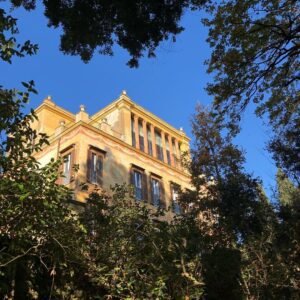
 Teatro Olimpico100 m
- Ponte della Musica – Armando Trovajoli200 m
- Flaminio400 m
- MAXXI – National Museum of 21st Century Arts500 m
- Alberto Moravia House Museum700 m
- Villa Mazzanti700 m

Upcoming events nearby
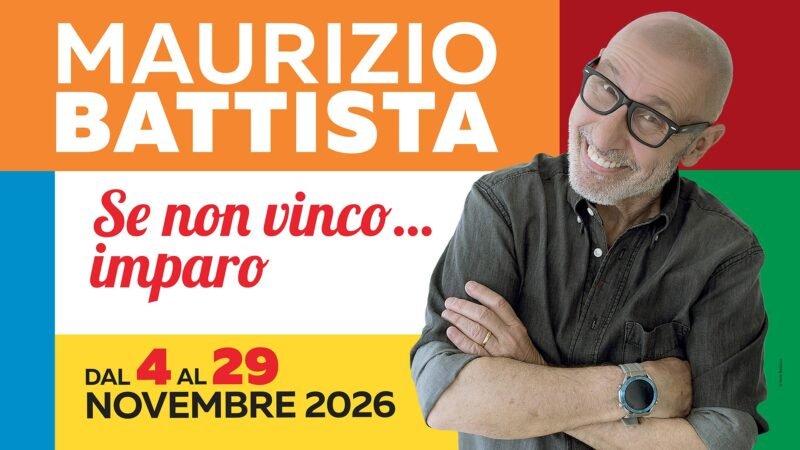
- Maurizio Battista at Teatro Olimpico, Se non vinco… imparo, November 4 to 29, 2026100 m
- Angelo Pintus at Teatro Olimpico, Loro non sanno niente, January 14 to February 14, 2027100 m
- MOMIX Botanica at Teatro Olimpico, February 23 to March 7, 2027100 m
- Giorgia Fumo, Out Of Office at Teatro Olimpico, November 16 and 17, 2026100 m



You might also like
- Titizé, A Venetian Dream at Teatro Olimpico in Rome, January 8 to 10, 2027
- Belle e la Bestia, the Musical at Teatro Olimpico, December 26, 27 and 28, 2026
- La rivolta della gioia with Silvia Gallerano at the Auditorium Parco della Musica, December 18 to 20, 2026
- The Nutcracker by Balletto di Roma at the Teatro Olimpico, December 17 to 20, 2026
- Ghemon in La prima volta, l’ultima volta, l’unica volta at Auditorium Parco della Musica, April 19, 2027
- Alessandro Bergonzoni Arrivano i Dunque at Teatro Olimpico, February 20 and 21, 2027