Six Nations 2027 Rome at Olimpico: Italy’s matches in Rome, February 13, March 6 and 13
In short. Six Nations 2027 Rome: Italy plays at home at Stadio Olimpico on Saturday, February 13 against Ireland, on Saturday, March 6 against France and on Saturday, March 13 against Wales, always at 15:10.
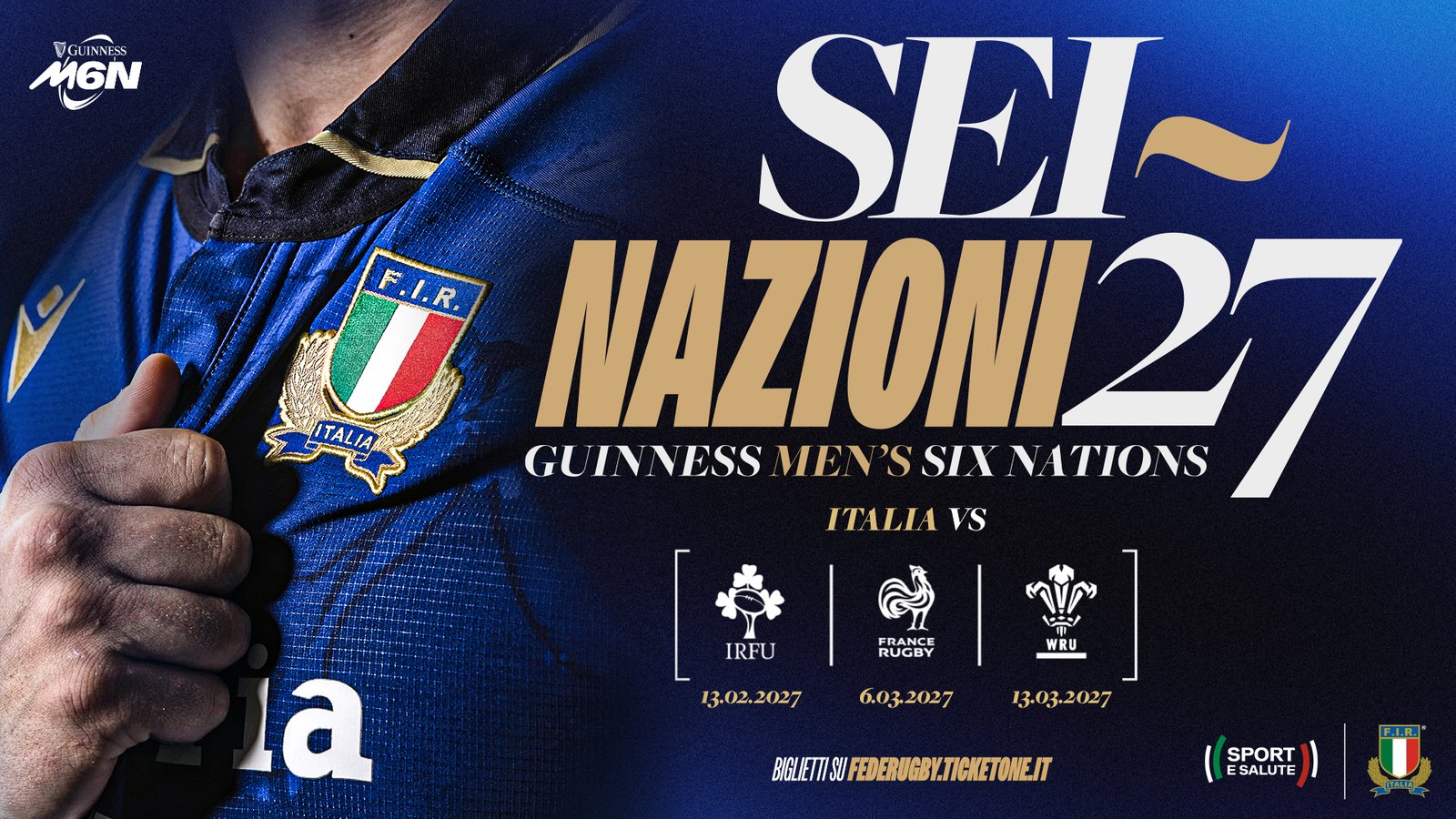
Six Nations 2027 Rome: Italy plays at home at Stadio Olimpico on Saturday, February 13 against Ireland, on Saturday, March 6 against France and on Saturday, March 13 against Wales, always at 15:10. The stadium is in the Foro Italico park, at Viale dei Gladiatori 2, 00135 Rome, on the right bank of the Tiber at the foot of Monte Mario. The easiest way to get there is Metro line A to Flaminio and then tram 2 to the terminus at Piazza Mancini, from which you walk across Ponte Duca d'Aosta. Alternatively, buses 32, 280, 910 and the lines that end at Piazzale Clodio. The prices published by the Italian Rugby Federation, presale fee included, start at 42 euros in the Curva and rise to 56 euros in the Distinti, from 77 to 147 euros in the Tevere and Monte Mario stands depending on the match, up to 170 euros for the Tribuna Tevere VIP. Tickets are bought exclusively on the presale network authorized by the FIR, reachable from the tournament page on the official website of the Italian Rugby Federation. The Federation warns that any other platform is not authorized.
The Six Nations is the oldest tournament in international rugby, and since Italy joined in 2000 it has become Rome's winter sporting event. Three Saturday afternoons, 70,000 seats, a festival village in the park and a city full of Irish, French and Welsh fans who come down to Rome for the match and stay for the weekend. On tournament weekends Foro Italico changes skin, and the rugby crowd is the most pleasant you can meet in an Italian stadium.
Six Nations 2027 in Rome: Italy's three matches at a glance
Italy's three home matches in the Guinness Six Nations 2027 are all at Stadio Olimpico and all on Saturday at 15:10: Ireland on February 13 (second round), France on March 6 (fourth round), Wales on March 13 (fifth and final round). Presale is open from April 9, 2026, as announced by the Italian Rugby Federation, and the schedule was presented with one opponent for each stage of the tournament: Ireland to open, the reigning champions France halfway through, Wales on the closing day.
Italy vs. Ireland, Saturday, February 13, 2027
It is Italy's first home match of the 2027 tournament and falls in the second round, a week after the away opener at Murrayfield. Ireland is the opponent that in recent years has represented the high point of European rugby: in 2024, the year of the Azzurri's best Six Nations up to that point, Italy's only heavy defeat was precisely the 36-0 against Ireland. At Olimpico, though, the Azzurri have a precise memory: the 22-15 of March 16, 2013, one of the two wins of that season in front of the Roman crowd.
Italy vs. France, Saturday, March 6, 2027, and the Garibaldi Trophy
France arrives in Rome as reigning champion: in 2026 Fabien Galthié's Bleus won the tournament with a last-minute kick from their fullback Ramos, in an edition the Federation described as one of unmatched balance. Italy and France play every year for the Giuseppe Garibaldi Trophy, established in 2007 for the bicentenary of the birth of the hero of two worlds, born in Nice when the city still belonged to the County of Savoy. The match is the fourth round of the tournament and falls just under a month after the clash with Ireland.
Italy vs. Wales, Saturday, March 13, 2027: the Super Saturday
The last round of the Six Nations is traditionally played on a single Saturday, with three matches back to back: the so-called Super Saturday. In 2027 it is Italy's turn to open it, at 15:10, hosting Wales at Olimpico. It is the match with slightly lower stand prices, but it is also the one where the crowd stays at the village until evening to follow the next two matches on the screens, the ones that decide the title.
Italy's full schedule in the Six Nations 2027
Italy plays five matches in the Six Nations 2027: two away and three at home, with all three home matches in Rome. The sequence, reconstructed from the Italian Rugby Federation pages, is this: Scotland vs. Italy at Murrayfield on Saturday, February 6 at 15:10 Italian time, Italy vs. Ireland at Olimpico on February 13, England vs. Italy at Twickenham on February 20 at 17:40 Italian time, Italy vs. France at Olimpico on March 6, Italy vs. Wales at Olimpico on March 13.
The two away games: Murrayfield and Twickenham
The opener in Edinburgh is a classic for the Azzurri: Scotland is the team Italy has beaten most often in the tournament, starting with the very first match in 2000. The Twickenham trip comes after the most celebrated win of recent history, the 23-18 at Olimpico on March 7, 2026, Italy's first against England. For those who follow the national team away from home too, the Federation publishes a dedicated page on away trips with the ticket request procedures.
Why the 15:10 kickoff matters
The three Rome matches start at 15:10, a time chosen for European television but also convenient for those coming from outside: you reach the city in the morning, have an early lunch, enter the village at lunchtime and leave the stadium around five in the afternoon, with the light still good in March and already fading in February. Anyone leaving the same day has room for an evening train. Anyone staying has the evening free for the city.
Where Quesada's Italy comes from going into the Six Nations 2027
Italy arrives at the Six Nations 2027 from fourth place in the 2026 edition, with two home wins over Scotland and England and an Olimpico that stayed unbeaten for the first time in 26 years of participation. The coach is the Argentine Gonzalo Quesada, in charge of the team from the cycle that in 2024 had already produced the best Azzurri tournament up to that point: two wins, a draw and a single big defeat.
2026, the year of the first win over England
On March 7, 2026, at Stadio Olimpico, Italy beat England 23-18. The decisive try was scored by Leonardo Marin, at the end of a move built on the Ioane and Menoncello axis. For Italian rugby it was a historic date: England, the inventors of the game, was the only team in the tournament Italy had never beaten. A month earlier, on February 7, the Azzurri had already won against Scotland, and the players had gone up on the village stage to celebrate with the crowd.
Olimpico as a fortress
The numbers of the 2026 edition released by the Federation describe a full stadium: 68,245 spectators against Scotland, 68,985 for the sellout against England, 137,230 tickets in two matches, about 99 percent of capacity. Box office revenue exceeded 7 million euros, up 51 percent from 2024, and more than 120,000 people stayed at the Foro Italico village to celebrate after the matches. For a tournament in which Italy for years played in front of generous but not sold out stands, it is a change of scale.
The players to watch
The captain is Michele Lamaro, who in 2024 was first in the tournament for tackles made, in an edition in which no team tackled more than Italy. Tommaso Menoncello, center, was voted best player of the 2024 Six Nations and in 2026 was a candidate for the MVP title for the third year running, with three Azzurri named in the tournament's ideal XV. Ange Capuozzo, the Italian-French fullback, is the player able to change a match with a single ball in his hands. The official lineups are known only in the days before each match.
Tickets for the Six Nations 2027 at Olimpico: prices and sections
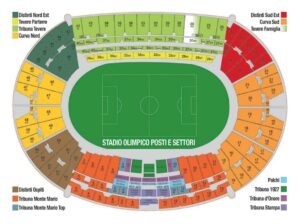
Tickets for Italy's three matches at Olimpico cost from 42 to 170 euros, presale fee included, according to the price list published by the Italian Rugby Federation. The stadium, in its rugby layout, is divided into eight sections you can buy. Italy vs. Ireland and Italy vs. France have the same price list. Italy vs. Wales costs a little less in the stands, while Curve, Distinti and Tevere VIP have the same price for all three dates.
Curve and Distinti
The Curva costs 42 euros for each of the three matches, the Distinti 56 euros. They are the sections chosen by those who want the stadium atmosphere without spending too much, and by families going for the first time. The Distinti, which at Olimpico are the four wedges between the curves and the stands, offer a more angled view but closer to the middle of the pitch than the curves.
Tribuna Tevere and Tribuna Monte Mario
The Tribuna Tevere costs 87 euros for Ireland and France and 77 euros for Wales. The Tevere Centrale costs 120 and 112 euros, the Tevere Top 140 and 127 euros, the Tevere VIP 170 euros for all three matches. The Tribuna Monte Mario costs 122 euros for Ireland and France and 112 for Wales, the Monte Mario Top 147 and 137 euros. The figures are those of the federal price list. Any changes are published on the tournament page of the official site.
PromoClub for clubs and members
For 2027 too, the Federation reserves the PromoClub rate, with reduced prices, for affiliated clubs and registered members: 20 euros in the Curva, 28 in the Distinti, 47 in Tevere, 67 in Tevere Centrale and Monte Mario, 82 in Tevere Top, 92 in Monte Mario Top. The idea, declared by the FIR, is to let the whole Italian rugby community enjoy the tournament celebration. It is the reason you see so many club tracksuits at Olimpico, from the youth teams to the veterans.
Groups, hospitality and safe purchases
For purchases of more than 10 tickets the Federation has a dedicated Groups Office, reachable at ufficiogruppi@federugby.it. For other ticketing questions there is the federal box office, biglietteria@federugby.it. There are hospitality packages with dedicated services, presented in a dedicated section of the federal site. The FIR reminds buyers that the only platform authorized to sell tickets for its events is the official partner's, reachable from the federal site, and invites people to report unauthorized platforms.
Where to sit at Olimpico for the Six Nations
At Olimpico the choice of section for rugby depends on three factors: budget, afternoon light and the kind of experience. The stadium is a single grandstand divided into Tribune (Tevere and Monte Mario), Curve (Nord and Sud) and Distinti, the latter placed between curves and stands on both sides.
Tevere or Monte Mario: the question of the sun
The Tribuna Tevere is on the river side, to the east. The Monte Mario is on the hill side, to the west. In the afternoon the sun drops toward Monte Mario: those in Tevere look at the pitch toward the west, those in Monte Mario have the light behind them. In February, with the low sun, the difference is felt. Since 1990 the whole stadium has been covered by the roof, so rain is a smaller problem than in the past, but in the front rows you can still get wet with the wind.
Curve: close to the try line, far from the center
In 1990, during the reconstruction, the two curves were brought nine meters closer to the pitch. For rugby this means the curves see up close the tries scored below them and see everything else from far away. Rugby, unlike soccer, is played a lot at the short end of the in-goal area: five-meter scrums and lineout mauls are better seen from there than from a high stand. It is a different experience, not a worse one.
The Terzo Tempo Village at the Foro Italico Park
The Peroni Nastro Azzurro Terzo Tempo Village is the festival village set up in the Foro Italico Park on Italy's match days, confirmed for February 13, March 6 and March 13, 2027. The partnership between the brand and the Federation has reached 20 years and is, according to the FIR, one of the longest-running sponsorships in Italian sport. The name is no accident: in rugby the third half is the time after the match when teams and fans get together, and it is as much a part of the identity of this sport as the scrum.
Before the match
The village opens before the match and becomes, for many, the real meeting point of the day: club groups arrived by coach from all over Italy, families, foreign fans in their national team shirts. At the center is a brand space with meet-ups with the national team players and with the athletes of Sport e Salute's Team Illumina. In 2026 the music was handled by Radio Deejay and the ceremony before kickoff was enriched with fireworks shows and a collaboration with the Italian Army.
After the final whistle
The best moment is leaving the stadium. In 2026 the Azzurri were a fixture on the village stage after the two wins, and the Federation counts more than 120,000 spectators who stayed to celebrate in the park over the two days. On Super Saturday the village lets you follow the tournament's other matches, and the afternoon stretches into the evening. The village has its own rules of use, published by the FIR, which govern access and stay in the area.
A curiosity about Six Nations 2027 at Olimpico, Italy's matches in Rome, February 13, March 6 and 13
Italy's first Six Nations match at Olimpico, on February 11, 2012, was played on an icy Saturday: that weekend snow had fallen on Rome, a rare event for the city. The opponent was England, who won 19-15. It is a curiosity that says a lot about the relationship between rugby and Rome: the tournament is played in the dead of the European winter, and the city hosting it is the southernmost in the Six Nations.
The second curiosity concerns the Garibaldi Trophy, at stake in the March 6 match. It was sculpted by Jean-Pierre Rives, who before devoting himself to sculpture was an international rugby player and several times captain of the French national team. The trophy was proposed at the end of 2006 by the National Committee for the bicentenary of Garibaldi's birth and first put at stake on February 3, 2007 at Flaminio, where France won 39-3. Since then Italy has won it twice: 22-21 in 2011, in the last ever match at Flaminio, and 23-18 in 2013 at Olimpico. In 2024 came the first draw, 13-13 in Lille, and the two federations kept the trophy six months each. Since 2017 there has also been the Anita Garibaldi Trophy, played by the two countries' women's national teams.
A third curiosity, of a completely different kind: the Italian Rugby Federation has its operational headquarters inside the stadium, in the Curva Nord. Anyone walking into Olimpico for the Six Nations, then, is literally walking into the home of the Federation that organizes the match.
Stadio Olimpico: how the Six Nations stadium is built
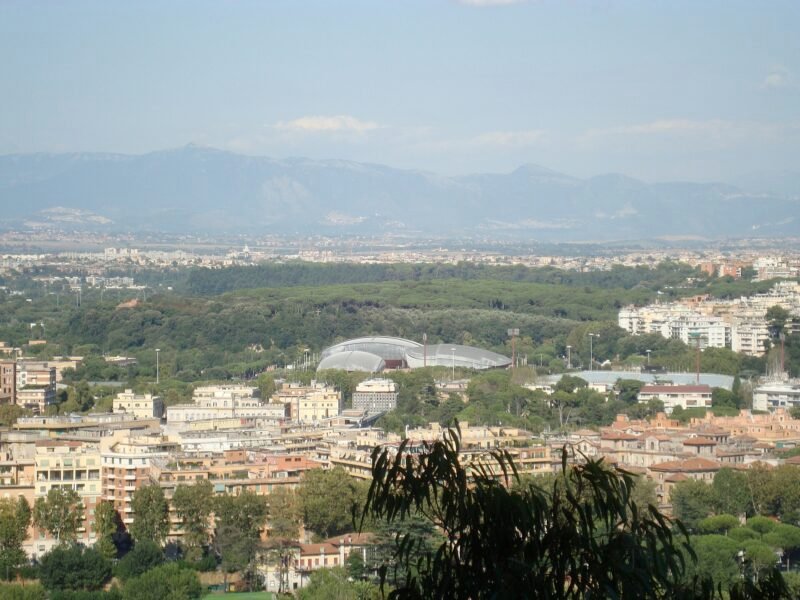
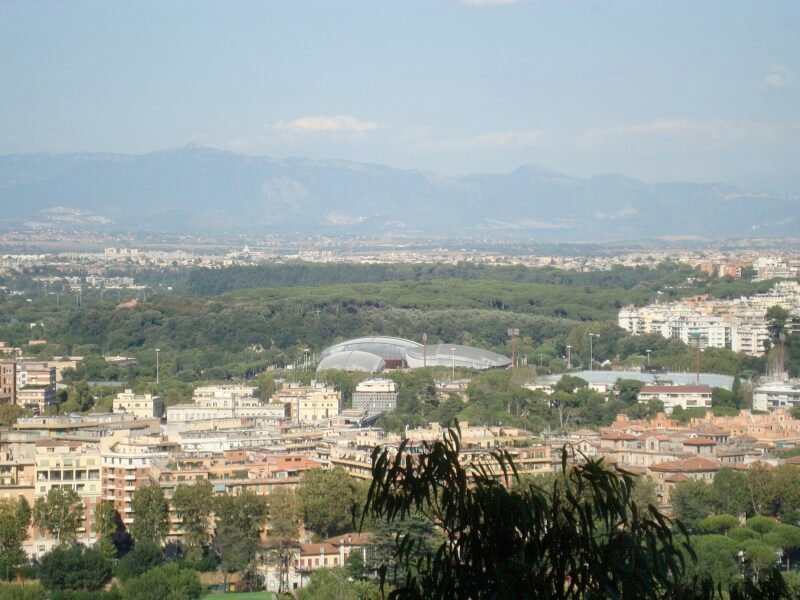
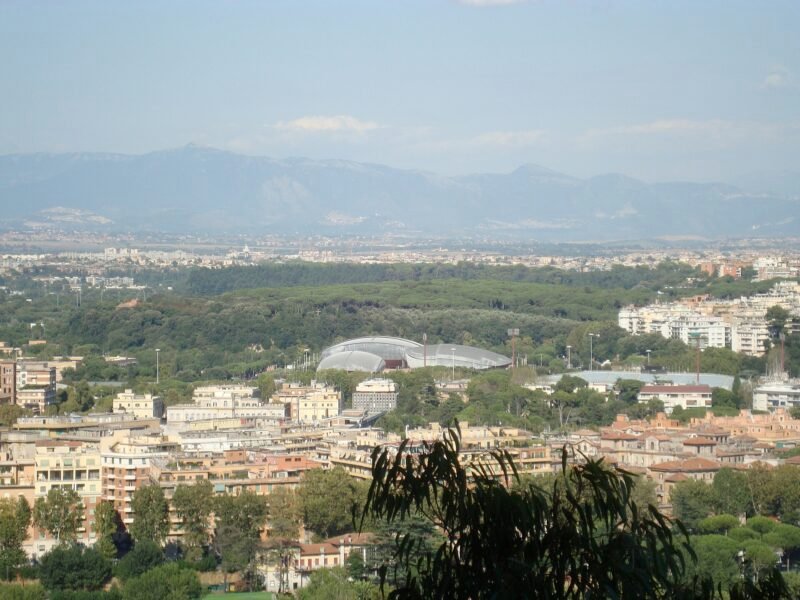
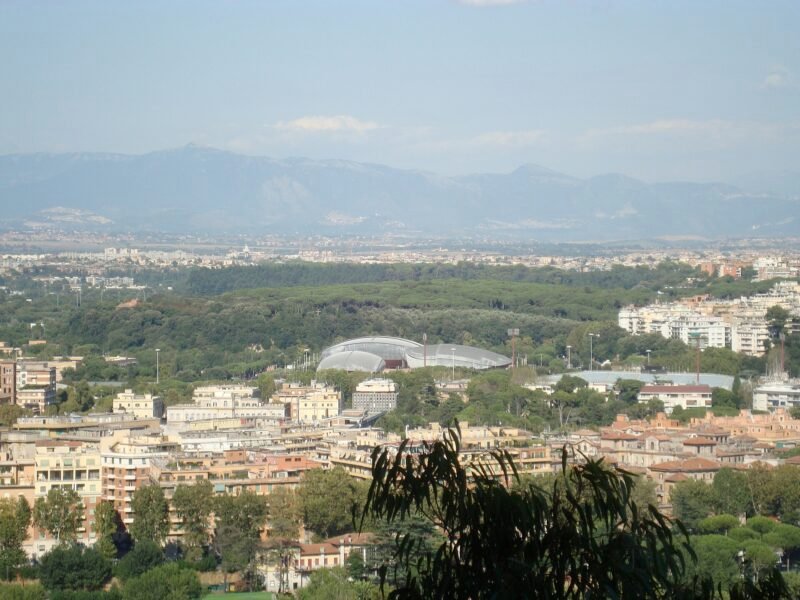
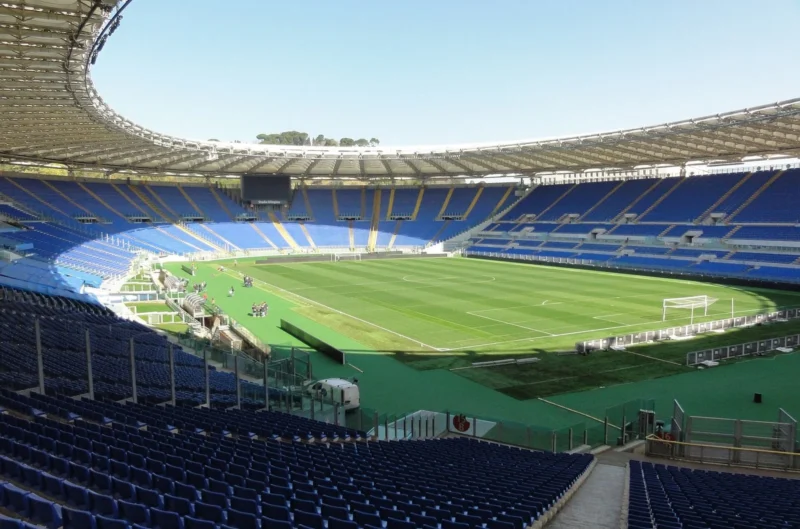
Stadio Olimpico in Rome is a multi-purpose venue with an approved capacity of 70,634 spectators, the second largest in Italy after San Siro. It is part of Foro Italico complex, sits on the plain between the southern slopes of Monte Mario and the Tiber, and is owned by Sport e Salute, the public company that has owned the whole Foro Italico since 2004. For the full history of the stadium there is a dedicated listing. Here what matters is understanding how it works on match day.
From Stadio dei Cipressi to Stadio dei Centomila
The first venue was born within the Foro Mussolini project, started in 1928 by Enrico Del Debbio: it was opened unfinished in 1932 as Stadio dei Cipressi. Between 1933 and 1937 Luigi Moretti revised the project, turning it into a scenic backdrop for the regime's rallies. The war stopped the expansions, and after the liberation of Rome in 1944 the area was occupied by Allied troops. The restoration between 1949 and 1953 was the work of Cesare Valle, Carlo Roccatelli and, after the latter's death, Annibale Vitellozzi. The stadium reopened on May 17, 1953 as Stadio dei Centomila and took its current name after Rome was awarded the 1960 Olympics.
The 1990 reconstruction and the roof
What you see today is largely another stadium. For the 1990 soccer World Cup the venue was almost entirely demolished: of the 1953 building only part of the outer facade of the Tribuna Tevere survived. The curves were brought closer to the pitch, the Tribuna Monte Mario was enlarged and the whole ring was covered by a Teflon and fiberglass canopy supported by a system of steel cables. The perimeter beam runs 29 meters above street level and rests on 16 pylons, 12 in steel and four in reinforced concrete that contain the stairs. The roof alone cost about 160 billion lire. In 2008, ahead of the following year's Champions League final, the stadium was modernized again: wider seats, new hospitality areas, doubled locker rooms.
Sections and entrances
The stands are accessed through 33 entrances: two for each Distinti section, four for each curve, seven for the Tribuna Tevere and 10 for the Monte Mario. The four reinforced concrete pylons give access to the highest level of the stands. The gate is printed on the ticket: find it beforehand, because going around the stadium to the wrong side with the pre-match crowd easily costs a quarter of an hour.
Something nobody tells you about Six Nations 2027 at Olimpico, Italy's matches in Rome, February 13, March 6 and 13
What nobody says is that Olimpico was not born as the home of rugby, and rugby arrived there almost out of necessity. For the first 12 editions of the tournament Italy played at Flaminio, the stadium by Pier Luigi Nervi and his son Antonio on the other bank of the Tiber, a few hundred meters as the crow flies. It was a stadium of about 24,000 seats, beautiful and compact, but too small: the tournament committee asked for at least 40,000 seats, and the expansion project announced in 2010 did not start in time. In 2011 there was even talk of moving the matches to Florence. In the end, from 2012, the FIR and CONI moved the national team to Olimpico while waiting for the works. Then the works stopped, the FIR handed back the management mandate for Flaminio and the move became permanent.
Today Flaminio is abandoned, at the center of recovery projects that have followed one another for years. Anyone arriving at Olimpico on tram 2 passes right by it: it's worth a look, because that is where Italy beat Scotland on its debut in 2000 and France in 2011.
The second thing not said is that Olimpico already had an old relationship with rugby, though an intermittent one. As early as 1954 the European Cup rugby final between Italy and France was played there, lost by the Azzurri 39-12 in front of about 25,000 spectators. Until 1995, however, the national team had returned there only once, in 1986, for the 15-15 against an England selection in front of 40,000 people. The jump in scale of Italian rugby, from the 24,000 of Flaminio to the almost 69,000 of 2026, is a recent story.
How to get to Stadio Olimpico for the Six Nations 2027
Stadio Olimpico is reached by tram 2 from Piazzale Flaminio to Piazza Mancini, or by the buses that end at Piazza Mancini, Piazzale Clodio and the Lungotevere. The Federation has announced that the mobility and traffic plan specific to the 2027 tournament will be published in the months before the first match: on match days some lines are rerouted and the streets around Foro Italico closed, so check it before heading out.
Tram 2 from Piazzale Flaminio
Tram 2 leaves from Piazzale Flaminio, where you get off Metro line A at the Flaminio stop and where the Roma-Civita Castellana-Viterbo railway also arrives, and reaches Piazza Mancini in about 15 minutes. From Piazza Mancini you walk across Ponte Duca d'Aosta and you are in front of the Foro Italico obelisk, with the stadium in the background. It is the simplest solution for those staying in the center: Metro line A to Flaminio, tram, 10 minutes on foot.
Metro line A and the last stretch on foot
Metro line A does not reach the stadium. The closest stop for those who want to avoid surface transport is Ottaviano, about 30 minutes on foot. It may seem like a lot, but on match days, with road closures and traffic, walking the last stretch is often the quickest choice, and the route is also good in a group.
Buses: Clodio, Mancini, Lungotevere
The bus lines to Olimpico are concentrated at three points. At Piazzale Clodio arrive, among others, lines 23, 30, 31, 70, 89 and 495. At Piazza Mancini the 53, the 201 and the 910 terminate, the 910 linking directly to Termini station. On the Lungotevere, in front of the stadium, run the 32, which is the most convenient for those coming from the Ottaviano Metro stop, and then the 69, 200, 280, 301, 446, 628 and 911. On match days the Lungotevere lines are often rerouted and terminated at Piazza Mancini or nearby.
Car, sharing and parking
Arriving by car on Six Nations day is not advisable: the streets around Foro Italico are closed and parking is scarce. The area is served by the main car, scooter, bike and e-scooter sharing services. The dedicated parking lots managed by the Federation are reserved, with limited spaces, for fans with mobility disabilities who request them. For those coming from outside Rome by train, Termini station is linked to Piazza Mancini by bus 910.
My advice for visiting Six Nations 2027 at Olimpico, Italy's matches in Rome, February 13, March 6 and 13
The advice is simple and holds for all three matches: get to Foro Italico by one o'clock, not half past two. The match starts at 15:10, but Six Nations day begins much earlier, and anyone arriving at the last moment misses the best part and ends up in line at the gates with 70,000 people. Arriving early you cross Ponte Duca d'Aosta without a crush, stop by the village, eat something and go in calmly, in time for the anthems. The anthems at the Six Nations are not a ritual to skip: hearing Olimpico sing the Canto degli Italiani and listening, with the respect rugby demands, to the visitors' anthem is part of the show.
Second piece of advice: choose the match based on what you're looking for. Italy vs. Ireland on February 13 opens the Rome season against one of the strongest opponents in the tournament. Italy vs. France on March 6 has the Garibaldi Trophy at stake and the reigning champions on the pitch. Italy vs. Wales on March 13 closes the tournament and lets you stay at the village for the other Super Saturday matches. For a first Six Nations with friends or kids, the best choice is Wales: same atmosphere, slightly lower stand prices, a longer afternoon.
Third piece of advice, a practical one: bring an ID and your ticket already downloaded on your phone, a pocket umbrella (it's allowed) and an extra layer. In February, when the sun goes down behind Monte Mario, it gets cold in the stands much earlier than you'd think.
What to bring and what to leave at home for the Six Nations at Olimpico
At Olimpico, for rugby matches, glass containers, cans and pets are not allowed. Pocket umbrellas, on the other hand, are permitted. Access to and stay in the stadium are governed by a set of rules published by the Federation, which buying the ticket means accepting, and by an infographic of prohibited items posted on the federal site. Banners are allowed only within the limits set by the FIR and with prior authorization from the Facilities Commission.
Bags and suitcases
Anyone arriving in Rome on the day of the match and leaving in the evening has a practical problem: the suitcase. The Federation points to a partner luggage storage service in the stadium area, bookable from its dedicated Olimpico page. Alternatively, it's best to leave bags at the station or hotel before heading to Foro Italico: you can't get into the stadium with a suitcase.
Security and communications
The Federation works with law enforcement on security procedures inside and outside the stadium and communicates relevant information to fans through the federal portal and with signs on site. In the days before each match it's worth checking the updates on traffic and access published by the FIR.
Another well-known fact, yet rarely mentioned
It is well known that Italy, in the Six Nations, has lost much more than it has won. Il Post, for the 25 years of participation, did the math: 125 matches played up to 2024, 15 won, a couple of draws, all the others lost. 1,800 points scored and 4,226 conceded. Between 2015 and 2022, 36 matches went by between one win and the next. And between 2013 and 2024 Italy did not win a single home match: more than 10 years in which, as the paper wrote, a generation of spectators went from elementary school to a driver's license without seeing Italy win in Italy.
What is rarely cited is the other side of these numbers: the crowd never stopped coming. In the 12 years without home wins Olimpico kept filling up in February and March, and the Federation built a whole day of celebration around the match. When the wins returned, 31-29 against Scotland on March 9, 2024, then Scotland and England in 2026, the stadium was already there. Roma Capitale estimates that in 2025 the economic impact of the tournament on the city was 6.3 million euros, up 19 percent on 2023.
There is another little-cited fact: the Rome Six Nations has been certified as a sustainable event under the ISO 20121 standard since 2022. The certification covers the event's sustainable management model and explains why the Federation insists so much on public transport.
Accessibility: the FIR's services for the Six Nations 2027
The Italian Rugby Federation makes free tickets for national team matches available to fans with certified disabilities, with the option of including a companion, while seats last. Each person can request at most two free tickets per event. Requests are made with an accreditation form dedicated to each match and are evaluated in order of arrival.
Tickets and accreditations for 2027
For the three home matches of 2027 the Federation notes that the complimentary tickets reserved for people with walking disabilities are sold out. It is still possible, however, to request a promotional code with purchase discounts by writing to accoglienzadisabili@federugby.it. Accreditation requests for wheelchair users remain open through each match's forms. Tickets are sent by email within three days before the event, and priority in the dedicated FIR parking goes to fans with mobility disabilities.
Shuttle, golf carts, Quiet Room and audio description
For 2027 the Federation lists a number of services: a shuttle with approved Arvalia Civil Protection vehicles between Termini station and Stadio Olimpico, round trip, by reservation while seats last. Three electric golf carts for getting around inside Foro Italico. A wheelchair service for those with mobility difficulties. In the Tribuna Monte Mario, at Sky Box 8, there is a Quiet Room, a reduced-sensory-stimulus space designed for children with disabilities and autism spectrum disorders. For blind and visually impaired fans a dedicated radio commentary service with audio description is available. All services are requested by email at the FIR's reception address.
The Six Nations at Olimpico with children
The Six Nations is one of the few big Italian sporting events where bringing children to the stadium is the norm. The rugby crowd is mixed, rival fans often sit close together, the mood is festive even when you lose. In 2026 Roma Capitale and the Federation brought more than 4,000 kids from more than 140 schools to the stadium with a project dedicated to schools.
Which section to pick with your kids
With small children the Distinti or the Tribuna Tevere are better: fewer climbs to the upper ring, a side view that helps follow the game, and closer exits. The Curve are fine with kids already used to the stadium. For children with disabilities and autism spectrum disorders the Quiet Room in the Tribuna Monte Mario is a valuable service, to be booked in time.
Explaining rugby in 10 minutes
Before going in it's worth explaining three things to kids: you pass the ball only backward, a try is scored by grounding the ball beyond the goal line, and you don't argue with the referee. They'll pick up the rest by watching. The village, with games and a stage, helps fill the wait and make sense of the day even for those who don't follow the match until the last minute.
The right photo to take at Six Nations 2027 at Olimpico, Italy's matches in Rome, February 13, March 6 and 13
The right photo isn't taken inside the stadium, but before: from Ponte Duca d'Aosta, arriving from Piazza Mancini. From there you get in a single frame the Tiber, the obelisk at the entrance to Foro Italico, the river of blue, green and red shirts crossing the bridge and, in the background, Olimpico's white roof with the green of Monte Mario behind it. The best moment is between noon and two, when the flow of fans is at its peak and the low, side light of February brings out the colors.
Inside the stadium, the photo to take is the anthems: the two teams lined up on the halfway line, arms around each other's shoulders, and the stands on their feet. From the Distinti, at mid-height, you capture the whole row of players with the opposite stand behind them. Anyone in the curve instead has the best framing of the place kicks: the kicker, the posts, and 70,000 people in silence.
The third photo is the third half: the Azzurri on the village stage after the match, as happened after the 2026 wins over Scotland and England. It's not guaranteed, it depends on the day and the result, but when it happens it's the most faithful portrait of this sport: the players a few meters from the crowd, with the sunset light falling on the Foro Italico park. One last suggestion: keep your phone charged, because the afternoon is long and the chances are many.
The fourth half: rugby and Rome's museums with your Six Nations ticket
With a ticket to Italy's matches at Olimpico, in 2026 you could visit 15 of Rome's civic museums and three state museums for free on the match weekend: it's the initiative IV Tempo, Rugby and Culture, promoted by the Federation with the Ministry of Culture and Roma Capitale. The Federation has announced that the 2027 agreements will be published as soon as possible. The 2026 list gives an idea of what to expect.
The museums of the 2026 edition
In 2026 the list included the Capitoline Museums, Centrale Montemartini, the Trajan's Markets, the Museo della Forma Urbis, the archaeological area of the Circus Maximus, the Sacred Area of Largo Argentina, the Ara Pacis Museum, the Museo di Roma at Palazzo Braschi, the Museo di Roma in Trastevere, the Galleria comunale d'arte moderna, the Civic Zoology Museum and the four museums of Villa Torlonia: Casino Nobile, Casino dei Principi, Casina delle Civette and Serra Moresca. Among the state museums were the Boncompagni Ludovisi house museum, the Hendrik Christian Andersen house museum and the National Museum of Musical Instruments.
How to organize the weekend
The match is on Saturday afternoon: Sunday is the natural day for museums. An itinerary that works for those coming from outside is Saturday morning in the center, a light lunch, Foro Italico and the match. Sunday, the Capitoline Museums and Trajan's Markets, or the Ara Pacis and a walk to Piazza del Popolo, which is a short walk from Piazzale Flaminio and tram 2. Before counting on free entry, check the 2027 list on the Federation's website.
Some important events that happened here in history
Stadio Olimpico is the Italian stadium with the most international history. On May 17, 1953 it was inaugurated as Stadio dei Centomila with a multi-sport day: a soccer friendly between Italy and Hungary, won 3-0 by the Hungarians with one goal by Hidegkuti and two by Puskás, followed by the finish of a Giro d'Italia stage won in a sprint by Giuseppe Minardi. The following year, in 1954, it hosted the European Cup rugby final between Italy and France.
On August 25, 1960 it was the setting of the opening ceremony of the Games of the XVII Olympiad. On its track Wilma Rudolph won three golds, Livio Berruti took the gold in the 200 meters with the world record equaled in the semifinal and the final, and the world records of Otis Davis in the 400 and Herb Elliott in the 1500 fell.
In soccer Olimpico has hosted the European Championship finals of 1968 and 1980, the 1990 World Cup final between West Germany and Argentina decided by an Andreas Brehme penalty, two European Cup finals, in 1977 and 1984, and two Champions League finals, in 1996 and 2009. On June 11, 2021 the touring European Championship opened there. In athletics, besides the Olympics, it hosted the European Championships of 1974 and 2024, the 1987 World Championships and, since 1980, the Golden Gala, now named after Pietro Mennea.
For rugby there are three dates to remember. November 1995, when world champion South Africa played its first test here after the World Cup win and won 40-21, with Italy ahead 21-17 until a quarter of an hour from the end, in front of about 40,000 people. February 11, 2012, Italy's first Six Nations match at Olimpico, in the snow. And March 7, 2026, Italy 23 England 18, the Azzurri's first ever win over the English. Between 1954 and 2024 the senior national team played 41 matches at Olimpico, 32 of them in the Six Nations.
Italy in the Six Nations: from Flaminio to Olimpico
Italy entered the Six Nations in 2000, turning the old Five Nations into the Six Nations, itself the heir of the Home Nations Championship born in 1883 among England, Ireland, Wales and Scotland and widened to France in the early 1900s. The tournament is privately run and has no qualification: you get in by agreement among the members. The Azzurri's entry came after a decade of good results in the 1990s, but also after a disastrous World Cup, closed with a 101-3 against New Zealand.
February 5, 2000 and Diego Domínguez
The first match was at home, at Flaminio, against Scotland, who had won the last Five Nations. It ended 34-20 for Italy. The Italian-Argentine fly-half Diego Domínguez scored 29 of the Azzurri's 34 points, with three drop goals: no one, in the entire history of the Five Nations, had done so much in a debut match. The BBC wrote that the win refuted doubts about if the Italians deserved the tournament. The bookmakers had given a winning debut at 100 to 1.
The home wins
Italy's wins in the tournament have almost always been at home and often by a few points. Among the home ones, at Flaminio: Scotland in 2000, Wales in 2003, Scotland in 2004, Wales in 2007, Scotland in 2008 and 2010, France in 2011. At Olimpico: Scotland 13-6 in 2012, France 23-18 and Ireland 22-15 in 2013, Scotland 31-29 in 2024, then Scotland and England in 2026. Among the away successes are Murrayfield in 2007 and 2015 and Cardiff in 2022, with the 22-21 that ended a run of 36 matches without a win. The 2024 tournament too closed with a win over Wales.
Italian rugby's two moves in Rome
Flaminio was the national team's home for the first 12 editions, from 2000 to 2011. The last ever match played there was Italy vs. France on March 12, 2011, won 22-21: the Azzurri's first win over the French in the tournament and the first Garibaldi Trophy. Since 2012 Italy has played at Olimpico, which the Federation calls the home of Italrugby and which today is also its headquarters.
Who has passed through Six Nations 2027 at Olimpico, Italy's matches in Rome, February 13, March 6 and 13
Some of the biggest names in world sport have passed over the turf of Olimpico. Ferenc Puskás and Nándor Hidegkuti scored the stadium's first official goals in 1953, with Hungary beating Italy. Wilma Rudolph and Livio Berruti made Olympic history in 1960 on its track. Andreas Brehme decided the 1990 World Cup final there. Samuel Eto'o and Lionel Messi scored Barcelona's goals there in the 2009 Champions League final against Manchester United. At the 2024 European Athletics Championships on the same track, gold went to Marcell Jacobs in the 100 meters, Gianmarco Tamberi in the high jump and Nadia Battocletti in the 5000 and 10000.
In rugby, the list begins with France in 1954 and continues with the great Southern Hemisphere teams: world champion South Africa in 1995 and New Zealand, the non-European national team most often at Olimpico, a guest four times on its end-of-year tours. Since 2012 all the Six Nations teams have passed through, and with them the players who have marked the last decade of European rugby.
For Italy, Olimpico is the stadium of Sergio Parisse, for most of these 25 years the face of the national team, and today of the generation of Michele Lamaro, Tommaso Menoncello, Ange Capuozzo and Leonardo Marin, the scorer of the try in the 23-18 over England. On the bench there has been Gonzalo Quesada, the Argentine coach who in 2024 led Italy to what was then its best tournament and in 2026 to the first season without home defeats. And in the stands, every year, tens of thousands of fans who have come from abroad: according to Roma Capitale, between 2023 and 2025 the social media content of the Rome matches reached 332 million people, more than 70 percent of them outside Italy.
Around Olimpico: Foro Italico, Ponte Milvio and Flaminio
Stadio Olimpico is at the center of one of the most interesting areas of 20th-century Rome, between Foro Italico, the Tiber and the Monte Mario hill. Anyone who arrives early or stays the next day has a lot to see on foot.
Foro Italico and Stadio dei Marmi
Foro Italico is the sports complex designed by Enrico Del Debbio starting in 1928 and then developed by Luigi Moretti: avenues paved with mosaics, the obelisk at the entrance, Stadio dei Marmi with its statues of athletes, connected to Olimpico by an underpass at the time of the 1960 Olympics. It is regime architecture, and it is impossible to look at it without thinking about that. But it is also one of the most accomplished sports complexes of 20th-century Europe. On Six Nations days the park is taken over by the village.
Milvian Bridge
A short walk away, along the Tiber, is Milvian Bridge, the Roman bridge of the battle between Constantine and Maxentius, today the heart of a busy neighborhood of bars and restaurants. After the match it is one of the natural destinations for those who want to continue the evening without going back to the center.
Flaminio, MAXXI and Auditorium
On the other bank, along Via Flaminia, which tram 2 follows, are Nervi's Stadio Flaminio, Zaha Hadid's MAXXI and Renzo Piano's Auditorium Parco della Musica. They are three buildings from three different eras, all within tram reach: for anyone with a free Sunday after the match, it is a contemporary architecture itinerary that few people do in Rome. Behind the stadium opens the Monte Mario Nature Reserve, the greenery that forms the stadium's backdrop.
Where to eat before and after the Six Nations match
On match day the simplest solution is to eat at the Foro Italico village, where you find food stands and beer. Anyone who prefers to sit at a table has three areas within reach: Ponte Milvio, with the highest concentration of bars, pizzerias and restaurants in the area, packed on match days. The Flaminio district, along the tram 2 route, quieter and with neighborhood trattorias. And Prati, toward Piazzale Clodio and Ottaviano, for those coming from Metro line A.
The practical advice is to book. On Six Nations weekends thousands of foreign fans look for a table at the same hours, especially on Saturday night. Anyone who wants a sit-down lunch before the match must do it by half past 12 to get to the gates comfortably. After the match, anyone who hasn't booked will find a seat more easily by heading to the center by tram and Metro, instead of fighting for a table at Ponte Milvio.
Rome in February and March: the Six Nations weekend
The Six Nations falls in one of the most pleasant seasons for visiting Rome: few tourists compared with full spring, lower hotel prices, less crowded museums, days that get longer in March. The flip side is the afternoon cold in the stands in February and the chance of rain: nothing dramatic, but an extra layer and a pocket umbrella make the difference.
On tournament weekends the city changes accent. On Saturday morning the center fills with green, blue and red shirts, visiting fans crowd the squares and cafes, and the atmosphere is that of a peaceful party. For those who live in Rome it's a chance to see their city through the eyes of someone arriving from Dublin, Paris or Cardiff. For those coming from outside, it's the best way to combine a major match with a city weekend. It pays to organize early: hotels and trains fill up on all three weekends.
Frequently asked questions about the Six Nations 2027 in Rome
When does Italy play at Olimpico in the Six Nations 2027?
In the Six Nations 2027 Italy plays three matches at Olimpico, all on Saturday at 15:10: against Ireland on February 13, 2027 (second round), against France on March 6, 2027 (fourth round, with the Garibaldi Trophy at stake) and against Wales on March 13, 2027, in the fifth and final round of the tournament, the so-called Super Saturday.
How much do Six Nations 2027 tickets cost in Rome?
Six Nations 2027 tickets at Olimpico cost, according to the Italian Rugby Federation price list including the presale fee, 42 euros in the Curva, 56 in the Distinti, from 77 to 140 euros in the Tribuna Tevere sections, 170 in Tevere VIP and from 112 to 147 euros in Monte Mario. The Wales match costs less in the stands. Registered members and clubs have PromoClub rates from 20 euros.
Where do you buy tickets for Italy vs. Ireland, France and Wales?
Tickets for Italy's Six Nations matches are bought only on the presale network authorized by the Italian Rugby Federation, reachable from the tournament page on the federugby.it site. The FIR warns that any other platform is not authorized and asks that it be reported to the federal box office. For groups of more than 10 people there is the Federation's Groups Office.
How do you get to Stadio Olimpico for the Six Nations?
Stadio Olimpico is reached by Metro line A to Flaminio and then tram 2 to Piazza Mancini, from which you walk across Ponte Duca d'Aosta. Alternatively, bus 910 links Termini station to Piazza Mancini and the 32 runs on the Lungotevere in front of the stadium. The Federation publishes the mobility plan in the weeks before the matches.
What can't you bring to Stadio Olimpico for rugby matches?
At Stadio Olimpico, for Six Nations matches, glass containers, cans and pets are not allowed, while pocket umbrellas are permitted. Suitcases don't get in: the Federation points to a partner luggage storage service. Banners are allowed only with prior authorization from the FIR Facilities Commission.
What is the Six Nations Terzo Tempo Village?
The Peroni Nastro Azzurro Terzo Tempo Village is the festival village set up in the Foro Italico Park on Italy's match days, confirmed for February 13, March 6 and 13, 2027. It hosts music, meet-ups with players and food stands. In 2026 the Azzurri went up on the stage after the wins over Scotland and England.
Are there services for people with disabilities at the Six Nations 2027?
For the Six Nations 2027 the Italian Rugby Federation offers free accreditations to wheelchair users, a promotional code for people with walking disabilities, a shuttle between Termini and Olimpico, electric golf carts in Foro Italico, a Quiet Room in the Tribuna Monte Mario and radio commentary with audio description. Requests are sent to accoglienzadisabili@federugby.it.
Does the Six Nations ticket give free entry to Rome's museums?
With a ticket to Italy's Six Nations matches, in 2026, you got free entry on the match weekend to 15 of Rome's civic museums, including the Capitoline Museums, Ara Pacis and Centrale Montemartini, and to three state museums. The Federation has announced that the agreements of the IV Tempo initiative for 2027 will be published on its site.
My advice for the Six Nations 2027 at Olimpico
On Six Nations weekends the advice is always the same: don't treat it as a match, treat it as a day. Buy the ticket early from the official network, because in 2026 Olimpico came close to a sellout. Get to Foro Italico at lunchtime on tram 2. Stay at the village after the final whistle, whatever the result. And if you can pick only one of the three, take Italy vs. Wales on March 13: it's the last round of the tournament, Italy opens it, and the afternoon at Foro Italico stretches into the evening with the other matches on the screens. It's the most complete way to understand why rugby in Rome has become a celebration.
Article written by the editorial team of Tour Leader Pro, contact them for Private/Corporate/V.I.P. Tours and Experiences.
Planning a trip to Rome? The English guides to visiting the city are on ItalyPlanner.com.
Contact Information
Nearby
 Stadio Olimpico200 m
- Foro Italico200 m
- Hotel Butterfly300 m
- Oasis in Rome 2027: the three dates at Stadio Olimpico600 m
- Ponte della Musica – Armando Trovajoli900 m
- Milvian Bridge1.0 km
Upcoming events nearby
- Vasco Rossi, Residency Show at Stadio Olimpico in Rome, June 2027100 m
- Olly at Stadio Olimpico in Rome, Tour Stadi 2027100 m
- Pinguini Tattici Nucleari at Stadio Olimpico in Rome, Tour Stadi 2027100 m
- Laura Pausini at Stadio Olimpico in Rome, Io Canto World Tour 2027100 m




You might also like
- Ghemon in La prima volta, l’ultima volta, l’unica volta at Auditorium Parco della Musica, April 19, 2027
- Nubras Ensemble at Auditorium Parco della Musica, February 27, 2027
- Simone Avincola canta Carella at Auditorium Parco della Musica, February 26, 2027
- Mauro Di Maggio at Auditorium Parco della Musica, December 10, 2026
- Giovanni Tommaso, My Four Seasons at Auditorium Parco della Musica, December 11, 2026
- Ordinare il mondo: The Nanda Lanfranco Archive at MAXXI, November 13, 2026 to January 31, 2027