Blade Runner Cine-Concert at Auditorium Parco della Musica, November 8, 2026
In short. Blade Runner Cine-Concert is scheduled for Sunday, November 8, 2026, in Sala Santa Cecilia at Auditorium Parco della Musica Ennio Morricone, Viale Pietro de Coubertin 30, with two screenings: at 17:00 and at 21:00, according to the…
Blade Runner Cine-Concert is scheduled for Sunday, November 8, 2026, in Sala Santa Cecilia at Auditorium Parco della Musica Ennio Morricone, Viale Pietro de Coubertin 30, with two screenings: at 17:00 and at 21:00, according to the calendar of Romaeuropa Festival, which presents the evening in collaboration with Accademia Nazionale di Santa Cecilia. Ridley Scott's film runs on a large high-definition screen while The Avex Ensemble performs Vangelis's score live, in sync with the images. Running time 138 minutes with an intermission, film in English with Italian subtitles, recommended for ages 14 and up. You get there on metro line A to Flaminio and then tram 2 (Flaminia/Reni or Apollodoro stops), or on bus 910 from Termini. The sources disagree on prices: Romaeuropa Festival lists tickets from 50 to 60 euros, while the Auditorium website presents them starting at 40 euros. Tickets are sold on the official website of Romaeuropa Festival, on that of Auditorium Parco della Musica and through the presale network authorized by the organizers.
Blade Runner Cine-Concert in Rome: the evening in brief
Blade Runner Cine-Concert brings to Rome, as an Italian premiere, the show in which the electronic score Vangelis wrote for the 1982 film is played live while the film runs on screen. It's one of the music events of Romaeuropa Festival 2026, hosted in the largest hall of the Auditorium.
Two screenings on the same day
The festival calendar gives two times, Sunday, November 8, at 17:00 and at 21:00. The Auditorium page lists the 21:00 evening performance: buyers should check the time printed on the ticket, because the two screenings are separate shows with separate seats. The double date is the news of the last few weeks: the festival added the afternoon performance after the first sales.
Running time, language and age
The show lasts 138 minutes with one intermission. The film is shown in the original English version with Italian subtitles, so without the classic Italian dubbing: the voices are those of Harrison Ford, Rutger Hauer, Sean Young. The festival recommends it for ages 14 and up, because of the violence of some scenes and the dark tone of the story.
Who produces the show
Blade Runner LIVE, the international title, is a production by Avex Classics International, made in agreement with Warner Bros. The version of the film chosen for the cine-concert is The Final Cut from 2007, the restored and re-edited edition that Ridley Scott considers definitive. In Rome the show is presented by Romaeuropa Festival in collaboration with Accademia Nazionale di Santa Cecilia.
What you see and hear at Blade Runner Cine-Concert
At Blade Runner Cine-Concert the audience sees the entire film and hears the score performed live by The Avex Ensemble, synchronized with the images for the first time, as both the festival and the production point out.
A score born for the synthesizer
The difficulty, and the appeal, lie in the nature of the music. The Blade Runner score isn't written for a symphony orchestra: it's built on synthesizers, electronic pads, suspended sounds, and it alternates melodies with a classical structure and futuristic timbres, in the service of the noir and retro style Scott wanted. Bringing it to the stage means rebuilding live sounds that for decades existed only on record. That's why this cine-concert is different from the screenings with orchestra the Roman audience knows: here the ensemble works with keyboards and electronic instruments, as well as acoustic instruments.
The pieces the audience recognizes
The film contains some of Vangelis's best-known pages. There's the Love Theme, with the saxophone solo that on the original recording was by Dick Morrissey, the composer's longtime collaborator. There's Tales of the Future, sung on the original soundtrack by Demis Roussos, his friend from Aphrodite's Child. There's One More Kiss, Dear, given in the film to the voice of Don Percival. And there are the opening titles, with the industrial landscape of Los Angeles crossed by the flames of the smokestacks.
The plot in a few lines
Los Angeles, 2019. Detective Rick Deckard, played by Harrison Ford, is called back into service as a replicant hunter: four androids who escaped from the off-world colonies have returned to Earth. The mission gets complicated when Deckard falls in love with Rachael, played by Sean Young, a replicant created by the Tyrell Corporation. It's the summary the festival itself publishes, and it's enough to walk into the hall even if you've never seen the film.
Blade Runner, Ridley Scott's film
Blade Runner is a 1982 film directed by Ridley Scott, based on the novel by Philip K. Dick and written by Hampton Fancher and David Webb Peoples. It's considered one of the greatest examples of neo-noir and one of the most acclaimed science fiction films.
From the novel to the set
Dick's novel, published in 1968 with the original title Do Androids Dream of Electric Sheep?, soon attracted the interest of filmmakers. Fancher's first screenplay called for a low-budget film, almost entirely indoors. Ridley Scott joined the project on February 21, 1980, when it was called Dangerous Days, and turned it into an urban noir. He chose the word replicant because android, in the early 1980s, seemed worn out to him. The title Blade Runner came from a 1974 novel by Alan E. Nourse.
The shoot
Filming began on March 9, 1981, and lasted four months, at the studios in Burbank, where the streets of a future Los Angeles were rebuilt. As locations they used the Bradbury Building for J. F. Sebastian's apartment and Los Angeles Union Station for the interior of the police headquarters. Deckard's apartment is inspired by Frank Lloyd Wright's Ennis House. They often shot at night, under artificial rain.
The visual style
Scott named as sources the French comics magazine Métal Hurlant and Edward Hopper's painting Nighthawks, and he drew inspiration from the Hong Kong skyline and the industrial landscape of his hometown, South Shields. The concept artist was Syd Mead. The special effects were supervised by Douglas Trumbull and Richard Yuricich. Blade Runner is one of the last great science fiction films without computer-generated effects: the opening pan of the city is a forced-perspective model about four and a half meters deep.
The cast
Alongside Harrison Ford and Sean Young, the cast includes Rutger Hauer as the replicant Roy Batty, Daryl Hannah as Pris, Edward James Olmos as Gaff, M. Emmet Walsh as Bryant, William Sanderson as J. F. Sebastian, Brion James as Leon, Joe Turkel as Eldon Tyrell and Joanna Cassidy as Zhora. Olmos invented Cityspeak, the mixed language spoken in the streets of the film.
The Final Cut, the version shown
The version shown at Blade Runner Cine-Concert is The Final Cut, released by Warner Bros. in 2007 for the film's 25th anniversary: it's the only one over which Ridley Scott had full artistic control.
Seven versions of the same film
Seven different versions of the film exist. In 1982 the theatrical version came out with a voice-over narration and a happy ending added after disappointing previews. In 1992 came the director's cut, without the narration and with the unicorn dream sequence. In 2007 The Final Cut added image touch-ups, improved backgrounds, resynchronized voices and a complete digital restoration of image and sound.
Why it matters for the concert
The choice of the Final Cut has a practical effect: no voice-over, and therefore more room for the music. In the scenes where Deckard walks the streets or studies the photographs, the images and the score do the talking. It's the edit that does the most justice to Vangelis's work, and it's good news for anyone coming mainly to listen.
Vangelis's score: the story of a long-awaited album
The Blade Runner score was composed by Vangelis in 1982, right after the Oscar he won for Chariots of Fire, and became one of his most admired works, even though for years it had no official release on record.
An album announced and never released
The film's end credits announced an album on Polydor, which never arrived. In 1983 the music received BAFTA and Golden Globe nominations for best score. To fill the gap, in 1982 the New American Orchestra recorded an orchestral version of it. Some pieces appeared in 1989 on the compilation Themes. The official edition came only in the 1990s: the sources disagree on the date, because some tie it to the release of the 1992 director's cut, while Vangelis's discography gives 1994. In the meantime a great many bootleg recordings circulated.
The musicians on the original recording
For some arrangements Scott used composer and pianist Peter Skellern. Demis Roussos sang Tales of the Future, Don Percival One More Kiss, Dear, and Dick Morrissey played saxophone on the Love Theme. A traditional Japanese ensemble and harpist Gail Laughton contributed one piece each.
Blade Runner Trilogy
In 2007, with the Final Cut, the three-CD box set Blade Runner Trilogy came out: the first disc reissues the official album, the second collects music written for the film and not used in the edit, the third is an unreleased Vangelis album for the 25th anniversary.
Who Vangelis was: the biography
Vangelis, the stage name of Evangelos Odysseas Papathanassiou, was born in Agria, Greece, on March 29, 1943, and died in Paris on May 17, 2022. A composer and multi-instrumentalist, he is considered the best-known Greek artist in the world and one of the leading composers of electronic music for film.
The beginnings and Aphrodite's Child
He began composing at four, largely self-taught, and refused lessons: all his life he had no basic knowledge of music notation. In the early 1960s he founded the beat band The Forminx, successful in Greece. In 1967 he founded the progressive rock band Aphrodite's Child with Demis Roussos and Loukas Sideras. He was offered the keyboard spot in Yes, but turned it down because he feared it would limit his own vision.
London and Nemo Studios
His solo career started in 1973 with the music for two films by French producer Frédéric Rossif. His first solo album is Earth, from the same year. After moving to London, he signed with RCA and worked in his private studio, Nemo Studios, where Heaven and Hell (1975), Spiral (1977) and China (1979) were made. The music of Heaven and Hell was used in Carl Sagan's television series Cosmos.
The Oscar and the movies
In 1982 he won the Oscar for the score of Hugh Hudson's Chariots of Fire. The same year his collaboration with Ridley Scott began, for whom he wrote Blade Runner and, in 1992, 1492: Conquest of Paradise. His scores also include Costa-Gavras's Missing, Antarctica, The Bounty, Roman Polanski's Bitter Moon, Oliver Stone's Alexander.
Jon and Vangelis, NASA, space
From 1979 he formed the duo Jon and Vangelis with Jon Anderson, the voice of Yes, with several hits in the 1980s. In 2001 he recorded Mythodea, used by NASA for the 2001 Mars Odyssey mission, and performed it in one of the very rare concerts of his career, at the Temple of Olympian Zeus in Athens. In 2016 he released Rosetta, inspired by the ESA space mission, and in 2021 Juno to Jupiter. His honors include the Legion of Honor, the title of Knight of Arts and Letters, NASA's Public Service Medal in 2003 and the asteroid 6354 Vangelis.
Vangelis and Italy
The Italian public knows his music even without realizing it. The piece Hymne, from the 1979 album Opéra Sauvage, was rearranged in 1985 and used for decades by Barilla. His music has served as theme and background music for programs such as Linea verde and Geo e Geo. As an arranger he worked with Riccardo Cocciante, Claudio Baglioni, Milva, Patty Pravo and Krisma.
The Avex Ensemble and the Blade Runner LIVE production
The Avex Ensemble is the group that performs Vangelis's score in the show Blade Runner LIVE, produced by Avex Classics International and touring theaters and concert halls in Europe and North America.
A touring show
The production has been on the road for a few seasons: in 2026 it's also scheduled in the United States, between late October and November, a few days before the Rome date. The international audience knows it in the same format: film on a big screen, musicians on stage, frame-accurate synchronization.
What the organizers publish
Neither the festival nor the Auditorium publishes the ensemble's lineup or the name of the conductor for the Rome evening. The information isn't published: anyone who wants to know how many musicians will be on stage will find out when they walk into the hall. What remains is the central point of the production, repeated by all the official sources: it's the first time the Blade Runner score has been performed live in sync with the film.
Tickets for Blade Runner Cine-Concert
Tickets for Blade Runner Cine-Concert are on sale on the Romaeuropa Festival website, which lists prices from 50 to 60 euros, and on the Auditorium website, which presents them starting at 40 euros.
Prices: two sources, two figures
The sources disagree. Romaeuropa Festival lists tickets from 50 to 60 euros, while the Auditorium gives a price starting at 40 euros. The difference probably depends on the sections of the hall and on discounts, but neither page explains it. The advice is to check the actual price at the time of purchase, on the official website.
Which performance to choose
The 17:00 performance ends around 19:20, leaving the evening free for dinner. The 21:00 one ends around 23:20: anyone going home on public transit needs to keep the Sunday holiday schedule in mind.
Sala Santa Cecilia, where Blade Runner is shown
Sala Santa Cecilia is the largest of the three halls of Auditorium Parco della Musica: 2,756 seats, designed by Renzo Piano for the symphonic repertoire and inaugurated on December 21, 2002, with the Accademia's Orchestra conducted by Myung-whun Chung.
What it's like
The ceiling is made of 26 American cherry shells, which shape the hall's acoustics. The audience sits all around the stage, even behind the orchestra. For a cine-concert the layout changes: the screen takes up the upper part of the stage, and the best seats are the ones facing it, where you see the images and the musicians together.
On top of a Roman villa
The hall is built on a level raised above the ground, because the remains of a Roman villa emerged underground and digging wasn't possible. There are only two elevators for the galleries: anyone who has difficulty climbing stairs should arrive early.
The complex
For the full story of Renzo Piano's complex, its halls and the cavea, see our page on Auditorium Parco della Musica.
A curious fact about Blade Runner Cine-Concert at Auditorium Parco della Musica, November 8, 2026
The nicest curiosity concerns the most famous line in the film, and so the moment when, on Sunday, November 8, the hall will fall silent. Roy Batty's final monologue, the one that ends with moments lost in time like tears in rain, was the last scene shot. Originally it was longer and didn't contain the last two sentences. It was Rutger Hauer who convinced Ridley Scott to cut the opening part, noting that a dying character wouldn't have time for a long speech, and it was he who improvised the ending. The most quoted words of science fiction cinema are therefore, in large part, the actor's invention on set.
Under that monologue runs Vangelis's music, and this is where the cine-concert changes the experience. In a normal screening the score comes from the speakers, fixed in the recording. In the hall, on Sunday, it will be played by musicians a few meters from the audience, with frame-accurate precision. It's the difference between watching a scene and feeling it happen.
A second curiosity concerns the date of the story. The film is set in Los Angeles in November 2019: a future that for the 1982 audience was far away, and that today is already seven years in the past. Seeing Blade Runner in November, seven years after the November imagined by Scott, has a strange flavor: the film's future has become our recent past, and the question about the humanity of artificial intelligence has become news.
Blade Runner for those who have never seen it
If you've never seen Blade Runner, don't worry: the cine-concert is also the best way to discover it, on the big screen and with live music.
What to know beforehand
The replicants in the film are organic androids created by the Tyrell Corporation, Nexus 6 series, stronger and more intelligent than humans but with a life limited to about four years. To identify them they use the Voight-Kampff test, an interrogation with an eyepiece aimed at the eye that measures emotional reactions. Blade runners are the agents in charge of retiring them, that is, eliminating them.
The question the film leaves open
In the 1992 and 2007 versions some clues suggest that Deckard himself may be a replicant: the unicorn dream and the unicorn-shaped origami left by his colleague Gaff. In 2000 Scott said he considered Deckard a replicant. The film never says so openly, and the debate among fans is still alive.
Something nobody tells you about Blade Runner Cine-Concert at Auditorium Parco della Musica, November 8, 2026
What few people say is that the Blade Runner score, now considered one of the most important in film history, didn't exist as a record for more than 10 years. The 1982 audience heard it only at the movies. Anyone who wanted to hear it again at home had to settle for the orchestral version recorded by the New American Orchestra, which kept Vangelis's melodies but not his sounds, or for the bootleg cassettes circulating among fans. That's also why the music of Blade Runner had an almost underground life, made of copies and searches, before becoming a classic.
The second thing concerns the hall. The cine-concert isn't a concert with a film in the background, nor a film with background music: it's a delicate balance, in which the original dialogue stays and the live music has to fit in without covering it. In a hall as big as Santa Cecilia, with 2,756 seats arranged all around the stage, position matters. From the side seats and from the galleries behind the stage the screen is hard to see or can't be seen at all, and the subtitles become tiring. When choosing your seat, look at the seating plan: facing the stage and not too close, to have the screen and the musicians in the same glance.
My advice for seeing Blade Runner Cine-Concert at Auditorium Parco della Musica, November 8, 2026
My advice is to choose the performance based on how you want to spend the day, and then arrive early. With the 17:00 screening you can reach the Auditorium in broad daylight, cross the Villaggio Olimpico in the light, have a coffee in the foyer and come out at half past seven to have dinner without rushing. With the 21:00 one you enter the night like the film, with the city already dark and the Auditorium lights on: the most fitting setting for a noir, in our opinion, but with the trip home after 23:00 on a Sunday.
Second point: brush up on the film. It isn't necessary, but it helps. Anyone who saw it years ago, maybe on television in one of the versions with the voice-over, will find in the Final Cut a different film, slower and more hypnotic. Watching the first 10 minutes again on a small screen, the night before, prepares your ear for the music.
Third: read the subtitles without becoming their prisoner. The film is in English, and anyone following every line risks missing the music. Blade Runner's dialogue is sparse and dry, and the long sequences without words are the heart of the show. That's when it's worth lifting your eyes from the text and listening.
Finally, the intermission. With 138 minutes and one break, it's worth using it to leave the hall, get some air on the inner plaza and come back in time: the second part contains the rooftop ending and Roy Batty's monologue, the moment many people buy the ticket for.
How to get to the Auditorium for Blade Runner
Auditorium Parco della Musica Ennio Morricone is at Viale Pietro de Coubertin 30 and you can reach it on tram 2, Flaminia/Reni or Apollodoro stops, and on buses 910, 53, 982 and 168. The nearest metro station is Flaminio, on line A.
Metro A and tram 2
From Flaminio station you come out onto Piazzale Flaminio and take tram 2 along Via Flaminia. Get off at Flaminia/Reni or Apollodoro and walk through the Villaggio Olimpico to the entrance. From the historic center it's the simplest solution.
The 910 from Termini
Bus 910 leaves from Piazza dei Cinquecento, in front of Termini station, and stops in front of the Auditorium with no changes. On Sundays the holiday schedule applies: it's worth checking departures on the transit company's website before going out.
By car
The stretch of Viale Pietro de Coubertin in front of the Auditorium is closed to cars. The complex has an internal paid parking lot with limited spaces. With Sala Santa Cecilia full twice on the same day, the streets of the neighborhood fill up early.
Getting back
After the evening performance, tram 2 takes you back to Piazzale Flaminio. Alternatively, a taxi booked a few minutes before the end: when a hall of almost 3,000 seats empties out, free taxis disappear fast.
Another well-known fact, yet seldom mentioned
It's well known that Philip K. Dick wrote the novel Blade Runner comes from. It's less often remembered that Dick never saw the finished film. The writer had criticized an early version of Fancher's screenplay, then read Peoples's rewrite and was satisfied with it. Invited to the studios, he saw about 20 minutes of special effects tests and told Scott, enthusiastic, that the world created for the film was exactly the one he had imagined. He died on March 2, 1982, shortly after the end of production and a few months before the American release on June 25. The film is dedicated to him.
Another well-known and seldom told fact concerns its success. Today Blade Runner is a cult film, but on its release in North America it earned little: 6.15 million dollars on its opening weekend and about 27.5 million in total, against a budget estimated at around 28 million. In those same weeks audiences preferred E.T. the Extra-Terrestrial, a reassuring science fiction, the opposite of Scott's dystopia. It was the rereleases in movie theaters around the world, and then the later editions, that built the myth. In 1993 the United States Library of Congress selected it for preservation in the National Film Registry, as a culturally, historically or aesthetically significant work.
The right photo to take at Blade Runner Cine-Concert at Auditorium Parco della Musica, November 8, 2026
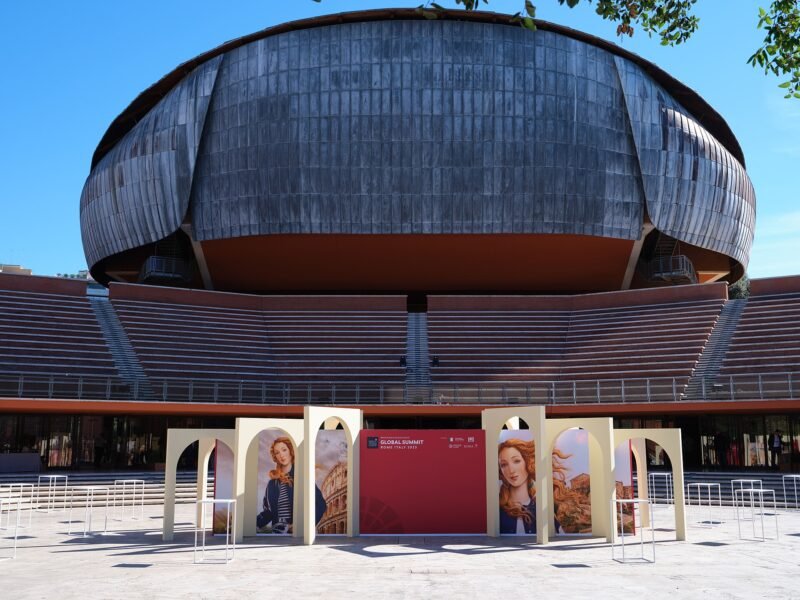
You don't take photos during the show: the screen and the ensemble are the heart of the evening, and the glow of a phone in a dark hall disturbs everyone sitting behind. The right photo is taken before or after, outside. The subject is Renzo Piano's Auditorium, with the three large lead-clad shells of the halls that, seen in the evening, look like hulls or carapaces resting on the lawn. It's an architecture that in the dark, lit up, really has something of the future city of Blade Runner: dark volumes, warm lights, reflections on the wet ground if it rains.
The best spot is the cavea, the stepped plaza at the center of the complex, from which you can see the halls side by side. With the 17:00 performance, when you come out the sky is already dark blue, the best time to photograph the halls with the lights on and a little leftover glow. With the 21:00 one the photo is taken on arrival, around 20:30, with the complex already lit.
If you love references, you can look for a low-angle shot, with the shells filling the sky and the people small at the bottom: it's the same visual grammar as Scott, who places human beings beneath enormous architecture. And if the November evening brings a little rain, even better: the wet asphalt of the Villaggio Olimpico under the streetlights is the closest set to Los Angeles 2019 that Rome can offer.
The neighborhood around the Auditorium
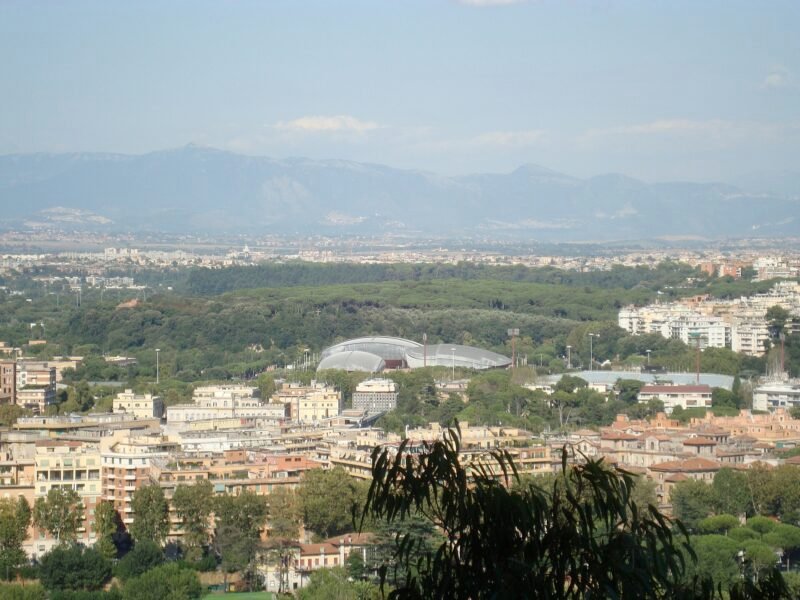
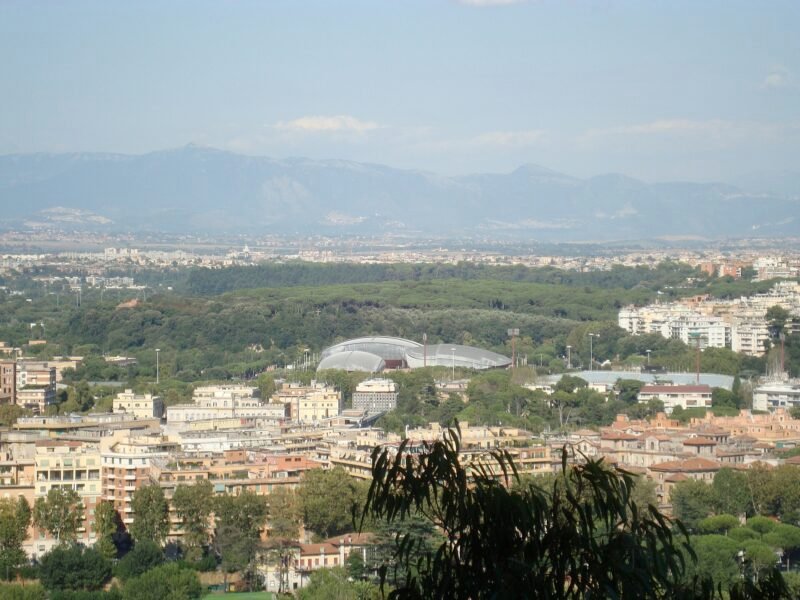
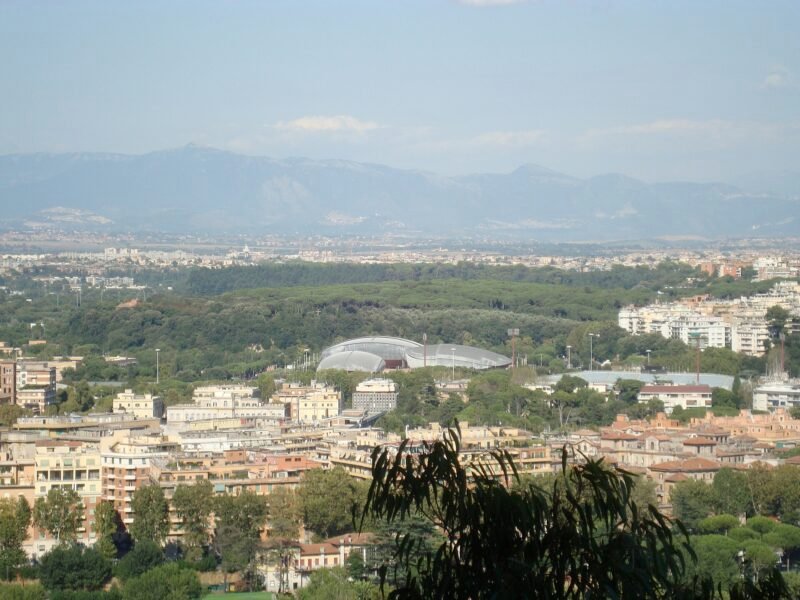
The Auditorium covers about 55,000 square meters between Villa Glori, the Villaggio Olimpico, the Corso di Francia viaduct and Viale Maresciallo Pilsudski, in a part of Rome built in the 20th century.
The Villaggio Olimpico
It's the neighborhood you walk through after getting off the tram, built for the Olympics and now residential. Near the Flaminia/Reni stop is the MAXXI museum. Not far away is Teatro Olimpico, which in these weeks hosts other festival shows such as Le Pas du Monde by Collectif XY.
Toward the Tiber and Ponte Milvio
Heading down toward the river you reach Ponte della Musica and the Foro Italico. Farther north, beyond Piazza Mancini, is Milvian Bridge, one of the evening meeting spots of north Rome.
Other music for the screen at the Auditorium
If you love electronic scores, you can also mark the concert by Kyle Dixon and Michael Stein with the music of Stranger Things, at the Auditorium on November 19, 2026: two composers who openly declare their debt to the synthesizers of the 1980s.
Some important events that happened here
The Auditorium area has a history much older than the complex. During the excavations for the foundations, the remains of a Roman villa from the 3rd century BC emerged, built on the site of a small archaic farm from the 6th century BC. Renzo Piano had to change the design: two of the three halls were moved west, almost to the Corso di Francia viaduct, and Sala Santa Cecilia was built on a raised level, without digging.
The modern story begins with a demolition. In 1936 the Augusteo, Rome's great concert hall, was torn down, and for more than 60 years Rome was left without an auditorium built for music. In 1992 the city council chose the Villaggio Olimpico area, and in 1993 Renzo Piano won the invitation-only competition.
On April 21, 2002, Rome's birthday, Sala Sinopoli and Sala Petrassi were inaugurated, and on December 21 of the same year Sala Santa Cecilia, with the Accademia's Orchestra conducted by Myung-whun Chung. Since 2003 the Auditorium has been the home of the season of Accademia Nazionale di Santa Cecilia, and since 2006 it has hosted the Rome Film Fest. In 2020 the city council decided to name it after Ennio Morricone, the composer who more than any other tied the name of Rome to film music.
Blade Runner Cine-Concert fits right into this double vocation, music and cinema, that the complex has cultivated for more than 20 years: a symphony hall that for one Sunday becomes a movie theater, in the name of a film composer.
Accessibility, age and practical information
Sala Santa Cecilia is built on a raised level and there are only two elevators for the galleries: anyone with accessibility needs should contact Fondazione Musica per Roma, at info@musicaperroma.it, before buying.
With teenagers
The festival recommends it for ages 14 and up. For a teenager who loves science fiction, video games or electronic music it's a rare opportunity: seeing a sound they only know from headphones being made live. For younger children the film is too dark and too long.
Arriving on time
With a film in sync with the music, the show starts at the stated time and doesn't stop. Arriving late means missing the opening titles, one of the most beautiful musical pages of the evening.
Where to eat
Inside the Auditorium there's a bar and a café in the foyer and a bar restaurant that can also be reached from the street. In the neighborhood, between the Villaggio Olimpico, Via Flaminia and Piazza Mancini, there are pizzerias and trattorias mostly frequented by residents. At Ponte Milvio the choice is wider and places stay open late.
Who has passed through Blade Runner Cine-Concert at Auditorium Parco della Musica, November 8, 2026
On the stage of Sala Santa Cecilia, on Sunday, November 8, The Avex Ensemble takes its place. On the screen above them pass Harrison Ford, Rutger Hauer, Sean Young, Daryl Hannah, Edward James Olmos, Joanna Cassidy, M. Emmet Walsh, William Sanderson, Brion James, Joe Turkel. And with them, invisible but present, Ridley Scott, Philip K. Dick, Syd Mead, Douglas Trumbull, and of course Vangelis, with the musicians of the original recording: Demis Roussos, Dick Morrissey, Peter Skellern, Don Percival.
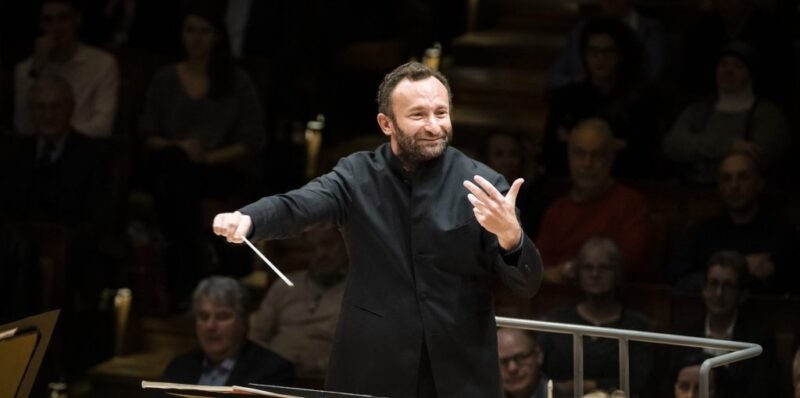
The hall that welcomes them has a history of great names. It was inaugurated on December 21, 2002, by the Orchestra of Accademia Nazionale di Santa Cecilia conducted by Myung-whun Chung, and since then it has been the home of the Accademia's symphonic season. In the 2026/2027 season the same hall hosts conductors and soloists such as Kirill Petrenko, Martha Argerich and Charles Dutoit, and Joe Hisaishi, the composer of Miyazaki's film scores, who brings to Rome another way of understanding music for the screen.
The whole complex bears the name of Ennio Morricone, and the halls those of Goffredo Petrassi, Giuseppe Sinopoli and Santa Cecilia, the cavea that of Luciano Berio. Vangelis, who didn't love concerts and gave very few in his life, enters this pantheon in a way that suits him: through his music played by others, under the images of the film that made him immortal. For Romaeuropa Festival, which every fall brings artists from all over the world to Rome, it's one of the evenings that unite the film audience and the music audience, just as the nearby Chara Kotsali at Mattatoio united dance and visual arts.
Frequently asked questions about Blade Runner Cine-Concert
When is Blade Runner Cine-Concert in Rome?
Blade Runner Cine-Concert is scheduled for Sunday, November 8, 2026, at Auditorium Parco della Musica Ennio Morricone, Sala Santa Cecilia. Romaeuropa Festival lists two screenings, at 17:00 and at 21:00, and the Auditorium page lists the 21:00 performance. The valid time is the one printed on the ticket.
How much do tickets for the Blade Runner cine-concert cost?
Tickets for Blade Runner Cine-Concert cost from 50 to 60 euros according to the Romaeuropa Festival website, while the Auditorium website gives a price starting at 40 euros. The two sources disagree: the actual price should be checked at the time of purchase on the official website.
How long is Blade Runner Cine-Concert?
Blade Runner Cine-Concert lasts 138 minutes with one intermission. The 17:00 performance therefore ends around 19:20, the 21:00 one around 23:20. The film shown is The Final Cut from 2007.
Is the film dubbed in Italian?
No, at Blade Runner Cine-Concert the film is shown in English with Italian subtitles. So you hear the original voices of Harrison Ford, Rutger Hauer and Sean Young, while Vangelis's score is performed live by The Avex Ensemble.
Can you bring a teenager to the Blade Runner cine-concert?
Romaeuropa Festival recommends Blade Runner Cine-Concert for ages 14 and up. The film contains violent scenes and a dark atmosphere, and it lasts more than two hours: for older teens who love science fiction or electronic music, it's a rare experience.
How do you get to Auditorium Parco della Musica?
Auditorium Parco della Musica Ennio Morricone, at Viale Pietro de Coubertin 30, can be reached on metro line A to Flaminio and then tram 2, Flaminia/Reni or Apollodoro stops, or on bus 910 from Termini. On Sundays the holiday schedule applies.
Who plays the Blade Runner score live?
The Blade Runner score is performed by The Avex Ensemble, in the Blade Runner LIVE production by Avex Classics International, in agreement with Warner Bros. The ensemble's lineup for the Rome evening isn't published by the organizers.
Final advice on Blade Runner Cine-Concert
Blade Runner Cine-Concert is, in our opinion, one of the most successful evenings of Romaeuropa Festival for anyone who loves movies: a film that changed how we imagine the future, music that for years could only be heard in a theater, and a hall of almost 3,000 seats designed for sound. My advice is to choose a seat facing the stage, arrive well ahead of time and, if possible, pick the 21:00 performance, to enter Scott's noir with the city already dark. Anyone who has seen the film only on television will discover how much of its power lay in the music. Anyone who knows it by heart will feel it breathe in a new way, with the notes born on stage at the same instant the rain falls on the screen.
Article written by the editorial team of Tour Leader Pro, contact them for Private/Corporate/V.I.P. Tours and Experiences.
Planning a trip to Rome? The English-language guides for visiting the city are on ItalyPlanner.com.
Contact Information
Nearby
 Museum of Musical Instruments (MUSA)100 m
- Auditorium Parco della Musica100 m
- Villa Glori500 m
- Fountain of Anna Perenna500 m
- MAXXI – National Museum of 21st Century Arts700 m
- Flaminio700 m

Upcoming events nearby
- Roma Jazz Festival 2026, November 1 to 24 at the Auditorium and Casa del Jazz100 m
- Evgeny Kissin and András Schiff at Santa Cecilia, November 9, 2026100 m
- Roma Gospel Festival 2026 at Auditorium Parco della Musica, December 13, 2026 to January 1, 2027100 m
- Santa Cecilia 2026/2027 Concert Season at Auditorium Parco della Musica, October 21, 2026 to June 5, 2027100 m



You might also like
- Nubras Ensemble at Auditorium Parco della Musica, February 27, 2027
- Antonio Pappano conducts Petrassi and Tchaikovsky at Santa Cecilia, Auditorium Parco della Musica, November 19, 20 and 21, 2026
- Sol Gabetta and Bertrand Chamayou at Auditorium Parco della Musica, November 25, 2026
- Kirill Petrenko conducts the Santa Cecilia Orchestra at Auditorium Parco della Musica, November 12, 13 and 14, 2026
- Alexander Soddy conducts Poulenc, Prokofiev and Dukas at Santa Cecilia, November 5, 6 and 7, 2026
- Daniel Harding Conducts Ravel and Debussy at Auditorium Parco della Musica, April 8, 9 and 10, 2027