Kyle Dixon and Michael Stein, The Music of Stranger Things at Auditorium Parco della Musica, November 19, 2026
In short. Kyle Dixon and Michael Stein play the music of "Stranger Things" live on Thursday, November 19, 2026, at 20:00 in Sala Sinopoli at Auditorium Parco della Musica Ennio Morricone, at Viale Pietro de Coubertin 30 (00196 Rome), between…
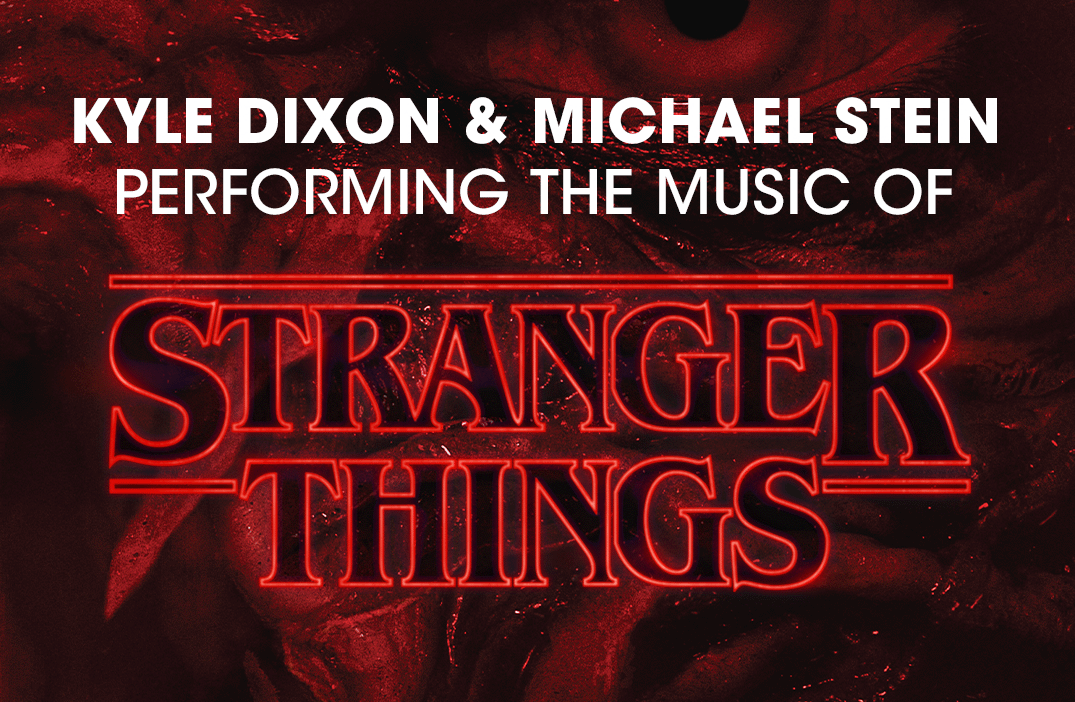
Kyle Dixon and Michael Stein play the music of "Stranger Things" live on Thursday, November 19, 2026, at 20:00 in Sala Sinopoli at Auditorium Parco della Musica Ennio Morricone, at Viale Pietro de Coubertin 30 (00196 Rome), between Flaminio and Villaggio Olimpico. From the center, take metro A to Flaminio and then tram 2 to the last stop at Piazza Mancini. Alternatively, there are buses 910, 53, 168 and 982. According to the official Auditorium page tickets start at 40 euros and are sold on the venue's official website, on the presale circuit authorized by the organizers or at the complex's box office.
For nearly 10 years a synthesizer piece a few seconds long opened every episode of one of the most watched series in the world. The people who wrote it don't come from Hollywood film scores but from the electronic scene in Austin, Texas. In November those two musicians bring to Rome, with lights, fog and images, the music of all five seasons. It's an evening for anyone who spent nights in Hawkins and for anyone who loves the analog sound of the 1980s, and the second group will have as much fun as the first.
Kyle Dixon and Michael Stein at the Auditorium: the essentials
The Kyle Dixon and Michael Stein concert is set for Thursday, November 19, 2026, at 20:00 in Sala Sinopoli, with tickets from 40 euros according to the Auditorium, which places it in the Pop/Rock section of its program.
Date and time
November 19, 2026, is a Thursday. The start is at 20:00, the time published by the Auditorium. The complex's rules allow entry to the hall until five minutes before the start: once the concert has begun, staff may seat latecomers in places other than those purchased. On a Thursday evening, with office rush-hour traffic on Via Flaminia and Corso di Francia, aim to be in the foyer by 19:30.
The hall
Sala Sinopoli is the middle one of the Auditorium's three large halls, named after the conductor Giuseppe Sinopoli and inaugurated on April 21, 2002, together with Sala Petrassi. It's a true concert hall, designed for acoustics, with the audience seated: for a show that relies heavily on images and light, the seat changes the experience compared with a club.
The price
The Auditorium lists a starting price of 40 euros. The higher price bands depend on the sector. Sales go through the official Auditorium website, connected to the authorized presale circuit, and through the complex's box office, which from October to March is open from 11:00 to 20:00.
What it isn't
The concert isn't part of the Roma Jazz Festival, which fills the Auditorium in the same weeks: it's a stand-alone event, in the Pop/Rock program. Nor is it a screening with orchestra, a common format for film scores: on stage are the two composers with their electronic instruments.
The show: all five seasons of Stranger Things live
The 2026 tour of Kyle Dixon and Michael Stein retraces the music of all five seasons of "Stranger Things", from the 2016 opening theme to the compositions of the fifth season, with visual direction by the artist MFO, Marcel Weber.
After the final chapter
The Auditorium's presentation places the tour after the concluding chapter of the series. It's a precise moment: once the story on screen is over, the music remains, and the two authors bring it back on stage as a single narrative. The concert doesn't necessarily follow the order of the episodes. It builds a sonic path through the saga, from beginning to end.
The opening theme
The starting point is the opening theme, the one the audience knows by heart: a synthesizer arpeggio rising and falling under the red title in period typeface. In 2017 that theme won Dixon and Stein the Emmy for outstanding original main title theme music. Hearing it in a concert hall, with a proper sound system and bass you feel in your chest, is a different thing from the TV at home.
The later seasons
The series' soundtracks came out in several volumes: the first two for the first season in August 2016, then the second season in October 2017, the third in June 2019, the fourth in July 2022. Each season widened the palette: more tension, more electronic orchestration, themes devoted to the characters. The Rome concert goes all the way to the fifth season, which the official presentation calls the most powerful in terms of composition.
MFO's visuals
The visual part is by MFO, stage name of Marcel Weber, a visual artist active in electronic music concerts. The Auditorium describes a stripped-down setup: lights, fog and images that merge into a stage design where light becomes matter. Don't expect clips from the series projected on a big screen. Expect an environment, an atmosphere, darkness crossed by light, which is the very aesthetic of the Upside Down.
Who are Kyle Dixon and Michael Stein: the biography
Kyle Dixon and Michael Stein are two American electronic musicians, members of the band S U R V I V E, formed in Austin, Texas, in 2009, and Emmy-winning composers for the "Stranger Things" score.
Austin, 2009
S U R V I V E formed in Austin in 2009. The lineup includes Kyle Dixon, Michael Stein, Adam Jones and Mark Donica. Within the group, Dixon and Stein also compose and produce as a pair. The name is written with spaced letters, like on the cover of a 1970s science fiction record, and it's already an aesthetic statement.
The sound of analog synthesizers
The music of S U R V I V E is built with drum machines and analog synthesizers: the instruments associated with the group include the Korg Mono/Poly, the Roland SH-101, the ARP Odyssey, the Sequential Prophet-6 and the Sequential Circuits Six-Trak. They're machines born between the 1970s and 1980s, or their heirs, with a warm, unstable sound no software fully imitates. The compositions show the influence of horror film scores from that era: slow pulses, insistent bass lines, melodies that rise by accumulation.
The records
The first album came out on May 28, 2012, on Mannequin Records and Holodeck Records, with tracks like "Floating Cube", "Omniverse" and "Black Mollies". The second, released by Relapse Records on September 30, 2016, arrived a few weeks after the series premiered and contains "Wardenclyffe", "Sorcerer", "Low Fog" and "Copter". In 2018 Relapse released a live recording made in Los Angeles on April 17, 2017. Alongside the albums, a series of EPs and cassettes came out between 2010 and 2016 on independent labels like Light Lodge, Living Tapes, Holodeck and Monofonus Press.
Before Stranger Things
Before the series, S U R V I V E had already contributed to the soundtrack of the independent horror film "The Guest". It's from there, from the genre film circuit and the Texas electronic scene, that the call for "Stranger Things" came: the creators of the series were looking for a sound that evoked the 1980s without imitating them, and they found it in a group that had been cultivating that sound for years.
After Stranger Things
The success of the series opened other paths for the two musicians. They wrote the music for "Spheres", a virtual reality work that in 2018 won the Grand Jury Prize for best VR immersive work at the Venice Film Festival. In 2022 their score for the film "The Retaliators" came out. In 2017 they also handled the music for Sensory, an immersive dining experience at the Sugar Mountain Festival in Melbourne.
The awards of Kyle Dixon and Michael Stein
The most important recognition for Kyle Dixon and Michael Stein is the Emmy won in September 2017 for the opening theme of "Stranger Things". The same year brought two Grammy nominations.
Emmy 2017
In September 2017 Dixon and Stein won the Primetime Emmy in the category for original main title theme music. It's the most direct award possible for that theme: recognition of a title theme that became as recognizable as the name of the series.
Grammy, ASCAP and World Soundtrack Awards
For the 2017 Grammys, both volumes of the first season's soundtrack received a separate nomination in the category for best score soundtrack for visual media, without winning. The same year brought the nomination at the ASCAP Composers' Choice Awards as television composers of the year and the one at the World Soundtrack Awards, also as television composers of the year.
Venice and Hollywood
In 2018, in Venice, "Spheres", with music by Dixon and Stein, won the jury prize for virtual reality. At the Hollywood Music in Media Awards the two were nominated in 2018 for "Spheres" and in 2021 for the independent film "The Hole in the Fence". The picture that emerges is of two musicians who, starting from a cult group, have become all-around composers for the screen.
A curious fact about Kyle Dixon and Michael Stein, The Music of Stranger Things at Auditorium Parco della Musica, November 19, 2026
The best curious fact concerns the 2016 calendar. The second S U R V I V E album came out on September 30, 2016, on Relapse, a label known mostly for extreme metal. A few weeks earlier, on August 12 and 19, the two volumes of the soundtrack for the first season of "Stranger Things" had come out. In less than two months an electronic group from Austin, known to synthesizer fans, found itself with two records in the spotlight: one made for television, the other for itself. Among the titles on the second is "Wardenclyffe", the name of Nikola Tesla's tower on Long Island, a reference that fits well with the imagery of a series made of secret laboratories and experiments with electricity.
A second curious fact concerns the name of the hall. Giuseppe Sinopoli, after whom it's named, was a conductor and a composer, one of the most cultured Italian musicians of the late 20th century. Having two composers from independent Texas electronica play in a hall bearing his name isn't a contradiction: it's a measure of how much the idea of music for the screen has changed. Today film and TV scores are also written by musicians with drum machines.
Finally, a detail about instruments. Among the synthesizers associated with the group is the Roland SH-101, a small monophonic synth born in the early 1980s, the same years in which the series is set. The sound you hear in the hall partly really does come from those years.
Auditorium Parco della Musica, the concert venue
Auditorium Parco della Musica Ennio Morricone is the music complex designed by Renzo Piano and inaugurated in 2002, managed by Fondazione Musica per Roma. For halls and services there's our page on Auditorium Parco della Musica.
Why Rome waited so long
In 1936, to free up the Mausoleum of Augustus, the Augusteo was demolished, the hall where the Santa Cecilia Orchestra and Chorus had played since 1908. For decades Rome remained without a real symphony hall. The international competition came in 1993, and on July 27, 1994, Renzo Piano's design won.
Three sound boxes
The three halls are separate buildings, shaped like a scarab, covered in lead and arranged in a fan around the open-air cavea named after Luciano Berio. Piano conceived them as large wooden instruments protected by a shell. The complex is completed by Teatro Studio Borgna, the recording studios, the Museum of Musical Instruments of the Accademia di Santa Cecilia and the hanging gardens named after Claudio Abbado.
The Roman villa
In November 1995 the excavations on the building site brought to light the remains of an ancient Roman villa. The design was changed to incorporate it, and two of the three volumes were moved west. The remains can be seen from the terrace between Sala Santa Cecilia and Sala Sinopoli, right next to the concert hall, and the finds are displayed in the archaeological museum under the cavea.
The November weeks
November is a busy month at the Auditorium: in the same period the Roma Jazz Festival 2026 takes place, and two days later, on Saturday the 21st, Sala Petrassi has Steve Hackett telling the story of Genesis. If you love the keyboards and synthetic sounds of the 1970s and 1980s, you can do two evenings in three days.
Something nobody tells you about Kyle Dixon and Michael Stein, The Music of Stranger Things at Auditorium Parco della Musica, November 19, 2026
What nobody tells you is that this isn't a soundtrack concert in the classic sense. If you're expecting an orchestra with the film on screen, as happens for many movie sagas, you'll be caught off guard. On stage are two electronic musicians, their synthesizers, and a lighting design. The music of "Stranger Things" was born that way, in a studio with machines, and that's how it's played. If you know S U R V I V E you know this. If you only know the series, you need to know it before buying a ticket.
The second thing concerns volume and fog. The official presentation speaks of lights and fog on stage. In an enclosed hall this means smoke machines and intense beams of light: if you're sensitive to light stimuli, or you're bringing a teenager who is, think it over carefully. The sound of the synthesizers, in the densest passages, comes through loud and deep, closer to an electronic concert than to a chamber recital.
Third thing: Sala Sinopoli has numbered seats, and the audience stays seated. For music that in a club you'd hear standing up, it's a choice that favors listening and seeing the lighting rig. Choose a central row, not too close to the stage: in a show like this, light is better watched from a few meters away.
How to get to the Auditorium for Kyle Dixon and Michael Stein
You can reach Auditorium Parco della Musica by metro A to Flaminio and tram 2 to Piazza Mancini, or by buses 910, 53, 168 and 982, or with the Roma Nord railway to Piazza Euclide.
Metro A and tram 2
This is the route I recommend if you're coming from the center. Get off at the Flaminio stop on metro A, exit onto Piazzale Flaminio and take tram 2, which runs along Via Flaminia to the last stop at Piazza Mancini. From there the Auditorium is a few minutes' walk. It's also the easiest route to repeat on the way back.
Buses
The 910 connects Termini station to Piazza Mancini and is handy if you're staying near the station. The 53 runs from Piazza Mancini to Largo Chigi, in the historic center. The 168 connects Largo Maresciallo Diaz to Tiburtina station. The 982 runs from Viale XVII Olimpiade to Quattro Venti station.
The Roma Nord railway
If you're coming from the northern neighborhoods along Via Flaminia, you can use the Roma Nord railway and get off at Piazza Euclide, in Parioli, then continue on foot or by surface transportation.
By car
The Auditorium has two paid parking lots, both with spaces reserved for people with disabilities: an open-air one in front of the complex, with access from Viale Pietro de Coubertin, and a covered multistory one, with access from Viale Pietro de Coubertin and Viale Maresciallo Pilsudski. The streets of Villaggio Olimpico fill up early on concert nights.
On foot
From Foro Italico you cross the Tiber on Ponte della Musica, for pedestrians and bikes. From Piazzale Flaminio the walk along Via Flaminia, past MAXXI, takes about 20 minutes.
My advice for attending Kyle Dixon and Michael Stein, The Music of Stranger Things at Auditorium Parco della Musica, November 19, 2026
My advice is to prepare with two different listens. The first is obvious: the series' soundtracks, at least the first season and the fifth, to have the beginning and end of the journey in your head. The second is less obvious and more useful: the second S U R V I V E album, the 2016 one, with "Wardenclyffe" and "Low Fog". Listening to it means understanding where the series' music comes from, and recognizing the roots of certain sounds in the hall. If you arrive knowing that "Stranger Things" was scored by an electronic band, and not by an orchestral composer, you'll hear the concert with different ears.
Second piece of advice: choose your seat wisely. With a starting price of 40 euros, the temptation is to get the cheapest ticket. In a show where light and fog do half the work, though, a central position matters. Better a few rows further back in the center than a side seat near the stage.
Third piece of advice: arrive an hour early and walk around outside. In November at 19:00 it's dark, and the three lit halls around the cavea are a show in their own right. A stop on the terrace next to Sala Sinopoli, with the remains of the Roman villa below and the lead shells above, is the right way to get into the mood of a concert that mixes past and future.
Last piece of advice: if you're coming with teenagers who are fans of the series, explain to them beforehand that they won't see scenes from the episodes. Avoid the disappointment, and the evening will be a discovery.
Tickets for Kyle Dixon and Michael Stein in Rome
Tickets for the November 19 concert at the Auditorium start at 40 euros and are sold on the official event page on the Auditorium website, which links to the authorized presale circuit, or at the complex's box office.
Where to buy them
The starting point is the concert page on the Auditorium website, with the purchase button. The physical box office is in the complex on Viale Pietro de Coubertin, open from October to March from 11:00 to 20:00, including Sundays and holidays.
What to avoid
For a concert tied to such a popular series, inflated-price tickets on unofficial sites are a frequent temptation. The rule is simple: buy only from the venue's website, from the circuit it indicates and from the box office. A ticket bought elsewhere may not be valid, and the Auditorium's rules don't protect people who buy outside official channels.
The rules
The box office rules are published on the Auditorium website and apply to all halls. Two points to remember: entry closes five minutes before the start, and children under 16 enter accompanied by an adult with a ticket, at a ratio of one adult for every two minors.
Another well-known fact, yet rarely mentioned
It's well known that the music of "Stranger Things" contributed decisively to the success of the series. It's mentioned less often that its authors weren't television composers when they were chosen. They were members of an independent electronic group with four members, records on small labels, limited-edition cassettes, club shows. Their work for film, up to that point, was a contribution to the soundtrack of an independent horror movie. Choosing them for the series was a bet, and the bet paid off right away: an Emmy for the title theme, two Grammy nominations.
A second rarely mentioned fact concerns continuity. Kyle Dixon and Michael Stein wrote the music for the series from beginning to end, for all five seasons. In an industry where composers often change from one season to the next, it's a rare case, and it's the reason why today they can take the entire saga on tour as a single work.
The third fact concerns the rest of the group. S U R V I V E isn't a duo: Adam Jones and Mark Donica are part of the band. The Rome concert bears the names of the two composers of the series, and rightly so, but if you're looking for the full group, look at other tours. Our advice is to keep the difference in mind: this is the concert of the composers of "Stranger Things", and the music of S U R V I V E is its root.
Accessibility, teens and practical information
Auditorium Parco della Musica is designed for full accessibility, with elevators, routes for blind visitors and welcome staff. Wheelchair users book their place at the dedicated number 06 8024 1281, active every day from 11:00 to 18:00.
Wheelchair spaces
The reserved spaces are limited and are booked by phone. For a concert that draws many fans, do it as soon as you decide to go. Both Auditorium parking lots have spaces reserved for people with disabilities.
With teens
"Stranger Things" has a young audience, and many parents will bring teenage children. The rules require children under 16 to enter accompanied by an adult with a ticket, one for every two minors. The concert takes up a weeknight evening: for kids aged 12 and up who love the series, it's an experience they'll remember.
Light and sound
Intense lights, fog and deep bass are part of the show. If you suffer from photosensitivity or hypersensitivity to loud sounds, weigh it carefully, and perhaps choose a seat toward the back and near an exit.
The right photo to take at Kyle Dixon and Michael Stein, The Music of Stranger Things at Auditorium Parco della Musica, November 19, 2026
The right photo isn't taken during the concert. In a dark hall crossed by beams of light and fog, a lit phone screen can be seen from every row and ruins the effect for those sitting behind, and the photos almost always come out blown out or grainy. A show built on light is meant to be watched.
The photo to take is outside, before going in. The subject is the Auditorium on a November evening: the three lit lead roofs, seen from the cavea named after Luciano Berio, the amphitheater at the center of the complex from which you can see the halls together. With a bit of humidity in the air, the lights on the shells have a halo that closely recalls the aesthetic of the series. You don't need any gear: just hold your phone steady, resting it on a railing.
A second shot is from the terrace between Sala Santa Cecilia and Sala Sinopoli, with the remains of the Roman villa in the foreground and the concert hall behind. 2,000 years of Rome and a synthesizer concert in the same image: it's the photo that tells the story of the evening better than any shot of the stage.
Inside the hall, at most, a shot of the stage before the start, with the instruments ready and the fog beginning to rise. Then the phone goes in your pocket.
The neighborhood around the Auditorium: Flaminio and Villaggio Olimpico
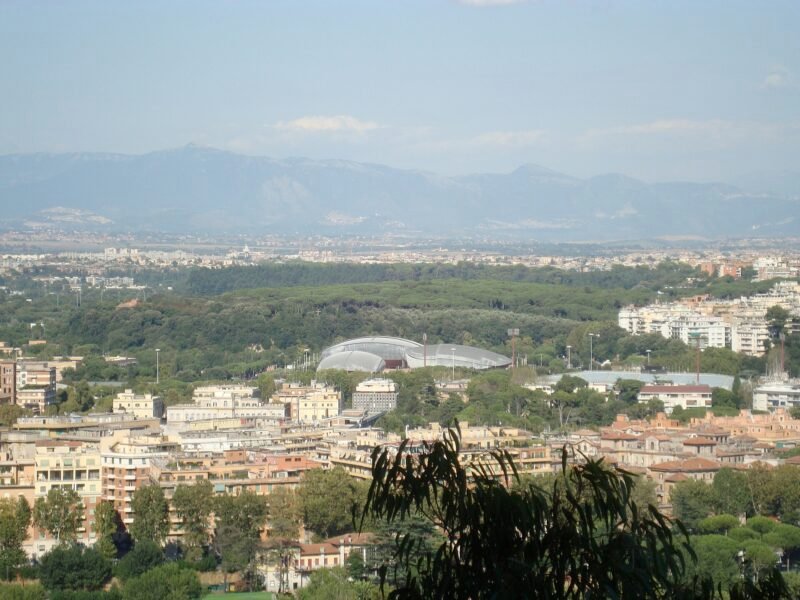
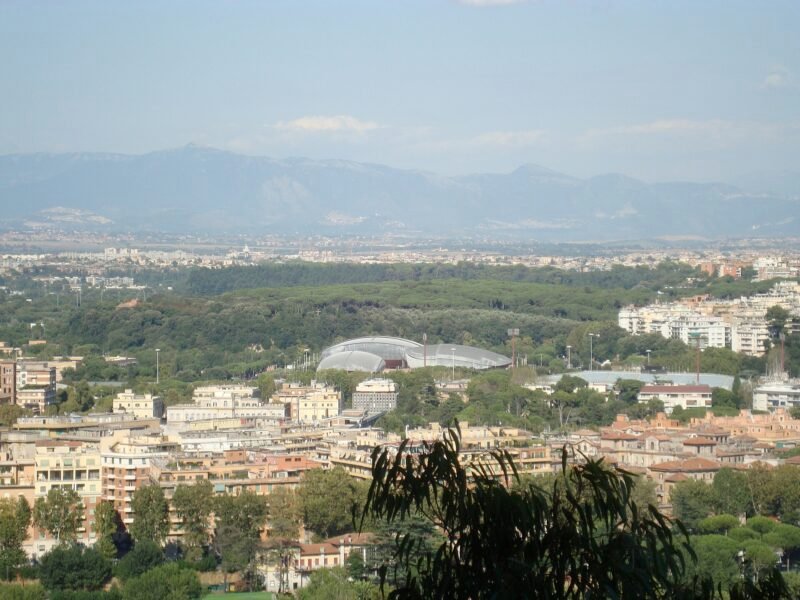
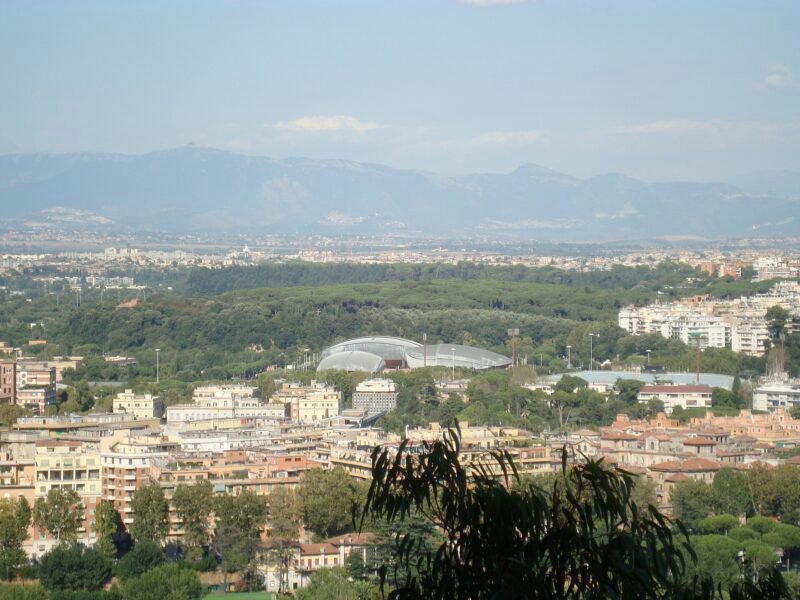
The Auditorium is at the western edge of Parioli, between Villa Glori, Villaggio Olimpico, the Corso di Francia viaduct and Viale Maresciallo Pilsudski, in an area shaped by the 1960 Olympics and by contemporary architecture.
Villaggio Olimpico
Villaggio Olimpico was built to house the athletes of the 1960 Rome Games. Not far away is Stadio Flaminio, designed by Antonio Nervi with his father Pier Luigi and inaugurated on March 19, 1959, for years the home of the Italian national rugby team.
MAXXI and Teatro Olimpico
A short distance away are MAXXI, the museum of 21st-century arts designed by Zaha Hadid, and Teatro Olimpico. If you arrive in the afternoon, you can combine a visit to the museum with the evening concert.
Villa Glori
Behind the Auditorium rises the hill of Villa Glori, opened to the public in 1924 as Parco della Rimembranza to a design by Raffaele De Vico. Since 1997 the park has hosted installations by contemporary artists.
Toward Piazza del Popolo
Along Via Flaminia, heading south, you reach Piazzale Flaminio and Porta del Popolo. If you have time before or after the concert, you can go as far as the Flaminio obelisk at the center of the square.
Some important events that happened here in history
The history of the place where Kyle Dixon and Michael Stein play begins long before the Auditorium. During the excavations on the building site, in November 1995, the remains of an ancient Roman villa emerged: work stopped and Renzo Piano's design was changed to incorporate it. That's why Sala Sinopoli today has a terrace next to it overlooking the archaeology.
On July 27, 1994, Piano's design had been declared the winner of the competition. In July 1999 the City founded the company Musica per Roma, transformed in 2004 into the foundation that still manages the complex. On April 21, 2002, the day of Rome's birthday, Sala Sinopoli, where the concert takes place, and Sala Petrassi were inaugurated. On December 21, 2002, it was the turn of Sala Santa Cecilia, with the Academy's orchestra conducted by Chung Myung-whun.
Since then the Auditorium has become one of the most visited cultural centers in Europe: in 2014 visitors were counted at more than 2 million. In 2006 it hosted the first Rome Film Fest, which has had its main venue here ever since. The bond between this complex and music for the screen is therefore long-standing. In 2020, after the death of Ennio Morricone, the complex was named after the composer: the most famous Italian film composer gives his name to the house where two American composers bring their music for television. Not far away, on the hill of Villa Glori, on October 23, 1867, around 70 Garibaldian volunteers led by Enrico and Giovanni Cairoli were defeated by the papal army.
How to plan the evening at the Auditorium
An evening with Kyle Dixon and Michael Stein at the Auditorium works well if you arrive at least half an hour before 20:00, better an hour if you want to eat in the complex.
Before the concert
The Auditorium has a foyer shared by the halls, bars, a café, a bar-restaurant also accessible from the street and a large bookstore. Arriving an hour early lets you grab something, take a walk in the cavea and stop by the archaeological terrace.
Where to eat nearby
To eat out, there are three convenient areas. Villaggio Olimpico and the area around Viale XVII Olimpiade have neighborhood pizzerias and trattorias. Via Flaminia, toward Piazza Mancini and toward Flaminio, offers restaurants and bars along the tram route. Ponte Milvio, to the north, is the liveliest area, with many places open until late.
After the concert
A 20:00 concert usually ends by 22:00. Tram 2 takes you back to Piazzale Flaminio, and from there metro A heads back to the center. If you feel like walking, you can head down toward Piazza del Popolo along Via Flaminia.
From outside Rome
If you arrive by train at Termini, you have two options: metro A to Flaminio and then tram 2, or bus 910 to Piazza Mancini. If you're staying overnight, a hotel in Flaminio or Prati cuts the trip back to a few minutes.
Private tours and experiences
For corporate groups, organized trips or V.I.P. evenings built around a concert, with transfers, dinner and a guided tour of the city on the same day, you can contact Tour Leader Pro.
Who has passed through Kyle Dixon and Michael Stein, The Music of Stranger Things at Auditorium Parco della Musica, November 19, 2026
First of all, Renzo Piano, who designed it, passed through the Auditorium. Its halls bear the names of Goffredo Petrassi and Giuseppe Sinopoli, the cavea that of Luciano Berio, the hanging gardens that of Claudio Abbado, the whole complex that of Ennio Morricone. On December 21, 2002, Chung Myung-whun conducted the Santa Cecilia Orchestra in the inaugural concert of the largest hall. Since then the Santa Cecilia orchestra and chorus have passed through here season after season, and since 2006 the directors and actors of the Rome Film Fest.
On November 19 Kyle Dixon and Michael Stein come through Sala Sinopoli, with visual direction by MFO, Marcel Weber. The music of a series followed all over the world becomes a concert in Rome's home of film music.
In the same weeks very different musicians pass through the Auditorium. On November 21, in Sala Petrassi, Steve Hackett, Genesis guitarist in the 1970s, tells his story with the band in an evening benefiting Emergency. On November 15 Gaia Banfi brings "L'ultima Maccaia" to Teatro Studio Borgna. And during the month the Roma Jazz Festival takes place, with its concerts spread across the halls. It's a good portrait of this place: a single week holds together English progressive rock, Italian singer-songwriters, jazz and Austin electronica.
Through the music of Dixon and Stein pass, ideally, the 1980s genre directors and composers the series looks to, and the audience of several generations that discovered that music in front of a screen.
Frequently asked questions about Kyle Dixon and Michael Stein in Rome
When do Kyle Dixon and Michael Stein play in Rome?
Kyle Dixon and Michael Stein play in Rome on Thursday, November 19, 2026, at 20:00, in Sala Sinopoli at Auditorium Parco della Musica Ennio Morricone, at Viale Pietro de Coubertin 30. The concert is devoted to the original music of "Stranger Things", from the first to the fifth season.
How much are tickets for The Music of Stranger Things at the Auditorium?
Tickets for The Music of Stranger Things at the Auditorium start at 40 euros, according to the official concert page. They're sold on the Auditorium Parco della Musica website, which links to the authorized presale circuit, or at the complex's box office, open from 11:00 to 20:00.
Who are Kyle Dixon and Michael Stein?
Kyle Dixon and Michael Stein are two American electronic musicians, members of the band S U R V I V E, formed in Austin, Texas, in 2009. They composed the score for "Stranger Things" and in 2017 won the Emmy for the original music of the series' main title theme.
Do you see scenes from the series at the concert?
The Kyle Dixon and Michael Stein concert isn't a screening of the episodes. The visual part is by the visual artist MFO, Marcel Weber, with lights, fog and images that create a stage environment. On stage are the two composers with their electronic instruments.
How do you get to Auditorium Parco della Musica?
You can reach Auditorium Parco della Musica by metro A to Flaminio and then tram 2 to Piazza Mancini, or by buses 910, 53, 168 and 982, or with the Roma Nord railway to Piazza Euclide. By car there are two paid parking lots.
Is the Stranger Things concert suitable for teens?
Yes, the concert at the Auditorium is suitable for teens who love the series. The rules require children under 16 to enter accompanied by an adult with a ticket, one for every two minors. Intense lights and fog are part of the show: if you're photosensitive, weigh it carefully.
Can you enter the hall after the concert has started?
No, the rules of Auditorium Parco della Musica allow entry until five minutes before the start. Once the show has begun, staff may seat latecomers in places other than those purchased. For the 20:00 concert, aim to be in the foyer by 19:30.
Last piece of advice: listen to the second S U R V I V E album the week before, get a central seat even if it costs a bit more, and arrive after dark to see the Auditorium lit up. The series is over. Its music, live, is another story.
Article written by the editorial team of Tour Leader Pro, contact them for Private/Corporate/V.I.P. Tours and Experiences.
Planning a trip to Rome? English guides to visiting the city are on ItalyPlanner.com.
Contact Information
Nearby
 Museum of Musical Instruments (MUSA)100 m
- Auditorium Parco della Musica100 m
- Villa Glori500 m
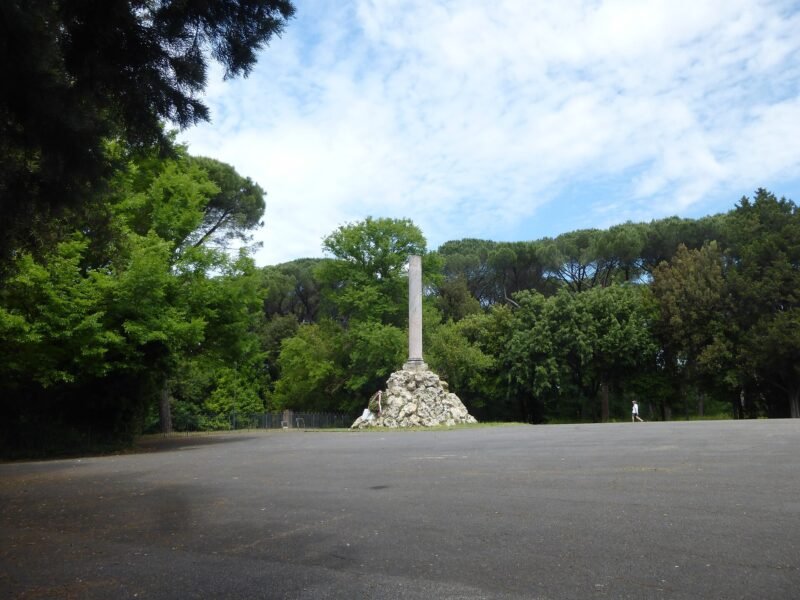
- Fountain of Anna Perenna500 m
- MAXXI – National Museum of 21st Century Arts700 m
- Flaminio700 m

Upcoming events nearby
- Roma Jazz Festival 2026, November 1 to 24 at the Auditorium and Casa del Jazz100 m
- Roma Gospel Festival 2026 at Auditorium Parco della Musica, December 13, 2026 to January 1, 2027100 m
- Santa Cecilia 2026/2027 Concert Season at Auditorium Parco della Musica, October 21, 2026 to June 5, 2027100 m
- Gaia Banfi, L’ultima Maccaia at Auditorium Parco della Musica, November 15, 2026100 m




You might also like
- Antonio Pappano conducts Petrassi and Tchaikovsky at Santa Cecilia, Auditorium Parco della Musica, November 19, 20 and 21, 2026
- The Queen of Rock, A tribute to Tina Turner at Teatro Olimpico, March 18 to 21, 2027
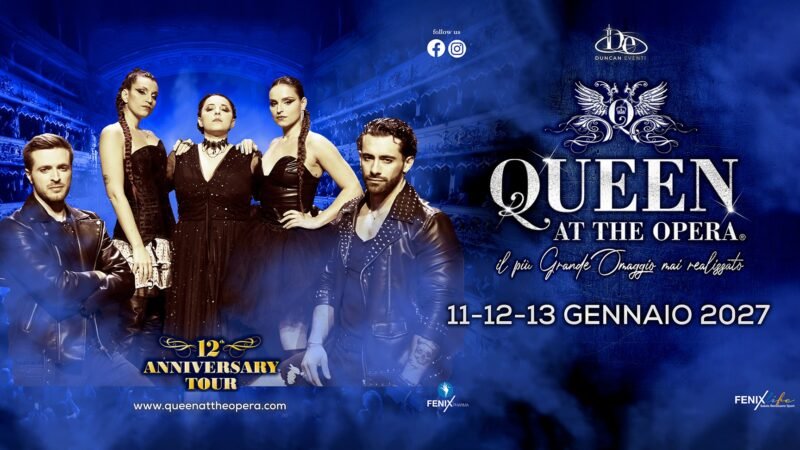
- Queen at the Opera: The Great Return at Teatro Olimpico, January 11 to 13, 2027
- Una Storia Unica: Banco del Mutuo Soccorso, Of New Trolls, Le Orme feat. Bernardo Lanzetti at Auditorium Parco della Musica, February 21, 2027
- Chiara Galiazzo in Nuova Luce at Auditorium Parco della Musica, December 17, 2026
- Chuck Ragan at Auditorium Parco della Musica, December 12, 2026