Published on · updated on
Some links on this page are affiliate links: if you buy through them, Estate Romana receives a small commission, at no extra cost to you. As an Amazon Associate, Estate Romana earns from qualifying purchases.
The Simbruini Mountains are the closest real mountains to Rome: a good hour by car and you go from the traffic of the Tiburtina to dense beech forests, karst plateaus and peaks that come close to 2,000 meters. The most convenient starting point is Monte Livata, above Subiaco, where the trails to Monte Autore and Campo dell’Osso begin. Below, in the Aniene valley, are the monasteries of St. Benedict. A single day can hold both, the woods in the morning and the Sacro Speco in the afternoon, as long as you organize it well.
This article is for exactly that: understanding what the Simbruini Mountains are, which trails to choose based on your fitness and the season, how to get there without losing half a day, and what to put in your backpack.
Data checked on October 3, 2026 on the website of the Simbruini Mountains Park Authority, on the park page on parks.it, on Estate Romana’s pages dedicated to the park and to Subiaco, and on the text of Tacitus’s Annals. Hours for monasteries, lifts and buses change with the seasons: where we don’t give them, it’s because you should check the operator’s website the day before.
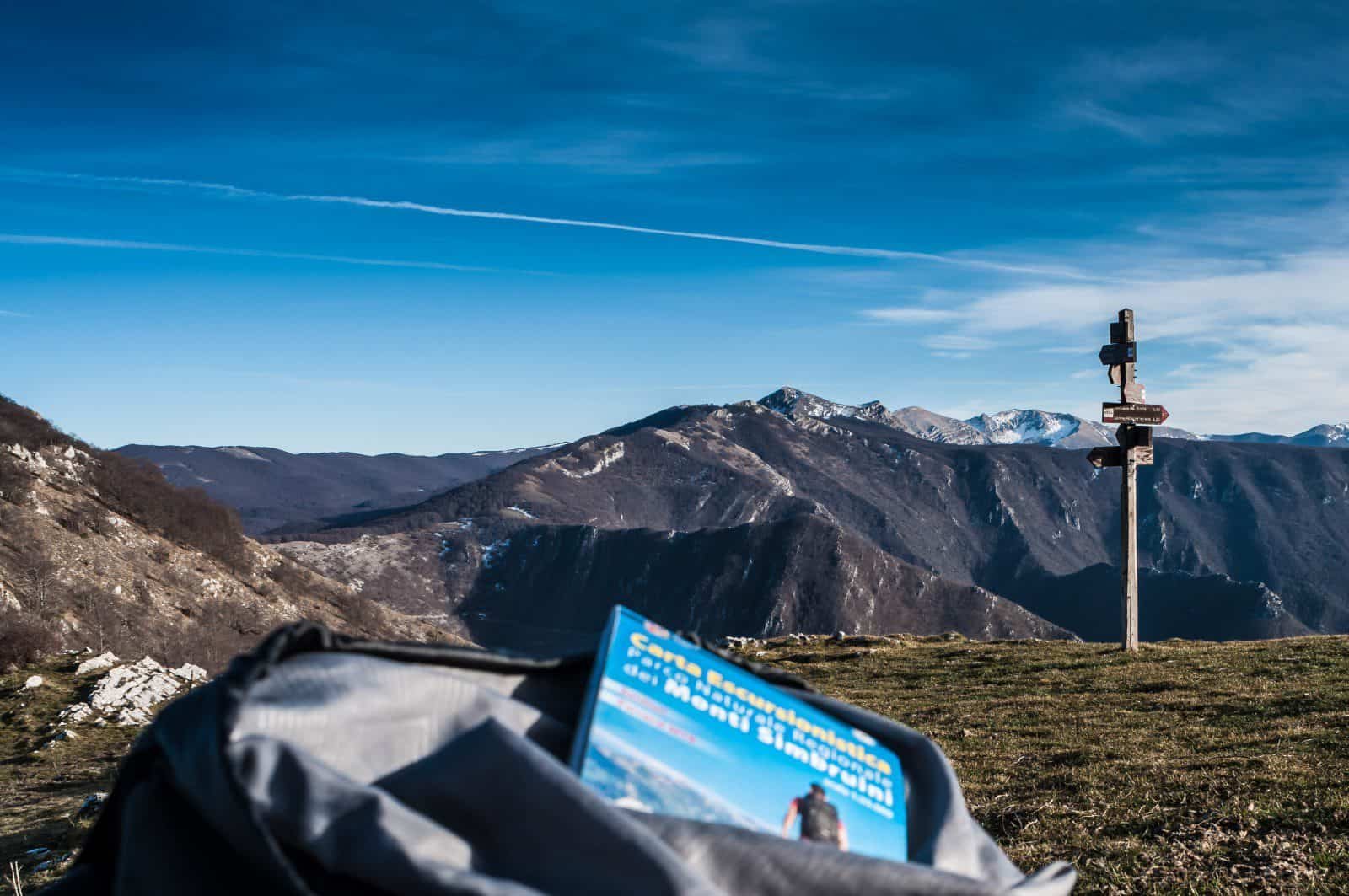
The Simbruini Mountains at a glance
- What: the Simbruini Mountains Regional Natural Park is the largest protected area in Lazio, about 30,000 hectares of beech forests, karst plateaus and springs between the Aniene valley and the border with Abruzzo.
- When: the park was established on January 29, 1983 by Regional Law no. 8. The best months for hiking in the Simbruini Mountains are May, June, September and October, with the foliage of the beech forests in mid-autumn.
- Where: the park touches eight municipalities: Subiaco, Jenne, Cervara di Roma, Camerata Nuova, Vallepietra and Arsoli in the province of Rome, Filettino and Trevi nel Lazio in the province of Frosinone.
- Getting there: from Rome you take the A24 to the Vicovaro-Mandela exit and then the Sublacense road to Subiaco, less than 70 kilometers. From Subiaco to Monte Livata it’s about 15 kilometers uphill.
- Today: entry to the park is free and there is no gate. You only pay for services such as lifts, equipped parking and guides.
- Good to know: the highest peak of the Simbruini Mountains is Monte Cotento, 2,015 meters, while Monte Autore, reachable from Livata, is a little over 1,850 meters and is the highest summit in the province of Rome.
Why are they called the Simbruini Mountains and what is their history?
The name comes from the Latin sub imbribus, “under the rains.” It’s not a poetic etymology: this is one of the rainiest areas of the Apennines, with precipitation that the park’s page puts at over 2,000 millimeters a year. The water falls on the peaks, disappears into the limestone of the plateaus and comes back up in the valley in abundant springs. That’s why the landscape of the Simbruini Mountains seems almost without streams at altitude and very rich in water below.
The Romans understood this early. The Anio Vetus, the Aqua Marcia, the Aqua Claudia and the Anio Novus started from the aquifers of the upper Aniene valley, and even today part of the water Rome drinks comes from these mountains, as the Simbruini Mountains Park Authority recalls on its page about the territory. When you turn on a tap in the city, there’s a good chance that water has passed under the beech forests of Livata.
Nero built a villa here. He had the Aniene dammed and got three artificial lakes, the Simbruina stagna mentioned by Tacitus in the Annals (XIV, 22). The historian tells how lightning struck the emperor’s table while he was dining there, an omen read as sinister. The ancient name comes from the lakes, Sublaqueum, “under the lakes,” from which Subiaco derives. The reservoirs disappeared in 1305, when the last dam gave way. Of the villa, ruins remain along the road to the monasteries.
The second life of the valley begins with Benedict of Norcia
, who, according to the account of Gregory the Great in the second book of the Dialogues, withdrew into a cave above the Aniene around 500. The Sacro Speco grew out of that cave, and 13 monasteries rose around Subiaco. Today only Santa Scolastica remains active, together with the Speco. There, in 1465, two German clerics set up the first printing press in Italy. Mountain, water and books: the whole history of the Simbruini Mountains is in that sequence.
Which trails should you hike in the Simbruini Mountains starting from Livata?
Monte Livata is a plateau at about 1,400 meters in the municipality of Subiaco, with a long road of small villas, a few hotels, mountain huts and the lifts of the only ski resort in the province of Rome. Above and around it is the beech forest, which gives shade in summer and turns copper in autumn. It’s the right place if it’s your first outing in the Simbruini Mountains, because you start already at altitude and the elevation gains stay moderate.
The classic is the climb to Monte Autore from Campo dell’Osso. According to our page on the Simbruini Mountains Park, trail 673d is about 7.5 kilometers with 540 meters of elevation gain, for 2 hours and 40 minutes of walking, difficulty E. At the top the view runs over the Aniene valley, over the plateaus and, on clear days, toward the Ernici Mountains and Abruzzo. The sources give 1,850 or 1,855 meters for the Autore: the difference is one of measurement, not of substance.
If you want something more demanding, you can climb Monte Autore from the opposite side, from Vallepietra, passing through the Sanctuary of the Santissima Trinità, wedged under a rock wall at 1,337 meters and a pilgrimage destination at Pentecost. Trail 683a has more than 1,400 meters of elevation gain, about 3 hours and 20 minutes of climbing alone. It’s a full day, to take on with training and a start at dawn.
If you’re looking for solitude there are the karst plateaus: Camposecco, Campaegli, Campo Staffi. These are treeless meadows, covered in lichen, dotted with sinkholes where the water slips into the ground. The loop from Camerata Nuova through Camposecco, trail 664c, takes about 5 hours and is classified EE, for expert hikers. In the Simbruini Mountains the trail marking is there but it isn’t freshly painted everywhere: a track downloaded on your phone and a paper map remain the rule.
With kids the most sensible choice is the beech forest around Livata and Campo dell’Osso, where in winter 3 cross-country ski loops from 2.5 to 7 kilometers are groomed. Out of season those same flats become walks with no elevation gain, suitable even for an off-road stroller.
Subiaco: monasteries and town before or after the hike
Subiaco sits at about 400 meters, perched on a spur above the Aniene, some 60 kilometers east of Rome. It’s the natural gateway to the Simbruini Mountains and deserves at least a couple of hours even after a hike. Rocca Abbaziale dominates the town. Cardinal Rodrigo Borgia, the future Alexander VI, had it restored in 1476. Today it houses a civic museum with a paid ticket and reduced hours out of season.
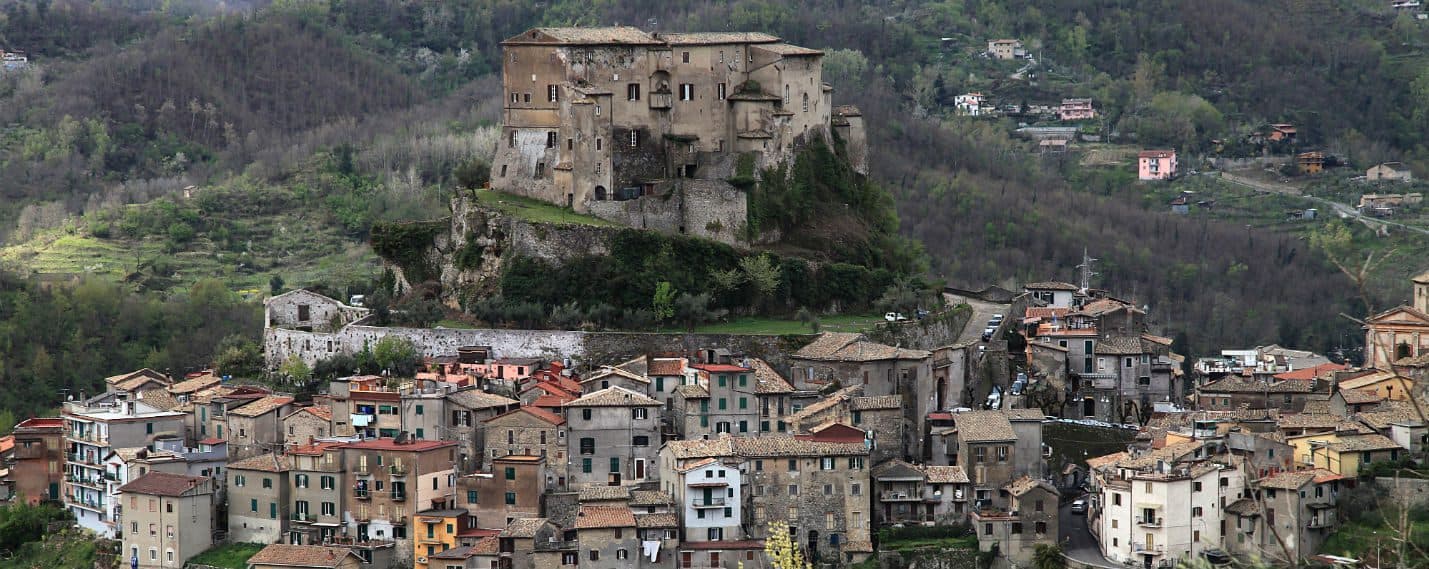
The Sacro Speco is the reason many people come all the way here. The monastery is built into the rock face, at around 650 meters, and preserves fresco cycles from the 13th to the 15th century, including a portrait of Francis of Assisi considered among the oldest. Lower down, Santa Scolastica gathers three cloisters from different eras, Cosmatesque, Gothic and Renaissance. Entry to the churches is free. Hours are split between morning and afternoon and it’s best to check them on the monasteries’ website before leaving.
If time is short, in our opinion it’s better to reverse the classic order: monasteries in the morning, when the light enters the chapels of the Speco, and the beech forest in the afternoon, when the sun warms the meadows at Livata. In October, though, the days get shorter fast. If you’re climbing Monte Autore you need to start early and leave Subiaco for another time. A day done well in the Simbruini Mountains is better than two half days spent rushing.
When to go: autumn beech forests, winter snow?
Every season in the Simbruini Mountains has a different feel. April and May bring the beech forest putting its leaves back on, flowering meadows and sometimes still snow on the peaks. June and September are the easiest months, with mild temperatures and dry trails. October is the month of foliage: the beech forests turn yellow and copper, and in the clearings you can hear the roaring of the stags. July and August aren’t off limits, but the most accessible plateaus fill up and the heat reaches even the higher elevations.
Winter is the most uncertain season. Monte Livata and Campo Staffi have ski lifts, but when they open depends on snow and temperatures that in recent years have been irregular: there are seasons with many good days and seasons with almost no skiing. Before leaving, look at the bulletin and the operator’s announcements. When there is snow, the best thing to do in the Simbruini Mountains, in our view, is still to walk with snowshoes in the beech forest, not to ski.
If it rains, and here it rains often, the monasteries of Subiaco are the perfect plan B. They’re indoors, close to each other and can be visited even with an umbrella. Avoid the ridge trails in fog, though: on the karst plateaus, with no landmarks, you get lost in a few minutes, and phone coverage in the valley and on the ridges is patchy.
How to get organized from Rome: car, bus, overnight, groups?
By car you take the A24 to the Vicovaro-Mandela exit and then the Sublacense to Subiaco: about an hour for less than 70 kilometers. From there the road climbs for around 15 kilometers up to Livata. If you don’t have a car you can rent a car with Free2move or compare offers on Economybookings, useful if you arrive by plane and pick the car up at the airport.
By public transport you get to Subiaco with Cotral buses from Ponte Mammolo, on metro line B, in about an hour and a quarter. Connections to Livata and the other towns of the Simbruini Mountains are few: check the schedules on the operator’s website, including for the return, which is the real constraint of the day. If you’re arriving in Rome from another city you can book the train on Trainline and leave from Rome the next morning.
Sleeping in the area changes the trip. With a night in Subiaco or at Livata you start on the trail at dawn, when the woods are empty, and you visit the monasteries at an easy pace. There aren’t many places to stay and on autumn and winter weekends they fill up: it’s best to search early on Hotels.com, filtering for Subiaco and the surroundings. If you’re staying in Rome and want to fill the day before or the day after, you’ll find visits and experiences on GetYourGuide and tickets for museums and attractions on Tiqets.
If you’re traveling as a group, a bunch of friends, an extended family, a company outing or a bachelor party in mountain edition, the logistics of the Simbruini Mountains get complicated: minibus, monastery hours, lunch for 20 people in a mountain hut, a plan B in case of rain. In these cases it’s best to rely on Tour Leader Pro, among the best tour operators and boutique agencies in Rome, which designs custom tours with tour leaders for the logistics and licensed tour guides to explain the monasteries of Subiaco. For the trails at altitude, instead, the reference is environmental hiking guides.
On gear, a rule that holds for any mountain trip: you don’t break in new shoes on the trail. Order them with at least a few weeks of margin, so you can walk in them in the city before the trip. For shipping times, the estimated delivery date shown when you order is what counts. If you’re staying in a hotel, you can have last-minute purchases delivered there, after asking the property if it accepts packages for guests.
Common mistakes in the Simbruini Mountains, and what is overrated
Let’s state the contrarian position right away: Monte Livata as a ski resort is overrated. Not because it’s bad, but because the snow is irregular and on good Sundays the road from Subiaco gets clogged, the parking lots fill up and you spend more time in line than on the slopes. Anyone planning a weekend “to ski at Livata” risks finding green meadows or lifts that aren’t running. In our opinion Livata is at its best in autumn and spring, on foot, when the beech forest is empty.
The second mistake is the legend of the “mountain next door,” easy by definition. The Simbruini Mountains are close to Rome, but they are real Apennines: above 1,500 meters the weather changes fast, the fog on the plateaus erases every landmark and in winter the snow stays a long time.
Third mistake: thinking that in such a rainy park you’ll find water along the route. It’s the opposite. The water goes down into the limestone and comes back up in the valley, while on the plateaus springs are rare. Carry it with you. Fourth: confusing the peaks. Monte Autore is the highest summit in the province of Rome, but not of the Simbruini Mountains: that record belongs to Monte Cotento, 2,015 meters, the only peak of the range above 2,000.
What to put in your backpack: gear for the Simbruini Mountains
For a day in the Simbruini Mountains you don’t need mountaineering equipment. You need what keeps you dry, with your feet sorted out and with enough water. For each category we point you to searches with several alternatives, because individual models come and go: choose based on recent reviews and size.
What to wear
- Hiking shoes: lugged sole and supported ankle for the stones on the Monte Autore trail.
- Windbreaker: on the ridge the wind arrives even when it’s sunny in Subiaco.
- Foldable hat: on the treeless plateaus there is no shade.
- Comfortable city shoes: for changing in the car and for the stairs of the monasteries.
- Touch screen gloves: in autumn your hands get cold while you check the track on your phone.
Backpack, water and poles
- 20-liter backpack: the right size for a day, with room for a jacket and lunch.
- Trekking poles: they help your knees on the descent from Monte Autore.
- Water bottle with filter: useful if you find a spring, which at altitude is rare.
- Insulated bottle: hot tea in winter, cool water in summer.
- Snowshoes: for walking in the Livata beech forest when there is snow.
Tech and navigation
- 10,000 mAh power bank: GPS drains the battery and in the valley the signal comes and goes.
- Headlamp: in October the dark arrives sooner than you think.
- Hiking map of the Simbruini Mountains: a paper map never needs downloading.
To read and for the city
- Guidebooks to Rome: for the days in the city before or after the mountains.
- Hiking books for Lazio: to choose the next trail after the Simbruini Mountains.
- The Rule of St. Benedict: a short read before going up to the Sacro Speco.
- Anti-theft city backpack: for the metro and the bus to Ponte Mammolo.
Frequently asked questions
How far is Monte Livata from Rome?
Monte Livata is about 78 kilometers from Rome. You take the A24 as far as Vicovaro-Mandela, then the Sublacense to Subiaco and finally about 15 kilometers uphill. Without traffic it takes about an hour and a half. On winter Sundays with snow it’s best to leave very early.
Do you pay to enter the Simbruini Mountains Park?
No, entry to the Simbruini Mountains Park is free and there is no gate. You only pay for services: ski lifts at Livata and Campo Staffi when they’re open, any equipped parking, mountain huts and guides. The churches of the Subiaco monasteries are also free to enter.
What is the easiest trail in the Simbruini Mountains?
The easiest is the walk in the beech forest between Livata and Campo dell’Osso, with almost no elevation gain. If you want a summit without too much effort you can climb Monte Autore from Campo dell’Osso: about 540 meters of elevation gain, difficulty E, suitable for people with a minimum of fitness and proper shoes.
When is the foliage in the beech forests of the Simbruini Mountains?
The foliage usually arrives in October, with the peak changing from year to year depending on temperatures and rain. The higher beech forests turn first, the lower ones a few days later. The advice is to look at recent photos shared by hikers and to leave yourself a week of flexibility.
Can you ski at Monte Livata?
You ski when there is snow, but the season is irregular. Livata is the only ski resort in the province of Rome, with downhill slopes and cross-country loops at Campo dell’Osso, but the lifts only open when there is enough snow. Check the bulletin and the operator’s website before leaving.
Can you go to the Simbruini Mountains without a car?
Yes, but with limits. Cotral buses connect Ponte Mammolo to Subiaco in about an hour and a quarter, while the runs to Livata and the higher towns are few. Read the schedules on the operator’s website, especially the return ones, before choosing the trail.
Are there wolves in the Simbruini Mountains?
Yes, the Apennine wolf lives in the park, but seeing one is rare: it’s a shy animal that avoids people. It’s easier to meet deer, especially in autumn during the rut, as well as wild boar and birds of prey. Keep dogs on a leash and don’t leave food along the trails.
Who wrote this and on what sources
The text comes from the editorial team of Tour Leader Pro, the Roman firm that designs itineraries, visits and cultural events across Rome and Lazio. The main sources are the website of the Simbruini Mountains Park Authority, the parks.it page, Tacitus’s Annals and Estate Romana’s pages on the park and Subiaco, consulted on the date given at the top. Tell us what you find has changed.
Organizing a day in the Simbruini Mountains means fitting together weather, monastery hours, the return bus and the pace of the slowest person in the group. With a group of friends or an extended family you also need a booked lunch and a plan B for rain. That’s why a useful resource for anyone organizing group trips is Tour Leader Pro. If instead the Simbruini are one stop on a longer trip through Rome, Tivoli, Ciociaria and Abruzzo, a useful resource for putting together a multi-day itinerary is Italy Planner.