Published on · updated on
Some links on this page are affiliate links: if you buy through them, Estate Romana receives a small commission, at no extra cost to you. As an Amazon Associate, Estate Romana earns from qualifying purchases.
Sabina by Vespa can be done in a day, starting from Rome: you leave the city along Via Salaria, leave it as soon as possible for the provincial roads among the olive groves, and head up toward Farfa, Fara in Sabina, Toffia and Casperia, with Rieti and the springs of Cotilia as an extension for those who have two days. October and November are the right months, because the olive harvest has begun, the oil mills are working and the air is cool without being cold.

The route brings together three things that are rarely found so close to the capital: a road the Romans already considered ancient in the time of Pliny, an oil that was among the first in Italy to get the Protected Designation of Origin, and hilltop villages where you park the scooter in front of the square. You travel at hill speed, you stop often, you eat lunch early.
Data checked on October 3, 2026 against the Sabina DOP oil production specification, the “Salaria, via” entry of the Enciclopedia Italiana Treccani, the website of the Soprintendenza for the archaeological area of the Baths of Vespasian, the official website of Farfa Abbey and the tourism pages of the municipality of Castelnuovo di Farfa. Hours and openings change with the seasons: where not indicated, the operator’s website is what counts.

Sabina by Vespa in brief
- What: a tour of Sabina by Vespa or scooter among olive groves, abbeys and hill villages northeast of Rome, following in part the route of the ancient Via Salaria.
- When: the best period runs from mid-October to late November, when the Sabina DOP olive harvest is underway (the specification sets it between October and January) and the oil mills are active.
- Where: the classic stops are Farfa Abbey, Castelnuovo di Farfa with Museo dell’Olio della Sabina, the monumental olive tree of Canneto Sabino, Fara in Sabina and, for those who continue, Rieti and the Baths of Cotilia.
- Getting there: from Rome you leave on Via Salaria (Strada Statale 4) and leave it at Passo Corese for the provincial roads of Sabina. If you don’t have a scooter you can arrive by train at Fara Sabina station and rent in the area.
- Today: the Sabina DOP designation covers 32 municipalities in the province of Rieti and 15 in the province of Rome, so the oil is bought directly at the oil mills along the route.
- Good to know: with a B license in Italy you can drive scooters up to 125 cc, but the four-lane stretch of the Salaria near Rome is busy and poorly suited to a light vehicle.
Why is Via Salaria the right road for Sabina by Vespa?
The Salaria is the only Roman consular road that carries in its name a commodity instead of a builder. The name comes from salt, which went inland from the salt pans at the mouth of the Tiber, toward the Sabines and beyond. The Enciclopedia Italiana entry also recalls that, according to Pliny, there was in ancient times a treaty between the Sabines and the Picenes for the free trade of salt: a sign that the road was an economic artery even before it was a Roman work.
From Rome the Salaria left through the Porta Collina of the Servian Walls and, later, through the Porta Salaria of the Aurelian Walls. The stops listed in the ancient itineraries can still be found on the map: Fidenae at the fifth mile, Eretum at the 19th, Reate, that is Rieti, at the 49th, Cutiliae at the 58th, then Interocrium, present-day Antrodoco
, and finally Asculum. In all about 170 Roman miles to the Adriatic, at the level of Porto d’Ascoli.
For those traveling on two wheels the advantage is practical: the Salaria runs in the valley of the Tiber and then of the Farfa, and to the right and left roads open up that climb into the hills. You can do a loop without ever coming back on the same roadway, and every detour leads to a different village. That’s why Sabina by Vespa works better than many tours of the Castelli Romani, where the weekend traffic is thicker.
What makes Sabina oil special?
Sabina extra virgin olive oil obtained the Protected Designation of Origin with EC Regulation No. 1263 of July 1, 1996, among the first Italian DOPs for oil. The specification establishes that at least 75% of the olives must come from local varieties such as Carboncella, Leccino, Raja, Pendolino, Frantoio, Moraiolo, Olivastrone, Salviana, Olivago and Rosciola. The oil yield cannot exceed 25% of the weight of the harvested olives, and the harvest runs from October to January.
The area is wide and crosses two provinces: 32 municipalities in the Rieti area and 15 in the province of Rome. In practice, once you’ve crossed the Tiber north of Monterotondo, almost every hill you see from the saddle is planted with olive trees. The landscape is made of terraces, dry-stone walls and very old trees, some of which were planted when the area was administered by the monks of Farfa.
The advice is to go after mid-October and to ask at the oil mills when they’re pressing. Many sell the new oil just pressed, and tasting it on a slice of bread in the milling room is worth more than any organized tasting. Bring a sturdy bag: the three or five liter tins are heavy, and under the seat of a scooter there is little room.
Where to go: the stops of a Sabina tour by Vespa
Farfa Abbey
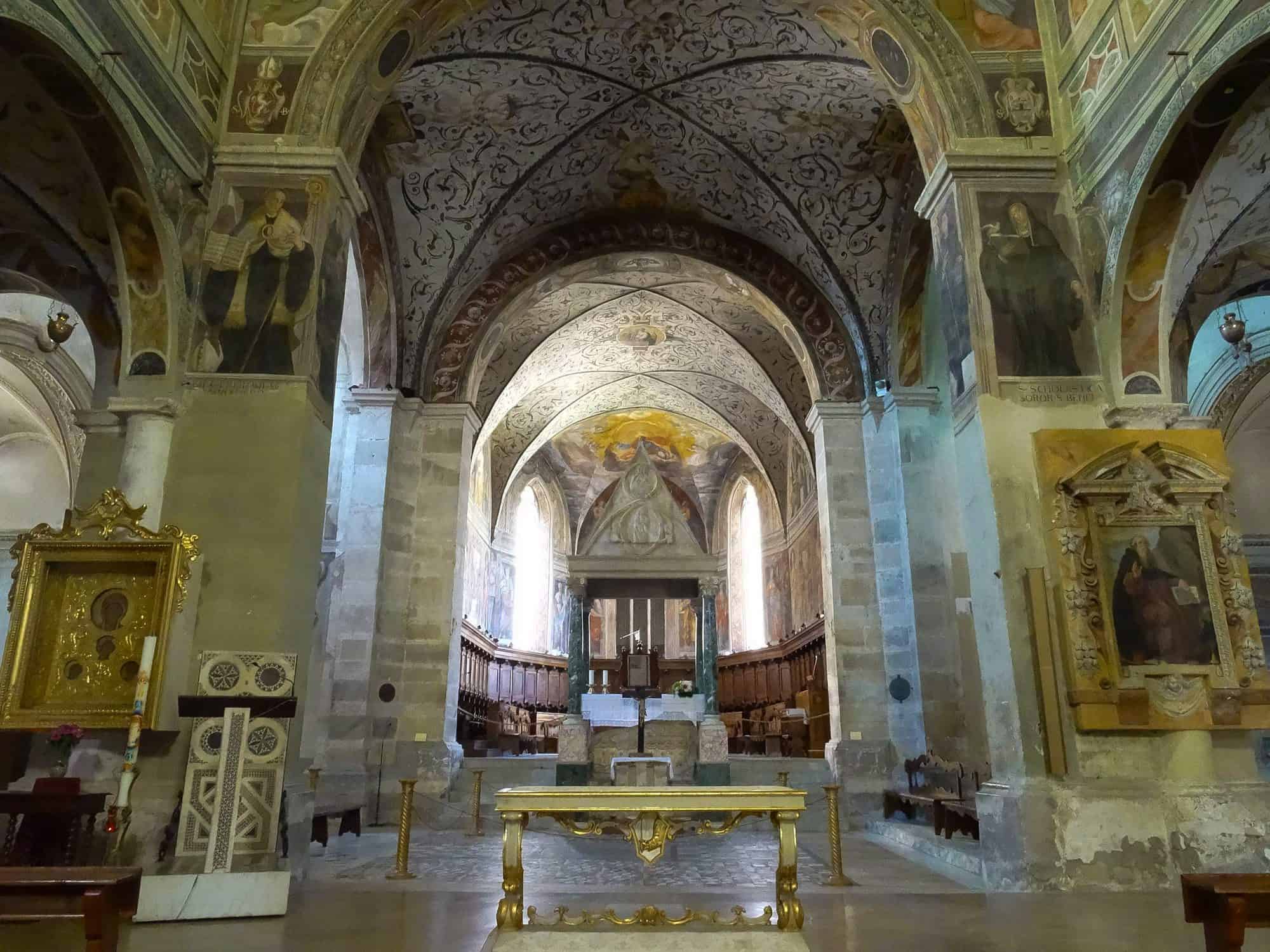
It’s the historic heart of the area. The Benedictine abbey dominated a vast territory for centuries, and the village around it keeps the shops lined up along the access road. Visits inside are made with the staff of the Abbey’s Cultural Services: hours change between daylight saving time and standard time, and it is closed on Mondays, so check the official Farfa Abbey website before leaving.
Castelnuovo di Farfa and the Oil Museum
A few kilometers from the abbey, Museo dell’Olio della Sabina occupies the 1500s Palazzo Perelli and tells the story of olive growing with installations by contemporary artists next to traditional tools. It opens on weekends and holidays, while on weekdays it can be visited by reservation. Updated hours and prices are on the Castelnuovo di Farfa tourism pages.
The olive tree of Canneto Sabino
In the hamlet of Canneto, in the municipality of Fara in Sabina, grows the olive tree that many call the largest in Europe: the reported measurements speak of over seven meters of circumference at one meter above the ground and a canopy some 30 meters wide. On its age, however, the sources do not agree, and we talk about it further on. It’s reached by a narrow road: with the Vespa it’s easier than by car.
Fara in Sabina, Toffia e Casperia
Fara sits on top of a hill and looks over the Tiber valley as far as Soratte. Toffia is a compact village of stone alleys, Casperia one of the most scenic in the province, with the houses arranged in a ring around the summit. All three have parking at the edge of the historic center, where you leave the scooter and continue on foot. The roads between one village and another are the best of the tour.
Rieti and the Baths of Cotilia
Those with two days continue on the Salaria as far as Rieti, ancient Reate, and then toward the San Vittorino plain. Here are the springs of the Aquae Cutiliae: the modern facilities are in the municipality of Castel Sant’Angelo, the ancient remains in that of Cittaducale. The Soprintendenza describes the area as Baths of Vespasian, with a large swimming pool of about 60 by 34 meters.
The link with the emperor is told by Suetonius: in 79 AD, struck by fever in Campania, Vespasian went back to the countryside of Cutilia and Rieti, where he spent his summers, and the use of the cold waters supposedly worsened his illness. He died there. For more ideas around the capital there’s our near Rome section.
Is the Canneto olive tree really 2,000 years old?
It’s the most repeated legend in all of Sabina, and in our opinion it needs to be scaled back. Many signs and websites talk about a tree more than 2,000 years old, almost the same age as the Roman Via Salaria. The most cautious estimates place it around the year 1000 instead, coinciding with the land reclamation promoted by the monks of Farfa, and analyses attributed to researchers at the University of Tuscia point to an even younger age, maybe 700 or 800 years.
It changes nothing for those who go to see it: it’s still a huge tree, still productive, and its story is tied to that of the abbey. But be wary of anyone who sells oil from “the 2,000-year-old tree” as if it were established fact. The age of monumental olive trees is hard to measure, because the inner wood hollows out over the centuries, and round numbers should always be taken with caution.
The other common mistake is about the road. Many people think that doing Sabina by Vespa means riding the Salaria from start to finish. On the stretch near Rome the state road has four lanes, with trucks and fast cars: on a 125 scooter it’s stressful and not very safe. My advice is to go as far as Passo Corese, or to load the bike on a vehicle, and start the real ride on the provincial roads.
How do you organize a Vespa trip to Sabina?
The first choice is the vehicle. If you already have a scooter in Rome, the ride starts from your door. If you’re coming from elsewhere, there are two ways: rent a car or a scooter in the city through platforms like Free2move, or compare car rental offers on Economybookings and reach Sabina by car, looking for a scooter locally.
If you don’t want to drive all the way to the villages, you can take the regional train line from Rome to the Fara Sabina station: tickets and schedules are available on Trainline or on the railway operator’s website. From there you can reach Farfa and the nearby villages. For Rieti, on the other hand, the most direct connection with Rome is by road, with schedules on the transport company’s website.
As for duration, here is the realistic time budget: one full day for Farfa, Castelnuovo, Canneto and a village of your choice, leaving Rome early in the morning. Two days if you want to add Rieti and Cotilia, with a night in Rieti or at an agriturismo. For a place to stay you can compare properties on Hotels.com, booking a few days ahead on November weekends.
If you’re traveling as a group, with friends, family or for a company outing, a bachelor party or a wedding in Sabina, coordinating vehicles, lunches at the olive mill and visits becomes a job in itself. For a custom tour, contact Tour Leader Pro, one of the best tour operators and boutique agencies in Rome, which organizes itineraries with professional tour leaders and, for explanations inside the abbey and at archaeological sites, with selected licensed tour guides.
When to order your gear
The article comes out right before the best season, so if you plan to leave in the next few weeks, order your helmet, gloves and phone mount right away. What counts is the estimated delivery date at the time of the order: if you’re staying at a hotel in Rome, ask the front desk first if it accepts packages in your name. A helmet has to be tried on, so leave time for a possible size exchange.
For couples, families and solo riders
For a couple, the classic ride is perfect on a Vespa 125 with a passenger, as long as you travel light: one small backpack each and the top case for the oil. The stops are frequent and short, and lunch at an agriturismo between Farfa and Toffia becomes the center of the day. If you’re riding alone, Sabina is quiet and the roads see little traffic on weekdays.
With children the scooter has clear limits: the passenger must reach the footrests with their feet and wear an approved helmet in the right size. For a family with small children, in our opinion, it’s better to do the same route by car and choose short stops: the olive oil museum, the big olive tree, a village with its square. The pace stays the slow pace of the hills. To eat in Rome before leaving or when you get back, there’s the Estate Romana restaurant map.
What should you do if it rains or you don’t have a scooter?
Sabina in fall can be rainy, and with wet asphalt and leaves on the curves the scooter loses a lot of its appeal. In that case my advice is to move the trip, or do it by car and focus on the indoor visits: the Abbey of Farfa, the Olive Oil Museum, a working olive mill. The three stops are within a few kilometers and fill a day comfortably.
If you still want the Vespa experience but don’t feel like riding outside the city, the solution is a scooter tour inside Rome with a local operator: you can find them on GetYourGuide, along with day trips to the surrounding area. For museums and ticketed attractions there’s also the catalog of Tiqets, useful to round out a weekend in Rome.
What to bring for Sabina by Vespa: gear and ideas
The list below comes from the concrete needs of a day on a scooter in the hills: protection, visibility of the road, power for the phone, room to carry the oil home. For each category we suggest several alternatives, because individual models often sell out. No prices: they change constantly, so check them when you buy.
What to wear in the saddle
- Jet helmet: the best model for the Vespa, light and with a good field of view. Check the approval.
- Jet helmet with long visor: protects your face better from wind and insects on the faster stretches.
- Modular helmet: a more protective alternative if you also ride the stretch of the Salaria to Rieti.
- Motorcycle gloves: in fall the mornings are cool, and in a slide your hands are the first thing to touch the ground.
- Motorcycle jacket: better with protective pads and a removable lining, to adapt to the warm hours.
- Motorcycle rain gear: it takes up little space under the seat and saves the day if the weather turns.
- Comfortable city shoes: closed, with a sole that grips, for riding and then walking in the alleys of the villages.
To see the road well
- Motorcycle goggles: essential with a jet helmet without a visor, against wind and dust.
- Photochromic goggles: they adjust to the shift between sun and shade in the olive groves.
- Polarized sunglasses: useful on foot too, in the sunny squares of the villages.
Tech
- Smartphone mount for scooters: to follow the navigation on the provincial roads without stopping at every fork.
- Waterproof mount: protects the phone from rain and humidity.
- 10,000 mAh power bank: navigation uses a lot of battery, and in the countryside outlets are not easy to find.
- Helmet intercom: to talk with your passenger or hear the navigation directions.
What to carry in your backpack
- Anti-theft backpack: compact, with hidden zippers, handy in Rome too before and after the trip.
- Insulated water bottle: cold water or a hot drink on November mornings.
- Foldable hat: it fits in a pocket and comes in handy when you walk through the villages in the sun.
- Foldable cooler bag: to bring home cheese and new oil without temperature swings.
To read
- Guidebooks to Rome: to prepare the days in the city before or after the trip to Sabina.
- Guidebooks to Lazio: useful for extending the ride toward Rieti, the Valle Santa and the lakes.
- Books on Sabina: history, abbeys and landscapes of the area between the Tiber and the Velino.
- Books on extra virgin olive oil: to learn how to taste it before you walk into an olive mill.
Travel, vehicles and lodging
- Free2move: rental and shared mobility to get out of Rome.
- Economybookings: comparison of car rental offers, useful if you prefer four wheels.
- Trainline: regional train tickets from Rome to Fara Sabina.
- Hotels.com: hotels and agriturismi in Rieti and Sabina for the two-day version.
- Experiences in Rome on GetYourGuide: Vespa tours in the city and day trips.
- Rome attractions on Tiqets: tickets for museums and monuments to pair with the trip.
Frequently asked questions
How long does a Vespa ride around Sabina from Rome take?
One full day is enough for Farfa, Castelnuovo di Farfa, the Canneto olive tree and a village of your choice. It’s best to leave early in the morning to avoid the outbound traffic on the Salaria and get back before dark. With two days you add Rieti and the Terme di Cotilia, sleeping in Rieti or at an agriturismo in the area.
Do you need a special license to ride a Vespa 125?
In Italy a category B license allows you to ride scooters up to 125 cc. If you have a license issued abroad, check the rules of your own country and the conditions of the rental company, which may be stricter. For larger engine sizes you need the license for the corresponding motorcycle category, and an approved helmet is always mandatory.
What is the best time to go to Sabina for the oil?
From mid-October to the end of November. The Sabina DOP specification sets the harvest between October and January, but it’s in the first weeks that the olive mills work at full speed and you find the new oil freshly pressed. The weather in that period is still suitable for a scooter in the middle hours of the day.
Can you visit the Abbey of Farfa without booking?
For individual visitors and small numbers, usually yes: visits are held with the abbey staff at fixed times. The time slots change between daylight saving time and standard time, and it’s closed on Mondays. For large groups, a reservation is required. Always check the official website before leaving, because the hours may change.
Can you ride Via Salaria by scooter all the way to Rieti?
You can, but the stretch near Rome has four lanes and heavy traffic, not very pleasant on a light scooter. My advice is to reach Passo Corese and follow provincial roads from there, getting back on the state road only where needed. Past Rieti, toward Cotilia and Antrodoco, the road gets quieter and more scenic.
How do you bring the oil home on a Vespa?
With the top case or a sturdy bag that’s well secured. Three- or five-liter cans are heavy and must not shift in the curves. If you buy a lot of oil, ask the olive mill if it ships: many do. What counts is the delivery date given by the producer when you place the order.
Who wrote this and from what sources
The text comes from the editorial team of Tour Leader Pro, the Rome-based organization that designs itineraries, visits and cultural events across Rome and Lazio. We cross-checked the Sabina DOP specification, the Treccani Italian Encyclopedia, the Soprintendenza per le Terme di Vespasiano, the website of the Abbey of Farfa and the tourism website of Castelnuovo di Farfa as of the date shown at the top. Let us know what you find changed.
Organizing a day in Sabina, for yourself or for a group of friends, means fitting together vehicles, abbey hours, olive mills that are open and a lunch that doesn’t drag on too long: a useful resource for anyone organizing group trips is Tour Leader Pro. If Sabina is just one stop on a wider trip through Lazio, between Rome, Tuscia, the lakes and the coast, a useful resource for putting together a multi-day itinerary is Italy Planner.