Richard Avedon at Palazzo delle Esposizioni, October 9, 2026 to January 31, 2027
In short. Richard Avedon. In the American West. 1979-1984 is open from October 9, 2026 to January 31, 2027 at the Palazzo delle Esposizioni, Via Nazionale 194, 00184 Rome.
Richard Avedon. In the American West. 1979-1984 is open from October 9, 2026 to January 31, 2027 at the Palazzo delle Esposizioni, Via Nazionale 194, 00184 Rome. The palace is open Tuesday to Sunday from 10:00 to 20:00, closed on Monday, and entry is allowed until one hour before closing, so the last admission is at 19:00. You get there by subway line A (Repubblica stop) or subway line B (Cavour stop). Even more convenient are buses 64, 70, 71, 117, 170 and H, which stop in front of the building (Nazionale/Palazzo Esposizioni stop). Prices are published on the venue's official website, where you also buy tickets through the presale network authorized by the organization. The exhibition features the complete series of 110 prints made by Avedon for the 1985 book, alongside archive materials from the Richard Avedon Foundation. It is curated by Clément Chéroux, director of the Fondation Henri Cartier-Bresson.
Exhibitions of every kind have passed through Via Nazionale. This is one of those worth moving an appointment for: a closed, complete photographic body of work, presented in full, with the working papers that explain how it was built. Below you'll find everything you need to organize your visit, from the history of the project to the right entrance, from the rules of the galleries to the coffee afterward.
Richard Avedon, In the American West: What You See at Palazzo Esposizioni
The Roman exhibition presents the complete series of 110 prints of In the American West, that is, exactly the images made by Richard Avedon for the volume published in 1985. Not a selection, not an anthology: the whole cycle, in the form in which the photographer had closed it. It is a fact that matters, because In the American West was conceived as a whole, a gallery of faces that gains meaning through repetition and through the comparison of one portrait with another.

The 110 Prints of the Complete Series
The photographs portray people Avedon met during his summer trips in the North American West between 1979 and 1984. The venue lists the places where the photographer went to look for them: truck stops, fairs, rodeos, amusement parks, oil fields, mining camps, slaughterhouses. And the trades of the people portrayed: ranch hands, miners, waitresses, drifters, carnival workers, the unemployed. No stars, no politicians, no models. Avedon, the official presentation says, wanted to broaden his portrait of the United States by including people who are not famous, whom he described as the hidden strength of the country.
The Archive Materials of the Richard Avedon Foundation
Alongside the prints, the exhibition displays documents from the Richard Avedon Foundation that tell the working method: manuscripts, working Polaroids and other materials taken from the files that Avedon kept on each subject, including correspondence with the people photographed. For those who already know the images from the books, this is the real novelty of the Roman visit. The finished portrait, large and frontal, seems to have come from a single shot. The papers instead show a work of selection, of relationships, of returns.
Who Sponsors and Who Organizes
The exhibition is sponsored by the Culture Department of Roma Capitale and the Azienda Speciale Palaexpo, organized by the Fondation Henri Cartier-Bresson with works on loan from The Richard Avedon Foundation, in collaboration with Palaexpo. It is curated by Clément Chéroux. All the official information, including any changes in hours on holidays, is on the exhibition page on the Palazzo Esposizioni website.
Who Richard Avedon Was Before the West
Richard Avedon (1923-2004) was, at the end of the 1970s, a photographer famous above all for fashion. The exhibition's presentation recalls it precisely: his images appeared in magazines such as Harper's Bazaar and Vogue, and his name had already entered the museums. In 1962 the Smithsonian Institution in Washington had devoted a retrospective to him, and in 1978 the Metropolitan Museum of Art in New York a solo exhibition.
From Fashion Magazines to the Great American Museums
This passage is the key to understanding the scope of the choice. The author was not a provincial documentarian, he was the man of the glossy covers, the one who photographed elegance in New York. When he set out for the West he had behind him two institutional consecrations and a career that needed nothing more. He chose to risk it on an opposite subject: the ordinary people of an America far from the newsrooms.
Why the Portrait, and Not the Landscape
The title evokes the West, and anyone would expect horizons, canyons, straight roads in the desert. In the 110 prints there is no landscape. There is only the person, against a white background. It is a decision of method and of poetics together: the place enters the photograph through the bodies, the clothes, the hands, the marks of work, not through the view. You understand this well in front of the key visual chosen by the venue, which I discuss further on.
How In the American West Came About, from 1979 to 1984
In the American West was born in 1979 from a commission by the Amon Carter Museum of American Art in Fort Worth, Texas. The museum asked Avedon for a work on the West. He turned it into an undertaking of six summers. The series was first exhibited in Fort Worth in 1985 and published the same year as a book by the publisher Harry N. Abrams of New York.
The Commission from the Amon Carter Museum in Fort Worth
It is a detail we gladly forget: a photographic cycle of this ambition did not arise from a personal urgency of the author, but from a museum assignment. The institutional commission, however, did not tame the result. On the contrary, it gave him the means to become systematic: six years, whole months in the field, research conducted with the patience of a census.
Six Summers on the Roads of the West
Between 1979 and 1984 Avedon traveled during the summer months across the North American West. He photographed more than 1,000 people. Of those 1,000, in the book and therefore in the exhibition, 110 images remain. The relationship between the two numbers already says a lot: the series is the result of a severe selection, and the archive displayed next to the prints lets you glimpse that selection.
The 1985 Book and the First Exhibition
1985 is the double year of the project: first exhibition at the museum that had commissioned it, and publication of the volume. The prints we see in Rome are those made for the book. Anyone who owns or has leafed through that volume will find the same images again, but in the size and the physical presence that only a print hung on a wall gives back.
The White Backdrop: Avedon's Method in the West
The method of In the American West is described by the venue in a sentence worth a manual: in front of a white backdrop, hung outdoors, in the shade and without artificial lights. Three technical choices that produce a precise effect.
In the Shade, Without Artificial Lights
Working in the shade means giving up direct sun, sharp shadows, the drama of raking light. Diffuse light uncovers everything: the grain of the skin, the wrinkles, the blemishes, the dust on the clothes. Giving up flashes means not constructing the face, but recording it. Anyone who has his fashion images in mind will find here a photographer who subtracts instead of adding.
The White Background as an Operating Table
The white backdrop removes context. You don't know if there's a mine behind the miner, or a diner behind the waitress. What remains is the person, isolated, frontal, often cropped at the edges of the frame. It may seem a ruthless choice. In our view the white background forces you to look. There are no distractions, no local color. You leave these rooms with faces in your head, not landscapes.
An America of Trades
The list of subjects provided by the venue, ranch hands, miners, waitresses, drifters, carnival workers, the unemployed, draws a social geography. Not the West of the movies, but that of manual labor, of fairs and amusement parks, of oil wells and slaughterhouses. It is this, more than the backdrop, that makes the series a document of the America of those years.
Clément Chéroux and the Fondation Henri Cartier-Bresson
The exhibition is curated by Clément Chéroux, director of the Fondation Henri Cartier-Bresson, which organizes it with works on loan from the Richard Avedon Foundation. The partnership between the two foundations is already a guarantee of rigor: on one side the institution that guards the legacy of another giant of 20th-century photography, on the other the one that holds Avedon's archive.
The Role of Palaexpo
The Azienda Speciale Palaexpo, which runs the Palazzo delle Esposizioni, collaborates on the organization and sponsors the exhibition together with the Culture Department of Roma Capitale. For the Roman public it means one concrete thing: a major international photography exhibition in the very center, in a venue built for exhibitions.
A Curiosity About Richard Avedon at the Palazzo delle Esposizioni, October 9, 2026 to January 31, 2027
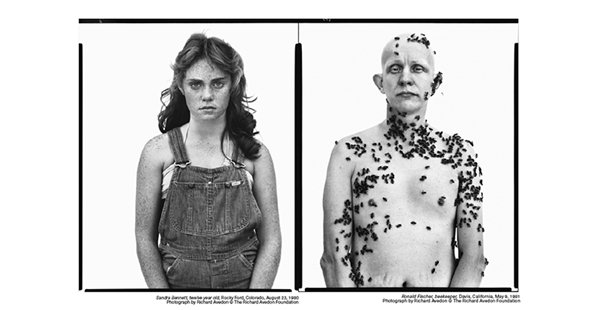
The best curiosity is in the image the venue chose to present the exhibition. The official key visual places two portraits of the series side by side, and the captions printed under each say a great deal. On the left, Sandra Bennett, 12 years old, photographed in Rocky Ford, Colorado, on August 23, 1980: a girl with freckles, long hair and denim overalls, her gaze steady toward the lens. On the right, Ronald Fischer, beekeeper, photographed in Davis, California, on May 9, 1981: a shirtless, bald man with his body and head covered in bees.
The captions are precise down to the day. Avedon didn't title the portraits with poetic formulas: name, age or trade, place, date. It is the same logic as the white backdrop, reducing to a minimum everything that isn't the person. The result is that every photograph also becomes a document, with the precision of a register.
The second curious detail concerns the dates. The venue writes that Avedon traveled during the summer months. The caption of the girl from Rocky Ford says August 23, high summer, while that of the beekeeper from Davis says May 9. It is the kind of particular worth noting in front of the captions in the gallery: lined up, the dates reconstruct the real calendar of those trips better than any summary, and say in which season and in which state the photographer was.
The third: the two images of the key visual come with the credit line of the Richard Avedon Foundation, a sign that every reproduction of these photographs goes through the archive that protects them today. The same archive that the Polaroids, manuscripts and letters displayed in Rome come from.
The Palazzo delle Esposizioni: Pio Piacentini's Building on Via Nazionale
The Palazzo delle Esposizioni was inaugurated on January 21, 1883, designed by Pio Piacentini, winner of a national competition. It was the first building in Italy entirely devoted to the fine arts, though not a museum. For the full profile of the place I refer you to our page on the Palazzo delle Esposizioni. Here I summarize what you need to understand why an exhibition like this finds its right home on Via Nazionale.
Two Competitions and a Latin Motto
The first competition was announced in 1876, without even indicating the site. 40 projects arrived, displayed at the Collegio Romano, and someone proposed Piazza del Popolo. A little over a year later a second call fixed Via Nazionale site, and the projects numbered 74. After much controversy, the winner was that of Pio Piacentini, marked with the motto "Sit quod vis simplex et unum". Work began only in 1880.
A Building Without Windows, Lit from Above
The fiercest criticism at the time was that it was "a building without windows". It was intended: the continuous walls were meant for hanging works, and the light had to come down from above through iron and glass roofs. Six large rooms converge on a central rotunda, in a symmetrical, mirrored layout. For an exhibition of photographs to be viewed up close, one by one, it is the ideal architecture.
The Statues and the Facade
The facade is dominated by the deep arched opening and by the sequence of statues placed in the late 1880s, the work of academic sculptors (the venue cites Cencetti, Biggi, Aureli, Trabacchi, Ferrari, Galletti and others). At the top, Art supported by Peace and Study. On the four pillars of the portico, Architecture, Sculpture, Painting, Industrial Art. Along the balustrades, 12 artists of the past.
From the Demolished Greenhouse to Desideri's Serra
In the original design the rear part was covered by a wide iron and glass vault, a greenhouse open toward the Quirinale gardens. In the 1930s it was demolished, described at the time as an "ugly and costly railway station shed". With the renovation begun in 2003, the architect Paolo Desideri created from it a new Serra of 2,000 square meters, which today houses the restaurant. The final design of the renovation is by Firouz Galdo. Michele De Lucchi signed the artistic direction, the lighting, the furnishings and the signage. The total cost of the renovation and consolidation work, according to the venue, was €28 million.
Something Nobody Tells You About Richard Avedon at the Palazzo delle Esposizioni, October 9, 2026 to January 31, 2027
The Palazzo delle Esposizioni has two faces and two levels, and almost nobody explains it to those who arrive. The monumental facade with the staircase is on Via Nazionale. But the building is built on a slope, and at the back and on the sides it faces streets at different levels, Via Milano and Via Piacenza. The venue writes it in its accessibility report: the only two entrances level with the street are Via Milano 13 and Via Piacenza.
Translated into practice: if you arrive with a stroller, with an older person who struggles on stairs, with a wheelchair, or simply with tired legs after a morning at the Forums, don't take on Via Nazionale staircase. Turn the corner and enter from Via Milano 13. You arrive at level 0, that of the Bookshop, the Cafe and the educational spaces. From there an elevator near the entrance takes you to the ticket office, which is on level 1, the main floor, corresponding to the main entrance. The reception staff watch over the entrance during opening hours and can provide a wheelchair or accompany the visitor.
The second thing few people know: Level Zero, according to the Cafe's page, also hosts free exhibitions, in addition to the Bookshop and the Art Workshops. If you're waiting for a late friend or have a quarter of an hour before your entry, you can use it well.
The third: for conservation reasons the rooms are kept between 20 and 21 degrees Celsius with relative humidity at 50 percent. In winter that is a comfortable temperature. But the coat check is mandatory for bulky bags and backpacks, helmets and umbrellas, so it's best to arrive with a coat you're happy to carry on your arm, or leave it together with your backpack.
Photography at Palazzo Esposizioni: A Tradition That Avedon Continues
The Palazzo delle Esposizioni has a long continuity of photography exhibitions, begun with the management of the Azienda Speciale Palaexpo established in 1998. The venue itself claims this line as one of the most innovative aspects of its activity.
The Years of Giacomelli, Woodman and Magnum
In the smaller rooms of the upper floor, and often in the annular space that connects the two parts of the building, the venue recalls the first major retrospective of Mario Giacomelli, staged shortly before the photographer's death. And then Parigi+Klein, Francesca Woodman. Providence, Roma, New York, Gianni Berengo Gardin. Copyright, Herb Ritts, the exhibition on Alfred Stieglitz and the photographers of Camera Work, and the great reportage of Magnum, testimoni e visionari. 1989-1999.
Photography Exhibitions of Recent Years
The list of recent exhibitions published by the venue confirms the line: Don McCullin a Roma, presented as the first major Roman retrospective of the British photographer. Boris Mikhailov. Ukrainian Diary. Albert Watson. Roma Codex. Sergio Strizzi. Lo sguardo oltre il set, with about 60 photographs. Mario Giacomelli. Il fotografo e l'artista, with about 300 original prints. And in summer 2026 Revelation, with the photographs of Lorenzo Meloni.
A Distant Precedent: Man Ray in 1975
Going further back, among the major retrospectives sponsored by the city in the 1970s the venue cites the one devoted to Man Ray in 1975. And the exhibition Linee della ricerca artistica in Italia 1960-1980, curated by Nello Ponente, included photography among the sectors documented. Avedon thus arrives in a place that has treated photography as art in its own right for decades.
My Advice for Visiting Richard Avedon at the Palazzo delle Esposizioni, October 9, 2026 to January 31, 2027
The advice is clear: go on a weekday, in the morning at the 10:00 opening or in the late afternoon, and give the exhibition at least an hour and a half. Not for the prints themselves, which can also be viewed well in an hour, but for the archive materials. Working Polaroids, manuscripts, letters exchanged with the people portrayed: they are small documents, meant to be read, and in front of a display case a line forms quickly. The recommended method: first a quick pass of the prints to take the measure of the series, then the archive papers, then the prints again. On the second pass the faces are different, because you know how they were sought out.
Remember the real hours: the palace closes at 20:00, but the last entry is at 19:00, and after that time not even the ticket office works. Whoever arrives at 19:15 stays outside.
Second piece of advice: leave your backpack at the coat check before you begin, since it is mandatory for bulky ones anyway, and bring with you only your phone on silent. The venue's rules allow using the cell phone to consult applications, but not to make calls, take photographs or film. Don't waste time looking for the shot, in these rooms you can't.
Third: if you come on Thursday, Friday or Saturday, schedule the visit for late afternoon and stop afterward at the Caffè delle Esposizioni, which on those days stays open until 02:00. It is the best way to end a Roman winter day: a serious exhibition and then a drink in the palace itself, without having to cross the city.
Fourth, for those coming with tired legs or a stroller: enter from Via Milano 13 and not from the staircase.
Hours, Tickets and Visiting Rules for the Avedon Exhibition
The Avedon exhibition follows the general hours of the Palazzo delle Esposizioni: Tuesday to Sunday from 10:00 to 20:00, closed Monday, last entry one hour before closing.
Where to Buy Tickets
Tickets are bought on the venue's official website, through the presale network authorized by the organization, and at the ticket office on level 1. Prices and any reductions are published on the official website: I report them there and not here, because exhibition fares can change and it's best to read them at the source at the time of purchase.
The Palazzo's Membership Card
The Palazzo Esposizioni offers a membership with three options: Individual, Dual (designed for coming with a companion) and Junior & Senior, reserved for those under 27 or over 65. For a Roman who plans to come back several times over the season, it is worth considering. Terms and prices are on the venue's website.
The Rules: What You Can and Can't Do
- Keep your ticket for the whole visit. It can't be reused once you leave.
- Bulky bags and backpacks, helmets, umbrellas and sharp objects must be left at the coat check.
- Animals are not admitted, of any size.
- No photographing or filming without authorization from the Palaexpo Management.
- You may take notes and draw, avoiding fountain pens and markers.
- You must stay at least one meter from the works and not touch cases and display cases.
- No eating or drinking in the rest and transit areas.
Information by Phone
The venue's number is 06 696271. The email reply service is active Monday to Friday from 9:30 to 17:00.
How to Get to the Avedon Exhibition on Via Nazionale
The Palazzo delle Esposizioni is at Via Nazionale 194, and the simplest way to get there is by bus: lines 64, 70, 71, 117, 170 and H stop at the Nazionale/Palazzo Esposizioni stop, in front of the building.
By Subway
With line A you get off at Repubblica and walk down Via Nazionale. With line B you get off at Cavour and climb toward Via Nazionale through Monti. The venue indicates both stops. Repubblica is the most straightforward choice, because you just follow the great axis of Via Nazionale to the facade.
From Termini Station
The venue gives a precise indication: from Piazza dei Cinquecento, in front of the station, you take one of the lines 64, 70, 71, 117, 170 or H toward Piazza Venezia, count four stops and get off at Nazionale/Palazzo Esposizioni. It is the route I recommend to those arriving by train from outside Rome with light luggage.
By Bus
Via Nazionale is one of the best-served public transportation axes of the center, because it connects the station area and Piazza della Repubblica with Piazza Venezia.
By Car
I advise against the car. The area is very central, parking is difficult, and for a visit of a couple of hours the time lost looking for a spot exceeds that of the exhibition. Anyone who must come by car should first check the rules for access to the historic center and the garages in the area.
Another Well-Known Fact, Yet Rarely Cited
That Richard Avedon was a fashion photographer everyone knows. That In the American West came from a commission by a Texas museum, few remember. Yet the venue writes it in the first line of the presentation: the series was born in 1979 from a commission by the Amon Carter Museum of American Art in Fort Worth, and was first exhibited there in 1985.
Why does it matter? Because it dismantles a commonplace. People often imagine that the great author cycles arise from solitary inspiration, and that institutions arrive afterward, to consecrate. Here the opposite happens: a museum of American art asks a photographer famous for elegance to take on the West, and gets a very harsh collective portrait of the America of work.
There is a second known and rarely cited fact: before the West, Avedon had already entered the museums. The Smithsonian in Washington had devoted a retrospective to him in 1962, the Metropolitan in New York a solo exhibition in 1978. So In the American West is not the work of a photographer in search of recognition, but that of an already consecrated author who decides to change subject, and to change it radically. The dates of the career, lined up, tell the choice better than any interpretation: 1962 Washington, 1978 New York, 1979 the departure toward the truck stops and the slaughterhouses.
Third fact: the Roman exhibition is not a selection. It is all 110 prints of the book. It rarely happens to see so famous a photographic cycle in its entirety, and it's worth remembering when you decide if you will go.
Accessibility of the Avedon Exhibition at Palazzo Esposizioni
The Palazzo Esposizioni is accessible to people with reduced mobility or sensory ability through three entrances free of architectural barriers: Via Milano 13 for the exhibitions, Via Milano 15 and 19 for the Bookshop and Cafe, Via Piacenza for the cinema, auditorium and restaurant.
Via Milano 13 Entrance
This is the entrance to use for the exhibition. You enter at level 0, at the same level as the sidewalk, crossing only a small threshold joined by a non-slip metal ramp. The entrance is staffed by reception personnel throughout opening hours and is equipped with an intercom connected to the porter's lodge and to the control room, staffed day and night.
Elevators and Internal Routes
From level 0 a lift near the entrance takes you to level 1, where the ticket office, the main coat check and the exhibition rooms of the main floor are. From level 1 to level 2 you go up with the two lifts that open onto the Rotunda. Every level is entirely flat, with no internal steps. Anyone already in the exhibition can return to level 0, where the Cafe and Bookshop are, with the lift near the coat check or with the one next to room 16.
Seating and Captions
The venue states that it provides seating along the routes: at the Spazio fontana on level 0, in the Rotunda and at the foot of the grand staircases on level 1, in the small side rooms next to room 16 on level 2, as well as benches along the exhibitions where the layout allows. Captions and gallery texts are designed for legibility: character size, contrast, lighting, height. For any special need the number to call is 06 696271.
The Right Photo to Take at Richard Avedon at the Palazzo delle Esposizioni, October 9, 2026 to January 31, 2027
Let's start from a fact that spares you embarrassment: inside the rooms you can't take photographs. The rules of the Palazzo Esposizioni forbid using electronic devices to take photographs or shoot video, and photographing the works is only possible with authorization from the Palaexpo Management. So no selfie next to the beekeeper covered in bees. The right photo is taken outside, and there's more than one.
The first is the whole facade, taken from the opposite sidewalk of Via Nazionale. The deep arch in the center, the columns, the statues on the balustrades and at the top the group of Art with Peace and Study: to get it all in the frame you have to step back, and the sidewalk across the street is the right spot. If the exhibition banner is on the facade, you'll have Avedon and Piacentini in the same image.
The second is a detail: the four statues on the pillars of the portico, Architecture, Sculpture, Painting, Industrial Art. Climb a few steps of the staircase and shoot from below upward, with the sky as the backdrop. It is an unintentional homage to Avedon's method: an isolated subject against a uniform background.
The third is for those who stop at the Cafe: the garden, which the venue describes as framed by Piacentini's walls, the early Christian basilica of San Vitale and a large magnolia. It is a quiet corner a few meters from the traffic of Via Nazionale, and the ancient wall of the church beside the 19th-century wall of the palace tells the layering of Rome in a single frame.
A technical tip: the facade faces Via Nazionale, and on winter days the light changes a lot between morning and afternoon. If you want the statues readable, avoid the hours when the sun is low behind the building and the facade ends up backlit. On overcast days, instead, the soft light evens everything out: exactly the shade light that Avedon sought for his portraits.
Where to Eat Before or After the Avedon Exhibition
The Palazzo delle Esposizioni has two refreshment points inside: the Caffè delle Esposizioni on Level Zero and the Esposizioni restaurant in the Serra. For a visit to the exhibition they are the most practical solution, because they don't require leaving.
The Caffè delle Esposizioni
The Cafe is a bistro on Level Zero, with entrances from Via Nazionale 194A and from Via Milano 13. The venue describes it with made-to-order cooking and always open: classic or American breakfast, lunch-break set menus, themed dinners or dinners by reservation, aperitivo with vegetarian and vegan boards. On Saturday and Sunday there is a brunch with two options, one American-style and one Italian-style with fresh pasta and braised dishes. The published hours: closed Monday, Tuesday, Wednesday and Sunday from 10:00 to 20:00, Thursday, Friday and Saturday from 10:00 to 02:00.
The Restaurant in the Serra
The Esposizioni restaurant occupies the Serra designed by Paolo Desideri, the transparent structure that restored in a contemporary key the great greenhouse of Piacentini's design. The menus are curated by the chef Alessandro Circiello, with organic and seasonal products. By joining the CLIMAVORE project, the restaurant has taken salmon off the menus. The published hours: Monday to Friday from 12:30 to 15:30, Saturday and Sunday from 12:30 to 16:00 for brunch. You can also enter from Via Piacenza. It's best to book on weekends.
Outside the Palace: Monti and Around
Those who prefer to go out are spoiled for choice. Going down toward the Monti district you find trattorias, osterie and small places serving Roman and international cuisine. Going up toward Piazza della Repubblica, bars, coffee shops and quicker places prevail, suited to a fast stop. The rule is simple: on Via Nazionale you have a coffee, in Monti you eat.
Some Important Events That Happened Here in History
On January 21, 1883 the Palazzo delle Esposizioni was inaugurated with a solemn ceremony in the presence of the king. The first exhibition, the venue says, was supposed to be reserved for Italian artists and was then opened to a limited foreign presence. The climate was academic, the subjects drawn from Roman history, the battles of the Risorgimento, the origins of Christianity.
From the following year and for over three decades the palace was the seat of the exhibitions of the Società degli Amatori e Cultori di Belle Arti. Between 1913 and 1916 it held the four editions of the Esposizione Internazionale d'Arte della Secessione, an attempt to bring Rome up to date on the European avant-gardes.
On January 3, 1931 the first National Art Quadriennale was inaugurated here, which had more than 200,000 visitors. First prizes went to Arturo Tosi and Arturo Martini. On October 28, 1932 the Exhibition of the Fascist Revolution opened, with the facade covered by a structure designed by De Renzi and Libera and metal fasces 25 meters high. The exhibition stayed in the palace for about two years. The third Quadriennale, in 1939, took place under the control imposed by the racial laws, with forms on the origins of each artist.
After the war the building was occupied by the food-supply offices. Restored, it hosted on December 18, 1951 the sixth Quadriennale, with a Modigliani retrospective curated by Jean Cassou. Then came the European 17th century (1956-1957), the 18th century in Rome (1959, 2,600 works), and Arte messicana dall'antichità ai nostri giorni (1962-1963) with works by Rivera, Siqueiros, Orozco, Tamayo and Frida Kahlo.
In the 1970s came Vitalità del negativo nell'arte italiana 1960/70, curated by Achille Bonito Oliva, and the five sections of the 10th Quadriennale between 1972 and 1977. The fall of pieces of stucco during a scientific exhibition made inevitable the restoration entrusted to Costantino Dardi. The palace reopened in 1990 with three exhibitions at once, La grande Roma dei Tarquini, Rubens and Mario Schifano. In 1998 the Azienda Speciale Palaexpo was established. In 2003 began the renovation that gave the building its present layout.
Around Via Nazionale: What to See After Avedon
The Palazzo delle Esposizioni is in the Monti district, along the axis that connects Piazza della Repubblica to Piazza Venezia: a perfect point from which to build a whole day around the exhibition.
The Basilica of San Vitale, Next to the Palace
The Basilica of San Vitale is set against the flank of the palace, lower than the street. Piacentini, the venue says, even thought of taking it apart and rebuilding it in a garden, then of realigning it with the street. Neither plan was approved, and the church is still there, a witness to the difference in level created by the lowering of Via Nazionale.
Piazza della Repubblica and the Baths of Diocletian
Going back up Via Nazionale you reach Piazza della Repubblica, the old Piazza delle Terme, which in the 19th-century plan was meant to welcome those arriving from the station. Here you can visit the Baths of Diocletian and the Basilica of Santa Maria degli Angeli, which the official history of the Palazzo Esposizioni itself recalls as the reference to antiquity already proposed by Michelangelo on the layout of the baths. A little farther on, Palazzo Massimo alle Terme completes the route with the collections of the Museo Nazionale Romano.
The Quirinale and the Scuderie
Behind the palace is the Quirinal Hill. The Quirinal Palace and the Scuderie del Quirinale can be reached on foot, uphill. Those who love major exhibitions can make a double program on the same day. On the hill there is also Sant'Andrea al Quirinale.
Monti, Trajan's Markets, Santa Maria Maggiore
Going down toward Via Cavour you enter the Monti district, with its streets of workshops and its climbs. Toward the Forums you reach Trajan's Markets. In the opposite direction lies the basilica of Santa Maria Maggiore.
Who Has Passed Through Richard Avedon at the Palazzo delle Esposizioni, October 9, 2026 to January 31, 2027
In almost a century and a half the Palazzo delle Esposizioni has seen a good part of the history of Italian art and many international names pass through. I cite some whose presence or direct role the venue documents.
Pio Piacentini, first of all: a Roman, born in 1846, trained at the Accademia di San Luca, of which he later became president, designer of the palace and author of the never-built solutions to free up its access. The king, at the inauguration of January 21, 1883. Cipriano Efisio Oppo, secretary general of the first four Quadriennali. The architects Del Debbio and Aschieri, who in the 1930s demolished the greenhouse and redesigned the displays. Aschieri himself, with Montuori, curated the second Quadriennale, where Mafai had a room with 29 works and a prize for Lezione di piano. At the Exhibition of the Fascist Revolution worked artists such as Sironi, Funi, Maccari and Nizzoli and architects such as Terragni, Libera and Valente. Giorgio Morandi was present at the third Quadriennale in 1939.
In the postwar years Jean Cassou curated the Modigliani retrospective of 1951 here, and Giorgio de Chirico that of Savinio at the seventh Quadriennale. In the 1970s Achille Bonito Oliva signed Vitalità del negativo. Tadeusz Kantor, during the exhibition on the Polish avant-garde, previewed one of his shows. Manfredo Tafuri curated the exhibition on Red Vienna. Costantino Dardi restored the building, bringing it back toward the original design.
Then the contemporaries: Richard Long, who in 1994 made eight installations conceived for these rooms. Sol LeWitt, who inaugurated the Project rooms by covering two rooms with large surfaces of color. Ugo Rondinone, who covered the central fountain and a wall with fragments of mirror. And, for photography, Mario Giacomelli, whose first major retrospective was staged here shortly before his death. From October the 110 people of the West photographed by Avedon join the list: miners, waitresses, carnival workers. Not famous, but now at home on Via Nazionale.
Avedon with Teenagers and with Children
In the American West is an exhibition of black-and-white portraits, silent, with no interactive installations: with small children it is a short visit, and with teenagers it can become a memorable lesson.
With Teenagers
With a 14-year-old a simple game works very well: before reading the caption, guess the trade of the person portrayed. The white background removes every hint of context and leaves only the clothes, the hands, the gaze. Then you read the caption and discuss. The portrait of Sandra Bennett, 12 years old, is a good starting point: a peer from 40 years ago, in a town in Colorado.
With the Youngest
For the youngest the Palazzo Esposizioni has a dedicated offering in the Art Workshop, with activities for families and schools published on the venue's website. Some are held on weekday mornings. For stroller access the same applies as said above: entrance from Via Milano 13, internal elevators, all levels flat.
A Note for Parents
Some portraits are harsh: bodies marked by work, people on the margins, and among the places listed by the venue the slaughterhouses also appear. With sensitive children it's best to make a first pass alone, or at least to know what to expect.
Rome Between October and January: The Period of the Avedon Exhibition
The exhibition covers almost four months, from Friday, October 9, 2026 to Sunday, January 31, 2027: autumn, the Christmas holidays, January.
October and November
These are the best months to visit Rome: days still long in October, fewer tourists in November, often mild temperatures. On weekdays in November the Palazzo is quiet, and a photography exhibition is better viewed without a crowd.
The Christmas Holidays
The period between December 8 and Epiphany brings many visitors to the center, Romans and non-Romans. Via Nazionale and the streets around it fill up. The Palazzo's hours on Christmas and New Year's days should be checked on the official website, because the venue publishes any changes for the holidays. December 25, 2026 and January 1, 2027 fall on a Friday.
January, the Last Month
The last weeks of an exhibition always bring latecomers. If you can, don't leave it to the last weekend: closing is Sunday, January 31, 2027, and the final Sundays are the most crowded days.
Frequently Asked Questions About Richard Avedon at the Palazzo delle Esposizioni
When can you see the Richard Avedon exhibition in Rome?
The exhibition Richard Avedon. In the American West. 1979-1984 is open at the Palazzo delle Esposizioni from October 9, 2026 to January 31, 2027. The palace is open Tuesday to Sunday from 10:00 to 20:00, closed on Monday, and entry is allowed until one hour before closing, that is, until 19:00.
Where is the Palazzo delle Esposizioni?
The Palazzo delle Esposizioni is at Via Nazionale 194, 00184 Rome, in the Monti district. The nearest subway stops are Repubblica on line A and Cavour on line B. Buses 64, 70, 71, 117, 170 and H stop in front of the building, at the Nazionale/Palazzo Esposizioni stop.
How many photographs are in the Avedon exhibition?
The Avedon exhibition at the Palazzo delle Esposizioni presents the complete series of 110 prints made for the 1985 book In the American West. Alongside the prints, archive materials from the Richard Avedon Foundation are displayed: manuscripts, working Polaroids and correspondence with the people photographed.
How much does a ticket for Avedon at the Palazzo Esposizioni cost?
The prices for the Avedon exhibition at the Palazzo delle Esposizioni are published on the venue's official website, where tickets are purchased through the authorized presale network. The Palazzo also offers a membership card in the Individual, Dual and Junior & Senior options, the latter for those under 27 or over 65.
Can you take photographs in the Avedon exhibition?
No, the rules of the Palazzo delle Esposizioni do not allow photographing or filming in the rooms: shooting the works is possible only with authorization from the Management of the Azienda Speciale Palaexpo. You can use your cell phone on silent to consult applications. The souvenir photo is taken outside, at Via Nazionale facade.
Who curated the exhibition In the American West in Rome?
The exhibition In the American West at the Palazzo delle Esposizioni is curated by Clément Chéroux, director of the Fondation Henri Cartier-Bresson, which organizes it with works on loan from The Richard Avedon Foundation, in collaboration with Palaexpo. It is sponsored by the Culture Department of Roma Capitale and the Azienda Speciale Palaexpo.
Is the Palazzo delle Esposizioni wheelchair accessible?
Yes, the Palazzo delle Esposizioni is accessible without barriers from Via Milano 13 entrance, level with the sidewalk. An elevator takes you to the ticket office on level 1 and other lifts connect all the floors, which are entirely flat. The reception staff can provide a wheelchair. For information the number is 06 696271.
Is there a place to eat inside the Palazzo delle Esposizioni?
Yes, the Palazzo delle Esposizioni has the Caffè delle Esposizioni on Level Zero, open Tuesday to Sunday and until 02:00 Thursday to Saturday, and the Esposizioni restaurant in the Serra, open for lunch on weekdays and for brunch on weekends. Hours and reservations are indicated on the venue's website.
How much time do you need to visit the Avedon exhibition?
For the Avedon exhibition at the Palazzo delle Esposizioni it's best to allow at least an hour and a half: the 110 prints take an hour, and the archive materials, Polaroids, manuscripts and letters, deserve extra time. Also factor in the coat check on arrival and the last entry at 19:00.
The Guide's Verdict on Avedon at Via Nazionale
To close, a judgment: among the exhibitions of the Roman autumn, this is one to recommend to anyone, even to those who say they don't understand photography. Because it asks for no expertise: it asks you to look at faces. Go without hurry, on a weekday, enter from Via Milano if the stairs weigh on you, leave your backpack at the coat check and give the archive papers the same time you give the prints. And if you want a guided visit of the area, among Via Nazionale, the Quirinale and Monti, you know whom to ask.
Article written by the editorial staff of Tour Leader Pro, contact them for Private/Corporate/V.I.P. Tours and Experiences.
Planning a trip to Rome? The English-language guides to visiting the city are on ItalyPlanner.com.