Raffaele Curi. Only Fragile Things Endure Forever at the Rhinoceros Gallery, through October 31, 2026
In short. Raffaele Curi. Only Fragile Things Endure Forever is at rhinoceros, the gallery of the Fondazione Alda Fendi Esperimenti at Via del Velabro 9, through October 31, 2026.
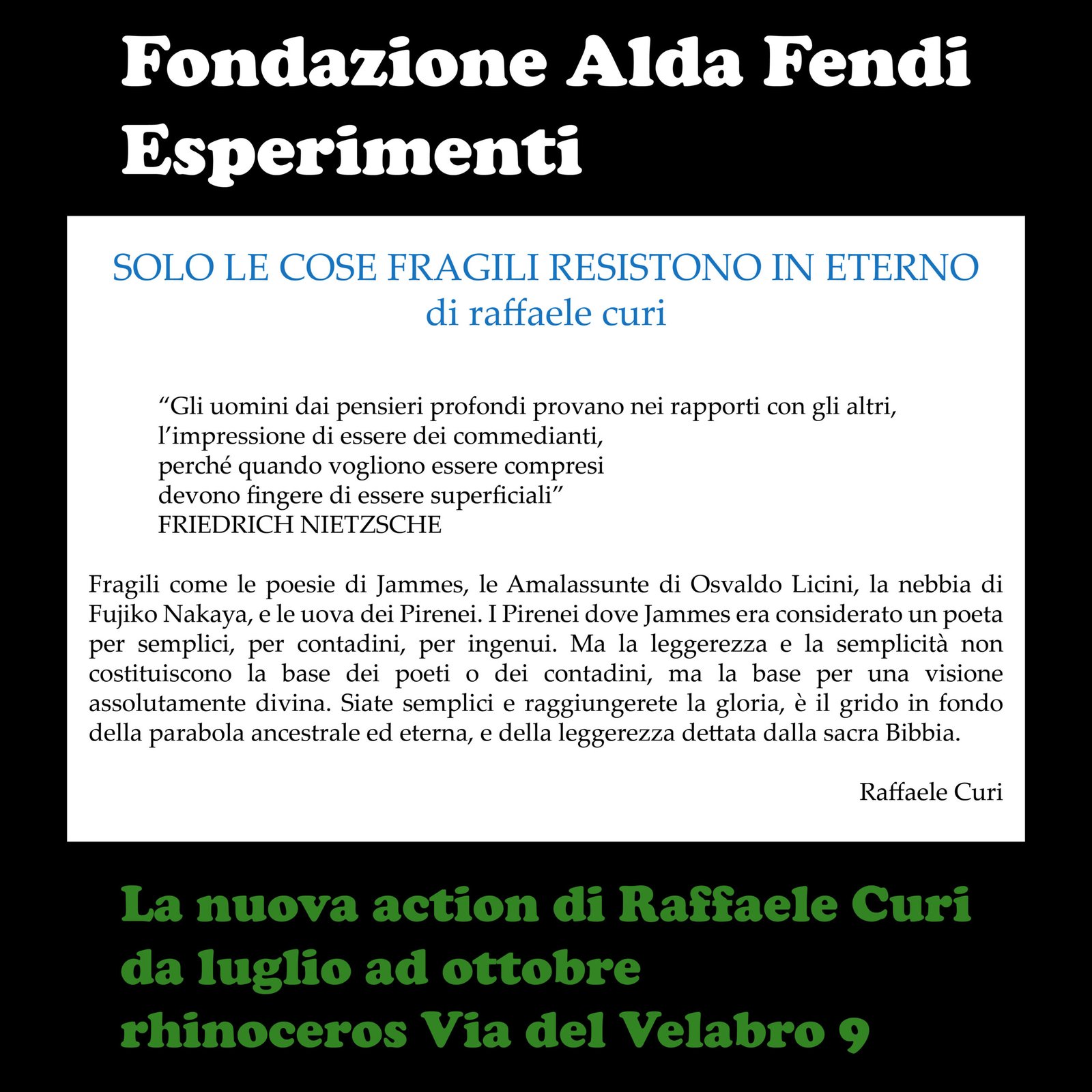
Raffaele Curi. Only Fragile Things Endure Forever is at rhinoceros, the gallery of the Fondazione Alda Fendi Esperimenti at Via del Velabro 9, through October 31, 2026. It is an action set, that is, an installation that occupies the four floors of the building designed by Jean Nouvel, among Shakespeare, Nietzsche, Francis Jammes, Osvaldo Licini and Fujiko Nakaya. Admission to the gallery is free, every day from 11:00 to 19:00, according to the official rhinoceros website. The building is in the Velabro area, next to the Arch of Janus and the church of San Giorgio al Velabro, between the Forum Boarium and the Palatine. To get there by public transit, it's best to set Via del Velabro in the ATAC route planner. On foot it's a few minutes from Piazza della Bocca della Verità. For information the gallery answers at 340 6430435 and at gallery@rhinocerosroma.com.
It isn't a show in the traditional sense, with works on the walls and captions. It's a path of quotations, lights, sounds and images built by a director and playwright, which you walk through like a play without actors. You get in free, and you come out after half an hour or an hour, depending on how much you let yourself be drawn in. In the oldest quarter of Rome, it's an excellent reason to stop in a building that almost everyone sees only from the outside.
Only Fragile Things Endure Forever: what you see
Raffaele Curi's new action set is a reflection on fragility understood not as a limit but as a quality that gives depth to human experience. It unfolds over the four floors of rhinoceros like an initiatory journey among literary, philosophical and artistic references.
It starts with Shakespeare
The action set opens with a quotation from Shakespeare's Richard III, an invitation to remember who is speaking on the day of battle. Right after, the eye is caught by a large photograph of the Pyrenees: an image of freshness and freedom, and the first reference to Francis Jammes, also known as the poet of the Pyrenees.
Licini's Amalassunte
The path continues with the art of Osvaldo Licini. Hanging from the ceiling, many silhouettes of his Amalassunte float in space as if moved by the wind. In the background plays Come nave in mezzo all'onde, from Nicola Porpora's Siface, performed by the mezzo-soprano Cecilia Bartoli.
The seven colors and the white light
To recall the role of color in Licini's painting, the installation is lit by the seven colors of the rainbow, from red to violet, which alternate in a continuous cycle, interrupted by a dazzling white light. In this play of lights appear the words of Friedrich Nietzsche on men of deep thoughts, forced to seem superficial in order to be understood.
The fog and the eggs of the Pyrenees
In the building's light well, the fog sculptures of the Japanese artist Fujiko Nakaya are projected. To close the path, accompanied by an enveloping soundtrack, the display cases hold a carton with three stamped eggs, each with the word Pyrenees on it. It is the simplest and most disorienting image of the whole installation.
The second part of the Prayer with the donkeys
Only Fragile Things Endure Forever is presented as the second part of Prayer to Go to Paradise with the Donkeys, a tribute to Francis Jammes conceived and curated by Curi and debuted in November of the previous year.
The donkey and goodness
In the Prayer the donkey, an ancient figure celebrated in Jammes's verses, represented goodness, simplicity and innocence, and the artist used a fusion of languages to express the need to return to a genuine goodness.
From goodness to lightness
The new chapter takes a step forward and focuses on lightness, delicacy and vulnerability. In the presentation text Curi insists on one idea: fragility, strength and intuition are feminine nouns in Italian, and for him "lightness is female." With the support of Alda Fendi, the path also wants to recall the strength of dream, imagination, desire and poetry.
Why it's worth it
The official press release speaks of another point of view on our existence, a tribute to what, in contemporary frenzy, escapes the distracted eye. In our judgment the risk of these installations is rhetoric, and Curi runs it. But the eggs of the Pyrenees, the suspended Amalassunte and Nakaya's fog are three images that stay with you. On an afternoon in the Velabro, half an hour here is worth more than another coffee.
Jammes, Licini, Nakaya: the installation's references
The installation weaves literary, philosophical and artistic references into a continuous sequence: Francis Jammes, Nietzsche, Shakespeare, Osvaldo Licini, Fujiko Nakaya and the music of Porpora sung by Cecilia Bartoli.
Francis Jammes, the poet of the Pyrenees
Francis Jammes is the French poet to whom Curi had already dedicated the Prayer with the donkeys. In Curi's words, in the Pyrenees Jammes was considered a poet for simple people, for peasants, for the naive. For the artist, instead, simplicity is the basis of a divine vision. The photograph of the Pyrenees at the beginning and the eggs at the end frame the path in his name.
Osvaldo Licini and the Amalassunte
The Amalassunte are figures from the painting of Osvaldo Licini, one of the great Italian artists of the 20th century. Curi chooses them as images of what is not matter but spirituality and fantasy, and makes them float in space like light apparitions.
Fujiko Nakaya and the fog
Fujiko Nakaya is the Japanese artist known for her fog sculptures. In the light well of rhinoceros there is no real fog but the projection of her works: an image of absolute fragility, a sculpture that exists only as long as it lasts.
Who is Raffaele Curi
Raffaele Curi, born in Ancona on April 13, 1948, is an actor, director and playwright and the artistic director of the Fondazione Alda Fendi Esperimenti, for which since 2001 he has written and directed avant-garde installations and shows.
From the Academy to The Garden of the Finzi-Continis
After finishing his classical studies he moved to Rome to attend the Accademia nazionale d'arte drammatica Silvio D'Amico. In 1970 he was noticed by Vittorio De Sica and joined the cast of the film The Garden of the Finzi-Continis, in the part of Ernesto, Giorgio's brother.
A long acting career
He continued his acting career with Fellini's Casanova in 1976, Il gatto by Luigi Comencini and Il... Belpaese by Luciano Salce in 1977, Scherzi da prete by Pier Francesco Pingitore in 1978, Claretta by Pasquale Squitieri in 1984 and Impiegati by Pupi Avati in 1985. On television he worked, among others, with Pupi Avati in Jazz Band and Cinema!!! and with Sandro Bolchi in Disonora il padre.
Man Ray and Menotti
A graduate in literature and philosophy, with many art history exams, he became assistant to the American painter, photographer and director Man Ray. For almost 20 years he was then assistant to Gian Carlo Menotti, the director of the Festival of Two Worlds.
With the Fendi sisters
He met the Fendi sisters and began working with them. When, in the 1990s, the maison came into the orbit of LVMH and Prada, Curi began the artistic direction of the new Fondazione Alda Fendi, producing installations and shows that since 2001 he has personally written and directed. In its first 18 years the Foundation counts 11 shows conceived and made by him.
The Fondazione Alda Fendi Esperimenti
The Fondazione Alda Fendi Esperimenti was born in 2001 at the wish of Alda Fendi, who after decades in the family company decided to devote herself to art, in collaboration with her daughters Giovanna and Alessia Caruso Fendi.
Alda Fendi
Born in Rome, after a period of study in London, Alda Fendi began working very young in the family company under the guidance of her mother Adele, also alongside Karl Lagerfeld. At a certain point, the Foundation says, she realized she had neglected art too much and fulfilled a dream of her youth.
What it has done
In its first 18 years of activity the Foundation produced 11 shows by Raffaele Curi, took part in the Rome Film Festival and the Venice Biennale, exhibited at the Peggy Guggenheim Museum and published three books. The principle is the continuous dialogue between ancient and contemporary, between art inside and outside the spaces where the Foundation operates.
rhinoceros, Jean Nouvel's building in the Velabro
rhinoceros is the seat of the Fondazione Alda Fendi Esperimenti at Via del Velabro 9: a building restored and furnished by the French architect Jean Nouvel, Pritzker Prize winner, with a gallery that unfolds over six floors up to the terraces and light wells.
A gallery that climbs
The Foundation's gallery is not closed in a conventional space: it unfolds along the floors of the building and mixes with the life of the visitors, up to the terraces and light wells devoted to visual and sound installations. That is why Curi's action set occupies four floors and uses the light well for Nakaya's projections.
Restaurant and apartments
The building also houses the gallery's restaurant and 25 apartments designed and furnished by Jean Nouvel, with views from the Palatine to the Circus Maximus. In short, rhinoceros is a building that lives all day, not a museum that opens and closes.
The gift to the Arch of Janus
On the occasion of the building's opening, the Foundation gave the city the lighting of the Arch of Janus, designed by Vittorio and Francesca Storaro, and placed in the area in front an installation by Raffaele Curi, Rhinoceros at Saepta.
Curi's action sets and the history of rhinoceros
Raffaele Curi's action sets for the Fondazione Alda Fendi Esperimenti are shows and installations that mix theater, visual arts, music and philosophy. Their author prefers to be called artistic director rather than curator.
The shows
Among the works cited by the press is Di tre colori e d'una dimensione, from 2007, which involved, among others, Olivia Magnani and Dominique Sanda. Other titles, such as Istantanee dell'assurdo and the installation in front of the Arch of Janus, tied Curi's name to the rhinoceros that gives the building its name.
A building in a unique position
Il Giornale dell'Arte, reporting on the inauguration of rhinoceros, which took place on an October 11, described the building as a palazzo rearranged between the 1800s and 1900s, not of particular architectural merit, but in a raised and extraordinary position next to the Arch of Janus. It is the most honest judgment: the value of the building is in the place and in Nouvel's project, which made it a small city of art, to use the expression with which it was presented.
The inauguration with Michelangelo
To open the new seat, as the specialized press recalled, the Foundation chose to look back in time and managed to exhibit Michelangelo. It is the same logic that returns today with Jammes, Licini and Nakaya: putting different eras side by side and letting them talk to each other.
How to visit an action set
An action set is not read like a show. There are no panels explaining every object, and the quotations are on the walls like lines from a script. The right way is to walk through it like a performance: follow the order of the floors, let the music and light do their work, and stop where an image strikes you. Whoever tries to understand everything at once gets tired. Whoever lets themselves be guided comes out with two or three precise images.
A curiosity about Raffaele Curi. Only Fragile Things Endure Forever at the Rhinoceros Gallery, through October 31, 2026
The best curiosity concerns the place even before the installation. The area where rhinoceros stands, called Velabro already in Roman times, is according to legend the spot where the basket with the twins Romulus and Remus was found. The Foundation itself recalls it in the presentation of the building: the ancient road that joined the bend of the Tiber, where Rome begins, to the Palatine passed right through here.
An installation on fragility in the legendary place of Rome's origins has a coherence that perhaps wasn't sought but works. The twins in the basket are the most fragile image the city has of its own birth: two newborns abandoned to the water, survivors by chance. Curi speaks of a fragility that endures forever. The Velabro is, according to the legend, its founding proof.
A second curiosity: the name of the building. Rhinoceros is also the name of Curi's installation in front of the Arch of Janus, Rhinoceros at Saepta. The rhinoceros, a massive and armored animal, as the symbol of a foundation that today exhibits a work on fragility: the paradox says a lot about Curi's taste for contrasts.
One thing nobody tells you about Raffaele Curi. Only Fragile Things Endure Forever at the Rhinoceros Gallery, through October 31, 2026
What nobody says is that you walk in free and without a reservation. The official rhinoceros website lists free entry every day from 11:00 to 19:00. In a city where shows often cost 15 or €20, an installation of this level in a Jean Nouvel building, with free entry, is an opportunity that many Romans don't know about.
The second thing rarely said concerns the duration. The press release speaks of an action set that can be visited until October. The official Rome tourism listings give the closing as October 31. Anyone who wants to be sure before going in the last week can call the gallery's number, 340 6430435.
The third: the installation has a soundtrack, with Cecilia Bartoli singing Porpora. It isn't a random background but part of the work. Whoever goes in with headphones or talking on the phone loses half the experience. The advice is to go in quietly, and to stay at least the time of one complete listen in the room of the Amalassunte.
The advice I give you for visiting Raffaele Curi. Only Fragile Things Endure Forever at the Rhinoceros Gallery, through October 31, 2026
My advice is to fit rhinoceros into a walk through the Velabro and the Forum Boarium, and to go in during the late afternoon. Start from the Mouth of Truth and Santa Maria in Cosmedin, look at the temples of the Forum Boarium, the Temple of Hercules Victor and the Temple of Portunus, then head up toward the Arch of Janus and San Giorgio al Velabro. The entrance to rhinoceros is right next to it.
Inside, follow the order of the floors without hurrying. Stop in front of the giant print of the Pyrenees, stay in the room of the Amalassunte long enough to listen to Porpora and to see the complete cycle of the seven colors, and look for the light well with Nakaya's projections. The eggs of the Pyrenees are at the end: don't look for them earlier.
Arrive around 17:00: you'll have two hours before the 19:00 closing, and on your way out you'll find the sunset light on the Arch of Janus. Allow half an hour or three quarters of an hour for the installation. Whoever wants to extend the evening will find the gallery's restaurant in the same building.
Another well-known fact, yet rarely mentioned
Everyone knows The Garden of the Finzi-Continis by Vittorio De Sica, the film from 1970. Few know that in the cast, in the part of Ernesto, Giorgio's brother, was a young actor just out of the Accademia Silvio D'Amico: Raffaele Curi. That is where the career of the man who now signs the installations of the Fondazione Alda Fendi begins.
The second rarely cited fact concerns Curi's teachers. He was assistant to Man Ray, the American painter, photographer and director, and for almost 20 years to Gian Carlo Menotti, director of the Festival of Two Worlds. Whoever walks through his installations finds both lessons again: the taste for objects out of context, like the stamped eggs, and the theatrical sense of space.
The third fact concerns the place: the Arch of Janus, in front of the building, is a four-sided arch 12 meters wide and 16 meters high, probably built in the middle of the 4th century. Scholars have recently put forward the hypothesis that it is the arcus divi Constantini mentioned by the Regionary Catalogues near the Velabro.
The right photo to take at Raffaele Curi. Only Fragile Things Endure Forever at the Rhinoceros Gallery, through October 31, 2026
The right photo inside rhinoceros is the one of the suspended Amalassunte, at the moment the light changes color. The cycle of the seven colors and the dazzling white light turn the same frame into seven different images: choose a spot, wait for one complete round and shoot in the color that convinces you most. Without flash, of course.
The second photo is of the three eggs with the word Pyrenees in the final display case. It's a minimal subject, almost a still life, and it works precisely for that reason: tight framing, neutral background, no effects.
Outside, the classic photo is the lit Arch of Janus, with the church of San Giorgio al Velabro beside it. The lighting donated by the Foundation and signed by Vittorio and Francesca Storaro is at its best at dusk, when artificial and natural light are balanced. Coming out of rhinoceros at 19:00, in October, you're at the right moment.
Some important events that happened here in history
The origins, according to legend: in the Velabro area the basket with Romulus and Remus is found, along the road that joins the bend of the Tiber to the Palatine.
Archaic and Republican age: a little beyond the Velabro, in the Forum Boarium, rise the temples of Hercules Victor, called Olivarius, and of Portunus, protective deity of the nearby river port.
203 and 204 AD: the Arch of the Argentarii is built, today next to the church of San Giorgio.
Mid 4th century: the Arch of Janus is built, the great four-sided arch, perhaps the arcus divi Constantini dedicated to the emperor Constantine.
7th century: the church of San Giorgio al Velabro is built, later decorated with the frescoes of Pietro Cavallini.
2001: Alda Fendi founds the Fondazione Alda Fendi Esperimenti, with the artistic direction of Raffaele Curi.
Opening of rhinoceros: the building restored by Jean Nouvel becomes the seat of the Foundation. The Arch of Janus receives the new lighting by Vittorio and Francesca Storaro.
Summer 2026: Only Fragile Things Endure Forever opens, on view until October 31.
Who has passed through Raffaele Curi. Only Fragile Things Endure Forever at the Rhinoceros Gallery, through October 31, 2026
In legend, the first to pass through the Velabro was a basket with two newborns, Romulus and Remus. In history, the merchants of the Forum Boarium passed through here, the devotees of Hercules and Portunus, the bankers who dedicated the Arch of the Argentarii, and the builders of the Arch of Janus. In the Middle Ages came Pietro Cavallini, with the frescoes of San Giorgio al Velabro.
In recent times the Velabro has seen the arrival of Jean Nouvel, one of the great architects of the world, called by Alda Fendi to rethink the building, and of the cinematographers Vittorio and Francesca Storaro, who lit the Arch of Janus. With the Foundation have come through here the shows and installations of Raffaele Curi, the man who as a young man acted for De Sica and Fellini and was assistant to Man Ray and Menotti.
Today, in the four floors of the building, pass the verses of Francis Jammes, the words of Nietzsche and Shakespeare, the Amalassunte of Osvaldo Licini, the fog of Fujiko Nakaya and the voice of Cecilia Bartoli. All together, until October 31, to say that fragility lasts longer than strength.
Hours and admission at rhinoceros
Hours
The rhinoceros gallery and the Fondazione Alda Fendi Esperimenti are open every day from 11:00 to 19:00, according to the official website.
Admission
Admission is free. You don't need to book to visit the installation.
When to go
The best hours are early afternoon on weekdays, when the Velabro is quiet, or the last hour before closing, to come out with the sunset light on the Arch of Janus. On weekends the Bocca della Verità area is very busy, but the installation, less known, usually stays calmer.
Contacts
For information the gallery answers at 340 6430435 and at gallery@rhinocerosroma.com. The official rhinoceros website gives Via del Velabro 9A for the gallery.
How to get to rhinoceros, Via del Velabro 9
By public transit
The Velabro is between the Forum Boarium, the Palatine and the Circus Maximus. To choose the most convenient bus line or subway station from your starting point, it's best to use the ATAC route planner, with Via del Velabro as the destination.
On foot
From Piazza della Bocca della Verità you walk up toward the Arch of Janus in a few minutes. From the Capitoline Hill you walk down toward the Forum Boarium, passing next to the Theater of Marcellus. From the Circus Maximus you walk back up toward the Velabro.
By car
The archaeological zone is crossed by busy roads and parking is scarce. Better to arrive on foot or by public transit.
Around the Velabro: what to see before and after
San Giorgio al Velabro and the Arch of the Argentarii
Next to rhinoceros are the basilica of San Giorgio in Velabro, with the frescoes of Pietro Cavallini, and the Arch of the Argentarii, from 203 and 204 AD.
The Forum Boarium and the Tiber Island
Going down toward the Tiber you reach the Forum Boarium, with the temples of Hercules and Portunus, and a little farther the Tiber Island.
The Palatine
The Velabro lies at the foot of the Palatine, the hill of the original Roma Quadrata and later of the imperial palaces. A visit to the Palatine in the morning and rhinoceros in the afternoon makes a well-built day.
Accessibility and visiting with children
Accessibility
The installation unfolds over four floors of the building. Those with specific needs should contact the gallery at 340 6430435 before the visit to learn how the floors can be accessed.
With children
The lights that change color, the suspended silhouettes, the stamped eggs: for a curious child the installation is a small world of strange things. The philosophical quotations will be read by the adults. The visit is short, free and easily combined with the Mouth of Truth, which always works with children.
Where to eat in the Velabro
In the same building is the restaurant of the rhinoceros gallery. For simpler alternatives, the nearby Ghetto, beyond the Theater of Marcellus, and Trastevere, beyond the Tiber Island, offer trattorias and places of every kind. Those who stay in the archaeological zone will find few places: better to move a few hundred meters.
A practical tip: the gallery closes at 19:00, which in Rome is early for dinner. Coming out of rhinoceros you can walk a bit toward the Theater of Marcellus and Portico d'Ottavia, have an aperitivo and have dinner after 20:00 in the Ghetto, with its Roman Jewish cooking tradition. Those who prefer Trastevere cross the Tiber Island and in 10 minutes are on the other side of the river. In both cases it's best to book, especially on Friday and Saturday.
The Velabro in October: the last weeks of the installation
October is the best month for a walk among the Forum Boarium, the Velabro and the Palatine: the heat is gone, the days are still bright and the tourist groups thin out. The installation closes on October 31. Those who want to see it calmly should choose a weekday. On weekends the neighborhood fills with visitors to the Mouth of Truth.
Frequently asked questions about Only Fragile Things Endure Forever
Until when can you visit Raffaele Curi's installation at rhinoceros?
Raffaele Curi's Only Fragile Things Endure Forever can be visited at rhinoceros, at Via del Velabro 9, until October 31, 2026. The gallery is open every day from 11:00 to 19:00.
How much does it cost to enter rhinoceros?
Admission to rhinoceros, the gallery of the Fondazione Alda Fendi Esperimenti, is free every day from 11:00 to 19:00, according to the official website. You don't need to book.
What can you see in the installation Only Fragile Things Endure Forever?
Only Fragile Things Endure Forever occupies the four floors of rhinoceros with a giant print of the Pyrenees, Osvaldo Licini's Amalassunte suspended among colored lights, the projections of Fujiko Nakaya's fog sculptures and three eggs stamped Pyrenees.
Who is Raffaele Curi?
Raffaele Curi is an actor, director and playwright born in Ancona in 1948, artistic director of the Fondazione Alda Fendi Esperimenti. He acted in De Sica's The Garden of the Finzi-Continis and was assistant to Man Ray and Gian Carlo Menotti.
Where is rhinoceros in Rome?
rhinoceros is at Via del Velabro 9, next to the Arch of Janus and the church of San Giorgio al Velabro, between the Forum Boarium and the Palatine. It is the building of the Fondazione Alda Fendi restored by Jean Nouvel.
What music do you hear in the installation?
In Raffaele Curi's installation at rhinoceros you hear Come nave in mezzo all'onde, from Nicola Porpora's Siface, performed by the mezzo-soprano Cecilia Bartoli, together with a soundtrack that accompanies the whole path.
How much time do you need for the visit?
For Only Fragile Things Endure Forever at rhinoceros, half an hour to three quarters of an hour is enough. It's best to combine it with a walk among the Mouth of Truth, the Forum Boarium, the Arch of Janus and the Palatine.
The final advice on Only Fragile Things Endure Forever
My advice is to go on an October weekday afternoon, after the Forum Boarium and before sunset on the Arch of Janus. It's free, it's short and it takes you inside a Jean Nouvel building that you would otherwise see only from the outside. Don't try to understand everything: better to watch the Amalassunte change color, listen to Cecilia Bartoli and stop at the end in front of the three eggs. Then, on the way out, look at the arch: it is fragile too, and it has endured for almost 17 centuries.
Article written by the editorial team of Tour Leader Pro, contact them for Private/Corporate/V.I.P. Tours and Experiences.
Planning a trip to Rome? The English-language guides to visiting the city are on ItalyPlanner.com.