Pierluigi Antonucci at Galleria Richter Fine Art, October 6 to November 20, 2026
In short. Coltivare la luce da fermi, the first solo show by Pierluigi Antonucci at Galleria Richter Fine Art, is open from October 6 to November 20, 2026 at Vicolo del Curato 3, in the Ponte district, a few steps from Castel Sant'Angelo.
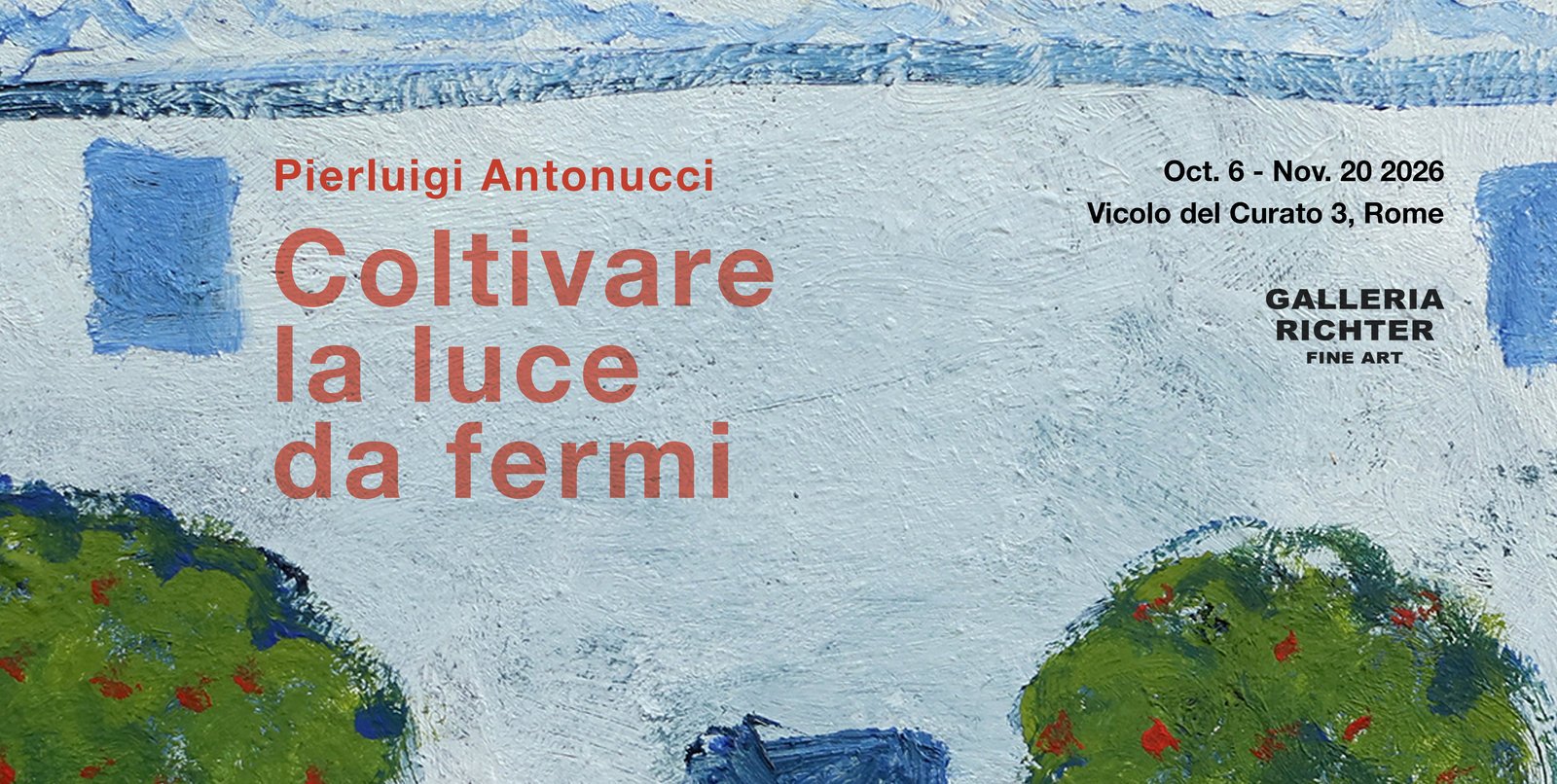
Coltivare la luce da fermi, the first solo show by Pierluigi Antonucci at Galleria Richter Fine Art, is open from October 6 to November 20, 2026 at Vicolo del Curato 3, in the Ponte district, a few steps from Castel Sant'Angelo. The opening is Tuesday, October 6 from 18:30 to 20:30. After that the show can be visited Monday to Saturday from 15:00 to 19:00, or by appointment. You get there by buses 40, 46, 62, 64, 87, 280 and 916, with stops on Lungotevere or on Corso Vittorio Emanuele II. For information and appointments, contact the gallery at info@galleriarichter.com.
Pierluigi Antonucci, Coltivare la luce da fermi in brief
Coltivare la luce da fermi brings together medium-sized paintings in which Pierluigi Antonucci, a painter born in Popoli in 1982, tells of the Abruzzo countryside where he lives and works, between memory, agriculture and philosophy.
The dates
The show opens on October 6, 2026 and closes on Friday, November 20, 2026. With the opening, Galleria Richter Fine Art begins its autumn exhibition season: it is Antonucci's first solo show at this gallery.
The hours
The gallery is open Monday to Saturday from 15:00 to 19:00, or by appointment. It is closed on Sunday. Anyone who only has the morning free has to write first to set up a visit.
The press office
The communication for the show is handled by UC Studio. The official press release is published on the gallery's website, in Italian and in English.
What you'll see in the Pierluigi Antonucci show
In the rooms on Vicolo del Curato you see landscapes, houses, dirt roads, rocks, barely stirred skies and wide valleys: real subjects, filtered through the painter's memory and imagination.
The subjects
The press release describes the repertoire precisely: houses, rocky landscapes, skies barely disturbed and never threatening, dirt roads, wide valleys. The human figure rarely appears, and when it does it is seen from behind, or with the face turned upward, toward the light of the sun. It is a painting of places more than of people, and of one precise light, that of the Apennines.
The technique
The common trait of the works is a vibrating tremor, a deliberate inexactness, combined with a strong essentiality of forms. The effect comes in part from the use of raw canvases, which give the scenes a light, vibrating quality. Touch after touch, the painter builds a sturdy sculptural relief, with a full application of paint that gives solidity to the image.
A non-mimetic painting
Antonucci does not copy reality: he reduces it to the essential, to the point of stylization. The landscape is not portrayed by resemblance, but given back in its meaning, as a resource to look after, listen to and inhabit. Anyone looking for landscape views will be thrown off. Anyone looking for a painting that takes its time will find what they're looking for.
The format
The works are medium-sized. There are no monumental canvases: the scale is that of a room, of a close relationship. In a gallery as small as the Richter it is the right size, and it forces the eye to move closer to the surface, where you see the raw weave of the canvas under the color.
How to look at these paintings
Antonucci's painting asks for a double movement. From far away you read the essential forms, the house, the road, the profile of the rock, the cut of the sky. Up close you see the work: the raw canvas breathing between one touch and the next, the full application of paint, the vibration that keeps the outlines from closing completely. The press release speaks of a painting as an expression of freedom, free of preestablished rules. The freedom shows above all in these imprecise margins, where the painter lets the image settle by itself.
The title: cultivating, and staying still
Coltivare la luce da fermi is a phrase of Antonucci's own, who ties his painting to the thought of the Japanese philosopher and farmer Masanobu Fukuoka.
Masanobu Fukuoka
Fukuoka, who lived from 1913 to 2008, is known above all for devising natural farming, the so-called do-nothing method, which reduces human intervention to a minimum and lets natural processes develop by themselves. Antonucci read his texts two years ago, and the direction of this show was born from that reading.
Painting as cultivation
In the text of the press release the painter explains that for him painting does not mean building images, but cultivating a quality of the gaze, able to slowly transform the one who paints and the one who looks. Cultivating implies care, time, repetition, waiting. Staying still indicates a condition that is apparently motionless but extremely active on the level of perception. Antonucci speaks of the idea that "removing, slowing down and not forcing can be radical gestures."
The studio in the countryside
The parallel with Fukuoka also concerns the way of working. Antonucci's painting matures in the studio in the countryside of Popoli, without forced research, open to the correspondences between pictorial practice and agricultural space. The painter does not try to impose the image, but to accompany its appearance, letting light, material and time find a balance.
Who is Pierluigi Antonucci
Pierluigi Antonucci was born in Popoli, in the province of Pescara, in 1982. He lives and works in Abruzzo and earned his degree in Visual Arts at the Academy of Fine Arts in L'Aquila.
His training
His academic degree in L'Aquila ties him to a school that has trained many painters of Central Italy. His choice to stay in Abruzzo, in the countryside of Popoli, is a statement: the press release insists on a bond with the land lived not only as a place far from the big cities, but as a root and a source of memories.
The solo shows
Among the earlier solo shows: Alla luce della Pittura, curated by Daniela Pietranico, at YAG/Garage in Pescara in 2024. Sudoku e Vento at Galleria Bianca in Palermo in 2014. A solo show at Spazio Transiti in Marina di Scarlino, in the province of Grosseto, in 2012. Studiolo #6, curated by Maria Chiara Valacchi, at Spazio Cabinet in Milan, in the same year.
The group shows
Antonucci exhibited in Studiolo, The best of Italian Youth, at the Museum of Modern and Contemporary Art San Francesco in San Marino in 2014. In Landina, esperienze di pittura en plein air, curated by Lorenza Boisi, at Villa Giulia in Verbania Pallanza in 2014 and at the Palazzotto in Orta San Giulio in 2013. In Lumen at MARS in Milan in 2013. With Bianca Arte Contemporanea of Palermo he took part in Arte Fiera Bologna in 2013 and 2014.
Alongside Enzo Cucchi
In 2012, at Bianca Arte Contemporanea in Palermo, Antonucci exhibited in La Pittura Isola alongside Enzo Cucchi, Angelo Mosca and Michele Tocca. His debut dates to 2010 and 2011 in Abruzzo: En Plein Air, il necessario rapporto con la realtà, and I Rifiutati, at Galleria/Galleria in Ortona, and Debut at Ex Aurum in Pescara.
An independent path
The press release presents his research as independent, not attributable to a category or a codified language, and alien to the conditioning of the contemporary circuits. After 2014 the résumé records a long gap until the Pescara solo show of 2024: 10 years of work in the countryside, far from the system, which this Rome show brings to light.
Galleria Richter Fine Art
Galleria Richter Fine Art is at Vicolo del Curato 3, in the Ponte district, and came about through the will of Tommaso Richter, a collector, who renovated the old workshop of a blacksmith next to the family's antiques space.
From the ancient to the contemporary
The tourist portal of Roma Capitale describes the gallery as an almost natural continuation of the family business, which runs from ancient art to the present day. It is a typical Roman story: in the streets around Via dei Coronari and Via Giulia, antiques have been at home for generations, and the move to the contemporary happens by contiguity, door next to door.
The artists
The gallery works mainly with contemporary Italian painting. Among the artists presented are Luca Grechi, Dario Carratta, Silvia Argiolas, Dario Molinaro, Emilio Leofreddi and Jacopo Casadei. Antonucci's solo show fits naturally into this line.
Rome Gallery Weekend
The Richter takes part in Rome Gallery Weekend, promoted by the Associazione Contemporanea, which also offers a tour dedicated to the galleries of Via Giulia and surroundings. It is a sign of an area that in recent years has become one of the districts of Roman contemporary art.
The spaces
The gallery occupies a former craft workshop: an intimate room at street level, suited to medium-format painting. The visit takes 20 minutes, but it's worth allowing more, because these canvases are read up close.
How to get to Galleria Richter Fine Art
You reach Galleria Richter Fine Art by the buses that run along Lungotevere and Corso Vittorio Emanuele II, lines 40, 46, 62, 64, 87, 280 and 916, and on foot from Castel Sant'Angelo, from Piazza Navona and from Campo de' Fiori.
By bus
The 40 and the 64 connect the area with Termini and Piazza Venezia. The 280 runs along Lungotevere. The 46, the 62, the 87 and the 916 pass along Corso Vittorio. From the stops you reach Vicolo del Curato in a few minutes on foot, through the alleys of the Ponte district.
On foot
From Ponte Sant'Angelo you get there in five minutes. From Piazza Navona it takes about 10 minutes, crossing Via dei Coronari area. From St. Peter's, going by Via della Conciliazione and the bridge, a good quarter of an hour.
By metro
The metro does not reach the Ponte district. The nearest Line A stations are in Prati, across the Tiber, about 20 minutes on foot. For those coming from far away, it's best to combine metro and bus.
By car
The area is inside the ZTL of the historic center. The easiest parking is on Lungotevere, when you find spots, or in the paid garages near Castel Sant'Angelo and the Janiculum. The advice remains public transport or your legs.
The Ponte district, the neighborhood of the show
The Ponte district is the fifth rione of Rome and takes its name from Ponte Sant'Angelo, which belonged to it until Sixtus V, in the 16th century, established the Borgo district.
The port and the pilgrims
In ancient Rome the area was part of the Campus Martius and hosted a port used to unload the materials for the great building works. In the Middle Ages and the modern age the roads leading to St. Peter's converged here: the continuous passage of pilgrims enriched the district, packed with inns, taverns and shops selling sacred objects.
The 16th century of the palaces
In the 16th century the road network made the district a desirable place, and aristocratic and merchant families built large palaces here on designs by famous artists. It is the century in which Ponte becomes the district of the bankers: the names of Via dei Banchi Nuovi, Via dei Banchi Vecchi and Via del Banco di Santo Spirito recall it.
The Tiber and the embankment walls
Rich and lively, the district was however the one hit hardest by the floods of the Tiber. After 1870 the construction of the embankment walls changed its face: the little streets that went down to the river disappeared to make room for Lungotevere. The old character has remained inside, in the alleys like that of the Curato.
What to see around Galleria Richter
Around Vicolo del Curato are concentrated some of the most beautiful places of Renaissance and Baroque Rome, from Castel Sant'Angelo to Via Giulia, from the Chiesa Nuova to Santa Maria della Pace.
Castel Sant'Angelo and the bridge
A few steps away is Castel Sant'Angelo, the mausoleum of Hadrian turned into a fortress of the popes, connected to the left bank by the Aelian Bridge, today Ponte Sant'Angelo. A visit to the Castle in the afternoon and the gallery at five is a natural pairing.
Via Giulia
Via Giulia, opened by Julius II at the beginning of the 16th century, starts from the Basilica of San Giovanni Battista dei Fiorentini and along its course hosts the Oratorio del Gonfalone and several art galleries.
The Chiesa Nuova and the Vallicelliana
Toward Corso Vittorio you find Santa Maria in Vallicella, the Chiesa Nuova of St. Philip Neri, and next to it the Biblioteca Vallicelliana, in the Borromini complex of the Filippini.
Santa Maria della Pace and Palazzo Altemps
Toward Piazza Navona you reach Santa Maria della Pace, with Bramante's cloister, and Palazzo Altemps, one of the sites of the National Roman Museum, both in the Ponte district.
How to organize the visit
The Pierluigi Antonucci show is visited in the afternoon, from 15:00 to 19:00, and fits well into a walk among Via Giulia, Via dei Coronari and the Tiber.
The ideal afternoon
Set out around three from Castel Sant'Angelo, cross the bridge, go into the gallery when it opens and continue along Via dei Coronari to Santa Maria della Pace and Piazza Navona. At sunset Lungotevere is the right place to finish.
The opening
The vernissage on October 6, from 18:30 to 20:30, is the moment to meet the artist. In Roman galleries openings are crowded and informal: you go in, you look, you exchange a few words. To really see the paintings, it's best to come back on any ordinary day.
By appointment
For a group, an academy class, a collector, the gallery also receives by appointment, outside regular hours. Just write in good time.
Accessibility
The gallery is in a former workshop at street level, but the alleys of the Ponte district have cobblestones and narrow sidewalks. Anyone who gets around in a wheelchair or with a stroller does well to contact the gallery before the visit.
With children
A small gallery is a good first contact with art for a child: few works, no lines, short times. With Antonucci's landscapes you can play a simple game, looking for the human figure hidden in the paintings, almost always seen from behind or with the face toward the sun. Then you go out and run toward Castel Sant'Angelo, which for a child remains the castle par excellence.
Where to eat near Vicolo del Curato
The Ponte district and the streets around Via dei Banchi Vecchi, Via dei Coronari and Via del Governo Vecchio offer wine bars, Roman trattorie, pizzerias and bistros, suited both to an aperitivo after the gallery and to dinner.
The aperitivo
At seven, when the gallery closes, the Banchi area comes alive: the wine bars and small bars of Via dei Banchi Vecchi and surroundings are the most natural choice for a glass.
Dinner
For a sit-down dinner, the trattorie between Via del Governo Vecchio and Piazza Navona are a few minutes away. The advice: move 100 meters away from the main squares and you eat better, spending less.
In October and November
Between October and November the historic center regains a more Roman rhythm: fewer summer tour groups, days still mild, outdoor tables until evening on the good days. It is the best season for a round of galleries followed by dinner in the alleys, without the crush of the hot months.
A curiosity about Pierluigi Antonucci at Galleria Richter Fine Art, October 6 to November 20, 2026
The curiosity concerns the résumé. In the list of Pierluigi Antonucci's exhibitions there is an evident gap: after the intense season between 2010 and 2014, with the solo shows in Palermo and Milan, Arte Fiera in Bologna, the group shows in San Marino and on Lake Orta, the résumé goes silent for 10 years, until the Pescara solo show of 2024. Coltivare la luce da fermi comes after that silence.
Read in light of the title, that gap becomes coherent. A painter who says he chose a slow practice, closer to cultivation than to the production of images, and who found in Fukuoka's do-nothing method a confirmation, could not have a crowded résumé. 10 years in a studio in the countryside are a field left to rest.
Then there is a detail about the venue. The gallery was born in what used to be a blacksmith's workshop: a place of manual labor, of material beaten and transformed. For a painting that claims the craftsman's gesture, the repeated touch and the raw canvas, it is a happy coincidence.
One thing nobody tells you about Pierluigi Antonucci at Galleria Richter Fine Art, October 6 to November 20, 2026
What nobody says is that Rome's private galleries are the easiest, and least crowded, way to see contemporary art in the city. Many visitors think you need an invitation, or that going in carries an obligation to buy. It isn't so: the galleries are open to anyone during the stated hours, and whoever comes in with curiosity is always welcome.
The second thing concerns the hours. The Richter opens from 15:00 to 19:00: whoever plans the day between state museums, which often close earlier, and private galleries has to flip the usual scheme. Museums in the morning, galleries in the afternoon. The Ponte district and Via Giulia let you see several in the same round.
The third: the show lasts six and a half weeks, until November 20. In late autumn the days get shorter, and after the clock change, at the end of October, at five in the afternoon it is already dark. To see these landscapes full of light with natural light still alive, it's best to go in the first weeks.
The advice I give you for visiting Pierluigi Antonucci at Galleria Richter Fine Art, October 6 to November 20, 2026
It's best to do what the title suggests: stop. In front of these canvases you don't review, you linger. Choose two or three paintings and stay in front of each for a few minutes. Move close until you see the weave of the raw canvas, then step back a few paces: the tremor of the brushstroke changes nature with distance, and what looks uncertain up close becomes solid from afar.
Second tip: before going in, read a couple of lines on Masanobu Fukuoka. You don't need an essay, it's enough to know that his method consisted of letting nature do the work, intervening as little as possible. With this key, Antonucci's landscapes stop looking like simple views of the countryside and become a reflection on doing and not doing.
Third: pair the gallery with a walk along the Tiber. Head out toward Ponte Sant'Angelo and look at the sky above the river. After an hour with this painting, a barely stirred sky won't seem like a detail to you anymore.
Another well-known fact, yet rarely cited
It is well known that the Ponte district takes its name from Ponte Sant'Angelo, the ancient Aelian Bridge built by the Emperor Hadrian to connect his mausoleum to the city. It is less often cited that a little downstream there was a second bridge, attributed to Nero and called triumphal, because the road traveled by armies returning from battle passed over it. Later it was called pons vaticanus and finally pons ruptus, broken bridge, because already in the Middle Ages it was in ruins.
Another little-remembered fact concerns papal justice. In the district a procession was frequent, led by a veiled figure dressed in black with a crucifix on his shoulder, followed by a cart with the condemned man in chains. The destination was the square of Ponte Sant'Angelo, where the gallows was set up. Today that square is a transit point for tourists headed to St. Peter's.
And a third: the house at Via dei Coronari 124 that tradition calls Raphael's house was never lived in by the painter. According to his will, it was bought to guarantee an income for the upkeep of his tomb in the Pantheon. Another form of slow cultivation, in its way.
The right photo to take at Pierluigi Antonucci at Galleria Richter Fine Art, October 6 to November 20, 2026
In a gallery the rule is to ask before photographing the works: generally galleries allow it for personal use, but it is a courtesy owed. If permission is given, the right photo is not the whole painting, which no smartphone reproduces, but a close-up detail of the surface, where the raw canvas shows through under the color. That is where you understand Antonucci's technique.
Outside, the right photo is Vicolo del Curato itself, one of the many alleys of the Ponte district that keep the old character, with the late-afternoon light falling slanted on the walls. The district lost its descents to the river to the embankment walls, but inside, the weave of the alleys has remained what it was centuries ago.
The third photo is from Ponte Sant'Angelo toward Castel Sant'Angelo at sunset, with the statues of the bridge backlit. It is a photograph everyone takes. It's worth taking it after seeing these painted skies, and comparing them with the real one.
Some important events that happened here in history
The history of the Ponte district largely coincides with that of the Rome of the pilgrims. In Roman times the area, included in the ninth Augustan region, the Circus Flaminius, hosted a port for the materials of the Campus Martius. Hadrian built the Aelian Bridge to connect his mausoleum to the city, and from that bridge the district took its name and its coat of arms, a white bridge on a red field.
In the Middle Ages and the modern age all the great roads leading to St. Peter's converged here. The floods of the Tiber hit the district more than any other. In the 16th century Sixtus V separated the part across the river, creating the Borgo district. In the same century the great palaces and the banks arose that gave their name to Via dei Banchi and Via del Banco di Santo Spirito. At the beginning of the century Julius II had opened Via Giulia.
After 1870, with Rome as the capital, the construction of the Tiber embankment walls and of Lungotevere erased the alleys that went down to the river and put an end to the floods. In the 20th century Via Giulia and Banchi area kept its antique dealers' and craftsmen's workshops. In recent years, next to those workshops, contemporary art galleries have been born such as the Richter, carved out of an old blacksmith's workshop.
Who has passed through Pierluigi Antonucci at Galleria Richter Fine Art, October 6 to November 20, 2026
Some of the great names of Roman art have passed through the Ponte district. In the nearby Basilica of San Giovanni dei Fiorentini are buried Francesco Borromini and Carlo Maderno. In the same church St. Philip Neri was rector, and he founded the Congregation of the Oratory there before moving to the Chiesa Nuova. On Via dei Coronari is the house bought by the testamentary will of Raphael, on Via di Tor di Nona the house-studio of Marcello Piacentini.
Italian painters of different generations have passed through Galleria Richter Fine Art: Luca Grechi, Dario Carratta, Silvia Argiolas, Dario Molinaro, Emilio Leofreddi, Jacopo Casadei. A stable that looks mainly to figurative painting and landscape, in which Antonucci finds a coherent place.
Through Pierluigi Antonucci's path have passed curators such as Daniela Pietranico, Maria Chiara Valacchi and Lorenza Boisi, and colleagues such as Enzo Cucchi, Angelo Mosca and Michele Tocca, with whom he exhibited in Palermo in 2012. From October 6 the painting born in the countryside of Popoli enters the district of the popes and the bankers: the kind of encounter that does good to both.
Other exhibitions and galleries in the area
The Pierluigi Antonucci show fits into the autumn season of Roman galleries, which is concentrated precisely among Via Giulia, Via dei Banchi Vecchi and Campo de' Fiori.
The galleries of Via Giulia
Along Via Giulia and in the side streets there are several contemporary art galleries and historic antique dealers: a two-hour round lets you see four or five, all with the same afternoon hours.
Palazzo Altemps
For those who want to compare today's painting with ancient sculpture, Palazzo Altemps is a 10-minute walk away, with its collection of classical statues.
Frequently asked questions about Pierluigi Antonucci, Coltivare la luce da fermi
When is the Pierluigi Antonucci show open in Rome?
Coltivare la luce da fermi by Pierluigi Antonucci is open at Galleria Richter Fine Art from October 6 to November 20, 2026. The opening is Tuesday, October 6 from 18:30 to 20:30. After that the show can be visited Monday to Saturday from 15:00 to 19:00, or by appointment.
Where is Galleria Richter Fine Art?
Galleria Richter Fine Art is at Vicolo del Curato 3, 00186 Rome, in the Ponte district, a few steps from Castel Sant'Angelo and Via Giulia. You get there by buses 40, 46, 62, 64, 87, 280 and 916, with stops on Lungotevere and on Corso Vittorio Emanuele II.
Who is Pierluigi Antonucci?
Pierluigi Antonucci is a painter born in Popoli, in the province of Pescara, in 1982. He lives and works in Abruzzo, earned his degree at the Academy of Fine Arts in L'Aquila and has exhibited in Palermo, Milan, Pescara, San Marino and at Arte Fiera Bologna.
What does the title Coltivare la luce da fermi mean?
Coltivare la luce da fermi is a phrase of Pierluigi Antonucci's own, inspired by the thought of Masanobu Fukuoka and his do-nothing method. It indicates a slow painting, close to cultivation, made of care, waiting and repetition.
What works can you see in the show?
In the Pierluigi Antonucci show you see medium-sized paintings on raw canvas: houses, rocky landscapes, dirt roads, valleys and skies, with human figures seen from behind or turned toward the light of the sun.
Do you need to book to visit Galleria Richter?
Galleria Richter Fine Art is open Monday to Saturday from 15:00 to 19:00 with no need to book during the stated hours. For visits outside hours or for groups, an appointment is arranged by writing to info@galleriarichter.com.
What is there to see near Galleria Richter Fine Art?
Near Galleria Richter Fine Art you find Castel Sant'Angelo, Ponte Sant'Angelo, Via Giulia, the Chiesa Nuova with the Biblioteca Vallicelliana, Santa Maria della Pace, Palazzo Altemps and Piazza Navona, all a few minutes on foot.
The verdict on the Pierluigi Antonucci show
Coltivare la luce da fermi is the right show for anyone who thinks that in Rome you only look at the ancient. A small gallery, a painter who chose the countryside and long time, a handful of landscapes to look at up close. Go on an October weekday afternoon, before the days get shorter, and then go out for a walk along the Tiber: you'll notice you look at the sky in a different way.
Article written by the editorial team of Tour Leader Pro, contact them for Private/Corporate/V.I.P. Tours and Experiences.
Planning a trip to Rome? The English-language guides for visiting the city are on ItalyPlanner.com.