Ordinare il mondo: The Nanda Lanfranco Archive at MAXXI, November 13, 2026 to January 31, 2027
In short. Ordinare il mondo. L'Archivio di Nanda Lanfranco is open at MAXXI from November 13, 2026 to January 31, 2027, in the Carlo Scarpa foyer of the National Museum of 21st Century Arts, at Via Guido Reni 4a, in the Flaminio district.
Ordinare il mondo. L'Archivio di Nanda Lanfranco is open at MAXXI from November 13, 2026 to January 31, 2027, in the Carlo Scarpa foyer of the National Museum of 21st Century Arts, at Via Guido Reni 4a, in the Flaminio district. It is a focus curated by Lara Conte devoted to the Genoese photographer who for decades documented Italian and international contemporary art. The museum is open Tuesday to Sunday from 11:00 to 19:00, closed on Monday, and the ticket office closes an hour before the museum. You get there on Metro A to Flaminio and then tram 2 toward Piazza Mancini, or on buses 910 from Termini, 53, 168 and 982, on Via Guido Reni there is a stop that bears the museum's name. Prices are published on the official MAXXI website, and tickets are bought at the desk or through the online sales channel indicated by the venue's official site. The last available day is Sunday, January 31, 2027.
Nanda Lanfranco is one of those names the general public does not know and insiders have seen everywhere, often without knowing it: under the photographs in Domus, in Artforum, in Il Giornale dell'Arte. MAXXI devotes to her a compact exhibition, to be seen unhurriedly, that tells from behind the lens half a century of contemporary art. It is the small show of the Roman winter that is worth more than many big ones.
Nanda Lanfranco at MAXXI: dates, hours and venue
The focus on Nanda Lanfranco runs from Friday, November 13, 2026 to Sunday, January 31, 2027, and occupies the Carlo Scarpa foyer of MAXXI, the museum's entrance space. The dates are those published on the museum's Italian page.
Opening hours
MAXXI opens Tuesday to Sunday from 11:00 to 19:00 and closes on Monday. The ticket office is open until an hour before closing: whoever arrives at 18:10 finds the desk closed. For special openings and for the holidays between December and January the reference is the museum's official website.
The "focus" format
MAXXI calls focus the smaller exhibitions, built around a precise core of works or documents. It is not a monumental retrospective: it is a deep dive, to see in an hour, perhaps combined with the other exhibitions on view in the museum. The advice is to treat it as the main reason for the visit, not as a passing stop.
The address
MAXXI is at Via Guido Reni 4a, 00196 Rome, in the northern quadrant of the city between Via Flaminia and the Tiber. For information the museum answers at 06 3201954.
What you see in Ordinare il mondo
Ordinare il mondo is devoted to showcasing Nanda Lanfranco's archive, whose collection is on loan to MAXXI, at the Centro Archivi MAXXI Arte. The exhibition retraces her work as a photographer, long kept out of the spotlight but central in documenting key figures and exhibitions of the Italian and international art scene.
From the Genoese beginnings to Celant
The path starts from the Genoese beginnings of the 1970s, marked by her encounter with performance photography thanks to her collaboration with the Samangallery, and arrives at the long friendship with Germano Celant. It is the biographical thread MAXXI indicates as the exhibition's structure: the profession of documentarian interwoven with a refined personal research.
The guiding image: Pistoletto at the Pompidou
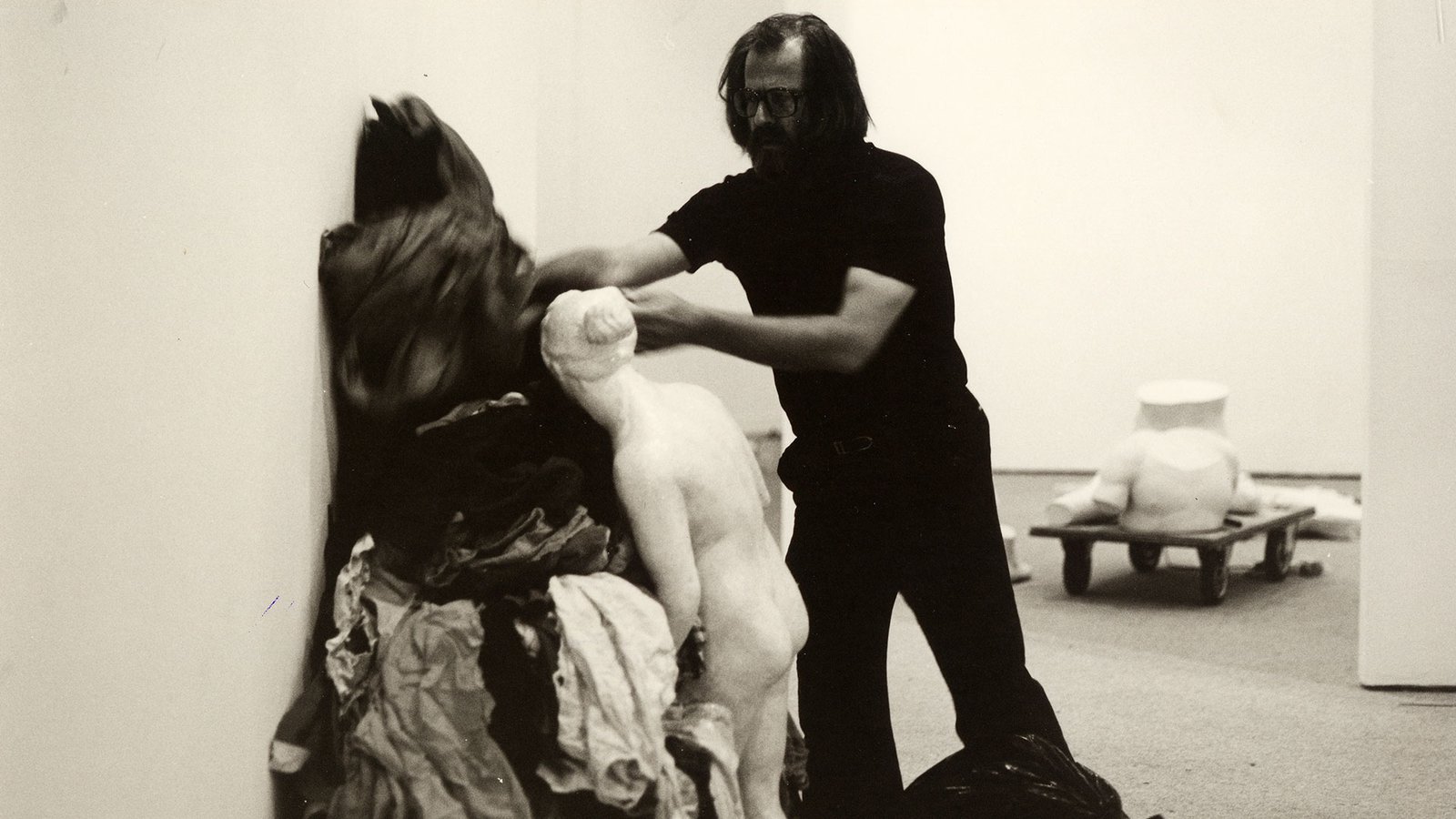
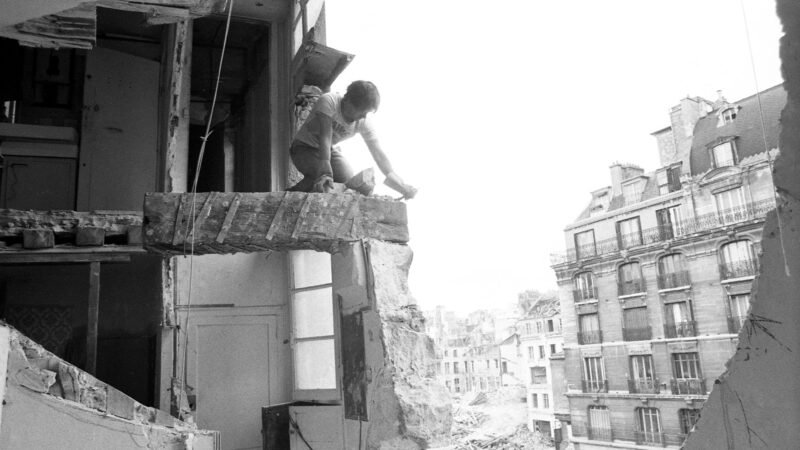
The image chosen by the museum to present the focus shows Michelangelo Pistoletto during the installation of Identité Italienne. L'art en Italie depuis 1959, the 1981 exhibition at the Centre Pompidou in Paris. It is a choice that says a lot: not the finished work, but the artist at work, at the moment an exhibition takes shape. It is exactly Lanfranco's point of view.
The magazines
Lanfranco's photographs appeared in many specialized magazines, from Domus to Artforum, from Artpress to Il Giornale dell'Arte. Whoever has leafed through those pages in recent decades has seen her work without perhaps knowing her name: the exhibition gives an author back to images many already have in their heads.
The title
Ordinare il mondo ("Ordering the World") is an exact title. The archive of a photographer who for 30 years followed exhibitions, installations and artists is an attempt to put order in a universe that by nature has little. The focus shows how that order was built, photograph after photograph.
Who Nanda Lanfranco was
Nanda Lanfranco, born Ferdinanda Riccarda Mercedes Garaventa, was born in Genoa in 1935 and died in Pieve Ligure. She took the surname of her husband, Sergio Lanfranco, and came to photography as an adult, after years devoted to her family. Her fullest biography, published by the Enciclopedia delle donne, is signed by her daughter, Monica Lanfranco.
Childhood at Calcinara
Born into a very poor family, she spent her childhood in the hills of the Genoa area, evacuated with her family during the war to Calcinara di Uscio, above Recco, in Val Fontanabuona. That place, loved and hated, would remain for her whole life the place to get away from and at the same time the one to return to with her lens.
Meeting Celant
Around the mid-1970s Lanfranco attended in Genoa some art and photography courses taught by a still-unknown Germano Celant, who would become one of the best-known art critics in the world. It was the beginning of a friendship and collaboration that never ended. In the small bathroom of her home, in the Foce district, she developed her first negatives.
The Hasselblad and the square format
From those years her technical preference for the square format and for the Hasselblad becomes clear, with the shot from above, not frontal, typical of that camera. It is a way of looking that whoever enters the foyer will recognize at once: the composed frame, the subject observed from a respectful distance.
The performances of the 1970s
In 1975 she photographed Laurie Anderson's performances in Genoa, the following year, at the Venice Biennale, those of Marina Abramović and Ulay. She collaborated for a long time with the Samangallery in Genoa, where she met Michelangelo Pistoletto, whose career she would document.
30 years of exhibitions
For over 30 years she was present, also for Il Giornale dell'Arte, at the great shows of Venice and Kassel. Alongside commissioned work she formed personal relationships with some artists, also documenting their private lives, their partners, parents, pets: an intimate archive, strictly in black and white.
Her personal work
Shy, reluctant to exhibit, she held few shows. From 1985 she photographed the statues of the Staglieno monumental cemetery, where she also brought Paolo Poli for some portraits, there followed still lifes emerging from the dark and, between 1987 and 1989, the cycle Tempo rubato, published by Allemandi in 1989, with bodies of elderly women and men from Calcinara. In 1991 an exhibition in Aosta, Foto di gruppo, curated by Alvar González-Palacios, gathered her portraits of artists. Until the mid-1990s she worked on a cycle on the Tarot, Mise en abyme, published by Allemandi in 1995.
The archive today
Her archive spans from the 1970s to the first decade of the 2000s and is today one of the richest sources on the history of contemporary art in Europe. Besides the loan to MAXXI, the Castello di Rivoli holds a Nanda Lanfranco Fund, established in 2025, with over 200 items among prints, slides and negatives.
A curiosity about Ordinare il mondo. The Nanda Lanfranco Archive at MAXXI, November 13, 2026 to January 31, 2027
Nanda Lanfranco photographed Marina Abramović and Ulay at the 1976 Venice Biennale, when the couple was at the start of their shared artistic story. 50 years later, in the same Roman winter, the Galleria Nazionale d'Arte Moderna devotes a major exhibition to Abramović, from November 18, 2026 to April 4, 2027, a few tram stops from MAXXI. Whoever visits both sees the artist from two sides: the works in her show, and the beginnings in the eyes of someone who was in the room.
Second curiosity: among Lanfranco's most singular portraits are those she made of Paolo Poli among the statues of Staglieno, Genoa's monumental cemetery. The Florentine actor, whom she greatly admired, among nineteenth-century marbles is an image that says everything about his irony and his visual culture.
Third: Lanfranco came to art thanks to a course. The teacher was Germano Celant, then still unknown to the general public. From those Genoese lessons came a partnership lasting decades, and a good part of the archive MAXXI shows today.
Zaha Hadid's MAXXI, the exhibition's venue
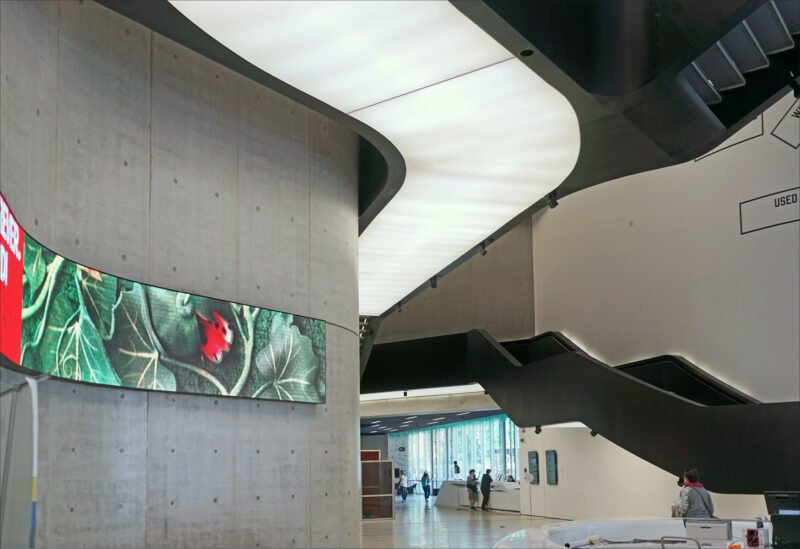
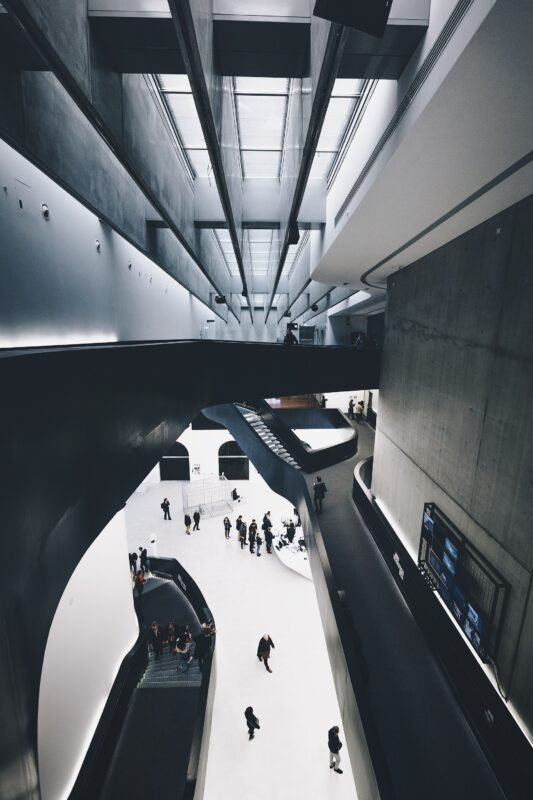
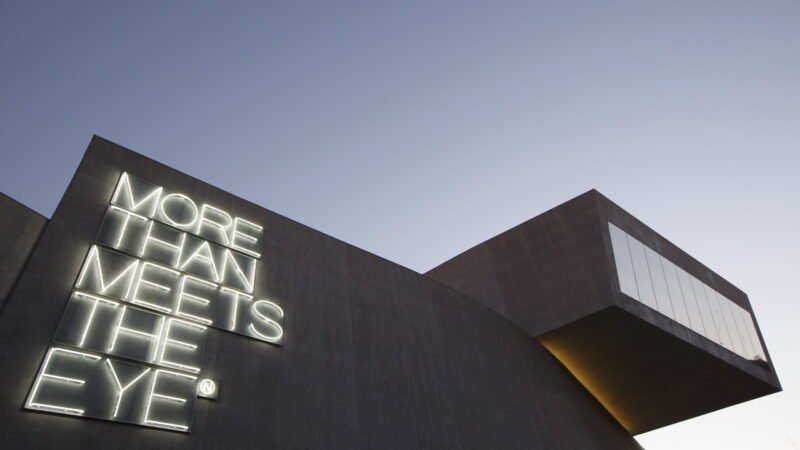
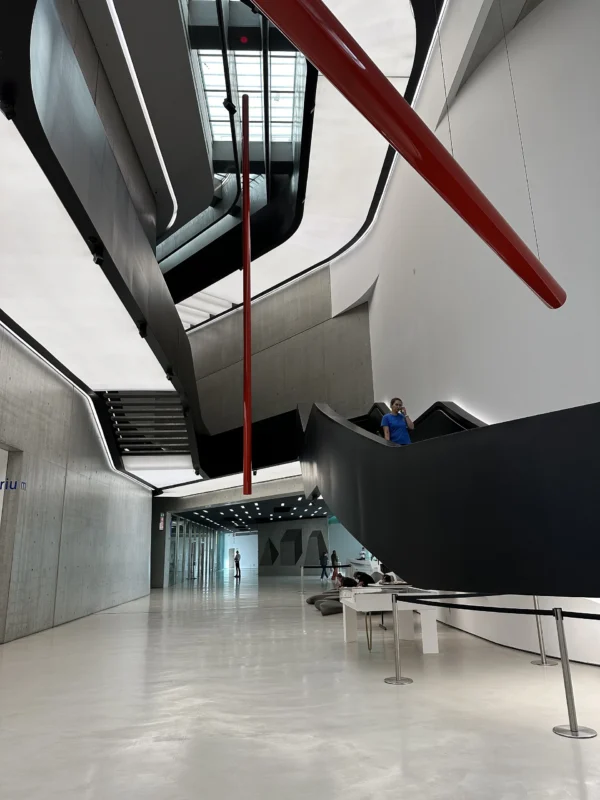
MAXXI is the first Italian national museum devoted to contemporary arts and architecture: designed by Zaha Hadid, it was inaugurated in 2010 on an area of 29,000 square meters in Flaminio. For a photographic archive that documented contemporary art for half a century, it is the natural venue.
From barracks to museum
The idea of a national museum hub for contemporary arts took shape in 1997, when the Ministry for Cultural Heritage obtained from the Ministry of Defense the area of the former Montello barracks, occupied by workshops and disused pavilions. The museum was thus born on military ground, in a residential district, far from the traditional places of Roman art.
The 1998 competition
The 1998 international competition drew 273 entries from around the world. Zaha Hadid won, with a project chosen for its ability to blend into the urban fabric and offer the city a sequence of public spaces. The foyer where the Lanfranco focus is installed is the first of those sequences: the entrance, where the museum's paths divide.
The Carlo Scarpa foyer
MAXXI's foyer bears the name of Carlo Scarpa, the great Venetian architect. Showing an archive here means placing it at the point of passage for all the museum's visitors: a choice that gives visibility to work long left in the shadows.
A square and three permanent works
At the center of the project is the square named for Alighiero Boetti, open outside hours too during events. In the museum three installations remain always visible, those by Anish Kapoor, Sol LeWitt and Maurizio Mochetti. The museum's general profile is on the page about MAXXI.
One thing nobody tells you about Ordinare il mondo. The Nanda Lanfranco Archive at MAXXI, November 13, 2026 to January 31, 2027
Those who look at the photographs of a contemporary art exhibition rarely ask who took them. The installations, the openings, the artists at work that we know from catalogs and magazines almost always have an author anonymous to the public. Nanda Lanfranco was for decades one of these authors. The thing nobody says is that, leaving this focus, you will look at catalogs in another way: looking for the credit line at the bottom, under the image.
Second little-known thing: Lanfranco was always reluctant to show her personal work, despite invitations from galleries and the urging of her family, because an exhibition implies public relations she did not like. The MAXXI focus is thus a double rarity: a show devoted to a photographer who wanted very few shows.
Third: even the year of her death has two versions. MAXXI ties the arrival of the collection at the museum to the year of her passing, 2024, the biography signed by her daughter and the Castello di Rivoli give 2023. A small discrepancy that says much about how little, so far, has been written about her.
The advice I give you for visiting Ordinare il mondo. The Nanda Lanfranco Archive at MAXXI, November 13, 2026 to January 31, 2027
It is better to enter the foyer after seeing the other exhibitions on at MAXXI, not before. After an hour spent in front of the works, Lanfranco's photographs show the flip side: the artists while they install, discuss, wait. It is a change of perspective that works only if you still have the finished result in your eyes.
Second: look at the framing, not only the subjects. The square format of the Hasselblad and the shot from above give many images an almost classical composure. This, more than the famous names, makes Lanfranco an author and not merely a witness.
Third: give the names time to arrive. Many of the faces portrayed belong to central figures of Italian and international art of the past 50 years. Reading the captions carefully turns the focus into a small history of contemporary art told through portraits.
Finally: if you can, come on a weekday in December or January, in the early afternoon. The foyer is a place of passage, and on peak weekends the flow of visitors makes it hard to stop in front of the photographs as they deserve.
How to get to MAXXI for the Nanda Lanfranco exhibition
MAXXI is reached from the center on Metro A to Flaminio and then tram 2 toward Piazza Mancini. It is the simplest route from Termini, from Piazza di Spagna or from the Vatican.
Metro A and tram 2
From Piazzale Flaminio tram 2 climbs Via Flaminia: the useful stop is the one nearest Via Guido Reni, and from there you walk toward the Tiber. It is the same combination given for the Auditorium Parco della Musica, which is about 650 meters from the museum.
The buses
The area is served by the 910, from Termini to Piazza Mancini, the 53, from Piazza Mancini to Largo Chigi, the 168, from Largo Maresciallo Diaz to Tiburtina station, and the 982, from Viale XVII Olimpiade to Quattro Venti station. On Via Guido Reni, about 130 meters from the entrance, there is a stop bearing the museum's name, marked as accessible.
On foot from the Ponte della Musica
The Ponte della Musica, for pedestrians and cyclists, links Flaminio to Lungotevere Cadorna, at the level of the Foro Italico. From Prati or Piazza Mazzini you reach the museum on foot in a pleasant walk.
By car
Parking in the area is difficult on weekdays and almost impossible on concert nights at the Auditorium or match days at the Stadio Olimpico. The Auditorium has two paid parking lots, about 10 minutes on foot from MAXXI.
Another well-known fact, yet rarely mentioned
That Germano Celant was one of the most influential critics of the second half of the twentieth century is known to anyone who deals with art. Less often cited is that his work, like that of every great curator, needed eyes beside his own. Exhibitions exist for a few weeks, what remains are catalogs, reviews and photographs. Whoever photographs an installation builds the memory of an exhibition, and often decides the image that will last longest.
The partnership between Celant and Lanfranco, begun in a Genoese classroom in the 1970s, tells exactly this. The photographer followed for decades exhibitions, artists and international shows, helping to fix in collective memory moments we would otherwise know only by hearsay.
There is a second little-said fact: the Genoa of the 1970s played a lively role in artistic experimentation. At the Samangallery, with which she collaborated for a long time, Lanfranco encountered performance photography, and it was there that she met Pistoletto. The MAXXI focus gives back to that Genoese season a place that art histories written from Rome and Milan tend to forget.
How to organize your visit to MAXXI
The focus on Nanda Lanfranco takes about an hour, with the museum's other exhibitions and a break at the bar, a full visit to MAXXI takes half a day.
The day and the time
MAXXI is closed on Monday. Tuesday and Wednesday are the quietest days, early afternoon the best time. On Saturday and Sunday the foyer fills up, and with it the exhibition space.
Museum services
MAXXI offers a coat check, restrooms including accessible ones, a coffee shop, bar and restaurant, audio guides and guided tours. The calendar of events tied to the exhibitions is on the official website.
Visiting in a group
For groups the focus works well as an introduction: 10 minutes on who Lanfranco was and her relationship with Celant, then freedom of route. For private and corporate guided visits to MAXXI and Flaminio, Tour Leader Pro organizes custom itineraries.
To combine on the same day
On the same day at MAXXI you can see the Sophie Calle exhibition, open until February 7, 2027, and the large show Vitalità dell'architettura italiana. Those who prefer a second museum will find farther south the Marina Abramović exhibition at the Galleria Nazionale.
The right photo to take at Ordinare il mondo. The Nanda Lanfranco Archive at MAXXI, November 13, 2026 to January 31, 2027
The rules on photographs in the galleries are set by the museum, and for an archive on loan it is best to ask staff before shooting. The right photo, in any case, is not a reproduction of the works: Lanfranco's images are to be looked at, not copied.
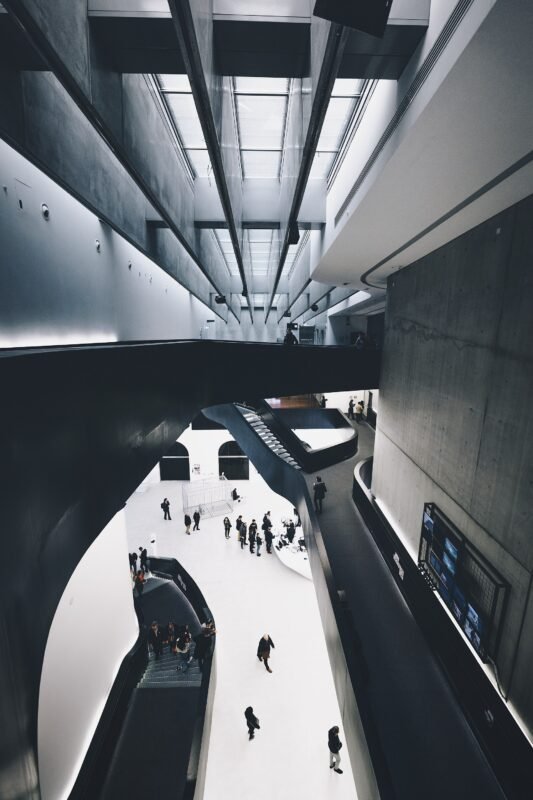
The photo to take is the one she would have taken: the visitor in front of the photograph. The Carlo Scarpa foyer is a place of passage, with light coming in from the glass walls and Zaha Hadid's walkways intersecting overhead. A person standing still in front of a portrait of Pistoletto while everyone around walks is an image that pays homage to Lanfranco's eye.
Outside, the classic photograph of MAXXI is taken from Alighiero Boetti square, with the overhang of the last gallery stretching toward Via Guido Reni. In November and December the afternoon light fades early: around 16:00 the concrete takes on a warm color that lasts a few minutes.
A suggestion: if you have a square-format film camera, bring it. There is no better way to understand the exhibition than trying to compose a frame as she did.
Flaminio around MAXXI: what is nearby
MAXXI is in Flaminio, between Via Flaminia, the Tiber and the Parioli hill. In a few minutes on foot you reach the Auditorium, the Ponte della Musica and Villa Glori.
The Auditorium Parco della Musica
Designed by Renzo Piano and opened in 2002, the Auditorium Parco della Musica Ennio Morricone is the home of the Accademia di Santa Cecilia. In the foyer runs a path of neon installations by Maurizio Nannucci, some Cellotex works by Alberto Burri are on display, and in the gardens are two Keith Haring sculptures from 1989: a small free art itinerary after the exhibition.
Villa Glori
Behind the Auditorium rises Villa Glori, opened to the public in 1924 as the Parco della Rimembranza to a design by Raffaele De Vico. Since 1997 it has hosted installations by contemporary artists, including Kounellis, Staccioli and, since 2000, Giuseppe Uncini's Porta del Sole and Paolo Canevari's Uomo erba.
Toward Villa Borghese
Tram 2 takes you in a few minutes to Piazzale Flaminio and Villa Borghese, with the National Gallery of Modern and Contemporary Art and the Etruscan Museum of Villa Giulia.
Milvian Bridge
Going up the Tiber northward you reach Milvian Bridge, the ancient bridge that in the evening becomes one of the meeting points of northern Rome.
Some important events that took place here in history
The history of the place where Nanda Lanfranco's archive is seen today begins with a barracks and arrives at a national museum in little more than a decade. In 1997 the Ministry for Cultural Heritage obtained from the Ministry of Defense the area of the former Montello barracks, in 1998 the international competition, with 273 entries, rewarded Zaha Hadid, in 2010 MAXXI opened as the first Italian national museum for the arts and architecture of the 21st century.
A kilometer from the museum, on the hill of Villa Glori, one of the best-known episodes of the Roman Risorgimento took place. On October 23, 1867 about 70 Garibaldian volunteers led by Enrico and Giovanni Cairoli, having reached Ponte Milvio without finding the hoped-for reinforcements, took refuge on the hill and were defeated by the papal army. Enrico died, Giovanni was gravely wounded.
In 1924 the same hill became the Parco della Rimembranza for the fallen of the First World War: the trees were planted by Roman students, each bearing the name of a soldier. In 2002, a short walk away, Renzo Piano's Auditorium opened. In less than a century this corner of Flaminio has passed from military memory to cultural memory: a photographic archive finds a coherent home here.
Who has played at Ordinare il mondo. The Nanda Lanfranco Archive at MAXXI, November 13, 2026 to January 31, 2027
Through the Carlo Scarpa foyer, in this exhibition, pass above all the protagonists photographed by Lanfranco. The first is Michelangelo Pistoletto, caught during the installation of Identité Italienne at the Centre Pompidou in 1981, in the image chosen by the museum, Lanfranco had met him at the Samangallery in Genoa and documented his career. Then Germano Celant, friend and lifelong reference point. In her biography are Laurie Anderson, photographed in Genoa in 1975, Marina Abramović and Ulay, at the 1976 Venice Biennale, and Paolo Poli, portrayed among the marbles of Staglieno.
Through MAXXI have passed, even before, the authors who made it: Zaha Hadid, who designed it, and the artists whose works remain always visible, Anish Kapoor, Sol LeWitt, Maurizio Mochetti. The square bears the name of Alighiero Boetti, the foyer that of Carlo Scarpa.
The exhibition finally bears the signature of the curator Lara Conte, who worked on the collection held at the Centro Archivi MAXXI Arte. And, behind the scenes, that of the family: her daughter Monica Lanfranco, author of her mother's biography, and her grandchildren Anteo and Cielo Lenzi Lanfranco, to whom the biography entrusts the care of the archive.
MAXXI accessibility
MAXXI is listed by Roma Capitale's tourism portal as an accessible museum, with restrooms dedicated to people with disabilities. The foyer, on the entrance floor, is the easiest space in the museum to reach.
Information before your visit
For access conditions, discounts and free admission for a companion, the reference is the museum, at 06 3201954. It is best to call beforehand, especially on the busiest days.
The stop and parking
Via Guido Reni stop bearing the museum's name is marked as wheelchair accessible. The Auditorium parking lots, about 10 minutes on foot away, have reserved spaces.
The Nanda Lanfranco exhibition with children
The focus on Nanda Lanfranco is an exhibition of black-and-white photographs, without difficult content: suitable for all ages, but designed for an adult audience.
With the youngest
For children the exhibition can become a game: find the artists' hands, count the cameras, recognize a face seen in a book. Afterward, the MAXXI square and the Auditorium gardens, with a play area, are the natural outlet.
With teenagers
With kids who photograph with their phones the exhibition works wonderfully: a photographer who developed negatives in her bathroom and chose each frame knowing she had few shots available is a lesson in looking. Ask them to pick a photo and explain why it is composed that way.
Where to eat near MAXXI
MAXXI has a coffee shop, bar and restaurant inside: for those visiting the focus and the other exhibitions it is the most practical solution.
The Auditorium
The Auditorium, about 10 minutes on foot away, has a bar and restaurant: a good base for a long break between a morning exhibition and an afternoon walk.
Flaminio, Parioli and Ponte Milvio
Flaminio is a residential district, with everyday dining designed for those who live and work in the area. For dinner after the exhibition there are two directions: the Parioli, with cocktail bars and restaurants, or Ponte Milvio, along the Tiber.
The Roman winter at MAXXI
The focus on Nanda Lanfranco covers the quietest months of the Roman year, from mid-November to the end of January: the period when museums become places to spend a whole afternoon again.
November and December
In November the district is animated by the Accademia di Santa Cecilia season at the Auditorium. In December the days shorten and the light vanishes early, in the holiday weeks the museums fill with families. On December 25 MAXXI is closed, for the other holidays it is best to check the official website.
January, through the 31st
After Epiphany, January is the quietest month for Roman museums and the ideal time for this exhibition. The last day is Sunday, January 31, 2027: whoever puts it off until the last weekend risks finding the foyer full.
Frequently asked questions about the Nanda Lanfranco exhibition at MAXXI
When is the Nanda Lanfranco exhibition open at MAXXI?
The exhibition Ordinare il mondo. The Nanda Lanfranco Archive is open at MAXXI from November 13, 2026 to January 31, 2027, in the Carlo Scarpa foyer. The museum opens Tuesday to Sunday from 11:00 to 19:00, is closed on Monday, and the ticket office closes an hour before.
Who was Nanda Lanfranco?
Nanda Lanfranco was a Genoese photographer, born in 1935, who for decades documented artists and exhibitions of the Italian and international scene. A pupil and friend of Germano Celant, she published in Domus, Artforum, Artpress and Il Giornale dell'Arte, and photographed among others Pistoletto, Laurie Anderson, Abramović and Ulay.
Who curated the exhibition Ordinare il mondo?
The exhibition Ordinare il mondo at MAXXI is curated by Lara Conte. It is a focus built on Nanda Lanfranco's collection on loan to the museum, at the Centro Archivi MAXXI Arte, and retraces her work from the Genoese beginnings of the 1970s to the friendship with Celant.
How much does the ticket for the Nanda Lanfranco exhibition cost?
MAXXI's prices for the Nanda Lanfranco exhibition are published on the museum's official website. Tickets are bought at the desk, open until an hour before closing, or online through the channel given by the official site. For discounts and groups the museum answers at 06 3201954.
How do I get to MAXXI by public transport?
MAXXI, at Via Guido Reni 4a, is reached on Metro A to Flaminio and then tram 2 toward Piazza Mancini, or on buses 910, 53, 168 and 982. On Via Guido Reni, about 130 meters from the entrance, there is a stop bearing the museum's name.
How long does it take to see the Nanda Lanfranco exhibition?
The focus on Nanda Lanfranco at MAXXI takes about an hour, reading the captions unhurriedly. Whoever wants to combine the museum's other exhibitions, such as the one on Sophie Calle, should allow half a day.
Is the Nanda Lanfranco exhibition suitable for children?
The Nanda Lanfranco exhibition at MAXXI is made of black-and-white photographs without difficult content, so suitable for all ages, even if designed for adults. For kids passionate about photography it is an excellent lesson in composition and looking.
The final advice on the Nanda Lanfranco exhibition
It is wise to distrust exhibitions that promise everything and appreciate those that deliver something precise. MAXXI's focus on Nanda Lanfranco belongs to the second kind: an hour of photographs that changes the way you look at contemporary art, because it shows who was looking before us. Come on a weekday, after the other exhibitions, and linger in front of the portraits longer than you think. By January 31.
Article written by the editorial team of Tour Leader Pro, contact them for Private/Corporate/V.I.P. Tours and Experiences.
Planning a trip to Rome? The English guides to visiting the city are on ItalyPlanner.com.
Contact Information
Nearby
 MAXXI – National Museum of 21st Century Arts100 m
- Flaminio100 m
- Teatro Olimpico500 m
- Ponte della Musica – Armando Trovajoli600 m
- Auditorium Parco della Musica700 m
- Museum of Musical Instruments (MUSA)700 m

Upcoming events nearby
- Sophie Calle at MAXXI, from October 16, 2026 to February 7, 2027100 m
- NATURE: Tatiana Bilbao Estudio. Campo aperto at MAXXI, from October 16, 2026 to February 7, 2027100 m
- Gordon Matta-Clark. Not the Work…The Worker at MAXXI, November 13, 2026 to February 28, 2027100 m
- 11 plus Rooms at MAXXI, November 27, 2026 to February 7, 2027100 m
You might also like
- Il Villaggio Olimpico di Roma at MAXXI: Il mondo in 300.000 mq, December 18, 2026 to April 25, 2027
- Sensing the Future at MAXXI, November 25, 2026 to January 31, 2027
- MAXXI Bvlgari Prize 2026 at MAXXI, from November 6, 2026 to March 7, 2027
- Alessandro Bergonzoni Arrivano i Dunque at Teatro Olimpico, February 20 and 21, 2027
- Back To Hawkins at Teatro Olimpico, February 17, 2027
- Selene Calloni Williams: Tu sei la Foresta at Teatro Olimpico in Rome, February 16, 2027