Lorenzo Ferri Museum
In short. The Lorenzo Ferri Museum is in Cave, in the province of Rome, at Via Cavour 23, and the visit has to be booked: the official site has a dedicated button that leads to the contacts page, the phone number is 06 5745934 and the email…

The Lorenzo Ferri Museum is in Cave, in the province of Rome, at Via Cavour 23, and the visit has to be booked: the official site has a dedicated button that leads to the contacts page, the phone number is 06 5745934 and the email address is museolorenzoferri@gmail.com. On Monday and Tuesday the museum is closed. From Wednesday to Sunday it opens from 10:30 to 12:30 and from 16:30 to 19:30, with the ticket office closing half an hour before closing time. The fixed closures of the year are January 1, August 15 and December 25. The hours go through seasonal variations that the museum announces on its own channels, and this makes the confirmation call the smartest move before hitting the road: it's 40 kilometers from Rome, and nobody wants to do it twice.
The full ticket costs €3. The reduced ticket costs €2.50 and goes to residents, groups over 20 people, children and teenagers from 3 to 18 and over 65. Entry is free for people with disabilities with a companion and for children up to age three. These are figures that in the Italian museum landscape are almost comic: three euros for a plaster cast gallery of hundreds of pieces and for a nativity scene of nine statues as tall as a second floor. The museum is civic, owned by the Comune di Cave, and is part of the Civic Museum "Città di Cave". Since 2024 it has belonged to the Museum System of the Castelli Romani and Prenestini, Museumgrandtour.
The venues are two and they don't coincide. The main section, the plaster cast gallery, occupies the building of the former Mattei Hospital at Via Cavour 23 and is accessible to people with mobility disabilities thanks to the elevator. The Monumental Nativity Scene section occupies the underground rooms of the Town Hall, the former Augustinian convent, in the historic center, and that part is not reachable by those with difficulty walking. In both sections there is a tactile path with information panels and scale reproductions of some statues, designed for low-vision and blind visitors: it's a rare choice in small museums, and in a museum of plaster sculptures it has a meaning that goes beyond regulatory compliance.
You get there by taking State Road 155 of Fiuggi, the one that links Rome to Frosinone through the Sacco valley. By car the reference toll exit is Valmontone, on the Autostrada del Sole. By public transport the Cotral lines work, leaving from the Anagnina and Ponte Mammolo terminals, while those arriving by train get off at the Valmontone railway station and continue with shuttles. Cave sits at the foot of the Prenestini Mountains, among chestnut woods, and has just under 11,000 inhabitants: those who arrive expecting a Roman periphery instead find a hill town with a square, a collegiate church and a town hall carved out of a convent.
What You Visit at the Lorenzo Ferri Museum
The Lorenzo Ferri Museum is dedicated to Lorenzo Ferri (1902-1975), sculptor, painter, restorer, sindonologist and teacher. The formula the museum uses to define him lines up five trades and it's not an affectation: they really are five parallel lives, and the museum has the merit of showing them all together instead of choosing the most convenient one to tell. The collection comes from the collection that the artist's heirs donated to the Comune di Cave, and is arranged in chronological order to give the complete path of the author, from the exercises of a 16-year-old boy to the last works of 1975.
The main section, inaugurated in December 2013 in the former Mattei Hospital, hosts a very extensive plaster cast gallery: plaster works representative of all phases of his career, from the 1920s to the 1970s. Among the best-known pieces are the studies for Roman sculptures such as the statue of Trilussa and the bust of Giolitti, the Ecce Homo, the Christ Alpha and Omega, the Christ the Redeemer, the reliefs for the competition for the bronze doors of St. Peter's Basilica, the oil painting "Eve in Eden" and the studies for the monument for the shrine of Knock in Ireland.
The Monumental Nativity Scene section, inaugurated a year earlier, in December 2012, in the underground rooms of the former Augustinian convent, hosts the gigantic nativity with the nine plaster statues sculpted between 1947 and 1948, after winning the competition held by the Pallottine Fathers for the renewal of the nativity scene of Sant'Andrea della Valle in Rome. They represent the Epiphany: Mary with the Child, Saint Joseph to the right of the Virgin and, opposite, the three Magi, one of them kneeling, with their respective pages bearing the offerings.
The verdict is clear-cut: the plaster cast gallery is interesting, the nativity scene is memorable. If you had time for only one of the two sections I'd go without hesitation to the underground space of the former convent, because the effect of nine figures almost four meters tall inside a cross vault has no equivalent within driving distance of Rome. But it would be a pity, because the plaster cast gallery explains how those nine figures came to be, and without it the nativity scene remains a stroke of theater instead of the arrival point of a line of research.
Who Lorenzo Ferri Was, the Sculptor the Lorenzo Ferri Museum Is Dedicated To
Lorenzo Ferri was born in Mercato Saraceno, in Romagna, on July 18, 1902, into a family with a Risorgimento tradition, and died in Rome on February 25, 1975, struck down by a heart attack while still working. In between are 72 years of a biography that seems written by a novelist with too much imagination: Rome, Buenos Aires, Benghazi, Salerno, the Vatican, Ireland, Jakarta, and for the whole time a single obsession that grew alongside him like a second profession.
He arrived in Rome in 1913, at age 11, and learned sculpture in the workshop of Giuseppe Fallani, restorer of the Sacred Apostolic Palaces. It's a detail worth more than a degree: it means entering as a boy into a trade that in Rome was still handed down by contact, with hands in the clay and eyes on the ancient marbles to be put back together. Between 1919 and 1920 he attended the School of Ornamental Art of San Giacomo, with teachers such as Antonino Calcagnadoro and Ermenegildo Luppi, and in 1921 he graduated from the Institute of Fine Arts of Rome. Between 1925 and 1926 he studied bas-relief and medal-making with Giuseppe Romagnoli at the School of the Mint: that is where the engraver's precision comes from that you recognize in the medallions displayed on the third floor.
Ferri conceived art as knowledge, and his two poles were Leonardo and Michelangelo. It's a statement that sounds naive today and which in fact explains every choice of his career: the reconstruction of Leonardo's Last Supper, the philological restoration of the Laocoön, the anatomical studies on the Shroud of Turin are so many applications of the same idea, that sculpting and understanding are the same gesture. Whoever enters the museum expecting a provincial devotional artist finds instead a would-be scientist with a chisel in hand.
Buenos Aires, Benghazi, Salerno: The Working Years of Lorenzo Ferri
Between 1926 and 1929 Ferri was in Buenos Aires, where he collaborated with the architect Mario Palanti and won first prize at the Exposición de Artes Aplicadas e Industriales. He was 24. Argentina in the 1920s was, for an Italian sculptor, what America was for a musician: a continuous construction site, enormous buildings to decorate, clients in a hurry and with money. Ferri returned to Rome in 1929 with a formed craft and with the idea that teaching could be a part of the profession and not a fallback.
From 1930 he taught at the Oratory of San Pietro, where he built a small community of young artists. Among the most gifted students was Alberto Carlo Carpiceci, who would become his brother-in-law and with whom he would sign the Monumental Nativity Scene. From 1935 to 1939 he worked in Benghazi, in Libya. From 1941 he was seconded to the Superintendencies of Salerno and Potenza for archaeological restorations, and from 1943 he took part in the restoration of the basilica of San Lorenzo fuori le Mura, hit by the bombing of July 19. In 1946 he returned to public teaching.
There is an episode that the catalogs mention in passing and which in fact says everything about the man: in 1942 he collaborated on the restoration of the Laocoön in the Vatican Museums, and in 1967 he identified fragments of the Polyphemus Group in the museum of Sperlonga, reconstructing significant parts of it. A restorer who puts a Hellenistic group back together from shards is the same person who will spend 40 years reconstructing a human body from an imprint on a sheet. The method is identical: start from a fragment and work back to the whole form. Whoever visits the museum keeping this thread in mind understands why the rooms are not a warehouse of plasters but the diary of an investigation.
The Plaster Cast Gallery of the Lorenzo Ferri Museum, Floor by Floor
The plaster cast gallery of the former Mattei Hospital is organized chronologically and is walked upward. It's an honest and tiring arrangement: you start with the plasters of a boy and end in front of the self-portraits of a man who knows he is at the end. Take the stairs slowly, because the museum is not big but it is dense, and the temptation to cross it in 20 minutes should be fought.
Ground Floor: The Early Works of Lorenzo Ferri
The room on the ground floor gathers the early works. The piece that strikes you first is "Lovers" from 1918, a plaster study of 16 by 20 by 63 centimeters: Ferri was 16. Next to it are the portraits of the early 1920s, the "Child with Apron" and the "Little Girl with Puffed Cheeks" from 1920, the bust of Wanda Rizzo from 1924, and above all "Angelina", the patinated plaster figure of 1922 that is considered his first real statue, with that lowered gaze the museum defines as modest and which is, more prosaically, the solution of a boy who doesn't yet know how to hold a model's gaze.
Part of the same room are the "Winged Victory" and the "Victory" of 1925, a half-figure in plaster 155 centimeters tall, and the patinated plaster bas-relief "Legend of Orpheus" of 1926, 2.40 meters by 96 centimeters: here the boy has become a professional and the relief combines classical composition and symbolic narration. Then there are the academic studies of 1926, the male and female nudes in bas-relief, the "Girl with Braids and Bare Shoulders", the "Prelate with Angular Biretta" in the form of a medal. The room closes with an oil self-portrait of 1966, titled with self-mockery "Pictor Peximus", worst painter: 46 by 55 centimeters of healthy professional modesty.
Third Floor: The Works of the Lorenzo Ferri Museum From 1930 to 1950
The rooms on the top floor gather the works made between 1930 and 1950, and they are the heart of the career. Here is "The Face of Art" of 1933, a female half-figure in plaster 110 centimeters tall and deliberately unfinished, which asks the visitor to complete it with the imagination. There is the "Ecce Rex Vester" series, worked between 1933 and 1951, with several plaster heads and a patinated plaster statue 208 centimeters tall, in which the anatomical research of the face is already conducted on the Shroud: it is the exact point where the study of the Shroud enters sacred sculpture and never leaves it.
Then there are "The Bride", a plaster statue of 1934-1944 inspired by the artist's wife, and its pendant "Final Farewell" of 1936-1944, both later translated into bronze and marble for the Jakarta museum. There is the patinated plaster bust of Trilussa of 1954, 60 by 67 by 83 centimeters, that is, the model for the Roman monument. There are the portraits of Antonio Rosmini of 1956, of Giovanni Giolitti of 1959, of Carlo Petrocchi of 1962, of Luciano Manara, of Ennio Quirino Visconti, of Cardinal Lepicier of 1930. And there is a substantial section of sacred art: the Madonnas with Child, the Christ in the Garden of Olives of 1949-1953 in four bas-reliefs, the Christ of the Shroud and the Pietà for the Ciro Gori chapel, the Saint Anthony of Padua, the Christ before Pilate, the Saint Leo the Great of 1947-1948, the Ecce Homo of 1958, and a most singular "Christus Yogi" of 1941 that alone would be worth a degree thesis on the encounter between Christian iconography and Orientalist suggestion.
In the small-format display cases appear the medal molds for the portraits of John XXIII of 1963, the portrait of Michelangelo of 1964, the Pietà of Palestrina, the two putti with doves of 1962. And among the paintings, the "Jesus the Carpenter with Mary" of 1946 on panel, the portrait of Cardinal Borgongini Duca of 1953, oil on canvas of 120 by 180 centimeters. If I had to point to a single piece on this floor I'd point to "The Face of Art": an unfinished plaster of 1933 that says more about sculpture than 20 finished works.
Second Floor: The Last Works of Lorenzo Ferri, 1960-1975
You reach the second floor already tired and it's a pity, because it's the most intense floor. It displays the works from 1960 to 1975. There are the plaster bas-reliefs of the "Christ Alpha and Omega" of 1957 with the related studies. The studies for the Christ the Redeemer of the Prima Porta cemetery, developed between 1961 and 1973. The complete series for the chapel of the Apparition of Knock, in Ireland, made between 1960 and 1963, with the Madonna, Saint Joseph and Saint John in plaster. The studies for the Madonna Immacolata on the globe of 1950 and of 1952-1954.
The piece worth the trip is "The Wait", gold-patinated plaster of 60 by 180 centimeters, worked between 1956 and 1965, which the artist intended as a figuration of the struggle between matter and spirit. Next to it is "The Reluctant Virgin" of 1964-1965, statue and studies. Then the painting, which is the surprise of this floor: the watercolor self-portrait of 1975, his last year of life. The "Jesus in the Garden of Gethsemane" of 1955, oil on canvas of 100 by 70. "From Vietnam to New York" of 1973-1974, oil on canvas of 132 by 244 centimeters, which has nothing of a sacred artist about it and deserves more than the three seconds almost everyone gives it. "Eve in Eden" of 1973-1974, 112 by 215 centimeters. And a "Head of Beethoven" of 1969, oil on canvas of 75 by 100. The sculpted portraits of Monsignor Ferdinando Baldelli of 1972, of Eugenio Terrachini of 1964, of Renato Donatelli of 1972 close the floor.
The Monumental Nativity Scene of the Lorenzo Ferri Museum
In 1946 the Pallottine Fathers announced a competition to renew the nativity scene donated by the Torlonia family, on the occasion of the centenary of the establishment of the Epiphany Octave willed by Saint Vincent Pallotti. The winning work was destined for the church of Sant'Andrea della Valle in Rome. Ferri won, and found himself facing a problem nobody had explained to him: placing a nativity in front of the apse of the second tallest church in Rome, at three meters above the floor. His artistic report speaks of great problems of proportional relationships, of harmonizing lines, masses and volumes. The proportions were calculated on the construction ratios of the building, that is, on the double-square rectangle of 1 to 2.
The stylistic choice was radical for the time: eliminate the folkloric elements and the theatrical pictorialism, and fuse the landscape of the grotto with masses that draw a concave curved line. No little shepherds, no little houses, no moss. Anyone who arrives in the underground space at Cave expecting the Neapolitan nativity scene blown up to giant size is left baffled for a good minute, and then understands.
The dimensions of the statues of the Monumental Nativity
The nine statues are in patinated plaster. The museum's catalog records the seated Madonna with the Child at 150 by 180 by 367.1 centimeters, Saint Joseph at 80 by 110 by 384.7, the Assyrian King with the page at 120 by 360 by 375.5, the kneeling Indian King at 225.5 by 175 by 265.8, the Indian King's page with the small chest at 71 by 160 by 265.8, the African King at 140 by 300 by 370.2, and the African King's page with the amphora at 60 by 130 by 301.2. Translated: the standing figures come close to 4 meters, the kneeling ones exceed two and a half meters. In front of Saint Joseph, who measures 3.84 meters, a grown man reaches just above the statue's knee.
The living models of the Monumental Nativity
This is the part visitors remember years later. For Saint Joseph, Sirio, the sculptor's son, posed. For the Assyrian King, Erminio Spalla posed, the boxer, European heavyweight champion in the 1920s and later an actor and singer: a body Ferri wanted because it held up the monumental scale without looking bloated. For the Indian King, an 80-year-old resident of the Cottolengo of Don Orione posed, while for the head of the same Indian King the artist used himself. Knowing that inside a nativity scene 4 meters high there are a professional boxer, an elderly man in care and the author's son completely changes the way you look at it.
How the Madonna and Saint Joseph came about
The first version of the Madonna and Saint Joseph convinced neither the artist nor the patrons. Ferri redid them in 60 days of uninterrupted work, modeling even at night under harsh lights to check the sculptural effects, that is to see how the shadows would work once the piece was placed high up and lit from below. The stated aim was to detach the material world, represented by the Magi with their trappings of wealth, and to exalt the spiritual world with the Virgin's purest and simplest lines. Look at the drapery: the Magi's is agitated, broken, full of undercuts. Mary's is continuous, almost smooth. The difference is not stylistic, it's theological.
Why the Monumental Nativity ended up in Cave
The nativity scene never reached Sant'Andrea della Valle. The economic difficulties of the postwar period made the Pallottines lose interest in the project, and in 1952 the work was inaugurated in the crypt of the Regina Pacis basilica, in Ostia. In December 2012 the whole complex was moved and set up in the vast underground space of the former Augustinian convent, adjacent to the town hall, in the historic center of Cave: a cross-vaulted space that, for once, seems built for the purpose. The link between Ferri and Cave, as we'll see, was not accidental, and the town inherited a work that Rome had commissioned and then let drop.
The Shroud studies at the Lorenzo Ferri Museum
The room devoted to the Shroud studies, in the former Augustinian convent, reconstructs the atmosphere of the Shroud room of Ferri's Roman studio and documents 46 years of research. It is the part of the museum that divides visitors, and it should be said up front for clarity: Ferri was not a theologian and the museum does not issue verdicts on the authenticity of the Turin cloth. Ferri was a sculptor who applied the tools of artistic anatomy to the image on the Shroud, with the same stubbornness with which he had reassembled a Hellenistic group from fragments.
Lorenzo Ferri's method
Ferri began working on the Shroud in the late 1920s, working from Giuseppe Enrie's photographic plates, and did not stop until his death. In 1950 he presented his artistic and scientific material at the First International Congress on the Holy Shroud. In 1952 he was received in private audience by Pius XII, to whom he presented the face of Jesus reconstructed from the imprint. In 1951 he reached the insight on which everything else rests: that the imprints on the cloth contained three-dimensional information, that is that the intensity of the image varied according to the distance between the body and the fabric. From that idea came the two sculptural reconstructions, the RP1 in resin made between 1966 and 1968, 198 centimeters tall, and the RP2 in plaster worked between 1972 and 1975, 197 centimeters tall, in addition to the 1972 reconstruction of the scourging and the 1974 one of the skull. From his measurements Ferri derived a height of around 1.85 meters, an S-shaped position of the body and a dislocation of the left shoulder.
The faces, the hands, the feet
The room displays the series of faces in chronological order, and the sequence is the most instructive thing in the whole museum. The 1933 Borgongini face in patinated terracotta, the 1937-1938 Christus face in patinated plaster, the 1951 Spinelli face in marble and in the painted plaster version, the 1954 Felbermayer face, the 1966 Vitt face in wax and the half-closed-eyes one of 1961, the Shroud face with barely sketched hair of 1970 in terracotta, the scourged face of 1971 in painted plaster. Alongside, the pairs of hands and feet divided into a first manner, of 1950-1960, and a second manner, of 1967-1968, in plaster and in resin: the revision of an anatomical detail carried out over 15 years.
Then there is a collection you don't expect and that throws you off: the death masks. Cavour, Trilussa, Mazzini, Tolstoy, Beethoven, Monsignor Borgongini Duca, Valtorta. Ferri studied them to understand how the human face changes after death, and displayed them next to the 1973 cadaveric Shroud face RP2. It's a room to be looked at with a steady stomach and without sentimentality: it's a laboratory, not a chapel.
The other pieces in the Shroud room
The room is completed by the cloth with the 1964 reproduction of the Shroud, 4.36 by 1.50 meters. The large oil on canvas "Jesus nailed to the cross on the ground" of 1953-1961, 247 by 122 centimeters. The graph of the axis of symmetry of the face, charcoal on paper of 1949. The living Shroud face in charcoal of 1958. The Shroud crucifix in plaster on wood of 1952 at one-quarter scale. The four bronze figures of the phases of the deposition from the cross of 1974. And the high-relief bust of 1972 with the dislocated shoulder. In the same room are displayed the original sketches for the Janua Coeli door, those of 1968-1970 in full-size plaster, 226 by 520 centimeters, and the two sketches in patinated plaster of 1970.
The upper room of the former convent: Fallani, Saint Francis and Jakarta
The upper room of the former convent of the Augustinian friars displays works made between 1950 and 1965 and, a rare and generous gesture, some works by Ferri's teacher, Giuseppe Fallani (1859-1933): the four plaster sketches submitted to the third competition for the Palace of Justice in Rome, that is "Strength", "Justice", "Charity" and "The Law", all from 1898, and a plaster "Venus" of 1904. Seeing the teacher next to the pupil, in a museum named for the pupil, is a museum choice that no great museum would allow itself and that works very well here.
Part of the same room are the sketches for the nativity scene of Sant'Andrea della Valle, that is the preparatory models of the statues you see at full scale in the underground space: the kneeling Indian King, the Madonna with the Child in two versions, Saint Joseph, the page, the Assyrian King with page. Going from the sketches to the statues is an exercise I recommend doing in the right order, first the small and then the large.
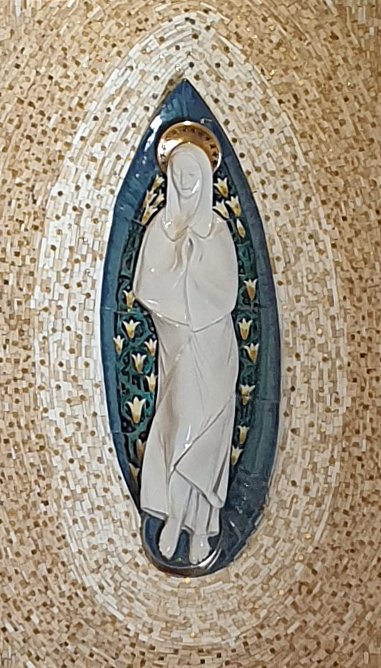
Then there is the Franciscan group commissioned by Bishop Cristoforo Arduino Terzi to enhance the Franciscan sites of the Rieti valley: the "Saint Francis and the wolf" of 1958, "Brother Masseo lying down", "Brother Angelo with the lute", "Saint Francis declaiming the Canticle of the Creatures", "Brother Bernardino kneeling", "Brother Leo writing the rule", all between 1960 and 1964, and the detail of the head of Saint Francis of 1972. Anyone who knows the sanctuaries of the Rieti valley recognizes the project right away. The room is completed by the Immaculate Conception in a ceramic mandorla of 1965, the monstrance with Saint Francis and a glory of angels of 1958, the seven holy founders of the Servite order, the plaster copy of the Sarcophagus of the Spouses of 1950 and the series of sketches for the national monument in Jakarta of 1964, with the ship, the young man with the bow, the Indonesian bull and the eagle emblem of Indonesia, of which there is also an imposing plaster detail of the head, 76 by 16 by 105 centimeters.
Lorenzo Ferri and the town of Cave: the Veronica, the bronze door, the Crucifix
There remains the question everyone asks on arriving: why a museum dedicated to a sculptor from Romagna, who lived and died in Rome, is in a town in the Monti Prenestini. The answer has a first and last name, Monsignor Lorenzo Castellani, parish priest of Cave. Ferri, for his Shroud studies, frequented Roman ecclesiastical circles, and there he became friends with Castellani, who brought him to Cave.
The first work for the town is a canvas of the Veronica with the face of Christ crowned with thorns, made for the Pro-Good Friday Committee of which Castellani was spiritual director, today kept in the church of Santa Maria Assunta. Two works followed that tell of by now an affectionate relationship: the bronze door of the same church of Santa Maria Assunta, the Janua Coeli, presented in 1970 to Paul VI and inaugurated in 1972, which illustrates the life of the Virgin and in which Ferri himself and Monsignor Castellani are portrayed. And the Shroud Crucifix, begun in 1964 and cast in bronze after the artist's death, displayed in the hamlet of San Bartolomeo.
A practical tip worth the time it costs: after visiting the museum, go up to the collegiate church of Santa Maria Assunta and look at the door. It's a few minutes' walk from the Palazzo Comunale, has no ticket and closes the circle, because in the gypsotheca you saw the full-size plasters and the sketches, and here you see the bronze mounted on its hinges, with the figures of the two friends who slipped into the story of the Virgin like the donors in the polyptychs of the 1400s.
The Trilussa monument and Lorenzo Ferri's Roman works
Lorenzo Ferri's most famous piece is not in a museum: it's in Trastevere, in Piazza Trilussa, and it's the monument to the poet. In 1952, after a heated debate in the City Council, the square until then known as Piazza di Ponte Sisto was named after Carlo Alberto Salustri, that is Trilussa, who died in 1950. The monument, with a base in brick facing and ancient architectural elements and with the bronze bust, was inaugurated on December 22, 1954 in the presence of a large crowd and of Mayor Salvatore Rebecchini. Running along the monument are the verses of "All'ombra": "Mentre me leggo er solito giornale / spaparacchiato all'ombra d'un pajaro" and the closing "de poté dì le cose come stanno / senza paura de finì in priggione".
Ferri had never portrayed Trilussa from life. He worked from photographs and from the descriptions of Rosa Tomei, the woman who had been at the poet's side. In the gypsotheca at Cave you can see the bust in patinated plaster and the full-length figure in small format, that is the two stages of that portrait built through someone else's memory. It's a fact that restores professional dignity to a monument that Romans treat as a place to rest their beers on a Saturday night: that face is a work of reconstruction, not a copy.
Among Ferri's Roman works is also the Christ the Redeemer of the Prima Porta cemetery, the Flaminio cemetery, a monumental marble statue 4 meters high worked on between 1961 and 1973: his ashes rest at the foot of that statue. And there is the chapter of the competition for the bronze doors of St. Peter's Basilica, in which Ferri was a finalist in 1948 with a sketch for the second level. The reliefs can be seen in the gypsotheca. He lost, as almost everyone lost, but the fact that an art teacher from the public school system reached the final of that competition says how much his hand was worth. To get your bearings in the rest of the capital's museum landscape you can start from the page devoted to the museums of Rome.
Knock, Jakarta and Lorenzo Ferri's international commissions
Between 1960 and 1963 Ferri made the marble Apparition group for the shrine of Knock, in County Mayo, Ireland. The shrine describes the statues as executed in very white Carrara marble, commissioned by the Knock Shrine Society, with the Virgin at the center, Saint John the Evangelist on her right and Saint Joseph on her left, following the account of the 15 witnesses of the 1879 apparition and the interviews of the 1930s with Mary Byrne O'Connell. In the chapel an altar with the Lamb and sculpted angels completes the scene. It is one of the most visited pilgrimage destinations in Europe, and almost all of the millions of people who pass through are unaware that the author is an Italian whose preparatory plasters are on the second floor of a former hospital in a town in the Monti Prenestini.
Between 1964 and 1966 Ferri worked on the bronze portal and the statues for the Independence Shrine in Jakarta. In 1963 he made mosaics and stained glass for the church of the Comboni Missionaries in Rome. In 1970 he received the prize of the Accademia Tiberina and was named a Tiberine academician. He made the medal for the centenary of Rome as capital. The three-dimensional reconstruction of the face of the Man of the Shroud was published in the volume "L'uomo della Sindone nella ricostruzione dello scultore Lorenzo Ferri", published by Kappa in 2012.
The Lorenzo Ferri Museum inside the Museo Civico Città di Cave
The Museo Civico "Città di Cave" was established on May 30, 2013 and includes three divisions. The first is the Lorenzo Ferri Museum with the Monumental Nativity, and it is the only one fully open to visitors: the other two, the Museum of Tobacco and Silkworm and the Archaeological Museum, are being set up. Anyone arriving in Cave counting on seeing the tobacco section too would do well to check its status before leaving.
The museum belongs to the Territorial Museum System of the Monti Prenestini and the Giovenzano Valley, the so-called Pre.Gio., and since 2024 it has belonged to the Museum System of the Castelli Romani and Prenestini Museumgrandtour. These are acronyms that tell the visitor little and that in fact matter quite a lot: they mean trained staff, shared catalogs and the possibility of building a day by putting together several nearby sites. Tobacco growing, incidentally, is a chapter of the economic history of this area that deserves more attention, and it is the same kind of productive memory documented at the hemp museum of Pisoniano, a few kilometers away.
How to get to the Lorenzo Ferri Museum and what to see nearby
Cave lies at the foot of the Monti Prenestini, surrounded by chestnut woods and coppice, on a largely hilly territory that reaches 450 meters at the Montagnozza. The town has just under 11,000 inhabitants and is crossed by history in a way nobody expects: here, on September 14, 1557, during the Salt War, the peace between Philip II of Spain and Pope Paul IV was signed, the one the textbooks call precisely the Peace of Cave. Whoever comes for the museum takes this home too.
For building a whole day, the neighborhood is very rich. A few minutes away is Palestrina, with the Sanctuary of Fortuna Primigenia and the national archaeological museum that holds the Nile mosaic. Above Palestrina is Castel San Pietro Romano with its fortress and the view. A little farther on are Genazzano with the Colonna castle and the Bramante-style Nymphaeum, and the Selva di Genazzano for those who want to walk. Toward the mountain you climb to the Prenestine chestnut grove, while to the east you reach Olevano Romano, the town of the northern painters, and Segni with its Cyclopean walls. With an extra hour by car you reach Subiaco with its Benedictine monasteries. On the other side, toward the north, you get to Tivoli and its villas.
The Lorenzo Ferri Museum with children and with schools
The museum offers educational workshops for students of schools of every level, organized according to needs and objectives in agreement with the accompanying teachers. The offer includes general and thematic guided visits to the gypsotheca lasting about an hour and thematic workshops of 2 hours that deal with the conception, production and techniques of the works, with a full or partial visit to the collection. The stated approach is inclusive, with attention to audiences with disabilities and special educational needs, and uses storytelling as an accessibility tool.
It's not improvised teaching: it responds to an idea of the artist, who had made exhibition panels and kept study copies of classical works and anatomical plasters, now lost, with the intent of creating an interactive museum adjacent to an art high school right in Cave. The high school was never born, the museum was. The underground nativity space works very well with children, for an elementary reason of scale: in front of a statue 4 meters high even a bored child looks up. The gypsotheca is more demanding and needs to be rationed. The room of the death masks, with small children, I would skip.
Accessibility at the Lorenzo Ferri Museum
The main section of the Lorenzo Ferri Museum, the one in the former Mattei Hospital on Via Cavour, is accessible to people with motor disabilities and is served by an elevator. The Monumental Nativity section, carved out of the underground rooms of the former convent in the historic center, is not accessible to people with reduced mobility, and it's worth knowing this beforehand and not on the spot.
In both sections there is a tactile route that allows the spaces to be used and the works to be known also by visually impaired and blind visitors, with information panels and dedicated stations holding scale reproductions of some of the statues on display, so as to convey the form and size of the originals. In a museum made almost entirely of plasters, that is of surfaces designed to be read in raking light, the idea of letting people touch scale copies is the most sensible possible translation of the experience. Admission is free for people with disabilities with a companion.
When to go to the Lorenzo Ferri Museum
The museum opens in two time slots, morning and afternoon, and this shapes the day more than it seems. The morning slot, from 10:30 to 12:30, is short and should be used by arriving at 10:30 sharp. The afternoon one, from 16:30 to 19:30, is three hours and is the right choice if you want to see both sections without rushing and then go up to the collegiate church. In summer the afternoon has the advantage of coolness: we are in the hills, and at 17:00 in August you breathe better here than in Rome.
The best period, if I can choose for you, is autumn. Around here autumn means chestnuts, woods that change color along the road from Palestrina and towns empty of tourists. Christmas obviously has its case, because a monumental nativity scene in December acquires a meaning that is somewhat lost in July. But it's also the moment when the underground section is most crowded. The period I would avoid is the height of August, not because of the heat but because of the calendar: on August 15 the museum is closed and in the weeks around it the hours may change. I remind you, for the last time, that the visit must be booked and that the number 06 5745934 settles any doubt in two minutes.
A curiosity about the Lorenzo Ferri Museum
Inside the Monumental Nativity there is a boxer. The Assyrian King, the figure that together with his page occupies a front of 3.60 meters, has the body of Erminio Spalla, who in the 1920s had been European heavyweight champion and who later turned to film and song. Ferri didn't choose him for his name: he needed a physique able to hold up the monumental scale without becoming a muscular caricature, and a professional boxer, trained to stay balanced, was the technical solution. In the same group an 80-year-old resident of the Cottolengo of Don Orione posed as the Indian King, while Saint Joseph is modeled on Sirio, the sculptor's son, and the head of the Indian King is Ferri's own.
Lined up, the thing is something of a marvel: in front of the Epiphany at Cave you find a sports champion, an elderly man assisted by a charitable work, a son and the author. A catalog of real men dressed as kings. It's the kind of information that changes the way you look at a work, because it dismantles the idea that 20th-century sacred sculpture was made of ideal models. Ferri worked exactly like the painters of the 1600s who picked their apostles out of the tavern, and the result is that those nine figures, despite their height, have believable flesh. Look at the Assyrian King's hands: they are hands with the knuckles of someone who has hit something.
Something nobody tells you about the Lorenzo Ferri Museum
Nobody will tell you that the most famous piece of this museum is not in the museum, and that millions of people have already seen it without knowing they've seen it. The monument to Trilussa in Piazza Trilussa, in Trastevere, the one the kids sit under on Saturday night, is by Lorenzo Ferri and was inaugurated on December 22, 1954. At Cave are kept the bust in patinated plaster and the figure in small format, that is the two preparatory stages.
The detail nobody tells is how that face came about. Ferri had never had Trilussa in front of him: the poet had died in 1950 and the square was named for him in 1952, after a heated debate in the City Council. The sculptor worked from photographs and from the descriptions of Rosa Tomei, the woman who had been at his side. Reconstructing a face from flat images and verbal testimony is exactly the technical problem Ferri was tackling, in the same years, on the imprint of the Shroud. The most popular monument in Trastevere and the most solitary research of his life are the same exercise applied to two different materials.
I'll add a second thing that is almost never written: in the upper room of the former convent are displayed four sketches from 1898 by Giuseppe Fallani, Ferri's teacher, submitted to the competition for the Palace of Justice in Rome. A monographic museum that displays its own teacher is a gesture of intellectual honesty worth the detour.
The advice I give you for visiting the Lorenzo Ferri Museum
Call. Before anything else, call 06 5745934 and book, because the museum works by appointment and the hours undergo seasonal changes. Having done that, organize the visit the opposite way from how almost everyone does it: start from the gypsotheca on Via Cavour, go up to the second floor, and only afterward go down into the underground space of the former convent for the Monumental Nativity. Whoever does the reverse route sees the twist first and then gets bored in front of the small plasters. Whoever does it in this order arrives in front of the nine statues having already seen the 20-centimeter sketches, and understands what it means to take a small model to 4 meters.
Second piece of advice: take the afternoon slot, from 16:30 to 19:30. It's three hours against the scant two of the morning, and it leaves you time to go up to the collegiate church of Santa Maria Assunta to see the bronze door Janua Coeli mounted on its hinges, after having looked at its full-size plaster sketches in the Shroud room. The circle closes there, not in the museum.
Third piece of advice, the most unwelcome: don't dispatch the Shroud room in three minutes because the subject leaves you cold. It's the most original part of the collection and can be looked at perfectly well as a chapter of 20th-century artistic anatomy, without subscribing to anything. The sequence of faces from 1933 to 1973, one next to the other, is a document on the sculptor's craft that has few equivalents in Italy.
Another well-known fact, yet rarely cited
Everyone says the Monumental Nativity was born for Sant'Andrea della Valle. What is rarely cited is the consequence: that nativity scene never arrived in Rome. The competition was announced by the Pallottine Fathers in 1946 to renew the nativity scene donated by the Torlonia family, on the occasion of the centenary of the Epiphany Octave established by Saint Vincent Pallotti. Ferri won, calculated the proportions on the double-square rectangle of the church and designed a placement in front of the apse, 3 meters above the floor. Then the economic penury of the postwar period made the patrons lose interest, and the work was left without a home.
In 1952 the nativity scene was inaugurated in the crypt of the Regina Pacis basilica, in Ostia, where it stayed for 60 years. Only in December 2012 were the nine statues moved and set up in the underground space of the former Augustinian convent, next to the town hall of Cave. The complete journey, then, is this: commissioned for the second tallest church in Rome, displayed in a crypt on the coast, finally relocated to a town in the Monti Prenestini.
There's a moral in this story. Works of art don't end up where they should: they end up where someone decides to take care of them. Cave took on a work that Rome had ordered and then let go, built a cross-vaulted space around it and put its author's name on the door. A €3 ticket is the rest of the story.
The right photo to take at the Lorenzo Ferri Museum
The right photo is just one and it's taken in the underground space of the former convent: stand at the feet of Saint Joseph, the statue the catalog records at 384.7 centimeters in height, and frame from below looking up, keeping in the field the springing of the cross vault. The contrast between the cut of the ribs and the figure's drapery does the work by itself, and the perspective distortion that usually ruins photos is here exactly what conveys the real scale. If you have someone with you, have them step into the low corner of the frame: without a human figure nobody will believe the proportions.
The second photo to take home is something else entirely. In the Shroud studies room, the sequence of faces arranged in chronological order should be photographed edge-on, not head-on: a row of heads from 1933 to 1973, in terracotta, in marble, in plaster, in wax, repeating the same subject 40 times with 40 different outcomes. It's the image that explains the museum better than any caption.
Two technical warnings. The first: the light here is that of rooms carved out of historic buildings, so keep the sensitivity high and resign yourself to giving up the flash, which on white plaster flattens all the modeling and destroys exactly what you came to see. The second: the rules on filming, tripods and professional use of images are set by the museum, and in a small venue they are agreed simply by asking the staff when you book.
Some important events that took place here in history
Cave has a date that appears in the textbooks of modern history: September 14, 1557. During the Salt War, the conflict that pitted Pope Paul IV Carafa and his French allies against the Spain of Philip II, the final negotiations took place right here and the peace was signed at Cave. It was the end of the papacy's last great military adventure in Italy and the beginning of a long Spanish predominance over the peninsula: a treaty signed in a hill town that closes a European chapter.
The events concerning the museum are more recent and can be counted on one hand. In 1946 the Pallottine Fathers announce the competition for the nativity scene, which Ferri wins. The nine statues are sculpted between 1947 and 1948. In 1952 the Monumental Nativity is inaugurated in the crypt of the Regina Pacis basilica in Ostia, and in the same year Ferri is received in private audience by Pius XII, to whom he presents the face reconstructed from the imprint of the Shroud. In 1970 the bronze door Janua Coeli is presented to Paul VI. It is inaugurated on the church of Santa Maria Assunta in Cave in 1972. In 1975 Ferri dies in Rome.
Then come the dates of memory. The heirs donate the collection of works to the Municipality of Cave. On May 30, 2013 the Museo Civico "Città di Cave" is established. In December 2012 the Monumental Nativity section opens in the underground space of the former Augustinian convent. On December 7, 2013 the gypsotheca opens in the former Mattei Hospital. In 2024 the museum joins the Museum System of the Castelli Romani and Prenestini.
Who has been through the Lorenzo Ferri Museum
The people who have left a trace in this museum, in plaster or in bronze, make up an improbable list. There are two pontiffs: Pius XII, who in 1952 received Ferri in private audience and saw the face reconstructed from the Shroud, and Paul VI, to whom in 1970 the bronze door for the church of Cave was presented. Of John XXIII, four medal molds from 1963 are kept. There is Monsignor Lorenzo Castellani, parish priest of Cave, the man for whom everything else exists: without his friendship the sculptor would never have set foot in this town.
There are portraits of the great: Giovanni Giolitti in 1959, Antonio Rosmini in 1956, Luciano Manara, Ennio Quirino Visconti, Cardinal Lepicier in 1930, Cardinal Borgongini Duca, Monsignor Ferdinando Baldelli in 1972, and of course Trilussa. There are the death masks of Cavour, Mazzini, Tolstoy and Beethoven, which Ferri studied to understand how a face changes after death. There is Erminio Spalla, the boxer turned Assyrian King.
And then there are the two names that matter most for the artist's story. Giuseppe Fallani, restorer of the Sacred Apostolic Palaces, Ferri's teacher when he was a boy, whose 1898 sketches for the Palace of Justice and a Venus of 1904 are displayed in the upper room. And Alberto Carlo Carpiceci, favorite pupil and later brother-in-law, who collaborated on the Monumental Nativity. A museum that displays the teacher and the pupil next to the author tells of a craft, not a career.
Quick questions about the Lorenzo Ferri Museum
Where is the Lorenzo Ferri Museum?
The main section is at Via Cavour 23, 00033 Cave, in the province of Rome, in the building of the former Mattei Hospital. The Monumental Nativity section is in the underground rooms of the Palazzo Comunale, the former convent of the Augustinians, in the historic center.
What are the Lorenzo Ferri Museum's hours?
Closed Monday and Tuesday. Wednesday to Sunday from 10:30 to 12:30 and from 16:30 to 19:30. The ticket office closes 30 minutes before closing time. Hours may vary with the seasons, so it's best to confirm when you book.
Do you need to book to visit the Lorenzo Ferri Museum?
Yes. The museum is visited by reservation, through the form on the official website or by calling 06 5745934.
How much is a ticket to the Lorenzo Ferri Museum?
Full price €3, reduced €2.50. The reduced rate applies to residents, to groups of over 20 people, to children and young people from 3 to 18 years old and to those over 65.
Who gets in free at the Lorenzo Ferri Museum?
People with disabilities with a companion, and children up to 3 years old.
Is the Lorenzo Ferri Museum public or private?
It is a civic museum, of the Municipality of Cave, and forms a section of the Museo Civico "Città di Cave".
What is the Lorenzo Ferri Museum's phone number?
06 5745934. The museum's email address is museolorenzoferri@gmail.com. The switchboard of the Municipality of Cave answers at 06 9500081.
Who was Lorenzo Ferri?
A sculptor, painter, restorer, Shroud scholar and teacher born in Mercato Saraceno on July 18, 1902 and died in Rome on February 25, 1975. He trained in Rome in the workshop of Giuseppe Fallani, graduated from the Istituto di Belle Arti in 1921 and worked in Argentina, in Libya, in Campania and in Basilicata before settling permanently in the capital.
How long does it take to visit the Lorenzo Ferri Museum?
An hour and a half for the gypsotheca at a relaxed pace, 40 minutes for the Monumental Nativity. Three hours if you want to see both sections and go up to the collegiate church for the bronze door.
How many statues does the Monumental Nativity of Cave have?
Nine, in plaster, sculpted between 1947 and 1948: the Madonna with the Child, Saint Joseph, the three Magi and their respective pages.
How tall are the statues of the Monumental Nativity?
The standing figures come close to 4 meters: the catalog records Saint Joseph at 384.7 centimeters, the Assyrian King with page at 375.5, the African King at 370.2 and the seated Madonna with the Child at 367.1. The kneeling figures exceed two and a half meters.
For which church was the Monumental Nativity made?
For Sant'Andrea della Valle in Rome, after winning the competition announced by the Pallottine Fathers in 1946. It was never placed there: in 1952 it was inaugurated in the crypt of the Regina Pacis basilica in Ostia and in December 2012 it was moved to Cave.
What are the Shroud studies displayed at the Lorenzo Ferri Museum?
They are the fruit of 46 years of Ferri's research on the image of the Shroud of Turin, conducted with the tools of artistic anatomy: sequences of faces from 1933 to 1973, pairs of hands and feet, death masks, drawings, and the two sculptural reconstructions of the body, the RP1 in resin of 1966-1968 and the RP2 in plaster of 1972-1975.
Does the museum take a position on the authenticity of the Shroud?
No. The collection documents the work of a sculptor and a scholar, it issues no verdicts. It can be visited as a chapter of 20th-century artistic anatomy.
Is it true that the Trilussa monument in Trastevere is by Lorenzo Ferri?
Yes. It was inaugurated on December 22, 1954 in Piazza Trilussa, with a base in brick facing and a bronze bust. At Cave are kept the bust in patinated plaster of 1954 and the figure in small format.
What is the Janua Coeli door?
The two-leaf bronze door that Ferri made for the church of Santa Maria Assunta in Cave between 1968 and 1972: it illustrates the life of the Virgin and the sculptor himself and Monsignor Lorenzo Castellani are portrayed in it. It was presented to Paul VI in 1970 and inaugurated in 1972. The full-size plaster sketches are displayed in the museum.
Is the Lorenzo Ferri Museum accessible to people with disabilities?
The main section on Via Cavour is accessible to people with motor disabilities and is served by an elevator. The underground nativity section is not. In both sections there is a tactile route with panels and scale reproductions for visually impaired and blind visitors.
Is the Lorenzo Ferri Museum suitable for children?
The Monumental Nativity yes, very much, as a matter of scale. The gypsotheca requires more attention and needs to be rationed. With small children I would avoid the room of the death masks.
Are there activities for schools at the Lorenzo Ferri Museum?
Yes: general and thematic guided visits of about an hour and thematic workshops of 2 hours, agreed with the accompanying teachers, with an inclusive approach attentive to special educational needs.
How do you get to Cave from Rome?
By car along the SS155 road to Fiuggi, or on the highway with the exit at Valmontone. By public transport there are Cotral lines from the Anagnina and Ponte Mammolo terminals. By train you get off at Valmontone and continue with shuttles.
How far is Cave from Rome?
About 40 kilometers east of the capital, at the foot of the Monti Prenestini.
What else is there to see in Cave besides the museum?
The collegiate church of Santa Maria Assunta with Ferri's bronze door, Palazzo Colonna with its tower, the sanctuary of San Lorenzo Martire, the sanctuary of the Madonna del Campo with the Basilica Petriana, and the hamlet of San Bartolomeo where the Shroud Crucifix cast in bronze after the artist's death is found.
Can the other sections of the Museo Civico Città di Cave be visited?
No: the Museum of Tobacco and Silkworm and the Archaeological Museum are being set up. The part that can be visited is the one devoted to Lorenzo Ferri and the Monumental Nativity.
What is the best time to visit the Lorenzo Ferri Museum?
Autumn, for the chestnut woods around and the calm. December if you want the nativity scene in its natural moment. On August 15 the museum is closed, as on January 1 and December 25.
A €3 museum in a town of 11,000 inhabitants that holds the models of a Roman monument, the marble group of an Irish shrine, the sketches of an Indonesian portal and 46 years of research on an image debated all over the world: the disproportion between the container and the contents is the reason I go back. Book ahead, go in the afternoon and start with the small plasters. The rest is done by the Saint Joseph, 3.84 meters tall, when you lift your head.
Article written by the editorial team of TourLeaderPro, contact them for Private/Corporate/V.I.P. Tours and Experiences.
Planning a trip to Italy? The English-language guides to organizing the trip are on ItalyPlanner.com.