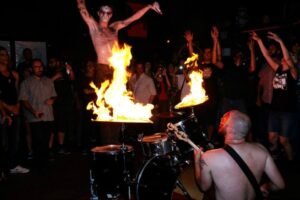
Kollatino Underground
In short. Kollatino Underground is a self-managed cultural space born from the occupation, in 2001, of the disused basements of the former Giorgi technical institute, in an area of east Rome lacking gathering places.

Kollatino Underground is a self-managed cultural space born from the occupation, in 2001, of the disused basements of the former Giorgi technical institute, in an area of east Rome lacking gathering places. Its operating base is at Via Georges Sorel 10, in the Collatino district, between Via Collatina and Colli Aniene, in the territory of Municipio V. From a youth and sports outpost born in an abandoned public building, the space has turned over time into a multidisciplinary platform devoted above all to theater and contemporary circus, with two performance halls, a rehearsal room, a photo lab and an in-house bar run on a self-managed basis by a cultural association. The best-known project that carries its signature is the Anomalie festival, devoted to new circus, born in 2007 and grown into one of the reference events for the performing arts in the city's eastern outskirts. For anyone who wants to read this part of Rome as a whole, the pages on the Valle dell’Aniene Nature Reserve and on Castagneto Prenestino are also useful.

Where Kollatino Underground Is and How to Get There
The operating address is Via Georges Sorel 10, postal code 00177, in the Collatino district, the urban zone that takes its name from Via Collatina and borders Colli Aniene to the north, Tor Sapienza to the east and Pietralata to the south. It is a fabric of public housing and houses built between the 1950s and 1970s, with few cultural services of its own, and this lack is exactly why, in the early 2000s, a group of young people from the neighborhood chose to reopen the basements of a closed school building instead of leaving them to neglect.
Accessibility and Getting Around the Neighborhood
The Collatino district is a mainly residential fabric, with sidewalks not always in optimal condition and signage designed more for those who live there than for occasional visitors. It is a trait common to many areas of the Roman outskirts, where attention to pedestrian accessibility has grown in recent years but remains uneven from street to street. For anyone with strollers or mobility difficulties, it's best to favor the car or a ride with an escort rather than relying only on public transport and the last stretch on foot.
By Metro and Bus
The reference Line B metro stop is Rebibbia, from which you continue on foot or with a short bus ride toward Via Collatina. Those coming from Line C can get off at Pigneto or Malatesta and continue with the surface lines that link Via Prenestina to Via Collatina. Several ATAC lines in the area cross the Collatino district and let you reach Via Georges Sorel without taking the car, although travel times from the historic center remain those typical of the east outskirts, between 30 and 40 minutes depending on the hour.
By Car
For those arriving from the Grande Raccordo Anulare the most direct way is the exit onto Via Collatina or Via Tiburtina, then joining the neighborhood's inner streets. Parking in the residential streets around Via Georges Sorel is generally free outside peak hours, but on show nights, when the public converges on the space, allow a few extra minutes to find a spot. Anyone coming from outside Rome who doesn't know the area would do well to load the address into a map before leaving: Via Georges Sorel is an inner side street, not a through road, and it's easy to overshoot it without noticing if you don't watch the navigator closely in the last two or three kilometers.
Where It's Easiest to Come From
For those staying in the historic center or in the first-ring neighborhoods, like San Lorenzo, Pigneto or Prati, the average travel time to Kollatino Underground is around 25 or 30 minutes by car outside peak hours, while with public transport allow a good three quarters of an hour, change included. Those arriving instead from out of town, perhaps from a stay in a hotel near Termini, can count on a direct link to Rebibbia on metro Line B, the simplest stretch of the route.
What Kollatino Underground Really Is: From Youth Occupation to Cultural Platform
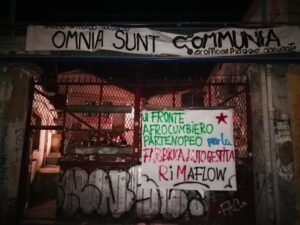
It must be said clearly because it is the point that generates the most misunderstandings: Kollatino Underground was not born as a concert hall or a municipal theater, but as an occupation. In 2001 a group of young people from the Collatino district, faced with a school building disused for years, whose basement rooms, gym included, stood empty and unused, decided to reopen them to make a gathering place. The sources that reconstruct this phase speak of a project born with a goal that was social and sporting above all, meant to give the neighborhood a gathering space that simply didn't exist.
The leap in quality comes a few years later. The available reconstructions agree on a turning point around 2007, when the center's activity begins to shift decisively toward theater and, soon after, toward contemporary circus. It is the year the Anomalie festival is born, and from this moment Kollatino Underground stops being just a neighborhood outpost and begins to be known in the Roman performing arts world, hosting residencies and incubating companies that went on to build careers of their own, among them the group Santa Sangre and the company linked to Matteo Latino.
An Occupation Turned Cultural Association
Today the entity that runs the space is constituted as an association, with a registered legal seat on Via dei Prati Fiscali, different from the operating address of Via Georges Sorel: a distinction common among Roman social centers, where the physical occupied place and the body that organizes its activities are two legally separate things. The sources don't agree on the exact year of founding: some reconstructions give 2001, others 2002, others still 2003. The most frequent and best-documented date, tied to the account of the reopening of the basements of the former Giorgi institute, remains 2001. What is undisputed is that it is one of the longest-lasting self-managed cultural outposts of the city's eastern outskirts, active for more than 20 years.
It should also be said that the occupation of Kollatino Underground fits into a precise phase of recent Roman history: the early 2000s are a moment when, in several outlying neighborhoods of the city, groups of young people reopen disused public buildings, generally former schools, former factories or former barracks, to make them into social centers, people's gyms or cultural spaces. It is not a phenomenon isolated to Collatino: it was a widespread practice across the Roman outskirts in those years, with very different stories in terms of duration, outcomes and relations with local institutions. Kollatino Underground stands out in this landscape for having progressively shifted its center of gravity from social gathering alone to an artistic production recognized also outside the activist circuit, a path that not all contemporary occupations followed with the same success.
The Activities of Kollatino Underground: Theater, Contemporary Circus, Music and Training
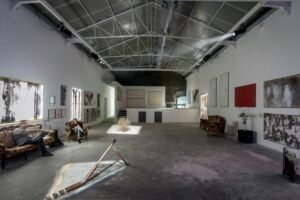
Over two decades the space has accumulated equipment that is not common to find in a social center born from an occupation: two performance halls, one large and one small, an equipped rehearsal room, a space for cinema, a darkroom lab for photography, a small library and an in-house bar that funds part of the activities. To these are added free internet access, a detail that is not at all a given in the area, and an equipment store shared among the resident companies.
It should be added that the calendar of activities does not follow a rigid model identical for every season: some years have seen a program more concentrated on prose theater, others a stronger emphasis on contemporary circus or live music, depending on the companies in residence at the time and the public grants the association obtained. This variability, typical of a space run with limited resources and without a multi-year program guaranteed in advance, is also one of the reasons it is always best to check the updated schedule rather than rely on information gathered in the past.
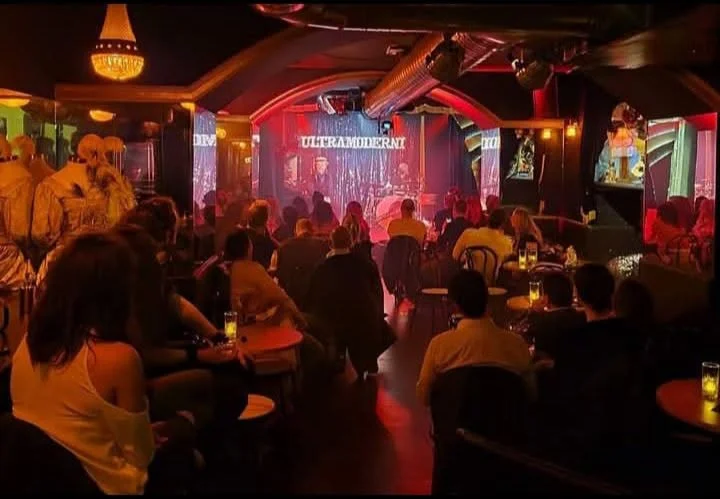
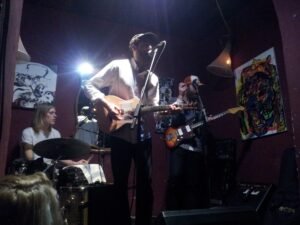
The program moves on several levels. There is the theater season proper, built together with a group of Roman companies that use the space in residence. There are the music series, which over the years have brought names from the Italian and international independent scene to Kollatino. There are the training courses aimed at those who want to work in the performance trades, from acting to technical work. And there is the work on contemporary circus, which over the years has become the most recognizable trait of the program. To this are added artistic workshops designed for different audiences, from the youngest to adults, and workshops linked to street art, juggling, radio production and videomaking, in line with an idea of urban regeneration that comes through artistic practices more than proclamations.
The Anomalie Festival and Contemporary Circus
The project that gave Kollatino Underground a visibility beyond the neighborhood is the Anomalie festival, born in 2007 and devoted to new circus, that is, to that generation of artists who moved acrobatics and juggling out of the traditional big top to bring them into the theater, the street and public spaces. Over the years the festival has grown to the point of physically leaving the boundaries of Via Georges Sorel: in the most recent editions it moved to Parco delle Canapiglie, in Torre Maura, another piece of the Roman east outskirts, a sign that the cultural project born at Kollatino now has a life and an audience bigger than the space that generated it.
The festival's formula mixes shows by Italian and international companies, training moments open to the public and occasions for artists to meet, in a format that over the years has taken on the character of a spread-out series more than a single event concentrated in a few days. For those who follow contemporary circus in Italy, Anomalie has become a periodic point of reference, able to draw to east Rome an audience that normally doesn't frequent the city's eastern outskirts, contributing concretely to that idea of cultural regeneration from below that Kollatino Underground has claimed from the beginning.
Training and Workshops
Alongside the show program, the space devotes a significant part of its activity to training. The courses cover the main skills of the live performance trades, from acting to circus disciplines, up to stage technique and the management of performance spaces, and are designed both for those approaching these languages for the first time and for those who already have an artistic path under way and look for a place to keep practicing. The workshops open to the public, instead, range over a wider fan of practices: street art, juggling, radio production, videomaking and analog photography in the in-house darkroom, equipment that few independent Roman spaces of this size can afford to keep active.
Capacity and Features of the Halls
The space's two performance halls, as already mentioned carved out of the basements of the former Giorgi institute, have modest dimensions, consistent with the scale of a neighborhood theater more than a large venue for shows. The larger hall hosts the more structured productions and the events with the highest demand from the public, while the smaller hall is designed for more intimate formats, open rehearsals, readings and training moments. This setup, common to many independent spaces born from a recovery and not from a theater designed from scratch, brings an advantage and a limit at the same time: the closeness between artists and audience is much greater than in a traditional theater, but capacity stays limited, and that is the reason why, for the most anticipated events, it's always best to ask ahead about seat availability.
The In-House Bar and the Community Life of the Space
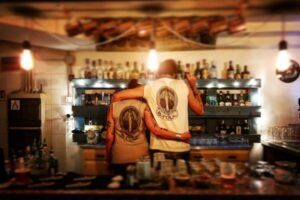
An element that often escapes those who look at Kollatino Underground only from the point of view of the schedule is the role of the in-house bar. In many Roman cultural social centers the bar is not an accessory service but one of the main sources of economic support for the activity, and at the same time the real place of sociability of the space: that's where artists meet after rehearsals, where the evening just seen is discussed, where the next initiatives are collectively organized. The economic model of a self-managed center, after all, almost always rests on three legs, the public grants won periodically, the takings from the box office and events, and precisely the bar's revenues, which often cover current expenses when the cultural program alone is not enough to support the fixed costs of implicit rent, utilities and upkeep of such an articulated space.
A Curiosity About Kollatino Underground
Few people outside the trade know what the building that houses the space originally was. Not a disused industrial shed, as often happens in Rome, but the basement rooms of a technical institute, the Giorgi, complete with a former school gym: a detail that explains why, in the initial phase of the project, the sporting component was as important as the cultural one. The real curiosity, though, concerns the name. Kollatino, with the K in place of the C, is not a random graphic whim: it recalls Via Collatina, which gives the neighborhood its name, but in the spelling with the K it also carries the echo of a youth culture, that of social centers and of occupation as a political practice, which in the 1990s and 2000s in Rome loved exactly that kind of alternative writing.
A second little-known detail concerns the administrative double identity of the space: the legal seat of the cultural association that bears the name Kollatino Underground is not on Via Georges Sorel, but on Via dei Prati Fiscali, several kilometers farther north, toward the Nomentano district. It's a technical aspect, but it says something important about how many realities of this kind work: the place the public knows and frequents does not necessarily coincide with the formal address of the body that runs it.
A third curiosity concerns precisely the redeveloped part of the building: the sources that reconstruct the birth of the project insist on the fact that what was recovered was in particular the gym and the basement storerooms of the Giorgi institute, that is, the most marginal and least prized rooms of the whole school complex. It's a detail that says a lot about the method with which the space was born: not the occupation of a whole, prestigious building, but the patient recovery of the leftovers of another public building, turned over time into two performance halls, a rehearsal room, a photo lab and a bar.
Something Nobody Tells You About Kollatino Underground
What is rarely told, when this space is described as a success story of regeneration from below, is that for years Kollatino Underground lived in a condition of precarious balance from the administrative point of view. An inspection conducted by the municipality's offices on November 26, 2011, during a music night, challenged the space under articles 68 and 80 of the Consolidated Public Security Law, treating it as a commercial business lacking the required requisites rather than as a cultural association. A 500-euro fine followed, and the suspension of music, dance and theater activities, up to a public closure order served on April 17, 2012.
The paradox, raised at the time by the association's president, is that the same space had won public grants for culture for years and received institutional support, only to find itself exposed to an administrative penalty precisely for the lack of a formal act assigning the premises: without that act, under the rules then applied, it wasn't possible to bring the space up to safety standards. It's a story that tells well the condition of many Roman social centers born from an occupation: recognized as cultural interlocutors by the same administrations that, on the regulatory level, can treat them as irregular.
What makes the story of 2011 and 2012 particularly instructive is the moment in which it happened: an inspection during a music night, that is, in the middle of a cultural activity open to the public, and not a routine check on an empty building. For those who frequent the space today without knowing its history, it's worth knowing that behind the apparent normality of a show schedule there was a period, more than a decade ago, when the very survival of Kollatino Underground as a place of public programming was by no means a given. The available sources don't report the final outcome of the administrative proceeding started in those years, nor any later judicial developments. What is certain is that the space kept operating in the following years, hosting the Anomalie festival and maintaining its theater and music program.
My Advice for Visiting Kollatino Underground
The most useful advice is not to treat Kollatino Underground as just any tourist stop, but as what it is: a living space of cultural production, with a program that changes from season to season and has to be checked on the association's official channels before setting out, because the hours and tickets of a self-managed center don't follow the logic of a traditional box office. Before leaving, it's best to look at the updated calendar on the site and the space's social page, so as to know whether that evening there is a theater show, a night of contemporary circus or a concert, which are very different experiences from one another.
The advice, for those who don't yet know the area, is to arrive with some time to spare before the start, because Via Georges Sorel is not a central street and finding your way the first time takes a few more minutes than expected. If the evening's program falls within the contemporary circus strand, it's worth finding out about the Anomalie festival too, which in the most recent editions is held at Parco delle Canapiglie in Torre Maura and no longer in the original spaces: it often happens, for those looking for events linked to Kollatino, to find appointments that carry its name but take place elsewhere, and it's good to know that before showing up at the wrong door.
A second piece of advice, less practical and more about approach: anyone visiting Kollatino Underground for the first time would do well not to expect the standards of an institutional theater, and to consider that a merit rather than a limit. The halls are those carved out of a school basement, the furnishing is essential, the in-house bar works as a real meeting place before and after the show: it's an experience more like an evening in a small community theater than an evening at the theater in the traditional sense, and it should be lived in that spirit. Finally I advise stopping at the bar after the show, when it happens: it's often in those moments, more than during the performance, that you really understand what kind of community has kept a space like this going for more than 20 years.
The Collatino and Colli Aniene Districts Around Kollatino Underground
The space is in a piece of east Rome that rarely appears in tourist guides, and for that very reason deserves a few more lines. The Collatino district takes its name from Via Collatina, the ancient consular road that linked Rome to Collatia, and grew in successive phases starting from the second postwar period, with blocks of public and residential housing that still define its urban profile today. To the north it joins Colli Aniene, a more recent and greener district, born in the 1980s along the valley of the Aniene river, with the big river park that bears the same name. To the east it borders Tor Sapienza, one of the historic working-class areas of the Roman outskirts. To the south it opens toward Pietralata, another district of 20th-century public housing now at the center of several cultural regeneration projects.
It is no accident that in this area of the city, over the years, more independent cultural outposts were born: the historic shortage of theaters, cinemas and libraries in the east outskirts pushed several generations to build for themselves the spaces that were missing. Anyone who wants to widen the view on this part of Rome can pair the visit to Kollatino Underground with a walk in the Valle dell’Aniene Nature Reserve, which runs right next to Colli Aniene, or with a quick trip to the events organized as part of the Aniene Festival at Parco Nomentano, a little farther north.
Municipio V and the Urban Fabric of East Rome
From the administrative point of view the Collatino district falls within Municipio V, one of the largest and most populous in the city, born from the merging of different areas at the time of the reform of the Roman municipi in 2013 and including, besides Collatino, also Colli Aniene, Tiburtino, Pietralata, Ponte Mammolo and other portions of the eastern outskirts. It is a territory marked by very rapid urban growth in the second postwar period, when Rome had to respond in a short time to a wave of internal immigration that brought families from all over Italy toward the capital in search of work: the public housing plans that resulted almost always favored the quantity of dwellings over the quality of public spaces, leaving as a legacy densely inhabited districts but poor in cultural services, in equipped green space and in meeting places other than the simple bar downstairs.
It is in this context that one must read the choice, made by several generations of Municipio V residents, to take back disused public buildings to make them collective spaces. Kollatino Underground is not an isolated case: in the same area, in the same years, other similar experiences were born, with different stories and fortunes, which together make up an informal map of independent east Roman culture, hard to find in traditional tourist guides but well known to those who live permanently in these districts.
Colli Aniene, Tor Sapienza and Pietralata: Three Different Faces of the Same Outskirts
The three districts surrounding Collatino tell three different phases of the urban growth of east Rome. Colli Aniene arises later than the others, between the end of the 1970s and the 1980s, as a planned subdivision along the river valley, with a more orderly urban layout than the often disorderly growth of other areas of the Roman outskirts. Precisely the presence of the Aniene river park has made it, over time, one of the greenest districts of this part of the city, appreciated by those looking for a compromise between closeness to the center and quality of urban environment. Tor Sapienza, by contrast, is one of the oldest public housing nuclei in the area, grown already from the early 1900s around an agricultural farmhouse and then massively expanded in the second postwar period. It is a district that has known important phases of social tension over the years, linked above all to the difficulties of coexistence in a context of strong housing hardship, and that remains today one of the most cited symbols, in Roman public debate, of the problems of the eastern outskirts.
Pietralata, finally, shares with Collatino a history of 20th-century public housing but has seen, in recent years, a more decisive investment in cultural regeneration projects, with spaces devoted to dance and the performing arts that now stand alongside the historic residential fabric. Lined up, these four districts, Collatino included, form a piece of the city worth reading together rather than as isolated stops: each carries a different piece of the same story, that of a Rome that grew fast in the second half of the 1900s and is today in search of a cultural identity of its own.
Another Well-Known Fact, Yet Rarely Cited
That east Rome is historically poor in cultural infrastructure is known to everyone who lives there. What tends to be forgotten is that this shortage is not a recent fact, but the result of decades of urban expansion concentrated on residential building and never truly accompanied by adequate public cultural services: districts like Collatino, Tor Sapienza and Pietralata grew quickly in the second half of the 1900s to meet the city's housing needs, while theaters, libraries and cinemas stayed concentrated in the center and in the districts of the first historic outskirts.
It is in this void that the success is explained, not only of Kollatino Underground but of an entire strand of Roman self-managed centers born from occupations of disused public buildings: closed schools, former factories, barracks no longer in use that became, within a few years, the only real cultural outpost of entire districts. A similar phenomenon, though with stories and characters of its own, can also be read in other independent Roman spaces such as the Palestra Popolare San Lorenzo or the Container San Lorenzo, born in different parts of the city but with the same logic of reusing from below spaces that would otherwise be abandoned.
One aspect worth stressing is how much this model, born almost always from very concrete local needs, ended up producing a benefit that goes beyond the single neighborhood. The Anomalie festival, to give the most obvious example, has grown into an event that brings an audience from all over Rome and not only from Collatino, showing that a cultural investment born to answer a need for proximity can, over time, generate value that benefits the whole city. It's a dynamic worth keeping in mind when discussing, in general, the role of cultural social centers in Roman urban life: they are not only a local remedy for a lack of services, but often become real citywide cultural infrastructure, while keeping a strongly local management and roots.
Third, little-cited element: the survival of these places almost never depends on a single source of funding, but on a fragile mix of public grants won periodically, in-house bars that support current costs and volunteer work. It's a model that holds as long as the community that animates it stays active, and it's the reason why the troubled administrative history of Kollatino Underground, with the suspension of activities in 2012, should be read not as an exception but as a structural risk shared by most of the city's cultural social centers.
The Right Photo to Take at Kollatino Underground
The shot that best tells this place is not the facade of the school building that houses it, which from outside stays anonymous like many other schools of the Roman outskirts of the 1960s. It is the interior of the halls, when they are set up for a contemporary circus show: the aerial apparatus, the technical structure in plain view, the audience seated very close to the ring, without the distance typical of a large theater. That's where you see the difference between a social center that has simply survived and one that has built real artistic competence.
If instead you attend an open-air evening of the Anomalie festival at Parco delle Canapiglie, the right photo is the one that holds together the artists on stage and the audience seated on the grass: an image that tells well how the contemporary circus born in a basement on Via Georges Sorel managed, over time, to occupy also the open space of a public park in the east outskirts. For those who attend the space in its usual home, it's worth taking home also a less spectacular but meaningful detail: the counter of the in-house bar, meeting point before and after the shows, which more than any other image tells the community dimension of the place.
Anyone with a minimum of photographic skill knows that theater spaces carved out of rooms not designed for performance always pose the same problem: the available light is that of the stage rig and not one meant for a photographer, so it's best to raise the camera's sensitivity and work without flash, so as not to disturb artists and audience and to truly convey the atmosphere of the evening. The rule that holds in every small independent theater applies: the best photo is taken seated, discreetly, before the house lights go down completely.
Some Important Events That Happened Here in History
The history of Kollatino Underground, more than a sequence of big public events, should be read as a succession of passages that turned a space born to answer a local need into a cultural outpost with citywide visibility. Below are the moments that the available sources allow us to reconstruct with the most precision.
The first event is the birth of the project itself, in 2001, when a group of young people from the Collatino district reopens the disused basements of the former Giorgi technical institute, gym included, and begins to use them as a place for youth and sports gathering in an area of the city that lacked one.
The second is 2007, the year the space's programming shifts decisively toward theater and the Anomalie festival is born, dedicated to new circus. From this point the Kollatino Underground starts to be known well beyond the borders of the Collatino neighborhood, as a place of production and not only of gathering.
The third is the administrative crisis of 2011 and 2012: the inspection of November 26, 2011, the fine and the suspension of music, dance and theater activities, up to the closure order served on April 17, 2012. It is the moment when the contradiction between cultural recognition and the lack of a stable legal status comes out most strongly, in a story that cuts across many self-managed spaces in Rome.
An intermediate moment, less a single event than a long process, is the gradual emergence, in the years after 2007, of a real ecosystem of resident companies: not a single group hosted for one season, but a stable network of artistic groups that used the Kollatino Underground as their operating base for years, helping to build the reputation in contemporary theater and circus that the space carries with it today.
The fourth event concerns the most recent transformation of the association into a formally recognized body, with its own tax code and VAT number, and its registered office in via dei Prati Fiscali: a step that marks, on paper, the distance between the social center of the origins and the organized structure of today, even though the physical space in via Georges Sorel remains an occupation. The fifth, to end with a more recent fact, is the decision to take the Anomalie festival outside its original boundaries, to Parco delle Canapiglie in Torre Maura: a sign of the project growing beyond the space that generated it.
It's worth adding a sixth element, less a single event than a line of continuity: over two decades of activity the Kollatino Underground has built stable relationships with theater and circus companies that have gone from emerging groups to established names on the national scene, often staying tied to the space as a place of residency or as a fixed stop in their work. It's a kind of continuity that, in the fragmented history of many Roman social centers, is by no means a given, and it makes the Kollatino Underground an interesting case study for anyone working on urban regeneration through culture.
Who has passed through Kollatino Underground
Asking who has passed through the Kollatino Underground means, to a large extent, asking which companies and artists found in this space a place to grow professionally before establishing themselves on bigger stages. It's a list that mostly concerns the world of independent theater and new circus, more than mainstream entertainment, in keeping with the vocation of the space from the beginning.
Rather than famous guests in the worldly sense, for the Kollatino Underground it makes sense to talk about companies and artists who found here a space for professional growth. Among the names the sources consistently associate with the space are the Santa Sangre collective and the company linked to Matteo Latino, both of which also grew thanks to the residencies offered by the center. Then there are groups like Muta Imago and Teatro Deluxe, which held periods of artistic residency here over the years. For anyone who follows the independent theater and new circus scene in Rome, these names tell the kind of path this space has made possible: not big productions with large budgets, but an incubator of new performance languages, born in a basement on the outskirts.
To these are added, over the years, dozens of music groups from the Italian and international independent scene who have played in the halls of via Georges Sorel, in a program that has always mixed live music, theater and circus arts without a rigid hierarchy between the languages. It is this variety, more than any single big name, that defines who regularly goes to the Kollatino Underground: a neighborhood audience together with a specialized audience that comes from all over the city to follow a single company or a single festival.
The students who came through the in-house training courses would deserve a chapter of their own, many of whom went on to a professional path in theater, stage technique or circus disciplines. It's a less visible audience than the one that fills the halls for a show, but probably the most significant, because it tells the role the Kollatino Underground has played for whole generations of young people in Municipio V, offering a concrete path toward the performing arts trades in a neighborhood where opportunities for artistic training remain scarce.
When to go to Kollatino Underground
Since this is a space with a seasonal program, the best time for a visit coincides with the months when theater and contemporary circus are active indoors, typically from autumn to spring, while in the middle of summer part of the activity moves outdoors, with the Anomalie festival held in recent editions at Parco delle Canapiglie in Torre Maura instead of the historic venue. Before planning an evening it's always worth checking the updated calendar on the association's official channels, because the program of a self-managed center changes more often than that of a traditional theater, and not all dates stay fixed from one season to the next.
There is no dedicated shuttle connecting the space to the nearest subway stations, so the final stretch of the trip is always up to the visitor, on foot or by local bus. It's a detail to take into account especially on winter evenings, when darkness comes early and some residential streets in the Collatino neighborhood are less well lit than those of the historic center.
Anyone planning a trip to Rome and also hoping for an evening off the most touristy circuits would do well to build the schedule with some flexibility: a space like this works on specific appointments, not on a program open every day of the week like a multiplex cinema. When planning, it's worth picking two or three possible dates in the calendar of your stay in Rome, so you have an alternative in case the chosen show turns out to be sold out or postponed, which is not rare in small independent venues with limited capacity.
What's around Kollatino Underground
Anyone who comes all the way here for a show can extend the visit to the rest of Rome's eastern outskirts, where several cultural venues devoted to the performing arts have grown in recent years. A few kilometers away, in the Pietralata neighborhood, there is the program of Territori Creativi at DAF in Pietralata, dedicated to contemporary dance. Toward the north, beyond Colli Aniene, the Aniene Festival at Parco Nomentano brings free music and theater along the river. For those who like walking in the green, the Valle dell'Aniene Nature Reserve runs right alongside Colli Aniene, while farther south, toward Prenestino, the Castagneto Prenestino offers one of the few historic chestnut groves left inside the urban fabric of the capital. It's a way to read eastern Rome not as an undifferentiated periphery, but as a mosaic of neighborhoods, each with its own cultural and natural identity.
Quick questions about Kollatino Underground
Where exactly is the Kollatino Underground?
At via Georges Sorel 10, postal code 00177 Rome, in the Collatino neighborhood, between via Collatina, Colli Aniene, Tor Sapienza and Pietralata, in the territory of Municipio V.
When was the Kollatino Underground born?
The sources don't agree on the exact year. The most detailed account, tied to the reopening of the basements of the former Giorgi technical institute, gives 2001. Other sources report 2002 or 2003.
Is it a social center or a theater?
It's both at once. It began as an occupation for youth and sports gatherings, and over time it has become a cultural platform with two performance halls, theater productions, contemporary circus, live music and training courses.
What is the Anomalie festival?
It's the contemporary circus festival born at the Kollatino Underground in 2007, which in the most recent editions takes place at Parco delle Canapiglie, in Torre Maura, and no longer in the original spaces of via Georges Sorel.
How do you get to the Kollatino Underground by public transportation?
The reference station on metro line B is Rebibbia. Alternatively you can get off at Pigneto or Malatesta on line C and continue on the local buses that connect via Prenestina and via Tiburtina to via Collatina.
Do you need to book to see a show?
It depends on the event and the season. For theater and contemporary circus shows, check on the association's official channels if a reservation or advance ticket purchase is required, because the rules change from one program to another.
Has the Kollatino Underground had problems with the authorities?
Yes. An inspection on November 26, 2011 charged the space with lacking the requirements set by the Consolidated Law on Public Security, with a fine and the suspension of activities, up to a closure order served on April 17, 2012.
Is it an occupation or does it have a legal title to the space?
The space in via Georges Sorel comes from an occupation in 2001 and remains self-managed by the association. The registered office of the body that organizes its activities is in via dei Prati Fiscali, an address different from the operating one.
What kinds of activities can you find, besides shows?
Training courses in the performing arts trades, art workshops for different audiences, darkroom photography labs, street art, juggling, radio and videomaking, as well as a small library and an inside bar that serves as a meeting point.
Which companies are tied to the Kollatino Underground?
Among the names that recur in the sources are the Santa Sangre collective and the company linked to Matteo Latino, as well as groups like Muta Imago and Teatro Deluxe, which held periods of artistic residency here.
What is around the Kollatino Underground?
The Collatino neighborhood, Colli Aniene with its river park, Tor Sapienza and Pietralata, the latter home to other independent cultural venues devoted to the performing arts.
Is the Kollatino Underground suitable for people visiting Rome for a few days?
It can be for those looking for a cultural experience different from the circuit of classical monuments who have already seen the main attractions of the historic center. It is not, however, a stop to put in a short itinerary built only around the city's best-known places, because it takes time to get there and to understand its context.
Can you visit the space without attending a show?
The information available mostly concerns the program of shows, courses and workshops. For a free visit of the spaces, outside a scheduled event, it's best to contact the association directly to check availability and arrangements.
What is the difference between the Kollatino Underground and a municipal theater?
The Kollatino Underground comes from an occupation and remains self-managed by a cultural association, with an economic model that relies on public grants, income from the inside bar and volunteer work, while a municipal theater has an administrative management and structured public funding from the start.
How many seats do the halls of the Kollatino Underground have?
The two inside halls, carved out of the basements of the former Giorgi institute, have a limited capacity, typical of a neighborhood theater. For this reason, for the most requested shows, it's best to ask about seat availability in advance rather than showing up without any check.
Is there parking near the Kollatino Underground?
There is no parking dedicated to the space. Parking is found along the residential streets of the Collatino neighborhood, generally free outside peak hours, but to be checked with more time to spare on the busiest show evenings.
Does the Kollatino Underground also organize events for children?
Among the labs and workshops offered over the years are activities designed for different audiences, including the youngest, alongside the main program aimed at an adult audience. For a specific event aimed at children it's still best to check the current calendar, because the offering changes from season to season.
Tips read together, not one at a time
Anyone who gets here after reading the whole page will have noticed a thread linking the different tips scattered through the text: check the calendar before leaving, allow more travel time than for a central area, don't expect the standards of a big theater and, if possible, pair the evening with a walk in the surrounding neighborhood, between the Aniene river park and the other cultural venues of the area. Put together, these precautions turn a visit that might seem complicated, because of the distance from the center and the unconventional nature of the space, into one of the most authentic experiences that Rome's eastern outskirts can offer to those who want to leave the usual itineraries.
In our view the Kollatino Underground is a useful case for understanding how cultural regeneration in Rome's eastern periphery really works on the ground: not a project dropped from above, but a path of 20 years, made of occupation, artistic growth and also clashes with administrative rules, that ended up producing one of the most recognizable theater and circus venues in this part of the city.
Frequently asked questions about Kollatino Underground
Where is the Kollatino Underground?
The Kollatino Underground is at via Georges Sorel 10, postal code 00177, in the Collatino neighborhood of Rome, the urban zone named after via Collatina, bordered to the north by Colli Aniene, to the east by Tor Sapienza and to the south by Pietralata, in the territory of Municipio V.
What is the Kollatino Underground?
The Kollatino Underground did not begin as a concert hall or a municipal theater, but as an occupation: in 2001 a group of young people from the Collatino neighborhood reopened the basement rooms of a disused school building, gym included, to make a gathering place that over time became a cultural platform.
What activities take place at the Kollatino Underground?
Today the Kollatino Underground hosts two performance halls, one large and one small, an equipped rehearsal room, a space for cinema, a darkroom lab for photography, a small library and an inside bar, with a program ranging across theater, contemporary circus, music and training.
What was the building before it became the Kollatino Underground?
Before hosting the Kollatino Underground, the building was home to the basement rooms of a technical institute, the Giorgi, complete with a former school gym. It's a detail that explains why in the early phase of the project the sports side was as important as the cultural one.
Do you need a membership card to enter the Kollatino Underground?
The Kollatino Underground is a self-managed space for cultural production, not a venue with a traditional box office. Hours, tickets and access arrangements should be checked on the association's official channels before you go, because the program changes from season to season and doesn't follow the logic of a conventional ticket window.
When is the best time to go to the Kollatino Underground?
The best time for a visit to the Kollatino Underground coincides with the months when theater and contemporary circus are active indoors, typically from autumn to spring. In the middle of summer part of the activity moves outdoors, with the Anomalie festival held in recent editions at Parco delle Canapiglie in Torre Maura instead of the historic venue.
Has the Kollatino Underground had problems with the authorities?
For years the Kollatino Underground lived in a condition of precarious balance from the administrative point of view. An inspection by the municipal offices, carried out on November 26, 2011 during a music evening, charged the space with the application of certain rules, in a story typical of cultural spaces born from an occupation.
Article written by the editorial staff of TourLeaderPro, contact them for Private/Corporate/V.I.P. Tours and Experiences. For a day organized in Rome's eastern outskirts, with a licensed tour guide, start from the TourLeaderPro contact page. Tour operators building itineraries on the lesser-trodden Rome will instead find the consulting service in the section devoted to tour operators.
Planning a trip to Rome? The English-language guides for visiting the city are on ItalyPlanner.com, with in-depth pieces for those who want to go beyond the usual itineraries of the historic center.
Contact Information
Via G. Sorel, 10
Roma Roma Città, Roma Città
Nearby
 CSOA Forte Prenestino, Social Center in Centocelle600 m
- Mausoleum of the Gordians600 m
- Associazione Culturale La Farandola800 m
- Aqua Virgo aqueduct1.4 km
- B-Folk1.4 km

Upcoming events nearby
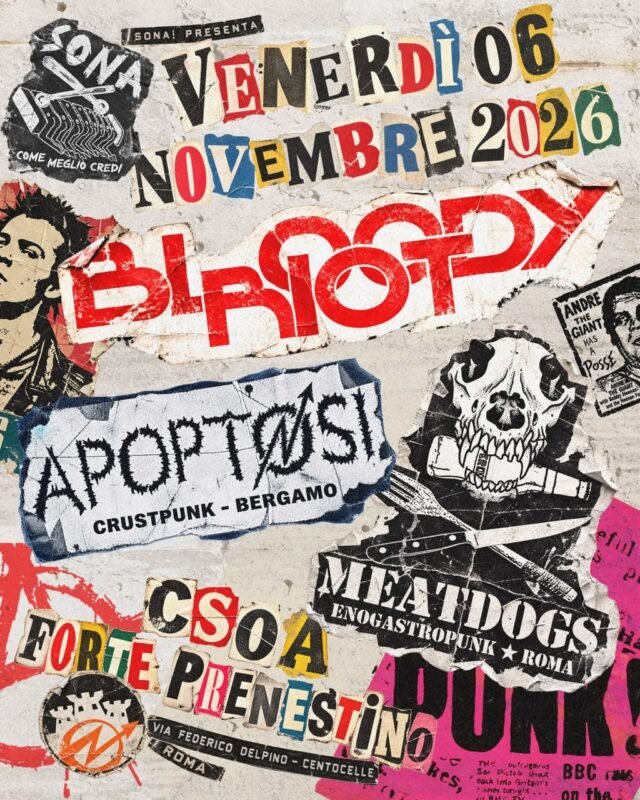
- SONA! Come meglio credi, Opening Night: Meatdogs, Apoptosi, Bloody Riot at CSOA Forte Prenestino, November 6, 2026600 m
- SONA! Come meglio credi: Leda and Lillà at CSOA Forte Prenestino, November 11, 2026600 m
- SONA! Come meglio credi: Asymmetric Drive, Petrolio, Bero Snaut at CSOA Forte Prenestino, November 18, 2026600 m
- SONA! Come meglio credi: Murosuono and The Apulian Blues Fondation at CSOA Forte Prenestino, November 25, 2026600 m