Church of Santi Quirico e Giulitta
In short. The church of Santi Quirico e Giulitta stands on Via Tor de’ Conti, in the Monti district, in that thin strip of the city that runs between the great wall of the Forum of Augustus and the Forum of Nerva, less than 200 meters from…
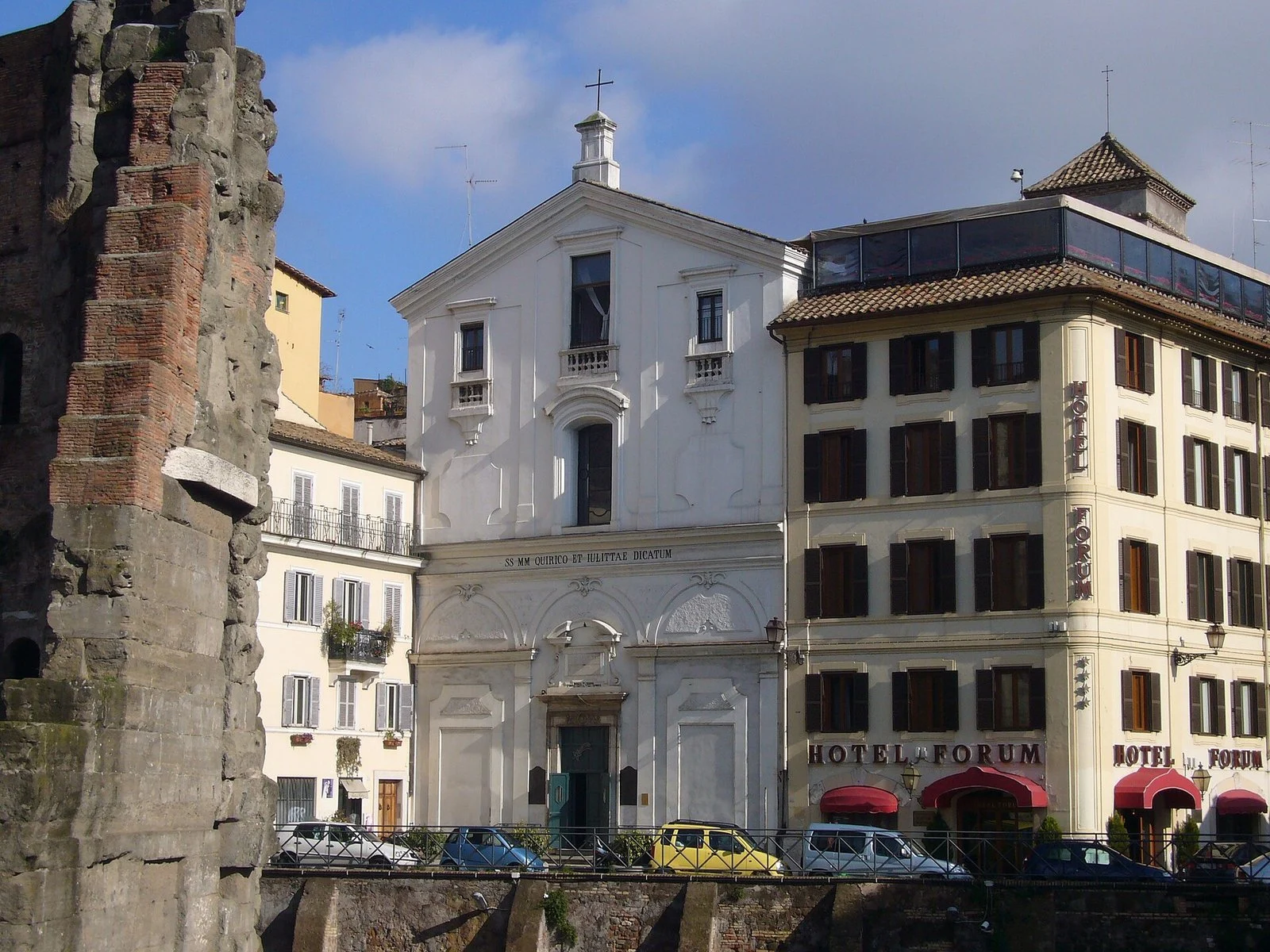
The church of Santi Quirico e Giulitta stands on Via Tor de’ Conti, in the Monti district, in that thin strip of the city that runs between the great wall of the Forum of Augustus and the Forum of Nerva, less than 200 meters from Trajan's Column and a couple of minutes on foot from Trajan's Markets. It is one of the least visited churches in the historic center, and not because it is hidden: you pass in front of it anyway, going up or down between Largo Corrado Ricci and Piazza del Grillo. Simply, almost nobody goes in. And yet under the 18th-century floor you walk on today there is a 6th-century building, its bell tower is Romanesque and its portal bears a 15th-century inscription celebrating a pope. Next to it, a few meters away, rises the Torre dei Conti, which partially collapsed on November 3, 2025 during restoration work, causing the death of a worker: an event that for months affected traffic and access to the whole area and that, for anyone planning a visit today, remains the most important practical piece of information. The lines that follow tell what this church is, since when it has existed, what it preserves, how it has changed over the centuries and in what condition the neighborhood around it is today.
Where the Church of Santi Quirico e Giulitta is and how to get there
The church of Santi Quirico e Giulitta is at Via Tor de’ Conti 31/a, in the Monti district, and faces the eastern side of the archaeological area of the Imperial Forums, behind the Forum of Augustus and opposite the remains of the Forum of Nerva. It is a position that explains almost everything about its history: the church was born inside the Forums area when these were still standing, and kept existing while everything else around it was buried, reused, demolished and finally excavated again.
On foot from the Colosseum and the Forums
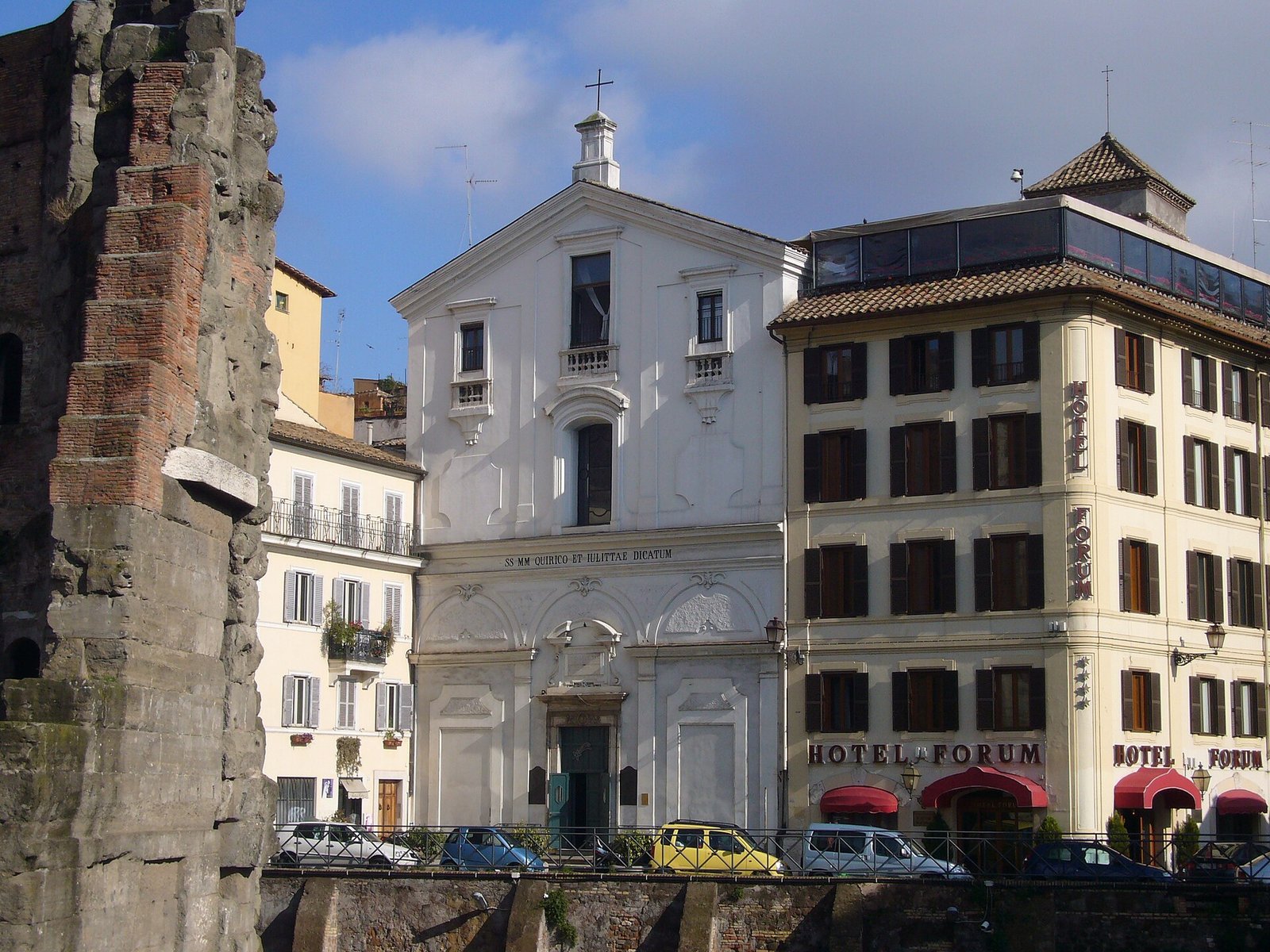
From the Colosseum the walk is a bit under 10 minutes: you go up Via dei Fori Imperiali on the right-hand side, run along the archaeological fence and arrive at Largo Corrado Ricci, the small widening where Via Cavour joins the Forums. From there Via Tor de’ Conti climbs toward the north, narrow between the boundary wall of the Forum of Augustus and the row of houses that close off the Monti district. The church is met after a few dozen meters, on the left, recognizable by its two-tiered facade in a light color and by the hotel leaning against its side.
Whoever arrives instead from the Capitoline Hill can go down from Piazza del Campidoglio toward Via di San Pietro in Carcere, pass next to the Mamertine Prison and enter Via Tor de’ Conti from the opposite end, reaching the church from Piazza del Grillo. It is the more beautiful of the two routes, because it keeps the Forums on the left and crosses one of the few stretches of the center where the medieval level and the ancient level remain visible together.
By public transport
The nearest metro stop is Cavour, on Line B, from which you walk down Via Cavour for about five minutes to Largo Corrado Ricci. Alternatively the Colosseo stop, also on Line B, is a little over 10 minutes' walk going up Via dei Fori Imperiali. Whoever arrives from Termini can take Line B toward Laurentina and get off at Cavour: it is the most direct route, and the walking stretch coincides with the descent of Via Cavour, all in a gentle slope in your favor.
On the bus front, the Imperial Forums area is served by the lines that run along Via dei Fori Imperiali and Piazza Venezia, but this very part of the network has been revised several times because of construction sites and pedestrianizations: it is best to check the route in force at the time of travel, because detours here are frequent. The tram doesn't come this far, and parking a car is in practice impossible: the entire area is subject to traffic restrictions.
Finding your way on Via Tor de’ Conti without picking the wrong door
Via Tor de’ Conti is a short, sloping street, with the ancient great wall on one side and buildings on the other. The church has no churchyard and no bell tower visible from afar on the facade: the Romanesque bell tower exists, but it stays on the right side, largely incorporated into the building of the former convent that today hosts a hotel. The surest reference is the single portal in the center of the facade, framed in marble and topped by a Latin plaque: it is the only opening of that kind along the whole stretch of street.
The Torre dei Conti construction site and access to the church today
On November 3, 2025, around 11 in the morning, a portion of the Torre dei Conti collapsed during restoration work funded by the National Recovery and Resilience Plan, and a second collapse occurred about an hour later, while rescue operations were under way. It is the fact that anyone who wants to visit the church of Santi Quirico e Giulitta must know, because the tower stands a few dozen meters from the church, at the southern mouth of Via Tor de’ Conti, and the management of the emergency kept a substantial part of the neighborhood under seizure and closure for months.
What happened on November 3, 2025
The Torre dei Conti was the center of a restoration and refitting project begun in 2022 by the Capitoline Superintendency for Cultural Heritage, for an amount of 6.9 million euros, with the aim of turning it into a service center and a museum space dedicated to the area of the Imperial Forums. The first collapse affected the face of the tower toward Via Cavour. The second, a little later, involved the roof. Four workers were buried. Three were pulled out alive. The fourth, Octay Stroici, 66 years old, was reached and freed by firefighters after 11 hours of work and died shortly after being taken to the Policlinico Umberto I. The mayor proclaimed a day of city mourning for November 5. The prosecutor's office opened a case for manslaughter and negligent disaster, and in January 2026 the number of people under investigation had risen to nine among technicians and managers of the companies involved. It is a matter still open, and on this page it is reported only for its effects on the place and on its accessibility.
How the red zone narrowed between January and May 2026
After the collapse the Campidoglio signed an ordinance for public safety that closed Largo Corrado Ricci and had some nearby buildings evacuated, creating what the news called the red zone. The securing operations, carried out by the firefighters, went on throughout the winter. On January 31, 2026 the danger was declared over for residents and shopkeepers, who were able to return to homes and shops. With ordinance number 39 of March 19, 2026 the following became usable again, in stages: the stretch of outdoor area of the senior center between Via Tor de’ Conti and Via della Madonna dei Monti, a connecting lane between Via dei Fori Imperiali and Via Cavour, and Vicolo Tor de’ Conti, which restored pedestrian passage between Via della Madonna dei Monti and Largo Corrado Ricci.
On May 6, 2026 a new ordinance declared the emergency phase concluded: Largo Corrado Ricci was returned in large part to pedestrian and vehicle circulation in both directions, a second lane toward the Forums was reopened on Via Cavour and the Templum Pacis construction site was handed back to the companies. The area immediately next to the tower, however, remained under seizure by the judicial authority, and a portion of the sidewalk of Largo Corrado Ricci remained off-limits to host the structural monitoring equipment. In September 2026 work on the monument had restarted and the city press indicated the following June as a possible horizon for a reopening, but this is a journalistic forecast and not an official date.
What to expect arriving today
The point: Via Tor de’ Conti and the pedestrian connections around the church became passable again in the spring of 2026, and the church was never at the center of the seizure, which concerned the tower and its immediate surroundings. Whoever arrives today nonetheless finds an area still marked by the construction site, with barriers, scaffolding, monitoring instruments and traffic that can change from one ordinance to the next. Before setting out it is best to check the Roma Capitale notices on traffic in the Imperial Forums area, because in an area under structural observation the provisions can be modified quickly.
The ancient origins: a 6th-century church inside the Forums area
The sources place the birth of the church of Santi Quirico e Giulitta no later than the 6th century, and tradition links it to Pope Vigilius, who led the Church of Rome between 537 and 555. The most cited archaeological fact is that the floor of the first building was at the same level as that of the Temple of Mars Ultor, in the Forum of Augustus: a sign that when this church was built the Forums were not yet buried under debris. It is one of the few direct indications we have on the life of the area in the decades after the end of the Western Empire, and it comes from a small, little-visited church, not from a great monument. Whoever wants to see that stratification explained in an orderly way can visit the Museum of the Imperial Forums, set up in Trajan's Markets.
Pope Vigilius and the dedication to Stephen and Lawrence
An inscription now lost, but transcribed before the 17th century, recorded the consecration by Pope Vigilius of an altar dedicated to Saints Stephen and Lawrence. The two were the martyr deacons par excellence of Roman devotion, and pairing them in a single dedication was common in foundations of the period. The church was therefore born with a title different from the current one, and with an orientation reversed compared to today: the apse faced the boundary wall of the Forum of Augustus, while the entrance opened on the opposite side.
The Einsiedeln Itinerary and the first attestations of the new title
The name of the two saints to whom the church is now dedicated appears for the first time in the Itinerary of the Anonymous of Einsiedeln, a pilgrim guide of the end of the 8th century that lists the routes and monuments of Rome as seen by a traveler from beyond the Alps. After that citation you have to wait until the 12th century to find another. The building then appears in the great medieval collections that describe the city: the Mirabilia Urbis Romae, the Liber Censuum of 1192, where it is registered with the number 243, and the Graphia aureae urbis Romae of the 13th century. They are short citations, but enough to show that the church never stopped functioning throughout the Middle Ages.
The Pantani district
Archaeological studies place the definitive ruin of the Imperial Forums in the 9th century, after a series of severe earthquakes. From that moment the area that today is crossed as an archaeological park became an inhabited district, built over the rubble, which Romans called the Pantani: a name that refers to stagnant water, because the collapse of the ancient drainage systems had made the floor of the basin between the Quirinal and the Capitoline marshy. In that medieval urban fabric stood several churches: San Lorenzo ai Monti, Santo Spirito ai Monti, Sant'Eufemia, Santa Maria in Campo Carleo, Sant'Urbano ai Pantani, Santa Maria Annunziata ai Monti, Santa Maria in Macello Martyrum. All were demolished between the 19th and 20th centuries, to free the Forums area and excavate it. The church of Santi Quirico e Giulitta is the only survivor.
A curiosity about the Church of Santi Quirico e Giulitta
The most solid curiosity about this church concerns its floor: the one you walk on today is not the original floor, and between the two there is a difference in level of several meters, because at the beginning of the 17th century the building was literally lifted. The church visible from Via Tor de’ Conti is therefore the higher of two superimposed churches, and the ancient one, now a crypt, is the truly sunken part of the complex.
A church that was lifted bodily
Between 1606 and 1608, under Pope Paul V, the church underwent a reorganization that included raising the walking surface. The Italian sources, from the Italian Wikipedia entry to the medioevo.roma.it directory, speak of about four meters. The English directory dedicated to the churches of Rome speaks instead of four feet, that is, a little over a meter. The difference is striking and it is not possible to resolve it without consulting the archival documentation of the work: whoever reads the entry should know this. What the sources agree on is the reason for the operation: humidity. Water got into the church, and the raising served to shelter it.
Where the water came from
On this point the sources diverge in an interesting way. The most widespread version in the Italian entries attributes the problem to floods of the Tiber. It is an explanation to take with caution: the river is almost a kilometer away as the crow flies and runs at a level that makes it hard to imagine its floods reached here regularly. Much more consistent with the history of the place is the explanation tied to the place name Pantani, that is, to the stagnation of water in the basin of the Forums after the collapse of the ancient drainage. The two things, moreover, do not exclude each other: a city with its ancient sewer system in ruins and a river without embankments suffered rising water and stagnation everywhere on the valley floor.
One thing nobody tells you about the Church of Santi Quirico e Giulitta
The thing the guides almost never say is that the Romanesque bell tower of the church still exists, dates from the 12th century, and is largely inside a hotel.
A bell tower almost nobody sees
The bell tower was built at the beginning of the 12th century, and its construction is attributed to Pope Paschal II, who led the Church of Rome between 1099 and 1118. It has three tiers, separated by slightly projecting cornices, with the belfry opened by triple-arched windows, partly walled up, on two floors. When the church was turned around, in 1584, the bell tower ended up on the wrong side with respect to the new entrance, and the construction of the convent in the mid-18th century incorporated it almost entirely. Today the former convent is the Hotel Forum, and the bell tower remains visible only in part, from a few side glimpses and from above.
The second thing rarely said: the portal may belong to another church
The marble portal of the facade is 15th century, with an elegant tympanum and a Latin plaque. The traditional reading ties it to the restoration commissioned by Sixtus IV in 1475, ahead of the jubilee year, and attributes it to Baccio Pontelli. There is, however, an alternative reading, supported in critical circles, according to which the frame was salvaged in 1750 from the church of San Bernardo, demolished to make room for Santissimo Nome di Maria al Foro Traiano. If it were true, it would mean that the oldest piece visible on the facade never belonged to this church. The two hypotheses coexist in the bibliography and neither has been definitively closed.
The Middle Ages, the bell tower and survival
Between the 9th and the 15th century the church of Santi Quirico e Giulitta goes through the period about which least is known and which nevertheless explains its current form.
The restoration by Sixtus IV and the inscription
In 1475 Sixtus IV promoted the restoration of the church ahead of the Jubilee, within a program of works that covered bridges, walls, streets and places of worship throughout the city. Above the portal a plaque was set into the wall with a Latin epigram attributed to the Florentine humanist Aurelio Brandolini, which can be translated like this: Quirico with his mother Giulitta sees restored the temples that for a long time lay in ruin. Under Prince Sixtus no antiquity remained in the places of worship. He rebuilt bridges, gates, temples and streets. It is a text that says a lot about how the Renaissance papacy told its own story, and that is really worth reading, stopping for a minute in front of the door.
The advice I give you for visiting the Church of Santi Quirico e Giulitta
There is just one piece of advice, and it concerns the schedule: this church is a rectory run by a religious community, not a monument with a ticket office, and its hours follow the liturgical life. Before coming it is best to phone.
What we know about the hours
The official tourism portal of Roma Capitale indicates for this church weekday Masses Monday to Friday at 19:00, the Saturday and eve-of-feast Mass at 19:00 and the Sunday and holiday Mass at 10:00, specifying that the hours may vary and inviting you to contact the church. The published phone number is 06 69797832. A specialized directory instead reports a different and wider picture, with daily opening in the morning and afternoon and weekday Masses at 9:00 and 18:30: it is information from some years ago and does not match the official one. In such a situation the only sensible thing is to call: inventing a schedule would be worse than not giving one.
How to fit it into a sensible tour
It makes no sense to come all the way here just for this church. It makes a lot of sense, instead, to include it in a route that starts from the Roman Forum and the Basilica of Maxentius, goes up toward Trajan's Forum and Trajan's Column and then slips into the Monti district passing right through Via Tor de’ Conti. From here, in five minutes of uphill walking, you reach San Pietro in Vincoli. With 10 more you reach the basilica of Santi Silvestro e Martino ai Monti, which in turn has an underground level of great interest. It is a half-day itinerary that alternates heavily visited monuments and almost deserted places, and that works well precisely because of this contrast.
The 1584 reversal and the cardinal title
In 1584 the church of Santi Quirico e Giulitta was turned around: the entrance was moved to where the apse was, which was demolished, and the old portico became the presbytery. It is the intervention that determined the current appearance of the building.
Why turn a church around
Reversals of orientation are not rare in Rome at the end of the 16th century, and they almost always respond to urban reasons: a street changes importance, one front becomes more visible than the other, and it makes sense to open the door where people pass. Here the new entrance faces Via Tor de’ Conti, that is, the street of the neighborhood, while the old one faced the Forums area, by then occupied by the building fabric of the Pantani. The operation was overseen by Alessandro de’ Medici, who had been made a cardinal in 1584 itself and who many years later, in 1605, would become pope for 26 days under the name Leo XI.
A cardinal title that arrived from another church
The story of the cardinal title of Santi Quirico e Giulitta is more tangled than it seems, and comes from a confusion of names. In Rome there was an ancient title, Sancti Ciriaci in Thermis, tied to a church dedicated to St. Cyriacus in the area of the Baths of Diocletian, later vanished. There was also a Benedictine monastery of San Ciriaco de Camilliano, suppressed by a decree of Eugene IV in 1435. In 1587 the old title of San Ciriaco alle Terme was formally transferred to this church, which since then has been the seat of the title of Santi Quirico e Giulitta. The first titular was precisely Alessandro de’ Medici.
What a cardinal title is
It is worth explaining, because it is a formula often read on the plaques of Roman churches without being clear. Every cardinal, as a member of the clergy of Rome, receives a church of the city as a symbolic title: he does not become its pastor or its owner, but takes on its patronage and becomes its representative in the College of Cardinals. The title of Santi Quirico e Giulitta was assigned in 2007 to the Irish cardinal Seán Brady. Assignments change with consistories and with the deaths of the titulars, so the fact should be understood as referring to that date and checked for today with the official sources of the Holy See.
The Baroque interventions and the 18th-century reconstruction
The church you visit today is, in substance, an 18th-century building constructed inside the perimeter of a much older one. The reason has a date: 1716.
The fire of 1716
In that year the church was devastated by a fire that compromised its interiors. The reconstruction began 12 years later, in 1728, on a design by Filippo Raguzzini, and reused much of the surviving structures instead of starting from scratch. The church was reconsecrated in 1734 and the facade was finished the following year. On the author of the facade the sources do not agree: some assign it to Raguzzini himself, others to Gabriele Valvassori.
Valvassori's convent and the birth of the hotel
Between 1750 and 1753 Gabriele Valvassori built the convent south of the church: for the first time in its history the building became conventual. The convent was secularized in 1873, after the annexation of Rome to the Italian State, and over the 20th century changed use several times. Between 1965 and 1970, in the same period in which the religious were carrying out a restoration of the church, the former convent became the Hotel Forum, which still occupies that block today. That is why the Romanesque bell tower is inside a hotel.
Dominicans, diocesan clergy, Franciscans
The church has changed custody several times. In the 18th and 19th centuries it was served by the Dominicans, who in 1856 promoted an important restoration of the interiors and marked its decoration. The friars remained until 1921, when the diocesan clergy took over. The parish, which served an area by then too small after the demolitions, had already been suppressed in 1910. Since 1951 the church has been entrusted to the friars of the Third Order Regular of St. Francis, who still run it as a rectory dependent on the parish of Santa Maria ai Monti.
What you see inside
The interior of the church of Santi Quirico e Giulitta has a single nave of four bays, covered by a barrel vault with lunettes, with four side altars and a quadrangular presbytery closed by a marble balustrade. It is a small space, crossed in a few steps, and precisely for this reason it should be looked at calmly.
The vault by Pietro Gagliardi
The vault of the nave carries at its center a fresco by Pietro Gagliardi, dated 1856, depicting the Glory of Saints Quirico and Giulitta: the two martyrs, that is, a small child and his mother, surrounded by angels and putti. Gagliardi was one of the most active decorators in Rome in the mid-19th century, in a season when Roman religious painting looked insistently to 16th-century models. The rest of the decoration of the vault is by Giovanni Luciani. In the pendentives of the arches frescoes with putti remain, now much faded.
The high altar and the altarpiece of the martyrdom
The presbytery is occupied by the old high altar, of 17th-century design, with an aedicule formed by a broken pediment supported by four Corinthian columns in alabaster. The altar dates to 1600 and its marbles were reworked in 1736. At the center of the aedicule is an altarpiece with the Martyrdom of Saints Quirico and Giulitta, dated 1631 and by an unidentified author: in the bibliography the name of Mattia Preti appears as a possible attribution, but it is an unconfirmed hypothesis. The presbytery is raised by two steps with respect to the nave. An altar facing the congregation was placed in 2017.
The side altars
There are four side altars, two per side. On the right side the first holds a 17th-century canvas with the Madonna and St. Joseph. The second, dedicated to St. Dominic de Guzmán, houses a Preaching of St. Dominic by Ercole Ruspi, a 19th-century painter active in the circle of Roman decorators. On the left side the first altar has a mid-18th-century canvas with St. Vincent Ferrer and St. Nicholas of Bari adoring the Baby Jesus, while the second carries a Madonna of the Rosary between Saints Dominic and Catherine from the first half of the 18th century. The strong presence of Dominican saints is explained by the centuries in which the order served the church.
The choir lofts and the Pantanella organ
Near the back wall there are two opposing choir lofts, painted in faux marble, supported by brackets and closed by balustrades. On the right-hand loft is the pipe organ, built in 1859 by Pietro Pantanella and restored in 2006 by the Inzoli firm. The instrument has fully mechanical action, a keyboard of 50 notes with a short first octave and a pedalboard of 14 notes constantly coupled to the manual. It is a 19th-century organ of the Roman school, of the kind that is rarely pointed out in guides.
Another well-known fact, yet rarely cited
The well-known fact, almost never recalled when talking about this church, is that the Imperial Forums did not collapse on their own: they were demolished twice, the first time by time and the second by men. Of all the churches that stood on the area of the Forums at the beginning of the 19th century, this is the only one still standing and in use, and there is no plaque on Via Tor de’ Conti to recall it.
The 19th-century demolitions
The opening of Via Cavour, at the end of the 19th century, was the first deep cut into the Monti district. It served to connect the new Termini station with the center, and drew a straight axis through a neighborhood made of alleys, differences in level and houses leaning on each other. In that passage the Torre dei Conti was left isolated from the buildings that surrounded it, and the fabric of the district was broken for the first time.
The demolitions of the 1930s
The second cut was much more radical. The opening of Via dei Fori Imperiali in the 1930s meant the demolition of an entire inhabited neighborhood, with the loss of houses, churches and layered urban memories. The churches demolished in this phase or shortly before are those already listed. The result is the archaeological area you cross today: an orderly and legible space, obtained however by erasing 15 centuries of stratification.
Why it matters, here
It matters because the church of Santi Quirico e Giulitta is the only surviving fragment of that intermediate city. Whoever looks at it today does not see only a Baroque church: they see the last piece of a neighborhood that no longer exists. The same holds, in another form, for the leaning tower of Rome, another of those buildings that survive by chance inside a completely transformed context, and for the basilica of Santi Cosma e Damiano, which was saved because it directly occupied an ancient hall and therefore could not be separated from it.
The cult of Quirico and Giulitta and its spread in Italy
Quirico and Giulitta are, in the Christian tradition, a three-year-old child and his mother, probably martyred in 304 during the persecution of Diocletian. Their cult is among the most widespread and at the same time among the least known in Italy: dozens of municipalities and hamlets have them as patrons, and at least 40 churches in Italy and Switzerland carry their name.
The Passio and its 40 versions
About 40 versions of the acts of their martyrdom are known, mostly listed in the Bibliotheca hagiographica latina. Many contain clearly legendary episodes, to the point that already in the middle of the 4th century doubts emerged about their reliability. The first serious investigation was conducted by Bishop Theodore of Ionicum, who at the urging of Bishop Zosimus cleaned the account of spurious elements and proposed a more sober version, which has come down to us through his Letter to Zosimus. Whoever reads a life of the saints must know that it is a hagiographic tradition, with an ancient core and a long narrative stratification, not a chronicle.
The account in the most sober version
According to the Passio considered most reliable, Giulitta was a widow from a well-off family who lived at Iconium, in Lycaonia, present-day Konya in Turkey. Having converted to Christianity and fearing for herself and her son, she left everything she owned and fled with two handmaids and the three-year-old child. She was discovered and captured while reaching Tarsus, and tried on the order of the governor of Cilicia. The account has it that the child, seeing his mother tortured, declared in turn that he was a Christian, and that the governor killed him on the spot. The mother was then beheaded. The bodies, according to tradition, were recovered by one of the handmaids and kept hidden until the Constantinian age. Some versions place the martyrdom in Antioch rather than Tarsus.
From Antioch to Marseille, from Marseille to Rome
The introduction of the cult into western Europe is traditionally attributed to St. Amator, bishop of Auxerre who died in 418, who is said to have brought the relics of the two martyrs from Antioch to Marseille. From there, again according to tradition, they were translated to Rome by Pope Vigilius, the same pope to whom the first church in this place is traced, who is said to have had a building dedicated to them erected in the area then called the Pantani. It is the account that closes the circle between the history of the saints and the history of Via Tor de’ Conti, and it should be taken for what it is: a devotional tradition, not a documented fact.
June 16 or July 15
The Catholic Church celebrates the two saints on June 16. The Eastern Churches on July 15. On the exact date of the martyrdom two traditions therefore compete, and critics tend to consider the Eastern one more probable, because July 15 already appears in the Letter of Theodore, while June 16 appears for the first time in the Catalogus Sanctorum of Pietro de Natali, of 1493. Curiously, liturgical traditions tied to July 15 survive in the West too: it happens at Lapedona in the Marche, at Serra San Quirico, at Santa Giuletta in the province of Pavia, at San Chirico Raparo in Basilicata, at Castelnuovo Bormida, at Ardauli and at Cargeghe in Sardinia.
The towns that carry their name
The geography of the cult is surprising in its breadth. The two martyrs are patrons, among others, of San Quirico d’Orcia in the Val d’Orcia, of Serra San Quirico in the Marche, of San Chirico Raparo in Basilicata, of Cisternino in Puglia, of Collesalvetti in Tuscany, of Corvino San Quirico and of Santa Giuletta in the province of Pavia, of Bagnasco and of Castelnuovo Bormida in Piedmont, of Cargeghe and of Norbello in Sardinia, of Lezzeno and of Locate Varesino in Lombardy, of Castellavazzo and of Cavarzano in the Belluno area, of Montelabbate in the Marche. The Genoese district of San Quirico in Val Polcevera, an independent municipality until 1926, carries the same name. It is a capillary diffusion, which crosses the whole peninsula and is explained by the antiquity of the cult and its popular force: the story of a mother and a small child has an immediate grip, much more than that of an adult martyr.
The right photo to take at the Church of Santi Quirico e Giulitta
The right photo is not the frontal facade, which on a street as narrow as Via Tor de’ Conti is almost impossible to frame entirely without distorting it. The right photo is the one that holds together the church and the ancient great wall in front of it.
The framing that tells the place
You stand on the opposite side of the street, level with the boundary wall of the Forum of Augustus, and frame diagonally: on one side the block of ancient stone, on the other the light facade of the 18th century, and in the middle the strip of sloping asphalt. It is the image that explains in one stroke what this place is, that is, a place where a modern church lives in contact with a wall from 2,000 years ago. A slightly wide-angle focal length helps, but without overdoing it, because the vertical lines bend right away.
The bell tower, if you can manage it
The third subject is the hardest: the Romanesque bell tower, visible only in part and from a few side glimpses, above the body of the former convent. There is no comfortable shooting point from the street, and the result depends a lot on the exact spot where you stand and on the season, because vegetation and roofs change what can be seen. Whoever manages it takes home an image that almost nobody has.
What not to photograph
Inside the church, no flash and no shots during services. And a warning that holds these months more than ever: the Torre dei Conti construction site is a place where a person died, and where the area next to the monument remains under seizure. Photographing the site up close, besides being inappropriate, may not be allowed. The tower is perfectly visible from Largo Corrado Ricci and from Via dei Fori Imperiali, at a distance, and that is where it should be shot from.
The Nativity Scene Museum in the underground rooms
In the underground rooms of the church, in the same spaces excavated in 1930 that preserve the remains of the 6th-century building, is the Angelo Stefanucci International Typological Museum of the Nativity Scene, one of the most important collections of its kind in the world.
What it is
The museum gathers nativity scenes from all the continents, made with very different materials and techniques, together with books, medals, posters and themed stamps. The founder is Angelo Stefanucci, a Roman, who lived between 1905 and 1990, who also gave life to the Associazione italiana amici del presepio, formed in 1953 and canonically erected the same year. It is the association that still manages the collection.
The difference from the page dedicated to the museum
On the site there is already a page dedicated specifically to the Angelo Stefanucci International Nativity Scene Museum, which tells about its collection, its route and the practical visiting information. This page instead deals with the church that hosts it: its history, its architecture, its paintings and the urban context in which it stands. Whoever is mainly interested in the nativity collection will find on the dedicated page the information that is only touched on here.
A note on the hours
The museum is traditionally open with very restricted hours, concentrated in a few afternoons a week, with extended opening in the Christmas period and a closure in August. Since it is run by an association of volunteers inside a church run by a religious community, the hours are subject to change, and the sources that report them are not all updated to the same date. Whoever wants to visit it would do well to contact the church or the association beforehand.
Some important events that took place here in history
The church of Santi Quirico e Giulitta has not been the stage of great political events, but its chronology intersects some decisive passages in the history of Rome, and should be read as a series of dates that tell the transformation of a piece of the city.
Mid-6th century: the consecration of the altar
The consecration of an altar dedicated to Stephen and Lawrence by Pope Vigilius, between 537 and 555, places the birth of the building in one of the most dramatic moments in the history of the city: these are the years of the Gothic War, of sieges, of depopulation. That in this context an altar was consecrated in the area of the Forums means that the area was still alive.
9th century: the collapse of the Forums and the birth of the Tower
In the 9th century a series of earthquakes brings the definitive ruin of the Imperial Forums. In the same century, according to tradition, the first fortified core of the Torre dei Conti is erected, built over one of the exedrae of the portico of the Temple of Peace and clad in travertine taken from the nearby forums. They are two faces of the same process: the ancient city stops functioning and becomes a quarry of materials and a base for the new city.
1203 and 1216: the Torre Maggiore
At the beginning of the 13th century Pope Innocent III promoted the enlargement of the fortress for his own family, the Counts of Segni, with works that ended in 1216, the year of his death. Some sources instead attribute the commission to Riccardo, count of Sora and brother of the pope. The tower reaches an estimated height between 50 and 60 meters and becomes known as the Torre Maggiore. Francesco Petrarca will call it Turris illa toto orbe unica, that tower which is unique in the whole world. Today the tower measures 29 meters.
1584 and 1606 - 1608: the reversal and the raising
Within a generation the church changes orientation and level: first the overturning of the axis, with the demolition of the apse and the transformation of the portico into the presbytery, then the raising of the floor ordered by Paul V to counter humidity. It is the moment in which the ancient church disappears beneath the modern one.
1716 and 1728 - 1734: the fire and the rebirth
The fire of 1716 destroys the interiors. The reconstruction on a design by Filippo Raguzzini begins in 1728 and ends with the reconsecration of 1734 and with the completion of the facade the following year.
November 3, 2025: the collapse of the Torre dei Conti
The partial collapse of the tower during restoration work, with the death of the worker Octay Stroici, is the most recent event that has marked this corner of the city. It imposed the closure of Largo Corrado Ricci, the evacuation of some buildings and months of securing work, concluded in the spring of 2026 with the gradual return to normal of traffic and of the activities of the neighborhood.
Who passed through the Church of Santi Quirico e Giulitta
The minor churches of Rome often have a list of visitors more interesting than that of the major monuments, because their history is made of discreet presences and obligatory passages. Here the most important name is that of a pope who was one for less than a month.
Alessandro de’ Medici, later Leo XI
Alessandro Ottaviano de’ Medici, a Florentine, was made cardinal in 1584 and was the first titular of the church when the cardinal title was assigned to it. He personally oversaw the reorganization of the building and the reversal of its orientation. In April 1605 he was elected pope with the name Leo XI, and died after 26 days of pontificate: one of the shortest in the history of the Church. The link between him and this church therefore predates his election, and concerns precisely the appearance the building has today.
Pope Vigilius and Pope Paschal II
Two much older popes appear in the history of the church: Vigilius, to whom the foundation and the consecration of the original altar in the mid-6th century are owed, and Paschal II, to whom the construction of the Romanesque bell tower at the beginning of the 12th century is traced. They are traditional attributions, supported by indirect sources more than by documents, but consistent with the chronology of the structures.
Filippo Raguzzini and Gabriele Valvassori
The two architects who gave the church and its convent their current appearance are among the protagonists of 18th-century Rome. Raguzzini, author of Piazza Sant’Ignazio, redesigned the church after the fire. Valvassori, who in Rome signed among other things the facade of Palazzo Doria Pamphilj on the Corso, built the convent in the middle of the century and may also have had a role in the facade of the church.
A niece of Napoleon
In the crypt is the tomb of Cristina Egitta Bonaparte Stuart, a niece of Napoleon, who died in 1847. It is an unexpected presence in such a secluded church, and says how much the Rome of the 19th century was crossed by European families and exiles who left a trace in the most improbable places.
Angelo Stefanucci
Finally, the figure who brought here something that wasn't there: Angelo Stefanucci, who between the 1950s and 1960s chose the underground rooms of this church as the seat of his collection of nativity scenes and of the association he had founded. Thanks to him an early Christian crypt excavated in 1930 became, without ceasing to be what it was, an international museum.
Frequently asked questions about the Church of Santi Quirico e Giulitta
Where is the church of Santi Quirico e Giulitta?
The church of Santi Quirico e Giulitta is at Via Tor de’ Conti 31/a, in the Monti district of Rome, behind the Forum of Augustus and opposite the remains of the Forum of Nerva. The most convenient metro stop is Cavour, on Line B, from which you walk down Via Cavour for about five minutes to Largo Corrado Ricci, where Via Tor de’ Conti begins.
How much does it cost to enter the church of Santi Quirico e Giulitta?
Entry to the church of Santi Quirico e Giulitta is open and free, as in all the churches of Rome open for worship. There is no ticket office and no ticket is required. For the International Typological Museum of the Nativity Scene set up in the underground rooms, management is entrusted to an association of volunteers and the traditional formula is free entry with a donation, but it is best to check the conditions at the time of the visit.
What are the hours of the church of Santi Quirico e Giulitta?
The hours of the church of Santi Quirico e Giulitta follow the liturgical life of the community that serves it and are not those of a museum. The tourism portal of Roma Capitale indicates weekday Masses Monday to Friday at 19:00, Saturday and eve-of-feast Mass at 19:00 and Sunday Mass at 10:00, specifying that the hours may vary. Other sources report a different picture: before coming it is best to phone 06 69797832.
Does the collapse of the Torre dei Conti prevent visiting the church?
No, the partial collapse of the Torre dei Conti on November 3, 2025 does not prevent reaching the church of Santi Quirico e Giulitta today. The judicial seizure concerned the tower and its immediate area, not the church. The pedestrian connections around Via Tor de’ Conti were reopened in stages between March and May 2026, when the emergency phase was declared concluded, but the area remains a construction site and traffic can change.
How do you get to the church of Santi Quirico e Giulitta by public transport?
You get to the church of Santi Quirico e Giulitta most conveniently by metro Line B, Cavour stop, from which you walk down Via Cavour in about five minutes. Alternatively you can get off at the Colosseo stop, also on Line B, and walk up Via dei Fori Imperiali in a little over 10 minutes. The buses that serve Via dei Fori Imperiali and Piazza Venezia undergo frequent detours: it is best to check the updated route.
How much time do you need to visit the church of Santi Quirico e Giulitta?
To visit the church of Santi Quirico e Giulitta 15 or 20 minutes are enough, rising to about 40 when including the descent into the crypt with the remains of the 6th-century building and the visit to the nativity scene museum. It is a short stop, meant to be fitted into a wider route between the Imperial Forums and the Monti district, not to take up a morning on its own.
Can you take photographs inside the church of Santi Quirico e Giulitta?
Inside the church of Santi Quirico e Giulitta photography is generally tolerated as in the other Roman churches open for worship, provided there is no flash, no tripod and never during services. Since it is a small rectory frequented by worshippers, it is good practice to ask the religious staff present first. The Torre dei Conti construction site a short distance away, on the other hand, should not be photographed up close, because the area next to the monument remains off-limits.
Why does the church of Santi Quirico e Giulitta have a church underneath?
The church of Santi Quirico e Giulitta has a church underneath because at the beginning of the 17th century, under Pope Paul V, its floor was raised to protect it from humidity, burying the 6th-century building that is visited today as a crypt. The sources diverge on the extent of the raising, which the Italian directories quantify at about four meters and the English ones at four feet.
Is the church of Santi Quirico e Giulitta suitable for children?
Yes, the church of Santi Quirico e Giulitta is suitable for children, above all for the International Typological Museum of the Nativity Scene set up in its underground rooms, which gathers thousands of miniature figures from all over the world. The story of the two titular saints, a mother and a three-year-old child, also lends itself to storytelling. The only point of caution is the stair that leads to the crypt.
A last piece of advice for whoever is planning the itinerary
The church of Santi Quirico e Giulitta is one of those stops that don't hold up on their own but change the sense of a day: 10 minutes inside an empty church, between a crowded archaeological area and a district full of people, are exactly what is needed to understand how Rome has layered itself. Whoever arrives for a few days and has to choose would do well to place it between the Imperial Forums and Monti, perhaps at the end of the morning, and to allow for the possibility that they may find it closed: in that case what remains is the facade, the 15th-century portal and the ancient great wall opposite, which alone are worth the detour.
Whoever is organizing a wider itinerary in the center of Rome, lining up the Imperial Forums, the Monti district and the minor stops met along the way, can find useful planning tools on Tour Leader Pro, while for a wider picture on transport, seasons and destinations in Lazio a good resource is Italy Planner.