Published on · updated on
Some links on this page are affiliate links: if you buy through them, Estate Romana receives a small commission, at no additional cost to you. As an Amazon Associate, Estate Romana earns from qualifying purchases.
The Meditrinalia was the October 11 festival when the ancient Romans tasted new wine for the first time. No grand temples, no processions: a formula to recite, a sip of freshly fermented must next to the previous year’s wine, and the idea that this gesture kept illness away. Today nobody in Rome celebrates it under that name, but the season is the same. Between the Sagra dell’Uva in Marino, the open cellars of the Castelli and the first bottles of novello, the first half of October remains the time when Lazio takes stock of the harvest that has just ended.
Here you’ll find the two halves of the story: what the Romans did that day, according to the few sources that talk about it, and where you can drink well today within an hour of the city. At the end there’s the practical part: how to get there without a car, what to bring home and what you need to redo the rite in your living room, with an old bottle and a new one.
Data checked on October 3, 2026 on Varro (De lingua Latina VI, 21), on the lexicon of Festus, on the official program of the 102nd Sagra dell’Uva in Marino and on the Trenitalia page dedicated to the Castelli Romani line.
Meditrinalia in brief
- What: the Meditrinalia is the Roman rite of the first tasting of new wine, drunk together with the previous year’s wine.
- When: October 11 of every year. In 2026 it’s a Sunday.
- The formula: “Novum vetus vinum bibo, novo veteri morbo medeor,” handed down by Varro.
- Today: no official event carries the name Meditrinalia. The same season is lived in the festivals and cellars of the Castelli Romani.
- How to get there: by train from Roma Termini, about half an hour to Frascati.
- Good to know: novello has nothing to do with it, because it can only be sold from October 30.
What was the Meditrinalia?
The main source is Varro, who wrote in the 1st century BC and already struggled to explain festivals much older than himself. In the sixth book of the De lingua Latina he says the day takes its name from mederi, to heal, and reports the testimony of a priest, Flaccus, flamen of Mars: on that day it was customary to pour a libation and taste new wine and old wine “for the purpose of medicine.” He adds that in his time many still did it, pronouncing a phrase: “Novum vetus vinum bibo, novo veteri morbo medeor.” I drink new and old wine, I cure myself of new and old illness.
The lexicon of Festus, which we know through the summary made centuries later by Paul the Deacon, confirms the formula and adds a detail: the name of a goddess, Meditrina, would have been derived from those words. It’s an explanation built after the fact. Of Meditrina no temples, inscriptions or stories remain, and modern scholars consider her an invention of the grammarians to give a face to a rite whose origin had been lost.
What remains certain is little, and it’s already a lot for such an ancient festival. The date, October 11. The gesture, that is, the tasting of two vintages together. The formula, which links wine to health. Everything else, from the banquets to the dances you read about around the web regarding the Meditrinalia, appears in no ancient text.
Why did the Meditrinalia fall precisely on October 11?
Because the grape harvest in ancient Lazio wrapped up between September and the first days of October, and by mid-month the must had already begun to ferment. It was the first moment useful to understand what the vintage would be like, and the Meditrinalia fixed it on a precise day. Tasting too early meant drinking grape juice, waiting too long meant reaching winter without knowing what was in the amphorae.
Around the Meditrinalia the Roman calendar lined up a series of rites tied to the end of work. Two days later, on the 13th, came the Fontinalia, the festival of springs, when wreaths of flowers were thrown into fountains and wells were decorated. On the 19th the Armilustrium closed the season of military campaigns with the purification of arms. October was the month when tools were put away, those of the farmer and those of the soldier.
Wine also had two other, better-known festivals. The Vinalia of April, on the 23rd, when the jars of the previous vintage were opened, and the Vinalia rustica of August 19, before the harvest. The Meditrinalia sits in between: it’s the moment of tasting, not the moment of celebration.
A wine festival or a health rite?
Here it’s worth taking a position contrary to the one you read most often. The Meditrinalia was not a “wine festival” in the sense we give today to a sagra. The sources don’t speak of public banquets or ritual drunkenness. They speak of a sip, a libation and a phrase about illness. Anyone who tells of Bacchic orgies in October is mixing together three or four different festivals, and often adds the Bacchanalia, which have nothing to do with this day.
The meaning was practical. New wine was frightening: cloudy, unstable, able to ruin the stomach. Mixing it with the old and accompanying it with a formula meant putting the vintage under protection before starting to drink it. The Meditrinalia was a household gesture, made by the master of the house in front of the amphorae, more like a toast of good wishes than a state ceremony.
The wine of the Meditrinalia was different from ours too. The Romans almost always drank it diluted with water, often sweetened with honey or flavored, and stored it in pitch-lined amphorae that left a taste of resin. The most celebrated wines came from southern Lazio and Campania: the Caecuban of the Fondi plain, the Falernian. Drinking it straight was considered a barbarian habit.
Where do you drink new wine today, near Rome?
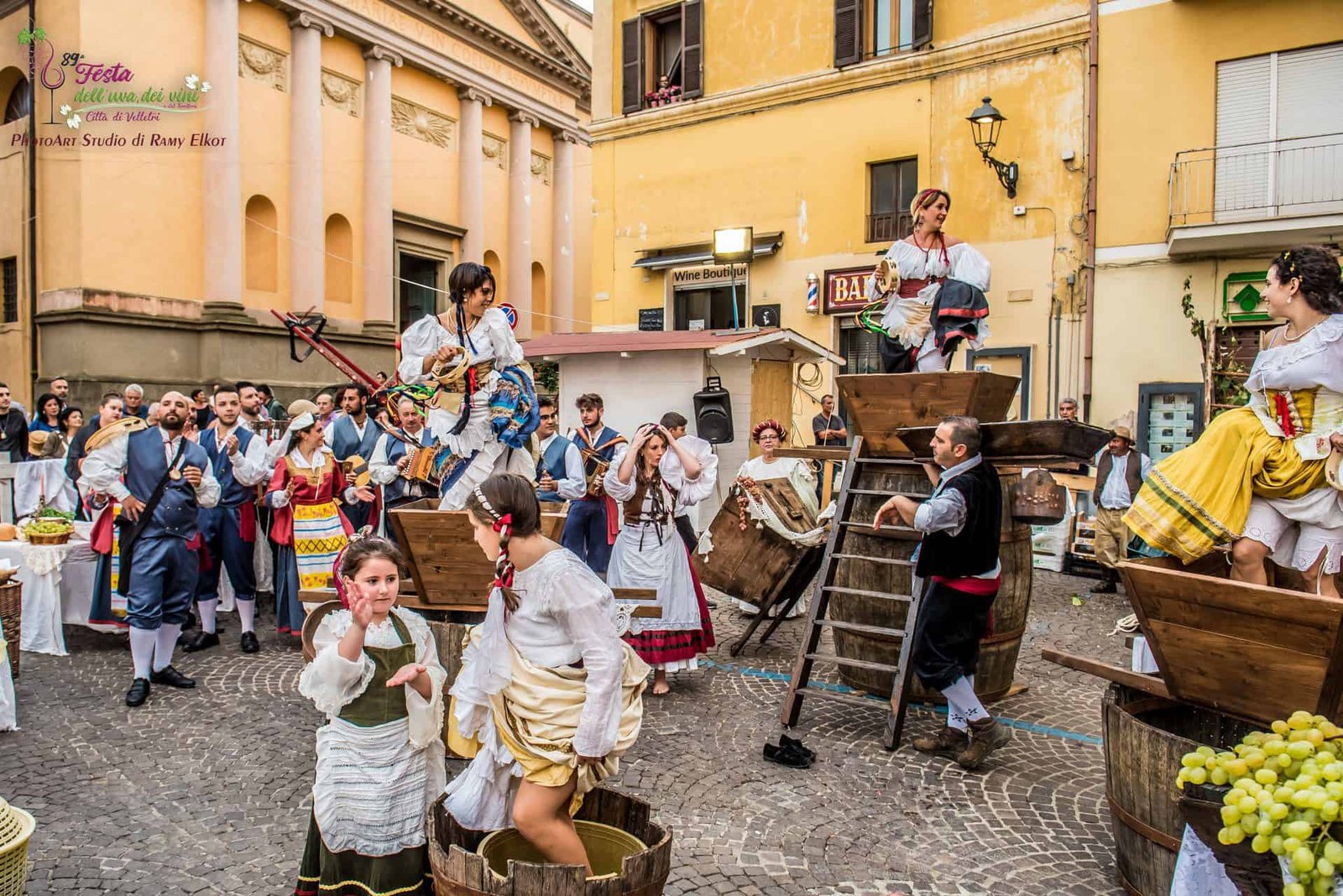
The modern calendar traces that of the Meditrinalia without knowing it. In Marino the Sagra dell’Uva has been held since 1925, an idea of the poet Leone Ciprelli, and has its central day on the first Sunday of October. The moment everyone waits for is the “miracle of the fountains”: wine flows from the Fontana dei Quattro Mori in place of water. In 2026 the 102nd edition runs from September 26 to October 5, with the historical parade and the miracle on Sunday, October 4 in the afternoon and a repeat on Monday the 5th, according to the official program of the Sagra.
In Frascati October is the month of the cellars and the full fraschette: it’s the season of the Ottobrate romane, the day trip out of town that Romans have been taking for centuries as soon as the heat is over. The special openings and tastings change every year and should be considered to be confirmed on the websites of the towns and of the individual wineries. The house wine is Frascati, a white based on Malvasia and Trebbiano, which in the Superiore and Cannellino versions has the highest designation, the DOCG.
If you’re looking for a red, look toward Ciociaria: the Cesanese of Piglio is the only DOCG red of the region and is found in almost all the wine shops of the Castelli. If instead you want to avoid the crowd of Marino, you find the same air, with fewer people, in Grottaferrata, in Ariccia, where the fraschette work all year round, and in Nemi, overlooking its lake.


For eating it’s best to choose before you leave. You book with TheFork where the place is listed. For addresses in Rome, on your way back, there’s the Estate Romana restaurant map.
Are the Meditrinalia and novello wine the same thing?
No, and the difference explains why the ancient festival fell so early. The wine of the Meditrinalia was fermenting must: cloudy, sweet, slightly fizzy. It’s what in the Castelli is still called “vino nuovo” and is drunk in the cellar between the harvest and All Saints, often with chestnuts. It doesn’t keep and doesn’t travel: it must be drunk where it’s made, in the weeks when it’s available.
Modern novello is something else. It’s a finished wine, made in part with carbonic maceration, a technique the Romans didn’t know. In Italy its sale is regulated by a ministerial decree of August 13, 2012: it can be put on the market from October 30 of the harvest year. On October 11, the day of the Meditrinalia, novello isn’t there yet. Anyone offering it to you on that date is selling you something else.
There is one detail of the Meditrinalia that no enologist would recommend today: mixing the new with the old. It had a precise meaning, the handover between two vintages. At the table you can cite it without imitating it. A bottle from the previous year next to the new one, two identical glasses, and the comparison tells the story on its own.
How do you plan a “Meditrinalia” day from Rome?
The easiest way is by train, because it solves the problem of who drives after drinking. From Roma Termini, the Castelli line gets you to Frascati in about half an hour. Another branch, the one to Albano, stops at Marino Laziale and Castel Gandolfo. Schedules and stops are on the Trenitalia page for the Castelli Romani line. To compare options and buy your ticket from your phone, there’s Trainline.
A typical day: morning in Frascati, with a walk below Villa Aldobrandini and lunch in a fraschetta. Afternoon in Marino, for the cellars dug into the peperino stone. If you have a second day, spend it on the two lakes, between Castel Gandolfo and Lake Nemi. On festival weekends the trains back fill up, so it’s best to head out before sunset or well after.
If you prefer the car, because you’re traveling with kids or want to load up a few cases, you can rent one for a day with Free2move. In that case you need someone who doesn’t drink, and a cooler bag in the trunk: new wine suffers from heat more than any other bottle.
If you don’t want to think about anything, there are tours leaving from Rome with a cellar tasting. Look among the experiences from Rome on GetYourGuide and the tickets for the Castelli Romani on Tiqets. If you’re staying overnight, so you can drink without watching the clock, compare places to stay in the area on Hotels.com.
If you’re a big group, a bunch of friends, an extended family, a company, things change. You need a vehicle, a cellar that accepts the headcount, a reserved table and someone to keep the schedule together. For custom tours, contact Tour Leader Pro, one of the best tour operators and boutique agencies in Rome, which builds the day with tour escorts for the logistics and, for the explanations in villas and museums, licensed tour guides.
What if it rains on Meditrinalia?
October in Lazio is generous but not guaranteed. In the rain the Castelli are still a good idea, because almost everything that matters is indoors: the cellars, the caves, the fraschette. In Marino, during the days of the Sagra, the Pro Loco schedules visits by reservation to the underground rooms of Palazzo Colonna. The rest of the year you have to ask for dates. In Castel Gandolfo there are the Pontifical Villas, and in Nemi the museum of the Roman ships. Read the visiting conditions on the operators’ websites before heading out.
If you stay in Rome, you can do Meditrinalia in the city. A tasting at a wine bar, or a visit to the places where ancient wine could be seen passing through. At Testaccio the hill made of amphora shards tells you how much was imported and consumed better than any book. More ideas for the day are among the destinations near Rome.
What to buy for Meditrinalia (even to have shipped)
New wine sold loose is bought at the cellar and drunk within a few days. Everything else can be ordered, even by people who aren’t in Rome in October. For each item there are several alternatives. If one is sold out, the others hold up.
Wine: bottles and cases delivered to your home
- Vino.com: to look for Frascati, Cesanese del Piglio and the other wines of Lazio with home delivery.
- Svinando: mixed cases from Italian wineries, good for anyone who wants to compare several vintages.
- Cantine Borga: Prosecco from the producer, for anyone who wants bubbles for the toast.
For tasting: glasses and decanters
- Tasting glass sets: old and new should be compared in the same glass.
- Wine glass sets: the table version, for six or more people.
- Wine decanters: they’re for last year’s red, not for the must.
- More decanters: different shapes and sizes, if the first one you picked isn’t available.
- Bottle aerator: the alternative that takes up less space in your suitcase.
For opening and storing
- Sommelier corkscrews: the two-step kind, which doesn’t break old corks.
- Electric corkscrews: for anyone who opens many bottles in one evening.
- Vacuum stoppers: so you don’t throw away the old bottle you opened halfway.
- Wine thermometer: a Castelli white that’s too cold tastes like nothing.
For carrying
- Insulated bottle bag: essential if you’re coming back by train with loose wine.
- Travel bottle carriers: padded, for the suitcase in the hold.
- Ice bucket: for the evening at home.
To read
- Books on wine in ancient Rome: why they cut it with water and honey, and what it tasted like.
- Books on the wines of Lazio: appellations, grape varieties, wineries.
- Varro, De lingua Latina: the source, for anyone who wants to read the sentence in its place.
- Guides to Rome and guides to the Castelli Romani: to stretch the trip.
How do you recreate Meditrinalia at home?
For Meditrinalia at home you need very little, and that’s the beauty of it. One bottle from last year’s vintage and one from the vintage just released, ideally the same wine or at least from the same area. Two identical glasses each. Varro’s sentence written on a card, in Latin and in Italian, for whoever opens the evening to read aloud.
Order matters. The old wine first, to have a point of comparison, then the new. You say the formula, drink a sip of each and comment. If you want to stay faithful to the rite, pour the first drops on the ground, in the garden or in a plant pot. That’s the libation, the offering. If you have kids at the table, do the same with grape juice, which is the closest relative of ancient must.
In the kitchen, everything that’s in season in the Castelli works: chestnuts, mushrooms, country bread, the porchetta from Ariccia. Don’t try to build an “ancient Roman dinner” with reconstructed recipes. That’s another project and needs other preparation. Meditrinalia was a brief gesture. It lasts 10 minutes and leaves the rest of the evening to conversation.
The most common mistakes about Meditrinalia
The first is expecting an event. There is no public celebration of Meditrinalia in Rome. If you look for a program with that name, you won’t find it. What exist are the sagre and the open cellars, which cover the same season under other names and other dates.
The second is arriving in Marino by car on the day of the miracle of the fountains. The center is closed to traffic and the parking fills up early. The third, when talking about Meditrinalia, is confusing must, new wine and novello, three different things that coexist in October for a few weeks. The fourth is buying loose wine and leaving it in the car in the sun while you have lunch. When you come back, it’s a different drink.
Frequently asked questions
When is Meditrinalia?
October 11, every year, in the ancient Roman calendar. In 2026 the day falls on a Sunday. It isn’t a recognized holiday of today’s civil or religious calendar, so you won’t find official events with this name. In those same weeks, though, Marino, Frascati and the other towns of the Castelli effectively celebrate the same thing: the end of the grape harvest and the first wine.
What does the word Meditrinalia mean?
According to Varro it comes from the Latin verb mederi, which means to heal, the same one that gives us “medico” and “medicina”. The name would therefore indicate the day on which you heal yourself with wine. The goddess Meditrina, mentioned in Festus’s lexicon, is in all likelihood a later invention, born to explain the name of a festival whose origin was no longer remembered.
What wine did the ancient Romans drink?
Wines very different from ours: often sweet and concentrated, stored in amphorae lined with pitch or resin and almost always cut with water when served. The most celebrated were Falernian, from Campania, and Caecuban, from the plain of Fondi in southern Lazio. There was also mulsum, wine with honey, served at the start of the meal.
Does the Sagra dell’Uva in Marino coincide with Meditrinalia?
No. The Sagra has its central day on the first Sunday of October and commemorates the victory at Lepanto in 1571, in which Marcantonio Colonna, lord of Marino, took part. In 2026 it ends on October 5, six days before the 11th. The season is the same and the wine is the same, but it’s a modern festival, born in 1925, with no direct ties to the ancient rite.
Can you get to the Castelli Romani without a car?
Yes. From Roma Termini, regional trains leave for Frascati, for Albano with stops at Marino Laziale and Castel Gandolfo, and for Velletri. For towns without a station, like Nemi or Grottaferrata, you continue by bus. On festival weekends the train is the most sensible choice, also because it removes the problem of who drives back.
Can you take new wine on a plane or have it shipped?
Fermenting must, no. It keeps producing gas and can’t handle the trip. Bottles of finished wine go in checked luggage, well protected, or you can have them shipped by the cellar or by an online wine shop. For flights the airline’s rules apply and, outside the European Union, the customs rules of the destination country. Read them before you buy.
Is Meditrinalia good for a trip with kids?
Yes, if you shift the focus from the glass to the grape harvest. In the Castelli towns, October means grapes, chestnuts, costume parades and fountains, all things kids like. Lake Nemi and Lake Albano offer an easy walk, and on the train the trip itself becomes part of the day. For them, at the toast, grape juice.
Who wrote this and from what sources
The text comes from the editorial team of Tour Leader Pro, the Rome-based organization that designs itineraries, visits and cultural events across Rome and Lazio. The ancient sources are Varro, De lingua Latina VI, 21, and Festus’s lexicon. The Sagra dell’Uva dates come from the official program, and the train information from the Trenitalia page, as of the date given at the top. Tell us what you find has changed.
Organizing a wine day in the Castelli for a group means choosing the right town for the date, booking the table and solving the trip back without a car. A useful resource for anyone organizing group travel is Tour Leader Pro. The Castelli are only one of Lazio’s wine territories, along with the Ciociaria of Cesanese and the Tuscia. A useful resource for putting together a multi-day itinerary is Italy Planner.