Tango. Historias de Astor at Auditorium Parco della Musica, November 14, 2026
In short. Historias de Astor: practical dossier. "Tango. Historias de Astor", a show of words, music and tango written, choreographed and directed by Miguel Ángel Zotto, is on stage on Saturday, November 14, 2026 at 20:00 in Sala Sinopoli at…
Historias de Astor: practical dossier. "Tango. Historias de Astor", a show of words, music and tango written, choreographed and directed by Miguel Ángel Zotto, is on stage on Saturday, November 14, 2026 at 20:00 in Sala Sinopoli at Auditorium Parco della Musica Ennio Morricone, Viale Pietro de Coubertin 30, 00196 Rome. On stage are Miguel Ángel Zotto and Daiana Guspero with three couples of dancers from the Compagnia TangoX2 and the Zotto Tango Academy, and the Tango Sonos orchestra live, with bandoneon, piano and violin. The event is organized by Opera Live Hub. The price given by the Auditorium starts from 36.80 euros. The running time isn't published. Tickets are sold at the Auditorium box office, open according to the official FAQ every day from 11:00 to 20:00 and on Sunday from 10:00 to 20:00, until 21:30 on show nights, or online from the channel indicated on the event page on auditorium.com. To get there, the Auditorium suggests tram 2 from Piazzale Flaminio, where you get off metro A, and buses 910, 53, 982 and 168. For the route it's best to use the ATAC planner.
Language: a performance based on dance, music or visual acts; no English version is announced, any spoken parts are in Italian.
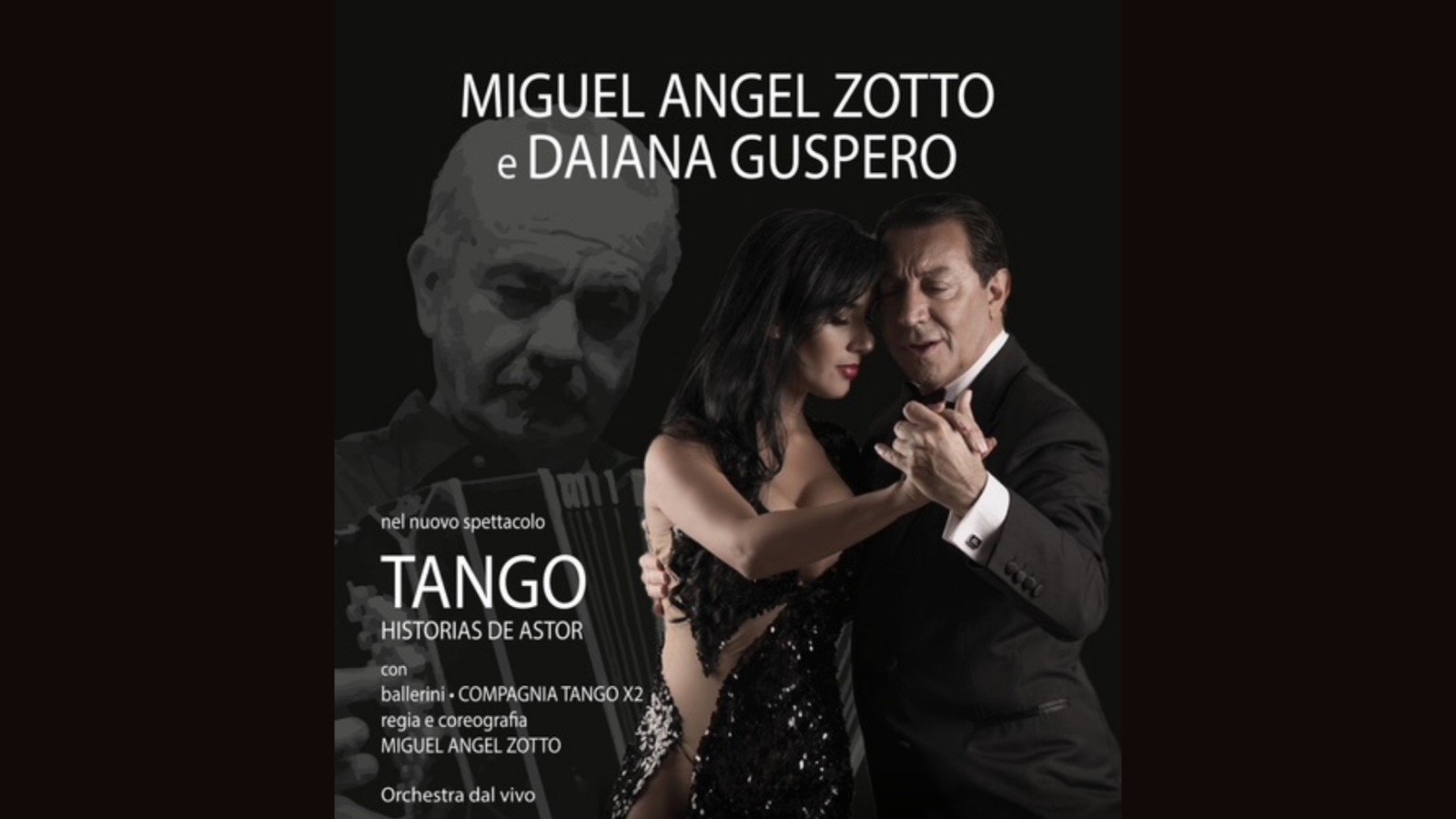
Historias de Astor: Piazzolla's life told in tango steps
"My family was from Trani": with these words, given to the recorded voice of Astor Piazzolla himself, begins the show with which Argentine dancer and choreographer Miguel Ángel Zotto pays tribute to the composer universally considered the father of modern tango. The Auditorium's page recalls that the work was first performed in Trani itself, in 2021, for the centenary of the musician's birth.
The show tells two stories together. There's the life of Piazzolla, born in Mar del Plata in 1921 to a family of Italian origin and who died in Buenos Aires in 1992, and there's the story of a musical genre and a dance that are the very essence of Argentina, born in the neighborhoods of Buenos Aires and transformed over the 20th century into a universal language.
The angel of tango
Leading the narration is an angel, the angel of tango, to whom Astor tells his life: his childhood, his encounter with tango, the orchestras he played in, his conducting of the Orchestra Fiorentina, the staging of "María de Buenos Aires". It's a theatrical device that recalls the poetic world of Piazzolla himself, author of a famous "Milonga del Ángel".
A bare-bones stage
The set is deliberately bare. In the background, a video wall runs period images of the musician's life. In front, four couples of dancers dance next to the orchestra, which is built into the stage and not hidden in the pit. The audience sees those who play and those who dance together.
The music: from Libertango to Adiós Nonino
All the pieces performed live are by Astor Piazzolla. The Auditorium's page mentions some of them: "Triunfal", "Libertango", "Milonga del Ángel", "Quejas de bandoneón" and "Adiós Nonino". It's a selection that crosses different phases of the composer's career, from the roots of traditional tango to the experiments of nuevo tango.
Adiós Nonino
"Adiós Nonino" is perhaps Piazzolla's most personal piece. He composed it in New York in 1959, after receiving the news of the sudden death of his father Vicente, on October 13 of that year. Nonino was the affectionate name Astor's children used for their grandfather: in Argentina, because of the influence of Italian immigration, the Spanish word abuelo is often replaced by nono, and nonino is its diminutive.
Libertango and Italy
"Libertango" is tied to Italy. The album of the same name was recorded in Milan in May 1974, on an intuition of manager and producer Aldo Pagani, with an orchestra of Italian musicians including Pino Presti on electric bass and Tullio De Piscopo on drums. In the same period Piazzolla recorded the album "Summit" with saxophonist Gerry Mulligan, again with a largely Italian lineup.
The Tango Sonos orchestra
For the show, the Tango Sonos orchestra brings together the bandoneon, the symbolic instrument of tango, with a piano and a violin. The Auditorium's page doesn't give the names of the individual musicians.
Who Astor Piazzolla was
Astor Pantaleón Piazzolla was born in Mar del Plata on March 11, 1921 and died in Buenos Aires on July 4, 1992. His paternal grandfather, Pantaleone, was a fisherman from Trani who emigrated to Argentina after his boat was wrecked. His mother, Asunta Manetti, came from Massa Sassorosso, in Garfagnana. Today in Trani, in the public gardens, there's a small square named after the musician, and in 2013 Massa Sassorosso also dedicated a square to him.
Childhood in New York
In 1925 the family moved to New York, where Astor lived until he was 16. At eight he received his first bandoneon from his father. His friendship with Carlos Gardel was crucial: Gardel encouraged him and invited him on a tour of the Caribbean. His father refused because of his son's young age, and so unknowingly saved his life, because Gardel died during that tour in a plane crash in Medellín, in 1935.
Paris and Nadia Boulanger
In the 1950s Piazzolla devoted himself mainly to art music. With the symphony "Buenos Aires" he won a scholarship in 1953 that allowed him to go to Paris, where he studied with Nadia Boulanger. It was she who brought him back toward tango, convincing him that his path ran through it. Back in Buenos Aires, in 1955 he founded the Octeto Buenos Aires and began building tango nuevo.
The murderer of tango
The fusion of tango, jazz and dissonance earned him fierce criticism from purists, who called him el asesino del tango. Time proved him right: biographers estimate that he wrote about 3,000 pieces and recorded about 500, and in 2008 Argentina named the Mar del Plata airport after him.
María de Buenos Aires and Horacio Ferrer
From 1967 Piazzolla worked with the poet Horacio Ferrer, with whom he wrote some of his most famous works: "María de Buenos Aires", "Balada para un loco", "Chiquilín de Bachín". "María de Buenos Aires" was recorded in 1968. In Italy it's also tied to the voice of Milva, one of the singers Piazzolla worked with.
The meeting with Zotto
The Auditorium's page reports a memory of Zotto himself: he met Piazzolla in Paris in 1989, and the composer later entrusted him with the choreography for the Broadway staging of "María de Buenos Aires". Horacio Ferrer, the opera's librettist, called him a great revolutionary in the history of tango. The Rome show therefore comes from a personal relationship, not just from admiration at a distance.
Piazzolla's ensembles: an evolution in seven stages
To understand the music you'll hear in the hall it helps to remember how Piazzolla changed his ensemble several times, always looking for a new sound. The sequence of his ensembles is this: in 1946 the Orquesta, in 1955 the Octeto Buenos Aires, in 1960 the first Quinteto, in 1971 the Noneto, in 1974 the Conjunto Electrónico, in 1978 the second Quinteto and in 1989 the Sexteto. Each step corresponds to a phase of his research.
Instruments never seen in tango
Nuevo tango differs from the traditional kind in its use of elements taken from jazz, in its dissonances and in the introduction of instruments foreign to the genre. With the Conjunto Electrónico Piazzolla brought the Hammond organ, flute, marimba, electric bass, drums, percussion and electric guitar into tango. The lineup chosen for "Historias de Astor", with bandoneon, piano and violin, is instead more intimate and recalls chamber ensembles.
The bandoneon
The bandoneon, the instrument Astor received as a gift from his father at eight in New York, remains the heart of the tango sound. For much of his career Piazzolla played it himself, alternating work as an instrumentalist with that of composer and arranger.
Piazzolla and Italy
Piazzolla's relationship with Italy isn't limited to his family origins. After a heart attack in 1973 the composer moved to Rome for a while, a city where he had had contacts with many artists in the past. In those years he met Gerry Mulligan and became interested in electronic music, also working with his son Daniel.
The Italian voices
Many of his pieces were translated into Italian by Angela Denia Tarenzi and performed by singers such as Edmonda Aldini, who in 1973 dedicated an entire album to him, "Rabbia e tango", Mina, Milva and Iva Zanicchi. Among his Italian collaborations there are also those with Tullio De Piscopo and Pino Presti.
A center in Pesaro
In 1993, the year after the composer's death, maestro Hugo Aisemberg and the Associazione Musicale di Pesaro founded the Centro Astor Piazzolla, with the goal of spreading tango and Río de la Plata culture through an archive, concerts, seminars and courses.
The name Astor and a bad leg
The musician's name came from a friend and client of his father, Astor Bolognini, a successful violinist in North America. Astor was born with a serious defect in his right leg, a clubfoot, and underwent many operations. His father pushed him to practice many disciplines to compensate for the physical problem. Biographies describe him as a hot-tempered boy, who probably had difficulty relating to children his age.
The last years
In the 1980s his health worsened: in 1988 he had bypass surgery, then went back to work with a sextet. In 1990 he had to interrupt his tour, and a few months later he suffered a stroke. Following his wish to die in his own country, his partner had him moved to Argentina, where he died on July 4, 1992. At home they called him El Gran Astor, or El Gato, the cat, for his skill and wit.
Miguel Ángel Zotto, the tanguero
Miguel Ángel Zotto was born in Villa Ballester, Argentina, on August 7, 1958. His family also comes from Italy, from the Basilicata village of Campomaggiore, and the original surname was Zotta, changed to Zotto by a transcription error in the Argentine register of immigrants. He started dancing tango with his paternal grandfather, Michele Arcangelo Zotta, born in Campomaggiore in 1884, and then with his father, an actor.
From Buenos Aires to Broadway
At 17 he began professional study with maestro Rodolfo Dinzel. In 1984 he was teaching tango at the University of Belgrano in Buenos Aires. The following year he turned professional by taking part on Broadway in Segovia and Orezzoli's "Tango Argentino", the show with which he toured the world.
Tango x 2
In 1988 Zotto founded the company Tango x 2, which the Auditorium's page describes as having more than 30 years of international activity. In April 2000 Tango X2 was named in Argentina among the three best tango companies of the century, and in 2002 Zotto was named an academician by the National Tango Academy of Buenos Aires.
Daiana Guspero and the Zotto Tango Academy
Daiana Guspero is Zotto's partner in tango and in life, as the show's presentation recalls. Her name has appeared next to Zotto's at least since January 2007, when the company presented the show "Miguel Angel Zotto's Buenos Aires Tango" at New York City Center. For "Historias de Astor" she also designs the costumes with him.
A school in Milan
The three couples who complete the dance company come from the Compagnia TangoX2 and the Zotto Tango Academy, the Milan school where the tanguero passes on his art. Their names aren't given on the event page.
Zotto and Italy
The dancer's link with Italy also runs through television: in 2011 he was a guest at the Sanremo Festival, where he performed a dance number with host Belén Rodríguez. His awards include the 1999 Positano prize and the Gino Tani prize.
How to watch Historias de Astor
The show brings together three languages that usually meet separately: biographical storytelling, concert and ballet. Those who know Piazzolla mainly through the concert versions of his pieces will discover how much that music was born, first of all, to be danced. Those who go to milongas will instead find the most famous pieces placed within a story that explains their origin.
The chronological thread
The narration follows a chronological order, from childhood to the years of maturity, and the alternation between Piazzolla's recorded voice, period images and danced scenes marks the passage from one phase of his life to the next. It's useful, before going in, to review the main stages: New York, Buenos Aires, Paris and the return to Argentina.
A couple at the center
The choreographic heart is the couple formed by Zotto and Guspero, around whom the other three move. Tango is a couple dance founded on guided improvisation and mutual listening: seeing two dancers who also share their private lives adds an element of understanding that's hard to build on paper.
Practical information
The Auditorium box office is at Viale Pietro de Coubertin 30. The official FAQ specify that the audience can generally enter the hall from 30 minutes before the start until five minutes before, and that entry isn't allowed once the show has begun. When the organizer allows it, latecomers are seated by the staff in different seats, including in other sections.
Discounts and accessibility
According to the FAQ, subject to availability there's a 20 percent reduced ticket for people with disabilities and free entry for a companion when needed. Blind people get a 50 percent discount. Bookings for wheelchair users are made at 06 8024 1281, every day from 11:00 to 18:00. Discounts are available only at the central box office.
Box office hours
The website's pages don't fully agree on the box office hours: the FAQ give every day from 11:00 to 20:00, Sunday from 10:00 to 20:00 and until 21:30 on show nights, while the contacts section gives, for the October to March period, hours from 11:00 to 18:00, and from 10:00 to 18:00 on Sundays and holidays. For the tango Saturday, those who want to buy in person would do well to show up in the early afternoon.
Cancellations and refunds
If the event is canceled, the FAQ explain that the refund method is announced together with the cancellation, through the same channels. Tickets bought in person are refunded at the point of sale, those bought online through the service provider. Paper tickets must be returned intact.
How to get there
From the Flaminio station on metro A take tram 2 to Piazza Mancini terminus, or the Roma-Nord train to Piazza Euclide stop. Buses 910, 53, 982 and 168 stop in front of the entrance. For those arriving by car there are two paid parking lots, one at ground level and one covered multistory, with spaces reserved for people with disabilities.
Around the Auditorium
The Auditorium stands between the 1960 Villaggio Olimpico, Pier Luigi Nervi's Palazzetto dello Sport and Stadio Flaminio, with green space reaching it from the park of Villa Glori. It's a neighborhood worth a visit: our page on Flaminio gathers the main places, from MAXXI to Milvian Bridge.
A Saturday night in Flaminio
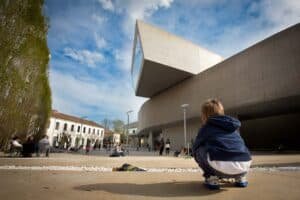
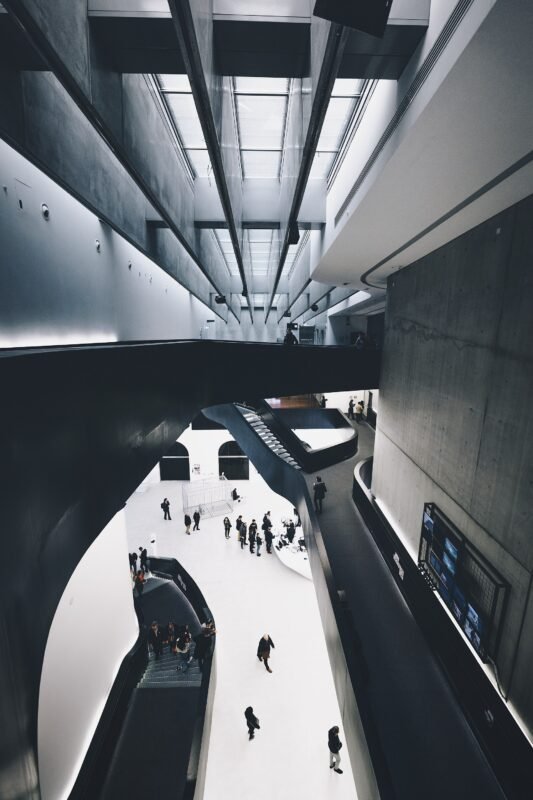
Those arriving in the afternoon can spend a few hours at MAXXI, the national museum of 21st-century arts, in the same part of the city, and then reach the Auditorium for the 20:00 show. After the evening, Ponte Milvio offers bars and restaurants a short distance away.
A curious fact about Sala Sinopoli
Sala Sinopoli was the first hall of the Auditorium to open to the public. The opening took place on April 21, 2002, the day Rome traditionally celebrates its birthday. The rest of the complex, with the large Sala Santa Cecilia, only opened on December 21 of the same year. On that first night Goffredo Petrassi, nearly 100, wanted to be there, and had the honor of the world premiere of the Concert Overture for orchestra he had composed in 1931. More than 70 years separated the writing of that piece from its debut.
A hall that changes shape
According to the Renzo Piano Building Workshop, Sala Sinopoli has about 1,200 seats, a movable stage and an adjustable ceiling, and is particularly suited to chamber music and dance, while other sources give 1,133 seats. The sources don't agree on the exact number, but all stress how the interior space adapts to the number of performers and the acoustics required.
Something nobody tells you about Sala Sinopoli
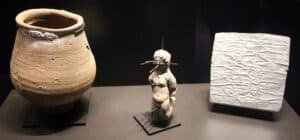
Giuseppe Sinopoli, to whom the hall is dedicated, wasn't only a great conductor. A graduate in medicine and surgery from Padua in 1972, he was passionate about archaeology and at the time of his death was about to defend a thesis in archaeology at the University of Rome: the degree was awarded to him posthumously. His collection of Minoan, archaic and classical Greek and southern Italian vases and ceramics, acquired by the Ministry of Culture, is on permanent display right at the Auditorium, in the Museo Aristaios. Whoever enters the hall bearing his name can see, a few meters away, the maestro's least known passion.
A death on the podium
Sinopoli died in Berlin on April 20, 2001, at 54, struck by a heart attack while conducting Verdi's "Aida" at the Deutsche Oper. His body lay in state on the Capitoline, in the Sala della Protomoteca, and the funeral was held in the basilica of Santa Maria degli Angeli e dei Martiri. The hall was inaugurated a year and a day after his death.
My advice for visiting Sala Sinopoli
My advice is to arrive at least 40 minutes before 20:00 and go up to the large terrace that runs around the buildings. From there, between Sala Santa Cecilia and Sala Sinopoli, you can see the remains of the Roman villa that came to light during the construction of the Auditorium. In mid-November it's already dark at that hour, but the view of the three large lead-clad volumes is always remarkable. Then you go into the hall calmly, keeping in mind that entry closes five minutes before the start.
Where to sit for dance
For a dance show it's best to choose seats not too close to the stage, from which you take in all the couples together and the design of the choreography. The gallery, which runs along three of the hall's four sides, offers a view from above that helps follow the steps.
Another well-known fact, yet not often mentioned
Everyone knows the Auditorium is the work of Renzo Piano. Less well known is that the project won an invited international competition with nine participants, and that the brief called for a single building containing all the halls. Piano instead proposed three independent buildings, structurally separated to improve sound insulation and arranged symmetrically around an empty space, which became the open-air theater of the cavea. The architect's studio describes the halls as large soundboards, true musical instruments.
The partnership with the acousticians
For the acoustics Piano worked with the Müller-BBM firm in Munich, involved in every phase of the project, from the competition to the construction site.
The right photo to take at Sala Sinopoli
The best shot is from the terrace, with the hall's roof in the foreground and the curve of the other two behind it. The lead sheets cladding the roofs give the volumes a metallic look that you can appreciate both in daylight and in the early evening. A wide-angle lens also lets you include the ancient wall in opus reticulatum that bounded the Roman villa, visible from the terrace of the archaeological museum.
Inside
Inside the hall, before the start, you can photograph the stage with the orchestra's instruments already set up. During the show filming isn't allowed.
Some important events that happened here in history
The history of Sala Sinopoli largely coincides with that of the Auditorium, of which it was the first space to open.
1992-1994: the choice of the area and the competition
The area between the Villaggio Olimpico and Villa Glori was chosen by the city council in 1992, after a long debate. The competition was launched in 1993, and Piano's studio dates the competition design to 1994.
April 21, 2002: the opening
With Sala Sinopoli the Auditorium welcomed its first audience. Eight months later, on December 21, the rest of the complex opened.
2020: the naming after Morricone
In 2020, by decision of Rome's city council, the Auditorium was named after Ennio Morricone, who had been a student of Petrassi.
Who has passed through Sala Sinopoli
The first name in the hall's history is Goffredo Petrassi, present at the opening with his 1931 Overture. Since then the hall has hosted a very wide-ranging program, consistent with its flexible nature: chamber music, jazz, singer-songwriter pop, dance. In the current season, among others, concerts by Nomadi and Neri per Caso are announced in the same hall.
Sinopoli and Rome
Giuseppe Sinopoli had also worked with the Accademia di Santa Cecilia, which since 2003 has had the permanent home of its concert season at the Auditorium. Naming the medium-size hall after him was a way to tie his name to a space open to all musical languages, like his career as composer and conductor.
Frequently asked questions about Tango. Historias de Astor
When is Tango. Historias de Astor on in Rome?
Saturday, November 14, 2026 at 20:00, in Sala Sinopoli at Auditorium Parco della Musica Ennio Morricone, Viale Pietro de Coubertin 30. It's a single date. Entry to the hall is generally allowed from 30 minutes before until five minutes before the start, and you can't get in once the show has begun, so it's best to arrive with a good margin.
How much is a ticket?
The Auditorium's official page gives prices starting from 36.80 euros. Tickets are sold at the Auditorium box office or online through the channel indicated on the event page. Discounts for people with disabilities, when available, are given only at the central box office, on presentation of the required documents.
Who dances in the show?
Miguel Ángel Zotto and Daiana Guspero, partners in tango and in life, dance together with three other couples of dancers from the Compagnia TangoX2 and the Zotto Tango Academy in Milan. Zotto also handles direction, choreography, artistic direction and lighting. The costumes are by Zotto and Guspero. The names of the other couples aren't published by the Auditorium, which only says they come from Zotto's company and school.
Is the music live?
Yes. The Tango Sonos orchestra, with bandoneon, piano and violin, is part of the set and performs pieces by Astor Piazzolla live, including Triunfal, Libertango, Milonga del Ángel, Quejas de bandoneón and Adiós Nonino. The show opens with the recorded voice of Piazzolla himself recalling his family's origins.
How long is it?
The running time isn't given on the Auditorium's page, which doesn't say either if there's an intermission. For information you can contact the Auditorium through the contacts published on its website, or ask directly at the box office on Viale Pietro de Coubertin in the days before the show.
What's the link between Piazzolla and Italy?
Very strong. His paternal grandfather was a fisherman from Trani and his mother came from Garfagnana. Piazzolla recorded the album Libertango in Milan in 1974 with Italian musicians such as Pino Presti and Tullio De Piscopo, and worked with singers such as Milva and Mina. The show itself premiered in Trani in 2021, for the centenary of his birth.
Do you need to know how to dance tango to enjoy it?
No. It's a theater show that combines storytelling, period images, live music and dance, designed for a general audience. Those who know tango will appreciate the quality of the couples and the choreography. Those who don't will get an introduction to the history of the genre through the life of its most famous innovator.
How do you get to the Auditorium?
By metro A to Flaminio and then tram 2 toward Piazza Mancini, or the Roma-Nord train to Piazza Euclide. Buses 910, 53, 982 and 168 stop in front of the entrance. Those arriving by car can use the two paid parking lots accessible from Viale Pietro de Coubertin and Viale Maresciallo Pilsudski.
My final advice on Tango. Historias de Astor
"Historias de Astor" is a chance to see up close one of the most famous tangueros of his generation in a show born from a personal relationship with Piazzolla, begun in Paris in 1989. The format, with the orchestra on stage and period images in the background, makes the night suitable even for those who know only the most famous tango titles. It's best to buy in good time, since it's a single date, and to arrive early for a walk on the Auditorium terrace. Those with time can also spend a few minutes at the Museo Aristaios and the remains of the Roman villa, turning the evening into a small journey between ancient Rome, 20th-century Buenos Aires and today's dance. For the rest of the program there's our page on Auditorium Parco della Musica, and for dance lovers, on October 26 the night Icone della danza was also staged in Rome at Teatro dell'Opera. For those who want to prepare, listening to Adiós Nonino and Libertango in Piazzolla's own recordings is the best way to arrive in the hall with ears already trained to the sound of the bandoneon.
Article written by the editorial team of Tour Leader Pro, contact them for Private/Corporate/V.I.P. Tours and Experiences.
Planning a trip to Rome? English guides for visiting the city are on ItalyPlanner.com.
Contact Information
Nearby
 Museum of Musical Instruments (MUSA)100 m
- Auditorium Parco della Musica100 m
- Villa Glori500 m
- Fountain of Anna Perenna500 m
- MAXXI – National Museum of 21st Century Arts700 m
- Flaminio700 m
Upcoming events nearby
- Roma Jazz Festival 2026, November 1 to 24 at the Auditorium and Casa del Jazz100 m
- Evgeny Kissin and András Schiff at Santa Cecilia, November 9, 2026100 m
- Roma Gospel Festival 2026 at Auditorium Parco della Musica, December 13, 2026 to January 1, 2027100 m
- Santa Cecilia 2026/2027 Concert Season at Auditorium Parco della Musica, October 21, 2026 to June 5, 2027100 m



You might also like
- Giorgia Fumo, Out Of Office at Teatro Olimpico, November 16 and 17, 2026
- Igor Sibaldi at Teatro Olimpico with Vuoi?, November 10, 2026
- Ghemon in La prima volta, l’ultima volta, l’unica volta at Auditorium Parco della Musica, April 19, 2027
- La Vie en Rose and Bolero by Balletto di Milano at Teatro Olimpico, April 2 to 4, 2027
- Le Coliche in 10 anni di Coliche e siamo ancora vivi at Teatro Olimpico, March 25 and 31, 2027
- Marta e Gianluca in Io e Gianlu at Teatro Olimpico, March 23 and 24, 2027