Laika, The Collapse of Democracy at the Rosso20sette gallery, from October 10 to November 14, 2026
In short. The Collapse of Democracy, the new solo show by street artist Laika, opens Saturday, October 10, 2026 at 18:00 at the gallery Rosso20sette arte contemporanea, at Via del Sudario 39 (00186 Rome), a few steps from Largo di Torre…
The Collapse of Democracy, the new solo show by street artist Laika, opens Saturday, October 10, 2026 at 18:00 at the gallery Rosso20sette arte contemporanea, at Via del Sudario 39 (00186 Rome), a few steps from Largo di Torre Argentina, and stays open until November 14, 2026. At the opening, according to the press release, the artist is present. The show is curated by Team Laika and brings together about 20 works among canvases, drawings on paper and installations born from a new trip to the United States. The hours are Tuesday to Saturday, from 11:00 to 13:00 and from 14:00 to 19:00. The press release does not give an admission ticket. For confirmations and information the gallery answers at info@rosso27.com and at the number published on the official website, rosso27.com. You get there by tram 8, Torre Argentina stop, or on foot from the Pantheon, Piazza Navona or Campo de' Fiori in a few minutes.
Laika at Rosso20sette: dates, hours and information
The Collapse of Democracy by Laika can be visited at Rosso20sette from October 10 to November 14, 2026, Tuesday to Saturday, with the opening on Saturday, October 10 at 18:00 in the presence of the artist.
When
The opening is Saturday, October 10, 2026 at 18:00. The exhibition closes on November 14, 2026, a Saturday. The hours given by the press release are Tuesday to Saturday, with a midday break: 11:00-13:00 and 14:00-19:00. On Sunday and Monday the gallery is closed.
Where
Rosso20sette arte contemporanea, Via del Sudario 39, 00186 Rome. The gallery's website gives Largo di Torre Argentina as a reference point: the street branches off the largo, in the rione Sant'Eustachio.
Who curates it
The exhibition is curated by Team Laika. The press release thanks The Winch, GPL Production and Tiburtini Carattere Tipografico, and carries a dedication: to Clara.
Admission
The press release does not give a ticket. To find out if a reservation is needed for the opening or for visits, the point of contact is the gallery, at the contacts published on the official website.
The Collapse of Democracy: what you see in the exhibition
The Collapse of Democracy is a new cycle of about 20 works, among canvases, drawings on paper and installations, with which Laika tells the contradictions of the United States, the country that, the press release recalls, proclaims itself the first democracy in the world.
The return to the United States
Almost three years after the trip from which States of Injustice was born, Laika has returned to the United States for a new chapter of the project, described by the press release as more political and urgent. The artist works through the paradox of a nation that made its values of freedom and justice a product exportable all over the world and that now, according to the exhibition's reading, collapses under the weight of betrayed values.
The question of the exhibition
The route, the press release writes, aims to confront the viewer with a question: are these really the Western values to defend, or is a radical revolution needed toward a future that is more sustainable and more faithful to democracy and human rights?
California as the frame
For the second time Laika has chosen California as the frame for the works. For the artist it is one of the states where the structural and cultural contradictions of the US system emerge in their sharpest and most visible form.
Denunciation and hope
The stated aim is denunciation and harsh criticism, but the press release also speaks of a glimmer of hope, entrusted to the tribute to the movements and faces of American society that have fought for change.
The three themes of The Collapse of Democracy
The works of The Collapse of Democracy are divided into three groups: wars and profit, the paradox of the fight against the foreigner, the tribute to the figures of American history who pointed the way to change.
Wars and profit
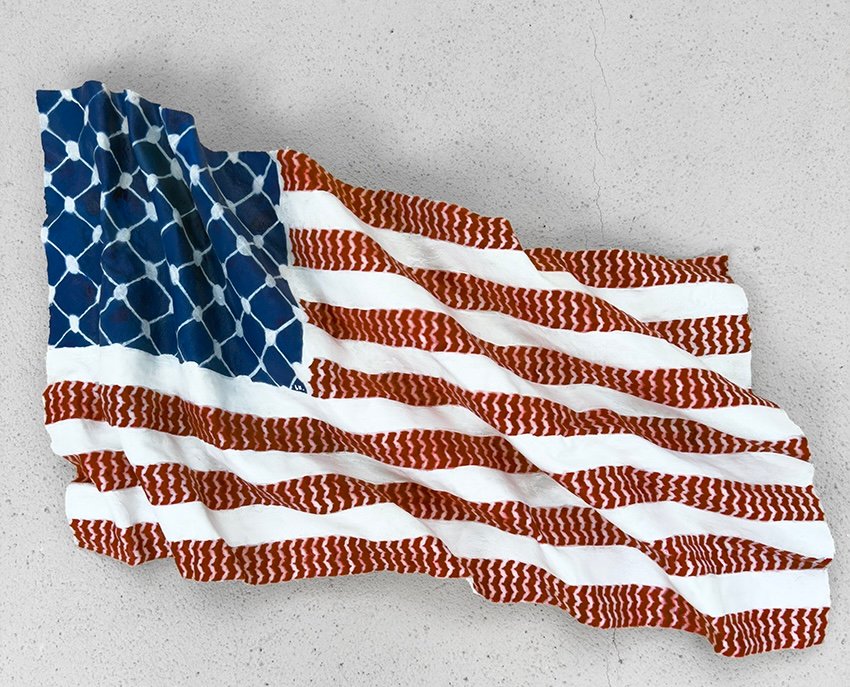
The first group opens with There is no peace without human rights, the introductory work, devoted to the triumph of wars fought to accumulate profit at the expense of life and human rights. In the same vein the press release places The flag for the oppressed, a reworking of the American flag with codes and symbols tied to Palestine, and the installation Blood for oil, in which barrels of crude become the canvas for portraits of boys and girls who are victims of conflicts fought for oil.
The paradox of the foreigner
The second theme is the all-American paradox of the fight against the foreigner: the creation of ICE, the rise of white supremacy, the debasement of the values of freedom and equality. Part of it are We the People, which quotes the first words of the American Constitution, and No one is illegal on stolen land, which portrays a Native American standing against an ICE agent.
The tribute
The third group is devoted to the personalities of American history and culture who for the artist point the way forward. Among them the press release cites Rosa Parks and Martin Luther King.
The work that gives the title
The three cycles come together in the work The Collapse of Democracy: a Statue of Liberty close to collapse, an image of the vulnerability of democratic values and of rights that rest on a fragile structure, one that can be demolished.
The works to look at closely
Among the images released with the press release are The flag for the oppressed and There is no peace without human rights, the latter made with spray and acrylic on canvas, in the 50 by 70 centimeter format.
There is no peace without human rights
The introductory work has a story: while making the mural it comes from, the press release tells, Laika met Shepard Fairey, known as OBEY, who was working on a piece right next to hers, and received his compliments. A meeting between two generations of political street art.
The flag for the oppressed
The stars and stripes flag is one of the most reproduced symbols in the world. Rewriting it with codes and symbols tied to Palestine, as Laika does, means using the visual language of power to overturn its message: it's the method of street art, brought into the gallery.
Blood for oil
The installation with the barrels of crude is the most physical work in the exhibition. The contrast between the industrial object and the faces of the children painted on it is the heart of the first thematic group.
Morir y vivir en Los Angeles
Among the press materials there is also a work titled Morir y vivir en Los Angeles, made with acrylic, marker and spray on canvas: another stage of the California journey.
Who is Laika: Rome's anonymous street artist
Laika is an Italian street artist and human rights activist, honored by Amnesty International in 2023, who has chosen not to reveal their identity or gender and appears in public wearing a mask.
The name
The stage name comes from the little dog Laika, born in 1954, the first living being to have reached space. The choice, the official biography explains, is tied to the idea of aiming for space, of never setting limits.
Anonymity
Anonymity gives the artist greater freedom of expression and shifts attention from private life to the messages, which speak of human, social and civil rights. The official biography uses a neutral, genderless linguistic form for the artist.
The beginnings in Rome
Laika began in the spring of 2019 by putting up stickers on the streets of Rome. International fame came in early 2020 with two works that went viral: Jenesuispasunvirus, among the first in the world devoted to Covid-19, and L'Abbraccio, the poster devoted to Patrick Zaki and Giulio Regeni.
Artivist
The biography defines Laika as an artivist, artist and activist at once. The work moves between night-time poster pasting, performance and the gallery, with a constant thread: human rights.
Laika's exhibitions, awards and actions
Laika has exhibited at Palazzo Albergati in Bologna, at Palazzo Gromo Losa and Palazzo Ferrero in Biella, at the J Museum in Jesolo, at the WopArt Fair in Lugano and at the Museo Regional Valle de Juárez in Mexico.
The exhibitions
At the J Museum in Jesolo Laika's works were shown in the group show Jago, Banksy, TV Boy e altre storie controcorrente. The first solo show, Art Is (Not) A Game, was held right at Rosso20sette in Rome and sold out, according to the official biography.
The documentary
Laika's work is at the center of the documentary Life Is (Not) A Game, directed by Antonio Valerio Spera and premiered at the 17th edition of the Festa del Cinema di Roma.
The 2023 awards
In 2023 Laika was honored as Person of the Year at the Nastri d'Argento in the documentary category and received the Art and Human Rights Award from Amnesty International.
Recent actions
In February 2026 Laika covered 400 nautical miles from Barcelona to Sanremo for the performance AGAIN, painted on a sail, to call attention to Gaza. Laika supports the Global Sumud Flotilla, whose boats were painted in August 2025 and April 2026. In June 2026, on the occasion of the opening of the soccer World Cup, Laika put up in front of the FIFA headquarters in Zurich a protest poster against Donald Trump and FIFA president Gianni Infantino.
The Rosso20sette gallery, the exhibition venue
Rosso20sette arte contemporanea is a Roman gallery at Via del Sudario 39, in the historic center, which gives Largo di Torre Argentina as a reference point and which hosted Laika's first solo show.
A link with the artist
The gallery and Laika share a history: Art Is (Not) A Game, the artist's first solo show, which sold out, was held here. The Collapse of Democracy is the return to the same space, with a broader and more political project.
A gallery in the center
Being on Via del Sudario means being between Largo Argentina and Corso Vittorio Emanuele II, in one of the most traveled areas of the historic center. The exhibition is easy to visit during a walk between the Pantheon and Campo de' Fiori.
Contacts
The gallery's official website, rosso27.com, publishes the address, phone and email, info@rosso27.com.
Largo di Torre Argentina, the exhibition's neighborhood
Largo di Torre Argentina is a square in the historic center that keeps at its center the sacred area with the remains of ancient temples and of the structures tied to the great complex of the Theater of Pompey. The entry Largo Argentina and Campo Marzio tells its story.
The sacred area
Among the ruins of the largo you can recognize the temples and structures of the Pompey complex, which included the Curia where Julius Caesar was killed. Among the stones lives a cat colony looked after by volunteers, told in the entry on the cat sanctuary of Largo Argentina.
The Teatro Argentina
The Teatro Argentina, inaugurated in 1732, home of the city's public drama theater, faces the largo. In the same weeks as the exhibition, Otello is staged there, from November 4 to 29, 2026.
Via del Sudario
The gallery's street branches off Largo di Torre Argentina, in the rione Sant'Eustachio, with the traffic of Corso Vittorio Emanuele II a few meters away: a convenient position for fitting the exhibition into any walk in the center.
How to get to Rosso20sette for the Laika exhibition
Rosso20sette is easily reached by tram 8, which stops at Torre Argentina, a few steps from Via del Sudario, or on foot from the main squares of the historic center.
By tram
Tram 8 has a stop at Torre Argentina. For those coming from Trastevere, on the other bank of the Tiber, it's the most convenient option.
By metro
No metro station is right next to the largo. The most convenient are Colosseo and Circo Massimo on Line B, from where you continue on foot or by surface transport. From Piazza Venezia to Largo Argentina the walk along Via delle Botteghe Oscure takes a few minutes.
By bus
Largo di Torre Argentina and Corso Vittorio Emanuele II are crossed by many surface lines connecting Termini, Piazza Venezia, the Vatican and Trastevere. Lines and times can be checked on the ATAC route planner before leaving.
By car
The area is inside the ZTL of the historic center. Anyone arriving by car has to park outside the limited traffic zone and complete the trip by public transport or on foot.
On foot
From the Pantheon, Piazza Navona, Campo de' Fiori and the Ghetto the gallery can be reached in a few minutes. Arriving on foot is the best choice.
How to plan the visit to the Laika exhibition
Visiting The Collapse of Democracy generally takes less than an hour and pairs easily with a walk in the historic center, keeping in mind the gallery's break between 13:00 and 14:00.
The opening
On Saturday, October 10 at 18:00 the artist is present. For those who want to see Laika, always wearing the mask, it's the chance. For those who want to look at the works calmly, a weekday is better.
The best time
Mornings between Tuesday and Friday are the quietest. Anyone stopping by in the early afternoon should remember the break: the gallery reopens at 14:00.
With kids
The exhibition is about wars, racism and rights, with strong images like the portraits of children on the barrels of Blood for oil. For a teenager it's an occasion for serious discussion. For younger ones it's best to prepare the visit.
Accessibility
The press release gives no information on the accessibility of the spaces. Anyone with mobility difficulties can ask the gallery, before the visit, what the entrance is like.
What to see around Rosso20sette
The gallery is a few minutes' walk from the best-known places of the historic center. A visit to the Laika exhibition pairs easily with a walk among the Pantheon, Piazza Navona and the Ghetto.
Pantheon and Minerva
Toward the north you reach the Pantheon and, right behind it, the basilica of Santa Maria sopra Minerva, with the Minerva obelisk in front of the façade.
Navona and Campo de' Fiori
Toward the west, beyond Corso Vittorio Emanuele II, you reach Piazza Navona and Campo de' Fiori. On the way is the basilica of Sant'Andrea della Valle.
The Gesù and the Ghetto
Toward the east, a few steps away, is the church of the Gesù. Going down toward the Tiber you enter the Jewish Ghetto and reach the Theater of Marcellus.
More street art in Rome
Anyone leaving the exhibition wanting to see works on the street will find a map in the entry on street art in Rome and, for the big murals, in the entry on Ostiense street art.
Where to eat near the gallery
The historic center around Largo Argentina offers every type of cuisine: Roman trattorias toward Campo de' Fiori, Roman Jewish cooking in the Ghetto, bakeries and pizza-by-the-slice places along Corso Vittorio Emanuele II.
For the opening
The 18:00 opening lends itself to an aperitivo in the streets around the Pantheon and a dinner in the Ghetto or at Campo de' Fiori. On a Saturday night it's best to book.
For a quick break
Anyone visiting the exhibition during the day will find bakeries and pizza-by-the-slice places along Corso Vittorio Emanuele II for a quick lunch, to fit into the gallery's break between 13:00 and 14:00.
A curiosity about Laika, The Collapse of Democracy at the Rosso20sette gallery, from October 10 to November 14, 2026
The nicest curiosity is in the name. Laika, the official biography recalls, was the little dog born in 1954 who was the first living being to reach space. The artist chose that name for the idea of aiming for space, of setting no limits. There is also a second level of reading: a name tied to a record in space, chosen by someone who in this exhibition questions the records a great power credits itself with, starting with that of first democracy in the world.
The second curiosity concerns the work that opens the exhibition. While painting the mural of There is no peace without human rights, the press release tells, Laika met Shepard Fairey, the famous OBEY, who was working on a piece right next to the artist's, and received his compliments. Two artists of different generations, both known for political posters, a few meters apart: a handing over of the baton that the exhibition carries all the way to Via del Sudario.
The third is Roman. Laika's first solo show, Art Is (Not) A Game, was held in this very gallery and sold out. The return to Rosso20sette closes a circle: the artist who began with stickers on the streets of Rome exhibits again a few steps from the sacred area of Largo Argentina.
One thing nobody tells you about Laika, The Collapse of Democracy at the Rosso20sette gallery, from October 10 to November 14, 2026
The thing almost nobody says is the hours. Rosso20sette is open Tuesday to Saturday with a midday break: from 11:00 to 13:00 and from 14:00 to 19:00. On Sunday and Monday it is closed. Anyone planning a weekend visit has only Saturday available, and anyone who comes at lunchtime finds the door closed.
The second concerns the artist. At the October 10 opening Laika is present, but always with the mask. Anonymity is a basic choice, which the official biography explains with freedom of expression and with the wish to shift attention from the person to the messages. Anyone hoping to discover the artist's face will be disappointed. Anyone who wants to hear the reasons has a rare opportunity.
The third is about the tone of the exhibition. The press release is explicit: the aim is denunciation and harsh criticism. Wars, ICE, white supremacy, Palestine, children who are victims of conflicts over oil. It is not a neutral exhibition and does not want to be. In our view it should be seen even by those who don't share all the artist's theses: it is a document of how Italian street art looks at the United States today.
The advice I give you for visiting Laika, The Collapse of Democracy at the Rosso20sette gallery, from October 10 to November 14, 2026
My advice is to choose between two different visits. The first is the opening on Saturday, October 10 at 18:00, with the artist present: a chance to see Laika and the public who follow the artist, but with the gallery crowded and the works less visible. The second is a weekday morning, between Tuesday and Friday, when the room is quiet and you can read the works one by one.
Anyone with time can do both. Otherwise, a weekday is best: the exhibition is built on three thematic groups and on works that ask to be looked at up close, like the rewritten flags or the painted barrels. Following the route in the order given by the press release, from the wars to the foreigner to the tribute, down to the Statue of Liberty that collapses, helps you grasp its logic.
One last tip: pair the visit with a walk. From the gallery to the Pantheon is a few minutes, and Largo Argentina, with its sacred area, offers a powerful counterpoint: the Curia where Caesar was killed, a few steps from an exhibition on the collapse of a democracy.
Another well-known fact, yet one rarely mentioned
It's well known that Laika is a Roman artist, but it is rarely remembered that the fame comes from two works put up in the city in early 2020. Jenesuispasunvirus, among the first works in the world devoted to Covid-19, and L'Abbraccio, the poster for Patrick Zaki and Giulio Regeni, went around the world starting from the walls of Rome. Before that, in the spring of 2019, there were only stickers.
Another well-known and rarely mentioned fact is the institutional recognition. In 2023 Laika received both the Art and Human Rights Award from Amnesty International and the Person of the Year prize at the Nastri d'Argento for documentaries, thanks to the film Life Is (Not) A Game by Antonio Valerio Spera, presented at the Festa del Cinema di Roma. For an artist who works at night, on the street and without a face, these are significant recognitions.
Finally, the exhibition has a direct precedent. Almost three years earlier Laika had made the project States of Injustice in the United States. The Collapse of Democracy is its continuation, born from a new trip and, as the press release stresses, more political and urgent.
The right photo to take at Laika, The Collapse of Democracy at the Rosso20sette gallery, from October 10 to November 14, 2026
Inside the gallery, the right photo is of the work that gives the exhibition its title: the Statue of Liberty close to collapse. It's the image that sums up the project, and photographing it whole, without cropping, conveys the sense of a structure about to give way. Before shooting it's best to ask the gallery if photographs are allowed.
The second photo is of the barrels of Blood for oil: framing a barrel with a painted portrait, at close range, brings out the contrast between the industrial surface and the face. It's a strong image, to be used with respect.
Outside, the photo to take is at Largo di Torre Argentina, a few steps away: the sacred area with the ancient temples, perhaps with one of the colony's cats among the stones. In the late October afternoon the raking light warms the ancient stones. Pairing this image with that of the collapsing Statue of Liberty tells the exhibition well: two ways of thinking about the fragility of institutions, 2,000 years apart.
Some important events that happened here in history
The area of the gallery is loaded with history. In the area of Largo di Torre Argentina stood the great complex of the Theater of Pompey, which included the Curia where Julius Caesar was killed. The sacred area at the center of the largo keeps the remains of the temples and structures of that complex: it is the Roman place where, more than any other, the end of a republic is remembered.
The Teatro Argentina, inaugurated in January 1732, faces the largo. On February 20, 1816 the premiere of Rossini's The Barber of Seville was staged there, met with a resounding fiasco and then a triumph. Giuseppe Verdi brought The Two Foscari there in 1844 and The Battle of Legnano in 1849. According to the Teatro di Roma's account, it was on the occasion of that performance that the Romans started the demonstrations that led to the Roman Republic.
More recently, the gallery's history intertwines with Laika's: Art Is (Not) A Game, the artist's first solo show, which sold out, was held at Rosso20sette. With The Collapse of Democracy the theme of the fragility of democracies returns to a place that, between Caesar and the Roman Republic of 1849, has seen more than one crisis of this kind.
Who has passed through Laika, The Collapse of Democracy at the Rosso20sette gallery, from October 10 to November 14, 2026
Through Rosso20sette has passed, first of all, Laika: the gallery hosted the first solo show, Art Is (Not) A Game, and hosts the artist again with The Collapse of Democracy. At the October 10 opening the artist is present, wearing the mask worn at every public appearance.
Around the gallery, Largo Argentina has seen decisive figures of Roman history pass. Julius Caesar, killed in Pompey's Curia. Gioachino Rossini, who presented The Barber of Seville at the Teatro Argentina in 1816. Gaetano Donizetti, with the premiere of Zoraida di Granata in 1822. Niccolò Paganini, in concert in 1827. Giuseppe Verdi, with two premieres in 1844 and 1849.
In the works of the exhibition, instead, pass the faces of Rosa Parks and Martin Luther King, chosen by the artist as models of change, and in the press release's account appears Shepard Fairey, met in California while making There is no peace without human rights. A gallery in the historic center that for five weeks gathers stories very far from one another.
October and November in Rome: the period of the exhibition
The Collapse of Democracy occupies the five weeks between October 10 and November 14, 2026, the period in which Rome returns to its rhythms after the summer and before Christmas.
The weather
October still has mild, bright days, ideal for pairing the exhibition with a walk. In November the days get shorter and rain is more frequent, and the gallery becomes a good indoor stop.
In the city in the same period
In the same weeks Rome hosts the Festa del Cinema, where the documentary about Laika was presented, and at the nearby Teatro Argentina Otello is staged. The historic center, outside high season, is more livable.
Frequently asked questions about Laika at Rosso20sette
When can you see the Laika exhibition in Rome?
Laika's exhibition The Collapse of Democracy is open at Rosso20sette from October 10 to November 14, 2026, Tuesday to Saturday, from 11:00 to 13:00 and from 14:00 to 19:00. The opening is Saturday, October 10 at 18:00, with the artist present.
Where is the Rosso20sette gallery?
The Rosso20sette arte contemporanea gallery is at Via del Sudario 39, 00186 Rome, a few steps from Largo di Torre Argentina. Tram 8 stops at Torre Argentina. From the Pantheon and Campo de' Fiori you get there on foot in a few minutes.
How much does it cost to see the Laika exhibition?
The press release for Laika's exhibition at Rosso20sette does not give an admission ticket. To confirm the visiting conditions and find out if the opening requires a reservation, it's best to contact the gallery at info@rosso27.com.
Will Laika be present at the opening?
Laika is present at the opening of The Collapse of Democracy, Saturday, October 10, 2026 at 18:00, according to the press release. The artist has never revealed their identity and always appears in public wearing a mask.
What works are in the Laika exhibition?
Laika's exhibition brings together about 20 works among canvases, drawings on paper and installations, divided into three themes: wars and profit, the fight against the foreigner, tribute to figures like Rosa Parks and Martin Luther King. Among the works are There is no peace without human rights, The flag for the oppressed and Blood for oil.
Who is Laika?
Laika is an anonymous Italian street artist and human rights activist, active in Rome since 2019. Laika is known for L'Abbraccio, devoted to Patrick Zaki and Giulio Regeni, and in 2023 received the Art and Human Rights Award from Amnesty International.
Is the Laika exhibition suitable for teenagers?
Laika's exhibition tackles wars, racism and human rights with strong images, like the portraits of children on the barrels of Blood for oil. For teenagers it's an occasion for reflection. For younger ones it's best to prepare the visit.
The final advice on Laika at Rosso20sette
The Collapse of Democracy brings to the center of Rome Laika's most political work: about 20 works that read the United States through wars, borders and rights, with a final tribute to those who have fought to change them. In our view the exhibition is worth the visit for the coherence of the project and for the dialogue with the place, a few steps from the sacred area where Caesar's republic ended. The advice is to choose a weekday morning to see the works calmly, remembering the 13:00 break, or the October 10 opening to meet the artist. In both cases, the walk between Largo Argentina and the Pantheon completes the visit.
Article written by the editorial team of Tour Leader Pro, contact them for Private/Corporate/V.I.P. Tours and Experiences.
Planning a trip to Rome? The English-language guides for visiting the city are on ItalyPlanner.com.