Hans Zimmer by Ensemble Symphony Orchestra in Rome, Teatro Brancaccio, November 16, 2026
In short. Hans Zimmer's film scores, from Gladiator to Interstellar, from Inception to The Lion King, played live by the Ensemble Symphony Orchestra conducted by Giacomo Loprieno.
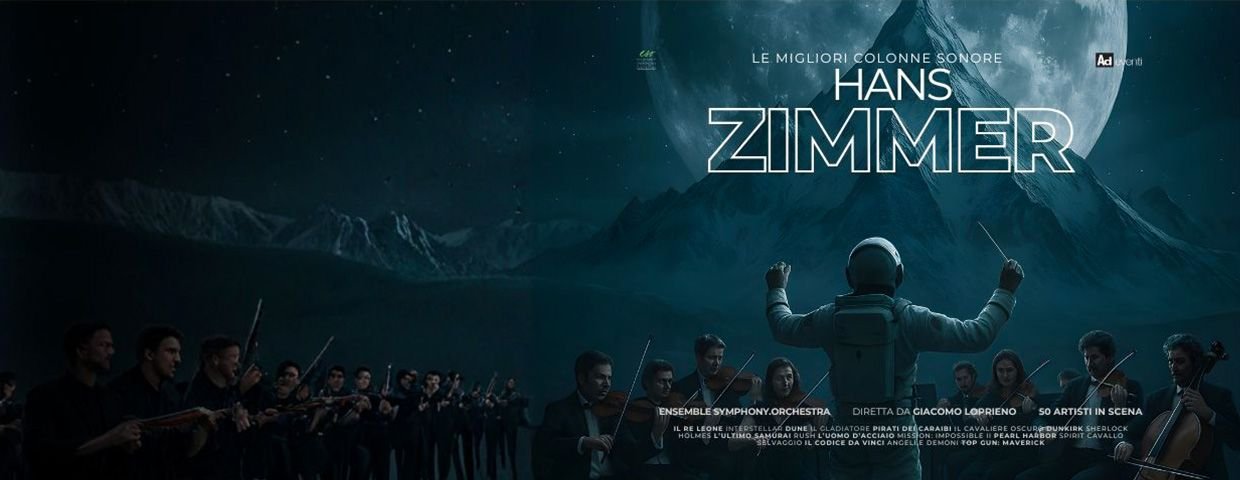
Hans Zimmer's film scores, from Gladiator to Interstellar, from Inception to The Lion King, played live by the Ensemble Symphony Orchestra conducted by Giacomo Loprieno. In Rome on Monday, November 16, 2026, at Teatro Brancaccio on Via Merulana, starting at 21:00.

I'll start with the most important thing, the one the evening's title risks getting misunderstood: Hans Zimmer doesn't take that stage. He isn't announced, he isn't expected, he doesn't show up as a surprise at the end. The November 16 concert is a tribute concert, that is, an Italian orchestra playing the music he wrote, with its own conductor and its own arrangement. It needs saying right away and clearly, because the formula "Hans Zimmer by Ensemble Symphony Orchestra" lends itself to confusion, and it's not rare for someone to walk in convinced they'll see the composer at the piano and leave disappointed not by the concert, but by the wrong expectation they walked in with. With that cleared up, the evening has a strong meaning of its own, and now I'll try to explain what it is.
The tour producer is Ad Eventi, which takes the project around Italy, and the Rome date is organized by Vincenzo Berti and Gianluca Bonanno for Ventidieci. On the stage of Teatro Brancaccio there are 50 musicians, not a reduced ensemble with keyboards pretending to be strings: 50, with soloists from the most solid Italian orchestras. In a hall with just over 1,600 seats, 50 instruments are a lot. If you're used to symphonic concerts in arenas, where the sound comes out of a tower of speakers and arrives already packaged, in a hall like this you discover something else: you hear the wood, you hear the breath, you hear the moment the bow bites the string. It's not a detail for enthusiasts, it's the reason an evening like this is held in a theater and not in an exhibition hall.
The setting is the Brancaccio season, which packs a remarkable amount of music into a few weeks: on November 20 Michele Bravi arrives, on December 14 Mario Biondi, on December 7 Arisa, and the day right after the Zimmer concert the hall hosts Steve Hackett with his Genesis repertoire. November 16 falls on a Monday, which for a Roman theater is the most unusual night of the week: I'll come back to this later, because it has practical consequences for the box office and for dinner before the show.
What exactly a live film score evening is
The difference between film in concert and tribute concert
It's worth distinguishing three formats the public tends to confuse. The first is film in concert: the whole film is screened and the orchestra plays the score in sync, headphones and click track for the conductor, no room to breathe. The second is the composer's concert: the composer in person, usually with his expanded band, rewriting his own themes for the stage. The third, the November 16 one, is the tribute concert: an orchestra that chooses the themes, arranges them in a sequence that works as a story and plays them without the film on top. The third format is the freest of the three and also the riskiest, because it takes away the crutch of the images. If the arrangement holds up, the music walks on its own, and if it doesn't, you realize that some themes on their own are shorter than memory suggests.
Why Zimmer's music survives the move to the concert hall
Zimmer's music, in this sense, is lucky. It's built on long blocks, on ostinatos that repeat and grow, on simple and recognizable harmonic progressions: material designed to carry 20 minutes of film and stay in your head afterward. Moving it into a concert hall works precisely because it needs no captions. When the Interstellar ostinato starts, or when the brass sets up the Pirates of the Caribbean march, the audience already knows where it is, and this lets the orchestra take its time, stretch a dynamic, let a pianissimo breathe that works in a hall and would be lost in an arena.
What to expect in length and pacing
A concert of this kind, in the usual practice of Italian symphonic film music productions, lasts about two hours, with an intermission halfway. The usual structure has a more narrative first half and a more muscular second half, with the big themes toward the end and at least one encore built on a piece everyone is waiting for. An official running time for the Rome date doesn't appear to have been published, so what follows is an order of magnitude and not a promise: if you're planning your trip home, count on an ending around 23:00, with an extra 20 minutes if the audience calls the orchestra back.
The Ensemble Symphony Orchestra and Giacomo Loprieno
Who they are and how much they tour
The Ensemble Symphony Orchestra is not a group formed for this tour. It's a concert machine that over the years has put together hundreds of dates across Italy and Europe, with numbers that last season topped 40,000 spectators and a long line of sold-out evenings. The list of collaborations says a lot about the ground they move on: Andrea Bocelli, Mario Biondi, Nile Rodgers, Kylie Minogue, Giovanni Allevi, Riccardo Cocciante, Umberto Tozzi, Samuele Bersani, Brunori Sas. It's a hybrid profile, halfway between a concert orchestra and a backing orchestra for high-end pop, and you can hear it in the result: clean attacks, a strong rhythm section, no fear of the microphone.
The conductor and his idea of the program
Giacomo Loprieno conducts the group and is also its public face. On the Zimmer project he has described a precise genealogy: after a 2025 season built on two strands, on one side productions devoted to Ennio Morricone, on the other those devoted to video game music, the choice was to combine the two languages. Film music on one side, and on the other the epic, spacey sounds that the world of games has made familiar to a young audience. Zimmer, in his account, is the point where the two roads meet, because he's the composer who more than anyone else brought electronics into the orchestra and the orchestra into mass culture. Loprieno speaks of a set list of iconic pieces designed as a journey: it's promoter language, of course, but that's the logic of the program and you can already see it in the announced titles.
50 musicians: what it means in practice
50 musicians on a drama theater stage means a compact layout, with the strings in front, the woodwinds in the middle, brass and percussion at the back, usually on risers. It also means that some parts written for huge ensembles get redistributed: where the record has 80 overdubbed strings, in the hall there will be 20 real ones, and the difference is made up with the arrangement and the volume. If you're looking for an exact copy of the record you'll be caught off guard, and if you're looking for what happens to that music when real people play it 10 meters away, in our view you'll leave happy.
The announced repertoire, without making up the set list
The titles in black and white
The theater announces a range of titles that gives an idea of the direction: The Lion King, Interstellar, Inception, Pirates of the Caribbean, Batman, Spirit, Superman, The Da Vinci Code, Pearl Harbor. The presentation of the evening also brings in Gladiator, which in the repertoire of these productions is an almost mandatory presence. None of these lists is a signed set list, and I'm not saying this out of formal caution: on tour the order changes from city to city, and a title announced in August can become a two-minute suite in November. Take it as the map of the territory, not as the hour-by-hour itinerary.
Gladiator, or the watershed
If I had to point to the moment when contemporary film music changed shape, I'd point to Gladiator in 2000. From then on the Zimmer model becomes dominant: few thematic elements, repeated and layered, ostinato percussion, an electronic bed under the orchestra, and melodies often given to a wordless female voice. In a concert hall that material works well because it's made of long crescendos, the thing a live orchestra does better than any sound system. The risk, if anything, is the opposite: that the crescendo becomes the only gesture available. A good program alternates those blocks with something more intimate, and that's why titles like The Da Vinci Code or Spirit, in the announced list, matter more than they seem to.
Interstellar and the organ
Interstellar, from 2014, is the title that in a theater can give the greatest satisfaction and at the same time the greatest frustration. The score is built around an organ sound that in the film has an enormous physical, almost architectural, presence, and that in a hall without an organ has to be redistributed among keyboards and brass. It's not a limit of this production, it's a limit of the format: no tour carries a pipe organ around. That said, the Interstellar ostinato live has an effect on the audience that alone is worth the price of the ticket, because the build is gradual and the moment the whole orchestra comes in together is one of the few cases in which a modern hall reacts the way a 19th-century theater reacted to an opera finale.
Inception, Batman, Superman: the question of titles
On three entries of the list it's worth being precise, because the promotional material cites them in generic terms. "Batman" in practice means the trilogy directed by Christopher Nolan, whose music Zimmer wrote together with James Newton Howard between 2005 and 2012. "Superman" in Zimmer's filmography corresponds to Man of Steel from 2013, not to the 1970s films with John Williams's fanfare: if you go in expecting that fanfare you have the wrong film and the wrong composer. "Pirates of the Caribbean" is the most curious case: the first score in the series is credited to Klaus Badelt, with Zimmer supervising and writing the main theme, and only from the later installments does the composer take over the whole score. These are footnote nuances, but they explain why in an evening like this some pieces sound more like the style of a workshop than the signature of a single author.
The Lion King, the title that divides generations
The Lion King from 1994 is the score that earned Zimmer his first Oscar and remains, for a huge share of the audience, their first contact with his music. In a tribute concert it's the piece that changes the temperature of the hall: the perceived average age drops, you hear voices singing along, and those who came for the space epic discover they know this one by heart too. In 2019 the composer returned to the same material for the photorealistic remake of the film, and the two versions offer the arranger different material to draw from.
Who Hans Zimmer is, briefly and without hagiography
From Frankfurt to London
Hans Florian Zimmer was born in Frankfurt am Main on September 12, 1957, so he has just turned 69. He grew up in Königstein, started playing the family piano and, by his own admission, couldn't stand lessons: the discipline and formality of classical study put him off, and his training remained largely self-taught. As a teenager he moved to London, and there he joined the circle of session musicians. It's a detail that explains a lot about the way he composes: he doesn't come from the conservatory, he comes from the rehearsal room and the recording studio, and the keyboard he uses is not a solo instrument but a control center.
The keyboard years
In the 1970s and 1980s he played with Ultravox and with the Buggles, and his name remains tied to one of the most quoted songs of the century: Video Killed the Radio Star. In 1980 he became a full member of Krisma, an Italian duo that for the occasion became a trio, and took part in the album Cathode Mamma as keyboardist and programmer, and the single Many Kisses sold more than a million copies in Europe. In 1985 he worked with Claudio Baglioni on the album La vita è adesso, which remains the best-selling record in Italian recording history. It's the moment when Stanley Myers, his mentor, pushed him toward film, and together they worked on exactly the fusion of traditional orchestral sounds and electronic instruments that would become Zimmer's trademark.
The American breakthrough
The breakthrough came in 1988 with Rain Man. Barry Levinson was looking for a musician, the director's wife heard a score Zimmer had written for a film about apartheid and pointed him out: the score, built on synthesizers mixed with steel drum sounds, earned him his first Oscar nomination. From then on his career sped up: Driving Miss Daisy, Thelma & Louise, The Power of One (for which he went to Africa to record choirs and drums), The Lion King, The Thin Red Line (six and a half hours of music recorded before Terrence Malick even started shooting), The Prince of Egypt. Then the 2000s: Gladiator, Black Hawk Down, Hannibal, The Last Samurai, The Da Vinci Code, Sherlock Holmes. And finally the long collaboration with Christopher Nolan and the Dune chapter, which in 2022 brought him his second Oscar after the one in 1995.
The numbers and the labels
Five Grammys, two Oscars from 12 nominations, three Golden Globes from nine, an Emmy for the miniseries The Pacific, a star on the Hollywood Walk of Fame in 2010 and, in 2007, 72nd place in the ranking of the 100 greatest living geniuses compiled by the Daily Telegraph. He led the music department of DreamWorks and founded Remote Control Productions, the company that produced composers such as Klaus Badelt, Lorne Balfe, Harry Gregson-Williams and John Powell. This last point is the one his critics use against him and his admirers claim for him: Zimmer is not just a composer, he's a school, with a recognizable style that hundreds of films have adopted. In a tribute concert this ambiguity becomes an advantage, because the audience recognizes even what it has never heard.
Where Teatro Brancaccio is and how to get there on the night of the concert
The address and how to recognize the right door
Via Merulana 244, postal code 00185. Via Merulana is just over a kilometer long and connects two papal basilicas, Santa Maria Maggiore at the top and St. John Lateran at the bottom. Number 244 is on the lower stretch, toward the Lateran, at the point where the street widens and the side of the palazzo turns toward the Colle Oppio. The theater occupies the lower corner of the Palazzo Brancaccio block and its facade does nothing to get noticed: a row of doors, a sign, and that's it. If you're coming for the first time, look for the big palazzo and then lower your eyes, or head for the bus stop named Merulana/Brancaccio.
By metro
There are two useful stops: Vittorio Emanuele on line A and Cavour on line B, with Termini as the interchange. From Vittorio Emanuele you come out on the square, skirt the garden or cut through Via Carlo Alberto, arrive below Santa Maria Maggiore and take Via Merulana downhill: just under 10 minutes, all on sidewalks, with the slope in your favor. From Cavour the route is a bit longer but nicer, because you walk up Via Cavour and pass under the apse of the basilica. Watch out on the way back: the Rome metro closes early and on weekdays the last train runs around 23:30, so if the concert ends at 23:00 and you stop to discuss the encore on the sidewalk, the margin shrinks fast.
By bus and tram
At the Merulana/Brancaccio stop the 16, 75, 714 and 717 pass, with the C3 on temporary routes. One stop further, at Merulana/Mecenate, the service is the same. If instead you get off at the intersection with Via Labicana, at the Labicana/Merulana stop, the choice widens a lot: 3, 53, 75, 85, 87, 186, 571, 810, plus the night bus N10, which is the really useful information in this paragraph, because at night the N10 is one of the few lines that keeps this area connected to the rest of the city when the metro has already closed. Practical tip: take a photo of the stop sign when you arrive, with the lines and times, so at half past 11 at night you don't have to look for it in the dark with a dead phone.
On foot from Termini
From Termini station to the Brancaccio it's just under 20 minutes on foot, and it's still the best way to get there. You leave from Piazza dei Cinquecento, take Via Cavour or Via Giolitti, turn under the apse of Santa Maria Maggiore and from there Via Merulana runs straight down to the theater. In mid-November, at half past six in the evening, the basilica is lit, the shops on the street are still open and the neighborhood has that cold light that suits it: it's a walk that prepares you for the concert better than any taxi stuck in the traffic of Via Merulana.
By car, the worst option
The theater falls within the limited traffic zone of the historic center and in one of the areas with the least street parking in the city. If you're coming from outside Rome it's faster to leave the car in a park-and-ride lot along line A or line B and do the last stretch underground. Times and permits for the limited traffic zones change over time and should be checked on the City's website before you leave, but the general rule still holds: on a show night, around here, a car is a problem and not a convenience.
The hall, the sections and where it's best to sit
Orchestra seats and two balconies
The Brancaccio is a rectangular hall with a capacity of around 1,600 seats, an orchestra pit under the stage and a structure with balconies instead of boxes. It's not an Italian-style theater with stacked tiers and a horseshoe plan: it's an early 20th-century hall, born when the politeama and the great period cinema were redesigning the way people sat in front of a stage. For a symphonic concert this shape is a blessing, because the sound arrives compact even at the sides and no one watches the stage from behind a column.
The published sections and prices
The theater's box office for this date divides the hall into eight sections with a published full price: Poltronissima A at 58 euros, Poltronissima B at 48, Poltrona A at 43, Poltrona B at 40, Prima Balconata A and B at 36, Seconda Balconata A and B at 30. The selection menu also shows options such as Poltronissima Gold and Poltronissima Gold Vip, which in setups of this kind correspond to the front center rows and packages with extra services. Prices may change and any booking fees are added, so consider this an order of magnitude and not a price list set in stone.
Where it's worth spending your money
For a 50-piece orchestra the best seat is not the front row. The very first rows put you below stage level, force you to look up for two hours and, more importantly, place you in the near field of the strings: you hear the first violin very well and the ensemble very little. It's best to aim for the central orchestra rows from the sixth to the 15th, where the balance of strings, woodwinds and percussion arrives already blended. If you want to save money, do something counterintuitive: take the front row of the Prima Balconata instead of a low side seat. From up there you see the full layout of the orchestra from above, which for a film score program is half the show, and the sound arrives after crossing the whole hall, so it's rounder. The only section I'd be careful about is the strip of orchestra seats that ends up under the overhang of the balcony, where the low ceiling dulls the highs and the percussion loses air.
Times, doors, cloakroom
The published start time is 21:00 on Monday, November 16. In the Brancaccio's usual practice the doors open around 20:15 and the audience goes in calmly: arriving half an hour early lets you find your seat without climbing over 12 people with the lights already down. In November the cloakroom is a real issue, because a coat on your seat becomes bulky after 10 minutes: if the service is running it's worth using, and if it isn't it's best to dress in layers.
A curious fact about Hans Zimmer by Ensemble Symphony Orchestra in Rome, Teatro Brancaccio, November 16, 2026
Eight days earlier, on the same stage, a film that bears his name
Almost nobody notices the nicest coincidence of this Brancaccio season, because to spot it you have to look at the program and the filmography together. From October 29 to November 8, 2026 the hall hosts The Prince of Egypt, the musical based on the 1998 DreamWorks animated film. The musical's songs are by Stephen Schwartz, and so far nothing strange. The point is that the orchestral score of that animated film, the one that accompanies the crossing of the Red Sea and the exodus, was written by Hans Zimmer, at the time head of the music department of DreamWorks itself. This means that between November 8 and 16 the same stage hosts, eight days apart, first the stage adaptation of a film Zimmer scored and then a concert entirely devoted to his music. Neither program says so, and it isn't a secret: it's simply the kind of connection a theater has no interest in making and that instead makes the evening more interesting.
And then there's the date of birth
A second, lighter curious fact. Zimmer was born on September 12, so if you come to the November concert you'll find him just entered into the 70th year of his life. The figure gives a sense of scale: when Rain Man came out, in 1988, he was 31, and when Gladiator came out, which changed the sound of action cinema for the next two decades, he was 42. The career the concert tells in two hours fits into just over 35 years, and it's a career in which the composer changed his mind about sound at least three times.
Something nobody tells you about Hans Zimmer by Ensemble Symphony Orchestra in Rome, Teatro Brancaccio, November 16, 2026
The composer of spaceships has an Italian past
If there's one thing that never appears in the presentations of these evenings, it's that Hans Zimmer worked on Italian pop music, on two far from marginal occasions. In 1980 he joined Krisma, the electronic duo formed by Maurizio Arcieri and Christina Moser, which for the occasion became a trio: Zimmer took part in the album Cathode Mamma as keyboardist and programmer, and the single Many Kisses passed a million copies sold in Europe. Five years later, in 1985, his name appears in the credits of Claudio Baglioni's La vita è adesso, the best-selling record in the history of Italian recording. The German kid who programmed synthesizers for Milan's new wave and for Roman pop is the same one who 15 years later would write Gladiator. When the keyboards come in under the strings in the hall, that's his mother tongue, not a modern graft onto a classical ensemble.
The practical consequence for listening
This past explains a feature of his writing that becomes obvious in concert: Zimmer doesn't think in singable melodies, he thinks in timbres and layers. Many of his themes, if you reduce them to a vocal line, are four or five notes. The richness comes from the layering, from the way a bass pedal widens, at the point where the percussion comes in. An orchestra tackling this repertoire therefore has to work more on dynamics than on virtuosity, and the audience listening has to do the same: the satisfaction doesn't come from the soloist's high note, it comes from the instant when 50 people change volume together.
And a point worth repeating
I'll go back to the starting point for a moment, because it always happens in the hall. The poster says "Hans Zimmer by Ensemble Symphony Orchestra": the English preposition indicates the performer, not the guest. It's a concert by the Ensemble Symphony Orchestra devoted to Zimmer. If someone in your group is nurturing the idea of a surprise appearance, better to dismantle it before leaving home than after the first encore.
My tip for visiting Hans Zimmer by Ensemble Symphony Orchestra in Rome, Teatro Brancaccio, November 16, 2026
Watch out for Monday: it's the day the box office is closed
This is the most concrete tip I can give you and it comes from a line hidden in the theater's information. The box office on Via Merulana is open to the public from Tuesday to Saturday, in the afternoon, and is closed on Monday, and on Sunday it opens only at show time, when there's a show. The concert falls on a Monday. Put simply: if you plan to stop by the box office on the afternoon of the 16th to buy or pick up your ticket, you risk finding the shutter down until the evening opening. Buy your ticket in advance through the official sales channels indicated by the theater, or stop by the box office on one of the preceding weekdays. If you're coming from outside Rome that same evening, take this detail into account before booking your train.
Having dinner before, and where
With a 21:00 start, dinner before the show is inconvenient but not impossible, as long as you choose the right approach. The trattorias of the Esquilino around Piazza Vittorio serve early and quickly, and the area behind Santa Maria Maggiore has enough places that you won't go hungry even on a Monday, which in Roman dining is the most common closing day. The best solution for evenings at the Brancaccio is another one: eat something light around 19:00 in the area of the Nuovo Mercato Esquilino or along Via dello Statuto, and save the real dinner for after, when the hall empties and the places in Monti 10 minutes' walk away are still open. A two-hour concert with an intermission goes down better on a light stomach.
How to prepare for listening
The least obvious tip is about the days before, not the evening. Listen again to two or three of the announced titles, but in the original film version and not in symphonic compilations. It does two things: you recognize the themes when they arrive, and above all you notice how much the live arrangement has changed them. The pleasure of a tribute concert is almost all there, in the gap between the version you have in your head and the one that reaches you from the stage. If you go without any reference you'll still have fun, but you'll miss half the game.
The right seat if you come with kids
It's an evening suited to a young audience too, and the repertoire says so clearly. With children under 12 I'd recommend the central orchestra seats, because a direct view of the orchestra keeps their attention alive much more than the sound does. With teenagers used to video game soundtracks, on the other hand, the balcony works very well and costs half as much. In both cases the intermission rule applies: two hours in a seat is long, and the moment you go out to stretch your legs is part of the show.
Another well-known fact, yet rarely mentioned
The theater wasn't paid for by a Roman prince
About the birth of the Brancaccio a convenient and wrong version has been going around for years, the one that credits the project to a Roman nobleman from a very ancient family moved by a patron's spirit. The reality is more modern and more interesting. The block was born as the residence of the Brancaccio family, and the capital that made the project possible came largely from the American side, that is, from the marriage between a Brancaccio and an American heiress named Field. It was that fortune, not Roman land income, that made possible the construction of the city's last great noble palazzo and, in the lower corner of the block, the theater. The sources also disagree about who designed it: some name Luca Carimini, others Giuseppe Sacconi, and the discrepancy probably comes from the fact that the construction went on for years and changed hands. Anyone who tells you the version with the single name of one architect is simplifying something that isn't simple.
A theater born with another name
The hall opened in January 1916 and wasn't called Brancaccio: it was called Teatro Morgana. The current name came later, and the change wasn't a whim, it was the sign of a switch from one management to another in an era when Roman theaters were born and died within a season. It's worth remembering because it helps you understand the nature of the hall: the Brancaccio isn't a court theater or a municipal theater, it's a theater born within a private real estate project, and this shaped its later history, made of cinema, revue, variety, dark years and reopenings.
And, on the music side, the video everyone has seen
The second very well-known and never-mentioned fact concerns the man the evening celebrates. The first music video broadcast by MTV in the United States, the very first, was Video Killed the Radio Star by the Buggles. In that video, for a few frames, a very young keyboardist appears: it's Hans Zimmer. The composer who would write the music for Interstellar and Dune is literally the first keyboardist to appear on American music television. Between that frame of 1981 and the November 16, 2026 concert at the Brancaccio lie 45 years of the history of sound, and a hall that opened in 1916 as Teatro Morgana.
The right photo to take at Hans Zimmer by Ensemble Symphony Orchestra in Rome, Teatro Brancaccio, November 16, 2026
Inside the hall, the rule is simple
During the performance, nothing. Not out of formality: a flash in a dark hall ruins the listening for 30 people and a lit screen bothers just as many, and in an evening built on dynamics respecting the dark is part of the deal. In Roman theaters the general rule allows a few shots without flash on the way in, before the lights go down, and at the final applause, but it depends on the production and the house staff may say no: if they do, you just comply.
The shot that's really worth it
The best photo of the evening isn't of the orchestra. It's the empty stage before the start, with the chairs arranged in a semicircle, the stand lights on, the instruments already set down and no musicians. It's an image you can only take in those 15 minutes between the doors opening and the orchestra coming on, and it tells the story of the concert better than any shot of the conductor from behind. From the central orchestra seats, fourth or fifth row, you get the whole semicircle without distortion. From the front row of the balcony you get the geometry from above, with the pattern of the chairs and risers, which is the most unusual photo and the one nobody takes because everyone is looking at their phone waiting for the lights to go down.
Outside the theater, afterward
The best outdoor shot isn't the theater's facade, which reads poorly at night. It's Via Merulana taken from the opposite sidewalk, with the bulk of Palazzo Brancaccio filling the whole background and the street running down toward the Lateran. At midnight, with the wet November asphalt and the car headlights, that street has a cinematic character that goes rather well with the evening that just ended. Alternatively, walking up five minutes toward Santa Maria Maggiore, the lit basilica at that hour is empty of tourists and the square allows a long exposure without a tripod if you lean against a pole.
Some important events that happened here in history
From 1916 to the dark years
The theater opened in the middle of the war, in January 1916, and went through all the changes of skin the 20th century imposed on Roman halls: drama, operetta, revue, cinema, variety. There were decades when the stage served mainly as a screen, and decades when the program shrank to a minimum. Discontinuity is the constant in this hall's history, and it explains why today the Brancaccio has no rigid genre identity: it hosts musicals, drama, dance, pop concerts, symphonic concerts and family shows in the same season, something a traditional theater would never do.
The 1978 reopening
The most important episode in its recent history is the 1978 reopening, led by Gigi Proietti together with Gabriele Lavia. It was an operation with a precise meaning in the theater climate of those years: recovering a large, popular hall, in a working-class neighborhood, for a theater that would speak to a broad audience. The Brancaccio came out of that season with a calling it has never really lost, that of a large, central, general-interest hall, able to fill up with names very different from each other.
The season around November 16, 2026
The current season tells us something too. In the weeks around the film score concert there are Mr. Rain in October, the musical The Prince of Egypt between October and November, Steve Hackett with the Genesis repertoire on November 17, Michele Bravi on the 20th, and then in December The Nutcracker, Arisa and Mario Biondi. Even before that, on September 30, Roberto Vecchioni had come through. Five genres in six weeks on the same stage: it's a snapshot of how a 1,600-seat private hall works today in a city that has few halls like it.
Outside the theater, on the same street
It's worth adding that the important history around here is also the history that runs along the street. Via Merulana was laid out as a direct link between two of the major basilicas and for centuries served papal pilgrimages. In the 19th century and then after Italian unification the street changed face with the buildings of the new neighborhood, and in the 20th century it became a literary landmark thanks to Carlo Emilio Gadda's novel set in a building on this very street. Walking along it before a concert, knowing all this, is a free way to stretch out the evening.
Who has passed through Hans Zimmer by Ensemble Symphony Orchestra in Rome, Teatro Brancaccio, November 16, 2026
The hall's historic names
The list of those who have taken this stage since 1916 is long and mixes worlds that today wouldn't meet. Variety and drama brought Ettore Petrolini, Totò, Anna Magnani, Aldo Fabrizi, opera brought Giuseppe Di Stefano, international music brought Louis Armstrong and Jimi Hendrix, Italian song brought Fabrizio De André and Adriano Celentano. A stage that has hosted Petrolini and Hendrix isn't just any hall, and it's also the reason a film score evening in here carries a different weight than the same evening in an arena.
Who takes the stage on November 16
On stage that evening are the 50 musicians of the Ensemble Symphony Orchestra with Giacomo Loprieno on the podium. The group brings together players who in their careers have played in the main Italian orchestras, and the production brings with it the experience of the group's previous projects, those devoted to Ennio Morricone and to video game music. Behind the scenes, the machine is Ad Eventi for the production and Vincenzo Berti and Gianluca Bonanno for Ventidieci on the organization of the Rome date.
And who, instead, doesn't
It's worth repeating one last time, because it's the most frequent question about evenings like this: Hans Zimmer is not announced and is not taking part. For years the composer has toured with his own show, with an expanded band and a completely different stage setup, and when he plays in Italy he does so in arenas and stadiums, not in a 1,600-seat hall. The two things shouldn't be confused. If you're looking for him, wait for the announcement of his dates, and if you're looking for his music played well, 10 meters away, you have a date on November 16.
The neighborhood around the theater, and how to use it before the concert
The Esquilino, the district everyone crosses and few look at
The Brancaccio opens its doors in one of the densest and least written-about districts of Rome. The Esquilino is the neighborhood of Umbertine buildings in regular blocks, of shops from four continents, of the porticoes of Piazza Vittorio, and it has the trait of changing its face completely within a hundred meters. It's also one of the few parts of the center where daily life hasn't been replaced by tourism: at seven in the evening, when you go to the theater, people are doing their shopping and kids are playing soccer under the porticoes. If you arrive an hour early, walk around the garden of Piazza Vittorio, take a look at the remains of the Trofei di Mario in the middle of the flowerbed, and then head down toward the theater: it's a 20-minute walk you won't find in any tourist itinerary.
Two basilicas at the two ends of the street
At the top of the street is Santa Maria Maggiore, one of the four papal basilicas and the only one that still keeps its early Christian layout in the nave, with the fifth-century mosaics along the top of the walls. At the bottom is St. John Lateran, the cathedral of Rome and mother church of all churches, with the 18th-century facade closing the square and the Scala Santa on the other side of the open space. Both close in the late afternoon, so to visit them you need to plan ahead, but even just from outside, lit up, they're worth the 10-minute detour.
What to see the same afternoon
If you arrive in Rome in the afternoon and want to make the most of the hours before the concert, the area offers three very different options. The first is San Pietro in Vincoli, 10 minutes on foot going up toward the Colle Oppio, home to Michelangelo's Moses: a church you can visit in 20 minutes that is worth twice the time it takes. The second is the Domus Aurea, on the Colle Oppio, which can only be visited by reservation and at set times, so it has to be planned ahead. The third is Palazzo Merulana, on Via Merulana itself, which houses a collection of 20th-century Italian art and has the advantage of being five minutes from the theater. With an evening that starts at 21:00, the last is probably the most sensible pairing.
The Colosseum, a step away and often ignored
It's worth remembering that from the Brancaccio to the Colosseum it's just under a quarter of an hour on foot, going down Via Labicana. If you come to Rome for the concert and have the afternoon free you can fit in a visit to the archaeological area and then walk back up to the theater. In November it gets dark early, and the lit Colosseum seen from Via Labicana as you walk up toward Via Merulana is one of those moments when the city does its job effortlessly.
November in Rome, and why a theater date falls at the right time
Weather and clothing
In mid-November Rome settles on highs around 15 degrees and lows that at night can drop below 10. It rains more than in other months, with short, heavy showers more than days of steady rain. For an evening at the theater this means two practical things: bring a folding umbrella even if the sky looks clear, and keep in mind that on the way out, at midnight, the temperature is several degrees lower than in the afternoon. A heavy coat, though, is uncomfortable in a theater seat: better light layers and a cloakroom.
The city in November
November is the month when Rome goes back to being a city and stops being a destination. Museums can be visited without lines, restaurants take bookings for the same evening, the neighborhoods breathe. If you're coming from elsewhere it's probably the best time of year to pair a concert with two days of sightseeing, because the ratio between what you spend and what you see is clearly better than in spring or summer. A weekday date like Monday the 16th makes this effect even stronger.
Monday night, an unusual choice
I'll come back to the day of the week, because it matters. Monday is traditionally the day off for theaters and many Roman restaurants. A concert date on a Monday is therefore a scheduling choice dictated by the tour, not by the theater, and it makes for a particular evening: less traffic, parking slightly less impossible, a more composed and less touristy audience. The downside, besides the box office being closed during the day, is that the options for after the concert shrink. The idea is simple: on a Monday at midnight it's best to know in advance where you're going.
Other halls and other evenings, if this one doesn't fit your plans
If the November 16 date doesn't work, Rome offers alternatives if you're looking for orchestral music or concerts in a hall. Auditorium Parco della Musica has three halls of different sizes and a program that covers practically every genre, with a permanent symphonic season, and Auditorium Conciliazione, a short walk from the Vatican, often hosts productions of this kind, with orchestras devoted to film and pop music. On the Brancaccio front, as mentioned, the following weeks bring other names, and the season continues into spring with musicals and drama. It's worth keeping an eye on the programs: symphonic film productions tour a lot, and a tribute that passes through a hall in November often comes back to another hall in the same city within a year.
Frequently asked questions
Will Hans Zimmer be at the concert?
No. It's a tribute concert performed by the Ensemble Symphony Orchestra conducted by Giacomo Loprieno. The composer is not announced among the participants.
When and at what time is it?
Monday, November 16, 2026, starting at 21:00, at Teatro Brancaccio.
What's the theater's address?
Via Merulana 244, 00185 Rome, in the Esquilino district, at the lower corner of the Palazzo Brancaccio block.
How much are tickets?
The full prices published for this date range from 30 euros for the Seconda Balconata to 58 euros for Poltronissima A, with middle bands at 36, 40, 43 and 48 euros. There are Gold sections with different conditions. Booking fees may be added to the prices.
Where can you buy tickets?
At the theater's box office or through the official sales channels indicated by the theater itself. Remember that the box office on Via Merulana is closed on Monday during the day, and the concert falls on a Monday.
How many seats does the hall have?
About 1,600, divided between the orchestra and the balconies, with the orchestra pit under the stage.
What's the nearest metro stop?
Vittorio Emanuele on line A, about 10 minutes on foot. Alternatively Cavour on line B, a little farther.
Which buses go to the theater?
At the Merulana/Brancaccio stop the 16, 75, 714 and 717 pass. At the intersection with Via Labicana the 3, 53, 85, 87, 186, 571, 810 and the night bus N10 also stop.
Can you get there by car?
Technically yes, practically it's best to avoid it: the area falls within the historic center's limited traffic zone and street parking is almost nonexistent. Better a park-and-ride lot plus the metro.
How long is the concert?
For productions of this kind the usual length is about two hours with an intermission. There's no official running time published for the Rome date, so take it as an estimate.
Which pieces will be played?
The announced repertoire includes music from The Lion King, Interstellar, Inception, Pirates of the Caribbean, Batman, Spirit, Superman, The Da Vinci Code, Pearl Harbor and Gladiator. The exact order is not published and on tour it changes from city to city.
How many musicians are on stage?
50, with soloists from Italian orchestras.
Is it suitable for children?
Yes, the repertoire is familiar and the orchestral format works well with kids. Just keep in mind the start time, 21:00, and the two-hour length.
Can you take photos?
Not during the performance, and never with flash. Before the start and at the final applause it depends on the house staff's instructions.
Is the metro still open when you come out?
Barely. On weekdays the last train runs around 23:30 and a concert ending at 23:00 leaves a tight margin. The N10 night bus and taxis remain the alternative.
Is the theater accessible to people with mobility difficulties?
The Brancaccio has dedicated spaces and a welcome service for audience members with disabilities, but the places are limited and must be requested in advance by contacting the theater. The accessibility section on the theater's website gives the updated procedures.
What is the Brancaccino?
It's the small hall run by the same theater, with an experimental program and a smaller capacity. It doesn't host this concert, but it's worth knowing it exists for the rest of the season.
Is it better to have dinner before or after?
With a 21:00 start, better something light before and the real dinner after. On a Monday, though, check in advance the hours of the place you have in mind, because many Roman trattorias close on exactly that day.
Why it's worth being there
In the end there's only one question: does it make sense to pay for a ticket to hear live music written to accompany images that won't be there that evening? The answer is yes, and not out of film-buff nostalgia. It makes sense because that music, born in the studio and built in layers on a computer, comes together differently in a hall: you hear where each layer comes from, you see who produces it, and you discover that under the electronic apparatus there's orchestral writing much more solid than Zimmer's detractors admit. It makes sense because a 1,600-seat hall is the right size for this repertoire, more intimate than an arena and big enough to hold 50 instruments at full volume. And it makes sense because in a city with a huge but scattered music scene, an evening like this, in a theater that in 1916 was called Morgana and has hosted Petrolini and Jimi Hendrix, is one of those crossings between history and the present that happen in Rome more often than people notice.
If you're coming from out of town and want to build a couple of Roman days around it, or you're organizing the trip for a group, you'll find useful material in our related projects: on italyplanner.com we put together itineraries and practical information for people traveling in Italy who want to fit in shows, museums and transfers without wasting days, and on tourleaderpro.com we work on the side of those who lead groups, with tools and materials designed for guides and tour leaders who need to make schedules, entries and evenings like this one add up. The rest of Rome's evenings, month by month, are on our pages devoted to the city's theaters and concerts.